

Introduction
Tardigrada (water bears) are microscopic invertebrates (50–2,100 μm in length) inhabiting various marine, freshwater and terrestrial environments (Nelson and others Reference Nelson, Guidetti and Rebecchi2015). The phylum Tardigrada consists currently of circa 1,200 species known throughout the world (from deepest oceans to the highest mountains) (Ramazzotti and Maucci Reference Ramazzotti and Maucci1983; Guidetti and Bertolani Reference Guidetti and Bertolani2005; Degma and Guidetti Reference Degma and Guidetti2007; Vicente and Bertolani Reference Vicente and Bertolani2013; Degma and others Reference Degma, Bertolani and Guidetti2009–Reference Degma, Bertolani and Guidetti2015). Tardigrades are soft bodied animals with four pairs of unsegmented legs terminating (most often) with claws. The bodies of terrestrial tardigrades are covered by the soft cuticle (sometimes with reticular sculpture, gibbosities, spines etc.) in Eutardigrada or by different types of cuticular plates (with or without filaments) in Heterotardigrada. From the palaeontological point of view, the most important element of tardigrade taxonomy are the eggs (Gómez González and others Reference Gómez González, Ruiz Zapata and López Sáez2006). Some species can only be identified by the egg specific structures. Tardigrade eggs (and occasionally exuviae or other chitinous body parts) are very resistant and can be fully or partially preserved in sediments for a few thousands years (Gibson and others Reference Gibson, Cromer and Agius2007; Cromer and others Reference Cromer, Gibson and McInnes2008). Tardigrada eggs have been found in pollen analyses of central European profiles, but only sporadically and most often in the youngest layers of Holocene sediments (Jankovská Reference Jankovská1990, Reference Jankovská1995). However, in the sediments from the boreal zone these objects were more frequent (for example Abisko palsa peatlands) (Jankovská and Kociánová Reference Jankovská and Kociánová2010). Eggs and other tardigrade remains have also been found in lake and bog sediments, from different time periods, on Spitsbergen, Marion Island, in Austria, Czech Republic, Venezuelan Andes and the Antarctic (Hesmer Reference Hesmer1929; Brehm and others Reference Brehm, Krasske and Krieger1948; Jankovská Reference Jankovská1990; Miller and Heatwole Reference Miller and Heatwole2003; Cromer and others Reference Cromer, Gibson and Swadling2006, Reference Cromer, Gibson and McInnes2008; Jankovská Reference Jankovská2006; Gibson and others Reference Gibson, Cromer and Agius2007; Montoya and others Reference Montoya, Rull and van Geel2010; Bernardová and Košnar Reference Bernardová and Košnar2012). Additionally, tardigrade remnants were also discovered in North American amber (Cooper Reference Cooper1964; Bertolani and Grimaldi Reference Bertolani, Grimaldi and Grimaldi2000).
At present, tardigrade eggs are considered components of the non-pollen-palynomorphs (NPP) elements in palaeontological pollen analyses (Gómez González and others Reference Gómez González, Ruiz Zapata and López Sáez2006). Nevertheless, a closer cooperation between pollen-analysts and tardigrade taxonomists or ecologists would elucidate whether tardigrades would prove useful to palaeoecological studies. As most species within the phylum Tardigrada have narrow distribution (for example Pilato and Binda Reference Pilato and Binda2001) and are relatively commonly preserved in sediments (for example Gibson and others Reference Gibson, Cromer and Agius2007; Cromer and others Reference Cromer, Gibson and McInnes2008), this group should be considered to have an important value in the reconstructions of past environmental conditions (at least in recent periods, up to several thousands of years).
Tardigrade studies in Svalbard were started in the 19th century and continued by a number of researchers throughout the 20th century (for the review see for example Kaczmarek and others Reference Kaczmarek, Schabetsberger and Litwin2012). Up to now circa 100 taxa were reported from this region but the presence of some of them needs confirmation (Coulson and others Reference Coulson, Convey and Aakra2014). However, in recent years the new species and new reports of known taxa are published from this region quite frequently (for example Smykla and others Reference Smykla, Kaczmarek and Huzarska2011; Kaczmarek and others Reference Kaczmarek, Schabetsberger and Litwin2012; Zawierucha Reference Zawierucha2013; Zawierucha and others Reference Zawierucha, Coulson and Michalczyk2013, Reference Zawierucha, Zmudczyńska–Skarbek and Kaczmarek2015a, Reference Zawierucha, Smykla and Michalczyk2015b) which suggests that the final number of tardigrade taxa on Svalbard is probably much higher.
Tardigrade eggs were initially found by the first author (VJ) in the sediments of a Truelove Lowland profile on Devon Island (Canadian Arctic) in 1971. Originally these were unidentified objects and were noted to be similar in shape and dimension to coenobia of coccal green algae. In association with the findings from Spitsbergen, these were secondarily determined in 1990 as tardigrade eggs and were assigned to Macrobiotus richtersi-areolatus (now Paramacrobiotus richtersi-areolatus) and Macrobiotus ambiguus types (now Dactylobiotus ambiguus (Murray, Reference Murray1907)) (Jankovská Reference Jankovská1991).
The aim of this paper is to make a careful reassessment of the tardigrade remains (based on old microphotographs prepared by the first author (VJ)) from Bockfjord-Volcano I-III and Vardeborgsletta-Linné (Svalbard) profiles to verify the earlier findings. The second objective is to present a full photo-documentation of the different egg types and other tardigrade remains found during this research, as Jankovská (Reference Jankovská1991) had been limited to types.
Material and methods
General methodology and site descriptions according to Jankovská (Reference Jankovská1991)
Site localizations and profiles descriptions
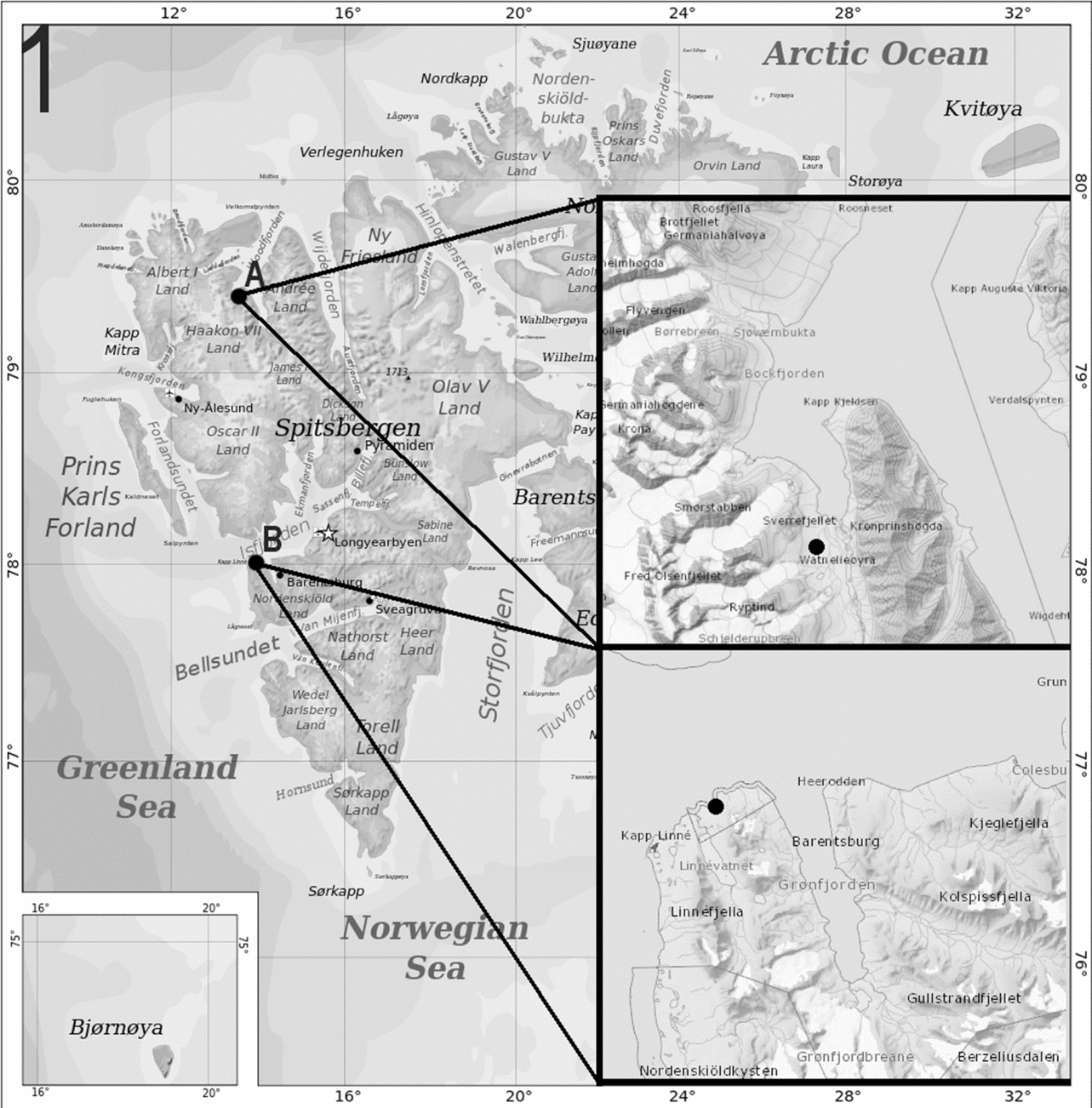
1) Bockfjord-Volcano II sampling site is situated in northwest Spitsbergen (Svalbard Archipelago) (79°25'N; 13°25'E; ca. 20 m asl) (Map. 1). The Quaternary Bockfjord volcanic complex comprises of three eruptive centres (Sverrefjellet, Halvdanpiggen and Sigurdfjellet), which represent erosional relics of stratovolcanoes and subvolcanic vents (Harland Reference Harland1997; Dallmann Reference Dallmann1999). Volcanic rocks intruded through the Andrée Land group of the Devonian Old Red basin. Sverrefjellet (506 m asl) is of Pleistocene to Holocene age. It is composed of pyroclastic layers and lava flows of pahoehoe and pillowed types. A partly subglacial volcanism could be expected based on the presence of the pillow lavas. The volcanic rocks (alkaline basalts) present here represent an alkaline intraplate volcanism with common xenoliths of the upper mantle and lower crust rocks. Volcaniclastic rocks are the predominant material composing the adjoining raised marine terraces (Harland Reference Harland1997).
The profiles Bockfjord I, II and III were collected from pits between 24 and 27 July 1988. Sampling sites were situated at the foot of the extinct volcano Sverrenfjellet (507 m asl) close to the Bockfjorden, a small fjord on the western side of Woodfjorden.
The relatively shallow profiles (30, 50 and 60 cm respectively) for palaeontological pollen analysis were collected from an area between the volcano Sverrefjellet and the gulf Watnelieøyra. Subsamples of all profile sediments were taken at every 5 cm and were formed of detritus with a mixture of fine inorganic materials (mainly a volcanic ash and weathered volcanic rocks)
2) Vardeborgsletta-Linné sampling site was situated in the Isfjorden region, between Kapp Starostin and Linné Lake, out the foot of Vardeborg Mt. (78°06'N; 13°45'E; ca. 25 m asl) (Map 1). The area between Linnévatnet and the Vardeborgsletta crest comprises Late Paleozoic sedimentary rocks (Harland Reference Harland1997, Dallmann Reference Dallmann1999). From the valley floor towards the Vardeborgsletta crest the sedimentary rocks of the following formations crop out: Orustdalen Formation (Mississippian, fluvial sandstones, conglomerates and floodplain shales), Petrellskaret Formation (Pennsylvanian? red and grey sandstones, shales, evaporites of channel, floodplain and coastal origin), Wordiekammen Formation, Gipshuken Formation and Kapp Starostin Formation (Pennsylvanian to Late Permian, marine limestones, shales, evaporites). Mesozoic to Neogene sedimentary rocks are not preserved on the left bank of Linnévatnet. The sedimentary sequence is affected by Palaeogene thrust tectonic. Quaternary sediments are generally of late Pleistocene to Holocene age. They are represented by proglacial subaqueous fan sediments, shoreline sediments and lodgement till (Lønne and Mangerud Reference Lønne and Mangerud1991). Postglacial marine terraces (from 75–65 m to 12 m asl) on eastern side of Linnévatnet are of early Holocene age (Mangerud and Svendsen Reference Mangerud and Svendsen1990).
The profiles were collected, on 24 and 27 July1988, from the bottom of two self-prepared pits in an area of peat bog with sediment thickness of 30 and 70 cm respectively; subsamples collected every 5 cm. Sampled material from both profiles had a character of partially decomposed peat.
The samples were collected using a metal blade and later stored in plastic bags. The age of the collected samples, from the both localisations, is estimated on circa 16th to 17th century (that is the studied sediments were circa 300–500 years old).
Samples, pollen and NPP diagram preparation
A total of 15 samples from the Bockfjord – Volcano II and Vardeborgsletta-Linné profiles were analysed. Samples taken from all profiles were prepared for pollen and other microfossil analyses using the acetolysis method (Erdtman Reference Erdtman1960) after pre-treatment of concentrated hydrofluoric acid for 24 hours at room temperature.
Tardigrada identification
All microphotographs were prepared using light microscope Olympus CX 31 (associated with photo camera) under 200x and 400x magnification). Identification of tardigrade remains and eggs were made based on the keys: Ramazzotti and Maucci (Reference Ramazzotti and Maucci1983); Bertolani and Rebecchi (Reference Bertolani and Rebecchi1993); Claxton (Reference Claxton1998); Binda and Pilato (Reference Binda and Pilato1999) and Kaczmarek and others (Reference Kaczmarek, Gołdyn and Prokop2011, Reference Kaczmarek, Schabetsberger and Litwin2012) and original descriptions (Richters Reference Richters1903; Murray Reference Murray1907; Maucci Reference Maucci1991). Tardigrada taxonomic nomenclature was used according to Bertolani and others (Reference Bertolani, Guidetti and Marchioro2014).
Profiles localisations: A – Bockfjord-Volcano II; B – Vardeborgsletta-Linné (https://commons.wikimedia.org/wiki/File:Topographic_map_of_Svalbard.svg, under licence: GNU Free Documentation Licence, modified)

Results
Tardigrade egg remains:
Tardigrada Doyère 1840
Eutardigrada Richters, 1926
Parachela Schuster, Nelson, Grigarick and Christenberry 1980
Macrobiotoidea Thulin, 1928 in Marley and others Reference Marley, McInnes and Sands2011
Murrayidae Guidetti, Rebecchi and Bertolani Reference Bertolani, Grimaldi and Grimaldi2000
Dactylobiotus R.O. Schuster 1980
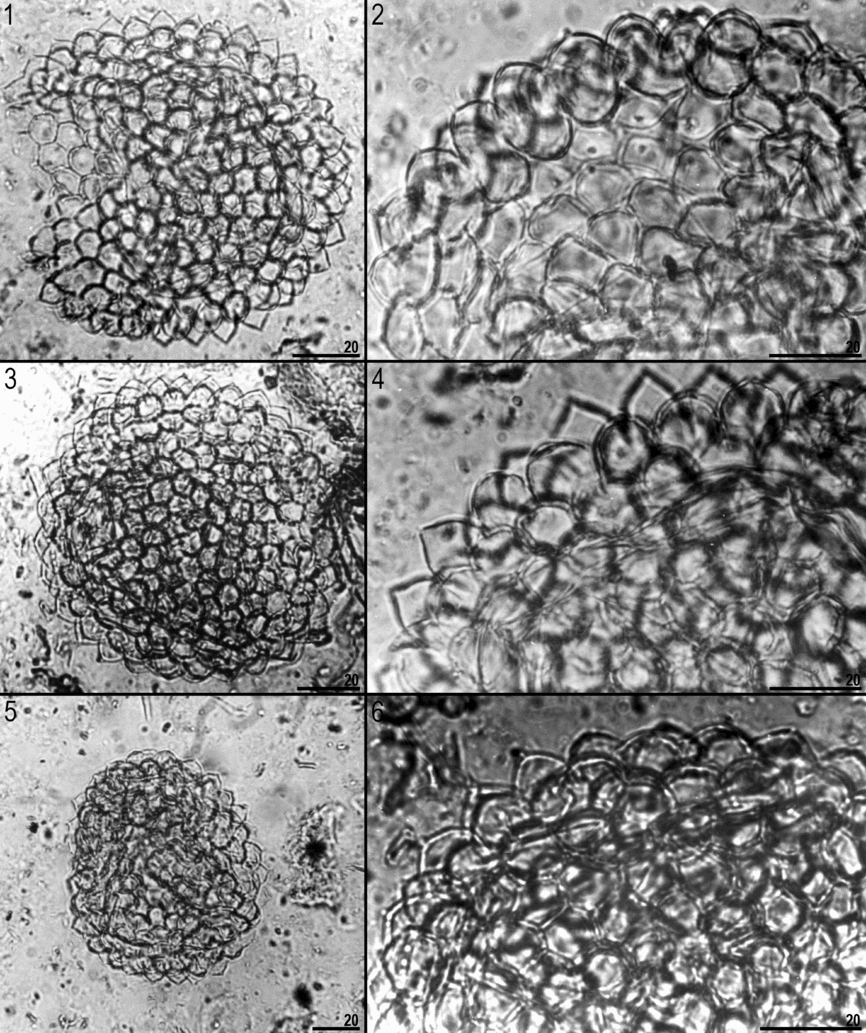
Dactylobiotus ambiguus (Murray Reference Murray1907) (Figs. 1–6)
Dactylobiotus ambiguus (Murray, Reference Murray1907): 1, 3, 5 – eggs (general view); 2, 4, 6. - – eggs (details of egg processes).
Reported as Macrobiotus ambiguus type in Jankovská (Reference Jankovská1991).
General remarks: The eggs of this freshwater species were common among all pollen slides from the Spitsbergen but only in the oldest sediments (that is about 500 years old). A similar situation was observed in the profile ‘Truelove Lowland’ (Devon Island, Canada), although it was not reported by Jankovská and Bliss (Reference Jankovská and Bliss1972, Reference Jankovská, Bliss and Bliss1977).
Dactylobiotus ambiguus was originally found on Zemlya Frantsa Iosifa [Franz Josef Land] and described from Shetland and Spitsbergen (Murray Reference Murray1907), and later has been reported from many localities in the Arctic, Antarctic, northern Europe and some mountain localities in other regions (McInnes Reference McInnes1994). On Svalbard Archipelago this species is common in freshwater habitats or very wet mosses and has been reported from Spitsbergen, Prins Karls Forland, Bjørnøya and Edgeøya (for the review see Zawierucha and others Reference Zawierucha, Coulson and Michalczyk2013). In the Canadian Arctic D. ambiguus is known from Nunavut (Axel Heiberg Island and Melville Peninsula) (Jørgensen and Kristensen Reference Jørgensen, Kristensen and Jørgensen1991; Szymańska Reference Szymańska1994); whereas, Dastych (Reference Dastych1970) and Węglarska (Reference Węglarska1973) reported D. ambiguus from freshwater habitats in the High Tatra Mountains (Poland). In studies of sediment cores, D. ambiguus has been reported in “pollen rain” from Lozoya Valley (Madrid, Spain) (Gómez González and others Reference Gómez González, Ruiz Zapata and López Sáez2006), and as D. cf. ambiguus in lake sediments from the Eastern Antarctica and the Antarctic Peninsula (Gibson and Zale Reference Gibson and Zale2006; Cromer and others Reference Cromer, Gibson and McInnes2008).
A large representation of this species in peat bog or lake sediments from Spitsbergen is not surprising, especially as the genus Dactylobiotus is typical lacustrine or hydrophilous and in general a Boreal-mountain taxon (Dastych Reference Dastych1988; Cromer and others Reference Cromer, Gibson and McInnes2008). The presence of eggs in the deepest/ oldest sediments (that is about 500 years old) may be indicative of a previous lake, small pond or puddle in the studied area, which has since been succeeded by tundra vegetation
Paramacrobiotus Guidetti, Schill, Bertolani, Dandekar and Wolf 2009
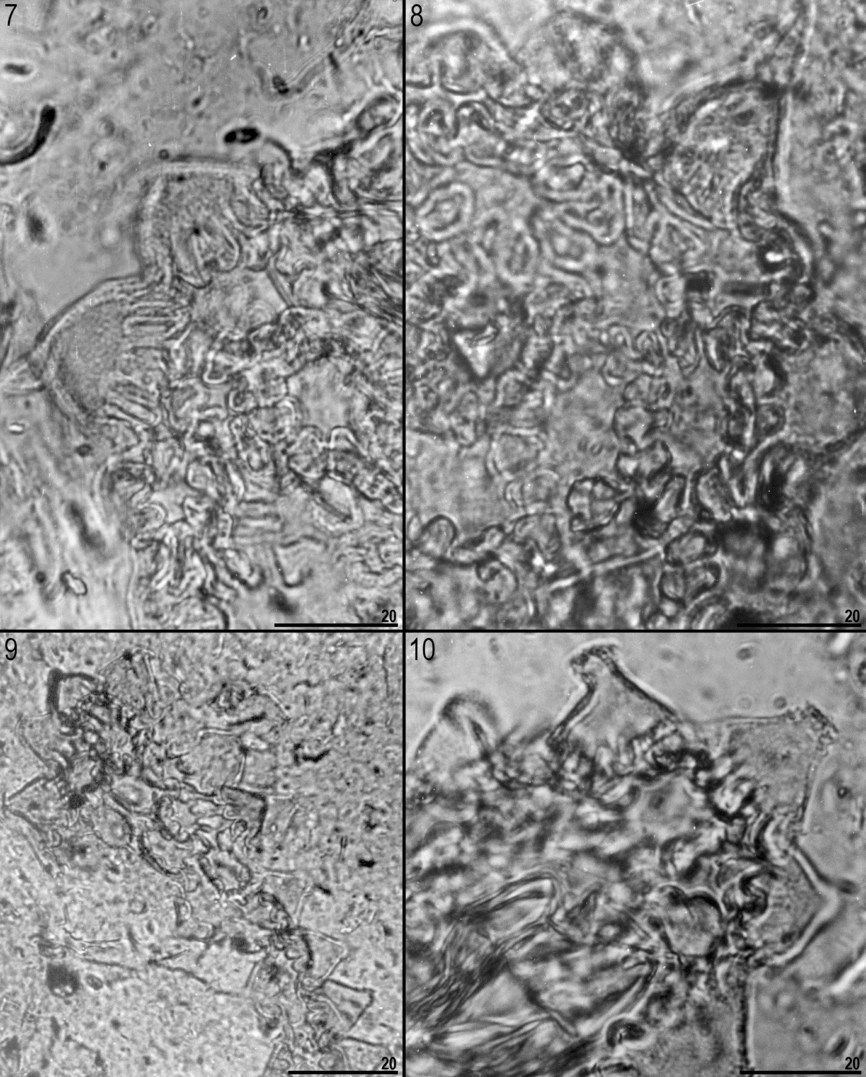
Paramacrobiotus richtersi group (Figs. 7–10)
Reported as Macrobiotus areolatus-richtersi type in Jankovská (Reference Jankovská1991).
Paramacrobiotus richtersi group: 7–9 – eggs (details of sculpture between processes); 10 – eggs (details of the processes shape).
General remarks: The eggs of this taxon were regularly found in the profiles from Bockfjord-Volcano and Vardeborgsletta-Linné, and as frequent objects in pollen slides from Truelove Lowland (Devon Island, Canada). These eggs were also obtained from a permafrost profile of a peat mound (Jankovská and Bliss Reference Jankovská and Bliss1972, Reference Jankovská, Bliss and Bliss1977).
Most of the eggs obtained from the sediment samples were deformed or broken, but the characteristic egg processes and the egg shell areolation were always visible. The eggs require further study to identify the species so the preliminary designation P. richtersi group is only valid for NPP objects in the pollen-analytical research.
Currently, 32 species are attributed to the genus Paramacrobiotus (Degma and others Reference Degma, Bertolani and Guidetti2009–Reference Degma, Bertolani and Guidetti2015) with most having very similar egg and adult morphology. Recently reported new species are more carefully described (see for example Kaczmarek and others Reference Kaczmarek, Michalczyk and McInnes2014a, Reference Kaczmarek, Cytan and Zawierucha2014b), but historically small taxonomic variations were not considered diagnostic of new species and thus many specimens and eggs were attributed to the nominal P. richtersi (originally described from Ireland). This situation has confused the true geographic range and ecological preferences of this species, but it is probably restricted to Palaeo- or Holarctic regions.
From the point of view of palaeontological studies, this tentative species identification is not very useful for past reconstructions of environmental conditions. However, some studies have suggested that P. richtersi could reach high densities in young soils (for example Hohberg Reference Hohberg2006) and the high concentration of eggs in studied samples could suggest the soil type during the period of the core sample (300–500 years ago) was newly formed.
Richtersius Pilato and Binda 1989
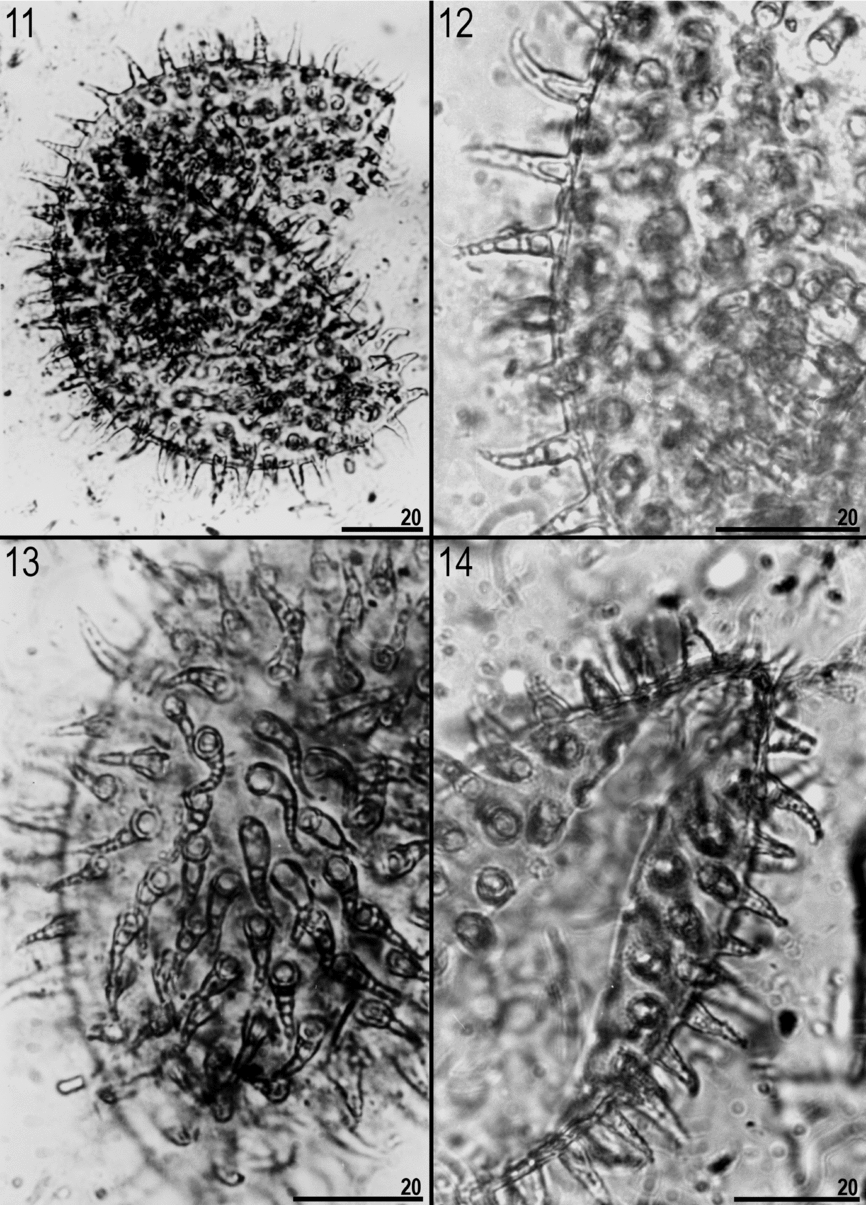
Richtersius coronifer (Richters Reference Richters1903) (Figs. 11–14)
Reported as Macrobiotus coronifer-islandicus type in Jankovská (Reference Jankovská1991).
Richtersius coronifer (Richters, Reference Richters1903): 11 – eggs (general view); 12–14 – eggs (details of egg processes).
General remarks: The eggs of this species were relatively common in all sediment profiles from the localities of Bockfjord-Volcano and Vardeborgsletta-Linné. The conspicuous eggs are identified by spiny processes with internal septa divided spaces (Fig. 12). The species has been described mainly from the Holarctic; especially frequent in the Arctic, sub-Arctic and mountain regions (McInnes Reference McInnes1994). There are many reports for Svalbard, including Holocene sediments (for review see Zawierucha and others Reference Zawierucha, Coulson and Michalczyk2013). According to Dastych (Reference Dastych1988) the species is boreal-montane (in Poland known only from the High Tatra and Pieniny Mountains), and strongly associated with carbonate bedrock.
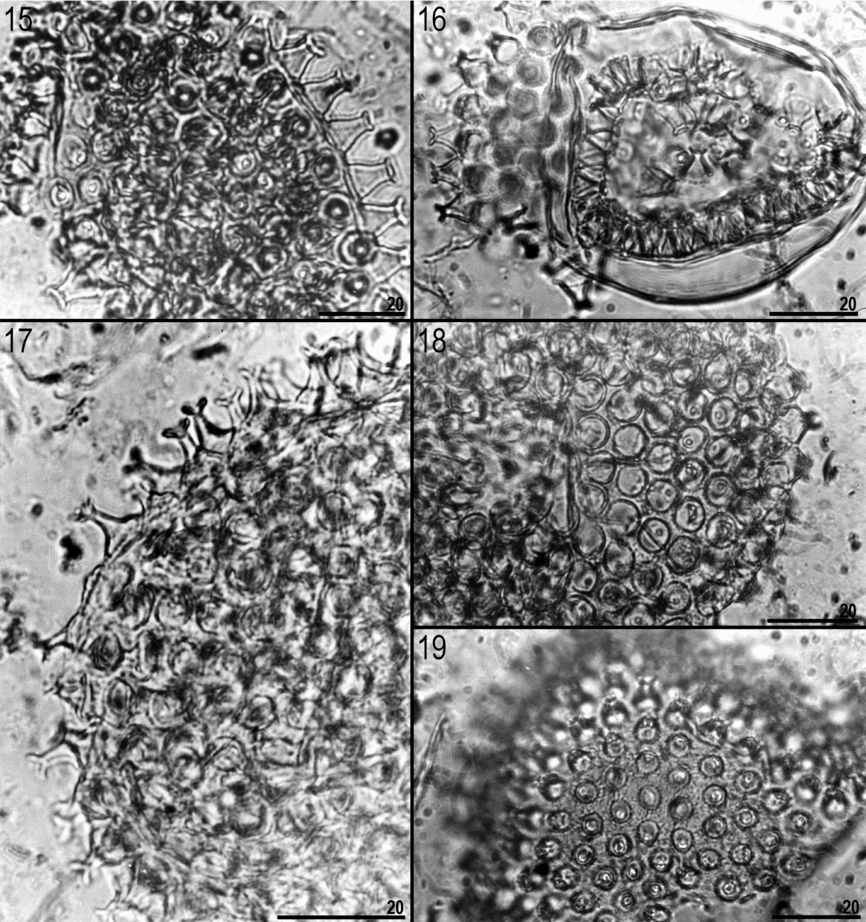
Macrobiotus hufelandi group: 15–18 – eggs (different types of egg processes); 19 – egg (details of the sculpture between processes).
Described from dry habitats, especially exposed mosses growing on carbonate rocks (for example Petersen Reference Petersen1951; Bartoš Reference Bartoš1967; Dastych Reference Dastych1988), the presence of Richtersius coronifer eggs in our samples probably originated, washed or blown in, from the local Quaternary limestone that has provided a continuous source over the time period of the profile (that is from 300 to 500 years old).
Macrobiotus C.A.S. Schultze 1834
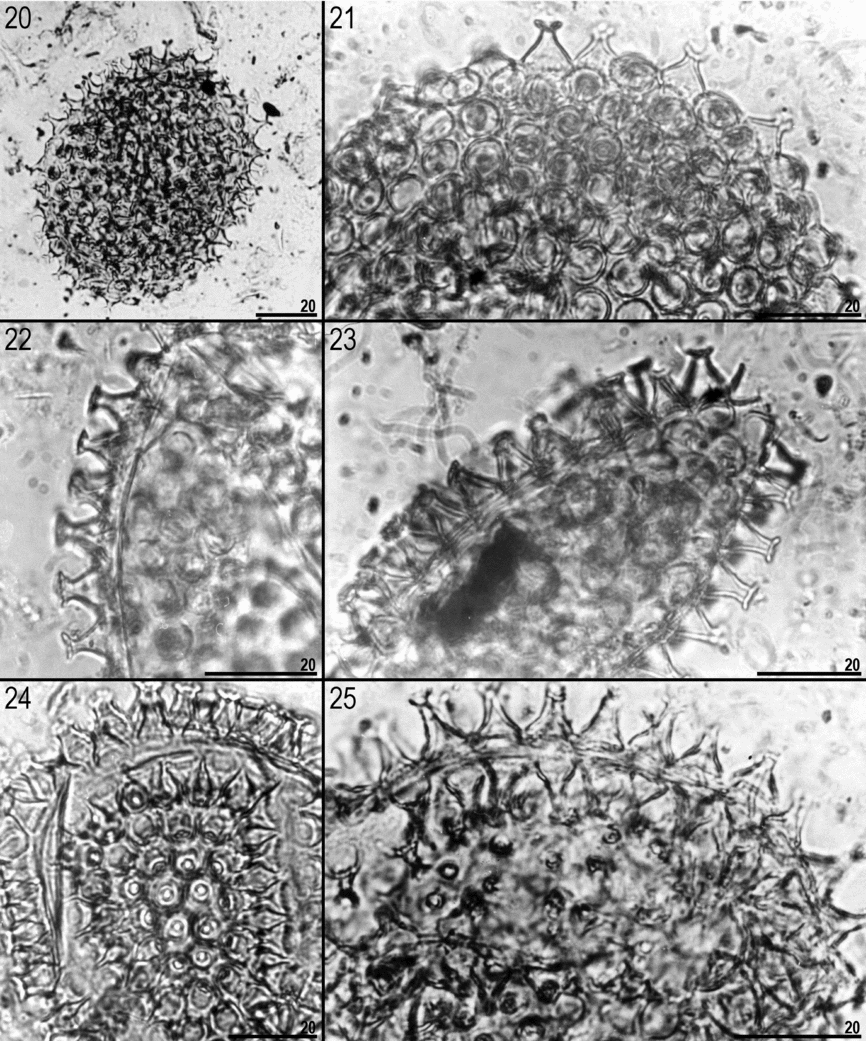
Macrobiotus hufelandi group (Figs 15–25)
Macrobiotus hufelandi group: 20 – eggs (general view); 21–25 – eggs (different types of egg processes).
Reported as Macrobiotus hufelandi type in Jankovská (Reference Jankovská1991).
General remarks: The eggs of M. hufelandi type occurred regularly in all profiles from the Bockfjord-Volcano and Vardeborgsletta-Linné localities. They have also been found in the profiles from Truelove Lowland (Devon-Island, Canada) and identified (from drawings) by author (VJ) from West Siberian material (pollen-analysis T.A. Blakharchuk). In examined material at least two different hufelandi group eggs types were found, which probably means there were two species but without adult specimens a definitive identification is not possible. Up to now, only one species of hufelandi group (Macrobiotus hufelandi hufelandi C.A.S. Schultze 1833) was reported from Svalbard (Zawierucha and others Reference Zawierucha, Coulson and Michalczyk2013). However, the present findings indicate that at least two species from hufelandi group inhabit Spitsbergen now or inhabited Spitsbergen in the past.
In the past, M. hufelandi was considered extremely cosmopolitan and cited from all types of habitats, from the Polar Regions (including Svalbard) through areas with temperate climate to the tropics (McInnes Reference McInnes1994). Gómez González and others (Reference Gómez González, Ruiz Zapata and López Sáez2006) have also reported M. hufelandi type eggs in “pollen rain” from Lozoya Valley (Madrid, Spain). Macrobiotus hufelandi is now considered a group of very similar species each with very restricted geographical ranges (for example Bertolani and Rebecchi Reference Bertolani and Rebecchi1993, Pilato and Binda Reference Pilato and Binda2001) and recently numerous new hufelandi-group species have been described from around the world (for example Pilato and others Reference Pilato, Kaczmarek and Michalczyk2003; Kaczmarek and Michalczyk Reference Kaczmarek and Michalczyk2004; Fontoura and others Reference Fontoura, Pilato and Lisi2008; Bartels and others Reference Bartels, Pilato and Lisi2009; Kaczmarek and Michalczyk Reference Kaczmarek and Michalczyk2009; Guidetti and others Reference Guidetti, Peluffo and Rocha2013a). The real geographical range of the nominal species is unknown, but is probably restricted to the Palaearctic.
Although as a group M. hufelandi taxa are widely distributed and in most environments very frequent, in sediments they were reported as occurring only occasionally (Jankovská and Bliss Reference Jankovská and Bliss1972, Reference Jankovská, Bliss and Bliss1977; Gómez González and others Reference Gómez González, Ruiz Zapata and López Sáez2006; Bernardová and Košnar Reference Bernardová and Košnar2012). Ecological requirements for members of this group are unknown and until we have more information, the hufelandi taxa have a rather low value for palaeoecological research
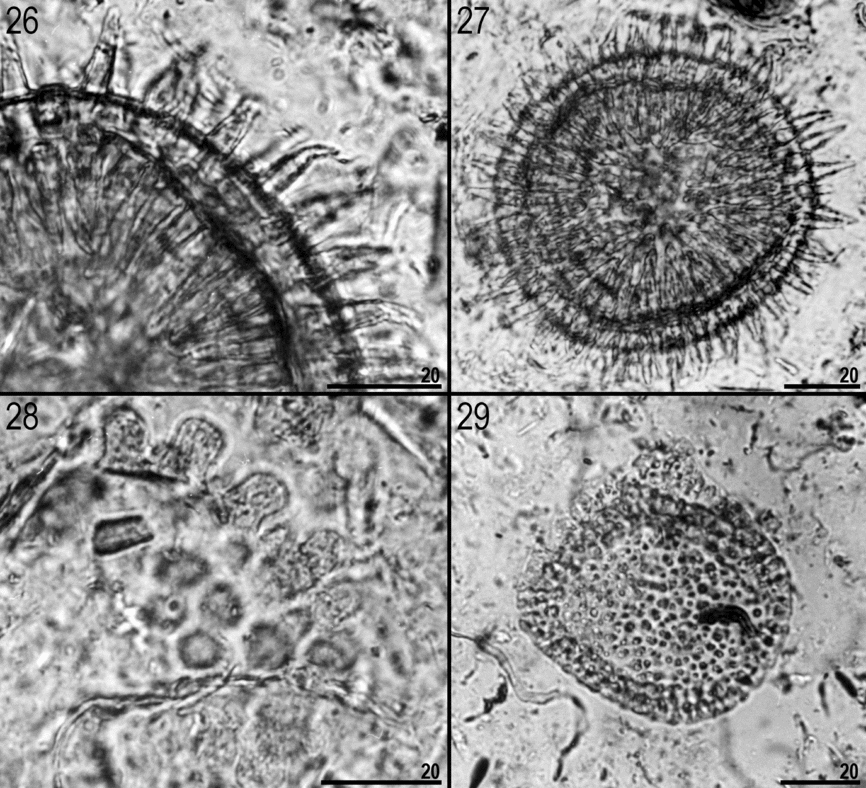
Macrobiotus peterseni Maucci, Reference Maucci1991 (Fig. 28)
Undefined objects, Macrobiotus peterseni Maucci, Reference Maucci1991 and Minibiotus cf. intermedius: 26–27 – probably tardigrade eggs; 28 – egg of Macrobiotus peterseni Maucci, Reference Maucci1991 (details of egg processes); 29 – egg of Minibiotus cf. intermedius (general view).
Reported as Macrobiotus peterseni type in Jankovská (Reference Jankovská1991).
General remarks: The eggs of this species occurred regularly in pollen slides from the Bockfjord-Volcano II profile. The species was originally described from Greenland (Maucci Reference Maucci1991) and this is the first record outside the type locality.
Macrobiotus peterseni belongs to the cosmopolitan Macrobiotus harmsworthi group of species with many similar taxa known throughout the world (see Kaczmarek and others Reference Kaczmarek, Gołdyn and Prokop2011). However, the eggs of M. peterseni with bell (dome) shape processes are very characteristic and quite easy to identify.
Macrobiotus peterseni is probably a species restricted to high northern latitudes, but limited knowledge about this species means ecological and geographical ranges require further study.
Minibiotus R.O. Schuster 1980
Minibiotus cf. intermedius (Fig. 29)
Reported as Macrobiotus intermedius type in Jankovská (Reference Jankovská1991).
General remarks: The eggs of Min. cf. intermedius have only sporadically been detected in the Spitsbergen profiles. The same type of eggs has also been identified (based on drawings by VJ) in the material from west Siberia (pollen-analysis T.A. Blakharchuk).
The identity of Min. intermedius, like M. hufelandi (see above), has been compromised by historical taxonomic inaccuracy. Early literature incorporated many Min. intermedius type specimens and eggs (some very different from the nominal Min. intermedius) together into what is now recognised as a species group. Modern taxonomy requires eggs and an examination of the dorsal and ventral sculpture/ pores of adult specimens (Claxton Reference Claxton1998). As a result, we are unable to determine the geographical range of nominal Min. intermedius, or provide information about its ecology.
Until more research defines this species-group this particular taxon has a rather low value for palaeoecological research.
Other tardigrade remains
Eutardigrada: buccal tubes (Figs 31–32)
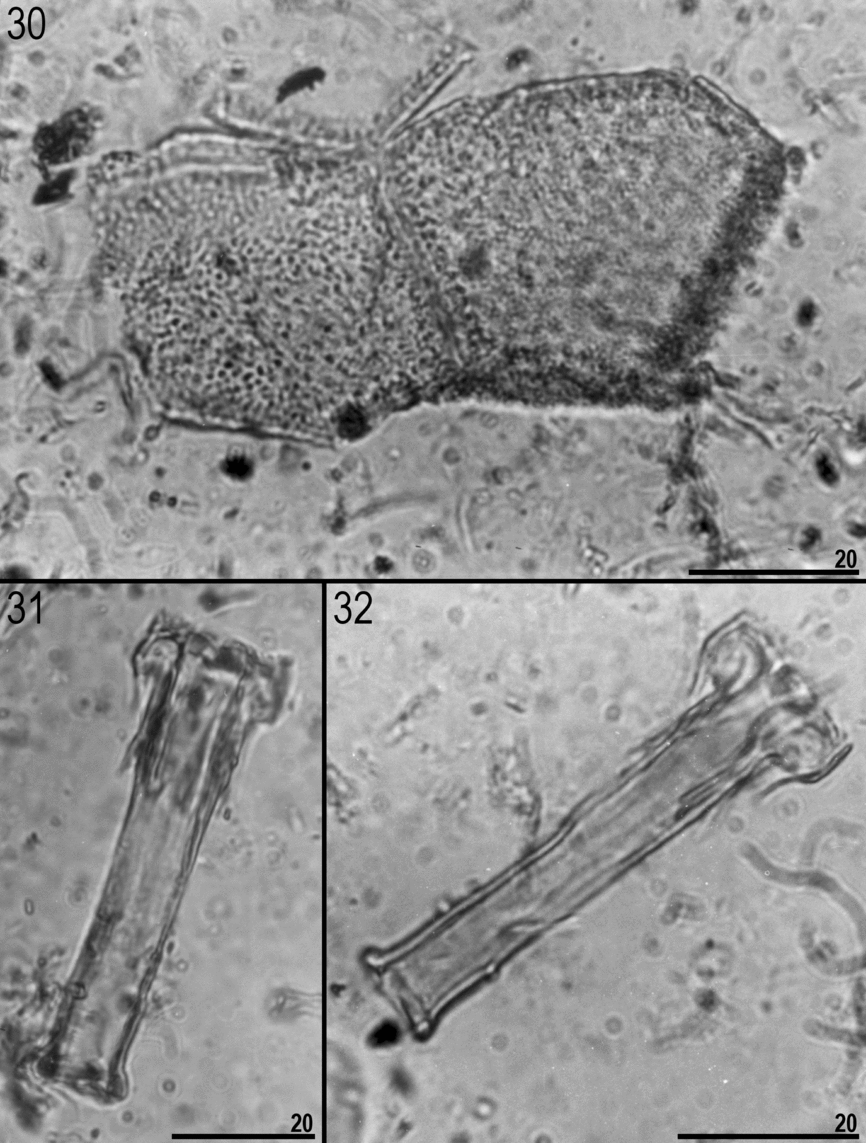
Body parts of tardigrades: 30 – dorsal paired plates of Heterotardigrada; 31–32 – buccal tubes of Eutardigrada.
In both Bockfjord-Volcano and Vardeborgsletta-Linné profiles the remains of tardigrade buccal tubes (composed of chitonous material) were frequently found. Interestingly, the tubes were observed even when the eggs were absent. This is the first occasion that tardigrade buccal tubes have been reported as NPPs in palaeontological pollen analyses. The structure of buccal tube an important taxonomic character, at generic, species and inter-species level and directly connected with feeding behaviour (Ramazzotti and Maucci Reference Ramazzotti and Maucci1983; Marley and others Reference Marley, McInnes and Sands2011; Guidetti and others Reference Guidetti, Altiero and Marchioro2012; Roszkowska and others Reference Roszkowska, Ostrowska and Kaczmarek2015).
The types of found buccal tubes could not be specifically identified but most probably belong to the genera: Bertolanius Özdikmen 2008, Dactylobiotus R.O. Schuster 1980, Macrobiotus or Paramacrobiotus. These all have broad buccal tubes, associated with omnivorous or carnivorous diets (for example Hohberg and Traunspurger Reference Hohberg and Traunspurger2005; Schill and others Reference Schill, Jonsson and Pfannkuchen2011), and are common species in many Spitsbergen habitats (for the review see Zawierucha and others Reference Zawierucha, Coulson and Michalczyk2013).
Heterotardigrada: dorsal plates (Fig. 30)
The objects that appear to be the dorsal paired plates of a Heterotardigrada (Fig. 30). These were regular but infrequent components of the profiles.
Most heterotardigrades prefer dry or xerophytic conditions (especially at high altitude and high latitude) (for exampleDastych Reference Dastych1985, Reference Dastych1988; Zawierucha and others Reference Zawierucha, Smykla and Michalczyk2015b), though they are also present in wet or very wet tropical habitats (for example Kaczmarek and Michalczyk Reference Kaczmarek and Michalczyk2010). The presence of such objects in studied profiles should indicate the presence of xerophytic microhabitats somewhere close to the profile site. Like Richtersius coronifer eggs, the heterotardigrades remains were probably transported into the peat bog by wind or water. Taxonomic identification of these objects was not possible so the value to palaeontology studies is limited.
Claws
Objects identified as tardigrade claws were regularly found on pollen slides from both Spitsbergen profiles. Although claws are a useful taxonomic diagnostic for generic or family level identification, unfortunately, all photographic records have been lost (destroyed in camera store) so making a detailed analysis was not possible.
Undefined objects: possible tardigrade eggs (Figs 26–27)
A small number of egg type objects were also present in the profiles. At present the exact identification of these objects is not possible; they could belong to an eutardigrade or Rotifera species. Further work is required before these can be included in the analysis.
Discussion
Palaeontological pollen analysis studies of the Bockfjord-Volcano and Vardeborgsletta-Linné regions of NW of Spitsbergen revealed not only a large amount of pollen but a considerable number of NPP. The surprisingly large number of NPP objects found in the Bockfjord-Volcano and Vardeborgsletta-Linné profiles were initially determined as tardigrade eggs (Jankovská Reference Jankovská1990), and then preliminarily identified as: Macrobiotus ambiguus, M. areolatus-richtersi, M. coronifer-islandicus, M. hufelandi, M. peterseni, and M. intermedius (Jankovská Reference Jankovská1991).
Tardigrades and their eggs have proved to be frequent NPP objects in palaeontological pollen analyses and have been reported from Holocene sediments in Czech Republic Jankovská (Reference Jankovská1990, Reference Jankovská2006); Svalbard (Jankovská Reference Jankovská1991) and sediments from high altitudes in the Andes (Montoya and others Reference Montoya, Rull and van Geel2010). However, it is more unusual to find buccal tubes, dorsal paired plates and claws as reported in this paper. Such findings, although not as valuable in taxonomic terms as eggs or adult specimens, provide some information about the tardigrades, at least to the generic or family level.
Research has also shown that tardigrade remains are frequently found in lake sediment cores (especially polar or mountain lakes) and have been dated to circa 40,000 year BP (Gibson and others Reference Gibson, Cromer and Agius2007; Cromer and others Reference Cromer, Gibson and McInnes2008). Cromer and others (Reference Cromer, Gibson and McInnes2008) suggested that the physicochemical conditions present in high latitude and alpine lakes enable better preservation of tardigrade eggs, or entire exuviae, than the sediment conditions in temperate or tropical lakes. Although it should be noted that standard methods used for pollen analysis (involving harsh chemical treatment of sediments) can destroy delicate microfossils such as tardigrade remains (Cromer and others Reference Cromer, Gibson and McInnes2008; Bernardová and Košnar Reference Bernardová and Košnar2012). Results from peat core analysis are rarer (Jankovská Reference Jankovská1991; Miller and Heatwole Reference Miller and Heatwole2003; this study) but possible.
The correct identification of tardigrade eggs is very important if they are to be of use in paleolimnological (Cromer and others Reference Cromer, Gibson and McInnes2008), or palaeontological studies. For some genera (for example Dactylobiotus, Macrobiotus, Minibiotus, Paramacrobiotus, Ramazzottius etc.) and species groups (for example ‘furciger’, ‘harmsworthi’, ‘hufelandi’, ‘richtersi’, etc.) the eggs are an important taxonomic character for the correct identification of tardigrade taxa (for example Ramazzotti and Maucci Reference Ramazzotti and Maucci1983; Bertolani and Rebecchi Reference Bertolani and Rebecchi1993; Biserov Reference Biserov1998; Claxton Reference Claxton1998; Binda and Pilato Reference Binda and Pilato1999; Pilato and others Reference Pilato, Binda and Lisi2002; Kaczmarek and others Reference Kaczmarek, Gołdyn and Prokop2011, Reference Kaczmarek, Schabetsberger and Litwin2012). Well preserved tardigrade eggs in relatively young sediments could provide a good tool for palaeontologists.
However, simple species identification in palaeo –ecology, –climatology or –biogeography is of limited value, which can be raised by knowledge about the biogeography and ecology of individual species furthering our understanding of past climatic and ecological conditions. For many years tardigrade species were considered cosmopolitan and eurytopic and this older data are not very useful for ecological, biogeographical or palaeontological studies. More recent studies have questioned this assumption and indicated species complexes that are composed of very similar taxa with restricted geographical ranges (for example Bertolani and Rebecchi Reference Bertolani and Rebecchi1993; Pilato and Binda Reference Pilato and Binda2001 or Michalczyk and others Reference Michalczyk, Wełnicz and Frohme2012), which does help palaeontological studies. While there are still gaps in our knowledge about the exact ecological and geographical ranges for many tardigrade species, modern studies are progressing rapidly and this will allow tardigrades to be considered useful subjects for further palaeontological work, for example habitat reconstructions. Indeed, Gibson and others (Reference Gibson, Cromer and Agius2007) and Cromer and others (Reference Cromer, Gibson and McInnes2008) showed that tardigrades could be used for reconstructing past conditions within lakes in Antarctica. The dynamics of tardigrade population observed in these lake sediments provided insight into the processes of colonisation, eutrophication, and climate change (Gibson and others Reference Gibson, Cromer and Agius2007; Cromer and others Reference Cromer, Gibson and McInnes2008).
Knowledge of the extant tardigrade taxa allowed them to suggest that the disappearance of the aquatic D. cf. ambiguous eggs was probably caused by increased eutrophication of the lake after the arrival of a penguin colony and, at the same time, the increase in terrestrial M. furciger eggs was associated with the increase of the nitrophilous alga Prasiola crispa (Lightfoot) Kützing 1843 (Gibson and others Reference Gibson, Cromer and Agius2007).
A recent study of lake core sediment from Petuniabukta (Spitsbergen) reported the remains of six tardigrade taxa: Echiniscus cf. blumii (correctly Echiniscus cf. blumi), Macrobiotus echinogenitus, Macrobiotus cf. harmsworthii (correctly Macrobiotus cf. harmsworthi), Macrobiotus hufelandi, Macrobiotus cf. hastatus (correctly Murrayon cf. hastatus), Macrobiotus cf. coronifer (now Richtersius cf. coronifer) (Bernardová and Košnar Reference Bernardová and Košnar2012). These results, with the occurrence of moss dominated vegetation throughout the core, were interpreted as indicating water had been accumulated in situ since the marine terrace uplift, in the mid-Holocene, and then formed into a shallow lake (Bernardová and Košnar Reference Bernardová and Košnar2012). These interpretations were probably based on the fact that Murrayon cf. hastatus is a freshwater species and occurred throughout the core. The other taxa are potential species groups for example M. echinogenitus, M. cf. harmsworthi and M. hufelandi, which can supply limited information on geographical and ecological ranges, and E. cf. blumi and R. cf. coronifer, which are found in more xerophytic environments. The later occurred in low numbers throughout the core, suggesting possible transport from a local dry site and the former intermittently through the core with an increase in the top section, suggesting local environment change to conditions favouring this species (Bernardová and Košnar Reference Bernardová and Košnar2012).
In the present study six tardigrade taxa were identified, but three (M. hufelandi group, M. cf. intermedius and M. peterseni) have limited palaeontological value due to insufficient data on taxonomy, geographical or environmental ranges. It is interesting to note that M. peterseni had previously only been reported from the type locality (Greenland). The presence in Spitsbergen sediments may confirm character and similar environmental conditions to Greenland, however, some caution is required as this species has not previously been reported on Svalbard (see Zawierucha and others Reference Zawierucha, Coulson and Michalczyk2013). Further study is necessary to explore whether M. peterseni requires very specific environmental conditions that have not yet been sampled on Svalbard, or whether conditions have changed leading to local extinction.
The other three taxa found are more useful for offering clues about past environmental conditions. The presence of boreal-montane, lacustrine/ hygrophilous species D. ambiguus suggests that a permanent lake, pond or ephemeral ponds and pools occupied the region in the near past. In comparison, the presence of R. coronifer, which is found in xerophytic limestone habitats, indicates the close proximity of exposed carbonate rocks. The presence of heterotardigrade dorsal plates in our samples would also indicate dry or very dry habitats. Paramacrobiotus cf. richtersi could not be specifically identified in our study but it can be considered as soil or leaf litter inhabitant. The nominal P. richtersi has been observed at high densities in young (proto-) soils (for example Hohberg Reference Hohberg2006), which are also present in the area of the present study.
The remains of tardigrade buccal apparatuses (buccal tubes) that were found in analysed profiles had not previously been reported in pollen analysis. Present analysis indicated the potential presence of Bertolanius sp., Dactylobiotus sp., Macrobiotus sp. or Paramacrobiotus sp., all of which are reported to be frequent inhabitants of mosses, lichens and freshwater environments on Svalbard (Zawierucha and others Reference Zawierucha, Coulson and Michalczyk2013 and papers cited there). Most of these genera are omnivorous or carnivorous (with prey species including rotifers, nematodes and other tardigrades) (for example Schill and others Reference Schill, Jonsson and Pfannkuchen2011; Guidetti and others Reference Guidetti, Bertolani and Rebecchi2013b; Guil and Sanchez-Moreno Reference Guil and Sanchez-Moreno2013). The presence of significant numbers of mouth parts in studied profiles may indirectly indicate a rich invertebrate community has existed for the time period of the profile that is 300–500 years ago.
Conclusions
Our study has shown that tardigrade remains are frequent NPP elements in pollen analyses of peat core profiles in Svalbard, and have also been reported from polar region lakes and peat sediments. The knowledge of tardigrade remains in core samples is still very limited. Although, the phylum Tardigrada has a cosmopolitan distribution, single species have restricted geographical and environmental ranges. Provided tardigrade remains can be clearly identified to known species (rather than species groups) we believe they would provide a useful insight in palaeontological studies and assist in the reconstruction of past environmental conditions. Dactylobiotus or Murrayon taxa may indicate the presence of freshwater habitats, while heterotardigrades or some eutardigrades like Richtersius coronifer may indicate the presence of dry or very dry environments.
Financial support
This work was also partially funded by the Prometeo Project of the Secretariat for Higher Education, Science, Technology and Innovation of the Republic of Ecuador. Studies have been partially conducted in the framework of activities of BARg (Biodiversity and Astrobiology Research group).
Conflict of interest
None.
Acknowledgements
The authors are very grateful to Dr W. O. Knaap and J. Van Leeuwen (University of Bern, Switzerland) for the cooperation during the pollen analyses of the sediments from the Spitsbergen. We want to thank to Dr J. Úlehla for the first English translation of this contribution and to Z. Formánková for technical assistance. Dr V. Opravilová (Masaryk University, Brno, Czech Republic) and Dr P. Degma (Comenius University, Bratislava, Slovakia) for a determination of some NPP objects (that is Macrobiotus peterseni). We also want to thank Doc. Dr D. Nývlt (Masaryk University, Brno, Czech Republic) and M. Hanáček (University of South Bohemia, České Budějovice, Czech Republic) who helped us to prepare a geological characterisation of studied areas. This study was supported as a long-term research development project no. RVO 67985939.