Introduction
The study we report on in this article was initiated to extend the direction of research in earlier work done jointly by the Canadian Institute of Actuaries and the University of Waterloo (Andrews, Bonnar, & Brown, Reference Andrews, Bonnar and Brown2007) to see if Canadians were saving enough for retirement. Their study concluded that two thirds of Canadians were not. The question arose, however, as to how to measure the cost of basic needs in retirement. Our study focused on the measurement of those needs.
To establish what level of income is considered adequate for Canadians to retire on, we could have used an approach based on standard-of-living preservation or an adequate standard-of-living threshold. For example, using the first approach to investigate the risk of insufficient retirement savings in the U.S., Munnell, Webb, & Golub-Sass (Reference Munnell, Webb and Golub-Sass2007) projected the replacement rates of a representative sample of U.S. households (i.e., the projected retirement income as a percent of pre-retirement income) and compared them to target rates, which varied by household type. Alternatively, they could have used the second approach and compared the projected retirement incomes to a threshold designed to satisfy the basic needs in retirement, irrespective of the household’s standard of living prior to retirement. The first approach is particularly relevant from the individual’s perspective since it emphasizes the importance of continuing a worker’s pre-retirement standard of living as he/she enters retirement. At a social level, however, the second approach is attractive since it is desirable that everyone has met a particular standard of living in order to alleviate elderly poverty.
Our study addressed the question of adequacy using the second approach. We considered the basic needs for an elder to be (1) food, (2) shelter, (3) medical care, (4) transportation, (5) miscellaneous expenses, and (6) home-based long-term care (for those who required it). The objectives of our study were embodied in the recently developed U.S. Elder Economic Security Standard (U.S. Elder Standard) (Russell, Bruce, & Conahan, Reference Russell, Bruce and Conahan2006), and this measure provided the foundation for our conceptual framework. The U.S. Elder Standard promotes a threshold that allows elders to age with independent economic security in their own homes.
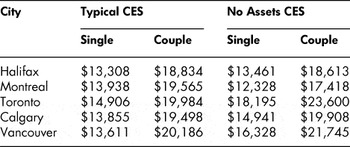
Table 1 provides a preview of the results that we develop in this article. It presents the Canadian Elder Standard (CES) for two different sets of circumstances in each of the five cities. The “Typical” elder owns a private automobile, a house without a mortgage, and receives occasional assistance in daily tasks such as household chores, preparing meals, and personal care. The “No Assets” elder differs in that their shelter is rented and they rely on public transportation.Footnote 1
2001 Canadian Elder Standard for two scenarios

A basic-needs threshold is generally referred to as a “poverty line”. Rather than focus on poverty, however, we followed the methodology of the U.S. Elder Standard in building “a measure of income that older adults require to maintain their independence in the community and meet their daily costs of living, including affordable and appropriate housing and health care” (Russell et al., Reference Russell, Bruce and Conahan2006, p. iv). In practical terms, our aim in this article is to price the typical, rather than the minimum, costs of basic needsFootnote 2. In addition to pricing this measure, this article explains the background on this topic, our objectives, and our methodology when building an absolute threshold for the elderly.
Background: Measures for Determining Poverty
Measures of poverty generally count the number of people who fall below a poverty threshold. There are essentially two distinct methods of determining this poverty threshold: absolute and relative. An absolute indicator of poverty is the cost of a household’s essential goods and services that satisfy a minimum standard of living. A relative approach compares the individual’s income (or consumption) to a percentage of the average (or median) in their surrounding population. In Canada, Statistics Canada’s Low Income Cutoff (LICO) and Low Income Measure (LIM) are the two most popular relative measures. The basis of LICO is average family expenditures, and LIM is set at 50 per cent of median adjusted income. The most popular absolute measure in Canada is the Market Basket Measure (MBM), introduced in 2003 by Human Resources and Social Development Canada (HRSDC) (HRSDC, 2003). As it is an absolute measure, the MBM prices a specific basket of goods and services for a number of urban communities across Canada. The MBM targets a standard of living above subsistence, with some degree of social inclusion. It generally relies on median costs/expenditures in pricing the basket items.Footnote 3
Canada has no official poverty line. Regardless, LICO, LIM, and the MBM are widely used to gauge poverty in Canada. LICO is commonly used when examining poverty over time; LIM, for international poverty comparisons, and the MBM, when assessing differences in the cost of living across Canada. Statistics Canada has repeatedly stated that LICO and LIM are not measures of poverty and it does not endorse their use as such – “at most, they were meant to show to what extent some Canadians are less well-off than others” (Statistics Canada, 2004b, p. 6). HRSDC has made similar disclaimers regarding the MBM.
LICO and LIM have numerous shortcomings when regarded as poverty lines. Notably, Sarlo (Reference Sarlo2001) gave a full account of their drawbacks. For example, he explained that LICO has been regarded as “unwieldy, arbitrary, purely relative, and unrelated to the actual costs of acquiring necessities” (Sarlo, Reference Sarlo2001, p. 14). He also believed that the MBM included items that were not basic necessities; that is, amenities whose absences do not put an individual into poverty (Sarlo, Reference Sarlo2001).Footnote 4 With regard to LIM, Veall (Reference Veall2007) discussed the shortcomings of using the below-LIM rate. He explained that LIM itself is arbitrarily set at 50 per cent of median income and that the LIM rate, being a pure count, does not account for the depth of poverty (the distance below LIM). In other research, Norman (Reference Norman2000) proposed that the publication of the LICOs be discontinued because its inaccurate measure of poverty in Canada could mislead public policy.
Another popular and established absolute measure in Canada, other than the MBM, is Sarlo’s Basic Needs Poverty Line (1996, 2001, 2006). In developing this measure, Sarlo used a market basket methodology to design a threshold, priced for major cities across Canada, which would satisfy the basic necessities of life and below which real deprivation was likely to occur. The resulting poverty line, however, was well below the other listed measures and, consequently, has been criticized as denoting “extreme poverty” (Osberg, Reference Osberg2007). Sarlo had also estimated an income level at which an individual could enjoy a reasonable level of amenities, such as giving gifts, referred to as a “social comfort line”. According to Sarlo’s definition, once someone fell below the social comfort line, the person would be considered near poor, and those who fell below the Basic Needs Poverty Line would be considered below poverty. The social comfort line was arbitrarily calculated as equaling twice the poverty line.
The National Council of Welfare (1999) published a discussion paper on poverty lines in Canada, with a particular focus on market basket approaches. The Council similarly calculated a “less statistical basket” as an alternative to the other available measures, in which some of the items were duplicates of the MBM while others were adjusted to reflect their recommendations on market basket poverty lines.
Sarlo (Reference Sarlo1996, Reference Sarlo2001, Reference Sarlo2006) convincingly argued why poverty is an absolute state, signaling a lack of the necessities of life, and thus should not be calculated using relative measures. Relative measures describe income inequality rather than deprivation and so should not be used as indicators of an adequate standard of living. The absolute poverty level measure, however, could be criticized as vague and subjective.
Objectives
None of the market basket measures – the MBM, the Basic Needs Poverty Line, and the National Council of Welfare’s basket – were tailored to the elderly. The National Council of Welfare (1999) chose a reference family of four, living in Vancouver during 1996, to illustrate the cost of each basket item. The Basic Needs Poverty Line and the MBM were calculated for a reference family (two adults and two children), and an equivalence scale was applied to determine the cost for other family structures. The categories in the equivalence scale did not include elders, only adults and children. The cost of basic needs for the retired elderly were, thus, treated like those for the working non-elderly. Because of their generally different life circumstances, however, elders are likely to have different costs, as we will explain.
In the U.S., Russell et al. (Reference Russell, Bruce and Conahan2006) developed the Elder Economic Security Standard (Elder Standard), a measure suited to our purposes for determining the cost of basic needs. This standard measures the absolute cost for U.S. elders to provide for their basic needs, taking into account regional differences and various life circumstances. Both the Wider Opportunities for Women (WOW) and the Gerontology Institute (GI) in the U.S. are national research partners in the Elder Economic Security Standard initiative. The U.S. Elder Standard answers the questions: “What is an adequate income for older adult households to age in place? How does it vary according to their life circumstances: whether they are living alone or with a spouse; rent or own their home; drive a car or use other transportation? How do elders’ living costs change as their health status and life circumstances change? What happens if they need long-term care to keep living at home?” (Russell et al., Reference Russell, Bruce and Conahan2006, p. 1). Although the standard has only been applied to U.S. data, such as the Boston area, the work by Russell et al. has provided a methodology to determine the minimum standard in any U.S. geographic area. Adopting their framework, we used corresponding Canadian data to produce standards for various cities across Canada. Throughout this article, we refer to our Canadian version of the Elder Standard as the Canadian Elder Standard (CES) to distinguish it from the original Elder Standard given in the Russell report.
The aim of the U.S. Elder Standard is to define and promote a measure that provides economic security for elders without compromising their independence in the community. The measure is not, therefore, one of subsistence. Likewise, we believe that a retirement income target should not be a poverty measure per se, since, according to Sarlo (Reference Sarlo2001), households with incomes just below the poverty line cannot make ends meet and thus require public subsidies to meet basic needs. Rather, we aimed to measure a reasonable, but still low-budget, standard of living threshold for the elderly.
Achieving a somewhat higher measure than subsistence is a subjective task. For example, Russell et al. (Reference Russell, Bruce and Conahan2006) chose the U.S. Department of Agriculture (USDA) Low-Cost Food Plan for the Elder Standard rather than the USDA Thrifty Food Plan. The Thrifty Food Plan allowed under $5 per day for all three meals and is the basis for Food Stamp allotments in the U.S. The USDA Low-Cost Food Plan allocated about $7 per day, which the Elder Standard identified as a more realistic plan. In addition, in areas with sizable public transit systems, the Elder Standard used the monthly cost of a senior public transportation pass rather than the cost of driving a private automobile for those elders whose health would continue to enable them to rely on the more affordable public transportation. There is a balance, therefore, between independent economic security and allocating the appropriate amount for the basic needs of older adults.
A second important feature of the U.S. Elder Standard that we emulate with the CES is the goal of finding the cost for an elder to age in place with well-being, dignity, and independence (i.e., the cost for elders to continue living at home with autonomy and economic security). The U.S. Elder Standard promotes a measure that regards the cost of aging in the comfort of one’s own home as a basic expense, rather than assuming that elders should downsize when met with financial constraints, which is the implicit assumption when a measure considers only rental units. In this regard, there is some degree of continuity for individuals, as they become elderly, which is not present in the other components of the U.S. Elder Standard. This assumption is also closer to reality for most elders. Clark (Reference Clark2005) found that elders are statistically far less likely to move homes than younger adults. In 2001, 93 per cent of Canadian elders aged 65 and older lived in private households, while the other 7 per cent lived in collective dwellings, mainly health care institutions such as nursing homes and hospitals (Clark). This rate increased with age: only two per cent of elders aged 65 to 74 resided in collective dwellings compared to 32 per cent of those aged 85 and older. Clark further noted that the rate of institutionalization has decreased over time owing to the growth in home care programs and community supports, making it possible for elders in poorer health to live in their homes longer. In fact, a common theme across Canada over the past decade has been the strengthening of social programs that allow elders to age in place, particularly with respect to home-based long-term care (Canadian Home Care Association [CHCA], 2008). Another explanation behind the decline in institutionalization is the recent downsizing in the health care system (Statistics Canada, 2004a).
Given that one aim of our study was to assess the amount that someone should save for retirement to cover basic needs, we assumed that the majority of people saved so that they could continue to live in their own home. Clark (Reference Clark2005) came to a similar conclusion, noting that elders with higher incomes were more likely to choose to live independently and privately in their family home than those with lower incomes, suggesting that this was the preferred option for those who could afford it.
The aging-in-place with independence feature had an important bearing on our approach to pricing each of the basic needs. First, independence meant that elders had the finances to meet their basic needs without income-eligible public subsidies; consequently, no income-eligible subsidies were assumed in our pricing. Second, in comparing elders to non-elders, we found that transportation served more as a tool of independence than as a means to commute to school or work. Consequently, we priced the cost of a modest automobile for cases where public transportation would be difficult or impossible owing to poor physical health. Third, we assumed that elders continued to live in their own homes, whether they were rented, mortgaged, or owned. Shelter costs in our study did not include nursing homes (i.e., services for long-term health conditions were assumed to be administered at home by a formal care provider). Also, the food component was built from a food basket purchased at a local supermarket, rather than the cafeteria food prices at a collective elderly living residence or the cost percentage of the bundled food and shelter price of a nursing home.
A final feature of the CES that distinguishes it from earlier Canadian measures is that it “takes into account that real costs of living vary by life circumstance” (Russell et al., Reference Russell, Bruce and Conahan2006, p.3). Elders live in diverse circumstances that generate different levels of financial need. For example, a healthy elder who owned his/her own home without a mortgage and received support from family and community would have vastly different costs than one in poor health who had a mortgage and relied exclusively on formal home-based long-term care. Rather than build a single measure for each city and household size like in Sarlo’s Basic Needs Poverty Line or the MBM, we designed our measure to enable a threshold to be built that is suited to an elder’s basic living circumstances in terms of age, gender, city of residence, household size, homeowner or renter, means of transportation, and health status.
Building an Absolute Threshold for the Elderly
We ascertained from Canadian data the basic cost-of-living for both a single and a coupleFootnote 5 household, for those who owned their own home with and without a mortgage, those who rented, those who relied on public transportation, and those who required a private automobile. Finally, we looked at the impact of changing health by investigating the out-of-pocket costs for the elderly requiring home-based long-term care. We produced CESs for five urban centres: Halifax, Montreal, Toronto, Calgary, and Vancouver.Footnote 6 We chose major cities because the majority of the Canadian population live in a metropolitan or urban area, including three of every four seniors (Health Canada and Interdepartmental Committee on Aging and Seniors Issues, 2002).
Age, Retirement, and Basic Needs Spending
The age- and work-related effect on general expenditure is controversial,Footnote 7and the effect on basic needs spending is also unclear. Although the elderly and non-elderly share the same categories of needs (i.e., food, shelter, etc.), the extent of their need and its underlying cause could be dissimilar owing to their different life circumstances. For example, like the rest of the age groups, the elderly require adequate food and shelter. With advancing years, an elder’s out-of-pocket cost of uninsured health care, however, generally grows from covering general medical needs, such as prescription drugs and medical treatments, to include also the expense of home support for long-term care.
Turcotte, Liu, and Schellenberg (Reference Turcotte, Liu and Schellenberg2006) showed, in their report designed statistically to portray the general well-beingFootnote 8 of Canadian seniors, that there can be considerable differences between the characteristics and life circumstances of younger and older seniors. Thus to account for the potential importance of age when pricing basic needs, we categorized the CES into two age groups (65–74 and 75+) for each household composition (single and married/common-law couple, both without children). We determined a couple’s age grouping by the age of the household maintainer (that is, the person primarily responsible for paying the bills, such as rent or the mortgage, taxes, and utilities).
We expected that retirement would bring about a change in spending patterns. One reason is that retirement effectively eliminates work-related expenses such as the additional cost of eating away from home, commuting, and clothing particular to the individual’s occupation. The increase in leisure time could also positively or negatively affect spending. For example, food expenditures are normally lower since retired households engage in more household production; in particular, they devote more time to food preparation at home (Brzozowski & Lu, Reference Brzozowski and Lu2006). On the other hand, more leisure time could lead to more recreation, such as costly vacations and other expensive activities. Since we were considering only basic needs in our study, however, we did not assess these types of voluntary costs. If our study had moved beyond basic needs into general needs, then our task would have been more difficult because general needs are completely relative and cannot be defined objectively (Denton & Spencer, Reference Denton and Spencer1988).
Four additional features of our study are as follows:
• We included universal health subsidies in the CES because they are available to all Canadians regardless of income.
• We included GST and provincial sales tax on all goods and services purchased when applicable.
• Following the example of the U.S. Elder Standard, we did not incorporate income taxes into our calculations since income tax varies by the income’s source (e.g., the OAS pension is taxable income while GIS is not). The CES is, therefore, an after-tax measure. We noted that, all else being equal, the necessary gross income would be lower for a retired elder than a working non-elder since elders have access to several tax benefits.Footnote 9
• We considered only one senior discount (although others exist) in the CES – the senior public transportation pass.
Issues When Pricing Each Cost Component
To determine the cost for each basic need (food, shelter, medical care, transportation, miscellaneous and home-based long-term care [for those who require it]), the developers of absolute measures would generally choose between:
• building a basket of goods and services to represent spending, then pricing each item in the basket or
• assuming the reported average consumption cost of the component from survey data.
The choice between a subjective evaluation of needs versus reported consumption costs could produce similar results for some items since the consumption level should equal the typical cost of the basic necessity (e.g., the median reported rent paid in cities with low vacancy rates). Food spending data, however, could be excessive because they could include restaurants and other amenities that are not basic necessities. Sarlo (Reference Sarlo2001) explained that using consumption data also bears other problems such as under-reporting and the omission of government subsidies as well as any in-kind gifts. For example, subsidized housing can create complications when pricing the cost of shelter if the amount subsidized is not reported.
Both methods – relying on consumption data and building a market basket – are influenced by the actual lower income of elders (Ruggles, Reference Ruggles1990). Their lower income leads to lower spending, which creates the appearance that they “need” less than other age groups.
The National Council of Welfare advocated for more specific baskets to be developed rather than percentages derived from reported survey spending. Their preference was not because baskets were more credible; they simply felt that readers could understand a market basket of specific items better than vague, general categories (e.g., calculating the cost of a category such as “transportation” by pricing the actual cost of taking the bus or driving a car rather than by relying on statistics derived from reported expenditure data). Taking into consideration these concerns, we endeavored to build a CES from individually priced items whenever practical; otherwise, we relied on consumption data that represented typical costs.Footnote 10
In cases where we priced a cost component differently between two age groups and we relied on expenditure data, our results suffered from the limitations of being a cross-sectional study. That is, since we drew our data from a single year, any age effects on expenditure in our results are not distinguishable from cohort effects. In contrast, the preferred approach would have been a longitudinal study in which households were tracked over long periods of time. A longitudinal study would have been outside our resources, and fortunately, there were very few cases where we relied on expenditure data and we distinguished by age groups.
The CES, like all thresholds, is subjective and somewhat arbitrary. Elders are a diverse group whose individual circumstances necessitate different levels of financial support. Although the final value of the CES could satisfy a typical elder, it will not fit all elders.
Pricing Each Cost Component
This section summarizes the cost components of the CES. For each component, there is a summary of our approach followed by a detailed narrative that explains and justifies our assumptions.
The U.S. Elder Standard priced its components with the objective to meet the needs of elders to age in place with well-being, dignity, and independence, and their conceptual framework served as our general model. To find Canadian costs, we combined the insight of the HRSDC, Sarlo, and the National Council of Welfare.Footnote 11 Our assumptions also reflected our earlier discussion of the relationship between basic needs spending and an individual’s age and retirement status.
Food
The CES assumed that elders prepared their food from home by purchasing the items in the Health Canada’s National Nutritious Food Basket (NNFB). The NNFB was individually priced for each of the relevant provinces or, where possible, for the actual city. A cost adjustment was made to reflect the economies of scale between the two household compositions (couple and single).
Discussion. Health Canada’s NNFB was the basis of the food component in our basket. “Health Canada developed the 1998 National Nutritious Food Basket based on the food purchasing patterns of Canadian households as reported in Statistics Canada’s 1992 Survey of Family Food Expenditure in Canada, Nutrition Recommendations, and the 1991 Canadian Nutrient File”.Footnote 12 The NNFB assumed home food production and viewed restaurants as a luxury rather than a necessity. It only included prepared foods when it was unlikely that the item would be produced at home from raw ingredients, such as yogurt. This was advantageous to our study since this assumption of home-based food production from raw ingredients is more consistent with the actual food habits of retired people than those in the workforce, according to Brzozowski and Lu (Reference Brzozowski and Lu2006).
A second benefit of the NNFB was its consistency with characteristics of the original Elder Standard’s food basket that fit with our objectives. First, the Elder Standard relied on the U.S. Department of Agriculture (USDA) Food Plans that, like the Health Canada NNFB, are federal government initiatives, and the NNFB fortunately covered all of the cities in our study. Second, the NNFB’s cost objective appeared to be in line with the Elder Standard approach. The HRSDC (2006, p. 55) described the NNFB as not an “ideal diet nor the cheapest diet which meets nutritional requirements”; rather, it represented a basket of food that was nutritious and consistent with what ordinary Canadians enjoyed eating. Similarly, the Elder Standard developers chose the USDA Low-Cost Food Plan over the USDA Thrifty Food Plan because they considered the latter too frugal. Third, both food baskets showed a drop in the quantity of food consumed at older ages. The lower consumption is explained by the rationale that the elderly generally need to eat less as they age since they require fewer calories at their reduced activity level. It could be argued, however, that many elders continue to consume the same quantity of food and even increase their level of activity after retirement.
We could continue to justify a cheaper food plan under this scenario since the retirement status of healthy, older individuals offered the opportunity to devote additional time to prudent grocery shopping,Footnote 13 effectively lowering the cost of purchasing the Health Canada NNFB, whose agreed-upon method of pricing is to use average consumer prices (Nova Scotia Nutrition Council and the Atlantic Health Promotion Research Centre, 2003). On the other hand, Ruggles (Reference Ruggles1990) argued that food needs could actually increase with age. She explained that, although the elderly could require fewer calories, they could also require special diets with higher costs owing to a medical condition. Also, worsening health that accompanies old age could limit their home food production, more so than when elders were employed. To acknowledge the added cost of being unable to prepare one’s own meals owing to poor health, we also measured the associated costs of requiring home-based assistance, including food preparation (see the pricing of home-based long-term care services).
Unfortunately, the Prices Division of Statistics Canada did not collect the costs of the NNFB for the age groups in the five cities of interest in our study. Many of the provinces did, however, and we therefore relied on the pricing initiatives from each province.Footnote 14 The 2001 monthly food costs were ascertained for each gender in the two age groups. The NNFB used a cost adjustment to incorporate the economies of scale in larger household sizes. For example, the base cost of the NNFB in Montreal was $146. In the case of a 75-year-old male elder living alone in Montreal, their annual cost of food consumption should increase by 20 per cent (= $146 × 1.2). If that same elder lived with his spouse, the cost of his individual annual food consumption, however, would increase by only 10 per cent (= $146 × 1.1) and the cost of his wife’s food also would increase by only 10 per cent (= $146 × 1.1). Along with the NNFB pricing, each province provided the adjustment, which was 15 per cent for singles and 10 per cent for couples in every city except Montreal, where the adjustment for singles was 20 per cent.
Shelter
Among typical necessities, shelter is generally the highest cost. Owing to the large variation that can exist between the costs of renting, owning a home mortgage-free, or owning a mortgage home, we reported shelter costs associated with each of these alternatives for the two household compositions, single and couple, within each of the five cities. To measure the typical rental cost of shelter, we used the 2001 Canada Mortgage and Housing Corporation (CMHC) median rental prices for one bedroom apartments, the 2000 Labour Force Survey (LFS) major appliances data, and the 2001 Survey of Household Spending (SHS) expenditure data on tenant insurance and utilities. We relied on the 2001 Canadian Census to find the median housing cost for homeowners with and without a mortgage, and the 2001 SHS household insurance expenditure data.
Discussion. As Michaud, Cotton, and Bishop (Reference Michaud, Cotton and Bishop2004) noted, there is no single data source that can adequately provide the full cost of renting in Canada. Consequently, we combined information provided by several organizations and surveys to measure its cost. We used a number of sources to calculate expenses for (1) rental prices, (2) utilities, (3) tenant insurance, and (4) major appliances:
• Rental Prices: We relied on the CMHC to obtain the median rents of one-bedroom units for each of our measured cities, as given by the CMHC through individual correspondence.Footnote 15
• Utilities: We used the SHS provincial data to obtain the cost of utilities for tenants of one-bedroom apartments. Many utilities are provincially controlled, so relying on provincial data should be an acceptable step. The reported utilities expenditure is binary – either the respondent paid for utilities or the expense was included in their rent; consequently, the median utilities cost for some of the provinces was zero. On the one hand, we did not want to use zero as the typical utilities cost for renters. On the other, it was necessary to consider that some renters did not pay for utilities since the CMHC rental price data correspondingly included rents that cover utilities costs and others that did not. For these reasons, we depended on the average cost, rather than the median, to serve as the typical utilities expense for tenants.
• Tenant Insurance: A household insurance policy is a necessity since the loss of one’s shelter and belongings would be catastrophic, particularly for the poor (Sarlo, Reference Sarlo2001). From the SHS by special request, we obtained the median expense for Canadian tenants who purchased tenant insurance for their one-bedroom apartment, which equaled $189.50 per year. We were unable to compute provincial-specific costs since the sampled number of tenants who purchased tenant insurance for one bedroom apartments was too small.
• Major Appliances: We adjusted the rental prices to account for the potential costs of purchasing major appliances by following the steps taken by the MBM. Michaud et al. (Reference Michaud, Cotton and Bishop2004) detailed the MBM’s method to “normalize” the rental prices across the provinces by adjusting for the impact of the inclusion of appliances. In short, we followed the MBM in making the adjustment by adding to the median rental price: the percentage of one-bedroom renters in the particular province who did not have the particular appliance included (from the 2000 LFS rent supplement) × the average annual expenditure on that appliance by Canadian households with two parents and two children in the second-income decile (from the MBM’s estimates from SHS data in Michaud et al., Reference Michaud, Cotton and Bishop2004).
To calculate the expense of owning a home for singles and couples, with and without a mortgage, we used the 2001 Canadian Census to find the total cost for utilities, mortgage payments, property taxes, and condominium fees in each city. The data suggested an age effect in the level of mortgage payment; the homeowner’s major payments were consistently lower for those homeowners aged 65 and older with a mortgage relative to those under age 65.Footnote 16 We did not observe this trend for homeowners without a mortgage, neither in the Census data nor upon deeper investigation using SHS utility data for homeowners. Consequently, we used elder data only when calculating the cost of owning without a mortgage, but used all ages for the mortgage-free homeowner cost.
A drawback of the Census data is that it does not include household insurance costs. To determine the household insurance expense for homeowners, we relied on the 2001 SHS data to calculate the median premium paid in 2001 by single and couple homeowners, with and without a mortgage, who purchased homeowners’ insurance covering fire, theft, and other perils in urban areas for each of the relevant provinces. Because the SHS does not have city-specific values, these provincial data are reasonable inasmuch as that Property/Casualty Companies normally have five pricing regions (BC, Prairies, Ontario, Quebec, and the Atlantic Region) as well as a rural/urban split.
Medical Care
We relied on the 2001 SHS expenditure data to compute the cost of medical care for the two age groups in each of the relevant provinces.
Discussion. In pricing the medical cost component, we did not price a “basket” of medical items and services but relied exclusively on reported expenditure data. Owing to the huge variety of medical needs among people, Sarlo (Reference Sarlo2001) explained that building a medical care basket would be extremely burdensome as well as ineffectual since it would be mostly speculation. He deemed that drawing average spending from surveys is an appropriate approach as it is unlikely that people spend much beyond their needs on medical expenses when they pay from their own pockets. Compared to the medical needs of the average family, which was Sarlo’s focus, it would be even more difficult to summarize the huge range of medical needs for the elderly. As Denton and Spencer (Reference Denton and Spencer1988) observed, “in terms of health, the elderly are the most heterogeneous age group in the population” (p. 215). For even simple lack of mobility, which affects 31.5 per cent of elders and is the most common type of disability among Canada’s elderly (Cossette & Duclos, Reference Cossette and Duclos2002), there exists an abundant selection of homeopathic and allopathic therapies for each of the various causes, such as arthritis, diabetes, and peripheral vascular diseases. The growing number of health conditions that accompany old age widens the range of necessary medicines and treatments. Attempting to summarize this huge diversity of medical needs in a basket of goods and services for the elderly would be an even more daunting task than attempting it for an average family.
Following the approach of Sarlo (Reference Sarlo2001), we determined the average medical expenses of Canadian elders from the expenditure data in the 2001 SHS. The medical care cost component covered all direct costs incurred by the respondent for all personal health care received, including insurance premiums paid, eye care, dental care, prescription and non-prescription drugs, hospital charges, fees from health care professionals, and health care supplies such as hearing aids. It did not include any amount that had been or would be reimbursed.
All provinces offer publicly funded drug benefits for people age 65 and older, although there is considerable variation between each provincial plan owing to differences in eligibility and cost-sharing policies (Demers, Melo, Jackevicius, Cox, Kalavrouziotis, Rinfret et al., Reference Demers, Melo, Jackevicius, Cox, Kalavrouziotis and Rinfret2008). As the goal of our study was to assess the expense of basic needs without the need to rely on public subsidies, we did not include in our data the medical care expenditures of those elders who, owing to their low incomes in 2001, would have received additional reimbursements on drug expenses from provincial publicly funded plans.Footnote 17
Advancing age brings about an increase in health needs. Canada’s publicly funded health care system serves as an enormous benefit to elders in lessening the severity of rising health costs. A measurement by Health Canada (2001) determined that in 2000–2001, nearly half of all health expenditures were on behalf of elders, despite elders making up only 13 per cent of the population. Despite the substantial cost reduction from Canada’s health care system, medical out-of-pocket costs can be more of an issue for elders than non-elders, which results from elders’ higher need for medical attention compounded by the lower likelihood of having private insurance coverage, one reason being that supplemental medical coverage is commonly an employment benefit (Chawla, Reference Chawla2005). For example, in 2003 only 22 per cent of women aged 75 and older were covered by dental insurance, in contrast to the 69 per cent of women aged 25 to 54 (Turcotte et al., Reference Turcotte, Liu and Schellenberg2006). Accordingly, we distinguished the health care costs by age groups 65 to 74 and 75 and older.Footnote 18 We would have preferred more than two age groups, but the sample sizes would have been insufficient. With the exception of Nova Scotia, in all other provinces the average cost increased between the two age groups, but the magnitude of the change was quite different (ranging from over $300 in Alberta to almost no change in Quebec).
Transportation
We priced the transportation cost component for two categories: private automobile and public transportation. We arrived at the cost of owning and operating a private automobile by adopting the MBM’s estimates in combination with information from the 2001 SHS, Natural Resources Canada, and the Elder Standard. We priced the cost of public transportation using the 2001 cost of senior public transit passes for each city and adding the MBM’s estimate for taxi fares.
Discussion. Transportation is an important source of independence for elders. We provided the cost of owning a private automobile for cases where mobility constraints would allow elders to drive but would impair their ability to take public transportation, which requires its riders to climb steep stairs, walk to designated stops, and potentially stand for long periods of time when seating is unavailable. Some elders, of course, are neither able to drive nor use public transportation, in which case they depend on informal and formal caregivers and services – these additional needs are included in the home-based long-term care component of the CES.
To price the cost of public transportation, we obtained the 2001 cost of senior public transit passes by contacting each city’s public transportation organization directly, and added the MBM’s estimate for taxi fares (one trip for each adult per month, priced at $16). To produce the cost of owning and operating a private automobile, we adopted the MBM’s estimate. HRSDC constructed the cost using the following items (this list was taken directly from HRSDC, 2006): 20 per cent of the cost of a five-year-old, four-door, four-cylinder Chevrolet Cavalier (including interest charges on a 36-month loan for the vehicle’s purchase price); the annual cost of an adult driver’s license fee; the annual cost of registering the vehicle; the cost of annual mandatory insurance for the vehicle; the cost of 1,500 litres of regular unleaded gasoline for the vehicle; and the cost of two oil changes and one tune-up annually. The Prices Division of Statistics Canada collected provincial and territorial costs for each of these components. The method was not simple and required an appreciable level of data investigation. Michaud et al. described the procedure fully (2004).
Assuming the same vehicle costs for an elderly couple as for an adult couple and their two children could be imprecise because the elderly are generally assumed to incur lower transportation costs on the basis that they no longer commute to work. On the other hand, the Elder Standard report (Russell et al., Reference Russell, Bruce and Conahan2006) observed that this difference in mileage is partially offset by higher auto insurance rates for the elderly. Also, the other costs of owning a private automobile (the loan payments, license fee, registration fee, and maintenance of the vehicle) would not be affected by the driver’s age. Further, the MBM’s estimate was possibly on the low side from the start as it did not include an allowance for repair; a potentially cavalier omission in the case of a five-year-old car. Finally, the specified amount of gas consumed per year assumed by the HRSDC appeared to be in line with the typical elderly couple according to the 2001 SHS. By examining Canadian elderly couples aged 65 and older, we determined that their median expenditure on gas and fuels for private vehicles in 2001 was $1,200.Footnote 19 According to Fuel Focus, Natural Resources Canada, the average retail price for regular gasoline in Canada during 2001 was $0.69 per litre, which included taxes.Footnote 20 This amounted to 1,739 liters of gas for the typical elderly couple in 2001, which surpasses the MBM’s estimated 1,500 liters by an ample margin. For these reasons, we did not see the necessity to tailor the MBM’s estimate to the elderly. We assumed that the cost for a single elder to own and operate a private automobile to be proportionally lower than the couple value by the same percentage as the Elder Standard (i.e., 18% lower).
Miscellaneous Costs
The miscellaneous component covers essentials such as clothing, paper goods, cleaning products, household items, personal hygiene items, and telephone service. We set this fifth component equal to 20 per cent of the total cost of the first four components.
Discussion. To price the miscellaneous expense, we followed the Elder Standard’s 20 per cent estimate. To illustrate the validity of a 20 per cent estimate, we considered Sarlo’s Basic Needs Poverty Line. Sarlo priced each miscellaneous item separately and, as a percentage of the four major components in his poverty line,Footnote 21 the total miscellaneous cost in each of the five relevant cities ranged between 21 and 29 per cent. His measure was intended for a reference family whose miscellaneous expenses were likely higher than those for elders. First, more cleanup and school supplies are necessary for the care of children. Second, it is probable that the clothing needs of the elderly are less than those of the members of the reference family where the parents are working and children are still growing. Indeed, Sarlo’s clothing component alone accounted for over half of his total miscellaneous cost for each city. In addition, numerous basic items for elders would be carried over from before retirement, eliminating the need to purchase them while retired. As a second example, the alternative basket presented by the National Council of Welfare (1999), which priced these items for a reference family living in Vancouver in 1996, had a miscellaneous ratio of 21 per cent if we followed the same ratio calculation we have outlined. It too priced each miscellaneous cost separately, using different approaches in pricing than Sarlo. Accordingly, our 20 per cent estimate appeared to be a reasonable assumption.
We recognized that lumping all such items into one category could be vague, but it also allowed for the diverse personal needs of the elderly that could result from a range of possible health conditions and personal circumstances. For example, an elder who is bed-ridden, but continues to live peacefully at home for years, has far different needs than an elder who remains healthy and active.
Home-Based Long-Term Care Services
From year to year, an elder’s need for formal help in their daily living could vary from none to full-time assistance. Accordingly, we priced the cost of receiving a high level of home-based long-term care (home care), as well as a low level, using the 2001 Statistics Canada Participation and Activity Limitation Survey.
Discussion. Assistance in daily activities can become a necessity for elders who are limited by long-term health conditions. In 2002, among the Canadian elders who were living in private dwellings and were aged 65 and older, more than a quarter obtained assistance with their indoor household work, outdoor household work, shopping, transportation, or personal care (Turcotte et al., Reference Turcotte, Liu and Schellenberg2006).
Elders find help and support from a variety of sources, including a spouse, family, friends, as well as formal sources such as the government, paid workers and non-governmental organizations (ibid). Among those elders who received assistance in 2002 owing to their long-term health problem, more than 70 per cent obtained it from informal sources while just under 50 per cent relied on formal sources. As elders age, their dependence on formal care increases. Currently, “the Canada Health Act recognizes home care as an element in the category of ‘extended health services’, and, as such, it is not an insured health service to which the principles of the Act apply” (CHCA, 2008, p. 9). Consequently, provincial and territorial governments take up some of the cost burden by offering home care programs to their residents with programs whose structure and services vary across each jurisdiction.Footnote 22 In developing the CES, we were concerned with the out-of-pocket expenses associated with formal home care.Footnote 23
We priced the home care cost component using the Statistics Canada 2001 Participation and Activity Limitation Survey (PALS), which collected data on Canadians whose health limits their everyday activity. A particular feature of the PALS that suited our study was that it surveyed only those individuals who live in private and non-institutional collective households. The PALS contained questions on how often the respondent received help in his/her daily activityFootnote 24 from an organization or agency, the frequency of the help, and the overall out-of-pocket cost for the help received. In our sample, we included respondents who received reimbursements from government tax credit and direct government financial support, since these benefits are universal (although the person’s income could affect the level of reimbursement, depending on the province). We excluded respondents who received reimbursements from other sources, such as private health insurance, since such sources are not universal and are, in fact, rare.Footnote 25
Owing to the varying need for home care assistance from year to year, the Elder Standard constructed and costed three home care service packages to reflect three levels of help: low, medium, and high. With the CES, we followed the format of the Elder Standard’s multiple care packages, but because of the data suppressionFootnote 26 that occurred when we attempted three level-of-care categories, we were only able to divide the respondents into two categories (high and low), and we were obliged to drop the minimum age from 65 to 55. In addition, we were unable to break down the home care cost by income and province, which was unfortunate since seven of the 13 provincial and territorial home care programs include income-testing (CHCA, 2008).
The daily activities that we used to classify the respondent’s level of care included (1) preparing meals, (2) everyday housework, (3) heavy household chores, (4) personal care, (5) medical treatment at home, and (6) help with moving about within the respondent’s residence. For each activity, the PALS respondents were asked the frequency of the formal care that they received. We allocated respondents into the low and high categories by assigning points to each individual based on the frequency of help received.
In this point system approach, each point reflected the approximate number of days per week that the respondent received help with a particular activity. More specifically, we assigned seven points to each “every day’” response, two points to each “at least once a week” response, and half a point to each “less than once a week” response. We tallied the points for each respondent. Respondents who required daily help with four activities or more per day, and thus had a score greater than or equal to 28 (7 × 4), were assigned to the high level-of-care category, while those requiring less and consequently had a score below 28 (0.5 to 27.5 points) were assigned to the low level-of-care category. After choosing the “four activities per day” as the point of division, we also found that 28 was the median score for the entire group,Footnote 27 making the decision rule both a sensible choice and consistent with the typical level exhibited in the data.
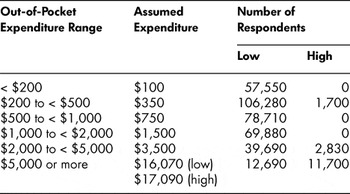
The respondents were asked the total out-of-pocket cost spent in the past 12 months on receiving help. They were given an option of providing an actual figure or choosing a range (see Table 2). Confidentiality laws barred us from receiving actual expenditure data. By special request, we obtained from Statistics Canada the count of respondents (weighted) who reported a value within each range and the average response above $5,000 (Table 2). Within each range, we assumed the midpoint value as the reported cost, this being the best approximation obtainable given the limitations of this data set. For our benefit, Statistics Canada removed a few extreme cases that they felt to be outliers (those with costs over $100,000). The resulting average annual expense was $982 for the low level-of-care category and $12,967 for the high level-of-care category.
Results for home-based long-term-care assistance for people over age 55 needing two levels of care – low and high. (Source: Statistics Canada, 2001 PALS, and authors’ own calculations)

The Canadian Elder Standard
We tallied the six components (shelter, food, medical care, transportation, home care assistance and miscellaneous costs) to arrive at the final CESs. There are 108 CESs for each city owing to the different sets of circumstances – that is, the different “tracks” for shelter, transportation, home care, and personal traits (age, marital status, and gender):
Shelter (3): tenant, homeowner with a mortgage, or homeowner without mortgage;
Transportation (2): passenger of public transportation and taxi rides, or private automobile owner;
Home-Based Long-Term Care Assistance (3): none, low, or high.
Age (2): 65 to 74 or 75 and over (affects cost of food and medical care);
Household Size and Gender (3): single male, single female, or couple (affects cost of food, shelter, and owning a private automobile);
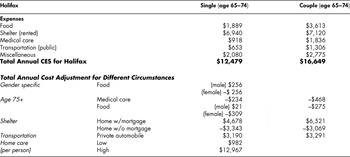
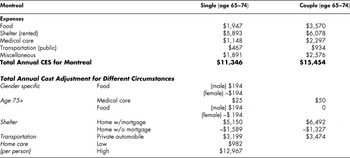
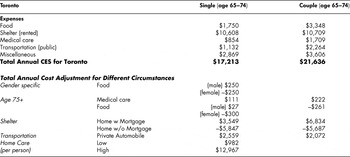
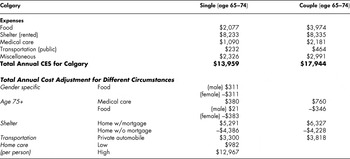
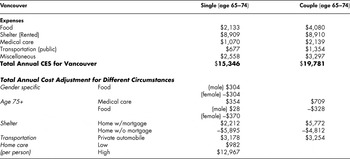
Tables 3 through 7 display the annual CESs for each city of interest. The base scenario is listed first at the top of each table for five components: (1) food, (2) shelter (rented), (3) medical care, (4) transportation (public), (5) miscellaneous and (6) home care assistance (none). In the base scenario, the cost data for each component is presented for a single elder and for a couple, both in the 65 to 74 age group.Footnote 28 We next listed the annual cost adjustments that allow for gender, different ages, and shelter arrangements, as well as a different mode of transportation.Footnote 29 For example, values to the right of “Transportation: Private automobile” are the added costs to the “Total Annual” of relying on a private automobile rather than public transportation for a single person or a couple. In Table 3, to calculate the CES for a 75-year-old single female Torontonian with a mortgage and car, we would begin with the baseline amount $17,213. To that amount, we would add $111 for the higher medical care cost of being age 75 or older ; subtract $300 for the reduction in food cost of a 75-year-old female; add $3,549 for the additional shelter cost of owning a home with a mortgage, and add $2,559 for the additional cost of using a private automobile for transportation. The total annual cost would be $23,132.
2001 CES for Halifax

Source:
Author’s own calculations.
2001 CES for Montreal

Source:
Author’s own calculations.
2001 CES for Toronto

Source:
Author’s own calculations.
2001 CES for Calgary

Source:
Author’s own calculations.
2001 CES for Vancouver

Source:
Author’s own calculations.
How Does the Ces Compare to Other Canadian Measures?
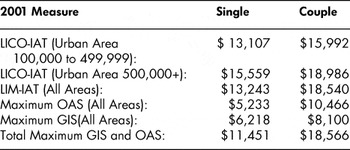
Sarlo (Reference Sarlo2001) established that the Canadian federal and provincial financial support programs – Old Age Security (OAS) and the Guaranteed Income Supplement (GIS) – ensured that no individual fell below his Basic Needs Poverty Line. Moreover, Ruggeri, Howard, and Bluck (Reference Ruggeri, Howard and Bluck1994) found that government financial support in nearly all provinces exceeded their developed poverty line.Footnote 30 Here, we compare the CES to the 2001 maximum OAS and GIS benefit levels, as well as the commonly used Canadian “poverty line” measures in 2001 (Sarlo’s Basic Needs Poverty Line, MBM, LICO, and LIM). Table 8 presents the after-tax 2001 LICO for the two urban sizes that are relevant to the five cities we examined, the after-tax 2001 LIM and the maximum annual OAS and GIS benefit rates in 2001. Table 9 lists the 2001 MBM (HRSDC, 2006) and Sarlo’s 1997 Basic Needs Poverty Line (Sarlo, Reference Sarlo2001), which we updated to 2001Footnote 31.
After tax LICO and LIM (for an Adult Single and an Adult Couple) and the Maximum Average OAS And GIS Benefit Rates for 2001. The LICO is given for Two Differently Populated Urban Areas. Source: Statistics Canada (2004a) and HRSDC website.

The 2001 MBM and Sarlo’s 1997 Basic Needs Poverty Line Projected to 2001. Source: HRSDC (2006) and Sarlo (Reference Sarlo2001).

To find a set of circumstances to use as a benchmark for comparisons, we first considered the CES for a typical elder, and then an elder who did not own any assets.
A Typical Elder
Elders are more likely to own their home mortgage-free than any other age group, thus substantially reducing their shelter costs. In 2001, 75.4 per cent of elder households headed by someone aged 65 to 74 owned their home, and 80 per cent of those households did so mortgage-free (Turcotte et al., Reference Turcotte, Liu and Schellenberg2006). Turcotte et al. also showed that, compared to previous years, the proportion of elder homeowners has grown while the proportion of elder renters has dwindled.
We first considered the CES for a typical set of circumstances (i.e., the elder owned a private automobile and a home without a mortgage). We further assumed the 65–74 age group, that a low level of home care assistance was required (for the couple, we assumed that both spouses required this care), and that the single elder’s CES was the average for a single male and a single female. We next compare the “Typical” CESs against the prominent Canadian poverty measures in increasing order (see Tables 1, 8 and 9 for actual values).Footnote 32
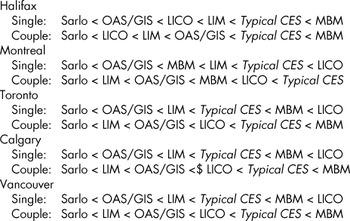
This typical set of circumstances results in a CES that is on par with the prominent Canadian measures for both singles and couples in all five cities. Sarlo is consistently the lowest, but his measure is commonly criticized as being too low (Osberg, Reference Osberg2007). For singles, LICO is usually the highest and MBM is always the highest for couples, except in Montreal.
An Elder with No Assets
We next considered a different set of circumstances in which the elder did not own a home or car and therefore relied on rented shelter and public transportation. We referred to this as the “No Asset” CES, and its values are given in Table 1. We developed the “No Asset” CES for the following reasons. First, the CES is most relevant to families with limited financial resources for retirement since their primary concern would be to cover the cost of their basic needs. Statistics Canada (2001) reported that 70 per cent of family units with no private pension assets in 1999 also did not own their home. Second, the “Typical” CES does not account for the wide variety of rental prices in each city and so is not very comparable to measures such as Sarlo’s Basic Needs Poverty Line and the MBM inasmuch as they assumed public transportation and a rented apartment. We next again list the measures in increasing order.

The values of the No Assets CES continue to be on par with the other measures. If we considered the MBM’s position relative to the CES more closely, the CES value of some cities exceeds the MBM, while others fall short. The general objectives of the MBM in terms of living standards are loosely in line with ours, except it allows for some luxuries such as modest recreation and entertainment.Footnote 33 Consequently, these results suggest that the basic cost-of-living for an elderly person is near to or even higher than that for a non-elderly adult living in the same circumstances. This conclusion is in opposition to the commonly held belief that retired elders automatically have fewer expenses than working non-elders. Another observation we made is that the combined maximum GIS and OAS benefit does not satisfy the cost of basic needs for elders without assets, except for couples in Montreal where the rental prices are comparatively low. For singles, the maximum OAS and GIS benefit falls short in all cities for both the No Assets and Typical elder. Finally, it is interesting from a policy perspective that, in each city, the No Assets CES and the Typical CES are not that far off from one another, with some exceptions – particularly Toronto (see Table 1).
The Importance of Circumstances
In determining the cost of basic needs, it is crucial to consider an elder’s circumstances. For example, had we assumed that a Typical elder owned a mortgaged home, the cost of basic needs would have jumped drastically, and the CES would have exceeded all other Canadian measures in every city for both couples and singles. From among all the circumstances in our study, poor health had the largest impact on the CES; the added cost of a high level of home care would more than double a couple’s basic cost of living in both scenarios.Footnote 34 Further, poor health could have implications beyond a surge in basic expenses. For instance, if it occurred before planned retirement and forced a withdrawal from the workforce, it would reduce the years of retirement savings and, consequently, cause an unexpected reduction in lifetime resources.Footnote 35 Given that the deterioration of health is much more probable for those with lower incomes and lower status occupations (Buckley, Denton, Robb, Spencer, & Byron, Reference Buckley, Denton, Robb, Spencer and Byron2004), the hardship of poor health is most likely to affect those who are least able to afford its financial burden.Footnote 36 The deterioration of health associated with aging could also affect other components of the CES; for instance, widespread mobility constraints among the elderly could suggest that owning a private automobile be viewed as a necessity for some. Including the cost of a private automobile produces CESs that surpass the MBM values in every city for both singles and couples.
Elders are four times more likely to suffer from long-term health conditions than those of typical working age (Cossette & Duclos, Reference Cossette and Duclos2002); thus, while elders are more likely to have cheaper circumstances in terms of shelter by owning a home without a mortgage, they are also more likely to incur the potentially much more significant costs associated with long-term health conditions. Unlike shelter and food, moreover, the need for home care is generally much less predictable since a downturn in health status can be sudden and beyond an individual’s control. Despite its huge impact, home care is overlooked when basic needs are considered.
Like the MBM and Sarlo’s Basic Needs Poverty Line, the No Assets CES in Table 1 illustrates the immense impact of geographical location on an individual’s primary expenses owing to the large range of rental prices across the cities. The CES for an elder renting in Toronto is almost 50 per cent higher than for one renting in Montreal, where the rental prices are comparatively low.
Our Typical CES in Table 1 could appear quite modest to an individual saving for retirement. In fact, the combination of OAS and GIS alone covers the majority of the costs, but not all as was previously determined by Ruggeri et al. (Reference Ruggeri, Howard and Bluck1994) and Sarlo (Reference Sarlo2001). Although the CES could provide for an elder’s basic needs, workers generally prefer to “enjoy their retirement” and aim to save enough disposable income to afford joining clubs, taking classes, and traveling. Measuring a social inclusion threshold, referred to as a “social comfort line” by Sarlo (Reference Sarlo2001), is a very subjective task whether it be a fixed level of income or replacement ratio. We are thus hesitant to promote the two thirds of pre-retirement salary rule of thumb, or any fixed percentage since the proportion depends on the worker’s circumstances and expectations after retirement rather than simply advancing age and current income.
Conclusion
In this study, we calculated the absolute cost of living for a single elderly individual and an elderly couple living in five major Canadian cities during 2001. The Canadian Elder Standard (CES) provides a general impression of the necessary after-tax income to cover basic needs for a variety of circumstances. From among a Canadian elder’s basic expenses (shelter, food, transportation, medical care, miscellaneous and home-based long-term care), the costs associated with home-based long-term care threatened to be the most severe. This expense is also, unfortunately, the least predictable and the most likely to affect poor elders. Home-based long-term care is an expense that previous Canadian measures have not considered. A good area for future research would be to find the cost of home-based long-term care at three levels of need (high, medium, and low), rather than two (high and low), by province and by income level. It would also be interesting to analyze the cost of basic needs in small towns/rural areas. In every city examined, the CES for a typical elder and an elder without assets was on par with the other Canadian measures (LICO, LIM, and the MBM). The maximum OAS and GIS benefit did not lift an elderly Canadian above basic needs as defined by the CES, LICO, LIM, or MBM measures. Our conclusions suggest that individual circumstances, rather than age, are the primary drivers in determining the cost of basic needs. Elders are a diverse group, particularly with respect to health, so it is important that elders, financial planners, and policy makers do not blindly rely on a fixed replacement ratio or universal level of income when projecting the level of finances needed to retire, since “one size” does not fit all.