Whether hymnology is thought to sit at the intersection of a range of academic disciplines, among them literature, musicology, theology and history, or whether it is regarded as peripheral to each of these, will depend on one’s perspective and interests. The nature and purpose of hymn texts and tunes has often seen them marginalized in academic terms, but works such as J.R. Watson’s The English Hymn: a critical and historical study and Nicholas Temperley’s The Music of the English Parish Church laid important foundations for the study of texts and tunes respectively.Footnote 1 This review of digital resources in hymnology has been prompted by the landmark online publication of the Canterbury Dictionary of Hymnology (CDH) (www.hymnology.co.uk/) in 2013, a bold project that highlights the rich interdisciplinary potential of hymnology. Until its publication, hymnology had lacked a standard reference text more recent than John Julian’s A Dictionary of Hymnology,Footnote 2 so its publication is a most significant development. Rather than consider it in isolation, this review takes the opportunity to reflect on it in relation to two other, longer-established online resources in hymnology: the Hymn Tune Index (HTI) (http://hymntune.library.uiuc.edu/) and Hymnary.org (www.hymnary.org/). The HTI first appeared in print (Oxford, 1998) before an updated online version, hosted by the University of Illinois Library, appeared in 2001; the current version of the HTI includes several further revisions. Hymnary.org, which was launched in 2007, is published by Calvin College, in Grand Rapids, Michigan, under the auspices of the Christian Classics Ethereal Library and the Calvin Institute of Christian Worship. Following comments regarding the content and usability of each of these three resources, the review will also offer some thoughts on the potential for researchers in using these sites in conjunction with each other and some remarks on hymnology in the wider context of digital humanities.
Though CDH is the only new resource under consideration here, each of the three sites is a different type of resource, and the addition of CDH to the earlier sites represents a significant development in the possibilities for using digital resources in hymnological research. Though called a ‘dictionary’, CDH actually is an encyclopedia, inspired by and in succession to Julian’s publication. It is edited by J.R. Watson (Durham University) and Emma Hornby (Bristol University), with Jeremy Dibble (Durham University) as Music Editor, Colin Gibson as Australasian Editor, Margaret Leask as Canadian Editor and Carlton R. Young as USA Editor. It is published by Canterbury Press and is available by subscription.Footnote 3 Both the HTI and Hymnary.org are, by contrast, freely available online. The HTI, created by Nicholas Temperley, indexes data from primary sources in a database of hymn tunes published with English-language texts up to 1820, with a focus on linking variant forms of tunes and the relationships between tunes and texts. It grew out of Temperley’s groundbreaking study of parochial music (see above). Hymnary.org is a database of hymn texts, tunes, hymnals, authors and composers aimed at serving ‘worship leaders, hymnologists, and amateur hymn lovers alike’.Footnote 4 It incorporates the Dictionary of North American Hymnology, a long-running project of The Hymn Society in the United States and Canada.
The Canterbury Dictionary of Hymnology
More than ten years in the making, the CDH represents the work of a six-person editorial team and over 300 contributors in 2 million words spread across more than 4,000 entries. Initially conceived as a printed publication, the decision to move to online publication was taken in 2009 and reflected the editors’ concerns about achieving comprehensive coverage and dealing with the work of contemporary and future hymn writers and composers, for, as they note, ‘hymnody, and the study of hymnology, never stands still’.Footnote 5 It describes itself as ‘an essential reference resource for scholars of global hymnody, with information on the hymns of many countries and languages, and a strong emphasis on the historical as well as the contemporary’.Footnote 6
The scholarly content of the site is extensive and thorough, drawing on the work of many distinguished scholars from around the world. Entries are placed in categories, which fall into seven broad areas: General, People, Places, Collections, Hymns, Eras and Traditions. Of particular note for readers of this journal is that the nineteenth century has 1,600 individual entries, more than any other era. A quick glance at the number of entries listed in various categories reflects the CDH’s emphasis on English-language hymnody (under ‘Places’ there are 2,360 entries relating to British hymnody, 862 to hymnody from the USA, with a further drop to 430 entries on German hymnody next in the list). However, there is impressive worldwide coverage, and while many articles deal with topics related to ancient hymnody, more recent topics of a global nature are also to be found. Notable too is that entries on authors and translators outnumber those on composers by about 2:1, though the music coverage here is extensive, and this is one of the major differences from Julian’s earlier work. The history of hymnology itself is also covered, with entries on 92 hymnologists and musicologists, ranging from the eighteenth century to the present day.
As might be expected, the bulk of the content is concerned with biographical accounts of authors and composers and entries on particular hymns. The biographical entries cover a host of figures, both familiar and obscure. Those on writers and composers well known for other aspects of their work are commendably focused and detailed on their contributions to hymnody; this is exemplified in Jeremy Dibble’s entry on Sir Arthur Sullivan. The essentials of his biography and his secular compositional output are covered in the opening three paragraphs. Thereafter, nearly 1,000 words are devoted to his work as a composer of hymn tunes. This section contains detailed information on associations of Sullivan’s tunes with particular texts, the circumstances of their composition and insightful analytical comment. Two musical examples are used to illustrate particular compositional traits and there is trenchant analysis of Sullivan’s arrangements of older hymn tunes and the role of organ accompaniment in choral settings of standard hymn tunes.Footnote 7
Entries on individual hymn texts and surveys of hymnody in particular traditions sometimes exhibit a dual focus informed by both scholarly expertise and the perspective of authors who are often eminent ecclesiastical figures. While this may seem unusual from a musicological perspective, it is actually a very interesting aspect of the site, revealing much about the ways in which hymns are perceived among the communities that use them.
Although the primary focus of CDH is biographical and historical, the ‘General’ category contains a number of essays of a more theoretical or conceptual nature such as ‘Aesthetics and theology in congregational song’ by Don E. Saliers and ‘Feminist hymnody’ by Janet Wootton. These are stimulating pieces of writing, with concepts such as Saliers’ idea of congregational song as a theological and aesthetic disruption or intervention worthy of further critical reflection and application to specific historical and contemporary contexts. Wootton’s essay gives a thorough historical and theological overview and might similarly be regarded as a stimulus for further research, for instance on the musical settings of hymns expressing feminist theology. This type of essay stretches CDH beyond being a purely reference text. The editors are clear that it will be updated several times each year; it is much to be hoped that in addition to filling gaps and expanding its biographical coverage, further essays of this type might be commissioned. Users should note the provision of a comment box at the foot of every entry for requests for corrections or additions; this is a simple but potentially effective tool to keep the dictionary up-to-date. As the site is still in its infancy, it remains to be seen how the editors will handle such requests and how the results of them will be incorporated.
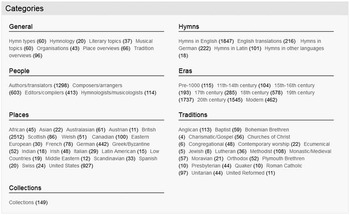
In terms of usability, CDH is logically organized, clearly laid out and largely intuitive to use. Content can be accessed by three main routes: browsing an alphabetical list of entries, using category filters or performing a search. The categories option is perhaps the most helpful; multiple filters can be applied and entries appear to have been categorized both logically and thoroughly. Figure 1 illustrates the range of categories available; by adding additional categories, it is possible to refine results with considerable precision and to produce a manageable list of potential articles for a given research topic. However, alphabetical shortcuts within category listings would be an easy and welcome enhancement, particularly in categories containing large numbers of entries. The search facility is somewhat basic; an advanced search, integrated with the categories feature, would be a most helpful addition.
The ‘Categories’ page in CDH

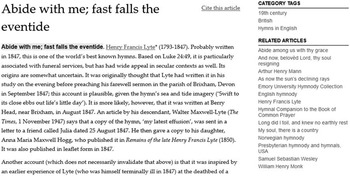
The articles themselves are clearly presented, with a range of hyperlinks on the right of the screen. Figure 2 shows the opening of Leon Litvack’s article on ‘Abide with me, fast falls the eventide’. In addition to the Category Tags and Related Articles headings, some longer articles also have a hyperlinked Table of Contents, but this helpful feature could be rolled out more widely across the site. For example, despite being over 10,000 words long, the entry on ‘Presbyterian hymnody and hymnals, USA’, which appears under the Related Article heading in ‘Abide with me’, has no sub-headings to assist navigation. These lists of Related Articles sometimes offer some curious results and point to some inconsistency in the way links between articles are managed. Within the main text of each article, links to other articles are provided as they are mentioned, such as to the entry for Henry Francis Lyte, mentioned at the start of the article on ‘Abide with me’ (see Fig. 2). The Related Articles list is generated using the reverse of this process. In this example, some, such as those on Lyte, the author, and Monk, composer of the most commonly associated tune, are predictable and useful; others, such as the ‘Emory University Hymnody Collection’ are more surprising. In this case, the Emory article includes this biographical aside, which provides the connection: “Emory has an 1861 edition without music produced by a committee with Sir Henry Williams Baker as chairman and an 1861 edition with music edited by William Henry Monk, composer of EVENTIDE, the tune to Henry Francis Lyte’s “Abide with me; fast falls the eventide”’.
‘Abide with me, fast falls the eventide’ in CDH

These small frustrations with the routes into the content are among a few ways in which the site’s functionality feels more basic than might be expected for a resource launched in 2013. Comparisons with Grove Music Online, though perhaps unfair in terms of the publisher’s experience in delivering online reference material, are, for a musicologist, inevitable. Musical examples in CDH are presented as images only; the lack of audio, available in Grove through the Sibelius Scorch plug-in, is regrettable. Facilities for formatting entries for printing, sharing article information and presenting citation data in various styles, all now common features of online resources are also notable absences here. However, this is Canterbury Press’ first major online publication of this type and it is to be hoped that such features may be added as the resource becomes more widely known and used. None of these criticisms undermine the site in a substantive way and nor do they seriously impede access to its outstanding scholarly content.
The Hymn Tune Index
HTI recognizes the essential relationship between text and tune that is central to the practice and very existence of hymnody. It charts the publication history of hymn tunes in English-language publications up to 1820 and provides comprehensive data on their musical details, textual associations, naming, attribution and variants. Though the necessarily restricted number of nineteenth-century tunes, hymnals and texts is likely to limit the potential of this resource for scholars of that century, it still offers considerable scope for making historical comparisons. Melodic data is presented numerically, and alphanumeric codes are used for the indexing of texts, hymnals and tunes. The presentation of the data demands careful attention; particularly when dealing with comparisons between variants of the same melody, differences need to be discerned by comparing long strings of numbers. This is not easy work, but the depth of data available is one of the site’s great strengths in terms of the research potential it offers, and sustained use does breed familiarity.
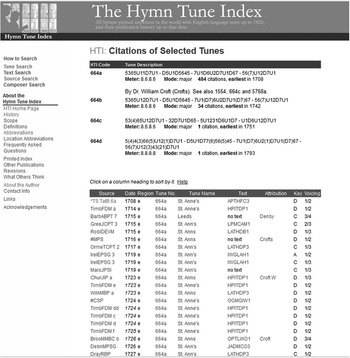
The data given for the tune ‘St Anne’, shown in Figure 3, provides an indicative example. First, the melodic pattern of each known variant is given. The numeric values correspond to pitches in the scale, U and D indicate moves into a higher or lower octave and figures in parentheses indicate melismatic notes. Below this is a list of each instance of one of these variants; hyperlinks are available for each source and text listed. While it requires patience and careful concentration to interpret the information presented, the great advantage of HTI is the amount of data it succeeds in conveying in a single screen.
HTI melodic data for the hymn tune ‘St Anne’

The history of HTI provides a fascinating insight into the development of digital humanities. It began life in the 1970s and has been transferred across different platforms before its online launch. Its entry in CDH, written by Temperley, and explanatory notes on the site itself give a comprehensive overview.Footnote 8 Aspects such as the limits necessarily placed on the number of characters permitted in particular fields and the consequent use of alphanumeric codes throughout the database testify to its long history. That they remain as the means of identifying data and navigating the database on the one hand feels a little antiquated, yet at the same time is testimony to the extraordinary breadth and depth of data available as converting these codes into full text would be a monumental task, but one that is by no means the most desirable of possible enhancements.
HTI’s 1820 cut-off is at once entirely understandable and extremely frustrating. The limitations of financial, human and time resources associated with any research project would surely have been accentuated by the sheer volume of source material and the labour-intensive process of data capture and entry. The multiplicity of nineteenth-century sources, let alone more recent ones, would have expanded the project enormously. There are indications on the site itself that plans for its expansion post-1820 have been considered, but the more recent CDH entry simply states that ‘Plans to extend the index beyond the year 1820 are dormant at present’.Footnote 9 As we become increasingly used to complete digital archives of particular publications or collections, HTI’s pragmatic but arbitrary cut-off point seems increasingly incongruous. The logistics of such an expansion are, as indicated, enormously complex and vast. However, the ever-increasing number of digitized sources widens the potential pool of contributors, as does the increased likelihood of multiple surviving copies of more recent publications. It would be interesting to explore the possibilities offered by crowdsourcing for spreading what might otherwise seem an impossibly large volume of data to input. It would be good to know whether such a possibility might be considered, though, of course, careful editorial control would still be required to maintain the index’s integrity, so this is not a simple solution by any means.
Hymnary.org
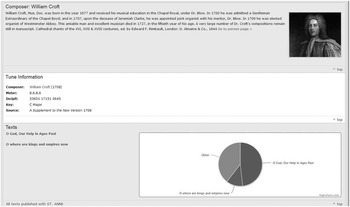
Hymnary.org is the least academically oriented of the three resources reviewed here. Its primary aim is to be a resource for churches and their worship leaders, and to that end it provides access to texts and tunes in a range of formats for printing, projecting as well as various types of audio, which, as noted, is regrettably lacking in CDH. Its source material is largely American hymnals of the nineteenth and twentieth centuries. It does contain some biographical entries on authors and composers, but coverage is patchy and the detail and rigour does not compare well with CDH in this regard. Similarly, the level of detail it provides for tunes is not as extensive as that found in HTI. Neither of these points are surprising or problematic, however, given the aim of this resource is rather different from the others. It does fill some of the post-1820 gap left by HTI, but not with sufficient breadth or depth to make it of comparable scholarly value. The information provided on the hymn tune ‘St Anne’, part of which is shown in Figure 4, illustrates the nature of the data available. Information on associated texts is presented in an easily understood graphic form. In addition to the basic information about the tune shown, links to online scores and recordings are provided further down the page.
Extract from ‘St Anne’ on Hymnary.org

The reason that Hymnary.org is included here is for the impressive range of its functionality; in this regard, it is far more sophisticated than either CDH or HTI, and it makes the best use of the opportunities presented by developments in software. It might be regarded as a product of the digital age in ways that the other two resources are not. It was clearly conceived as an online resource and offers users an experience that has no paper-based equivalent. HTI, as the oldest of the three resources considered here, has its origins in a time when online dissemination of research was not a possibility. CDH is the successor of a printed reference text and while containing the standard features of web pages, such as hyperlinks and a search facility, it still feels rooted in print culture.
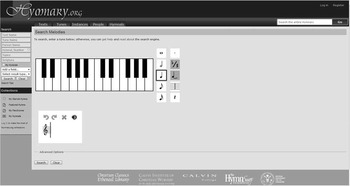
Especially impressive is Hymnary.org’s melodic search function, the interface of which is shown in Figure 5; an on-screen piano keyboard and a small selection of notation options allow users to enter a melodic fragment as a search term. The user’s choice of key and rhythmic values does not seem to impede its ability to produce accurate results, making this a superb addition to text-based searches. It also feels far more intuitive than HTI’s number-based system for melodic searches. Other helpful features include timeline graphics that give a quick overview of a particular text or tune’s popularity since its earliest recorded appearance, scriptural and topical search options and the ability to save particular references following creation of a free user account. Significantly, the ‘About Melodic Search’ page indicates that its development was assisted by a number of free and open-source tools, suggesting that similar features could be developed for use elsewhere.Footnote 10
The interface for Hymnary.org’s melodic search

Research Potential
CDH should be regarded as the standard reference text in hymnology, and it thus represents an essential starting point for all hymnological research. Researchers at any stage of their academic career will find its biographical coverage valuable in giving context to their work. As well as the welcome focus on hymn-related activity in biographies of well-known figures, illustrated earlier, entries on individuals who are virtually unknown outside the world of hymnody will also be very useful. Here, at last, is an up-to-date, easily accessible source that can be drawn upon and cited, saving the need to hunt for basic biographical details in obscure, inaccessible publications. Postgraduate researchers in particular will find the survey essays helpful in shaping their own research projects. These are authoritative texts, written by leading academics. They will both provide essential grounding in a topic and give stimulation for further focused research on areas that they necessarily cover only briefly. As well as being a key resource for historical research topics, the site – especially in the conceptual essays mentioned earlier – offers potential for interdisciplinary research. Exploration of the intersections between music, literature and theology will be enhanced by CDH, for here is precise, scholarly commentary on all these fields, presenting an open invitation for researchers. The richness of CDH’s musical coverage is of great significance in this regard; Julian’s Dictionary did not cover musical topics, and, for obvious reasons, much scholarly work on hymnody has focused on hymn texts and their relationships with particular theological, social or political positions. The important work CDH has done in documenting the contributions of composers, arrangers and editors and addressing a range of more general musical topics points to the possibility of future research into hymnody’s functions in various historical, geographical and ecclesiastical contexts as the performance of music, literature and theology simultaneously.
For anyone researching musical aspects of hymnody in the period it covers, HTI is also indispensable. The ability it offers to establish the provenance of particular hymn tunes, the lineage of hymnals and the historical relationships between texts and tunes is unparalleled. Here too, there is great potential for interdisciplinary research; for instance, the musical characteristics of a particular religious institution can readily be identified from the data it holds. Aspects such as the use of existing or new repertoire and stylistic preferences can easily be quantified for use as the basis of research projects. This is an invaluable tool for gathering evidence on the performance of hymnody. It allows the musical repertoire of any hymnal or organization to be set in context and thus provides a solid foundation for interpretative analysis. It is particularly helpful for anyone planning a research project involving primary sources in hymnody, allowing their relevance and scope to be assessed in advance and providing a host of possible sources for comparison. Handling and presenting data from HTI requires careful thought; challenges of interpretation mean that its alphanumeric codes do not easily transfer to research papers as raw data, though they do make citations clear and concise, especially for research presented online, where direct links can be included. Presenting the data in tabular or graphic form works well, but it is a pity that there are no options available beyond a manual ‘cut and paste’ for exporting the raw data into applications that can present it in these ways.
Of course, the two sites offer rich potential to researchers when used in conjunction with one another. The combination of technical data and contextual commentary has considerable potential for stimulating research. Future research might also involve contributing to the further development of either or both sites. While there is no current progress on this with regard to HTI, the editors of CDH have a clear plan for publishing regular updates.
Hymnology and the Digital Humanities
The long history of HTI shows that hymnology has long been part of the digital humanities, and the existence of these three online sources in addition to hymnals available through digital archives gives hymnologists ready access to a variety of primary and secondary source material. In particular, the arrival of CDH brings hymnology into line with other disciplines in having an online core reference text that will be periodically updated.
Some of the comments above indicate that there is still some work to be done for hymnology to catch up with the digital research resources available in other disciplines. Hymnary.org, despite its different target audience, demonstrates some of the possibilities available in terms of harnessing the power of developments in software. Furthermore, in an ideal online world, CDH and HTI would be fully integrated and cross-referenced. Currently, having to interrogate both separately can be time consuming and frustrating; successful integration would bring a smoother experience and more confidence in being able to identify the required data.
Again thinking speculatively, it would be good if the now enhanced online presence of hymnology might act as a spur to greater online collaboration between hymnologists. The resources reviewed here, in common with many digital research resources, offer little opportunity for user interaction or collaboration. In a field where scholars are likely to be spread across a wide variety of disciplines, a forum for sharing research ideas emerging from these and other digital resources would be a welcome development.
In summary, hymnology is now able to boast a significantly enhanced digital presence; the availability of a variety of resources presenting different types of data can only be a positive step in developing awareness of hymnological research in the disciplines it encompasses. The arrival of CDH complements HTI and should do much for the future of research in hymnology.