Introduction
Tamarind (Tamarindus indica L.) is an economically important wild tree species occurring in tropical countries. It has a wide range of industrial and domestic uses. Besides using as food, different parts of the tree are used in textile and pharmaceutical industries as well as in Ayurveda and traditional medicines. It also has enormous social and ecological importance. This multi-functional tree species contributes to the rural economy of the state, particularly in Palakkad district, the lead producer, which incidentally has the highest deprivation rate (42.33%) in rural households (KSPB, 2018). Tamarind is well adapted to the dry tracts of Palakkad, and is intermingled with many customs and traditions of the rural society. During the lean season, after harvesting of paddy, the rural community engages in household primary processing of tamarind which is a cottage industry in the district.
In India, two tamarind varieties are reported based on the fruit size, number of seeds and the pod colour namely, East Indian type with big pods and 6–12 seeds and West Indian types having short pods with approximately four seeds (Orozco, Reference Orozco2001). However, there are no reports on the fruit diversity of tamarind in Kerala. There are some accepted primitive cultivars like ‘valanpuli’, a highly sour, long-fruited type and sweet types like ‘madhurapuli’ and ‘thenpuli’. Since valuable germplasm is slowly vanishing due to urbanization, it is high time to conserve all rare tamarind accessions available in the state.
Scientific characterization of available tamarind accessions could facilitate the efficient utilization of superior types and thereby provide additional income for economically backward rural people, helping to improve their well-being and standard of living. Local communities play a pivotal role in the conservation of ecosystem and possess enormous traditional knowledge of indigenous flora, which are to be documented. Hence, a survey was conducted to know the existing fruit diversity by in situ characterization and document the sweet tamarind types and elite accessions having commercial potential in Palakkad gap of Kerala.
Materials and methods
Study area
Tamarind is a sustainable tree species in the agro ecosystem of dry tracts of Palakkad district of Kerala located at latitude 10.7866°N to 10.5354°N and longitude 76.6629°E to 76.6936°E. The total geographical area of the district is 4480 km2, contributing 11.53% of the state's geographical area. The district experiences semi-humid climate on the east part and humid climate on the western part. The temperature of the district ranges from 20 to 40 °C. The average rainfall ranges from 700 to 3500 mm. Topographically, the district can be divided into midland and highland. The soil is mainly laterite, peaty (kari), forest and black. Laterite is seen in the major portions of all taluks (Surendran et al., Reference Surendran, Sushanth, Mammen and Joseph2015).
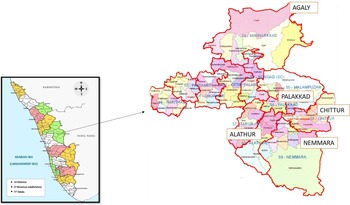
The occurrence of tamarind in the natural system is reported from all over Kerala and in Palakkad district, representing about 42.59% of the total area under trees. Based on the experience and knowledge of local people and bidders, trees were sampled in five revenue blocks, viz. Alathur, Nenmara, Palakkad, Agali and Chittur, of Palakkad district (Fig. 1). Of these, the blocks Alathur, Palakkad and Nenmara constitute central plain in agro ecological unit 22 (AEU 22); the block Chittor represents the eastern plain, AEU 23 and the block Agali constitutes AEU 18. A preliminary survey was conducted in 2020 in consultation with agricultural officers of concerned areas and regular local bidders to locate tamarind trees exhibiting variability. Purposive sampling was done in 2021 and 113 varying tamarind types were located from boundaries of households, garden lands, road side and border of irrigation canals.
Map showing collection sites.

Data collection
Samples were collected from full bearing trees with the help of skilled climbers using long poles fitted with hooks which were used to pull down fruit bearing branches. Ethnobotanical surveys were also carried out to assess the local perception of morphological variation. Morphological characterization of tree, leaf, fruit and seed characters was carried out as per tropical fruit descriptor (IBPGR, 1980), protocol developed by Leakey et al. (Reference Leakey, Fondoun, Atangana and Tchoundjeu2000), El-Siddig et al. (Reference El-Siddig, Gunasena, Prasad, Pushpakumara, Ramana, Viyayanand and Williams2006) and PPVFRA DUS guidelines (Singh et al., Reference Singh, Rethinam, Peter, Marimuthu, Singh, Singh and Prakash2017). The growth habit, girth at chest height and cortex texture were recorded. Fruit samples collected at ripening stage were immediately observed for all morphological and biochemical characters at Cashew Research Station, Kerala Agricultural University, Madakkathara, Thrissur, Kerala, India. Colour, shape, length, girth and weight of matured pods were recorded as an average of 30 well-ripened fruits. The pulp was extracted and seeds were separated manually from the fruit to observe colour and taste of pulp. The variables related to seed were number of seeds per pod, seed weight, seed colour, seed shape, seed weight per pod, seed brightness and seed roughness. Weight of pod (pdwt), pulp (pwt), shell (shwt), fibre (fwt) and seed (swt) of all samples were determined using a precision weighing balance. The length of pods was measured with a thread and measuring scale as the distance between pod tip and beginning of pedicel. Length of a curved fruit was measured on outer side of curve. The taste of each sample was recorded as sweet, sour or intermediate.
The pulp yield (PY) was calculated as the ratio between pulp weight and fruit weight and expressed as per cent (pwt/pdwt × 100) (Van den Blicke et al., Reference Van den Bilcke, Alaerts, Ghaffaripour, Simbo and Samson2014). The real pulp value (RPV) is a measure often used for primary screening of tamarind accessions (Soloviev et al., Reference Soloviev, Niang, Gaye and Totte2004; El-Siddig et al., Reference El-Siddig, Gunasena, Prasad, Pushpakumara, Ramana, Viyayanand and Williams2006). It was computed as PY × (pwt/100) (Van den Blicke et al., Reference Van den Bilcke, Alaerts, Ghaffaripour, Simbo and Samson2014). Biochemical analysis of all samples was also carried out, recording total soluble solids (with digital refractometer) and titrable acidity (AOAC, 1998). As a reference for the identification of sweet types, market samples from Thailand available in the local market of Kerala were also included for biochemical analysis.
Analysis of phenotypic diversity
The phenotypic frequency distribution of 13 characters was calculated for all samples. The diversity index (H′) was computed using phenotypic frequencies to assess the phenotypic diversity for each character. The diversity index (Shannon and Weaver, Reference Shannon and Weaver1949) is as follows:

where pi is proportion of accessions in i thclass of an n class character and n is the number of phenotypic classes for a character. The standardized H′ ranging from zero to one was obtained by dividing H by the loge of total number of phenotypic classes as follows:

By pooling all traits across the collections, additive properties of H′ were used to evaluate the genetic diversity among collections.
Hierarchical clustering on principal components
The samples of trees collected were subjected to agglomerative hierarchical cluster analysis using R statistical programme based on eight commercially important yield-contributing traits, viz. pod length, fruit weight, pulp weight, seed weight, number of seeds/pods, fibre weight, real pulp value and acidity, having high variation (coefficient of variation above 20%).
Principal component analysis was performed initially to reduce the dimensionality of the data set into a few continuous variables comprising the most important information in the data. The number of principal components to be retained was chosen by visual inspection of scree plot and eigen values ≥1 (Kaiser, Reference Kaiser1958).
A hierarchical cluster analysis on the PCA results was performed to obtain a more stable cluster, following the method of average linkage and squared Euclidean distance. This partition was further consolidated by applying a K-means algorithm with a predefined number of six clusters and hierarchical cluster dendrogram was constructed.
Identification of elite tamarind types
The clusters representing high values for economic yield-contributing characters were selected from the hierarchical cluster tree. The collections belonging to these clusters were identified as promising types. Box plots of desirable fruit traits were constructed for these promising collections to confirm superiority. Sweet types of tamarind were spotted by constructing a scatter plot between acidity and ratio of total soluble solids and total titrable acidity (TSS/TTA).
Results
Diversity in tamarind collections
The growth habit of majority of collections was upright (67.26%) with brittle cortex (83.19%). The colour of mature fruit varied from reddish brown (9.73%) to brown (18.58%) to grey (71.68%) (Fig. S1). More than 70% of collections produced reddish brown pulp. Although straight pods were dominant (74.43%), curved fruits were also observed in 25.66% of tamarind trees. Majority of collections (>60%) produced medium-sized pods with low fruit weight (<15 g). Only 4.42% of the collections exhibited high fruit weight of above 25 g. Brown or dark brown-coloured seeds were observed among accessions with five shapes, viz. cordate (2.65%), quadrangular (75.22%), oval (15.04%), D-shaped (5.31%) and irregular (1.77%). The seeds were mainly brilliant and polished (99.12%).
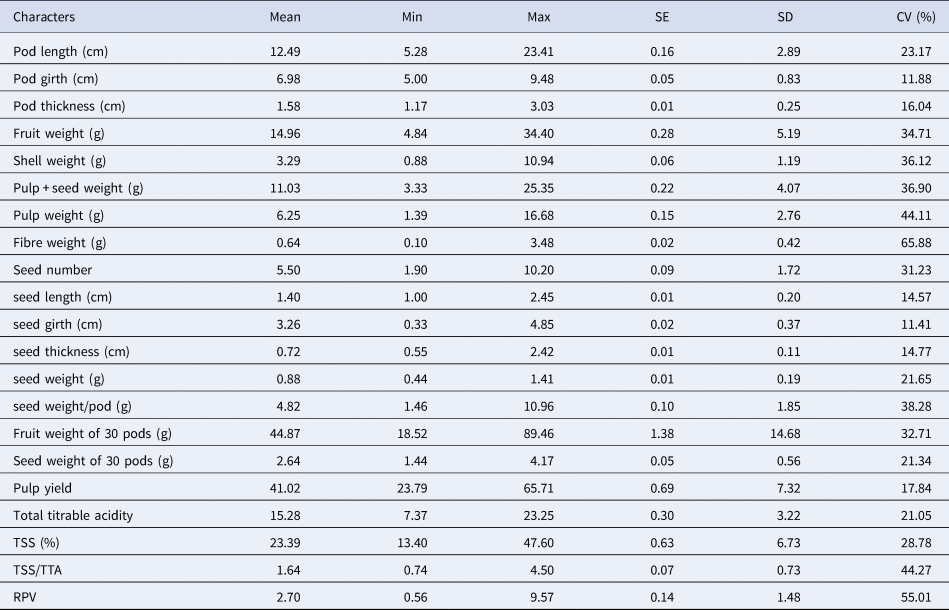
Standard descriptive statistical parameters were calculated for 21 quantitative characters of 113 collections and the mean, range, standard deviation and coefficient of variation were established (Table 1). Significant difference was observed among the collections for all the quantitative traits. The highest standard deviation (14.67) was exhibited in the weight of 30 fruits which is the most indicative variable of tamarind in Kerala. Coefficient of variation was the highest for fibre weight (65.88%), followed by real pulp value (55.01%), pulp weight (44.1%) and the ratio of total soluble solids to total titrable acidity (44.2%). Pod length ranged from 5.28 to 23.41 cm and fruit weight from 4.83 to 34.40 g. The seed weight ranged from 1.46 to 10.96 g. Total titrable acidity ranged from 7.37 to 23.25%.
Standard descriptive statistics of the observed fruits for 113 collections of tamarind

The estimates of morphological diversity indices (H′) for individual traits varied from 0.07 for seed brightness to 0.83 for seed weight per pod, with an overall mean diversity index of 0.50 (Table S1). The standardized Shannon and Weaver diversity indices were classified as low (0–0.33), intermediate (0.34–0.66) and high (0.67–1). The majority of the morphological traits, viz. growth habit, mature pod colour, shape, length and weight, seed weight per pod and cortex structure were polymorphic with high genetic diversity.
Identification of elite tamarind types
Principal component analysis was performed based on eight morphological characters. Eigen value obtained through PCA was used to determine the number of PCs to be retained. The scree plot in response to principal components revealed that the first three principal components had eigen values above 1, which accounted for 83% of the total variation (Table S2). The first factor (PC1), which explained 53% of the total variation, exhibited large negative association with fruit weight, pulp weight, fibre weight and RPV. The second factor (PC2) accounted for 17% of total variance and featured pod length, seed number and seed weight. The third principal component which explained 13% of the total variation was associated with acidity.
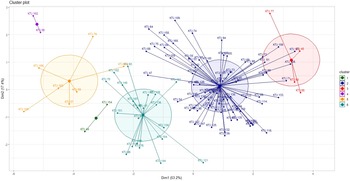
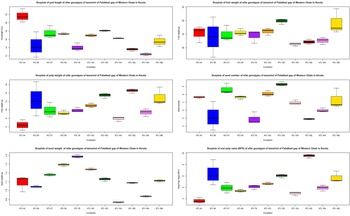
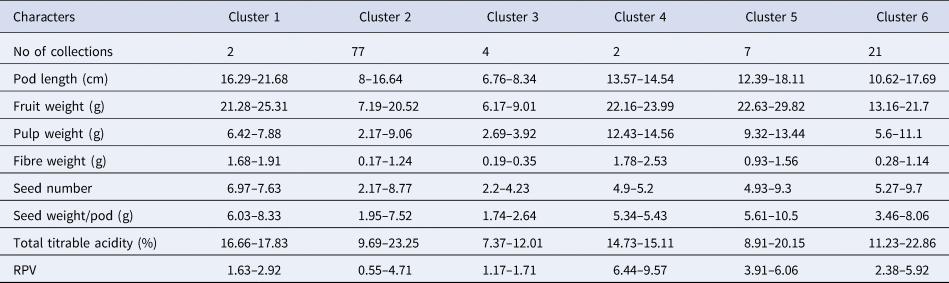
The hierarchical cluster analysis of PCA suggested six main clusters (Fig. 2). The hierarchical cluster trees were cut to a height of 3.87, showing the cluster dendrogram dividing the tamarind collections into six clusters (Fig. S2). Cluster I was contributed by two collections, KTJ 44 and KTJ 154. This group represented samples with long pods (16.29–21.68 cm). Cluster II was formed with 77 collections having average fruit qualities, representing major gene pool of tamarind in Palakkad gap, while cluster III was formed by four samples, KTJ 48, KTJ 60, KTJ 88 and KTJ 77, representing trees with small fruits (6.67–8.34 cm), low fruit weight (6.17–9.01 g) and low acidity (7.37–12.01%). Cluster IV was formed by two collections, KTJ 162 and KTJ 56, which had high real pulp value (5.99–9.57), pulp weight (12.43–14.56 g) and fruit weight (22.16–23.99 g). Cluster V consisted of seven individuals having better values for all yield-contributing traits, viz. fruit weight (22.63–29.82 g) and fruit length (12.39–18.11 cm). Cluster VI was formed by 21 individuals having better fruit qualities than cluster II. The numerical characteristics that defined the best values for each cluster are presented as Table 2. Box plot diagram (Fig. 3) of all individuals in cluster I, IV and V having superior economic traits showed that pulp weight was high in collection KTJ 166 (14.56 g) and KTJ 56 (12.43 g). The fruit weight was also high in these two collections. The pod length was high in the collection KTJ 44 (21.68 cm).
Hierarchical clustering of tamarind collections of Kerala using first two principal components.

Box plots of characters of tamarind elite genotypes from Palakkad gap of Kerala, India.

Cluster-wise summery of economically important traits of tamarind collections of Kerala

Spotting sweet tamarind types
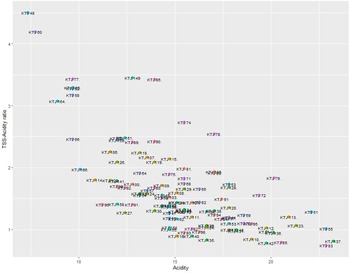
A scatter plot between acidity and ratio of total soluble solids to total titrable acidity (TSS/TTA) was drawn to establish sweet types (Fig. 4). Collections with low acidity and greater sweetness were identified. As per DUS guidelines, accessions with acidity less than 8% were categorized as sweet types. In the scatter plot diagram, two samples KTJ 48 and KTJ 60 were spotted as sweet types in the population with acidity below 8% and TSS/TTA ratio above 4. During the survey, although 18 samples known to be as sweet by the local people were collected, only two samples could be identified as sweet types. These two collections fell in cluster III. The pod length of these samples ranged from 5 to 13 cm, fruit weight from 2.3 to 15.87 g and pod girth from 4.2 to 7.5 cm. The survey also spotted five samples, KTJ 164, 58, 77, 165 and 52, which were identified as intermediate with 8–10% acidity (Fig. 4). The fruit qualities of sweet tamarind types were found comparable with market samples of sweet tamarind from Thailand available in Kerala market (Table S3). The market samples had acidity in the range of 3.48–7.35% and TSS/TTA ratio 4.6–9.5. Among sweet types, KTJ 60 had an upright growth habit and wrinkled texture with 12–14 paired leaflets. The sweet type KTJ 48 located had spreading growth habit with brittle texture and 13–16 paired leaflets.
Scatter plot of acidity and TSS-acidity ratio of tamarind collections of Kerala.

Discussion
Tamarind is generally seen wild on the boundaries of homesteads, garden lands, roadsides, fallow lands, forest lands and canal bunds in all the 14 districts of Kerala. Though Kerala lacks systematically planted tamarind plantations, Palakkad district is the major contributor (14,654 tons) to the total production of the state (34,406 tons) (Malhotra et al., Reference Malhotra, Cheriyan, Meena, Kumar and Sreekumar2021). The fruits are collected from trees in homesteads and avenue plants owned by the Public Works Department, Irrigation Department or Forest Department as well as from neglected trees in garden lands. Most of the trees were originated from seeds and have widespread canopies.
The survey revealed that the trees growing naturally on the boundaries of garden are maintained by the rural people. Although tamarind is not a commercially cultivated crop in Kerala, this multipurpose tree serves as a source of income for rural dwellers. The fruits, seeds, timber and even leaves are in great demand. It is a plant genetic resource that has great potential, and is a part of Kerala's cultural identity. The post-harvest handling and primary processing of fruit by removing the shell and seed is carried out in Palakkad as a small-scale cottage industry.
Alternate bearing habit was noticed in some collections but more than 80% were regular bearers. In Kerala, flowering of tamarind trees usually commences during dry summer in March and extends up to July. With the onset of summer showers, the tree flushes and starts flowering. The colour of flush varies from green to brown while the colour of bracts and bracteoles varies from pale green to pink (Shankarprasad, Reference Shankarprasad2019). The harvest season is from February to April, 10–12 months after flowering. Even though trees with staggered flowering are also observed, the peak bearing season is summer. The corolla spread varies from 2.14 to 3.27 cm, pedicel length from 0.54 to 1.23 cm, petal length from 1.30 to 1.65 cm and petal width from 0.55 to 0.88 cm (Shankarprasad, Reference Shankarprasad2019). Singh et al. (Reference Singh, Singh and Joshi2008) has also reported similar results in Gujarat, except for corolla spread.
Diversity in tamarind collections
The highly heterogeneous and cross-pollinated nature of the fruit crop (Usha and Singh, Reference Usha and Singh1996) contributes generally towards the wide range of variation exhibited by seedlings, which aids in the selection of superior genotypes. Cross-pollination and predominance of seed propagation in tamarind over a long period of time also gives immense opportunity to locate elite trees having desirable horticultural traits (Singh et al., Reference Singh, Mishra, Singh, Singh, Singh, Maheshwari, Bhargava and Saroj2021).
This study quantifies the variability in the tamarind population naturally occurring in Palakkad district of Kerala (Fig. S3). The survey revealed that local people in Kerala distinguished tamarind generally as sweet and sour types based on sourness. They also differentiated long and short types based on length of pod and number of seeds/pods. The long types with 8–10 seeds, 16–23 cm length and high sourness are generally considered as sour types, locally known as ‘valanpuli’ meaning long-fruited tamarind types. Whereas, small types with less sourness are considered as sweet types and are popularly known as ‘madhurapuli’ meaning sweet-fruited types or ‘thenpuli’ meaning as sweet as honey. Attempts have been made to designate different tamarind genotypes based on the fruit characters. Hernandez-Unzon and Lakshminarayana (Reference Hernandez-Unzon and Lakshminarayana1982) reported two types of tamarind: one with brown pulp turning dark brown on storage and the other with red pulp. Kennedy et al. (Reference Kennedy, Thangaraj, Vijaykumar and Thamburaj1997) classified tamarind fruits into five groups: long and bold fruit, medium fruit, small fruit, curved and irregular and sweet fruit. Karale (Reference Karale2000) categorized the tamarind genotypes in Maharashtra into sour, sweet and red type. In Philippines and Thailand also, cultivars were differentiated based on fruit size and sweetness (El-Siddig et al., Reference El-Siddig, Gunasena, Prasad, Pushpakumara, Ramana, Viyayanand and Williams2006). This variation might have resulted from genetic intercrossing processes (Fandohan et al., Reference Fandohan, Assogbadjo, Glèlè Kakaï, Kyndt and Sinsin2011).
Tamarind has tremendous potential under semi-arid ecosystem of western India (Singh and Singh, Reference Singh and Singh2005; Singh et al., Reference Singh, Singh and Joshi2008). Pareek and Awasthi (Reference Pareek and Awasthi2002) reported that seedling plants depicted heterozygosity in morphological, physiological and phenological characters. In our study, 21 quantitative and 14 qualitative descriptors were combined morphologically to better differentiate the collections as suggested by Fandohan et al. (Reference Fandohan, Assogbadjo, Kakaï, Sinsin and Van Damme2010). Wide variations were observed in sweetness, acidity, size and shape of fruits and seeds in tamarind under Kerala conditions. It suggests significant heterozygosity, which may be due to the existence of natural seeding population in the ecosystem. This variation in population is in consistence with previous studies in tamarind (Keskar et al., Reference Keskar, Karale, Dhawale and Chaudhary1989; Shinde and Kulval, Reference Shinde and Kulval1995; Karale et al., Reference Karale, Wagh, Pawar and More1999; El-Siddig et al., Reference El-Siddig, Gunasena, Prasad, Pushpakumara, Ramana, Viyayanand and Williams2006). Among fruit characters, weight of 30 fruits showed highest standard deviation as suggested by Osorio et al. (Reference Osorio, Muriel and Torres2018). In our study, there was highest coefficient of variation in fibre weight (65.88%), followed by real pulp value (55.0%) as observed by Shankarprasad (Reference Shankarprasad2019).
There was a wide range in pod length (5.28–23.41 cm) with an average fruit length of 12.49 cm. Shankarprasad (Reference Shankarprasad2019) had reported an average pod length of 12.5 cm, ranging from 9.79 to 19.22 cm. Whereas, Osorio et al. (Reference Osorio, Muriel and Torres2018) reported an average fruit length of 8.68 cm for Colombian collections, which indicates the superiority of tamarind population in Kerala probably due to a bimodal rain regime. Genetic variation in tamarind is primarily due to diversity in fruit characters, particularly variation in colour and sweetness of fruit pulp. Along with phenological diversity, tree-to-tree variations also existed in flowering and bearing habits.
Cursory scrutiny of hierarchical clustering dendrogram reveals similarities and differences between collections in each cluster. The clusters I, IV and V represented collections with heavy fruits (more than 20 g) and this fruit weight coincides with pod length and pulp weight. It agrees with the observations of Fandohan et al. (Reference Fandohan, Assogbadjo, Glèlè Kakaï, Kyndt and Sinsin2011), Singh and Nandini (Reference Singh and Nandini2014) and Osorio et al. (Reference Osorio, Muriel and Torres2018) and revealed that these fruit traits are under additive gene control and selection for genetic improvement for these traits will be effective. Selection for one of these characters will simultaneously improve pulp weight, seed weight and fruit length. Field survey, evaluation and collection of promising lines and ex situ conservation of local types adaptable to a specific geographical region is required for crop improvement and enrichment of the gene pool.
Spotting sweet tamarind types
In Kerala, there are many local accessions which are very sweet and the most sought-after indigenous fruit by rural children in earlier days. The sweet-type local accessions ‘madhurapuli’ and ‘thenpuli’ were preferred for consumption as fruit in rural Kerala and were generally considered as low yielders. During the field survey, our team noticed loss of sweet-type fruits from trees due to consumption by flocks of birds at peak ripening stage. The owners are reluctant to retain sweet types because of small-sized fruit, less quantity for sale, proneness to bird attack and lack of niche market in Kerala. Moreover, high population pressure has led to erosion of these types from the ecosystem. In the course of survey, many reportedly sweet-type trees were found to have been removed. This alludes to the depletion of the particular gene pool and focuses on the need for conservation.
Tasting the fruit can give an indication of the sweetness, but is rather subjective. Among 113 collections, 18 were collected as sweet types based on local enquiry. In this study, collections having acidity of less than 8% were categorized as sweet types based on the DUS guidelines. The ratio between total soluble solids and total titrable acidity could also be considered as an indicator of sweetness (Kumari et al., Reference Kumari, Bhat, Wali, Bakshi and Jasrotia2015; Suszek et al., Reference Suszek, de souza, Nóbrega, Pacheco and da cruz silva2016). The scatter plot with acidity and TSS/TTA ratio spotted two collections, KTJ 48 and KTJ 60, as sweet types. This is the first documentation of sweet-type tamarind in Kerala. These were trees neglected by the bidders but pinned by the rural women, who collected the sweet fruit separately for home scale preservation and preparation of traditional recipes. Five collections were noted as intermediate types. Sweet types need to be studied in detail for variation within the tree as it is a rare trait controlled by recessive genes (Feungchan et al., Reference Feungchan, Yimsawat, Chindaprasert and Kitpowsong1996). Bud spots, or isolated branches of sweet fruits in a sour tree, were reported in the Philippines and generate great scope for crop improvement. Wide variation is attributed to geographical isolation and gene mutation and occurrence of sweet tamarind may be due to point mutation (El-Siddig et al., Reference El-Siddig, Gunasena, Prasad, Pushpakumara, Ramana, Viyayanand and Williams2006).
The acidity and TSS/TTA ratio of identified sweet tamarind types were found comparable with the market samples. There are more than 50 cultivars of sweet types in Thailand (Nasution and Yapwattanaphun, Reference Nasution and Yapwattanaphun2017) and there exists wide variability. The sweetness is a unique character and even in sour trees, sweet fruits can be located occasionally (El-Siddig et al., Reference El-Siddig, Gunasena, Prasad, Pushpakumara, Ramana, Viyayanand and Williams2006).
Conclusion
The morphological characterization of tamarind population in Kerala revealed great diversity in its fruit, offering immense scope for selection of improved types for domestication. A rapidly eroding gene pool underlines the urgent need to conserve the germplasm with rich diversity. This study enabled documentation of the available diversity in tamarind population of Kerala. Further molecular characterization is needed to identify the diversity in a broader perspective for further utilization in crop improvement programmes. Characterization of fruit diversity has brought to light 11 elite types with high-yielding character.
In Kerala, sour types with long pods are preferred and conserved for income generation, while sweet types with low fruit weight and length have less commercial value. Two sweet types were identified having fruit qualities comparable to Thailand types available in open market in Kerala. These form the first report of sweet tamarind in Kerala. Sweet types have not been exploited to their full potential. Systematic crop improvement programmes may help to develop the sweet type into a commercially important fruit crop suitable to the dry tracts of Kerala.
Supplementary material
The supplementary material for this article can be found at https://doi.org/10.1017/S1479262123000588.
Acknowledgement
We are thankful to the State Planning Board, Government of Kerala, for the funding of the project. We wish to express our sincere thanks to Kerala Agricultural University for the constant support in implementation of the project having immense field visits. Our sincere thanks to people of Palakkad district for their support to collect the samples. We also acknowledge Dr Joseph K. John, Principal Scientist, NBPGR RS, Thrissur, Kerala India, for the guidance.