Aguinis et al. (Reference Aguinis, Ramani, Campbell, Bernal-Turnes, Drewry and Edgerton2017) contribute interesting analyses of cited sources in contemporary undergraduate industrial-organizational (I-O) psychology textbooks and continue their ongoing investigation into the long-term viability of I-O psychology as a unique discipline (see Aguinis, Bradley, & Brodersen, 2014). These analyses, conducted by authors who are members of business schools, attempt to answer questions related to the nature of work conducted by I-O psychologists, comparing the quality and importance of work conducted by faculty in business schools with that conducted by faculty in psychology departments. One of their general themes is that members of business schools are conducting important research that is influencing the future of I-O psychology by overtaking undergraduate textbooks. As such, the article has the feel of a conquering hero taunting its vanquished foe.
Concerns about applied psychology's long-term viability are nearly as old as the field itself. Early applied psychologists had to fight with experimentalists like Titchenor and Boring to justify their professional existence (O'Donnell, Reference O'Donnell1979). Nearly 50 years ago, Lawler and colleagues held what might be the first symposium to discuss the impact of business schools on the future of I-O psychology (Lawler et al., Reference Lawler III, Cranny, Campbell, Schneider, MacKinney, Vroom and Carlson1971). In particular, they were concerned about the migration of I-O psychologists into business schools (which themselves were a relatively new phenomenon; see Friga, Bettis, & Sullivan, Reference Friga, Bettis and Sullivan2003): “Industrial-organizational psychology is moving to the business schools. Can it be maintained in psychology departments given the attractions business schools offer and its questionable standing there?” (Lawler et al., Reference Lawler III, Cranny, Campbell, Schneider, MacKinney, Vroom and Carlson1971, p. 21). Since that time, the extrinsic attractions of business schools have only grown. In the 2016 Society for Industrial and Organizational Psychology (SIOP) Income Survey, the median salary of SIOP members in business schools was $132,000 compared to $85,000 for psychology faculty members. For assistant professors, the mean salary of business school faculty was $113,263 compared to $70,947. These extrinsic motivations to leave psychology departments for business schools have long-lasting intellectual consequences for our field. Other incentives to leave psychology departments include less pressure to obtain external grants in business schools, as well as the avoidance intradepartmental battles, often between I-O and clinical psychology (though it should be noted that business schools are not immune to disciplinary battles, often with management programs competing with finance, strategy, and accounting for resources).
Twenty years ago, we expressed concern about what we perceived as the gap between I-O psychology and the basic discipline of psychology: the I-O psychology–psychology gap (Highhouse & Zickar, Reference Highhouse and Zickar1997). In the early days of I-O psychology, psychologists were given general training in psychology and often conducted research across a variety of different research topics (see Lowman, Kantor, & Perloff, Reference Lowman, Kantor, Perloff and Koppes2007). For example, I-O psychology pioneer Walter Dill Scott studied with Wilhelm Wundt and published articles on hypnotic suggestion, memory, and emotions in addition to his work on personnel selection and advertising. Psychology departments were smaller in the early days of psychology, and intradisciplinary lines were much fuzzier than they are now. As departments have grown in size and as the various subfields of psychology have grown, the ties between I-O psychology and other areas of psychology have become even more frayed. The migration of many I-O psychologists from departments of psychology to business schools exacerbates a problem that already existed. I-O psychologists in business schools do not have daily interactions with psychologists of other disciplines, and they are rewarded for publishing in management journals. As these people become the gatekeepers of research in I-O psychology journals, it is only natural that I-O psychology scholars begin to adapt their research efforts away from traditional I-O psychology topics toward topics of interest to managerial sciences—or, as some have suggested, toward pseudotheory (Cucina, Hayes, Walmsley, & Martin, Reference Cucina, Hayes, Walmsley and Martin2014).
In Aguinis et al.’s (Reference Aguinis, Ramani, Campbell, Bernal-Turnes, Drewry and Edgerton2017) analyses, only six out of the top 50 most-cited sources are psychology outside of the realm of I-O psychology, with only one of the top-ten journals fitting that category (Psychological Bulletin). In addition, although there are many people in the top 155 most-cited authors in I-O textbooks who got PhDs in general psychology or other types of psychology besides I-O psychology, most of these people conduct research nearly exclusively in the work psychology realm. For example, Filip Lievens received a PhD in general psychology and David Kravitz received one in social psychology, though nearly most of their research is conducted now within the realm of I-O psychology. Aguinis et al.’s analysis provides evidence that psychologists outside of I-O have little influence within I-O psychology textbooks, which is more evidence of the I-O psychology–psychology gap.
In one more alarming analysis in Aguinis et al. (Reference Aguinis, Ramani, Campbell, Bernal-Turnes, Drewry and Edgerton2017), the Academy of Management conference will likely soon overtake the SIOP conference in terms of the conference where the majority of most influential (as judged by their analysis) authors present. Although we do not have data on this conjecture, we believe that the number of other types of psychology conferences that SIOP members attend is decreasing. The number of I-O psychologists who attend the annual APA and APS conferences is quite small, as is attendance at other psychology-based conferences. Aguinis et al.’s conclusion that “Based on the knowledge summarized in I-O psychology textbooks, I-O psychology is much closer to business and management than social psychology and psychology in general” (Reference Aguinis, Ramani, Campbell, Bernal-Turnes, Drewry and Edgerton2017, p. 549) suggests that our 1997 predictions have been realized in 2017.
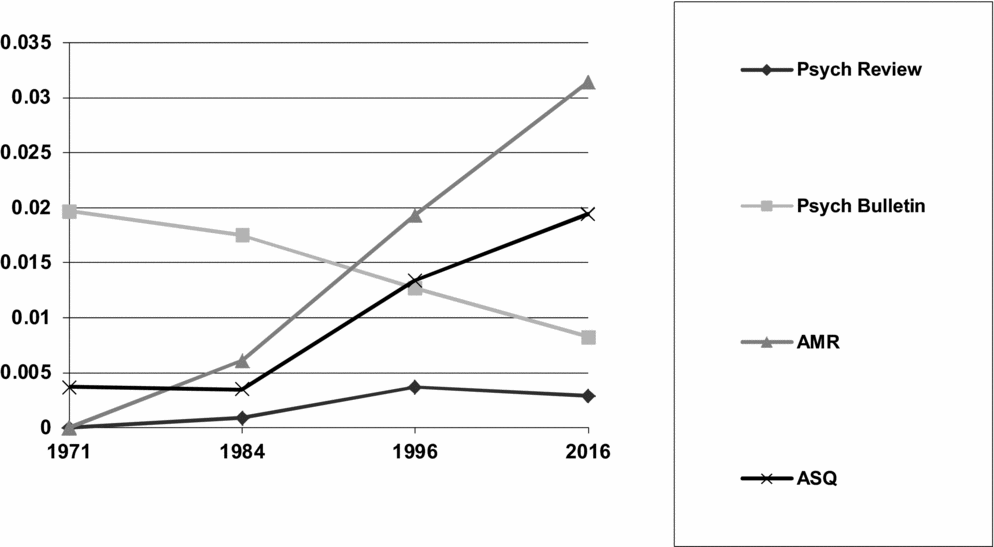
This disconnect with the basic psychology literature is troubling for several reasons. First off, our historical identity has been as psychologists. Although nostalgia for our field's roots may not be a justifiable reason by itself to maintain a strong connection to psychology, our respect for the psychological experimental tradition, as well as our field's strong penchant for individual differences measurement, have been two themes that have distinguished us from traditional management researchers. As more and more I-O psychologists migrate to business schools, the influence of these two themes has diminished and has been supplanted by more systems theory approaches. Highhouse and Zickar (Reference Highhouse and Zickar1997) illustrated that the citation of top business/management journals had increased in Personnel Psychology and Journal of Applied Psychology since 1971, whereas the citation from top general psychology journals had decreased; we suspect that the trend has continued since that time. To follow up that analysis, we analyzed the references of Personnel Psychology in 2016 and compared the results with our previous data. As can be seen in Figure 1, the percentage of articles cited in Personnel Psychology articles that are from Academy of Management Review and Administrative Science Quarterly has continued to grow, whereas the references to Psychological Bulletin articles have decreased and those in Psychological Review have remained still at a very low rate.
Figure 1.
Percent of citations by source personnel psychology.
Second, I-O psychology has benefitted immensely from our core connection to basic psychology. Throughout our history, many of the best ideas from I-O psychology have been influenced by connections to other areas of psychology. Pat Smith and Lorne Kendall's influential behaviorally anchored rating scales (BARS), for example, were inspired by work in developmental psychology (Smith & Kendall, Reference Smith and Kendall1963). Assessment centers and leadership theory were influenced by work on psychodrama and sociometry (Hooijberg & Choi, Reference Hooijberg and Choi2000). Our close connections to social psychology have influenced our research on topics as vast as team performance, job satisfaction, and organizational trust. As I-O psychologists lose connection to research being conducted by other areas of psychology, we miss out on important knowledge that can help advance our theories and practice. In addition, we avoid reinventing the wheel—discovering topics and ideas that have already been figured out by more basic psychologists. It could be argued that we are being overly negative and that, by being in business schools, I-O psychologists will be influenced by a new set of intellectual forces, which will help broaden the impact of our field. We agree that expanding our sources of inspirations can be a positive development, only as long as we maintain our strong connection to psychology. As our analysis of Personnel Psychology demonstrates, however, these new influences seem to be supplanting, not supplementing, our connections to psychology.
The economics driving I-O psychologists to business schools is likely to continue this migration into the future. Twenty years ago, we provided some suggestions on how I-O psychology programs could work to reduce the I-O psychology–psychology gap. These include fighting the trend to expand core content courses outside of psychology, including basic psychological journals into doctoral seminars, balancing the trend to include business-related competencies with competencies useful for psychology departments (e.g., grant writing training), and encouraging debates that question the core assumptions of our fields. Twenty years later these suggestions seem still important though unlikely to reduce the gap. We believe additional efforts should be focused on how to maintain strong connections between business school I-O psychologists and the discipline of psychology. These faculty should seek joint appointments with departments of psychology, chair and serve on theses and dissertations of psychology doctoral students, attend colloquia and psychology-focused conferences, and read on a regular basis psychology journals in basic areas. In addition, we are concerned that many of the traditional I-O psychology outlets have been taken over by business school scholars. We believe there is a market for new journals that affirm the importance of psychologically based research related to the context of work.
In closing, Aguinis et al. (Reference Aguinis, Ramani, Campbell, Bernal-Turnes, Drewry and Edgerton2017) use their analyses to reflect on some of the changes that have occurred in our field. Such handwringing about our identity seems to be part of our historical DNA as I-O psychologists. The trend to business schools is primarily caused by economic factors and may be a symptom of our success as I-O psychologists. As we express throughout this piece, however, we are troubled by the growing disconnect between I-O psychology and psychology in general. We believe that more connections with our mother discipline of psychology will benefit the field in the long term.




 You have
Access
Aguinis et al. (Reference Aguinis, Ramani, Campbell, Bernal-Turnes, Drewry and Edgerton2017) contribute interesting analyses of cited sources in contemporary undergraduate industrial-organizational (I-O) psychology textbooks and continue their ongoing investigation into the long-term viability of I-O psychology as a unique discipline (see Aguinis, Bradley, & Brodersen, 2014). These analyses, conducted by authors who are members of business schools, attempt to answer questions related to the nature of work conducted by I-O psychologists, comparing the quality and importance of work conducted by faculty in business schools with that conducted by faculty in psychology departments. One of their general themes is that members of business schools are conducting important research that is influencing the future of I-O psychology by overtaking undergraduate textbooks. As such, the article has the feel of a conquering hero taunting its vanquished foe.
Concerns about applied psychology's long-term viability are nearly as old as the field itself. Early applied psychologists had to fight with experimentalists like Titchenor and Boring to justify their professional existence (O'Donnell, Reference O'Donnell1979). Nearly 50 years ago, Lawler and colleagues held what might be the first symposium to discuss the impact of business schools on the future of I-O psychology (Lawler et al., Reference Lawler III, Cranny, Campbell, Schneider, MacKinney, Vroom and Carlson1971). In particular, they were concerned about the migration of I-O psychologists into business schools (which themselves were a relatively new phenomenon; see Friga, Bettis, & Sullivan, Reference Friga, Bettis and Sullivan2003): “Industrial-organizational psychology is moving to the business schools. Can it be maintained in psychology departments given the attractions business schools offer and its questionable standing there?” (Lawler et al., Reference Lawler III, Cranny, Campbell, Schneider, MacKinney, Vroom and Carlson1971, p. 21). Since that time, the extrinsic attractions of business schools have only grown. In the 2016 Society for Industrial and Organizational Psychology (SIOP) Income Survey, the median salary of SIOP members in business schools was $132,000 compared to $85,000 for psychology faculty members. For assistant professors, the mean salary of business school faculty was $113,263 compared to $70,947. These extrinsic motivations to leave psychology departments for business schools have long-lasting intellectual consequences for our field. Other incentives to leave psychology departments include less pressure to obtain external grants in business schools, as well as the avoidance intradepartmental battles, often between I-O and clinical psychology (though it should be noted that business schools are not immune to disciplinary battles, often with management programs competing with finance, strategy, and accounting for resources).
Twenty years ago, we expressed concern about what we perceived as the gap between I-O psychology and the basic discipline of psychology: the I-O psychology–psychology gap (Highhouse & Zickar, Reference Highhouse and Zickar1997). In the early days of I-O psychology, psychologists were given general training in psychology and often conducted research across a variety of different research topics (see Lowman, Kantor, & Perloff, Reference Lowman, Kantor, Perloff and Koppes2007). For example, I-O psychology pioneer Walter Dill Scott studied with Wilhelm Wundt and published articles on hypnotic suggestion, memory, and emotions in addition to his work on personnel selection and advertising. Psychology departments were smaller in the early days of psychology, and intradisciplinary lines were much fuzzier than they are now. As departments have grown in size and as the various subfields of psychology have grown, the ties between I-O psychology and other areas of psychology have become even more frayed. The migration of many I-O psychologists from departments of psychology to business schools exacerbates a problem that already existed. I-O psychologists in business schools do not have daily interactions with psychologists of other disciplines, and they are rewarded for publishing in management journals. As these people become the gatekeepers of research in I-O psychology journals, it is only natural that I-O psychology scholars begin to adapt their research efforts away from traditional I-O psychology topics toward topics of interest to managerial sciences—or, as some have suggested, toward pseudotheory (Cucina, Hayes, Walmsley, & Martin, Reference Cucina, Hayes, Walmsley and Martin2014).
In Aguinis et al.’s (Reference Aguinis, Ramani, Campbell, Bernal-Turnes, Drewry and Edgerton2017) analyses, only six out of the top 50 most-cited sources are psychology outside of the realm of I-O psychology, with only one of the top-ten journals fitting that category (Psychological Bulletin). In addition, although there are many people in the top 155 most-cited authors in I-O textbooks who got PhDs in general psychology or other types of psychology besides I-O psychology, most of these people conduct research nearly exclusively in the work psychology realm. For example, Filip Lievens received a PhD in general psychology and David Kravitz received one in social psychology, though nearly most of their research is conducted now within the realm of I-O psychology. Aguinis et al.’s analysis provides evidence that psychologists outside of I-O have little influence within I-O psychology textbooks, which is more evidence of the I-O psychology–psychology gap.
In one more alarming analysis in Aguinis et al. (Reference Aguinis, Ramani, Campbell, Bernal-Turnes, Drewry and Edgerton2017), the Academy of Management conference will likely soon overtake the SIOP conference in terms of the conference where the majority of most influential (as judged by their analysis) authors present. Although we do not have data on this conjecture, we believe that the number of other types of psychology conferences that SIOP members attend is decreasing. The number of I-O psychologists who attend the annual APA and APS conferences is quite small, as is attendance at other psychology-based conferences. Aguinis et al.’s conclusion that “Based on the knowledge summarized in I-O psychology textbooks, I-O psychology is much closer to business and management than social psychology and psychology in general” (Reference Aguinis, Ramani, Campbell, Bernal-Turnes, Drewry and Edgerton2017, p. 549) suggests that our 1997 predictions have been realized in 2017.
This disconnect with the basic psychology literature is troubling for several reasons. First off, our historical identity has been as psychologists. Although nostalgia for our field's roots may not be a justifiable reason by itself to maintain a strong connection to psychology, our respect for the psychological experimental tradition, as well as our field's strong penchant for individual differences measurement, have been two themes that have distinguished us from traditional management researchers. As more and more I-O psychologists migrate to business schools, the influence of these two themes has diminished and has been supplanted by more systems theory approaches. Highhouse and Zickar (Reference Highhouse and Zickar1997) illustrated that the citation of top business/management journals had increased in Personnel Psychology and Journal of Applied Psychology since 1971, whereas the citation from top general psychology journals had decreased; we suspect that the trend has continued since that time. To follow up that analysis, we analyzed the references of Personnel Psychology in 2016 and compared the results with our previous data. As can be seen in Figure 1, the percentage of articles cited in Personnel Psychology articles that are from Academy of Management Review and Administrative Science Quarterly has continued to grow, whereas the references to Psychological Bulletin articles have decreased and those in Psychological Review have remained still at a very low rate.
Percent of citations by source personnel psychology.
Second, I-O psychology has benefitted immensely from our core connection to basic psychology. Throughout our history, many of the best ideas from I-O psychology have been influenced by connections to other areas of psychology. Pat Smith and Lorne Kendall's influential behaviorally anchored rating scales (BARS), for example, were inspired by work in developmental psychology (Smith & Kendall, Reference Smith and Kendall1963). Assessment centers and leadership theory were influenced by work on psychodrama and sociometry (Hooijberg & Choi, Reference Hooijberg and Choi2000). Our close connections to social psychology have influenced our research on topics as vast as team performance, job satisfaction, and organizational trust. As I-O psychologists lose connection to research being conducted by other areas of psychology, we miss out on important knowledge that can help advance our theories and practice. In addition, we avoid reinventing the wheel—discovering topics and ideas that have already been figured out by more basic psychologists. It could be argued that we are being overly negative and that, by being in business schools, I-O psychologists will be influenced by a new set of intellectual forces, which will help broaden the impact of our field. We agree that expanding our sources of inspirations can be a positive development, only as long as we maintain our strong connection to psychology. As our analysis of Personnel Psychology demonstrates, however, these new influences seem to be supplanting, not supplementing, our connections to psychology.
The economics driving I-O psychologists to business schools is likely to continue this migration into the future. Twenty years ago, we provided some suggestions on how I-O psychology programs could work to reduce the I-O psychology–psychology gap. These include fighting the trend to expand core content courses outside of psychology, including basic psychological journals into doctoral seminars, balancing the trend to include business-related competencies with competencies useful for psychology departments (e.g., grant writing training), and encouraging debates that question the core assumptions of our fields. Twenty years later these suggestions seem still important though unlikely to reduce the gap. We believe additional efforts should be focused on how to maintain strong connections between business school I-O psychologists and the discipline of psychology. These faculty should seek joint appointments with departments of psychology, chair and serve on theses and dissertations of psychology doctoral students, attend colloquia and psychology-focused conferences, and read on a regular basis psychology journals in basic areas. In addition, we are concerned that many of the traditional I-O psychology outlets have been taken over by business school scholars. We believe there is a market for new journals that affirm the importance of psychologically based research related to the context of work.
In closing, Aguinis et al. (Reference Aguinis, Ramani, Campbell, Bernal-Turnes, Drewry and Edgerton2017) use their analyses to reflect on some of the changes that have occurred in our field. Such handwringing about our identity seems to be part of our historical DNA as I-O psychologists. The trend to business schools is primarily caused by economic factors and may be a symptom of our success as I-O psychologists. As we express throughout this piece, however, we are troubled by the growing disconnect between I-O psychology and psychology in general. We believe that more connections with our mother discipline of psychology will benefit the field in the long term.