INTRODUCTION
One of the most threatening recent developments to face hospitals is the emergence of carbapenemase-producing Enterobacteriaceae (CPE).Reference Nordmann, Dortet and Poirel 1 Nosocomial outbreaks of CPE are being reported with increasing frequency.Reference Canton, Akova and Carmeli 2 , Reference Nordmann, Naas and Poirel 3 Different types of CPE exist, including Enterobacteriaceae that produce Klebsiella pneumoniae carbapenemases (KPC),Reference Nordmann, Cuzon and Naas 4 which represent a major problem in short-stay hospitals and especially in long-term acute care hospitals (LTACHs).Reference Munoz-Price, Hayden and Lolans 5 – Reference Chitnis, Caruthers and Rao 8 There, vulnerable patients are in close proximity to each other and multidrug-resistant organisms can spread easily.Reference Munoz-Price 9
KPC was first identified in an isolate from North Carolina, United States, in 1996.Reference Nordmann, Cuzon and Naas 4 The first recognition of KPC in the Chicago region (Illinois, USA) occurred in 2007 and since then, numbers have been rising. A point-prevalence survey in 24 acute-care hospitals and 7 LTACHs in 2011 showed that 3.3% of adult patients in short-stay hospital intensive care units (ICUs) and 30.4% of LTACH residents were colonized with KPC.Reference Lin, Lyles-Banks and Lolans 10
LTACHs are assumed to be a driving force behind the KPC epidemic due to high prevalence, high transmission rates, and patient movement between facilities.Reference Won, Munoz-Price, Lolans, Hota, Weinstein and Hayden 7 , Reference Prabaker, Lin and McNally 11 – Reference Schechner, Kotlovsky and Tarabeia 13 The potential for the regional spread of antibiotic resistance has been demonstrated extensively.Reference Donker, Wallinga, Slack and Grundmann 14 – Reference Smith, Dushoff, Perencevich, Harris and Levin 17 Several studies have incorporated patient movement in models of infectious disease spread, ie, for pathogens such as Clostridium difficile,Reference Huang, Avery and Song 18 methicillin-resistant Staphylococcus aureus (MRSA),Reference Lee, Bartsch and Wong 16 , Reference Barnes, Harris, Golden, Wasil and Furuno 19 – Reference Lee, Bartsch and Wong 21 and vancomycin-resistant enterococci.Reference Lee, Yilmaz and Wong 22 No model is available for the spread of KPCs in LTACHs. Furthermore, the optimal strategy to contain the spread of Gram-negative bacteria, including KPCs, in LTACHs is unknown.Reference Ben-David, Masarwa and Navon-Venezia 12 , Reference Domenech de, Zahar, Abadie and Guillemot 23
Therefore, we investigated the epidemiology of KPCs in 4 different LTACHs participating in a bundled KPC control intervention in the Chicago region.Reference Hayden, Lin and Lolans 24 We used advanced modeling to explicitly fill in missing data (eg, missed swabs), estimate testing characteristics (eg, imperfect sensitivity of rectal cultures for KPC), determine the transmission capacity of KPC, and quantify the effect of patient cohorting on transmission within these 4 LTACHs.
METHODS
Data
This analysis was performed on data collected from 4 LTACHs in the Chicago region between June 11, 2012 (or June 1 in 1 LTACH), and June 30, 2013, a time within the original study period during which complete data regarding patient room occupancy were available. All patients admitted were included. During this period, a bundled intervention was implemented in all 4 LTACHs that consisted of screening all patients for KPC on admission, every-other-week point-prevalence surveys, bathing all LTACH patients daily with 2% chlorhexidine gluconate (CHG) cloths (Sage Products, Cary, IL), education of medical staff on KPC and infection prevention, and adherence monitoring that focused on hand hygiene.Reference Hayden, Lin and Lolans 24
In addition, cohorting strategies were implemented. Ideally, 1 floor was to be a cohort floor where KPC-positive patients would be cared for by cohorted staff. This was done at LTACH D. For logistical reasons, this was not feasible at the other LTACHs, where the cohorting strategies were locally modified. At LTACH B, all KPC-carriers were treated in single rooms without staff cohorting. LTACHs A and C had mixed-cohort floors, ie, the majority of patients were KPC-positive but KPC-negative patients were also housed on the cohort floor and were cared for by the same staff. Previously identified KPC carriers were not screened upon readmission but were placed directly in single rooms or on a cohort floor.
The study was reviewed and approved by the institutional review board of Rush University Medical Center and granted expedited review.
Microbiology
KPC carriage status was determined from microbiological cultures of rectal swabs, obtained on admission and during point-prevalence surveys conducted every other week. These screening cultures were included in the current analysis. Samples were screened using an ertapenem disk method in a central laboratory; bla KPC was confirmed by polymerase chain reaction (PCR).Reference Cole, Schuetz, Hill and Nolte 25 – Reference Mangold, Santiano and Broekman 27 In line with the study protocol, patients previously identified as KPC-positive were excluded from screening.
Clinical cultures were ordered as needed by treating physicians, and samples yielding carbapenem-resistant Klebsiella spp. or Escherichia coli were used in the sensitivity analysis. Clinical cultures were considered positive for KPC if a Klebsiella spp. or an E. coli isolate was isolated that displayed intermediate susceptibility or resistance to imipenem. This approach was validated in the original analysis.Reference Hayden, Lin and Lolans 24
Markov Model
A Markov model was used to describe KPC transmission. Patients were assumed to be either colonized with KPC or susceptible to colonization. The rate of transition from susceptible to colonized was dependent on the number of colonized patients on the floorReference Bonten 28 and was defined by α + β * I/N, where α is the background transmission rate, β is the patient-dependent transmission rate, I is the number of colonized patients present, and N is the total number of patients in the unit (I/N=fraction of colonized patients on the unit, or colonization pressure). In β, all transmissions were included that were dependent on the colonization pressure on the floor. This rate could include transmission from colonized to susceptible patients (either directly or through the contaminated hands of HCW) and transmission from the environment when this was dependent on the colonization pressure. All other transmissions were accounted for in α, eg, the endogenous route and transmission from the environment independent of the colonization pressure on the floor (including transmission from HCWs moving between floors). The endogenous route represents bacteria that were already present in the host at undetectable levels and that presumably reached detectable levels under antibiotic pressure. KPC carriers were assumed to remain colonized during their entire stay in the LTACH. We assumed that the test specificity for KPC detection was 100% and no distinction was made between different species of Enterobacteriaceae.
As patients were not cultured every day and culture results might have been falsely negative, the exact number of colonized patients was unknown. Therefore, a Bayesian framework using a data-augmented Markov chain Monte Carlo (MCMC) method with Metropolis-Hastings algorithm was developed, taking unobserved colonization and colonization times into account, analogous to the method used by Worby et al.Reference Worby, Jeyaratnam and Robotham 29 We also estimated the probability of a patient being a KPC carrier on admission (f) and the sensitivity of the screening process (ϕ), which included the swabbing technique, transportation and storage of swabs, culture method, and accuracy of the bla KPC PCR assay (details are provided in Online Appendix A).
Nurses generally were assigned to 1 floor. Therefore, every LTACH-floor was considered a distinct unit in which transmission could occur. The high acuity units (wards that cared for patients with higher-level medical or nursing needs) were physically separated from the general floors and had a distinct nursing team; therefore, these were considered separate units. In 2 LTACHs (B and D), 1 floor was divided into 2 separate units because they were separated both physically and in terms of nurse assignment. Each admission was considered a new admission if the patient had left the facility for at least 1 day, and the culture results obtained during previous admissions were not taken into account in the current analysis.
A total of 1,000,000 iterations of the algorithm were run per LTACH. To account for the burn-in time, the first 20% of the iterations were not used for calculation of parameter estimates. Plots of convergence of the parameter estimates were inspected visually, and the Geweke diagnostic was calculated for all chains. To calculate summary measures for all LTACHs, a meta-analysis using a random-effects model was performed.Reference Borenstein, Hedges and Rothstein 30 , Reference Neyeloff, Fuchs and Moreira 31 A natural logarithm transformation was performed for α and β to normalize distributions. To investigate the effects of cohorting, numbers of acquisitions per 1,000 patient days at risk were calculated for non-cohort and cohort floors. In addition, absolute numbers of acquisitions per LTACH were estimated. These numbers were then converted to numbers of acquisitions per 1,000 patient days to facilitate comparisons between LTACHs and the effects of different cohorting strategies. A weighted least-squares regression analysis was performed to relate differences in study protocol adherence to numbers of acquisitions. Effects on parameter estimates of clinical cultures that yielded KPC were evaluated in a sensitivity analysis. We also analyzed the data using the assumption from the original study that patients remained colonized for the remainder of the study duration once they had tested positive. To that end, we created a new dataset in which positive cultures were added on the day of admission for patients who had previously tested positive.
The algorithm for the parameter estimates was written in C++, the meta-analysis was done in Microsoft Office Excel 2010, convergence diagnostics were done in R, and the regression was performed in SPSS 21 (IBM, Armonk, NY).
RESULTS
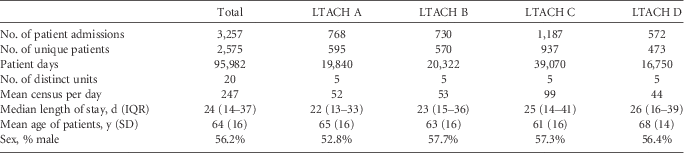
The current analysis included 95,982 patient days and 3,257 admissions of 2,575 unique patients, with comparable patient mix among LTACHs (Table 1).
Patient and Admission Characteristics

NOTE. LTACH, long-term acute care hospital; IQR, interquartile range; SD, standard deviation.
A total of 7,250 cultures were obtained (6,757 surveillance cultures and 493 clinical cultures). The median number of cultures per admission was 2 (range, 0–28), and KPC was detected in 761 cultures (11.3%). Of positive isolates, 90% were K. pneumoniae, 5% were E. coli, 3% were Enterobacter aerogenes, and 2% were other Enterobacteriaceae species. Rates of adherence to cohorting (represented as the proportion of positive patients on cohort floors or in single rooms) were 88% in LTACH A, 97% in LTACH B, 91% in LTACH C, and 99% in LTACH D.
MCMC Model
Pooled and individual parameter value estimates from the model are presented in Table 2 and Online Figure S1. For individual LTACHs, 95% credible intervals largely overlap. Trace plots of all chains were inspected and seemed stable. All chains had a Geweke diagnostic (z-value) below 2 and were considered converged.
Parameter Values of the Original Model

NOTE. LTACH, long-term acute care hospital; 95% CrI, 95% credible interval.
a Mean and 95% confidence interval instead of median and 95% credible interval.
b Values after transformation back to the original scale.
c Including the swabbing process, transportation and storage of swabs, culture method, and accuracy of the bla KPC PCR assay.
The estimated sensitivity of the screening process was 81%. The per-admission reproduction number R A , which is the average number of KPC transmissions caused by 1 KPC-positive patient during a single admission,Reference Diekmann, Heesterbeek and Britton 32 , Reference Cooper, Medley and Stone 33 can be approximated by multiplying the transmission parameter β (0.0136) by the mean length of stay (29.5 days), which yields a value of 0.40. The relative importance of patient-to-patient transmission compared to background transmission can be calculated as β * mean prevalence/(β * mean prevalence + α). With an overall mean prevalence of 29.3% as calculated by the model, we estimate that 60.9% of the acquisitions resulted from patient-to-patient transmission and that the remaining 39.1% resulted from background transmission.
Calculated acquisitions per 1,000 patient days at risk, absolute numbers of acquisitions per month, and acquisitions per 1,000 patient days are depicted in Table 3. When comparing these to the numbers reported in the original study, the model predicts more acquisitions than were observed.Reference Hayden, Lin and Lolans 24
bla KPC-Encoding Enterobacteriaceae (KPC) Acquisitions in the Original Model

NOTE. LTACH, long-term acute care hospital; 95% CrI, 95% credible interval
a LTACHs A + C: non-cohort floors and mixed cohort floors, LTACH B: single rooms for positive patients, LTACH D: non-cohort floors and pure cohort floors
b Only patients at risk for colonization (excluding patients positive for KPC)
c A subset of actual numbers found in the original study,Reference Hayden, Lin and Lolans 24 only definite transmissions (excluding patients that missed their admission swab but had a positive screening culture at follow-up).
LTACHs B and D had the lowest number of acquisitions per 1,000 patient days, while LTACHs A and C had higher rates. The strategies adopted at LTACHs B (single-room isolation) and LTACH D (a strict cohort floor for colonized patients) or the implementation of the infection control bundle at these locations were more effective in reducing KPC cross transmission than the strategies implemented at LTACHs A and C.
The weighted least-squares regression analysis showed a negative association between adherence to cohorting (mean percentage of KPC-positive patients on cohort floors or in single rooms) and the number of acquisitions per 1,000 patient days at risk. Adherence to collection of admission swabs, every-other-week surveillance swabs, hand hygiene, the quantity of CHG cloths ordered per patient per month, or patient-related variables (eg, length of stay, age, gender) were not significantly associated with the number of acquisitions (Online Appendix B).
Sensitivity Analysis
When positive clinical cultures for KPC were added, parameter estimates remained largely unchanged (Online Appendix C, Table S1). When (artificial) positive cultures for previously known carriers were added (Online Appendix C, Table S2), the estimates for the transmission parameters were lower, whereas the probability to be positive on admission was higher than in the main analysis.
DISCUSSION
The results of this study show that in 4 LTACHs with high endemic prevalence of KPC, the per admission reproduction number, R A , was 0.40. This value indicates that patient-to-patient transmission of KPC during a single admission is not enough to maintain endemicity in a setting with daily chlorhexidine bathing, staff education, and cohorting. Admissions of colonized patients and endogenous selection conserve the transmission cycle of KPC. These findings strongly suggest that the admission of colonized patients is a main driver of the KPC epidemic in these LTACHs.
In the current study, different units were regarded as separate entities, but spillover between units was likely. For example, nurses may have taken over shifts on other floors, and other staff, such as doctors and physiotherapists, visited patients on all units and may have contributed to the spread of KPC. This possibility was captured in the parameter α, together with endogenous selection. The latter may occur when a patient is colonized with KPC at undetectable levels on admission and these bacteria grow to detectable levels during the patient’s LTACH stay. The relevance of this mechanism has also been demonstrated for extended-spectrum β-lactamase–producing bacteria.Reference Domenech de, Zahar, Abadie and Guillemot 23
Different parameter estimates for the 4 LTACHs may have arisen from inherent differences between them, eg, differences in size and referral patterns. The cohorting strategy should not have influenced the transmission parameters. Cohorting reduces the number of contacts between colonized and uncolonized patients, possibly mediated by healthcare workers, but the transmission probability given a contact between a colonized and an uncolonized patient is not mediated by cohorting. Only if adherence to the infection prevention bundle was higher in cohort wards than in non-cohort wards would cohorting have had a direct influence on transmission parameters. Therefore, we considered the number of acquisitions per 1,000 patient days to judge the cohorting effect. LTACHs B and D had the lowest numbers of acquisitions per 1,000 patient days, suggesting that their strategies were superior to the strategy of mixed-cohort floors, as adopted at LTACHs A and C. However, 95% credible intervals of parameters for the 4 LTACHs overlapped, precluding firm conclusions. The regression analysis indicated that the higher the adherence to cohorting, the lower the number of acquisitions. This result is another indication that separating KPC-positive from KPC-negative patients is a good control strategy for containing the spread of KPC.Reference Chitnis, Caruthers and Rao 8 , 34 However, confounding factors such as differences between LTACHs in hand hygiene compliance or case mix may still have played a role. A similar result was found by Ben-David et al.Reference Ben-David, Masarwa, Adler, Mishali, Carmeli and Schwaber 35 In their univariate analysis, lower adherence to placement of colonized patients in single rooms or cohorting was a risk factor for newly discovered CPE carriage in a long-term care facility. Creating a cohort for KPC control is intuitively attractive but can be difficult in practice. Our data provide an important demonstration of the potential benefit that can be weighted against the effort needed to maintain the cohort. Although this benefit might be explained by physical separation of positive and negative patients, it may also be related to nurse cohorting, optimal bathing technique, and more attention to hand hygiene.
The finding that the estimates for swab sensitivity for all 4 LTACHs were similar and that all 95% credible intervals overlapped may reflect the fact that all swabs were analyzed in a central laboratory. There do not seem to be major differences among LTACHs in swabbing techniques used.
There were differences between the number of acquisitions predicted by the model and the crude data, as observed in the epidemiological study.Reference Hayden, Lin and Lolans 24 These differences can be partially explained by the sensitivity of KPC screening that is taken into account in the MCMC model. Because specificity was assumed to be 100%, model estimates for the number of acquisitions should be equal to or higher than study counts. Furthermore, in the MCMC model, cultures from previous admissions were ignored and patients who were considered KPC-positive on admission in the epidemiological study might have acquired KPC carriage in the model. Because patients may lose colonization between discharge and readmission, assuming patients are still positive on admission leads to overestimation of the prevalence of colonization on admission. Because no information was available on colonization status during previous LTACH visits before the start of the study, we had incomplete data on previous colonization status. Therefore, our main model, which allows for colonization on admission, is most likely more accurate. Finally, no samples were obtained from some patients. These missing data were taken into account in the MCMC model. The sensitivity analyses demonstrated the robustness of the model estimates.
Although we are not aware of similar studies in LTACHs, Worby et alReference Worby, Jeyaratnam and Robotham 29 used a similar method to estimate transmission parameters of MRSA in 10 general hospital wards in the United Kingdom. Naturally, differences in setting and pathogen characteristics preclude direct comparisons of study results. However, estimates for α and β, as obtained for KPC in LTACHs, were at least 10 times higher than those of MRSA in general hospital wards. This result might reflect the fact that more severely ill patients needing more intensive treatment, creating more opportunities for the spread of pathogens, are treated in LTACHs. But this result may also indicate that KPC has a higher transmission capacity than MRSA.
This study has several limitations. Data were collected during a bundled intervention, and awareness of KPC and enforcement of hand hygiene were heightened in this environment. Therefore, values of transmission parameters may be underestimated but reflect achievable control parameters. Also, individual effects of separate elements of the bundle are difficult to distinguish. Due to the small number of regression points, no multivariable regression was possible.
In conclusion, in LTACHs with a high endemicity of KPC carriers, patient-to-patient transmission is insufficient to maintain endemicity. Instead, high admission prevalence appears to be the main factor driving endemicity. In such settings, during active strategies to prevent colonization and infection with KPC, cohorting of KPC carriers on separate floors or in single rooms seems beneficial. Prospective comparative studies are needed to quantify the benefits of different strategies.
Acknowledgments
Financial support. This work was supported by the Netherlands Organization of Scientific Research (VICI NWO grant no 918.76.611 to MJMB and Priority Medicines Antimicrobial Resistance grant no. 205100013 to MRH and MCJB), by funding from the European Community (RGNOSIS Integrated project [FP7/2007-2013] under grant no. 282512 to MCJB and MJMB), by the U.S. Centers for Disease Control and Prevention (grant no. U54CK000161 to RAW and grant no. 200-2011-M-41103 to MKH), by funding from a Fulbright Scholarship to MRH, and by an unrestricted gift from the Foglia Family Foundation to RAW.
Potential conflicts of interest. All authors report no conflicts of interest relevant to this article.
SUPPLEMENTARY MATERIAL
To view Supplementary Materials for this article, please visit http://dx.doi.org/10.1017/ice.2015.163