Introduction
The Wombat Hole prospect in northeastern Victoria, Australia, was discovered during regional mapping in the 1970s by Essex Minerals, and named from a small green rock found at the entrance of a wombat burrow in the steep southwestern flank of the Morass Creek gorge (Cuffley, Reference Cuffley1980, Reference Cuffley1982). Subsequent field collecting and investigation by the authors has shown that the prospect consists mainly of altered primary bornite hosted by a grossular‒vesuvianite skarn. What initially appeared to be a simple supergene assemblage of chrysocolla with minor azurite and malachite, has been shown to be a complex array of unusual secondary bismuth minerals, including the phosphate mrázekite; the vanadates namibite, pucherite and schumacherite; the silicate eulytine and the carbonate bismutite (Birch et al., Reference Birch, Henry and Pring1995). Further investigation of the unaltered bornite revealed an assemblage of exsolution phases and inclusions such as chalcopyrite, wittichenite and the Bi‒Te‒(S) minerals joséite-A, hedleyite, sulphotsumoite and native bismuth. In this paper, the authors aim to characterise the primary ore mineral suite and estimate the conditions under which it formed, including the timing and origin of the hydrothermal fluids. We also examine the relationship between the primary mineralisation and the unusual assemblage of secondary bismuth-bearing minerals, thereby providing evidence for the mobility of bismuth and tellurium over short distances during weathering. No equivalent or similar Cu‒Bi‒Te deposit is currently known from elsewhere in southeastern Australia.
Regional geology
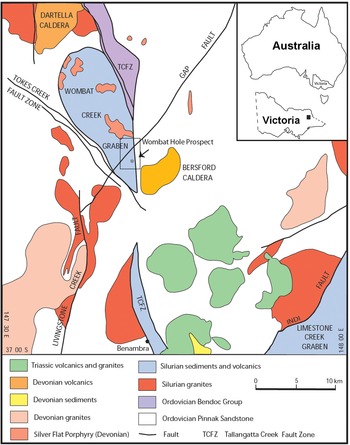
The limestone lens hosting the Wombat Hole exoskarn is one of a number occurring in the Upper Silurian Wombat Creek Graben, a relatively small but deep extensional basin exposed in northeastern Victoria (Fig. 1). The graben contains deformed Silurian volcanics – the Mitta Mitta Rhyolite (~2 km thick) – overlain nonconformably by the Late Silurian Wombat Creek Group (WCG). The WCG is subdivided into three formations, beginning with the Undowah Siltstone (150–200 m) nonconformably overlying the Mitta Mitta Rhyolite and overlain conformably by the Toaks Creek Conglomerate (up to 1400 m). The uppermost Gibbo River Formation lies conformably on, and interfingers laterally with, the Toaks Creek Conglomerate. Deposition in the three formations occurred under marine to subaerial and fluvial environments (VandenBerg et al., Reference VandenBerg, Hendrickx, Willman, Margart, Simons and Ryan1998; VandenBerg, Reference VandenBerg, Willman, Maher, Simons, Cayley, Taylor, Morand, Moore and Radojkovic2000). The Wombat Creek Graben was deformed during the Bindian Deformation at the end of the Silurian, with the entire sequence tilted to the west and truncated by a series of complex faults (VandenBerg et al., Reference VandenBerg, Hendrickx, Willman, Margart, Simons and Ryan1998; VandenBerg, Reference VandenBerg and Birch2003).
Simplified geological map of the Benambra region (revised and adapted from VandenBerg et al., Reference VandenBerg, Hendrickx, Willman, Margart, Simons and Ryan1998). The location of the Wombat Hole prospect is marked within the rectangle showing Fig. 2.

Limestone lenses occur throughout the three formations in the WCG and vary from 1500 m in length and 150 m thick to a few metres or less (VandenBerg et al., Reference VandenBerg, Hendrickx, Willman, Margart, Simons and Ryan1998). Many of the limestones were mapped by H.S. Whitelaw prior to 1913, but it wasn't until 1954 that his descriptions and detailed maps were published (Whitelaw, Reference Whitelaw1954). The limestone hosting the Wombat Creek skarn does not appear on any of his maps, but it appears likely to be a southerly extension of the deposit he mapped at the junction of Morass Creek and the Gibbo River. This limestone was named the Silver Flat lens by VandenBerg et al. (Reference VandenBerg, Hendrickx, Willman, Margart, Simons and Ryan1998), whereas the lens containing the skarn was named the ‘Basalt’ lens, and is probably hosted by the Undowah Siltstone. The limestones are generally free of terrigenous material and have been interpreted by VandenBerg et al. (Reference VandenBerg, Hendrickx, Willman, Margart, Simons and Ryan1998) as megaclasts shed from a stable shelf outside the rift, though Talent et al. (Reference Talent, Simpson, Molloy and Mawson2005) suggested they are a mix of allochthonous and autochthonous origins. Conodonts and macrofossils in the limestones provide ages ranging from Early to Late Silurian (Talent et al., Reference Talent, Simpson, Molloy and Mawson2005).
Intrusions
Porphyritic granite was observed by Cuffley (Reference Cuffley1980) in a narrow window exposed beneath the basalt in the floor of Morass Creek. This was interpreted at the time as Triassic in age, by analogy with other similar intrusions in the region (see Fig. 1). However, more extensive bodies of porphyry intruding the WCG sediments were mapped by VandenBerg et al. (Reference VandenBerg, Hendrickx, Willman, Margart, Simons and Ryan1998) and named the Silver Flat Porphyry. The porphyry bodies are composed of phenocrysts of feldspar and quartz up to 3 mm across in a fine-grained groundmass. An Upper Silurian to Lower Devonian age has been attributed to the intrusions based on their setting, rather than on an erroneous Ordovician U/Pb age (VandenBerg et al., Reference VandenBerg, Hendrickx, Willman, Margart, Simons and Ryan1998; VandenBerg, pers. comm.).
Mineralisation
Epigenetic base-metal mineralisation occurs in the limestone lenses throughout the WCG and includes silver-bearing galena, chalcopyrite, bornite and pyrite with minor sphalerite and baryte. Some lenses in the Mitta Mitta and Gibbo River area, north of Benambra, were mined for copper, lead and silver on a small scale in the 19th century (Whitelaw, Reference Whitelaw1954; Cochrane, Reference Cochrane1982). Limited exploration has been undertaken by mining companies in the 1980s and 1990s.
Wombat Hole prospect
Setting
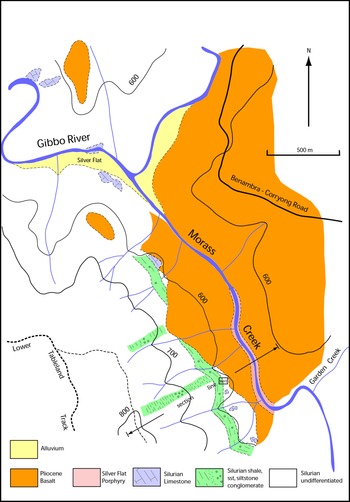
The Wombat Hole prospect is exposed in the southwestern side of the gorge of Morass Creek (36°46'26"S, 147°41'38" E) (Fig. 2), which provides a window into the southern part of the WCG sequence. Morass Creek has formed as a lateral stream along voluminous olivine basalt flows dated at 2.3 Ma (Late Pliocene) (Wellman, Reference Wellman1974), which filled a pre-existing valley. No eruption point has been identified, but the basalts flowed northwards for 30 km into Morass Creek then into the Mitta Mitta river, reaching a maximum thickness of 250 metres. Exposures in the gorge are poor, however a few outcrops of limestone have been located (Cuffley, Reference Cuffley1980) (Fig. 2). The Wombat Hole prospect is situated in the southern-most outcrop of the so-called ‘Basalt’ limestone lens, which has been metamorphosed to a dense granular aggregate of garnet and minor vesuvianite.
Geological fact map of the Morass Creek gorge containing the Wombat Hole prospect (adapted from Cuffley, Reference Cuffley1980).

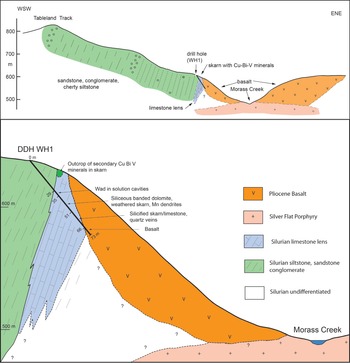
The exposure of the mineralised portion of the skarn is only a few metres across at the top of the limestone lens below an outlier and scree slope of basalt filling the gorge (Fig. 3). Above the skarn is a hard porcellaneous cherty siltstone band, which is associated closely with other limestones in the gorge area (Cuffley, Reference Cuffley1980). Limited trenching by Essex Minerals revealed irregular karst topography under a scree of basalt and chert (Cuffley, Reference Cuffley1980). The steep terrain posed difficulties with drilling and only one hole penetrated the skarn zone, but without encountering mineralisation (Fig. 3). The first 29 metres of the drill hole were in chert. Skarn and limestone persisted for 35.5 metres after which the drill encountered basalt, which was presumed to be infilling a sinkhole in pre-Tertiary karst topography. The drilling did not continue to the underlying porphyry and no core has been preserved (A. Olshina, pers. comm. 2004). Assays of a grab sample of surface material gave values of up to 10 ounces Ag and 1.2 ounces of Au per tonne (Cuffley, Reference Cuffley1980).
Cross sections of the Morass Creek gorge through the Wombat Hole prospect and details of the drill-hole data (composed from data in Cuffley, Reference Cuffley1980). Upper section is ~1300 m across.

Mineralogy
Methods
Electron microprobe analysis was used to characterise as many of the skarn minerals as possible. Compositions of silicate minerals were determined using a Cameca SX50 microprobe, operating at 15 kV and 0.2 μA. Standards used were periclase (Mg), corundum (Al), hematite (Fe), wollastonite (Si and Ca), manganese metal (Mn), rutile (Ti), jadeite (Na), synthetic K-tantalite (K), strontianite (Sr), vanadium metal (V), fluorite (F) and halite (Cl). The same equipment operating under the same conditions was used to analyse ore minerals, with standards being bismuth metal (Bi), arsenopyrite (As), galena (Pb), gold metal (Au), silver metal (Ag), copper metal (Cu), troilite (S and Fe), selenium metal (Se) and tellurium metal (Te). Energy dispersive X-ray spectroscopy was used to qualitatively identify some very small phases. Analytical systems with fewer elements were used for some of the supergene species. Back-scattered electron images were obtained using a JOEL Superprobe.
Skarn features
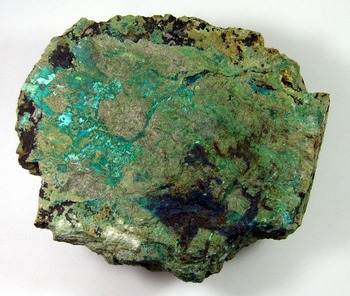
The most extensively mineralised and conspicuous material in the Wombat Hole occurrence consists of a compact, fractured mass of fine-grained garnet irregularly veined by bright blue‒green chrysocolla (Fig. 4). In places there are irregular dark purplish brown patches of altered sulfide up to ~5 cm across containing islands of remnant bornite. In more weathered sections, black iron-manganese oxy-hydroxides form thin coatings on fractures in the chrysocolla.
Typical sample of mineralised Wombat Hole skarn, showing pervasive chrysocolla veining through the fractured garnet-rich host. Dark patches are copper silicate surrounding remnant bornite islands. Museums Victoria specimen E14182, 23 × 20 cm. Photograph by WDB.

Skarn silicates
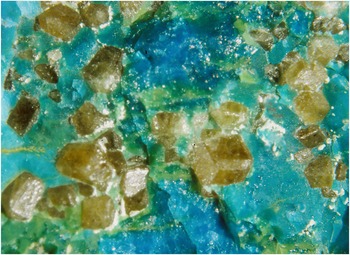
The garnets making up the bulk of the skarn are pale brownish, granular to subhedral and up to 1 mm across. In thin section they are isotropic and unzoned. In places, larger euhedral brownish yellow garnets up to 2 mm occur along the margins of chrysocolla veins. Aggregates of garnets enclosed in the chrysocolla suggest detachment from fracture margins during the emplacement of the chrysocolla (Fig. 5). In thin-section these garnets are distinctly anisotropic, showing anomalous birefringence, with sector-twinning and zoning evident. Microprobe analysis shows compositions mainly in the grossular field (Gr78And22‒Gr45And55) (Table 1). The rims of the larger, anisotropic crystals are slightly enriched in Fe compared to the cores, however there is no evidence for retrograde overprinting. Minor amounts of vanadium (<0.1 wt %) were detected in some analyses.
Grossular‒andradite garnets enclosed in chrysocolla. Image is 6 mm across. Museums Victoria specimen M43557. Photograph by Frank Coffa.

Silicate minerals in the Morass Creek skarn.

Vesuvianite forms pale brown, prismatic crystals and fibrous sheaf-like clusters up to 2 mm across within the garnet host. It also occurs as transparent darker brown crystals up to 3 mm long that have been fractured and randomly orientated and embedded in chrysocolla (Fig. 6). In this respect, they resemble the occurrence of the larger garnets, having also been detached from vein margins by the invasion of chrysocolla. Microprobe analysis (Table 1) yielded an ideal formula for boron-free vesuvianite calculated on the basis of 50 cations, according to the method of Groat et al. (Reference Groat, Hawthorne and Ercit1992).
Disaggregated vesuvianite crystals (brown prismatic) in chrysocolla. Note the pale green patches across the centre of the image; these are an amorphous bismuth oxide containing small amounts of V and Te (see text). The image is 6 mm across. Museums Victoria specimen M43563. Photograph by Oskar Lindenmayer.

Sporadic small sub-rounded and prismatic grains of diopside are associated with garnet. The diopside is compositionally uniform with Mg/(Fe+Mg) values in the range 0.82–0.86 (Table 1). Clinozoisite and tremolite were mentioned by Cuffley (Reference Cuffley1980) as occurring in the skarn. However, these have not been identified in this study and it may be possible that the fibrous sheaf-like vesuvianite was misidentified in thin-section.
Hypogene ore mineralogy
Bornite and exsolution phases
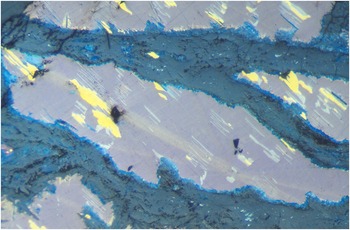
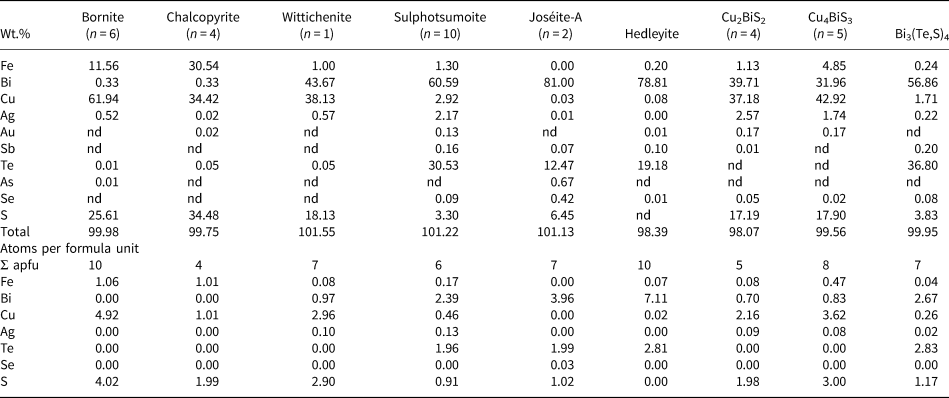
The remnant patches of bornite (Cu5FeS4) are up to 1‒2 cm across. Analyses show it to be stoichiometric, with traces of Bi (<0.4%) and Ag (<0.6%), negligible Te and no measurable Au (Table 2). Polished sections reveal abundant lamellae of wittichenite (Cu3BiS3) up to 50 μm long and showing strong preferred orientation, indicating structural control of its exsolution from the bornite (Figs 7 and 8a). Compositions are within the range recorded from other localities (e.g. Cook and Ciobanu, Reference Cook and Ciobanu2003; McQueen and Larson, Reference McQueen and Larson1985; Anthony et al., Reference Anthony, Bideaux, Bladh and Nichols1990). Chalcopyrite (CuFeS2) forms oriented blebs and lamellae up to 0.3 mm long (Fig. 7). It is stoichiometric and contains no detectable Bi, Au or Ag (Table 2). Both wittichenite and chalcopyrite are interpreted as due to high-temperature exsolution from bornite, although it is difficult to determine which exsolved first on the basis of textural evidence.
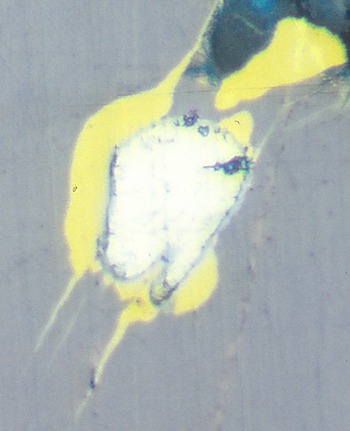
Reflected light image of polished section of primary bornite, showing oriented exsolution phases; grey rods of wittichenite with yellow chalcopyrite. Note alteration fringes of blue covellite. Smaller bright inclusions are telluride inclusions. Image is 2 mm across.

Ore minerals in the Morass Creek skarn.

‘nd’ – not determined
Bismuth metal, sulfides and tellurides as inclusions
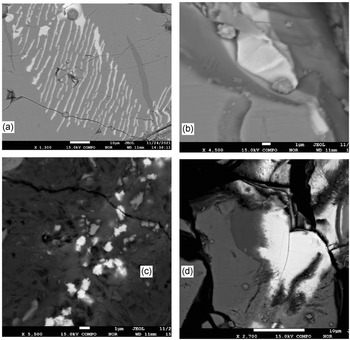
Also present in the bornite are various inclusions of Bi-bearing phases (Fig. 8), ranging in size between 1 and 20 μm. The smallest inclusions detected are grains of native bismuth possibly containing traces of copper (Fig. 8c,d). Many of the grains show an unusual feather-edge margin, suggesting they have been partly altered. In the case of Bi‒Te phases, as a general rule it is difficult to positively identify tellurium-bearing species without X-ray diffraction; this technique was not possible due to the very small grain size of the observed inclusions. Tetradymite-group species commonly exhibit non-stoichiometry arising from stacking disorder, as well as extensive solid solution (Cook et al., Reference Cook, Ciobanu, Wagner and Stanley2007; Cook and Ciobanu, Reference Cook and Ciobanu2003; Ciobanu et al., Reference Ciobanu, Slattery, Cook, Wade and Ehrig2021). However, from plotting microprobe analyses and by comparisons with other analyses it has been possible to assume the identity of the more common inclusions in the bornite.
The most common telluride mineral observed is sulphotsumoite (Bi3Te2S). The blocky nature of these crystals suggests they are inclusions trapped in the bornite rather than having been exsolved from it (Fig. 9). S/(S+Te) ratios range from 0.29 to 0.37, and up to 5 wt.% copper and 1.9 wt.% Fe were detected, although it's possible these might be artefacts from adjacent phases or minute inclusions. Grains of joséite-A (Bi4TeS2) and hedleyite (Bi7Te3) were also identified. The formulae for the tetradymite-group phases were calculated according to the method of Ciobanu et al. ( Reference Ciobanu, Birch, Cook, Pring and Grundler2010) (see Table 2). The formula for hedleyite is not stoichiometric, with the number of Bi atoms in the ideal formula unit being 7.6 on the basis of Te = 3. Such deviation is commonly observed for hedleyite (Ciobanu et al., Reference Ciobanu, Birch, Cook, Pring and Grundler2010), wheras other distinct related phases, such as Bi8Te3, have been recorded in the tetradymite homologous series (Ciobanu et al., Reference Ciobanu, Slattery, Cook, Wade and Ehrig2021). A phase with a formula close to Bi3(Te,S)4, and a copper–silver telluride were also analysed (Table 2). Unidentified Bi‒Te grains up to 50 μm were also observed in the garnets. More detailed work is required to determine the full suite of Bi‒Te phases. Several other unnamed phases with formulae close to Cu2BiS2 (Figs 8b and 10) and Cu4BiS3 were also detected during analysis (see Table 2). These formulae are based on multiple analyses from distinct grains which showed no evidence for submicrometre mixtures or contamination from other phases.
Back-scattered electron images of some phases in bornite. (a) Cluster of wittichenite lamellae (white scale bar is 10 μm); (b) Cu–Bi–S phase (probably Cu2BiS2), 10 μm long, in bornite; (c) native bismuth (white) in bornite; note feathered margins to grain (white scale bar is 10 μm); and (d) chain of native bismuth grains (~1 μm) in alteration around bornite.

Sulphotsumoite inclusion (~0.1 mm across) mantled by chalcopyrite in bornite.

Ternary plot showing some of the identified phases in the Bi‒Te‒S system. Symbols are as follows: joséite-A (open diamond); sulphotsumoite (filled circles); hedleyite (open triangle on Bi‒Te join); unnamed Bi3(Te,S)4 (open square).

Supergene mineralisation
The supergene or secondary minerals recorded in the skarn have formed over a range of temperatures and from components derived from different sources. The very earliest supergene episode is represented by thin rims of covellite (CuS) that fringe the bornite in contact with the dark copper silicate veins (see Fig. 7).
A major episode of sulfide alteration, probably due to the influence of silica-rich fluids during weathering, resulted in the formation of chrysocolla. It forms translucent to opaque sky-blue to bluish green patches and veins up to several centimetres thick (see Fig. 4). As well as enclosing broken crystals of vesuvianite and garnet, it also hosts a number of secondary minerals, some of which, such as mrázekite, bismutite and wulfenite, appear to have crystallised at the same time as the chrysocolla solidified. The dark copper silicate forming the alteration around the remnant bornite contains small and variable amounts of Fe, Bi and Te, with traces of Ag and S.
Gold (electrum)
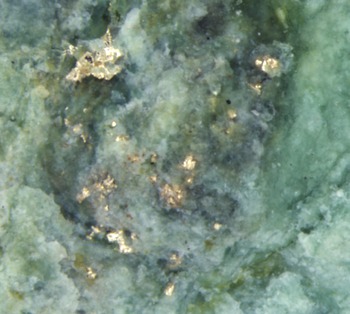
Rare irregular grains of gold, up to 0.5 mm across and containing up to 23 wt.% silver, are visible in hand-specimen, generally associated with chrysocolla (Fig. 11). No gold was observed in thin section associated with the bornite or detected in analysis of the bornite. The weathered oxidised matrix surrounding some gold grains contains substantial Bi (ranging from 28 to 63 wt %), Cu (5 to 18 wt.%), and with 1.5 wt.% Te. The association with chrysocolla and oxidised matrix suggests the electrum is supergene in origin.
Grains of gold (electrum) in chrysocolla. Field of view is 2 mm across. Museums Victoria specimen M43568. Photograph by Oskar Lindenmayer.

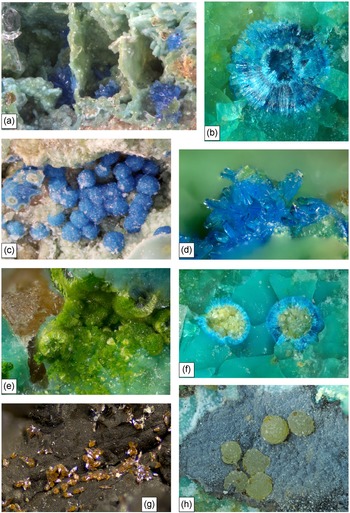
Mrázekite [Bi2Cu3(OH)2O2(PO4)2.2H2O] is the most prominent of the secondary bismuth minerals. It commonly forms royal-blue spherules made up of tightly packed radiating needles enclosed in chrysocolla (Figs 12b, d). Rosette-like aggregates up to 1 mm across and free-standing clusters of single crystals up to 0.5 mm occur on fractures and in small cavities in the chrysocolla (Fig. 12a,c,e). Analytical and powder X-ray diffraction data were presented by Birch et al. (Reference Birch, Henry and Pring1995). When identified, this was only the second known world occurrence of the mineral.
Supergene minerals in the Wombat Hole skarn. (a) Mrázekite clusters in cavities in chrysocolla, M43557, field of view (fov) is 6 mm across; (b) radiating aggregate of mrázekite (0.5 mm across) in chrysocolla, J Haupt specimen; (c) mrázekite in fracture in garnet, M43616, fov is 6 mm; (d) Mrázekite crystal group, J Haupt specimen, fov is 2 mm; (e) mrázekite nucleated around garnet fragments in chrysocolla, J Haupt specimen, fov is 0.7 mm; (f) crust of platy namibite crystals, J Haupt specimen, fov is 2 mm; (g) pucherite crystals on Fe-Mn oxy-hydroxide coating, J Haupt specimen, fov is 1 mm; and (h) schumacherite hemispheres in chrysocolla, J Haupt specimen, fov is 2 mm. Photography: J Haupt (b,d,e,f,g and h); O Lindenmayer (a and c).

Bismutite, (BiO)2CO3, occurs rarely as yellowish spheres up to 0.2 mm across, and very rare tabular yellow wulfenite crystals (PbMoO4) up to 1 mm across, both occur enclosed in the chrysocolla. Eulytine (Bi4(SiO4)3) forms minute pale-green spheres and botryoidal coatings enclosed in schumacherite (see below) (Birch et al., Reference Birch, Henry and Pring1995).
A number of minerals in the supergene assemblage appear to have been the last to crystallise. Predominant amongst these is a suite of very rare bismuth vanadates, which occur in fractures through the chrysocolla and on late-forming black crusts of Fe/Mn oxy-hydroxides.
Namibite, Cu(BiO)2VO4(OH), occurs sparingly as dark pistachio-green hemispheres and coatings made up of very thin tabular crystals (Fig. 12f). In their first description of namibite from Morass Creek, Birch et al. (Reference Birch, Henry and Pring1995) used the formula CuBi2VO6 from the original description by von Knorring and Sahama (Reference von Knorring and Sahama1981) and with V assumed to be pentavalent, deduced that Cu was monovalent from charge-balance requirements. Subsequently the namibite formula has been revised to that shown (Mrázek et al., Reference Mrázek, Veselovsky, Hlousek, Moravcova and Ondrus1994; Kolitsch and Giester, Reference Kolitsch and Giester2000) in which Cu is divalent. Pucherite, BiVO4, forms honey- to orange-brown crystals up to ~0.2 mm with schumacherite and namibite (Birch et al., Reference Birch, Henry and Pring1995) (Fig. 12g). Schumacherite, ideally Bi3O(VO4)2(OH), forms yellowish brown to pale-green spheres, hemispheres and globular coatings with a waxy appearance (Fig. 12h).
The black Fe/Mn oxy-hydroxide crusts on which some phases have nucleated have not been characterised. Opaline silica (hyalite or opal-AN) forms colourless globules and coatings associated with chrysocolla. Minor azurite and malachite occur as veinlets and irregular patches up to a few cm across. No calcite was identified in material collected.
Te-bearing phases
Measurable Te has been detected in several secondary phases. An unusual, avocado-green material forms compact clay-like patches up to 10 mm across enclosed in chrysocolla (see Fig. 6). Analyses show it to be a bismuth-rich oxide phase, which is near-amorphous to X-ray diffraction. The material contains up to 1.9 wt.% vanadium and up to 3.4 wt.% tellurium, and may be the main secondary phase which hosts remobilised tellurium, though in amounts insufficient to form discrete crystalline tellurates. Another Te-bearing phase consists of amorphous tiny (~25 μm) yellow globules with apparent Cu–Fe–Bi–Si–Te–O composition scattered across chrysocolla. Attempts to characterise this phase by microprobe and synchrotron methods have been unsuccessful to date (Missen, pers. comm. 2021).
Discussion
Mineralogical and textural evidence indicates that two processes, separated by millions of years, were involved in producing the full suite of minerals in the Wombat Hole skarn.
Skarn formation
By analogy with other limestone bodies in the WGF, the precursor limestone for the Wombat Hole skarn was relatively pure, i.e. silica-poor, although it may have contained small amounts of sulfides. A number of the recrystallised limestone bodies in the region contained small quantities of copper, lead, zinc and iron sulfides (Cochrane, Reference Cochrane1982), however only one other lens has been metasomatised to a skarn (VandenBerg et al., Reference VandenBerg, Hendrickx, Willman, Margart, Simons and Ryan1998). In contrast, the high bismuth content of the Wombat Hole prospect is typical of skarn mineralisation (Kwak, Reference Kwak1987). The absence of lead and zinc mineralisation, typical of limestone deposits in the region, suggests the mineralising fluids generated by the Silver Flat Porphyry carried the copper and bismuth.
The anhydrous assemblage garnet (grossular‒andradite)‒vesuvianite‒diopside is typical of the prograde stage of carbonate replacement skarns at higher temperatures and with hypersaline fluids. There is no evidence for any retrograde crystallisation, in which hydrous minerals such as epidote, chlorite and amphibole form in the presence of lower temperature, lower salinity fluids (Kwak, Reference Kwak1986). This suggests that magmatic fluids were dominant, and that meteoric fluids were generally absent, possibly reflecting depth of formation.
Temperature
The absence of quartz in the simple assemblage of grossular‒vesuvianite (and minor diopside) in the skarn means the upper thermal stability of the silicate assemblage is poorly constrained. In the absence of quartz, vesuvianite is stable to high temperatures, 825 ± 25°C at 100 MPa (Hochella et al., Reference Hochella, Liou, Keskinen and Kim1982). However, it is unlikely that such an elevated temperature was attained in the contact zone of a high-level porphyritic intrusion. Grossular also has a wide thermal stability range (Taylor and Liou, Reference Taylor and Liou1978).
The exsolved phases in the primary bornite provide a better indication of temperature of formation. At temperatures > 600°C, bornite may trap large amounts of trace elements, which exsolve during cooling along grain boundaries, within aggregates or as orientated lamellae (Cook et al., Reference Cook, Ciobanu, Danyushevsky and Gilbert2011). Bornite can contain a maximum of 17.2 wt.% bismuth at 420°C, with the extent of solid solution higher at low $f_{{\rm S}_ 2}$ conditions. Below this temperature wittichenite will exsolve (Sugaki et al., Reference Sugaki, Kitakaze and Hayashi1981, Reference Sugaki, Kitakaze, Hayashi and Sunagawa1984; McQueen and Larson, Reference McQueen and Larson1985). Chalcopyrite may exsolve rapidly from bornite at relatively low temperatures (e.g. 150°C) under hydrothermal conditions (Li et al., Reference Li, Brugger and Pring2018).
From the above evidence, a reasonable estimate of the uppermost temperature range for the formation of the skarn is between 650°C and 500°C. This accords with results from other skarn or epithermal deposits that contain similar bornite-hosted exsolved Bi phases (McQueen and Larson, Reference McQueen and Larson1985; Cook and Ciobanu, Reference Cook and Ciobanu2001, Reference Cook and Ciobanu2002).
The nature of fluids
The stability of vesuvianite and grossular is restricted to fluids with low ${\rm X}_{{\rm C}{\rm O}_ 2}$ (<0.2) (Hochella et al., Reference Hochella, Liou, Keskinen and Kim1982; Valley et al., Reference Valley, Peacor, Bowman, Essene and Allard1985). The assemblage of grossular and vesuvianite is indicative of silica-saturated conditions and is typical of fluid-buffered assemblages where sufficient volumes of water-rich fluid are introduced from an external source to rapidly dilute any CO2 evolved from the heating of the limestone (Ferry Reference Ferry and Kerrick1991; Tracy and Frost Reference Tracy, Frost and Kerrick1991).
The oxidised nature of the Fe in the minerals represented by the andraditic component in the garnets and the presence of diopsidic pyroxene suggest a localised increase in $f_{{\rm O}_ 2}$ , typical of the proximal contact zone of shallow intrusions (Tracy and Frost Reference Tracy, Frost and Kerrick1991; Kwak Reference Kwak1987).
The presence of bismuth telluride and other Bi-bearing inclusions in the bornite indicates these were the first metallic phases to crystallise. Bi‒Te minerals can record the physico-chemical conditions of formation, in particular $f_{{\rm S}_ 2}$ /$f_{{\rm T}{\rm e}_ 2}$
 (e.g. Zhou et al., Reference Zhou, Sun, Fu, Lin and Jiang2016). At elevated $f_{{\rm T}{\rm e}_ 2}$
 , Te-dominant minerals, such as hedleyite, form. With increasing S, sulphotsumoite and joséite-A are favoured (Afifi et al., Reference Afifi, Kelly and Essene1988; Cook and Ciobanu Reference Cook and Ciobanu2003). Ciobanu et al. (Reference Ciobanu, Birch, Cook, Pring and Grundler2010) noted Bi:Te (+S,Se) ratios >1 as indicative of reduced conditions, and ratios <1 oxidising conditions, suggesting hedleyite formed first then sulphotsumoite as the fluids evolved to become more oxidised. With increasing $f_{{\rm S}_ 2}$
 bornite formed, containing dissolved bismuth which subsequently exsolved as wittichenite and other Cu‒Bi‒S‒phases as the temperature dropped.
The role bismuth may play in scavenging gold in melts within hydrothermal fluids, including during skarn formation, is well-documented (e.g. Cook and Ciobanu, Reference Cook and Ciobanu2004; Ciobanu et al., Reference Ciobanu, Birch, Cook, Pring and Grundler2010; Zhou et al., Reference Zhou, Sun, Fu, Lin and Jiang2016). The native bismuth inclusions present in the bornite may represent bismuth droplets carried in by the hydrothermal fluids, as the melting point of bismuth (271°C) is well within the estimated temperature range for the skarn's formation (e.g. Ciobanu et al., Reference Ciobanu, Birch, Cook, Pring and Grundler2010).
Supergene mineralisation
Eventually, after an unknown interval, but probably several hundred million years, the skarn was exposed at the surface enabling weathering and oxidation to commence. It is likely that chrysocolla formed at this stage, possibly in near-neutral conditions, as demonstrated experimentally by Yates et al. (Reference Yates, Joyce and Heaney1998), especially if carbonate was present to buffer pH. Chrysocolla is widespread in secondary copper deposits throughout eastern Australia (Crane et al., Reference Crane, Sharpe and Williams2001) although it is relatively rare in Victoria, probably reflecting less arid climatic conditions and the absence of large-scale primary copper deposits. The formation of a copper-silicate gel and its subsequent solidification is likely to have resulted in the fracturing of the garnet‒vesuvianite host. The alteration of bornite to form the covellite fringe probably occurred at this time.
If the copper-silicate gel also contained trace amounts of bismuth, as well as phosphorus, molybdenum and lead, then mrázekite and wulfenite could crystallise as ‘exsolution’ products because these elements aren't accommodated in the chrysocolla colloidal structure. Te was not present in sufficient amounts to form discrete crystalline Te species, but its presence in measurable amounts in alteration products is evidence of its mobility under supergene conditions, as discussed inter alia by Missen et al. (Reference Missen, Ram, Mills, Etschamm, Reith, Shuster and Smith2020).
Electrum within chrysocolla or rimmed by Cu- and Bi-rich oxides indicate a supergene origin. Supergene alteration of the primary bornite‒bismuth sulfide mineralisation generated acidic fluids that locally mobilised gold and silver, perhaps carried as thiosulfide complexes. A feature of thiosulfate-mediated dissolution of Au is that any associated Ag is also readily complexed and transported by the thiosulfate ions, so that supergene gold retains a significant Ag content (Sheets et al., Reference Sheets, Craig and Bodnar1995; Craw et al., Reference Craw, MacKenzie and Grieve2015).
Late-stage introduction of V-bearing fluids remobilised more of the bismuth and copper to form the secondary vanadates. The source of the vanadium is uncertain, but may have been derived originally from a small degree of dissolution of the primary garnet, perhaps recycled through the amorphous avocado-green phase that contains a small amount of vanadium.
Only very low concentrations of vanadium are required in solution to form vanadates, as they are relatively insoluble in water (Williams, Reference Williams1990). Mrázekite and chrysocolla contain divalent Cu, whereas namibite contains monovalent Cu indicating the presence of a strong reducing agent. The vanadium was likely to have been transported as the vanadate VO43– species, which requires highly alkaline fluids (Baes and Mesmer, Reference Baes and Mesmer1976) suggesting the fluids forming the secondary minerals changed from strongly acidic to highly alkaline over time.
The effect of the basalt flows (which fill the gorge) on skarn mineralogy, including possibly providing V-bearing fluids for the vanadates, is difficult to determine. The interpretation by Cuffley (Reference Cuffley1980) that the basalt infilled karst topography on the side of the gorge suggests it may have covered the skarn after weathering had already commenced. However the limited mapping doesn't rule out the exposure and weathering of the skarn having occurred in the subsequent 2.3 million years. The latter seems to be the more likely.
The small amounts of azurite and malachite in the skarn may be due to more recent weathering where carbonate was available from adjacent limestone.
Conclusions
The Wombat Hole Prospect skarn formed initially by the interaction of a megaclast of Silurian limestone with fluids generated by the intrusion of the high-level Silver Flat Porphyry in the Early Devonian. The high garnet/pyroxene ratio, low-Fe garnets and pyroxene, and low-sulfur minerals such as bornite are characteristic of skarns that form proximal to intrusions (Meinert, Reference Meinert, Hagemann and Brown2000). It therefore seems that a classification as a carbonate-replacement Cu‒Bi‒(Te) exoskarn is the most appropriate term for the Wombat Hole prospect. The bismuth content is typical of skarn mineralisation and possibly results from the transport of melt droplets within the hydrothermal magmatic fluids. As the bornite cooled in the temperature interval from ~500°C to 150°C, wittichenite and chalcopyrite formed by exsolution. Whereas bismuth tellurides and sulfotellurides are also hosted by the bornite, the euhedral nature of the crystals suggests they are inclusions rather than formed by exsolution. When the mineralised skarn was exposed to atmospheric weathering, oxidation resulted initially in the formation of secondary chrysocolla and the fragmentation of the primary garnet and vesuvianite. Secondary bismuth phases such as mrázekite, bismutite and eulytine formed as the chrysocolla solidified, followed in the final stages by the suite of vanadates such as namibite and pucherite. The small extent of the skarn and its remote setting, where contact relationships are obscured, lead to some uncertainty about the paragenesis of the secondary mineralogy. However, the Wombat Hole prospect provides evidence for the mobility of Bi and Te over short distances during weathering and the phases responsible for immobilising them.
Acknowledgements
The authors wish to acknowledge Graham Hutchinson for assistance with the microprobe analysis and BSE imagery in the School of Geography, Earth and Atmospheric Sciences at Melbourne University; Colin Macrae, Advanced Characterisation Facility, CSIRO Minerals, Melbourne, for assistance with microprobe analysis; Owen Missen for advice on telluride phases; and John Haupt and Oskar Lindenmayer (Museums Victoria) for photography of the supergene minerals. We also thanks the two reviewers for their comments and suggestions, which enabled us to improve the paper.