Introduction
Anthropogenic disturbances have caused widespread species extinctions, with further consequences on ecosystem processes and ecological services triggered by organisms (Hooper et al., Reference Hooper, Chapin, Ewel, Hector, Inchausti, Lavorel, Lawton, Lodge, Loreau, Naeem, Schmid, Setala, Symstad, Vandermeer and Wardle2005; Kremen et al., Reference Kremen, Williams, Aizen, Gemmill-Herren, LeBuhn, Minckley, Packer, Potts, Roulston, Dewenter, Vázquez, Winfree, Adams, Crone, Greenleaf, Keitt, Klein, Regetz and Ricketts2007). Much of the debate about the impacts of biodiversity loss on ecosystem functioning has thus far focused on higher organizational levels by considering the role of species groups instead of those from individual species and organisms (Loreau et al., Reference Loreau, Naeem, Inchausti, Bengtsson, Grime, Hector, Hooper, Huston, Rafaelli, Schmid, Tilman and Wardle2001; Bellard et al., Reference Bellard, Bertelsmeier, Leadley, Thuiller and Courchamp2012). However, understanding the functional role of organisms and individual species becomes crucial to further predict their ecological importance and contribution to ecosystem functioning processes (Covich et al., Reference Covich, Palmer and Crowl1999; Thrush et al., Reference Thrush, Hewitt, Gibbs, Lundquist and Norkko2006).
Despite the almost exponential increase in research on ecological functions and further benefits to human well-being and environmental maintenance, contributions at individual or even specific levels remain poorly studied. On the other hand, functional groups have been used to better represent the relationship between functional diversity and ecosystem functioning (Slade et al., Reference Slade, Mann, Villanueva and Lewis2007; Nichols et al., Reference Nichols, Uriarte, Bunker, Favila, Slade, Vulinec, Larsen, Vaz-de-Mello, Louzada, Naeem and Spector2013a; Griffiths et al., Reference Griffiths, Bardgett, Louzada and Barlow2016a). Overall, studies have shown that the loss of both taxonomic and functional diversities leads to negative effects on ecosystem functioning (Hooper et al., Reference Hooper, Chapin, Ewel, Hector, Inchausti, Lavorel, Lawton, Lodge, Loreau, Naeem, Schmid, Setala, Symstad, Vandermeer and Wardle2005), but ecological processes in perturbed ecosystems can also be buffered by functionally redundant species (Barragán et al., Reference Barragán, Moreno, Escobar, Halffter and Navarrete2011). Few studies, however, have explored the individual contribution and the influence of the sex of organisms on ecosystem processes; interspecific variation and species intraspecific differences have also been poorly considered (Wohlfahrt et al., Reference Wohlfahrt, Bahn, Haubner, Horak, Michaeler, Rottmar, Tappeiner and Cernusca1999; Crutsinger et al., Reference Crutsinger, Collins, Fordyce, Gompert, Nice and Sanders2006; Carvalho et al., Reference Carvalho, Ferreira Châline, Audino, Louzada and Châline2018).
Dung beetles (Coleoptera: Scarabaeidae: Scarabaeinae) are a recognized bioindicator group used for ecological investigations (Barlow et al., Reference Barlow, Lennox, Ferreira, Berenguer, Lees, Mac Nally, Thomson, Ferraz, Louzada, Oliveira, Parry, Solar, Vieira, Aragão, Begotti, Braga, Cardoso, de Oliveira, Souza, Moura, Nunes, Siqueira, Pardini, Silveira, Vaz-de-Mello, Veiga, Venturieri and Gardner2016; França et al., Reference França, Barlow, Araújo and Louzada2016a, b) and for research on ecosystem functioning (Braga et al., Reference Braga, Korasaki, Andresen and Louzada2013; Griffiths et al., Reference Griffiths, Louzada, Bardgett, Beiroz, França, Tregidgo and Barlow2015, Reference Griffiths, Bardgett, Louzada and Barlow2016a). These detritivore beetles mediate a variety of relevant ecological processes, such as secondary seed dispersal, nutrient cycling, soil bioturbation, and parasite suppression (reviewed by Nichols et al., Reference Nichols, Spector, Louzada, Larsen, Amezquita and Favila2008). The ecological functions performed by these insects mainly result from their nesting and resource allocation strategies. Among dung allocation strategies, roller (or telecoprid) dung beetles are those that make dung balls and roll them for distances ranging from a few centimeters to several meters. Once the nesting place is reached, the balls are buried in tunnels and chambers that have been built (Halffter and Matthews, Reference Halffter and Matthews1966; Halffter and Edmonds, Reference Halffter and Edmonds1982), which benefits the soil environment and plant productivity (Bang et al., Reference Bang, Lee, Kwon, Na, Jang and Kim2005; Yamada et al., Reference Yamada, Imura, Shi and Shibuya2007; Griffiths et al., Reference Griffiths, Bardgett, Louzada and Barlow2016a).
Here, we used a laboratorial experiment to investigate the intra and interspecific contributions of two roller dung beetle species (Canthon (Goniocanthon) smaragdulus Fabriciuys, 1781 (Nunes et al., Reference de OA Nunes, Nunes and Vaz-de-Mello2018) and Canthon sulcatus Castelnau, 1840) to the dung burial function. Canthon (Peltecanthon) sulcatus is a diverse genus of dung beetle, distributed throughout the American continent (Vaz-de-Mello, Reference Vaz-de-Mello, Martín-Piera, Morrone and Melic2000; França et al., Reference França, Korasaki, Louzada and Vaz-de-Mello2016c). However, the ecology and behaviour of this genus is poorly known (Vaz-de-Mello et al., Reference Vaz-de-Mello, Larsen, Silva, Gill, Spector and Favila2014). In particular, we evaluated the relationship between the dung beetle individuals’ biomass and the dung burial rates they performed, as this function is considered to be one of the most important dung beetle-mediated ecological processes. Dung consumption and burial can lead to other crucial incidental functioning processes (Nichols and Gardner, Reference Nichols, Gardner, Simmons and Ridsdill-Smith2011; França et al., Reference França, Louzada and Barlow2018), such as secondary seed dispersal (Santos-Heredia and Andresen, Reference Santos-Heredia and Andresen2014; Griffiths et al., Reference Griffiths, Louzada, Bardgett, Beiroz, França, Tregidgo and Barlow2015), microbial transport across the soil surface (Slade et al., Reference Slade, Roslin, Santalahti and Bell2016), and soil bioturbation (Nichols et al., Reference Nichols, Spector, Louzada, Larsen, Amezquita and Favila2008; Braga et al., Reference Braga, Korasaki, Andresen and Louzada2013). We assessed how dung beetle biomass would influence dung burial rates, as this functional trait has been shown to influence dung beetle-mediated ecological processes (Gregory et al., Reference Gregory, Gómez, Oliveira and Nichols2015). We hypothesized that (1) males, females, and couples of the same species remove dung at different rates; (2) different species remove dung at different rates; and (3) there is a positive relationship between individual biomass and the amount of dung burial on intra and interspecific levels.
Materials and methods
Study region
We sampled individuals of the dung beetle species C. smaragdulus and C. sulcatus in January 2015, during the rainy season, at Rio Doce State Park, in the state of Minas Gerais, southeastern Brazil (19°48′18″–19°29′24″ S and 42°38′30″– 42°28′18″ W). This state park has an area of approximately 36,000 ha and is considered one of the largest preserved Atlantic forest areas within the state of Minas Gerais (Coelho and Ribeiro, Reference Coelho and Ribeiro2006). Although it presents a mosaic of vegetation categories, it is considered a tropical rainforest domain, classified as submontane semidecidual stationary forest (Antunes, Reference Antunes1986). The region presents a transition of mesothermic humid tropical and mesothermic rainy tropical climate (Antunes, Reference Antunes1986), with a mean temperature between 20 °C and 22 °C and a well-defined dry season from April to September and a rainy season between October and March (Antunes, Reference Antunes1986).
Sampling design
We used 25 pitfall traps (25 × 5.2 cm), placed linearly 25 m apart in a transect within a forest fragment. Pitfall traps were made by cutting the neck off from 2-L plastic bottles. The tapering part of the bottle was cut off and placed upside down on the top of the bottle, forming a funnel, which allowed the beetles to be trapped while also preventing them from escaping. Traps were buried with their openings at the ground level. We placed a small amount of soil and leaf litter inside each pitfall trap (below the funnel) to accommodate and avoid stressing the trapped dung beetles. To attract the dung beetles, we placed a small container with 25 g of pig dung above each trap and we used a plastic lid supported by bamboo sticks as a rain cover. All traps remained in the field for 72 hours and dung beetles were collected every 24 hours, when the traps were rebaited. Living dung beetles collected were kept in plastic containers (15 × 9.4 cm) half filled with a humidified mixture of soil (70%) and sand (30%).
After fieldwork, live dung beetles were transferred to the Insect Ecology and Conservation Laboratory at the Federal University of Lavras (Brazil), where containers were kept within a controlled room (humidity 65% ± 10%, temperature 26 °C ± 1 °C, and 12 h/12 h light/dark photoperiod). The beetles were reared following the methodology of Favila (Reference Favila1993).
Selection of individual dung beetles
Prior to the experiment, individual dung beetles were first separated by species and then by sex. Due to the absence of sexual dimorphism in C. smaragdulus specimens, we opted to separate males from females by observing their reproductive behaviour, as described by Belles and Favila (Reference Belles and Favila1983) and Favila (Reference Favila, Anaya, Espinosa_García and Cruz_Ortega2001). Males made dung balls with resources that were provided to them. We then observed that they stood on the ground, raising their bodies while keeping both hind legs extended, which was interpreted as the moment when pheromones are emitted. When a female approached, sexual recognition was made through contact between heads and antennae. The female then climbed onto the resource ball and the male rolled it to a location where copulation occurred. Here, we observed the male approaching the female and mounting her. The female remained in a favourable position for him to attempt copulation. We used this attempt by the male to copulate with the female to consider them as a couple and to identify each sex. All individuals that failed to display reproductive behaviour were excluded from the trial.
Canthon sulcatus specimens present sexual dimorphism, which allowed us to separate individuals by observing their anterior tarsal claws: males present bidentate tarsal claws, whereas the female's anterior tarsal claw is simple dentate. We further dissected 10 individuals of each sex from both species to confirm our sex classification. The high number of matches (100%) confirmed that our techniques were precise for sexing this dung beetle species.
After sexing the beetles, we separated 10 couples, 20 males, and 20 females of each species, and placed them in separate plastic containers. There were 10 containers with one couple in each container, 10 containers with two males each, and 10 containers with two females each.
Experimental design for dung burial evaluation
To evaluate dung burial capacity (first hypothesis), three treatments were performed with two individuals of the same species: males (MM), females (FF), and distinct-sex couples (MF). A total of 10 replicates were performed for each treatment, totalling 30 replicates for each species (for the second hypothesis). Each repetition comprised a bucket with 5 kg of a humidified substrate, prepared with 70% soil and 30% sand. Two individuals of each respective treatment (MM, FF, and MF) of one of the species and 100 g of pig dung mixed with human excrement (80:20 pig-to-human ratio, following Marsh et al., Reference Marsh, Louzada, Beiroz and Ewers2013) were placed in each bucket, which was then covered by canvas to prevent any beetle from escaping. Before being placed in a bucket, the beetle biomass was weighed with a Shimatzu AY220 balance scale (Shimadzu Corporation, Kyoto, Japan) accurate to within ± 0.0001 g to further analyse it (third hypothesis). Beetles were not fed for 7 days prior to the experiment, and beetle-mediated dung burial was quantified 48 hours after the beginning of the experiment.
We prepared 10 additional buckets following the same methodology above, but without placing any beetle, to account for any humidity loss/gain that could influence the measurement of dung removal rates. In each of these ‘humidity control’ buckets, the changes in humidity from the dung were calculated and the mean value was subtracted from the amount of dung buried by the beetles in each replicate. The positions of the buckets, both those corresponding to the treatments and those of the humidity control, were randomized to avoid any influence of bucket placement.
Statistical analysis
All data were analysed using the software R (R Core Team, 2017). A general linear model assuming quasi-Poisson distribution was used to examine whether the biomass varied among treatments within each species (males, females, and couples) or between species (C. smaragdulus and C. sulcatus). The average biomass of the two individuals of each bucket was considered the dependent variable, and the treatment levels and the species of beetle were the explanatory variable. We used general linear models (GLMs) assuming quasi-Poisson distribution to examine whether the dependent variable (dung burial rates) varied among treatments (three levels: MM, FF, and MF) and the two Canthon species (C. smaragdulus and C. sulcatus) (first and second hypothesis). Biomass was used as a covariable in the model, because it could influence the response variable (third hypothesis). On both models when significant differences were detected in formed interactions, we performed a contrast analysis to determine which categories were different in relation to the response variable. All models were submitted to residual analysis to verify the adequacy of distribution errors (Crawley, Reference Crawley2002, Reference Crawley2013). The quasi-Poisson distribution was performed as recommended to deal with overdispersed data (Ver Hoef and Boveng, Reference Ver Hoef and Boveng2007). We performed Shapiro–Wilk tests of normality with the response variable and model residuals in the shapiro.test function in stats package (R Core Team, 2017). The significance level of the analysis was alpha = 0.05.
Results
Biomass in the intra and interspecific levels
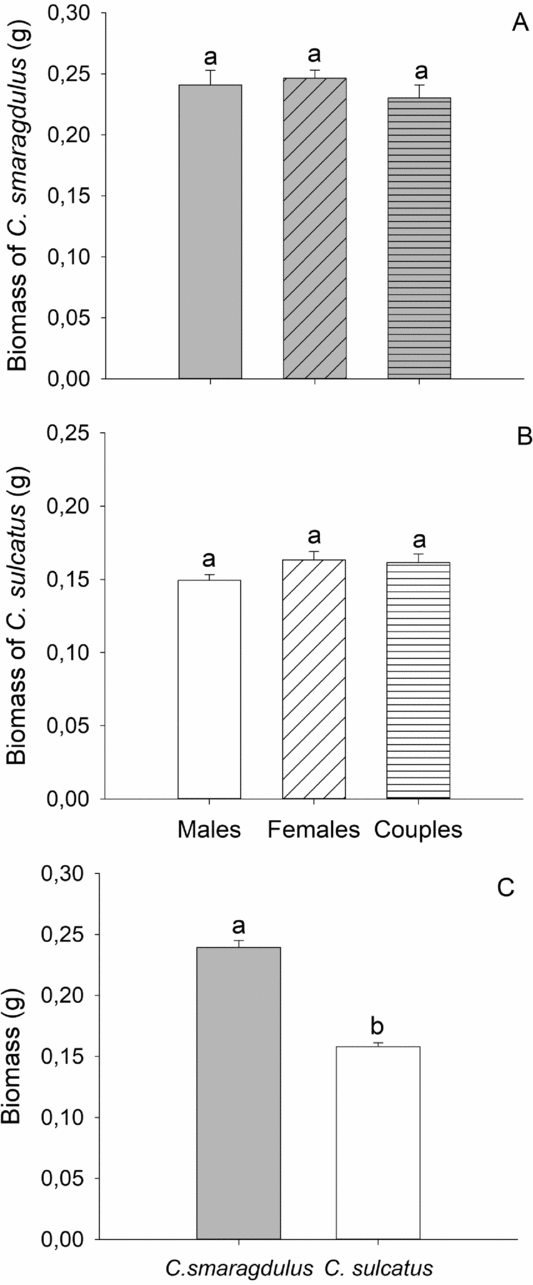
There were no significant differences in mean biomass when we considered the interaction of treatment with C. smaragdulus (MM pairs 0.241 ± 0.012 g; FF pairs 0.246 ± 0.007 g; 0.230 ± 0.011 g) (Fig. 1A) and with C. sulcatus (MM pairs 0.149 ± 0.004 g; FF pairs 0.163 ± 0.006 g; MF pairs 0.162 ± 0.006 g) (F2,54 = 1.033; P = 0.363) (Fig. 1B). However, the mean biomass of individuals differed between species (F1,56 = 152.235, P < 0.01). Canthon smaragdulus individuals (0.239 ± 0.006 g) had greater biomass than C. sulcatus individuals (0.156 ± 0.04 g) (Fig. 1C).
Mean and standard error of the biomass of individuals (A) males, females, and couples of Canthon smaragdulus, (B) males, females, and couples C. sulcatus, and (C) of C. smaragdulus and C. sulcatus. Different letters indicate statistical difference between treatments as indicated by GLM at 5% significance, n = 60.

Dung burial rates in the intra and interspecific levels
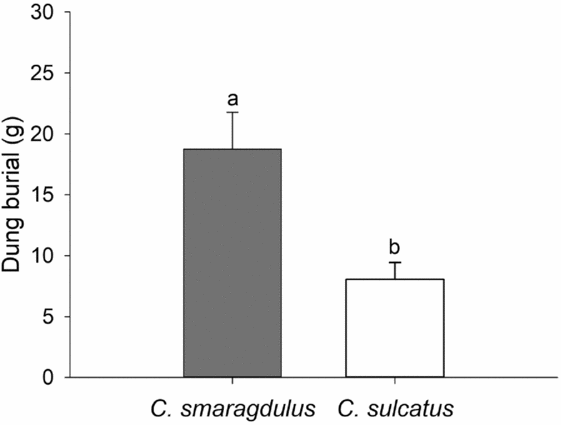
We did not find significant differences in mean dung buried when we considered the interaction of treatment with C. smaragdulus (MM pairs 19.91 ± 7.22 g; FF pairs 17.63 ± 4.84 g; MF couples 18.82 ± 3.52 g; mean ± SE) and with C. sulcatus (MM pairs 11.74 ± 2.28 g; FF pairs 8.84 ± 2.94 g; MF couples 7.95 ± 1.23 g; mean ± SE) (F2,53 = 0.49; P = 0.61) (first hypothesis). However, supporting our second hypothesis, we found a difference in the amount of dung buried by species, where C. smaragdulus (18.78 ± 3.03) buried more dung than C. sulcatus individuals (8.07 ± 1.38; mean ± SE) (F1,58 = 7.12, P < 0.01) (Fig. 2).
Mean and standard error of the amount of dung buried by Canthon smaragdulus and C. sulcatus. Different letters indicate statistical difference between treatments as indicated by GLM at 5% significance, n = 60.

Relationship between individual biomass and the amount of dung burial on intra and interspecific levels
No significant effect on the amount of dung buried was observed when considering the interaction between the biomass of the beetles, treatments within each species, and species (F2,48 = 0.05, P = 0.95). We found no effect on the amount of dung buried when we considered the interaction between biomass and C. smaragdulus and C. sulcatus (F1,52 = 0.21, P = 0.65) (third hypothesis).
Discussion
Our study provides empirical evidence that different dung beetle species remove different amounts of dung, therefore supporting previous research demonstrating that bigger beetles may perform larger amounts of dung beetle-mediated ecological functions (Gregory et al., Reference Gregory, Gómez, Oliveira and Nichols2015). Dung consumption and burial by dung beetles are key processes for the occurrence of other ecological functions, such as soil bioturbation from the construction of tunnels, seed dispersal, and the increase in plant productivity (Nichols et al., Reference Nichols, Spector, Louzada, Larsen, Amezquita and Favila2008; Braga et al., Reference Braga, Korasaki, Andresen and Louzada2013; Griffiths et al., Reference Griffiths, Louzada, Bardgett, Beiroz, França, Tregidgo and Barlow2015; Santos-Heredia et al., Reference Santos-Heredia, Andresen, del-Val, Zárate, Mendoza and Jaramillo2016; Braga et al., Reference Braga, Carvalho, Andresen, Anjos, Alves-Silva and Louzada2017).
We found no differences in dung burial rates by males, females, or couples within each species. Previous research has shown that dung beetle sex is an important driver for tunnel depth (Gregory et al., Reference Gregory, Gómez, Oliveira and Nichols2015) and that dung burial behaviour may change between sexes (Emlen, Reference Emlen1997). However, the resource offered was incompletely buried in either of our replicates. This demonstrates that the amount of dung offered in this experiment may be too large, and that there was no competition between the individuals placed within each bucket. While we concede that beetles in this experiment did not reallocate the resource as quickly as they usually do (Hanski and Cambefort, Reference Hanski and Cambefort1991), future studies are needed to evaluate the effect of different densities of beetle individuals on dung burial rates.
Our results also demonstrate that the biomass of males, females, and couples of each species had no relation to dung burial within the examined species. Larger intraspecific variation in biomass within a species increases the probability of relationships between the individual biomass and the functions they perform (Braga, unpublished observations). If this variation in intraspecific biomass is low (or does not exist), the relationship of biomass to ecological function will most likely not exist. This is a likely explanation for the patterns found here, as there was no intraspecific variation in the biomass from males, females, and distinct-sex couples in this experiment.
Individuals of C. smaragdulus performed more dung burial than C. sulcatus. Although C. smaragdulus species has a higher biomass than C. sulcatus, our results demonstrate that the biomass of the individuals of each species had no direct relation to dung burial rates. In studies with dung beetles at the community level, the biomass of individuals in the community has had a relation to the amount of dung buried by the beetles (Andresen, Reference Andresen2002; Slade et al., Reference Slade, Mann, Villanueva and Lewis2007; Nichols et al., Reference Nichols, Uriarte, Peres, Louzada, Braga, Schiffler, Endo and Spector2013b). Communities that have dung beetles with greater biomass have a higher capacity for dung burial (Horgan, Reference Horgan2001; Anduaga, Reference Anduaga2004). Although this relationship is valid in studies with dung beetle communities, it did not exist in the species we worked with. The biomass of individuals will only be an ecologically considerable trait for dung burial in those species with large biomass and presenting a high capacity for dung burial, like those of the genus Dichotomius (Andresen, Reference Andresen2003; Anduaga, Reference Anduaga2004; Braga, unpublished observations). This demonstrates the need for research using other factors, such as different functional traits and environmental contexts in which the beetles are found (Nichols et al., Reference Nichols, Uriarte, Peres, Louzada, Braga, Schiffler, Endo and Spector2013b; Griffiths et al., Reference Griffiths, Louzada, Bardgett, Beiroz, França, Tregidgo and Barlow2015, Reference Griffiths, Louzada, Bardgett and Barlow2016b).
Our work addressed the individual contribution of two roller dung beetle species to dung burial rates and demonstrated that each species may contribute differently. In addition, the dung burial rates were indirectly related to the biomass of each species, but the larger species performed higher dung burial rates. Thus, it is important to understand the behaviour and ecology of the species and their influence on the capacity for dung burial, one of the main ecological functions performed by dung beetles (Nichols et al., Reference Nichols, Spector, Louzada, Larsen, Amezquita and Favila2008). Further studies are needed to evaluate the contribution of other individual species of dung beetle for dung burial. We believe that fine-scale data based on individuals can be useful for better understanding and valuating the ecological function provided by dung beetles. Further studies are needed to evaluate the contribution of other individual species of dung beetle for dung burial and the other ecological processes they mediate.
Acknowledgements
We thank Paula Braga and Breno Barreto for essential help in the laboratory. We acknowledge the Rio Doce State Park and IEF for authorizing our field collection. R.C. thanks the FAPEMIG for providing the scholarships. F.F. is funded by NERC (NE/P004512/1) and Brazilian Council for Scientific and Technological Development (CNPq; PELD 441659/2016-0) grants.