Introduction
The prevailing explanation for extraordinarily high HIV prevalence rates in parts of sub-Saharan Africa employs a behavioural paradigm and emphasizes the high rate of concurrent sexual partnerships, although there are strongly opposing viewpoints in the literature regarding the role of the latter (Epstein, Reference Epstein2010; Lurie & Rosenthal, Reference Lurie and Rosenthal2010a, Reference Lurie and Rosenthalb; Mah & Halperin, Reference Mah and Halperin2010a, Reference Mah and Halperinb; Morris, Reference Morris2010; Sawers & Stillwaggon, Reference Sawers and Stillwaggon2010; Epstein & Morris, Reference Epstein and Morris2011; Mah & Shelton, Reference Mah and Shelton2011). Donor countries and international aid agencies have expended enormous effort to try to alter individual sexual behaviours, and only relatively recently has sexual concurrency per se been seriously addressed. Throughout the long history of the regional pandemic both donor and recipient countries have largely neglected the contexts and structural drivers of individual sexual behaviours – some have suggested, for political reasons (Hunsmann, Reference Hunsmann2009). As Paul Farmer notes in Partner to the Poor, ‘the failure to contemplate social and economic aspects of epidemics stunts our understanding of them,’ making it much more difficult to contain and defeat them (Farmer, Reference Farmer2010; Rosen, Reference Rosen2012).
Although behaviourally focused prevention appears to have produced recent reductions in HIV incidence rates in the region (Joint United Nations Programme on HIV/AIDS, 2010), it is unclear which interventions have been most effective, and to what extent. There is clearly a need to better understand the nature and role of network factors such as long-term sexual concurrency, which has been inadequately captured and under-reported in sexual behaviour surveys, and is at least partially structural in nature because it involves deeply entrenched social and cultural norms (Epstein & Morris, Reference Epstein and Morris2011). The heavy toll of the ongoing HIV pandemic in sub-Saharan Africa has prompted renewed attention to the social and economic upstream contextual or structural factors, sometimes termed ‘the causes of the causes’ of disease, which may facilitate viral transmission and undermine intervention effectiveness (Commission on Social Determinants of Health, 2008; Gupta et al., Reference Gupta, Parkhurst, Ogden, Aggleton and Mahal2008). In a recent supplement to the Journal of the International AIDS Society devoted entirely to structural drivers of HIV transmission, Seeley et al. (Reference Seeley, Watts, Kippax, Russell, Heise and Whiteside2012) noted that elimination of HIV will require ‘a comprehensive HIV response, that includes meaningful responses to the social, political, economic and environmental factors that affect HIV risk and vulnerability’.
Also, a prevailing view emphasizes the role of poverty in the spread of HIV, despite numerous studies demonstrating an inverse relationship between HIV serostatus and poverty status in sub-Saharan Africa, which is opposite to the case in the developed world and contrary to common expectations about disease susceptibility and poverty status (Shelton et al., Reference Shelton, Cassell and Adetunji2005; Gillespie et al., Reference Gillespie, Kadiyala and Greener2007; Mishra et al., Reference Mishra, Assche, Greener, Vaessen, Hong and Ghys2007; Parkhurst, Reference Parkhurst2010). Commenting in The Lancet, Shelton et al. (Reference Shelton, Cassell and Adetunji2005, p. 1058) suggested that both wealth and economic disadvantage may play pivotal roles in HIV transmission through sexual concurrency networks, with wealth being ‘associated with the mobility, time, and resources to maintain concurrent partnerships’ and where women ‘might improve their economic situation by having more than one concurrent partner.’ Several investigators have attempted to help resolve the ongoing controversy about the relative importance of poverty, inequality and sexual concurrency in explaining the severity of the sub-Saharan Africa pandemic. For example, a review by Shandera (Reference Shandera2007) identified several viral, host, transmission and societal factors that might explain the higher rates of infection in the region. A country-level empirical study by Nattrass (Reference Nattrass2009) identified a number of social factors associated with HIV prevalence rates, finding little effect of poverty but large and significant effects of the predominant religious affiliation of the country. Within sub-Saharan Africa countries, HIV prevalence rates are generally higher in urban compared with rural areas, but there is also much regional variation, with some poorer, rural areas, such as the Nyanza region of Kenya, having very high prevalence rates. Nattrass et al. (Reference Nattrass, Maughan-Brown, Seekings and Whiteside2012) provide an excellent review of the recent literature on the complex inter-relationships among poverty, sexual behaviour and HIV in sub-Saharan Africa and the methodological challenges inherent in studies attempting to shed light on them. The authors use a panel dataset on young men in Cape Town, South Africa, to overcome problems of endogeneity and blunt indicator measurements of sexual behaviour, finding important differences by sex.
A review by Fox (Reference Fox2010) identified a positive association between HIV prevalence at the country level and the Gini coefficient (a standard measure of economic inequality) among sub-Saharan Africa countries. These findings suggested a potential association between HIV prevalence and rapid economic development affecting primarily the urban regions of poor developing countries and reflected in rising wealth inequalities, such that it is not poverty or wealth per se, but the level of inequality in a region that predicts HIV prevalence. However, cross-country aggregate-level comparisons are prone to problems such as ecologic fallacy or aggregation bias, and to omitted variable bias from the inability to control for many potentially important explanatory factors. Also, if absolute income (or wealth) affects health and there are diminishing returns to health, then a relationship between health and income is produced at the aggregate level in the absence of a direct effect of economic inequality – the so-called absolute income effect (Gravelle et al., Reference Gravelle, Wildman and Sutton2002; Kawachi, Reference Kawachi2011).
In contrast, the income inequality hypothesis argues that income inequality is an indicator of ‘social distance’ and that greater distance causally leads to greater psychosocial stress and poorer health outcomes (Wilkinson, Reference Wilkinson2005; Wilkinson & Pickett, Reference Wilkinson and Pickett2006; Wilkinson & Pickett, Reference Wilkinson and Pickett2009). In the field of economics, this concept implies that ‘utility’ from consumption depends on comparison of one's own income and consumption to that of others, a concept that has gained recent empirical support in behavioural economics (Luttmer, Reference Luttmer2005; Fliessbach et al., Reference Fliessbach, Weber, Trautner, Dohmen, Sunde, Elger and Falk2007). Yet a third ‘society-wide effects’ hypothesis argues that the effects of inequality are related to social capital, trust and social cohesion, with increasing inequality causing reduced cohesion and increased crime and violence (Leigh et al., Reference Leigh, Jencks, Smeeding, Salverda, Nolan and Smeeding2009). Social heterogeneity, or a social context of varying and potentially competing population preferences and needs, has been linked to the under-provision of public goods (Banerjee & Somanathan, Reference Banerjee and Somanathan2007).
Using Demographic and Health Survey (DHS) data from 170 regions across sixteen countries, Fox (Reference Fox2012) extended her earlier work by employing multilevel modelling techniques to control for regional-level absolute wealth and a number of individual-level HIV risk factors and establishing an independent association between regional-level wealth inequality and HIV prevalence. It has also been noted that the geographic level of the community studied might affect the results of an evaluation of the association between wealth inequality and health outcomes, with support in the literature of a general pattern that the smaller the community, the less likely it is that association will be observed (Wilkinson & Pickett, Reference Wilkinson and Pickett2006). Nearly all studies of HIV/AIDS and wealth inequality have been cross-country or regional comparisons. However, one recent study examined two regions (districts and DHS sampling clusters) simultaneously within one country, Malawi, using a multilevel framework (Durevall & Lindskog, Reference Durevall and Lindskog2012). Specifically, the authors evaluated the effect of district-level consumption inequality and cluster-level (neighbourhood) wealth inequality on risk of HIV infection in Malawi women aged 15–24, finding a strong positive association between risk of HIV infection and inequality at both geographic levels, but no association for individual poverty.
The current study builds on these prior efforts by empirically investigating the relationship between wealth inequality at the statistical enumeration area (SEA) or cluster level within multiple countries in south-eastern sub-Saharan Africa using the most recent DHS data on HIV prevalence and several socioeconomic and demographic factors. The advantages of this study are that all data within a given country are from the same survey; the number of data points is much larger than previous country-level studies; it examines the inequality–HIV association at a lower level of aggregation (i.e. at the cluster level, compared with the regional or district level) where it has been harder to detect; and two different measures of SEA wealth inequality are utilized as an internal validation of the key independent variable.
Conceptual model
This paper uses ecological systems theory applied to health (or the social ecological model of health). It views individual health status as determined by a broad array of factors operating at multiple levels, often termed macro-, exo-, meso- and micro-, which describe influences as intercultural, community, organizational and interpersonal or individual, and has been adopted by the World Health Organization's Commission on the Social Determinants of Health. While this conceptual model applies to general health status, it is utilized here to examine potential influences on specific disease susceptibility. In the developing world the major threats to population health are infectious disease vulnerability and transmission. HIV is the leading cause of adult mortality in southern sub-Saharan Africa and has been responsible for reversing a long-term trend of decreasing mortality rates there. Adult mortality (or, conversely, life expectancy) is a key indicator of population health and directly reflects the general health status of the population.
As a more direct mechanism of action, researchers theorize that rapid economic development is associated with rising wealth inequality and reduced social cohesion, leading to the breakdown of traditional family structures. For instance, new opportunities in urban regions may prompt economic migration by male or female household members. They, and those left behind in rural regions, may then take on informal, long-term partners, leading to higher prevalence of HIV in more unequal settings (Fox, Reference Fox2012). Durevall & Lindskog (Reference Durevall and Lindskog2012) note several specific potential links between structural inequality and risk behaviours, particularly transactional sex providing young women and their families the means to remain above subsistence or to improve their economic status. This paper investigates whether HIV prevalence rates are in part determined by such wealth inequities, which reflect differences in social position and levels of social cohesion within a given geographic region (in this case the DHS SEA or cluster), controlling for individual/household wealth and other key individual-level variables.
Methods
Data and sample
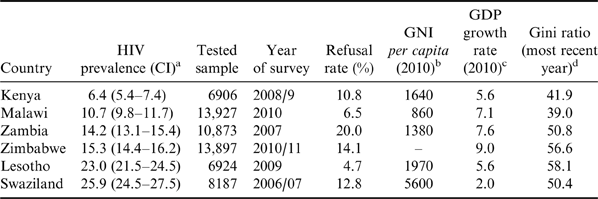
A pooled analysis was conducted using DHS household survey data collected since 2006 from six sub-Saharan Africa countries with HIV prevalence rates exceeding 5% and HIV biomarker data and data on all covariates. The UNAIDS programme classifies a national prevalence rate higher than 1% as a generalized epidemic (Joint United Nations Program on AIDS, 2011). Data are downloadable from the MEASURE DHS website at http://www.measuredhs.com/data/available-datasets.cfm. The six countries were: Kenya, Lesotho, Malawi, Swaziland, Zambia and Zimbabwe. The countries are located in south-eastern sub-Saharan Africa and have among the highest HIV prevalence rates on the African continent (see Table 1).
Country sample, sub-Saharan Africa, DHS 2006–2011
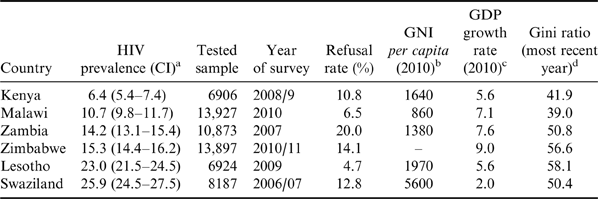
a Countries ordered from lowest to highest prevalence. Figures weighted for probability of selection into the sample.
b GNI per capita, PPP (purchasing power parity, current international $), 2010. Zimbabwe's data missing due to the ongoing political and economic crisis; data from World Bank, World Development Indicators Database.
c Annual GDP growth rate for 2010. Data from World Bank, World Development Indicators Database.
d Gini data from UNU-WIDER World Income Inequality Database, Version 2.0c, May 2008.
The DHS surveys are nationally representative population-based surveys with large sample sizes (usually between 5000 and 30,000 households). In all households, women aged 15–49 are eligible to participate; in many surveys men aged 15–54(59) from a sub-sample are also eligible to participate. There are three core questionnaires in DHS surveys: a Household Questionnaire, a Women's Questionnaire and a Male Questionnaire. The HIV biomarker data complement self-reported household survey information by providing an objective profile of a HIV status in the population. The sample is usually based on a stratified two-stage cluster design. The first stage is the SEA (or cluster), generally drawn from census files. In the second stage, within each SEA, a sample of households is selected from an updated list of households. The sample is generally representative at the national level, residence (urban–rural) and regional (departments, states) levels. This paper evaluates regional or community-level factors (i.e. characteristics of the SEA) that may affect HIV prevalence. Admittedly, the SEA is an arbitrary geographic boundary used only for the purposes of the survey, but it is nevertheless based on census data and can be aggregated proportionally using the DHS sampling weights so that it should remain representative of the populations under study.
This study analysed the binary dependent variable HIV-positive serostatus. The DHS provides anonymous, voluntary testing using blood spots collected on filter paper from a finger prick. An initial ELISA test is performed in the laboratory, with re-testing of all positive tests and 5–10% of the negative tests with a second ELISA. For those with discordant results on the two ELISA tests, a new ELISA or a Western Blot is performed (Measure DHS, 2012).
Two key independent variables were created aggregated at the SEA level: (1) the Gini coefficient, representing household wealth inequality, which was constructed using a transformation of the DHS wealth index score, and a Stata user-provided program called FastGini for calculating a weighted Gini-coefficient; (2) a second inequality index using the categories of the DHS categorical wealth index variable: the ratio of the mean wealth of households in the top 20% wealth quintile to that of those in the bottom 20% quintile. Several key household- or individual-level characteristics were controlled for, including household wealth quintile (using the DHS-provided household wealth index), frequency of multiple sexual partnerships during the past year and number of lifetime sexual partners, self-reported sexually transmitted infection in the past year, condom use at last intercourse and several demographic variables associated with HIV serostatus, though it should be recognized that the sexual behaviour ‘controls’ were recognized as potential mediators of the association.
Because they were constructed using principal components analysis, the wealth index scores in the DHS included negative values. Therefore, they had to be transformed in order to make all the values greater than zero in order to calculate a Gini coefficient. Although the most common method for doing so is additive transformation (adding the lowest negative value to make all scores positive), this method has been shown to have distortionary effects on the underlying distribution (Sahn & Stifel, Reference Sahn and Stifel2003). Therefore, an alternative and more reliable exponential transformation of the wealth index scores was used (Wai-Poi et al., Reference Wai-Poi, Spilerman and Torche2008; Fox, Reference Fox2012).
Empirical model
The final empirical model regressed the dependent variable individual HIV serostatus on the two key community-level independent variables (mean cluster-level Gini coefficient and wealth ratio) separately, and included twelve individual-level control variables: number of sexual partners (other than husband/wife) in the past year (dummy coded as 0, 1, 2 and 3 or more), lifetime number of sexual partners (coded as 1, 2, 3–5, 6–10 and >10), condom use at last intercourse, self-reported STD in the past year, wealth status, male sex, urban residence, age (in years), education level, employed (currently working, having worked in past year, or on leave in the past 7 days), married or living together and religious affiliation (Catholic, Protestant/other Christian, Muslim, no/other religion).
Multicollinearity was evaluated by examining the correlation matrix for potential control variables included in the final model. Initially, two sexual risk behaviour control variables which measured the number of sexual partnerships in the past year were evaluated. These two variables were the number of sexual partners (1) other than the spouse and (2) including the spouse, during the past year. Because these two variables were correlated above 0.75, a single measure was chosen – number of sexual partnerships (other than the spouse) during the past year – as the one providing the best measure of this construct. A measure of number of lifetime sexual partners was also included.
Analysis
Because the data were nested within clusters and within countries, the assumption of standard logistic regression that respondents are independent within each cluster and that there is equal variance among clusters did not hold. Therefore, a multilevel regression framework was needed to account for the hierarchical structure of the data. A final multilevel logistic regression model was used of the form:
 $$logit [Pr(HIV_{ijk}=1|X_{ijk}, \zeta_{jk}, \zeta_k)]=X' _{ijk}\beta +\zeta_{jk}+\zeta_k$$
,
where  $\zeta_k|X_{ijk}\sim N(0,\psi)$ at level 3, and
 $\zeta_{jk}|X_{ijk}, \zeta_k\sim N(0,\omega)$ at level 2. This model assumed random variation in the intercepts across clusters and countries (random intercepts model) but constant slopes for the beta coefficients.
The three levels consisted of 43,091 respondents clustered within 2641 SEAs across six countries. The analysis proceeded in four steps. First, a null or base model including only the dependent variable HIV prevalence was run to establish the degree of variance at each of the two higher levels in order to validate use of a multilevel framework. Next, the level-1 demographic control variables were added to the model in order to assess the improvement in model fit and presence of significant effects for individual-level predictors of HIV serostatus. Finally, in each of two separate models, the key independent variables wealth Gini coefficient and wealth ratio were added to test for significance of these two predictors, controlling for the individual-level demographic variables. Finally, these first three steps were repeated using a model that included individual-level measures of sexual risk behaviours serving as potential mediators of the association, in order to look for attenuation of the effects of the inequality measures. Also, because concurrent sexual partnerships are one mechanism linking HIV infection to increased economic inequality, in separate ordered logit models the pathway of extramarital relationships as the dependent variable was assessed to attempt to better understand the potential mechanisms by which inequality might increase HIV prevalence.
Results
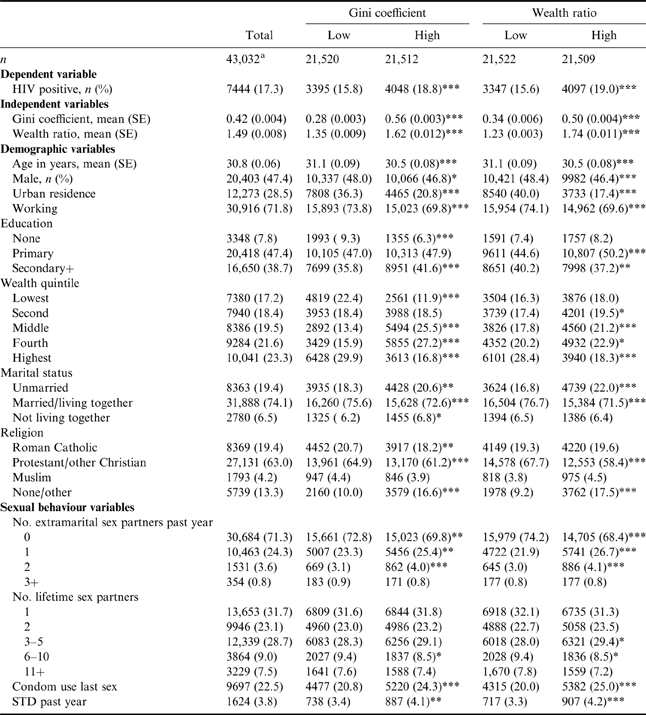
There were significant differences by low and high values (above and below the median) for both key independent (predictor) variables considered in the model and for most demographic and sexual behaviour variables. Table 2 indicates these differences, reporting means and standard errors for continuous variables and counts and percentages for categorical variables. Overall, the mean HIV prevalence rate was 17.3%. The mean percentage of households in the lowest wealth quintile was 17.2%; the percentage of respondents reporting multiple sexual partnerships in the past year was about 29%; the percentage reporting condom use at last sex was 22.5%; and the percentage reporting an STD in the past year was only 3.8%. Results were remarkably similar for the two measures of wealth inequality (Gini coefficient and wealth ratio), and most comparisons between low and high groups within these two separate inequality measures were statistically significant and largely in the anticipated direction. In these bivariate analyses, higher cluster-level Gini coefficients and wealth ratios were associated with higher HIV prevalence rates and generally with higher rates of risky sexual behaviours.
Summary statistics for variables included in final model, by low and high Gini coefficient and wealth ratio

a Estimated population size adjusted for survey sampling frame.
*p<0.05; **p<0.01; ***p<0.001.
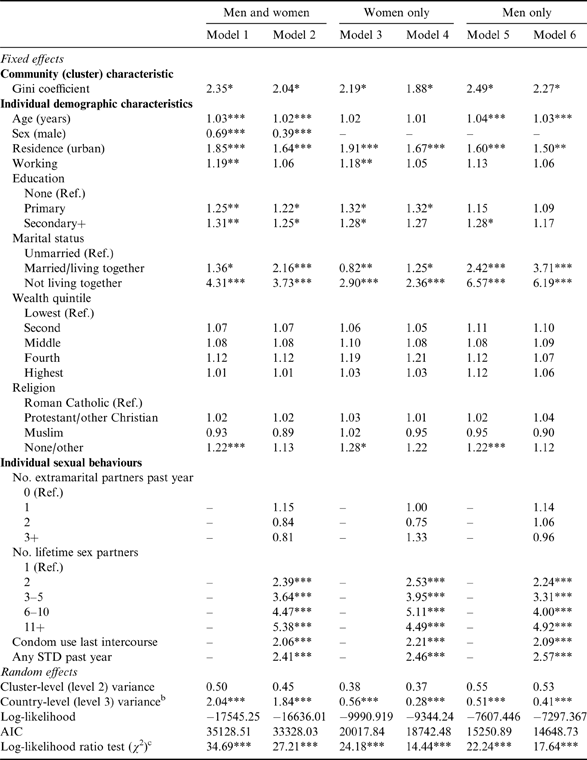
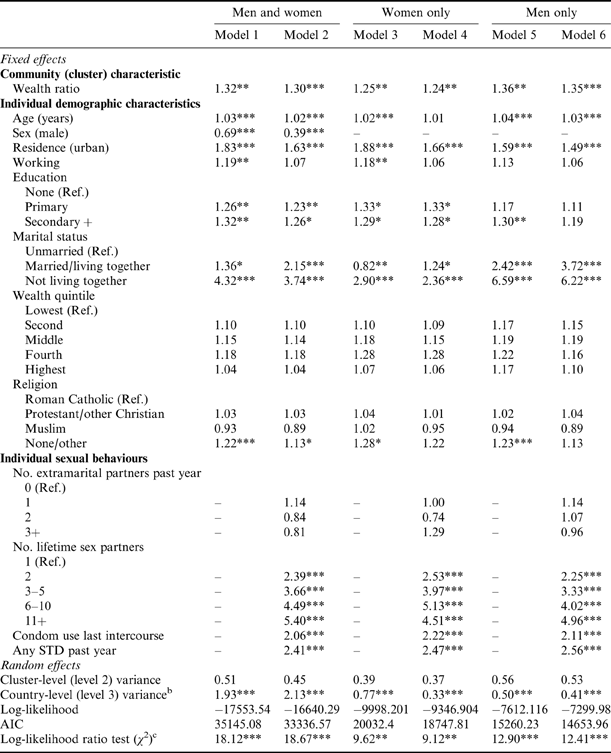
The final multilevel regression models are shown in Table 3 (for the Gini coefficient) and Table 4 (for the wealth ratio), both for women and men combined and separately for women and men. The coefficients and their patterns in the two tables are remarkably similar. Base models (data not shown) including only the dependent variable HIV prevalence rate showed significant variation by country as anticipated from Table 1. In Model 1 of both Table 3 and Table 4, including the key independent variables cluster-level wealth Gini coefficient and wealth ratio, respectively, and individual-level demographic control variables, both inequality measures were associated with an increased likelihood of being HIV positive. Male sex was protective, while urban residence, age and being employed were associated with a slightly increased likelihood of being HIV positive. Compared with unmarried persons (the referent group), those who were married or living together were at higher risk and those not living together were at much higher risk of being HIV positive. Including the cluster-level wealth Gini coefficient and wealth ratio in Model 1 significantly improved the model fit (significant log likelihood ratio test) relative to base models. Both the cluster-level wealth Gini coefficient (OR=2.35, p<0.05) and the wealth ratio (OR=1.32, p<0.01) were associated with a significant increase in the likelihood of being HIV positive. The marginal effect of the Gini coefficient was that a 1 point increase in the Gini coefficient of an SEA cluster was associated with a 2.35 times increased likelihood of being HIV positive, controlling for all other variables in the model. Similarly, a 1 point increase in the wealth ratio was associated with a 1.3 times increased likelihood of being HIV positive, controlling for the other variables in the model.
Parameter estimatesa (odds ratios) for three-level models predicting HIV-positive status, Gini coefficient
a Parameters for predictors (fixed effects) are reported as odds ratio; for random effects, the parameter is the variance.
b Significance of random effects evaluated by comparing model with a similar one in which random effects have been constrained to be zero.
c Compared with model excluding the independent variable.
*p<0.05; **p<0.01; ***p<0.001.
Parameter estimatesa (odds ratios) for three-level models predicting HIV-positive status, wealth ratio
a Parameters for predictors (fixed effects) are reported as odds ratio; for random effects, the parameter is the variance.
b Significance of random effects evaluated by comparing model with a similar one in which random effects have been constrained to be zero.
c Compared with model excluding the independent variable.
*p<0.05; **p<0.01; ***p<0.001.
Adding in the sexual behaviour variables in Model 2 of Tables 3 and 4 attenuated the effects of both measures of wealth inequality. There was a dose-dependent increase in the odds of being HIV positive with more lifetime sexual partners such that reporting eleven or more partners increased the likelihood of being HIV positive over five-fold. Condom use at last intercourse and an STD in the past year increased this likelihood by two and almost two-and-a-half times, respectively. (Note that because this analysis is correlational, endogeneity or reverse causality probably explains the former association, i.e. condom use is likely to be more frequent among those who know they are HIV positive and/or who engage in higher-risk sex.)
Looking at Tables 3 and 4, Models 3 and 4 for women only, some interesting findings are evident. In both tables the odds ratios decrease slightly but remain significant. Comparing Model 1 with Model 3 in both tables, the odds ratio for married/living together (compared with the referent group unmarried) reverses and becomes less than 1 for women, indicating a protective effect for women who are married to or living with their partner, controlling for age (which becomes non-significant in Table 3). More education among women appears to be slightly protective (decreased odds of HIV infection), whereas it appears to increase risk in the combined men–women models. Also, the odds of HIV infection associated with not living together reduces (from 4.3 to 2.9 times) compared with that for men and women combined. Comparing the full models incorporating the risk behaviours (Model 2 compared with Model 4), again age becomes non-significant and the odds ratio for married/living together again becomes greater than 1, suggesting that risk behaviours are mediating some of this effect and removing any protection associated with cohabitation with sexual partners for women.
Looking at Tables 3 and 4, Models 5 and 6 for men only, odds ratios for the Gini coefficient and wealth ratio are larger for men. Age is a significant predictor in both reduced and full models, and education appears to increase, rather than decrease risk, although it becomes non-significant in the full models (Model 6 in both tables). It is apparent that the risks associated with cohabitation and not living together (compared with the unmarried referent group) in the combined men–women model is driven by males. The coefficients increase from Model 5 to Model 6 for married/living together for males, suggesting that some other factors increasing risk are not being fully picked up by the risk behaviours.
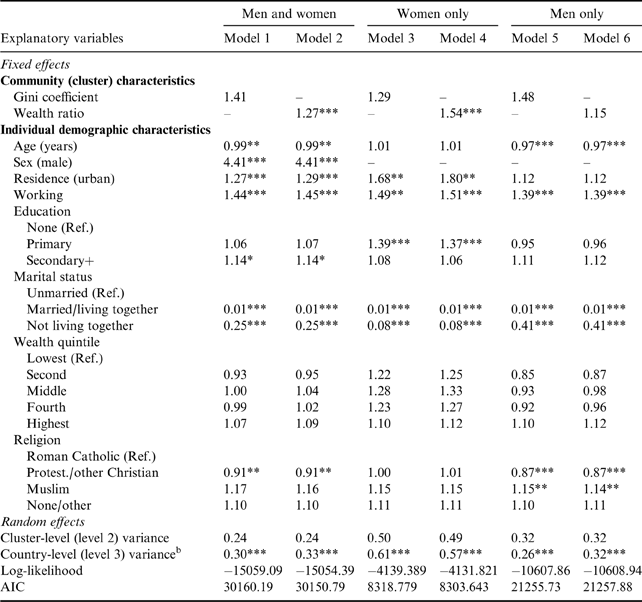
Results from the ordered logit models predicting numbers of extramarital partners in the past year (Table 5) indicated that the likelihood of having more extramarital partners was higher in clusters with more wealth inequality, although this relationship was significant only for the model including the wealth ratio predictor variable (OR=1.27, p<0.001). Not surprisingly, marriage/cohabitation appeared to be highly protective in all ordered logit models (OR=0.01, p<0.001), while being a younger male appeared to increase risk by over 4-fold. Looking at these models by sex indicated several interesting differences. The significant result for wealth ratio held for women (OR=1.54, p<0.001) but not for men (OR=1.15); age was not a significant factor in the models for women but was significant and protective in the models for men; urban residence was a significant risk factor for women but not for men; among women, primary education appeared to be a significant risk factor, while a secondary or higher education was no longer significant (compared with models for women and men combined). The risk associated with secondary or higher education appeared to work in opposite directions for men compared with women, reducing risk for women and increasing it for men. Religion was not a significant factor among women but was among men. Among men, being of Protestant or other Christian faith (compared with Catholic) significantly reduced risk, while being of Muslim faith increased it.
Parameter estimatesa (odds ratios) for three-level ordered logit models predicting number of extramarital partners in the past year
a Parameters for predictors (fixed effects) are reported as odds ratio; for random effects, the parameter is the variance.
b Significance of random effects evaluated by comparing model with a similar one in which random effects have been constrained to be zero.
*p<0.05; **p<0.01; ***p<0.001.
Discussion
The relationships between HIV prevalence and the control variables were all in the anticipated direction based on previous studies and expectations about HIV risk and demographic and sexual variables operating at the individual level. Both the cluster-level Gini coefficient for household wealth and the wealth ratio were significant predictors of HIV serostatus, controlling for all other variables in the models, including household wealth and several known behavioural and demographic predictors of positive serostatus. This is the second known study to produce empirical evidence of these effects using multiple countries and regions in sub-Saharan Africa, and the second to demonstrate this effect at the DHS cluster level by utilizing its inherent population-based survey sampling strategy. Although a large literature suggests that economic inequality increases the risk for a variety of diseases after controlling for absolute levels of wealth or income (Subramanian & Kawachi, Reference Subramanian and Kawachi2004; Wilkinson, Reference Wilkinson2005; Wilkinson & Pickett, Reference Wilkinson and Pickett2009), very few have demonstrated it in the context of infectious disease in developing countries. Similarly to these two prior studies (Durevall & Lindskog, Reference Durevall and Lindskog2012; Fox, Reference Fox2012), there is a persistent association between regional/district- and/or neighbourhood/cluster-level wealth inequality and HIV serostatus after controlling for household-level wealth. Also consistent with these two prior studies, results from models with extramarital partners as the dependent variable suggest that the mechanism is at least in part mediated by an increase in risky sexual behaviour.
Consistent with the one prior study of this association at the DHS cluster level in Malawi (Durevall & Lindskog, Reference Durevall and Lindskog2012) but contrary to findings from national-level studies, household wealth was not significantly associated with HIV-positive serostatus. This result could be explained by more recent evidence pointing to a complex, dynamic association between wealth and HIV serostatus in sub-Saharan Africa. Parkhurst (Reference Parkhurst2010) found that, at the country level, as per capita GDP increased, the confirmed trend for the prevalence of HIV infection to increase with increasing wealth quintile dissipated. He identified a threshold of approximately US$2000 above which this tracking with wealth becomes inconsistent. Half of the countries in the current sample exceeded this GDP threshold. Furthermore, Parkhurst's analysis of trend data from two Tanzania DHS studies suggested that HIV has become more prevalent in poorer individuals as development has progressed (Parkhurst, Reference Parkhurst2010). Similarly, Fox (Reference Fox2012) found that in poorer regions/countries, individuals with more wealth were more likely to be infected, whereas in wealthier regions/countries, individuals with less wealth were more likely to be infected with HIV. She noted that these results, combined with those of prior supportive studies, suggest a changing social gradient with increasing wealth and development in which, due to increasing knowledge, prestige and power, wealthier segments of the population are better able to adapt to new health threats, socially reproducing health inequalities via social stratification mechanisms (Phelan et al., Reference Phelan, Link and Tehranifar2010; Fox, Reference Fox2012).
The null results for the major religious affiliations could be explained in that most national studies have looked at national-level religious affiliation, and most African Muslim nations are supra-Saharan, where HIV prevalence rates are much lower. Muslims comprised a very small segment of this pooled sample (less than 5%) so the power to detect a significant effect was reduced. However, the direction of the odds ratios suggested a slight protective effect for Muslim religion. The significant effect for ‘none/other’ religious affiliation, which is attenuated with the addition of the sexual behaviour variables to the models, is consistent with the possibility of increased risk-taking behaviours in this minority group in association with lower social status or differential treatment based on religion.
Disaggregation by sex indicated that the relationships between community wealth inequality and HIV-positive status were stronger for males. However, in the ordered logit models predicting risk behaviour (number of extramarital partners in the past year), the wealth ratio was a significant predictor only in models for women. Primary education was a risk, and age was not a risk in models for women (these two reversed in the models for males). Although causality cannot be inferred from these results, taken as a whole, they could be interpreted as suggesting a situation in which neighbourhood wealth inequalities, particularly in urbanized areas, are associated with, and possibly promoting, increased extramarital sexual relationships by women of childbearing age, who are able to trade sex for money or resources provided by men in households with greater wealth, thus escalating HIV risk within sexual networks. The positive relationship for women with a primary education could reflect increased contact in urbanized areas, through the educational system, with men seeking extramarital partnerships, with women increasingly engaging in such relationships in contexts of high wealth inequalities but less so as they achieve higher levels of education and a trajectory leading to greater autonomy and financial independence. These results point to the importance of disaggregating by sex in such analyses and exploring potential mechanisms of action/causal pathways through modelling behavioural mediators. They are also consistent with the Nattrass et al. (Reference Nattrass, Maughan-Brown, Seekings and Whiteside2012) panel study, in which household assets were negatively correlated with HIV status for women but not for men, and in which HIV-positive women were much less likely to have made the transition from (primary) school to tertiary education, a transition which would place them on a trajectory of lowered risk.
It is important to note several study limitations. One methodological limitation is the assumption of constant slopes on the beta coefficients for the two key independent variables. However, adding random slopes to the models would have introduced greater complexity and was not necessary for the purposes of the analysis, and the limited number of countries (six) at level 3 precluded adding this feature at that level. Another likely limitation is violation of basic ordinary least squares logistic regression assumptions through inadequate model specification and the presence of omitted variables, which would bias the beta estimate for the key independent variables in the direction of a type-1 error. Clearly the final regression model did not capture all variables affecting HIV prevalence at multiple levels and may conflate to some degree mediation and confounding, but it did capture important available individual-level predictors, and by adding potential behavioural mediators last, it was possible to assess the extent to which some variables might mediate the observed effects of the independent variables. Endogeneity in the independent variables or omission of a ‘left-out common cause’ of both wealth inequality and HIV prevalence in which an omitted variable is associated with both cluster-level wealth inequality and with HIV prevalence, or other forms of omitted variable bias, are also a potential sources of bias in this analysis. Also, the DHS Wealth Index used to construct these independent variables has limitations that may lead to erroneous conclusions regarding the direct effect of wealth on HIV status. Because different assets are used in each country to construct the index (although a basic set of assets, such as type of flooring, water supply, sanitation facilities, appliances, transportation, etc. are included in every survey), it is not directly comparable across countries. Also, the index is not the best proxy for consumption expenditure, the SES measure preferred by economists (Howe et al., Reference Howe, Hargreaves, Gabrysch and Huttly2009). It also tends to negatively weight assets from traditional forms of subsistence production and over-weight assets obtained in the modern cash economy, and thus tends to capture involvement in the modern, cash-oriented economy, which is also highly correlated with both urbanization and education level (Bingenheimer, Reference Bingenheimer2007). This property may help explain its consistent positive association with HIV status among poorer developing African countries. However, the DHS index is considered a reasonable measure of economic well-being, it is the measure that was available in the datasets, and its major purpose was to construct within-cluster relative measures of economic inequality and to control for absolute measures of individual wealth status rather than to compare wealth status across countries.
Also, because these data are cross-sectional, the relationship between wealth inequality and HIV prevalence can only be observed at a single point in time. Reverse causality, in which HIV infection affects household wealth and cluster-level wealth distribution, is undoubtedly present. Although the sexual behaviour variables were somewhat weak measures of HIV risk behaviour (with floor effects and apparent under-reporting), a dose–response relationship for lifetime sexual partners suggested that variance associated with this risk factor was captured. Future studies should try to identify more valid measures of behavioural risk and to assess these factors as potential individual-level mediators in a multi-level modelling framework. Also, these results point to some of the difficulties in doing empirical work in the field of social/structural determinants of health. It is often difficult to relate macro-level social factors to individual health status due to unavailability of accurate measures of both micro- and macro-level factors, and to the complexity of methodologies needed to adequately control for factors operating at multiple levels. Nevertheless, neglect of these higher-level factors moderating individual behaviours risks ascribing too much predictive power to micro-level factors and may lead to missed opportunities to modify social environments and create structural changes that induce more health-supportive behaviours.
Acknowledgments
The author would like to thank Drs Mark Holmes and Benjamin Meier for helpful suggestions and advice in drafting this manuscript, and Dr Bates Buckner for her encouragement. This work was supported in part by an NIH center grant (R24 HD050924) to the Carolina Population Center, the University of North Carolina at Chapel Hill.