Natural resources such as fuels and minerals can supposedly be beneficial to the development of a national economy, especially in developing countries.Footnote 1 Paradoxically, natural resources in many developing countries not only fail to deliver growth-promoting effects but are associated with sluggish economic development, weak political institutions and social conflicts.Footnote 2 When trying to explain why and how resource endowment appears counterproductive, some scholars focus on human development and point out that resource-rich countries tend to neglect the cultivation of human resources which are crucial for long-term economic growth. For instance, a study by the Organization for Economic Cooperation and Development (OECD) compares the performances of different countries in the Program for International Student Assessment (PISA) exam, which tests the mathematics, science and reading comprehension skills of 15-year-olds in 65 countries every two years, and finds a significant negative relationship between a country's total earnings from natural resources as a percentage of GDP and the knowledge and skills of its high school population.Footnote 3
Do resources pose a curse on human development? This study aims to answer this question with empirical evidence from China. Although China is far from resource dependent at the national level, there are rich deposits and a vast variety of natural resources, such as coal, ferrous and non-ferrous metals, nonmetals, oil and natural gas, distributed across the country. These resources are not only crucial for local economic livelihoods and fiscal income but also generate profound social, political and environmental impacts on the host regions. Although a growing literature has tried to assess how resources influence local economic growth in China,Footnote 4 inadequate attention has been paid to how they impact other social outcomes such as human development. To bridge this gap, this study investigates how resource abundance influences the provision of human capital-enhancing public goods, namely education and health care, by Chinese local governments.
We adopt a mixed research method that combines large-N quantitative analysis of all Chinese provinces and qualitative case studies of selected mining areas. This method allows us not only to test the impacts of resource endowment systematically but also to identify their causal channels. We start with a cross-regional and longitudinal data analysis of the Chinese provinces, and find that resource dependence significantly reduces local public expenditure on education and health care. In order to explain further the lack of incentive to spend on these human capital-enhancing public goods in resource-rich regions, we conducted extensive, in-depth field research in several mining areas in Shanxi province, Jiangxi province and Inner Mongolia Autonomous Region. The interviews and data we collected from and about these sites reveal that the local economic structure and reduced demand for labour, the shifting of responsibilities from the state to the mining sector, and the myopia of local residents and officials all combine to discourage government spending on human capital development.
Our findings contribute to the ongoing debate on whether and how resources affect development. The new evidence from China confirms that a reliance on mineral resources discourages public investment in human development. This study also depicts a more nuanced picture about public goods provision in China. The conventional wisdom is that Chinese local governments tend to undersupply public goods that do not generate instant economic or political returns because of a cadre evaluation system which emphasizes hard indicators such as GDP and fiscal revenue; however, this does not explain the cross-regional variation in the provision of certain public goods. We find that resource dependence, an important explanatory variable that has been overlooked by existing studies, engenders additional disincentives for the local provision of human development-promoting public goods such as education and health care.
The rest of this article is organized as follows. The second section reviews the comparative literature on the relationship between resource endowment and human capital development. The third section justifies the use of the subnational approach to analyse the resource curse in China. The fourth section conducts a panel data analysis to assess the effects of resource dependence statistically. Through detailed case studies, the fifth section explores the disincentives for local public investment in human development. The last section concludes.
Resources and Human Capital: Comparative Experiences
Countries with rich natural resources such as fuels and minerals are often found to suffer from sluggish economic development.Footnote 5 Scholars have used different angles to explain this paradoxical phenomenon. The famous Dutch disease theorem argues that the boom of the resource sector undermines the non-resource sectors and the long-term prospects for development.Footnote 6 Other scholars find that there is little public or private incentive to promote human capital accumulation, which is crucial for long-term economic growth, in countries dependent on the export of resources, especially petroleum. Footnote 7
Existing studies have advanced a few arguments on why resource-rich countries tend to neglect human capital development. From the economic perspective, the Dutch disease theorem argues that the boom of the natural resource sector diverts capital and the labour force away from the non-resource sectors.Footnote 8 Compared to the mining industries, which are capital intensive, the non-resource sectors, including manufacturing industries, require more advanced labour skills.Footnote 9 However, the lesser appeal and lack of competitiveness of these non-resource sectors, especially the high-tech and service industries which require high-level human capital, diminish the demand for a more comprehensive education of the labour force beyond the basic working skills. Moreover, compared to the manufacturing industries, the mining industries lack beneficial forward and backward linkages with the rest of the economy, which prohibits a more complex division of labour and the advancement of specialized labour skills.Footnote 10 Under such circumstances, the economic incentives to invest in the cultivation of human resources tend to be low.
An institutional analytical approach highlights the role played by the rentier state, that is, a state that derives the dominant share of its revenue from resource rent rather than from productive income.Footnote 11 As resource rents reduce the government's reliance on revenue derived from the taxation of the general population, the rentier state has less incentive to respond to citizens' needs and to provide public goods.Footnote 12 Moreover, when the political elite is narrowly based on a fixed and identifiable support group, it is motivated to prioritize the redistribution of resource rents within the support group over the provision of public goods to the general population in exchange for political support and regime stability.Footnote 13
Alongside a lack of motivation, there are at least two other reasons why the rentier state has a weakened capacity to provide public goods such as education and health care.Footnote 14 First, as its reduced dependence on taxation undermines its connection to the general public, the rentier state tends to lack socially intrusive and elaborate bureaucracies,Footnote 15 which are essential for the effective delivery of public goods. Furthermore, the existence of rich, easily extractable resources often attracts criminal gangs, warlords and military rebels, all of which can weaken a government's territorial control and its ability to maintain law and order.Footnote 16 When a government's control is contested or diluted by extra-legal forces, it becomes difficult for the government to carry out many of its functions and its capacity to provide public goods may be negatively affected.
There are studies that have drawn attention to the reshaping effects of resource endowment on people's cognition and psychology. Development scholars have long suggested that a resource boom can induce either myopic sloth or exuberance in policymakers.Footnote 17 The short-sightedness of policymakers in resource-abundant countries may prevent them from investing in the public goods that are vital to long-term prosperity.
However, there are those who dispute the negative effects of resources on human capital accumulation.Footnote 18 They disagree with the cognitive argument and contend that people are revenue maximizers instead of revenue satisficers, and thus a resource boom should not discourage investment in human capital.Footnote 19 Furthermore, some argue that state actors are typically well informed about the consequences of resource booms and receive advice from the World Bank and other international organizations, which prevents them from ignoring human capital development.Footnote 20 So it follows that controversies exist regarding whether a resource boom generates negative impacts on a government's incentive to provide human capital-enhancing public goods.
Studying the Resource Curse in China: A Subnational Approach
So far the resource curse literature is mostly based on international comparisons or country-level case studies, with individual countries as the analytical unit. Only recently have scholars started to zoom in on single countries and examine the impacts of resource abundance on social, economic and political outcomes at subnational levels.Footnote 21 An important benefit of the subnational approach is that it helps to alleviate the institutional heterogeneity issue in cross-national comparisons, because although regional variations exist within countries, the nationwide institutional settings such as regime type and bureaucratic structure control for these potentially intervening factors. Moreover, studying the local conditions within one country allows more accurate examination of the causal effects of resources. Therefore, subnational analysis is a worthwhile approach to advance the discourse on the curse of natural resources.
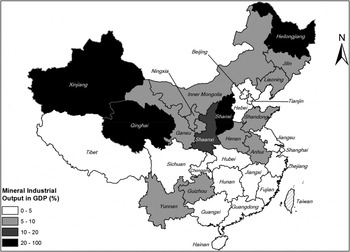
This study conducts a subnational analysis on China. The Chinese economy is not driven by resource export, and China does not exhibit any major symptoms of the resource curse at the national level; however, many of its localities host rich natural resources, including fuels, minerals, and most notably coal, and rely heavily on these resources for economic income and fiscal revenue. Defining the resource dependence rate as the percentage of mineral industrial output in GDP, Figure 1 shows that the resource sector plays substantial roles in quite a number of Chinese provinces, especially those in the inland areas.
Average Resource Dependence Rates of Chinese Provinces (1999–2009)

The resource sector contributes not only to the economy but also to the central and local fiscal coffers through taxation and non-tax exactions. In general, mining enterprises pay value-added tax (VAT), income tax, and on a much smaller scale, resource tax, which are shared between the central and local governments at certain rates.Footnote 22 They also pay business tax and other local taxes that go exclusively to the local treasuries. Moreover, local governments impose a large variety of non-tax charges on the resource sector. For example, Shanxi province collects from the coal industry such fees as the Coal Sustainable Development Fund (meitan kechixu fazhan jijin 煤炭可持续发展基金), Enterprise Transformation Fund (qiye zhuanchan jin 企业转产金), and Environmental Protection Deposit Fund (huanjing baohu baozheng jin 环境保护保证金), which are all local revenues and not shared with the centre.Footnote 23 Overall, local governments in resource-rich regions are usually heavily dependent on the resource sector for fiscal revenue (a fundamental characteristic of the rentier state), and this may well affect their rationales in policymaking, including the provision of public goods.
The Chinese economy is highly decentralized along geographical lines. The decentralized economic structure had long existed under the command economy in the pre-reform era,Footnote 24 and post-Mao reform since the late 1970s has further enhanced regional economic autonomy.Footnote 25 Local governments enjoy considerable discretion in economic policymaking and benefit directly from local economic growth. Therefore, they have both the autonomy and the incentive to create economic policies that best suit their interests.
Specifically, the provision of public goods, including education and health care, is highly localized in China. Local governments are responsible for around 80 per cent of national budgetary expenditure, and are tasked with providing the vast majority of public services such as infrastructural construction, social welfare and public security. Although the central government makes transfer payments to sponsor local expenditures, these fiscal transfers only meet a small fraction of the local needs, especially at the grassroots levels. In 2010, local governments shouldered 82.7 per cent of the national total expenditure on education, central government provided only 4.9 per cent of the total expenditure, and the central transfers expended via local governments accounted for another 12.4 per cent. In terms of health care, local governments were accountable for 69.1 per cent of the national total expenditure, central government a meagre 1.5 per cent, and the central transfers expended via local governments accounted for 29.4 per cent.Footnote 26 Under such a highly decentralized system, the provision of public goods is heavily impacted by the fiscal capacities and preferences of local governments.
China's current cadre evaluation system does not prioritize the provision of public goods when assessing the performance of local officials, and public goods such as education and health care usually give way to administrative expenses and economic construction.Footnote 27 Nevertheless, there is considerable cross-regional variation in local public expenditures on education and health care. Some regions, such as Beijing, Shanghai, Zhejiang and Tibet, spend notably more than the other provinces on these human capital-enhancing public goods. How to account for such cross-regional variation? Do resources play a role, as the comparative studies suggest? We propose the hypothesis that if a regional economy relies more heavily on the resource sector, the local government will spend less on human capital-enhancing public goods.
Resources and Public Expenditure on Human Capital: A Statistical Analysis
To test the hypothesis empirically, we conduct a panel data analysis on the 31 Chinese provinces from 1999 to 2009, a period when China experienced a boom in the resource market as prices and demand rose. The statistics come from China Land and Resources Statistical Yearbook 2000–2010,Footnote 28 Finance Yearbook of China 2000–2010,Footnote 29 China Statistical Yearbook 2000–2010, China Population Statistics Yearbook 2000–2006, China Population and Employment Statistics Yearbook 2007–2010 Footnote 30 and China Data Online. Footnote 31
We have two sets of dependent variables that measure a province's investment in human capital development, namely expenditures on education and health care. For education, we use per capita budgetary expenditure on education, including expenditure on pre-schools, elementary schools, junior high schools, high schools, vocational schools, universities, professional training, and distance education, etc. For health care, we use per capita budgetary expenditure on health care, which includes spending on hospitals, community medical services in urban and rural areas, epidemic prevention, maternity care, child care, and drug administration, etc.Footnote 32 To offset the effects of inflation, we calculate real per capita expenditures by dividing the nominal expenditures with the provincial deflator (with 1998 as the base year). There was a notable rising trend in real education and health care expenditures between 1999 and 2009, reflecting the Chinese government's increasing investment in human development, although cross-regional variations were persistent in both expenditures.
The key explanatory variable, resource dependence rate, is measured by the share of industrial output of mineral industries in GDP. According to China's Mineral Resource Law, mineral resources include crude oil, natural gas, coal, other nonmetal minerals, ferrous metals, nonferrous metals and salt, with coal as by far the largest category, making up around 70 per cent of the national mineral industrial output in 2009.Footnote 33 We focus on locally extracted and processed mineral resources that can directly or indirectly contribute to the local economy, and exclude offshore oil and natural gas in our data analysis. The resource dependence rate varies both spatially and temporally. Inland regions such as Heilongjiang, Shanxi, Qinghai and Xinjiang are commonly more resource-dependent than the coastal regions. On the other hand, owing to the booming mineral market, most provinces, even the less resource-dependent ones, witnessed generally increasing rates of resource dependence from the turn of the millennium until the 2008 financial crisis, which caused sharp drops in 2009.
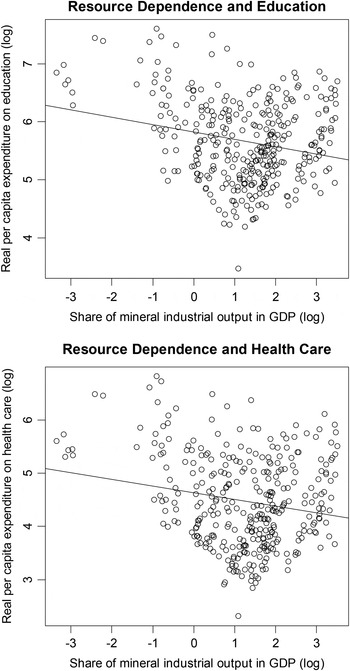
A simple bivariate analysis reveals a striking negative correlation between resource dependence and public expenditures on education and health care. By plotting per capita education expenditure and health care expenditure against the resource dependence rate, respectively,Footnote 34 Figure 2 shows that both expenditures decrease as the resource dependence rate increases.
Resource Dependence and Expenditures on Education and Health Care

In addition to resource dependence, previous studies have suggested a few other factors that may influence local expenditure on public goods and need to be controlled for in the data analysis. First of all, the economic development level has been identified as an important determinant of public goods provision. With the development of the economy, citizens tend to demand more public goods of higher quality.Footnote 35 Meanwhile, the local economic development level determines the fiscal capacity of local governments and consequently affects their provision of public services.Footnote 36 Therefore, we include real per capita GDP (nominal per capita GDP divided by the provincial deflator) to control for economic development level.
Generally, Chinese local governments have few incentives to spend on public services. A previous study finds that those localities which are less reliant on subsidies from above tend to spend a smaller share of their annual expenditures on public education.Footnote 37 In this sense, fiscal transfers from the central government can encourage the provinces to spend more on human capital-enhancing public goods. However, there exists a potential endogeneity problem, because the central government may make fiscal transfers in response to the local need for public goods. Therefore, we include the lagged (one year) real per capita central fiscal transfer (nominal fiscal transfer divided by the provincial deflator) as a control variable, which, arguably, influences the current public expenditures but should not suffer from reverse causality.
Population size and density may also influence the demand for and supply of public services. In a larger population, society may become more congested and the demand for public services may increase accordingly.Footnote 38 On the other hand, some argue that economies of scale may decrease the unit cost of public services as the population density grows.Footnote 39 In either case, we need to control for the influence of the population density. Therefore, we include population density, i.e. total population divided by the geographical area of a province, as a control variable.
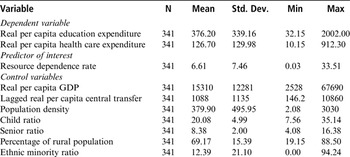
The supply and quality of public goods may also be influenced by the composition of the local population. First of all, different age groups may have varying needs for public goods. For example, the younger generation needs more educational services, while the elderly may require more medical services. To control for the age structure of the population, we include child ratio (the percentage of the population aged 15 or under) and senior ratio (the percentage of the population aged 65 or above). Second, the notorious urban–rural divide in China may distort the provision of education and health care towards urban citizens. To counter this bias, we use the rural share of employed persons to measure the portion of rural residents in the total population. Lastly, for purposes of national unity, ethnic minorities generally receive more favourable policies from the Han Chinese-dominated government. Thus, their presence in the population may increase local expenditure on public services. We use the share of ethnic minority population in the total population to measure the weight of ethnic minorities. The summary statistics of the dependent and independent variables are presented in Table 1.

We use a fixed effects modelFootnote
40
to conduct the panel data analysis with the following formula:
 ${Y_{it}} = \gamma {R_{it}} + \prod^{\prime} {X_{it}} + {\lambda _i} + \zeta_t + {\varepsilon _{it}}$
, where i (i = 1,2,…31) indicates the 31 provinces and t (t = 1,2,…11) indicates the 11 years from 1999 to 2009.
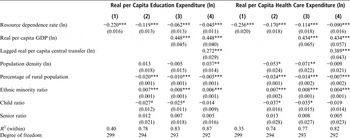
The dependent variable Y represents the real per capita expenditures on education and health care, respectively. R is the predictor of interest, resource dependence rate. X is a vector of control variables, including real per capita GDP, lagged real per capita central transfer, population density, child ratio, senior ratio, percentage of rural population, and ethnic minority ratio. The variable λ is the province-specific effect, and ζ the time-specific effect. The error term ε captures the effects of other disturbances on the dependent variable. To satisfy the normal distribution assumption, the highly skewed variables are normalized by using natural logs. To address potential endogeneity issues, we progressively include the independent variables in the estimation, starting with the variables unlikely to be endogenous. The models yield rather robust and consistent results (see Table 2).Footnote 41
Impacts of Resource Dependence on Education and Health Care Expenditures

Note:
The numbers in the parentheses are standard errors. Significance codes: *** p < 0.001; ** p < 0.01; * p < 0.05.
The regression results confirm that resource dependence negatively affects local public expenditures on education and health care, and the effects are statistically significant in all the models. According to Model 1, on average, the most resource-dependent region would spend 1.7 yuan less per head on education than would the least resource-dependent region, and two yuan less per head on health care. Considering that the lowest per capita expenditure on education was 32 yuan and the lowest per capita expenditure on health care was only ten yuan during the period of this study, the impacts of resource dependence are tangible, especially on health care expenditure. Therefore, the presence of rich mineral resources does undercut local public investment in human capital in China.
Economic development and central subsidies are important determinants of education and health care expenditures. First, economic development enhances local governments' investment in education and health care. This is unsurprising because governments in richer regions have more financial resources with which to provide such services. Meanwhile, the citizens perhaps have a greater demand for such public goods. Second, the positive effects of central fiscal transfers indicate that central subsidies have been crucial for financing those public services that develop human capital. Given the weak local incentives to prioritize public expenditure that does not directly and visibly boost the local economy or the political careers of local officials, the central government has to use fiscal transfers as a tool to correct such tendencies.
The demographical factors also matter, but to varying degrees. The statistically significant negative effects of rural population suggest that notably less is spent on education and health care for rural residents than for urban citizens. The clear urban bias confirms that the long-existing urban–rural divide in China is also manifest in the provision of public goods, and the gap has not disappeared since 2003 when the Chinese central government started to pay more attention to the “three rural problems” (sannong wenti 三农问题). On the other hand, ethnic minority ratio increases education and health care expenditures, and the effects are statistically significant and robust. The favourable treatment of minority populations is probably a deliberate tactic used by the Han-dominated Chinese government to win the support of ethnic minorities. Population density appears to increase per capita expenditure on education but has a negative effect on the spending on health care, although the effects are statistically significant only in some models, suggesting that health care services may benefit from economies of scale, while education services tend to be congested in populated regions. Finally, a perplexing result is that child ratio seems to decrease education and health care expenditures, while senior ratio increases these expenditures, although the effects of senior ratio are statistically insignificant. It reveals an apparent bias against the younger generation in public expenditure, and calls for more in-depth research on the effects of the age structure on the provision of public goods in China.
How Do Resources Matter? Case Studies of Mining Areas
To explain why resource dependence discourages local spending on education and health care, we conducted case studies of five mining areas in three provinces in China: F City (county level) in Jiangxi province, T City and Y City in Shanxi province, and A League (meng 盟) and E City in Inner Mongolia Autonomous Region. We selected these prefecture and county-level localities for several reasons. First, the observations at these local levels and the interviews with the stakeholders on the ground allowed us to appreciate how the resource sector operates and affects the local state and society. Second, under the current division of fiscal responsibilities among different government levels, the prefecture and county levels bear the greater part of the financial burden for public education and health care services. Thus, the examination of these levels is crucial to the understanding of the provision of public goods in China. Third, our selected localities are typical coal-dominated economies. They are representative of the resource economies not only in their own provinces but also in many other regions in China, given that coal is the most abundant of China's mineral resources. Lastly, these localities differ in multiple dimensions, including the stage of resource exploitation (established versus emerging coal producers), size of population and territory, economic development level, degree of urbanization, and geographical location, etc. which allows us to test the robustness of the effects of resources under different conditions.
We visited the five sites, some multiple times, between April 2011 and October 2013, during which we conducted face-to-face interviews with local officials in coal bureaus, fiscal and taxation departments, development and reform commissions, and work safety supervision departments, etc., as well as with village cadres, managers of state-owned and private mining enterprises, researchers, lawyers and local citizens. Although individual sources of information may carry certain biases as to what information is released, the multiple sources cross-validate each other and allowed us to generate a relatively reliable picture about these sites. We also obtained official documents and statistics from the interviewees, government websites and published statistical reports. Our interviews and observations reveal several causal channels through which the presence or discovery of coal influences local incentives for the provision of public goods. While some of the findings echo the experiences of other resource-rich countries, there are also unique phenomena that have not been discussed in comparative studies.
Economic structure and demand for labour
The Dutch disease theorem argues that a resource boom undermines the manufacturing sector.Footnote 42 The direct deindustrialization effect is felt acutely in the mining areas in China. Although the original Dutch disease theorem concerns the deindustrialization of manufacturing industries, the resource boom in China not only crowds out manufacturing industries in relatively industrialized regions but also squeezes out primary industries in traditionally agricultural economies.
Y City in Shanxi is a typical example of the first type. Under the Maoist planned economy, although designated as a strategic base to supply fuel and raw materials for the nation's industrialization, Y City strived for economic self-sufficiency through industrial diversification, and it successfully established different heavy and light industries. However, when the market reform started in the 1980s, the non-coal manufacturing industries found themselves in increasingly disadvantageous positions in the national market, whereas the coal sector enjoyed a considerable competitive edge and became dominant in the local economy. By 2011, 60 per cent of Y City's GDP came from the secondary sector, and over 90 per cent of the large-scale industries were coal-related. A significant share of the tertiary sector, which accounted for 38 per cent of the GDP, provided services to the mining sector, such as the sales and transportation of coal.Footnote 43 Similar patterns also show up in T City and F City.
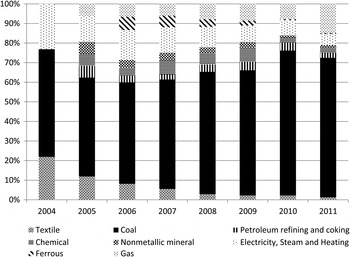
Meanwhile, the resource boom has crowded out the primary industries in Inner Mongolia. E City has traditionally been famous for cashmere production. However, since it discovered a huge coal reserve in recent years, coal and related energy and chemical industries have rapidly dwarfed cashmere production and the cashmere-based textile industry (see Figure 3). Even the largest cashmere producer started to diversify its investments and entered coal-related business in 2003. Similarly, A League also turned from a traditional economy based on agriculture and husbandry to an industrial economy after it discovered rich coal mines in the last decade. In recent years, around 80 per cent of its economy has been derived from the secondary sector, in which coal and coal chemical industries made up 80 per cent and made by far the largest contribution to local fiscal revenue.Footnote 44
Composition of Industrial Added Value by Large-Scale Industries in E City, Inner Mongolia (2004–2011)

Such crowding-out effects were not only the result of rising coal prices since the early 2000s, which made coal-related industries highly profitable, but were also attributable to the peculiar taxation system in China. All enterprises in China pay largely the same taxes, including VAT, income tax and business tax, at the same rates, regardless of the type of industry. For exploiting the state-owned mineral resources, mining enterprises only need to pay resource taxes at very low rates, which are almost negligible when compared with the other major taxes. For instance, in a coal-mining district of Y City, VAT and enterprise income tax accounted for 53.5 per cent and 17 per cent of the tax revenue, while resource tax contributed a mere 3.7 per cent.Footnote 45 Similarly, resource tax only contributed 1.5 per cent of the tax revenue collected in a coal-mining district of F City in 2011.Footnote 46 The low resource tax rates make mineral resources essentially costless for the mining enterprises, thus giving them a considerable competitive edge. Consequently, the discovery of mineral resources in a region attracts a great deal of investment to the mineral-related industries there, crowding out the non-resource sectors, including both primary and manufacturing industries.
While replacing other industries, increasing mechanization means that capital-intensive mining industries typically do not provide commensurate job opportunities. In T City in Shanxi, the mining industry only created around 15 per cent of the job opportunities in the secondary sector.Footnote 47 Compared to Shanxi, mining in Inner Mongolia is even more labour efficient owing to even higher levels of mechanization. Moreover, many of the limited number of jobs in the mining industries do not require a high level of education or labour skills. Apart from some managerial and technical posts, most of the jobs in the mining companies are for miners and mechanical workers on the ground, for which only limited skills are needed.Footnote 48 However, when the labour-intensive non-resource industries, such as the manufacturing industries in Y City and the husbandry sector in E City, were squeezed out, it significantly reduced the demand for labour in these regions. For instance, in one town of E City, around 50 per cent of the peasants and herdsmen lost their land to mining and processing facilities. Although the township government encouraged these people to engage in service industries such as transportation, sales and catering (mainly serving the mining enterprises and their employees), many remained jobless, especially the older people.Footnote 49 As the demand for labour declined in these regions, naturally the local governments were less inclined to spend on education and health care services to keep its labour force educated and healthy.
Moreover, the mining enterprises' reliance on migrant workers may further erode the local governments' incentives to invest in human resources in resource-rich regions. The mining enterprises commonly prefer to hire migrant workers rather than local residents. Underground mining work often entails dismal working conditions and a high risk of fatal accidents, especially in smaller privately owned mines with substandard safety conditions. As we shall explain below, local residents are generally reluctant to work in the mines. However, many migrant workers from other provinces, such as Henan, Shaanxi and Sichuan, are attracted by the relatively high wages and low skill requisites demanded. In addition, the small number of less dangerous technical and managerial positions require a technical specialty or a higher educational level, a requirement that local citizens mostly do not meet. Thus, the mining companies also have to look elsewhere to recruit workers for these positions. For example, in T City, a private mining company hired its entire team of miners and technicians from Jiangsu province.Footnote 50
Mining companies also prefer to hire migrant workers because they are more easily managed and disciplined than locally hired employees. Lacking social connections in the workplace, it is more difficult for migrant workers to organize themselves to protect their interests against the harsh working conditions. In contrast, local residents are more likely to stage collective protests over labour disputes or mining injuries and fatalities. As a result, non-local workers compose the majority of the labour force in many mines.
The reliance on migrant workers may further reduce the incentives for local governments to invest in the education and health care of its own labour force. The current household registration system and the highly localized provision of public goods in China mean that citizens can only access most public services in the regions where they are registered. Therefore, local governments in mining areas do not have to provide educational or health care services for migrant workers, who must return to their places of origin for these services. Furthermore, the high labour mobility across regions in China also weakens the incentives for local governments in mining areas to invest in the human capital of the migrant labour force – as this may well end up benefiting other regions.
Shifting of governmental responsibilities
Besides eroding local governments' incentives to spend on education and health care, the existence of the resource sector also allows local governments to shift their responsibility to provide public goods conveniently to the mining enterprises. Similar to the work units (danwei 单位) established under the Maoist planned economy, the state-owned mining enterprises normally form close-knit communities that accommodate the employees and their families and take on many of the responsibilities usually assumed by the government (qiye ban shehui 企业办社会). The enterprises provide and pay for various public services not only for their employees but also for the residents in the neighbourhood, including child care, elementary and secondary education, medical care and public security, etc. In Y City, the coal industry ran its own education bureau, which managed more than ten elementary, junior high and high schools. In F City, one mining company even had jurisdiction over the entire town where it is located. Alongside sponsoring schools, it also constructed roads and provided water and electricity at low prices for the neighbouring villages. Before the abolition of agricultural taxes, this mining company even paid the agricultural taxes for the villagers. Although many work units in non-resource sectors have long since been dismantled as a result of the market reform, the mining enterprises continue to carry out the multiple functions assigned to them in the Maoist era and provide public services to local residents. Only recently did the local governments start to take over the mining enterprise-run schools,Footnote 51 but many other services – including medical services – still remain the responsibility of the mining companies as of 2013.Footnote 52
Under such circumstances, the mining enterprises share a large part of the public service responsibilities and expenses that should be borne by the government. For example, a state-owned coal enterprise in T City spent more than two million yuan per year on local elementary and secondary schools before they were transferred to the local government. Even after the local government took on the responsibility for the schools, the enterprise still had to finance the salaries and benefits of the school employees for two more years; the same enterprise continues to run the hospital, which costs around two million yuan per year.Footnote 53 Local governments in mining areas are thus able to cut down on their expenditure on education and health care owing to the mining enterprises' contributions in these areas.
Although they compensate to some extent for the public services that local governments fail to provide,Footnote 54 the standard of the educational and medical services provided by mining enterprises can often be inconsistent and of poor quality owing to the conflicting goals and fluctuating profitability of the enterprises. In pursuit of economic profits, the mining enterprises do not necessarily prioritize expenditures on these services, and thus their quality is hardly guaranteed. Moreover, when the mining enterprises suffer poor market conditions, they often cut back on public service expenditures. For example, when the coal price dropped shortly after the Asian financial crisis in the late 1990s, the mining companies in Y City paid their teachers in arrears, which greatly affected teaching quality and led to the loss of many good teachers in the schools.Footnote 55
Myopia of local citizens and officials
Although comparative studies disagree on the cognitive impacts of resource abundance on citizens and policymakers, there exists perceptible myopic sloth among the residents in resource-rich regions in China, which may contribute to the neglect of human capital development. In the five localities we visited, a large number of local residents lived off the income derived from the discovery of resources in their region instead of actively working in agriculture or manufacturing. Residents in the villages where sizeable mineral reserves are discovered can enrich themselves by selling the collectively-owned land. In E City, for instance, some rural households received as much as one million yuan in cash, plus other housing and social welfare benefits from the local government and mining enterprises, as compensation for the loss of land. This allows households to live a very decent life for decades without working. And, indeed, not a few people choose not to work after winning the “resource lottery.”Footnote 56 Second, people with sufficient funds and strong political connections with local officials can seek mining rights and operate their own mines. Many such private mine owners have made a fortune in the past decade. Furthermore, when the government recently started to shut down or consolidate small and medium-sized mines, many owners sold their mines for handsome prices.Footnote 57 Third, the less well-off local residents can engage in derivative businesses from the mining sector, such as acting as middlemen between sellers and buyers of mineral products and providing transportation and property management services for the mining companies. Owing to their strong sense of entitlement to the mineral resources discovered in their villages, villagers often monopolize these secondary businesses and force the mining companies to use their services. Last but not least, some local residents invest their newly acquired wealth in real estate speculation and usury, sometimes earning interest rates as high as 30 per cent.Footnote 58
In all these ways, the relatively high and easily acquired income from direct or indirect involvement in the mining sector strongly discourages local residents from engaging in any jobs that require hard work or advanced labour skills. Under such circumstances, local residents tend to lack the motivation to invest in their own human capital by, for example, entering into higher education. In the words of some local residents, the people in these mining areas are “lazy,” “conservative” and have a “lack of ambition,” and some “would rather live on social security cheques than to work in the mines.”Footnote 59 Even worse, some local residents become psychologically dependent on the resource wealth. During our field research, we often heard complaints about the unreasonable requests put forward by local residents to mining companies. Some villagers, driven by their sense of entitlement to the resources under their village, would try every means to extort money from the mining enterprises. For example, when some residents needed money, they would block the road and ask the mining companies for cash or coal. If property belonging to villagers was damaged, they would ask the mining companies for compensation, even when there was insufficient evidence to support their claims. To appease the villagers and avoid trouble, the companies often provide the villagers with extra benefits such as food and coal during festive times. At the same time, local governments, wary of social instability, also pressure the mining enterprises to meet these unreasonable requests. As a result, some local residents quickly realize that blackmailing the mining companies is a most efficient way to make money.Footnote 60 It is hardly surprising that the local residents who exhibit such parasitical psychology (chidahu xinli 吃大户心理) lack the motivation to invest in their own personal development.
When citizens pay less attention to the cultivation of human capital, local governments are under less pressure to provide human capital-enhancing public goods. Moreover, similar tendencies of psychological dependence on coal (kaomei chimei 靠煤吃煤) also manifest among local officials in the mining areas. Because the hard indicators of their performance evaluations, economic growth and fiscal revenue, are largely determined by the resource market and macroeconomic environment, there is little local officials can do to improve their performance. As a result, they are interested only in making policies that provide boosts to the coal industry and not in spending more on human capital development.
As mentioned above, some scholars dispute such cognitive effects of resource abundance, arguing that policymakers should understand the unsustainability of resource booms in the long run and that people should be revenue maximizers instead of revenue satisficers.Footnote 61 However, the empirical evidence from China confirms the existence of short-sighted behaviour on the part of both the policymakers and the citizens. Local officials in China do not have long horizons owing to the limited tenure of political positions, and hence they tend to pursue policies that generate instant returns but ignore those that are beneficial only in the long run. At the same time, the behaviour of some local residents should not necessarily be understood as revenue satisficing, because when compared with farming and manufacturing jobs, riding on the tail of the mining sector is a most cost-efficient way to maximize their revenues, especially considering the low income levels prevalent in agriculture and manufacturing industries in China.
Conclusion
Comparative studies suggest that countries endowed with rich natural resources such as fuel and minerals often fall behind in human development. Several economic, institutional and cognitive arguments have tried to explain why rich natural resources undermine public or private investment in human capital. However, there have been insufficient empirical studies to substantiate the correlation as well as the causal links between resource dependence and human capital development. This study focuses on China and employs a subnational approach to investigate the impacts of resource dependence on human capital development. The single-country case study alleviates – although may not entirely eliminates – the institutional and cultural heterogeneity which is often present in cross-national studies. By adopting a mixed research method that combines cross-regional and longitudinal data analysis and in-depth case studies of selected mining areas, we find that local governments in resource-dependent regions in China do tend to spend less on human capital-enhancing public goods such as education and health care, and we identify several channels through which resource dependence affects the incentives for local governments to invest in human capital.
First, the booming resource sector crowds out other labour-intensive non-resource sectors, including manufacturing and primary industries. The diminished demand for labour is aggravated by the mining enterprises' reliance on migrant workers for both economic and political reasons. The reduced need for labour, together with the inflow of a non-local labour force, weakens the incentives for local governments in mining areas to provide education and health care services in order to ensure the supply of a skilled and healthy labour force.
At the same time, local governments in resource-rich regions in China shift their responsibilities to provide public goods onto the mining enterprises, partly as a legacy of the Maoist planned economy. Although the local governments do not completely ignore citizens' needs, by passing responsibilities onto the mining enterprises they leave local residents exposed to the serious risks of inadequate and unstable educational and health care services because the mining enterprises prioritize the pursuit of economic profits and are vulnerable to market shocks.
Finally, resource abundance induces myopic sloth among local residents and officials. The easy and lucrative income from resource wealth has tangible impacts on local residents' mentalities and discourages them from seeking jobs that require hard labour and advanced labour skills. Meanwhile, the GDP-oriented cadre evaluation system also weakens the incentive for local governments in resource-rich regions to spend on human capital-enhancing public goods because they do not directly boost the resource sector, which primarily depends on the resource market conditions.
Overall, this study finds that dependence on natural resources discourages public expenditure on human development in Chinese localities, an alarming finding for China's long-term development. To reverse these counterproductive effects of resource endowment, the Chinese central government should actively motivate local governments to provide more human capital-enhancing public goods. Fiscally, it should provide more subsidies specifically targeting these expenditures. More importantly, the cadre evaluation system has to be overhauled to prioritize human development instead of narrowly focusing on GDP growth as the key criterion for political promotion.