INTRODUCTION
18Fluorodeoxyglucose (FDG) positron emission tomography (PET) has been utilised for staging, treatment planning and predicting prognosis in patients with cancer in different body sites.Reference Ampil, Caldito and Reiser 1 – Reference Siva, Herschtal and Thomas 4 Despite the administration of concurrent chemoradiotherapy (CRT), prolonged survival in individuals with lung cancer has not been realised. The authors, like most clinicians, routinely assess the effects of therapy applied with a definitive intent. Therefore, we describe eight cases of metabolic tumour response (MTR) shown on FDG-PET following treatment of locally advanced non-small-cell lung cancer (NSCLC) and the associated long-term outcomes.
METHODS AND RESULTS
The medical records of 186 people diagnosed and treated for stage IIB-IIIB NSCLC during the period between June 2005 and April 2009 were examined. A retrospective analysis of survival data indicated that eight patients with post-treatment FDG-PET imaging experienced long-term survival (defined as survival duration exceeding 36 months) after CRT.
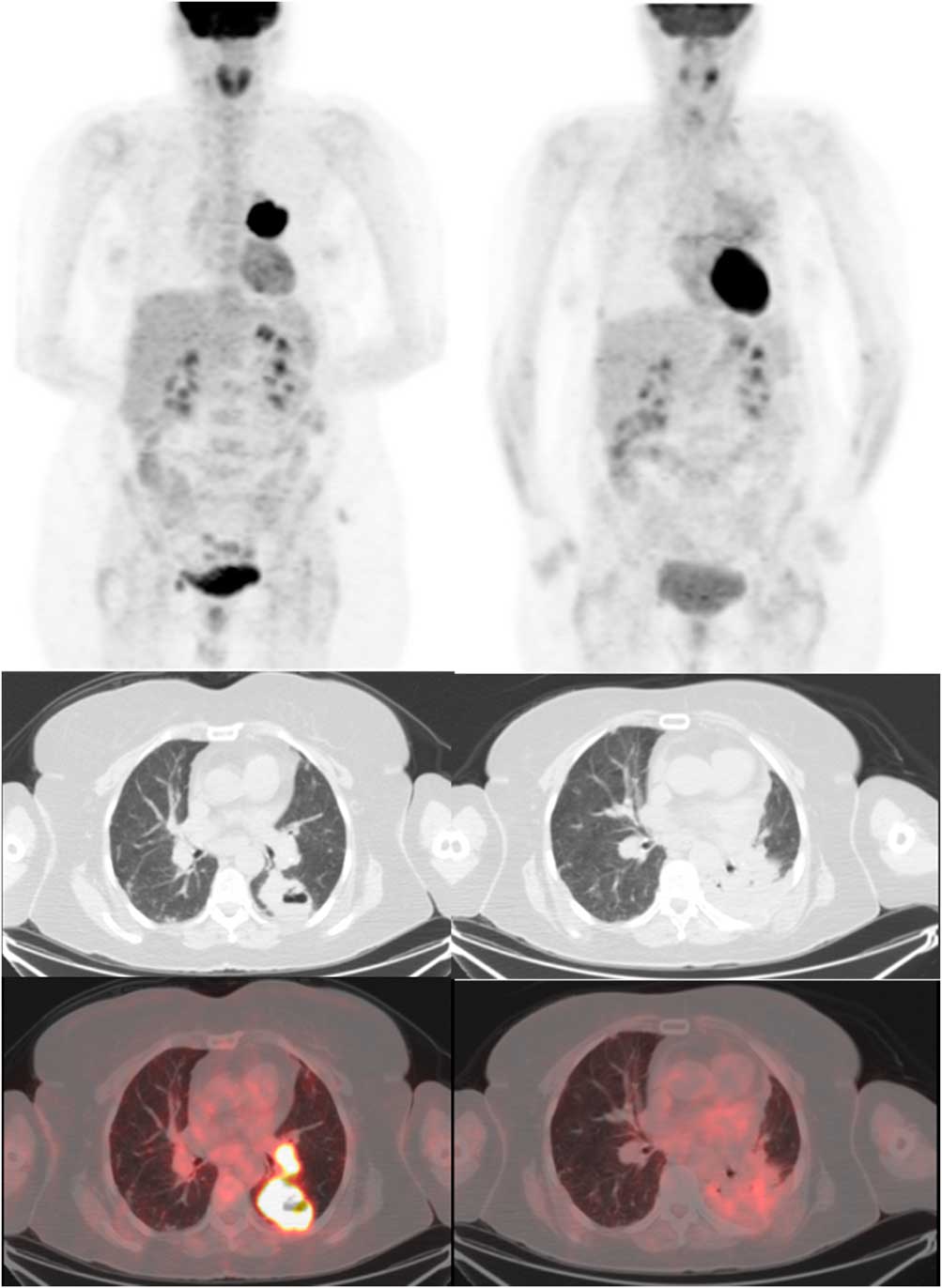
Megavoltage external beam irradiation generally encompassed the intrathoracic neoplasm and mediastinal adenopathy with inclusion of clinically evident supraclavicular disease. Three-dimensional radiotherapy planning utilised the fusion of FDG-PET and computed tomography images; the administered total dose ranged from 60 to 70 Gy (mean 63·8 Gy). The chemotherapy regimen consisted of several cycles of cisplatin and etoposide with substitution of carboplatin instead of cisplatin in patients with impaired renal function. FDG-PET was usually performed before therapy and 2–3 months after completion of CRT. Interpretation of images by visual analysis was either a positive or negative scan (Figure 1) indicating incomplete or complete MTR, respectively.
18FDG-PET imaging showing metabolic response of non-small cell lung cancer to chemoradiotherapy.

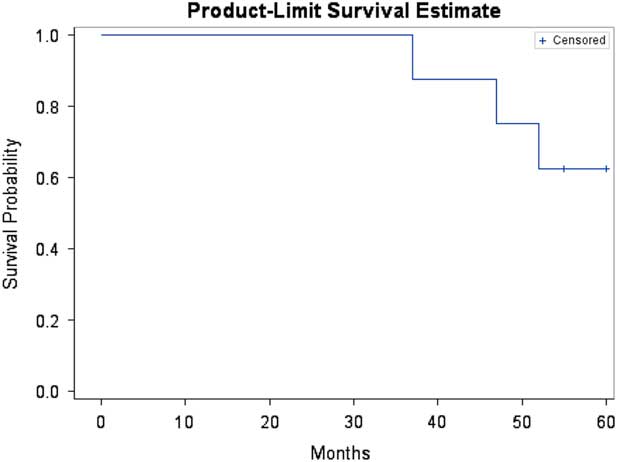
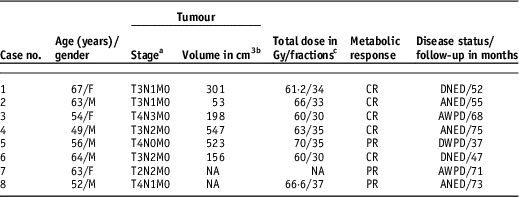
The mean age of the patients was 58·5 years, and stage IIIA disease was predominant (Table 1). All of these people had a good performance status before CRT. Two patients (cases 1 and 2) were concurrently receiving β-blocker medication for hypertension. A complete MTR was observed in the majority (63%) of patients, and among the six people with available information, tumour volume exceeded 100 cm3 in 83% of the cases. Of the five patients who were alive, the median follow-up was 71 months (range: 55–75 months). Survival ranged from 37 to 52 months in the three deceased individuals. The cumulative prognosis at 5 years is shown in Figure 2. Even though prolonged survival was observed, progression of disease occurred in three patients (38%).
A 5-year cumulative survival of patients with 18Fluorodeoxyglucose-positron emission tomography (FDG-PET) metabolic response of non-small-cell lung cancer to chemoradiotherapy.

Clinical summary in 18Fluorodeoxyglucose-positron emission tomography (FDG-PET) metabolic tumour response of non-small-cell lung cancer to chemoradiotherapy

Abbreviations: CR=complete response; DNED=died without cancer; ANED=alive without cancer; AWPD=alive with progressive disease; PR=partial response; DWPD=died with progressive disease; NA=not available.
a American Joint Committee on Cancer staging system.
b Tumour volume determination using the formula π/6 (width) (length) (height).
c Radiation dose.
DISCUSSION
In general, it is not known a priori who will and who will not exhibit a treatment response in any assessment of results in treated patients. The frequency of complete MTRs on FDG-PET or negative scans after treatment of lung cancer has ranged from 12 to 47%.Reference Antoniou, Marcus, Tahari, Wahl and Subramanian 5 – Reference Patz, Connoly and Herndon 8 The 63% in the present study may be explained by the small number of cases. Gupta et al.,Reference Gupta, Master and Kannan 9 in a meta-analysis of studies regarding the diagnostic merit of FDG-PET in the determination of treatment response, remarked that the negative predictive value of an after-therapy negative FDG-PET is exceptionally high, and such finding is highly suggestive of the absence of viable disease. With regard to the prognosis predictive efficacy of this particular radionuclide imaging, a higher survival rate or longer median survival was reported for those individuals with demonstrated negative scans following lung cancer treatment compared with those with positive images.Reference Antoniou, Marcus, Tahari, Wahl and Subramanian 5 , Reference Pandit, Gonen, Krug and Larson 7 We undertook this retrospective study to also gain insight with regard to the contributory factors for the sustained favorable results of therapy. Because of the retrospective design and our small sample, we can only speculate that the presented excellent performance status and predominance of stage IIIA NSCLC were influential in effecting a favorable outcome (the latter feature reported in the literature as being associated with a better prognosis than with stage IIIB diseaseReference Goldstraw, Crowley and Chansky 10 ). In previous investigations of the prognostic value of post-treatment negative FDG-PET,Reference Antoniou, Marcus, Tahari, Wahl and Subramanian 5 , Reference Pandit, Gonen, Krug and Larson 7 , Reference Patz, Connoly and Herndon 8 characteristics indicative of improved survival included young age, localised stage in small cell lung cancer cases and perhaps stage IIIA disease. This patient series showed that a larger tumour volume should not by itself exclude patients from receiving curative chemoradiotherapy.Reference Ball, Fisher and Burmeister 11 Also, two patients being treated with β-blockers remained continuously disease-free before demise or at last follow-up. This prognostic correlation seems to be in accord with a recent finding that β-blocker medication use is associated with improved distant-metastasis-free survival, disease-free survival and overall survival in patients with NSCLC.Reference Wang, Liao and Zhuang 12
There are several limitations in the present study. First, the retrospective design with the small number of patients restricts generalisation of the findings. Second, our chart review did not reveal information regarding the quality of remaining life in the long-term survivors. Third, our investigation lacked observations pertaining to the patient group with non-responsive tumours shown on FDG-PET.
CONCLUSION
Due to increasing economic constraints on the healthcare sector, diagnostic methods such as FDG-PET have to show a proven clinical benefit to obtain financial reimbursement. Only a few studies to date (ours included) have suggested that FDG-PET is useful not only for its diagnostic function, but also as a feasible tool for post-treatment prognosis assessment in patients with locally advanced NSCLC.
Acknowledgement
None.