The indigenous peoples of the northern Great Lakes region were central to the development of the anthropological field of study of focusing on nonhuman personhood. The term “other-than-human persons” was coined by ethnographer A. Irving Hallowell (Reference Hallowell and Harvey1960) in his classic cultural and linguistic study of the northern Ojibwa, who represent one group within the broader linguistically and culturally related indigenous peoples of the Great Lakes region known as the Anishinaabeg. This group includes the core alliance of the Council of the Three Fires—the Ojibway (Chippewa), Ottawa (Odawa), and Potawatomi (Clifton et al. Reference Clifton, Cornell and McClurken1986). An indigenous translation of Anishinaabeg is “Spontaneous People”—“spontaneous” indicating a sacred emergence from the land (Johnston Reference Johnston1976; Warren Reference Warren1984 [1885]). From his ethnographic research with the Ojibwa, Hallowell (Reference Hallowell and Harvey1960:22) identified relationships between human beings and other-than-human “persons” as being of cardinal significance.
Archaeologists have increasingly recognized that other-than-human persons are not only the purview of anthropological research but also an important archaeological topic. This is because people who lived in the past societies we study understood themselves to be “bound up in reticular arrangements with similar and not so similar forms” (Watts Reference Watts and Watts2013:3). Understanding the significance, as Hallowell noted—even cardinal significance—that relationships with nonhuman persons held for past communities becomes a pressing need for archaeology (Alberti and Bray Reference Alberti and Bray2009:338; Brown and Walker Reference Brown and Walker2008:297). Studying other-than-human agency is an area of rapidly expanding interest in archaeology, drawing on theories of ontology, new materialisms, and assemblages (e.g., Alberti et al. Reference Alberti, Jones and Pollard2013; Alt and Pauketat Reference Alt and Pauketat2019; Cipolla Reference Cipolla2019; Harris Reference Harris2018; Harrison-Buck and Hendon Reference Harrison-Buck and Hendon2018; Lucas Reference Lucas2012; Watts Reference Watts2013).
A central aim of studying other-than-human beings in archaeology is to move beyond representationalist accounts of the past and to take seriously the ontologies of nonwestern communities in which there are neither distinctions between animate and inanimate things nor divisions between nature and culture (Alberti and Marshall Reference Alberti and Marshall2009; Cipolla and Allard Reference Cipolla and Allard2019; Harris Reference Harris2018; Jones and Alberti Reference Jones, Alberti, Alberti, Jones and Pollard2013; Viveiros de Castro Reference Viveiros de Castro2015). As Viveiros de Castro (Reference Viveiros de Castro2004:465–466) explains, there is no meaningful distinction between when humans and nonhumans confront each other and intrahuman interaction, nor is there a difference in relational categories. Human beings are no longer the sole players in the past that archaeologists study (Harris Reference Harris2018). Materiality is not about matter, but about relations between entities (Ingold Reference Ingold2007). Artifacts are not just symbols but animate players in the making of both past and present (Harris Reference Harris2018). They are coproductive of the world (Jones and Alberti Reference Jones, Alberti, Alberti, Jones and Pollard2013:19).
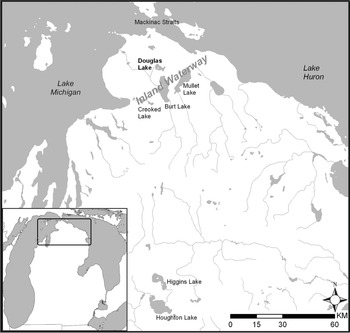
In this article, I explore some of the ways ancestral Anishinaabeg and other-than-human persons, known to them as manitou, may have confronted each other during the Late Woodland period (ca. AD 600–1600) in the northern Great Lakes region. This study is focused on a set of nonvessel, archaeological ceramic artifacts from the Inland Waterway landscape in northern Michigan (Figure 1). As part of the analysis, I identify these objects as nonhuman figurines and interpret these figurines not as representations of other-than-human persons, but rather as manitou-in-clay, whose making and breaking influenced both waking and dream worlds.
Northern Michigan showing the Inland Waterway landscape.

Nonvessel, modified ceramic objects were first identified in the Inland Waterway at a Late Woodland site by Lovis (Reference Lovis2001), and he interpreted these as figurines of other-than-human beings. Without an awareness of his previous work, it would have been easy to misidentify or overlook the potential significance of what are mostly small, seemingly irregularly formed ceramic objects (described below). Many similar objects may be extant, but they are as yet unidentified in archaeological collections from sites across the northern Great Lakes region. We may, therefore, be missing the chance to understand the long legacy and deep significance of relationships with other-than-human persons in the region—many of which were mediated through dreams—as well as the opportunity to foreground these relationships in the growing archaeological research on relational identities and nonhuman persons. Emerging archaeologies advancing this topic have not caught up to the anthropological focus on the Anishinaabeg. This article reflects one step in what will hopefully be many toward rectifying this vexing discrepancy.
Mishipishu: Danger and Power
The concept of “manitou” is complex and not easily translated into English. It includes a sense of an animating spirit in the world, but it also describes both natural and supernatural nonhuman persons. While “manitou” is often translated as “spirit,” this translation seriously reduces the combination of substance, power, and real agency found in Anishinaabeg manitous (Dewdney Reference Dewdney1975:37). These other-than-human persons occupy the top rank in the power hierarchy of animate beings (Hallowell Reference Hallowell and Harvey1960:38). Humans’ relationship with manitou is always personal. As Ojibway scholar Basil Johnston explains, manitous “were just as much a reality as were trees, valleys, hills, and winds,” and people “felt the presence of the manitous all around them” (Johnston Reference Johnston1995:xx–xxi).
In this article, I specifically seek to explore relationships with Mishipishu (also spelled Misshipeshu, Mishi-bizheu, or Mishibijiw), the principal manitou of the underworld. Mishipishu is a manitou dwelling in an aquatic habitat to whom feline characteristics are often ascribed (Dewdney Reference Dewdney1975:123). This manitou is commonly referred to as an “underwater panther” but is also referenced in ethnohistoric and ethnographic accounts as “the great lion,” “the underwater lion,” “the great lynx,” “the king of fishes,” an “underwater tailed serpent,” an “underwater horned serpent,” “the great lizard,” and “the water-king” (Barnouw Reference Barnouw1977; Berens Reference Berens, Brown and Gray2009; Dewdney Reference Dewdney1975; Gray Reference Gray, Carter and McCormack2011; Howard Reference Howard1960; Johnston Reference Johnston1995; Kohl Reference Kohl1985 [1860]; Landes Reference Landes1968; Lenik Reference Lenik2010; Smith Reference Smith1995; Treuer Reference Treuer2010). Whatever form assumed, Mishipishu is always a complexly powerful, seductive, and dangerous underwater nonhuman known as the head of all water spirits. Mishipishu is a fierce and singularly powerful being occupying a complex place in traditions and life worlds (Smith Reference Smith1995:99).
Mishipishu is always encountered in or near water (Redsky Reference Redsky and Stevens1972:121). This manitou could inhabit any lake, and is also reported to exist in mountains near lakes where underground passages connect caverns to water, in tunnels between lakes, in slimy mud banks and swamps, on islands, in rapids, and within whirlpools (Barnouw Reference Barnouw1977; Dewdney Reference Dewdney1975; Gray Reference Gray, Carter and McCormack2011; Kohl Reference Kohl1985 [1860]; Lenik Reference Lenik2010; Lovis Reference Lovis2001; Smith Reference Smith1995). Mishipishu is one of the most dreaded and most powerful Anishinaabeg manitous (Dewdney Reference Dewdney1975:122), variously described as an “evil mighty water monster” (Landes Reference Landes1968:108) and a “wicked water spirit” (Kohl Reference Kohl1985 [1860]:424). Mishipishu is associated with water-based calamity, including boating accidents, drownings, floodings, and fish shortages (Smith Reference Smith1995:116).
In his glossary of Ojibwa manitous, Johnston (Reference Johnston1995:243) defines Mishipishu (Mishi-bizheu) as the Great Lynx, which dwelt at the bottom of the sea. As the foremost inhabitant of the deep, the Great Lynx draws people down to their deaths. According to one ethnographic account recorded by anthropologist Robert Ritzenthaler among the Ojibwa at Court Oreilles, Wisconsin, two girls were canoeing across a lake in which it was known that the bad manitou, Mishipishu, lived in an island of mud, and “as they got to the middle, they crossed the mud, and in the center of the mud was a hole of clear water. The water was swirling around the hole, and as they started to cross it, a lion came out of the middle and switched his tail across the boat, trying to turn it over” (Barnouw Reference Barnouw1977:132). In an ethnohistoric account from the Potawatomi, we learn that “such panthers maliciously drown people, who are afterwards found with mud in their mouths, eyes, and ears” (Howard Reference Howard1960:217). In Hoffman's observation of the Midewiwin Society (Grand Medicine Society) among the Ojibwa at the end of the nineteenth century, he repeatedly identifies this manitou as evil and dangerous. In one scene, the head Mide looks into the Midē´wigân (the lodge) to view the malevolent manitous occupying the interior and sees that the “evil spirits within are crouching upon the floor, one behind the other and facing the east, the first being Mi-shi´-bi-shi´—the panther” (Hoffman Reference Hoffman1891:262). These evil manitous are “the ones who endeavor to counteract or destroy the good wrought by the rites of the Midē´wiwin” (Hoffman Reference Hoffman1891:262).
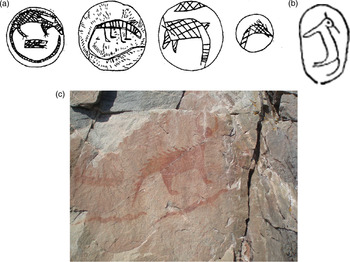
Ethnohistoric, pictographic, and archaeological renderings of Mishipishu in Figure 2 illustrate images of this manitou. No single example or medium, however, fully encapsulates the range of its representation in Anishinaabeg iconography. Archaeological portrayals of Mishipishu are found in rock art and engraved disks, called Naub-cow-zo-win disks, recovered from archaeological sites in Michigan dating to approximately AD 1300–1450 (Figure 2; Cleland et al. Reference Cleland, Clute and Haltiner1984; see also Cleland Reference Cleland1985:Figure 2.B). As portrayed on archaeological disks, the mythological creature has a long tail, slim body, and pointed snout. In later rock art and pictograph renderings, Mishipishu is portrayed with a long tail curved under the body with horns and spines on the back (Cleland Reference Cleland1985:135; Figure 2). Sometimes Mishipishu is represented as having brassy (potentially copper) scales on its body (Dewdney Reference Dewdney1975:127). Mishipishu has remained a subject of contemporary Anishinaabeg art (e.g., Morrisseau Reference Morrisseau and Dewdney1965).
A range of ethnohistoric, pictographic, and archaeological artistic renderings of Mishipishu: (a) Naub-cow-zo-win disks (Cleland Reference Cleland1985:Figure 2.B; 2–3 cm diameter); (b) pictograph rendering of the panther from a nineteenth-century Midewiwin mide birch bark scroll (Hoffman Reference Hoffman1891:292; 3–4 cm); (c) Mishipishu in Agawa Pictograph Site, Lake Superior Provincial Park, Ontario (https://www.flickr.com/photos/wonderal/165250184/). (Color online)

Metamorphosis is an earmark of power for the Anishinaabeg, and other-than-human persons are known to regularly assume a variety of forms (Hallowell Reference Hallowell and Harvey1960:38). Mishipishu was adept at metamorphosis, especially in dreams, where it had malevolent implications for men and hunters (Treuer Reference Treuer2010). Mishipishu came to hunters in seductive forms that made dreaming of him hard to avoid (Kohl Reference Kohl1985 [1860]:422). In sharing his life history with Hallowell, northern Ojibwa Chief Berens describes a story called “A Fight with Micipijiu, the Water Lion” (Berens Reference Berens, Brown and Gray2009). In it, he tells of a lion that lives in the water that has “something to do with bossing the fish,” and that a hunter who dreamt of this lion before marriage ended up having ill children. In another Anishinaabeg recollection (Gray Reference Gray, Carter and McCormack2011:254), a female elder named Brightman narrates a story of malignant feline beings with horns and long tails who dwelled near rapids and were motivated by jealously. They appeared to men in dreams, in the form of beautiful women, and they offered “blessings”—namely, excellent hunting skills or medicine power. If these gifts were accepted, the men's wives and children would successively die through illness or accident, and so men were cautioned to never dream of these panthers. That said, sometimes panthers came to dreams in disguise, making the acceptance of gifts inadvertent.
Danger and power are the two inseparable sides of the manitou that is Mishipishu. Mishipishu routinely attacks and drowns people. Dreaming of Mishipishu is destructive, yet gaining access to this manitou can confer power. This duality is evident, again, in various ethnohistoric accounts of Mishipishu. In the rest of the story (above) of the two girls who were attacked while crossing the lake, one of the girls cuts Mishipishu's tail off to escape, and it lands in her boat as a solid piece of copper, which she gives to her father. Other people in her community then come to her father trying to trade goods for just a small piece of that copper because they think it might bring luck to hunting/fishing expeditions or to their homes (Barnouw Reference Barnouw1977:133). Returning to the ethnohistoric account from the Potawatomi noted above, in the same narrative describing how these panthers drown people, we also learn that if Mishipishu appears to a man, he can become a great warrior (Howard Reference Howard1960:217). In another Ojibwa ethnohistoric account in which hunters dream of Mishipishu, the manitou takes one of the dreamer's children but tells the dreamer, “Thou wilt have, so long as thou art in union with me, so much power as I have myself” (Kohl Reference Kohl1985 [1860]:424).
Geography and Archaeology of the Inland Waterway Landscape
I turn now to exploring the complex manitou that is Mishipishu in the Late Woodland Inland Waterway landscape in northern Michigan. The Inland Waterway is a series of lakes, rivers, and streams that creates an inland route between Lakes Michigan and Huron, providing an alternate to the oft-dangerous passage through the Mackinac Straits. The use of the Inland Waterway to travel between Lake Michigan and Lake Huron is well documented historically by Native Americans and European trappers (Blackbird Reference Blackbird1887; see Figure 1).
The physiography of this area is the result of a complex history of Wisconsinan glacial advances and retreats, and it consists of glaciated moraines, outwash plains, drumlins, kames, and kettle lakes (Albert Reference Albert1995; Francis Reference Francis2001; Pearsall et al. Reference Pearsall, Barnes, Zogg, Lapin and Ring1995). Before Europeans drastically altered the natural landscape, well-drained glacial features supported a beech-maple-hemlock forest (a type of northern hardwood forest), whereas the more poorly drained outwash plains and moraines supported northern white-cedar-forested wetlands. Lying inland from the coasts of the Great Lakes, beyond the protection of the lake effect, the Inland Waterway landscape sees more climatic extremes, characterized by short growing seasons (<100 days), heavy snowfalls, and diurnal temperature fluctuations as extreme as 65°F (Albert Reference Albert1995; Francis Reference Francis2001).
This area was first explored archaeologically during the NSF-funded Inland Waterway Project, which involved two probabilistic survey sampling phases over 10 weeks in 1974 and then test excavations at identified sites in 1975 (Lovis Reference Lovis1976, Reference Lovis1978a, Reference Lovis1978b). Identifying a strong correspondence between site location and proximity to water, the survey found 20 preceramic, 20 ceramic, and two undetermined sites. Twenty of these were attributed to either the Middle Woodland (ca. 200 BC–AD 500) or Late Woodland period (ca. AD 600–1600; Lovis Reference Lovis1978b:40). When site size could be determined, it was relatively small, with a mean minimum diameter of 27 m (Lovis Reference Lovis1976).
These inland sites were reported to have lower densities of cultural materials than sites in the Traverse Corridor along the coast of Lake Michigan (Lovis Reference Lovis1976:371). Using settlement data from the survey, Lovis (Reference Lovis1978b) proposed that there was a change from a generalized to a more specialized use of this interior area between the Middle and Late Woodland period. More specifically, he interpreted Late Woodland Inland Waterway sites as locales for specialized seasonal resource extraction, which were strong for winter resource catchments as well as spring maple sugaring (Holman Reference Holman1978, Reference Holman1984; Lovis Reference Lovis1978b). Native American communities engaged in a seasonal round where they spent late spring through late fall on the coast, winter in the interior, and early spring at locales between winter and late spring occupations (Holman Reference Holman1984:72).
Notably, the Inland Waterway Project also revealed that the major recreational draw of Michigan's inland lakes posed substantial threat to the archaeological record (Lovis Reference Lovis1978a). Despite this call, there was no further professional archaeological research in the region for another 35 years until the NSF-funded Cultural Landscapes of Douglas Lake Archaeological Research Program (CLOD) was launched in 2007. CLOD was based out of the University of Michigan Biological Station (UMBS), a biological and environmental research and education station that has been operating for the last 100 years. The station preserves 10,000 acres along Douglas and Burt Lakes, including several kilometers of shoreline, thereby keeping recreational development to a minimum. The protection afforded by UMBS has allowed us to find relatively undisturbed archaeological sites and to expand knowledge on the dynamics of precontact occupation of this interior landscape (Howey Reference Howey2015; Howey and Frederick Reference Howey and Frederick2016; Howey and Parker Reference Howey and Parker2008).
Archaeological findings from the CLOD research program on the trajectory of Late Woodland period (ca. AD 600–1600) occupation around Douglas and Burt Lakes indicates that regular activity around these lakes began during the early Late Woodland period (ca. AD 600–1000; Pine River and Mackinac phases), intensified between AD 1000 and 1200 (Bois Blanc phase), and remained pronounced during the later part of the Late Woodland period (ca. 1200–1600; Juntunen phase). For more on the regional ceramic wares after which these phases are named, see Hambacher (Reference Hambacher1992), Holman (Reference Holman1978), (Lovis Reference Lovis1973), McPherron (Reference McPherron1967), and Milner (Reference Milner1998). Three Late Woodland period occupation sites—two on Douglas Lake and one on Burt Lake—have been excavated that further disclose the occupation trajectory of the Inland Waterway landscape.
Inland Waterway Late Woodland Other-Than-Human Persons Figurines
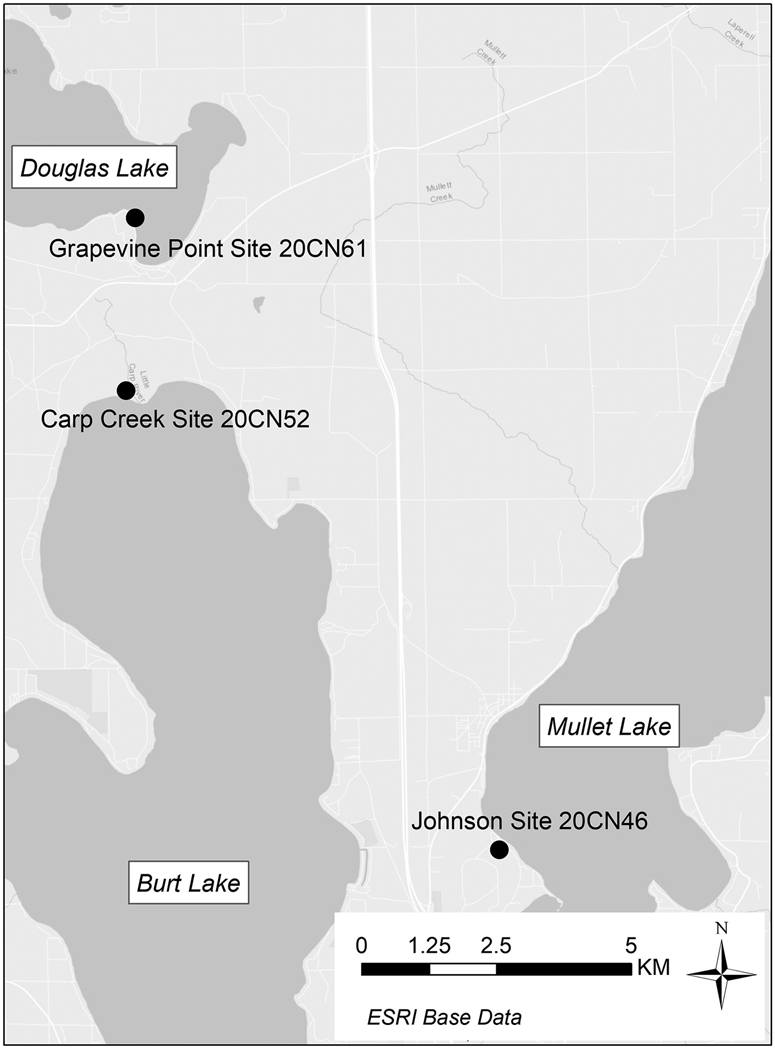
Nonhuman figurines have now been recovered from three Late Woodland sites excavated in the Inland Waterway landscape (Figure 3). The presence of nonhuman figurines was first identified by Lovis (Reference Lovis2001) in his analysis of nonvessel ceramic fragments/objects recovered from excavations at the Johnson site (20CN46) during the 1974–1975 Inland Waterway project. With knowledge of his research informing our work when we started CLOD, field school students and other project participants were told of the importance of keeping all nonvessel ceramic fragments/objects, even small and seemingly insignificant “waster” ceramic fragments. We excavated three Late Woodland sites as part of CLOD (20CN52, 20CN61, and 20CN63), and we found possible ceramic figurine pieces at two of these sites (20CN52 and 20CN61).
The location of the three Late Woodland archaeological sites in the Inland Waterway landscape where nonhuman ceramic figurines have been found: the Johnson site (20CN46), Grapevine Point site (20CN61), and Carp Creek site (20CN52).

The Johnson Site (20CN46)
The Johnson site (20CN46), excavated in 1974–1975, is on a terrace set back from the shore of Mullett Lake, one of the large inland lakes forming the Inland Waterway (see Figure 3). The terrace position places the site in an area protected from westerly winds and next to a cedar swamp, a location identified as having high winter resource potential, including winter deer habitat (Lovis Reference Lovis2008:88; see Holman [Reference Holman1978] for catchment analysis). Ceramics are the dominant artifact, and they show the site to have a small Middle Woodland component and a much more intensive Late Woodland component (Lovis Reference Lovis2008:83). The site was interpreted as an example of a specialized Late Woodland interior seasonal resource extraction site, specifically, as a repeatedly reused cold-season campsite (Lovis Reference Lovis2001:107). Ceramic figurines and figurine fragments were found in four proveniences at the site as reported by Lovis (Reference Lovis2001). The reader should refer to the original publication by Lovis (Reference Lovis2001) for images of these figurines and their full context at this site. An almost intact figurine was found in a feature with a cross-fit Juntunen Linear Punctate vessel, relatively dating the figurine to approximately AD 1200–1600. This object is interpreted as a bear figurine (Lovis Reference Lovis2001:Figure 2, Reference Lovis2008:Figure 11). A second figurine interpreted to be a bear was also recovered from a unit with Bois Blanc–phase ceramics (ca. AD 1000–1200; Lovis Reference Lovis2001:Figure 4). Finally, there were seven figurine fragments found in a feature and associated level with Mackinac-phase vessels dating approximately AD 800–1000 that Lovis (Reference Lovis2001) interpreted as Mishipishu figurine parts (Lovis Reference Lovis2001:Figure 5). The parts are thinner and longer than bear representations, and one part has a flattened appendage suggestive of a flipper (Lovis Reference Lovis2001: Figure 6).
In interpreting the figurines from the Johnson site, Lovis (Reference Lovis2001:115) suggests that the bear figurines could have been representations made for hunters to use in winter bear-hunting magic/ritual. Mishipishu, as an underwater panther manitou, is strongly associated with water, storms, and danger, as described above. Lovis (Reference Lovis2001:116) interpreted the presence of Mishipishu figurines as potentially related to the need for protection from Mishipishu during travel at the end of winter, when ice breaks up in interior lakes and streams, and the journey becomes especially perilous.
Grapevine Point Site 20CN61
Grapevine Point site (20CN61) is located on a promontory along Douglas Lake, known colloquially as Grapevine Point (see Figure 3). Our survey and excavations at this site show that it covered an area of approximately 15 × 20 m. Cultural materials, as well as two AMS dates from the site, indicate that it was an early Late Woodland site (ca. AD 600–1000; Pine River and Mackinac phases). These dates are 1310 ± 40 BP with 1σ cal AD 667–751 (Beta 209909) and 1080 ± 40 BP with 1σ cal AD 905–991 (Beta 262447; Howey and Frederick Reference Howey and Frederick2016:42). The site produced little to no evidence of long-term habitation: no features, little fire-cracked rock (FCR), and sparse calcined bone. Lithics are predominantly formal tools of nonlocal cherts, and there were no primary flakes or cores. Faunal remains preserved well due to the wetness of the site, suggesting that this was a resource extraction site for primary processing of deer and spring-spawning fish, notably perch and pike (Howey and Frederick Reference Howey and Frederick2016; Howey and Parker Reference Howey and Parker2008).
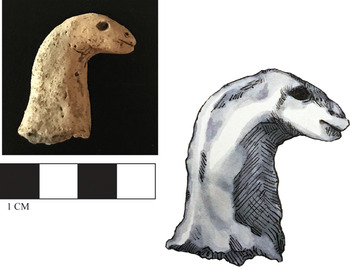
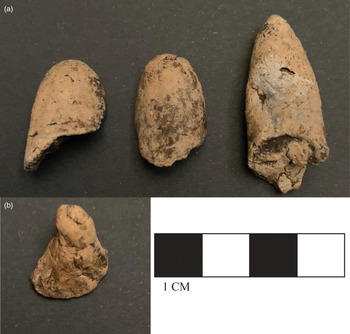
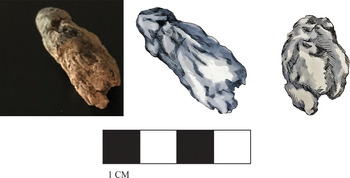
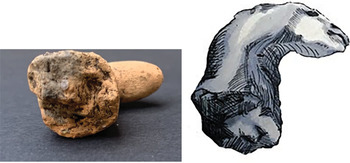
Seven nonvessel ceramic objects were recovered from this site and interpreted to be figurine parts. One is an item that can be almost definitively identified as the head of Mishipishu (Figure 4). The ceramic pieces from the Johnson site discussed above are compellingly evocative of Mishipishu, but this piece requires much less deciphering of abstractions to see that it is a ceramic rendering of this manitou. Four additional possible Mishipishu parts, including one ceramic piece—which I, at first, interpreted as a foot fragment (Figure 5)—were also found at 20CN61. Given that some renderings of Mishipishu incorporate horns, it is interesting to consider the possibility that this may not be a foot, but a horn (see Figure 5b). Lastly, there were two other possible figurine parts that were too small to identify (not shown here).
Head of a Mishipishu figurine recovered at 20CN61. Artistic rendering done by Hannah Corrow, University of New Hampshire. (Color online)

(a) three possible Mishipishu parts from 20CN61; (b) possible foot or horn piece of Mishipishu figurine from 20CN61. (Color online)

Carp Creek Site (20CN52)
The Carp Creek site (20CN52) is located on a low terrace at the confluence of Carp Creek (which drains from Douglas Lake) and Burt Lake (see Figure 3), and it has a large midden built up over years, which speaks to repeated occupation. Materials in the midden include a broken part of a large grinding stone, numerous piles of cooking hearth remains (with dense charcoal and calcined bone), and several (broken) pipes. Charcoal from this midden dates to 950 ± 40 BP with 1σ cal AD 1037–1137 (Beta 26244; Howey and Frederick Reference Howey and Frederick2016:43). With large amounts of Bois Blanc phase ceramics (ca. AD 1000–1200), the ceramic assemblage fits this time period, but the site also includes diagnostic sherds of later Late Woodland styles (ca. AD 1200–1600, including Juntunen and Traverse Wares).
Seventeen nonvessel ceramic objects that can be construed as figurine parts were recovered from excavation units in the midden at this site. One of these appears as a possible complete bear figurine (Figure 6). Although this object is somewhat abstract, from Corrow's artistic rendering of this object, it becomes easier to visualize it as a bear and one that is sculpted in the act of walking. It seems possible that the person who made this object intentionally made it as a bear in motion.
Possible bear figurine recovered from 20CN52. Drawing by Hannah Corrow, University of New Hampshire. From Corrow's artistic renderings, it is easier to appreciate that the bear was sculpted as if it were walking, but it is still abstract. (Color online)

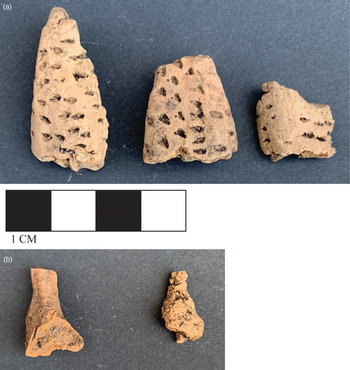
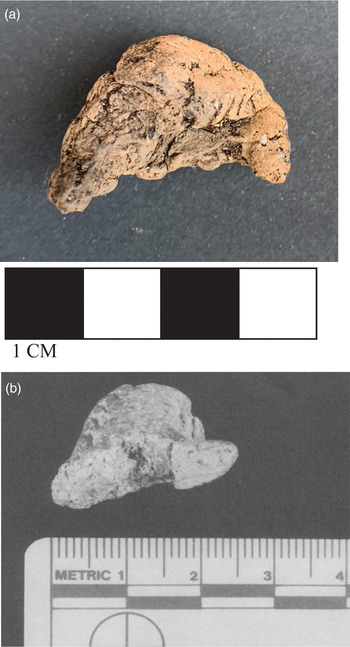
Among the ceramic objects are five parts of what may be Mishipishu figurines, including three with what could be scales or power lines (Figure 7a). As indicated above, some renderings of Mishipishu have scales, and Lovis (Reference Lovis2001) did note that what he interpreted as power lines could alternatively be scales. Six ceramic objects were unidentifiable possible figurine parts from the midden, as well as two parts similar to the item described as a possible foot or horn from 20CN61 (see Figure 7b). The final figurine piece looks much like the flattened appendage piece Lovis (Reference Lovis2001) discovered and interpreted as a flipper from Mishipishu (Figure 8).
(a) Three possible Mishipishu figurine parts from 20CN52 with possible scales or power lines; (b) two possible foot and/or horn parts from 20CN52 (similar to object shown in Figure 5b from 20CN61) (Color online).

(a) Figurine piece recovered from 20CN52; (b) flattened appendage ceramic piece interpreted as a flipper from Mishipishu (Lovis Reference Lovis2001:Figure 6), which is similar to the figurine piece from 20CN52. (Color online)

Possible Temporal Patterning to Late Woodland Figurines
A second site on Grapevine Point was excavated and assigned state site number 20CN63. This site covered a much larger area than Grapevine Point 20CN61, with cultural material found in a 60 × 40 m area. The site produced some early Late Woodland cultural materials and one secure early Late Woodland AMS date of 1214 ± 36BP 1σ cal AD 734–858 (AA86586). The majority of materials and radiometric dating, however, indicate that 20CN63 saw its primary occupation during the second half of the Late Woodland period (926 ± 36BP 1σ cal AD 1049–1147 (AA86583) and 550 ± 40 BP with 1σ cal AD 1324–1412 (Beta 209910; Howey and Frederick Reference Howey and Frederick2016:42). The team found numerous cultural features and dense FCR, suggesting substantial habitation during the later Late Woodland period (ca. AD 1200–1600). Grapevine Point 20CN63 is the latest-dating site of the three Late Woodland occupation sites excavated by CLOD. It is interesting that no figurines or figurine fragments were found at the latest-dating site on Douglas and Burt Lakes in this study. The same recovery methods and procedures were used here as at Grapevine Point 20CN61 and Carp Creek (20CN52), so this does not likely reflect a recovery error.
The bear figurines from the Johnson site (20CN46) are also found in later contexts, including from a Bois Blanc feature, approximately AD 1000–1200, and a possible Juntunen association, approximately AD 1200–1600. Bear figurines were not found at the earlier Late Woodland Grapevine Point site 20CN61, but compelling bear figurine parts were recovered from excavations at the Carp Creek site (20CN52), which has Bois Blanc dates (ca. 1000–1200), as well as some later ceramics (ca. AD 1200–1600). Could there be a temporal component related to figurine distribution in the Inland Waterway? Figurines of bears seem to be coming from contexts dating later in time. Does this reflect, perhaps, changes in people's relationships with manitou, their religious practices, and/or resource extraction activities in the region? Clearly greater chronological control is needed to identify the temporal patterning, but initial observations suggest that it may be worth future detailed analysis. I leave the temporal issue here, as well as the bear figurines, and turn to examining the significance of the striking collection of powerful other-than-human Mishipishu figurines from this Inland Waterway landscape.
Making and Breaking Mishipishu in the Late Woodland Inland Waterway Landscape
Mishipishu's danger and power stem logically from where it dwells—water. Water is both powerful and dangerous, both life-giving and life-taking. Water knows no bounds. It can destroy our belongings, our homes, and us instantly. Water is notorious for behaving in ways that do not match up with human needs and expectations (Cipolla and Allard Reference Cipolla and Allard2019:1092), and yet water is something we cannot live without. For Late Woodland inhabitants of the Inland Waterway landscape, this duality was an ever-present reality. They were dependent on large, potentially dangerous bodies of water (i.e., inland lakes) for travel, movement, and social connection, as well as subsistence in the form of fish and other water-borne food resources. The figurines of Mishipishu were made and deposited by Late Woodland peoples who were enmeshed in the danger of the waterscapes of the Inland Waterway and at the same time dependent on these waterscapes for travel and subsistence.
We now know that Mishipishu figurines were not a unique occurrence at one site but were a feature of Late Woodland life in the Inland Waterway region. With additional contextualized examples of these objects, we can take interpretive ideas further. I propose that the making and breaking of these Inland Waterway figurines was not just symbolic but a way of actualizing relationships between other-than-human persons and ancestral Anishinaabeg living in the region during the Late Woodland period. Interpreting these figurines only as representations of manitou overlooks the ways these figurines likely functioned as social persons in the lifeworlds of those enmeshed with them (Pauketat and Alt Reference Pauketat, Alt, Harrison-Buck and Hendon2018:77). Through their fabrication and use in prescriptive ceremonial practices related to dreams of Mishipishu, as well as through rituals in which they were broken and discarded to confer protection during fishing and travel on inland lakes, they were vibrant relational entities—manitou-in-clay. These manitou-in-clay played an essential agentive role in the navigation of personal and community danger.
Ceremonial Prescriptive Practices
Ethnohistorically and ethnographically, Mishipishu appears to regularly compel prescriptive practices from people. Those who had dreamed of Mishipishu could receive some respite from the consequences by throwing offerings into the water (Landes Reference Landes1968:31). In the Ojibwa ethnohistoric account of the hunter who dreamed of Mishipishu and gave him one of his children in exchange for the manitou's power, Mishipishu warns the dreamer that if he does not remember to regularly engage in ceremonial, prescriptive offerings, Mishipishu will take more of his children (Kohl Reference Kohl1985 [1860]:425). In Minnesota, special prayers for protection when ricing or fishing were required to appease this dangerous manitou (Treuer Reference Treuer2010). In Lake Nipigon, Ojibwa communities had a rock erected to Mishipishu where offerings of “copper pails were thrown into the water and black dogs as well as white dogs, decorated in the very best, were offered alive to the water god for it to eat” (Dewdney Reference Dewdney1975:127; from Morriseau Reference Morrisseau and Dewdney1965). The Potawatomi held rites for the underwater panther bundle in order to placate, honor, and control Mishipishu with proper ceremony (Howard Reference Howard1960:217). In another Ojibwa story of this manitou, a son is taken to the underworld for a long period of time, during which he is presumed dead by his father. When he returns, he tells his father, “When I left to go fishing, I didn't offer tobacco, as you told me to do, because I did not believe in those practices and I thought they were just superstitious fairy tales” (Johnston Reference Johnston1995:134).
During the Late Woodland period in the Inland Waterway, ceremonial prescriptive acts related to this manitou appear to have taken the form of making three-dimensional ceramic renderings of Mishipishu, conducting ceremonial prescriptive practices with them, and then breaking them. Making these manitous-in-clay manifested these powerful animate beings, a necessary step for conducting ceremonial offerings to mitigate the danger of Mishipishu. The Mishipishu figurines recovered from Grapevine site 20CN61 and the Carp Creek site (20CN52) are all broken. In his analysis of the Mishipishu figurines at the Johnson site (20CN46), Lovis (Reference Lovis2001) suggested that they may have been ritually broken/killed. The figurine from Grapevine site 20CN61 offers the most compelling case of purposeful breaking. Looking at the base of the broken head, the fracture does not seem to have come from the object falling or being trampled. Instead, it appears that the head has been snapped off (Figure 9). While not definitive, this suggestion of breaking/ritual killing furthers the idea that these ceramic objects were powerful animate entities in their own right. They had to be animate players to be effective in ceremony, but perhaps they could not rearrange their entanglements with Mishipishu without this additional step of “killing” the manitou-in-clay.
View of the base of Mishipishu figurine head piece recovered from 20CN61 (shown in Figure 4; 3 cm diameter). The base offers a compelling case of purposeful breaking because it appears to have been snapped off. (Color online)

Spring Seasonality
In the northern Great Lakes, winter is a predictable season of scarcity. With low temperatures and snow, plant and animal resources become scarce (Frederick Reference Frederick2019). Although the predictable shortages of winter can be mitigated with risk management strategies, early spring—following winter and coming before the start of resource-abundant late spring and summer—is still a very lean season in the northern Great Lakes (Frederick Reference Frederick2019; Holman Reference Holman1978; Holman and Lovis Reference Holman, Lovis, Barnard and Wendrich2008). The Inland Waterway's large inland lakes reach peak levels of danger, as noted by Lovis (Reference Lovis2001:116), in early spring when the ice thaws and breaks, creating treacherous rapids and flows along with still-frigid water temperatures. As dangerous as fishing and traveling on these inland lakes would have been in early spring, the Great Lakes would have been nearly impassable. Consequently, Late Woodland communities had no choice but to confront and move through the Inland Waterway to acquire early-spring resources.
I have found Mishipishu tied to early spring seasonality specifically in some ethnohistoric and ethnographic accounts. According to Brightman (the elder Anishinaabeg woman discussed above), Mishipishu lived in the river that comes down from where one will be fasting in the spring (Gray Reference Gray, Carter and McCormack2011:254). Ojibwa Midewiwin master James Red Sky explained that mishe-beshoo “gathers moss and grass and places it in a hole where it hibernates until spring” (Redsky Reference Redsky and Stevens1972:121). Another account tells of Ojibwa throwing a pinch of tobacco in lakes in the early spring before their first trip on the water (Smith Reference Smith1995:120). As Landes (Reference Landes1968:31) notes, those who dream of Mishipishu can receive some respite by throwing offerings into the water, either in spring, when waters were thawing, or in fall, when waters were starting to freeze.
Grapevine Point site 20CN61 has a distinct spring-fishing signature with little evidence of any other season of use, and, unlike the Johnson site and 20CN52, this site only produced Mishipishu figurines (no bear figurines, since bears are a winter resource; Howey and Parker Reference Howey and Parker2008). It is interesting, then, that we see the least ambiguous Mishipishu manitou-in-clay figurine recovered in the Inland Waterway at 20CN61. In addition, this figurine, of all those recovered, appears most compellingly to have been purposefully broken. During the early-spring liminal season, the power and danger of the lakes is particularly pronounced, as the lakes are dangerous to fish on, yet any and all fish that Late Woodland communities could harvest from these lakes during this time would offer critical nutrition. Because Mishipishu is understood to eat fish, an absence of fish in a lake is often attributed to this monster's presence (Smith Reference Smith1995:116). For those coming to fish in spring at 20CN61, Mishipishu, who embodied the danger and power of the water and had the ability to do harm to their family or deny them fish that were critical to their well-being, was important to ritually make and break.
Powers Below and Powers Above: Possible Thunderbird Figurines
As the head of the “Powers Below,” Mishipishu is known to be in perpetual battle with the “Powers Above”—the manitous of the sky, the Thunderbirds (Howard Reference Howard1960:218). Unlike Mishipishu, who is malevolent in dreams, Thunderbird manitou are grandfathers (Smith Reference Smith1995:128), and humans wish to dream of them. Although it could be easy to reduce the Thunderbird (upper world) and Mishipishu (lower world) relationship to good versus evil, such dualism oversimplifies the mutually dependent relationship between them (Smith Reference Smith1995:183). In their battles, they are fixed in eternal and inevitable reunion with one another (Smith Reference Smith1995:3). This helps determine the position and existence of Anishinaabeg human persons as enmeshed in an ongoing dialectic between the upper world, lower world, and lived world (both waking and dream).
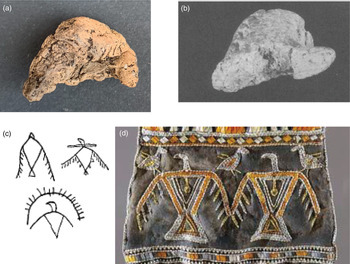
Given that Mishipishu and Thunderbirds are perpetually connected in the Anishinaabeg worldview, it is important to consider the possible presence of Thunderbirds when looking at the nonvessel ceramic objects recovered from the Inland Waterway Late Woodland sites. I reexamined an object from the Johnson site (20CN46) near Mullett Lake that Lovis interpreted as a flattened appendage, perhaps a flipper (see Lovis Reference Lovis2001:Figure 6), with a very comparable object we found at the Carp Creek site on Burt Lake (20CN52; see Figure 8). Note that both of these objects measure 3 cm and share features, which suggests that they are similar objects. Although the object Lovis found (Lovis Reference Lovis2001:Figure 6) could be a rendering of Mishipishu, it could also be a Thunderbird. In fact, Lovis (Reference Lovis2001:112) noted that a reviewer of his article had suggested that what he perceived as a flipper could be a wing. This underscores the evolving interpretive process involved in these types of identifications.
Figure 10 presents these two objects with a Thunderbird pictograph from a nineteenth-century Midewiwin mide birch bark scroll (Hoffman Reference Hoffman1891) and a historic quillwork pouch with Thunderbird motif. The links with Thunderbird features are tentative yet notable. Thunderbirds are commonly depicted in Anishinaabeg iconography with wings spread and hatched lines under the wing, as shown in Figure 10. (See Lenik [Reference Lenik2012] for more Thunderbird images.) Both of these ceramic objects have two protruding sides, and both have hatching along these sides. The object from Carp Creek has particularly distinct hatching on the underside of one possible wing (see Figure 10). There is some evidence to support interpreting these ceramics as related to Thunderbird, but they could also be interpreted as flipper parts from Mishipishu.
The two similar figurine pieces from (a) 20CN52 and (b) Johnson site shown compared to (c) nineteenth-century Midewiwin mide birch bark scroll pictographs of Thunderbird (Hoffman Reference Hoffman1891) and (d) nineteenth-century Anishinaabeg quillwork pouch with Thunderbirds motif (Harvard Peabody Museum of Archaeology and Ethnography #99-12-10/53071). Note that these could be interpreted as potentially Thunderbird manitou-in-clay. (Color online)

If these are Thunderbird manitou-in-clay, it is interesting to think about how they would have been incorporated into the ceremonial prescriptive practices with manitous during the Late Woodland on the waterscapes of the Inland Waterway. In perpetual battle with the Sky Supernaturals—the Thunderbirds—Mishipishu is recurrently defeated (Landes Reference Landes1968:31). This is one of the only situations in which Mishipishu's malevolent power sees its limits. Anishinaabeg turn again and again to Thunderbirds to act against Mishipishu (Smith Reference Smith1995:146). In addition to making and breaking Mishipishu, people may have sought respite from the manitou's danger by creating Thunderbird manitou-in-clay to bring into agentive presence the only other being who could counter the power of Mishipishu. Perhaps small sub-battles in the perpetual battle between Mishipishu and Thunderbirds played out on the shores of the inland lakes of the Inland Waterway.
Discussion: Danger and Dreams
During the Late Woodland period in the Inland Waterway landscape, the harsh environment of northern Michigan presented risks for resource shortages, and the region's hunter-gatherer-fisher communities had to systematically plan their resource procurement activities over the annual cycle to mitigate these risks (Frederick Reference Frederick2019; Holman and Lovis Reference Lovis2008; Howey and Frederick Reference Howey and Frederick2016; O'Shea Reference O'Shea2003). As discussed above, the early spring was a time when, even with systematic planning, communities were likely to face resource shortages and food stress. Securing an influx of high-quality food resources would be critical, even if the harvesting activities presented real, physical danger to the harvesters. Fishing on the inland lakes as ice cover was breaking up would be one such dangerous but crucial activity. Whereas the risks of resource failure were a community-level issue, the actual activities involved in harvesting resources in seasonally harsh times posed personal danger.
The danger of Mishipishu was, most likely, made manifest through dreams to those about to go on expeditions on the Inland Waterway's waterscapes. Dreams may seem far removed from the material archaeological record, but ethnographically and ethnohistorically, it is clear that, for the Anishinaabeg, much of the relationship between human persons and other-than-human persons played out in dreams. Dreams, then, cannot be seen as immaterial. Hallowell (Reference Hallowell and Harvey1960) identified the Anishinaabeg as a dream-conscious people because it is here that people came into direct communication with powerful other-than-human persons. To enter the dream world “was to step into, not out of the real world” (Dewdney Reference Dewdney1975:37). Dewdney (Reference Dewdney1975) likewise explains that the manitou world was accessible only through the doorway of dreams; it was in dreams that all the powers that determined survival were vested. According to Smith (Reference Smith1995), dream experiences, by providing access to the power of manitou, “gave meaning to one's life and actually introduced one into a world of heightened rather than diminished reality” (Reference Smith1995:86).
As discussed above, Mishipishu seduced people in dreams by making promises of prowess in subsistence activities, such as hunting and fishing. For people living in what could be a marginal resource setting, where risk was a defining feature of life, mitigating risk was not a matter of overcoming nature. It was, instead, a cooperative endeavor that hinged on a reciprocal relationship between humans and nature (Mann Reference Mann2018:93). As people navigated this cooperative endeavor, the presence of manitous, both natural and supernatural, would have been immediate (Johnston Reference Johnston1995:5). I argue that making and breaking Mishipishu manitou-in-clay—as well as the only manitou that could rival Mishipishu's power, Thunderbird—defined critical ceremonial prescriptive acts for both addressing risk and managing personal fears of being seduced in dreams by this powerful other-than-human person. As the ethnohistoric accounts above make clear, crossing Mishipishu could lead to a lack of resources (fish) in water bodies or to infertility or death for an individual or an individual's loved ones. The fear that hunter-fishers had of Mishipishu as they were about to embark on dangerous journeys was personal—and likely visceral. Materializing these other-than-human beings for and through acts of petition was one way people were able to obviate the danger of dream-world and waking-world relationships with Mishipishu.
Interpreting these Late Woodland ceramic objects not just as symbols of manitou but as manitou-in-clay who coproduced the world through their relationships with people is compelling. That said, it is not the only interpretation available, and other frameworks can and should be explored. In any exploration it must be acknowledged that these objects were emotionally potent accumulations of substance (Creese Reference Creese and Cipolla2017). An important direction for future research would be to engage contemporary Anishinaabeg spiritual leaders to learn more about the continued significance of manitou, water, underworlds, and Mishipishu. This could help enrich interpretative frameworks with firsthand knowledge, respecting, of course, proper boundaries of sacred, private knowledge.
Concluding Thoughts
A handful of small, seemingly irregularly formed Late Woodland nonvessel ceramic objects from the Inland Waterway in northern Michigan may not seem, at first glance, to be a robust dataset for contributing to growing archaeological research on the cardinal significance that relationships with other-than-human persons bore in the past. But by situating these items in their temporal and socioecological context and bringing rich Anishinaabeg ethnohistoric and ethnographic perspectives to bear, I have offered an interpretation of these objects as key to materializing Late Woodland peoples’ relationships with manitous, the power and danger they faced in their landscapes, and their desire to survive and thrive. The archaeological record, then, can and should be approached with these dynamic, lived histories, and multilayered relationships at the forefront.
These manitou-in-clay were vibrant relational entities who played an essential agentive role in the navigation of personal and community danger. Relationships with Mishipishu, the powerful and dangerous manitou of the underworld, were especially critical, visceral, personal, and conflicted. During the Late Woodland period, on the shores of the inland lakes of the Inland Waterway, humans and Mishipishu confronted each other; Mishipishu and Thunderbirds confronted each other; and perpetual confrontations between dream worlds, waking worlds, underworlds, and upper worlds played out. Humans were not the sole players during this past, and modes of interaction traversed the human/natural/supernatural regularly. Considering manitou-in-clay in this rich context is important for continuing to push beyond representationalist accounts of the past—an impulse that is valuable not only in this specific case but also when conducting archaeological research in any place where indigenous peoples’ ontologies similarly do not include distinctions between animate and inanimate entities or a division between a “real” waking world and a dream world.
Acknowledgments
I am grateful to the many people who helped with the archaeological excavations of sites around Douglas and Burt Lakes, including several wonderful field school students. Especially deep gratitude goes to Kathryn Frederick, Bob Vande Kopple, and Kathryn Parker for their instrumental involvement. The University of Michigan Biological Station provided critical support and access to sites. Field research was supported by the National Science Foundation under #0851096. Any opinions, findings, and conclusions or recommendations expressed in this material are those of the authors and do not necessarily reflect the views of the National Science Foundation. I first presented the ideas for this article in an SAA session dedicated to Bill Lovis's career in celebration of his retirement. I thank Bill for generously sharing his knowledge of the Johnson site and its ceramic figurines with me, as well as for engaging in lively discussions over the years about Great Lakes archaeology that have made me a better archaeologist. This article benefited tremendously from the insights of editor Lynn Gamble and three anonymous reviewers, one of whom inspired me significantly by suggesting that manitou-in-clay was a productive term for these ceramic objects. Katie Umans provided valuable copyediting assistance. Any shortcomings, of course, remain my own.
Data Availability Statement
The nonvessel ceramic objects recovered during the Cultural Landscapes of Douglas Lake (CLOD) project at Carp Creek (20CN52) and Grapevine Point (20CN61) are cataloged and curated in the University of Michigan Museum of Anthropological Archaeology. The nonvessel ceramic objects recovered from the Johnson site (20CN46) during the Inland Waterway Survey are part of Michigan State University's archaeological collections.