When women are not represented in elected bodies in proportion to their numbers in the general population, a case can be made that their exclusion is unjust, that it impairs the quality of general debate and undermines democratic legitimacy (Mansbridge Reference Mansbridge1999). But more typically, substantive, not descriptive, representation is the reason scholars and activists concern themselves with numbers of women in legislatures. Because they expect women to act differently than their male colleagues, both scholars and activists expect that electing more women to public office will “make a difference” for women in public policy. Studies show that women in public office do tend to support public policy that is women-friendly or even feminist and to give greater legislative attention to women's issues than do their male colleagues (see inter alia Bratton Reference Bratton2005; Carey, Niemi, and Powell Reference Carey, Niemi, Powell, Thomas and Wilcox1998; Carroll Reference Carroll and Bystydzienski1992; Darcy, Welch and Clark Reference Darcy, Welch and Clark1994; Dodson Reference Dodson2006; Dodson and Carroll Reference Dodson and Carroll1991; Dolan Reference Dolan1997; Dolan and Ford Reference Dolan and Ford1995; Hogan, Reference Hogan2008; Saint-Germain Reference Saint-Germain1989; Swers Reference Swers1998, Reference Swers2002; Thomas Reference Thomas1991, Reference Thomas1994; Thomas and Welch Reference Thomas and Welch1991; Thomas and Wilcox Reference Thomas and Wilcox1998). But just because women in public office often support different policies than do their male colleagues does not guarantee that their presence leads legislatures to adopt these policies. This study aims to determine if having more women in a state legislature makes a state's policy any more women-friendly.
Women's descriptive representation is linked to their substantive representation through the idea that women will “act for” or on behalf of other women (see Pitkin Reference Pitkin1967), as their delegates in the “microcosm” of the legislature. Sharing their group membership means sharing their experiences and policy goals, understanding their perspectives, and prioritizing their issues. Thus, having more women in a legislature will mean that there will be more advocates for a women-friendly policy agenda in a legislature and that more policy reflecting that agenda will be initiated and passed. As Jane Mansbridge writes, “…descriptive representation by gender improves substantive outcomes for women in every polity for which we have a measure” (Reference Mansbridge2005, 622). This argument fuels the campaign for female gender quotas worldwide.
The link between women's descriptive and substantive representation has commonly been approached 1) by asking women legislators themselves (and sometimes their male colleagues) whether they feel that they have made a difference, what their legislative priorities are, and how close they are to women constituents and women's groups (Carey, Niemi, and Powell Reference Carey, Niemi, Powell, Thomas and Wilcox1998; Carroll Reference Carroll2001; Dodson Reference Dodson2001; Norris Reference Norris1996; Thomas Reference Thomas1994; Thomas and Welch Reference Thomas and Welch1991), or 2) through studies that consider the legislation proposed by men and women, their committee behavior, and their voting records (Bratton Reference Bratton2005; Dodson Reference Dodson2006; Dolan Reference Dolan1997; Hogan Reference Hogan2008; Reingold Reference Reingold2000; Saint-Germain Reference Saint-Germain1989; Swers Reference Swers1998, Reference Swers2002; Thomas Reference Thomas1994; Tolbert and Steuernagel Reference Tolbert and Steuernagel2001). Only a few previous studies have approached the link between descriptive and substantive representation by looking at the bottom line, the actual policy outputs of legislatures (e.g., Berkman and O'Connor Reference Berkman and Robert1993; Bratton and Ray Reference Bratton and Ray2002; Caiazza Reference Caiazza2004; Chen Reference Chen2008; Crowley Reference Crowley2004; Hansen Reference Hansen1995; Thomas Reference Thomas1991; Tolbert and Steuernagel Reference Tolbert and Steuernagel2001). Susan Hansen (Reference Hansen1995), for example, examined the impact of women on policy outcomes represented by an index constructed by the National Organization for Women in 1987. Amy Caiazza (Reference Caiazza2004), in another example, tested the proportion of female legislators against an index of women-friendly policy outcomes produced by the Institute of Women's Policy Research (IWPR).
We update Hansen's study, using a time when there were more women in state legislatures, and, more importantly, at a time when many issues critical to women, including welfare reform, abortion, sex education, and birth control were at or close to the top of the political policy agenda in virtually all states. We also improve upon Caiazza's model by taking an expanded measure of women's descriptive representation, disaggregating her index of women-friendly public policy, and using an instrumental variable for women's descriptive representation to reduce sources of error in parameter estimates. Our study is broader in scope than previous studies of women's descriptive and substantive representation in the American states because it considers a larger and more recent set of policies, includes all 50 state legislatures, and employs a more finely tuned methodology.
We use states as our level of analysis for two other reasons. First, state legislatures in our federal system have more control over policy that affects women's interests than does Congress. As Caroline Tolbert and Gertrude Steuernagel (Reference Tolbert and Steuernagel2001) assert, states are the locus of activity on women's health care, governing policies on access to and public funding for abortion, insurance coverage for contraception, infertility treatments, breast and cervical cancer, and osteoporosis screenings, and so on. States also govern much of the domestic-violence criminal law and provisions pertaining to training for police, prosecutors, and health-care professionals. And, since the reform of welfare delegated the responsibility for determining the size and scope of welfare benefits to states, states are also the most significant institutions governing welfare policy, much of which is aimed at females (Soss et al. Reference Soss, Schram, Vartanian and O'Brien2001). Second, women have made the greatest inroads as representatives at the state level, with a longer history of higher levels of representation, in contrast to Congress where women did not cross a 15% threshold until 2006 (see Center for American Woman and Politics (CAWP) Fact Sheets Statewide Elective Executive Women 1969–2004 and Women in the U.S. Congress 1917–2004).
Linking numbers of elected women to policy only indirectly touches on the actions of the women legislators themselves and disregards the complexities of the policy process.Footnote 1 Yet policy is the most politically important outcome to feminists and activists. We estimate whether an increase in elected women, independent of party composition in the state legislature, statewide public opinion, state fiscal resources, and women's interest organizations, facilitate the adoption of women-friendly public policy.
THEORIZING THE LINK BETWEEN WOMEN'S DESCRIPTIVE AND SUBSTANTIVE REPRESENTATION
The ability of female legislators to make a difference on behalf of women in policy terms is usually theorized in terms of critical mass, a kind of threshold percentage that is predicted to increase the likelihood of women's policy representation, below which women will be too small a minority to have sufficient influence on behalf of women, or would be too constrained by their own self-perception or the attitudes of their peers to interact effectively (Kanter Reference Kanter1977). Once women cross the critical threshold, it is believed that the social dynamic will shift and women's legislative priorities will change, as will the success rates of women-friendly public policy initiatives and the legislative priorities of their male colleagues (Flammang Reference Flammang1985; Saint-Germain Reference Saint-Germain1989; Thomas Reference Thomas1991; Thomas and Welch Reference Thomas and Welch1991; Yoder Reference Yoder1991).
But the theory of critical mass is problematic and underdeveloped (Beckwith and Cowell-Meyers Reference Beckwith and Cowell-Meyers2007; Bratton Reference Bratton2005; Childs and Krook Reference Childs and Krook2006). Some of its limitations include the fact that the exact threshold percentage is unclear (is it 15%, 20%, 25%, or 30%?), that “token” women may make a crucial difference to women's policy interests through “critical acts” (Childs Reference Childs2001; Dahlerup Reference Dahlerup1988), that adding more women may lead to a backlash by men (Berkman and O'Connor Reference Berkman and Robert1993; Bratton Reference Bratton2005; Crowley Reference Crowley2004; Kathlene Reference Kathlene1994; Reingold Reference Reingold2000, 246; Rosenthal Reference Rosenthal1998); that all elected women may not be inclined to follow a similar “women-friendly” agenda; or that their male colleagues might do just as competent a job at furthering that agenda as the women would. The use of the concept of critical mass also implies a certain inevitability to change, but it may be more useful to conceptualize critical mass as more of a “framework of probabilities rather than [of] certainties” (Phillips Reference Phillips1995, 82; see also Dodson Reference Dodson2006). Thus, the crucial question in connecting descriptive representation to substantive representation circles around whether and by how much the first is likely to lead to the latter. This project estimates whether an increase in women's descriptive representation, independent of party composition in the legislature, public opinion, state fiscal resources, and women's interest organizations, facilitates substantive representation, measured as the adoption of women-friendly public policy.Footnote 2
DEFINING WOMEN'S SUBSTANTIVE REPRESENTATION
The idea that women legislators will “make a difference” by acting not just “as” but also “for” women by advancing their policy preferences and interests (Pitkin Reference Pitkin1967) hinges, in part, on the assumption that women have a distinct identity as women that is shared across the group, and that this identity generates a commonality of interest in women's issues (Phillips Reference Phillips1995; Sapiro Reference Sapiro1981). If we define women's interests as is commonly done as, for example, those “particularly salient to women” (Swers Reference Swers2002) or as those that “disproportionately become the responsibility of women as a result of the sexual division of labor” (Carroll Reference Carroll and Bystydzienski1992), the problem becomes clear: Women's interests are not homogeneous (Reingold Reference Reingold2000; Sapiro Reference Sapiro1981). Women's identities may intersect with other social forces like race and class (Caraway Reference Caraway1991; hooks Reference Hooks1989; O'Brien, Reference O'Brien2004; Weldon Reference Weldon2006). It is also true that issues that are salient to women may not advance women's status or equality (Dodson Reference Dodson2006; Reingold Reference Reingold2000; Saint-Germain Reference Saint-Germain1989) and that women's issues are often conflated with feminist issues (Gelb and Palley Reference Gelb and Palley1996).
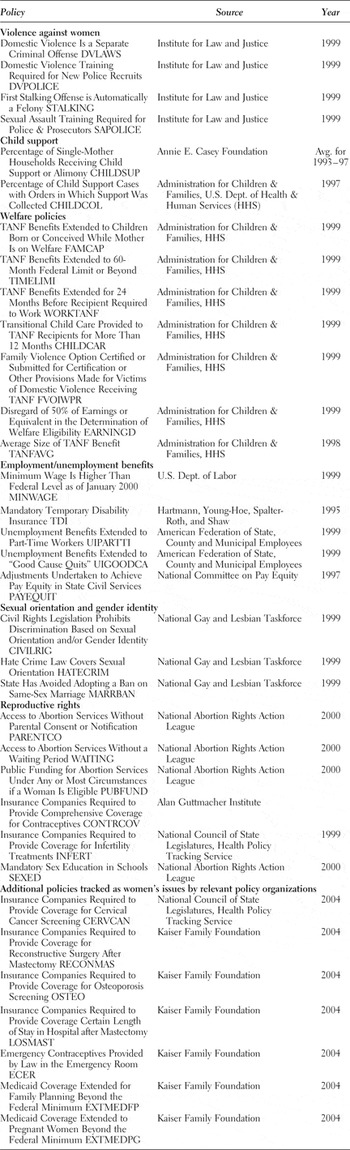
Yet in order to measure women-friendly public policy and predict its production, we must adopt a reasonable standard. One common approach to resolving this problem is to employ the key policy concerns of women's advocacy organizations (Carroll Reference Carroll2001; Dolan Reference Dolan1997; Swers Reference Swers2002; Thomas Reference Thomas1989, Reference Thomas, Thomas and Wilcox1998). Because we build on Caiazza's Reference Caiazza2004 study, we define women's substantive representation as Caiazza does, using the policies identified by the Institute for Women's Policy Research as central to the interests of women in the U.S. states.Footnote 3 The IWPR's agenda is derived from the Platform for Action agreed to at the United Nations Conference on Women in Beijing in 1995, which represented a broad, global consensus about the nature of women's interests. The Beijing Platform serves not only as the means for IWPR to measure the status of women in the U.S. states but also as the agenda for the President's Interagency Council on Women and the background for the Center for Women Policy Studies' Contract with Women of the USA State Legislators Initiative, all of which lends credibility to its use as a means for assessing women-friendly public policy. We were able to find data on U.S. state policies for 27 of the 31 items Caiazza used on the IWPR agenda. We include seven additional policies related to women's health that are tracked by other organizations as women's (health-care) issues, and that go beyond reproductive health. We thus test a comprehensive list of 34 public policies, each ostensibly central to women's status in the states, and we consider each separately in our analysis. Table 1 lists the policies that we examine.Footnote 4
Indicators of women-friendly public policy in the U.S. states, circa 2000

RESEARCH DESIGN AND MEASUREMENT
We use regression to investigate the relation between descriptive and substantive representation, controlling for variables that affect both the likelihood that women are elected and policy outcomes. Specifically, using least squares or logistic estimation, we regress the extent of or presence/absence of each of the 34 state women-related policies on a set of independent variables common to each regression. Our focus is on the importance of descriptive representation for the substantive outcome (policy adoption), controlling for other politically proximate factors common to all policy processes (i.e., the public opinion environment, political party, and interest groups).Footnote 5
Because many common variables may be ancillary to both the presence of women in the state legislature and the adoption of women-friendly public policy, we use two equations to estimate the association between descriptive representation and substantive outcomes. First, we estimate the percentage of women in state legislatures (descriptive representation) using factors unlikely to account for policy adoption (substantive representation) but likely to account for women in state legislatures: the number of women candidates and the number of seats in state legislatures (house plus senate).Footnote 6 Second, we use the percentage of women in state legislatures predicted from the first stage to estimate the second stage equation, which estimates the relation between the “error-corrected” percentage of women in state legislatures, controlling for other variables likely to have a direct effect on women legislators' policy choice. These variables include two aspects of the public opinion environment (liberalism and feminism), the degree of Democratic political party dominance of the legislature, and the presence of pro- and antifeminist interest groups. These variables are likely to be related to the presence of women legislators and to policy choice.
Our indicators are based on long-term state averages (1990–2000) to estimate their impact on policy in place in 2000. The result is a study with n = 47 states with complete information.Footnote 7
The first stage regression model is:

where:
Xi1 = women's descriptive representation (1990–2000 average percentage of women in state house + senate) in ith state;
Zi1 = 1990–2000 average number of women candidates for state house + senate seats in ith state; and
Zi2 = 1990–2000 average number of seats in state house + senate in ith state.
The second stage regression model is:

where:
Yi = policy outcome in ith state;
X′i1 = predicted value (from first stage equation) of women's descriptive representation in ith state;
Xi2 = 1990–2000 percentage Democratic in ith state house + senate (averaged);
Xi3 = 1990–2000 average percentage of Democratic women in ith state house + senate (averaged);
Xi4 = 1990–2000 average opinion liberalism in ith state;
Xi5 = 1990–2000 average feminist thermometer score in ith state; and
Xi6 = 1990–2000 average number of “pro”/number of “anti” women's groups in ith state.
Descriptive Representation
Women's descriptive representation is usually conceptualized as the proportion of women in the legislature and their presence in leadership positions that may help women select the legislative agenda. Since women must be elected to attain leadership position, we find that these two measures are highly correlated (r = .83). Like Caiazza (Reference Caiazza2004), we use the percentage of women in the state legislature, but we average the percentage of women in each state legislature from 1990 to 2000.
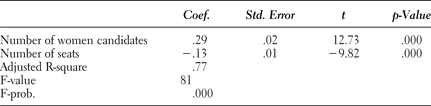
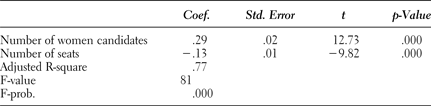
Table 2 shows the results from the first stage regression. First, with an R2 of .77, the model fit is very good; adding other variables (including various measures of opinion liberalism and the percentage of women in the workforce) did not improve the fit. Second, the results show that for each additional woman candidate, there is an additional .3 of 1% of women in the legislature. During the decade, the average number of women candidates varied from 13 to 231. Thus, if the average number of women candidates (53) were to run in every state, the presence of women in the average state house would increase by .3*(53), or 16%. The results also show that for each additional seat in the state legislature, there is .1 of 1% fewer women in the legislature. One more female candidate more than cancels the negative effect of one more seat.
The observed value of the percentage of women in a legislature varies considerably. (Of course, the predicted value varies less.) The state with the smallest (observed) percentage of women in the state legislature (5.4%) is Alabama; the state with the highest percentage (37.5%) is Washington; the average is 20.3%. We use the predicted value in the second stage regression.
Regression of average % of women in state legislatures from 1990 to 2000 on average number of women candidates (house + senate) 1990–2000 and average number of (house + senate) seats 1990–2000 (n = 50)
Political Party
The Democratic Party, since 1980, has tended to be more closely associated with support for women's issues than the Republican Party, such as extending abortion rights (Berkman and O'Connor Reference Berkman and Robert1993; Tolbert and Steuernagel Reference Tolbert and Steuernagel2001), criminalizing violence against women (Weldon Reference Weldon2002), expanding employment opportunities, providing women's health-care innovations, and advancing social welfare issues in general, and Republican legislators have been shown to be less likely to sponsor feminist legislation (Bratton and Haynie Reference Bratton and Haynie1999; Dolan Reference Dolan1997; Swers Reference Swers1998, Reference Swers2002). We calculate the average percentage of the legislature that was Democratic from 1990 to 2000Footnote 8 and account for the nexus between the Democratic Party and elected women by including in the regression the average percentage of Democrats in the legislature from 1990 to 2000 who were women.
During the period of our study, the average percentage Democrat in state legislatures ranged from 25% (in Idaho) to 86% (in Hawaii). The overall average was 56%. The average percentage of Democratic women was 60%, ranging from 35% in Idaho to 89% in Alabama. The correlation between these two variables is .88. However, the percentage of Democratic women is clearly not the same as the percentage of women in the legislature, since the correlation between the percentage of Democratic women and the (predicted) percentage of women in state legislatures is negative (−0.38).
Public Opinion
Support for women's issues in public opinion should provide a positive context for their substantive representation (Arceneaux Reference Arceneaux2001; Brace et al. Reference Brace, Sims-Butler, Arceneaux and Johnson2002) in part because the preferences of the constituency are foremost in the minds of legislators (Fenno Reference Fenno1978; Fiorina Reference Fiorina1974). Activists on behalf of women often make claims based on public opinion to encourage legislators and political parties to adopt their policy agenda (Mansbridge Reference Mansbridge1986; Mueller Reference Mueller1988), and public opinion has been shown to be strongly correlated with state legislative output (Erickson, Wright, and McIver Reference Erikson, Wright and McIver1993). We use two separate indicators of state public opinion that should affect not only the probability that states will adopt policies that are believed to support women's interests but also the propensity to vote for women representatives. The first indicator of political climate is Robert Erickson, Gerald Wright, and John McIver's (1993) overall opinion liberalism, updated to reflect the 1990–2000 period.Footnote 9 The mean score is conservative (−14), ranging from very conservative (−29 in Mississippi) to the most liberal (4 in Vermont).
Because Erickson, Wright, and McIver's measure does not address attitudes about issues specific to the women's movement, the second indicator of the public opinion environment is the average score from two American National Election Study (ANES) surveys from 1990 to 2000 for each state on the feeling thermometer for “feminists.” Like the measures developed by Paul Brace and his colleagues (Reference Brace, Sims-Butler, Arceneaux and Johnson2002, 184), this measure “supplement(s) general measures of ideology in explaining behavioral and policy outcomes in the states.” Other studies (Arceneaux Reference Arceneaux2001; Caiazza Reference Caiazza2004) use similar measures of opinion about women's issues. The mean feeling thermometer score for “feminists” is 55, ranging from 28 (in Idaho) to 78 (in Mississippi).Footnote 10 The two opinion environment scores are not the same (r = 0.34).
Interest Groups
How opinion and women's descriptive representation affect policy may hinge on the role of interest groups. Organized interests are central to the way public opinion is translated into public policy (Gray et al. Reference Gray, Lowery, Fellowes and McAtee2004). An active women's movement in civil society articulating women's issues and insisting upon legislative action can create a legislative context favorable to the issues it advocates by publicizing those issues and framing a proposed legislative agenda around them (Banaszak, Beckwith and Rucht Reference Banaszak, Beckwith and Rucht2003; Carroll Reference Carroll and Bystydzienski1992; Katzenstein and Mueller Reference Katzenstein and Mueller1987; Mueller Reference Mueller1988; Skocpol et al.; Weldon Reference Weldon2002). Women's organizations can also bring direct pressure upon (or provide immediate support to) elected women, providing them with an informational, political (and often financial) base to advance those issues (Hall and Deardorff, Reference Hall and Deardorff2006).
Because one interest group engenders an opposing group, groups supporting women's issues activate opposing interests (Beckwith Reference Beckwith, Banaszak, Beckwith and Rucht2003; Buechler Reference Buechler1990; Meyer and Staggenborg Reference Meyer and Staggenborg1996; Tarrow Reference Tarrow1998). The emergence of an active countermovement should be expected to impede the efforts of elected women to advance women's issues and to create a legislative environment less conducive to enacting those issues. We construct a measure for women's organizational strength in the separate states using a count of women's interest organizations registered to lobby with state legislatures.Footnote 11 A higher score on this scale would represent an organizational context that we theorize would be more favorable for the transmission of women's descriptive representation into substantive representation. The mean on this scale is 1.6, indicating, on the average, more “pro” than “anti” women's groups. The range is considerable, from −2 (in Alabama) to +5 (in Connecticut).
Resources
Because some of the policies considered women-friendly are redistributive and entail direct on-budget allocations, their adoption may be resource dependent. While wealthier states may have a greater ability to institute some of these policies, poorer states may have greater political demand for some of them. We include in some of our models a measure of each state's resources as the average of each state's median incomes in 1990 and 2000, from the U.S. Census, but we have no a priori expectation about its direction of influence.
RESULTS
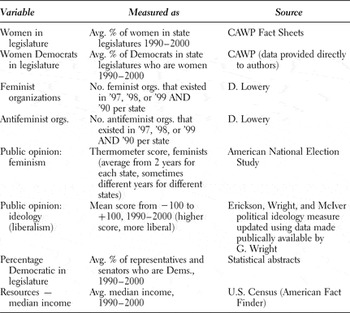
Table 3 lists those indicators of the likely explanations for women-friendly policy choices that support the preferences of many women's advocacy groups. Recall that our focus is not on the politics of each policy. Rather, we focus on the claim that electing women leads to substantively favorable policy choices. We control only for variables likely to directly shape general legislative policy choices affecting women, specifically political party and constituency opinion (including attitudes toward feminists that are especially likely to affect the choice of women-friendly policies), interest groups most likely to focus on women-friendly policies, and, in selected cases, resources.
Independent variables: List and sources

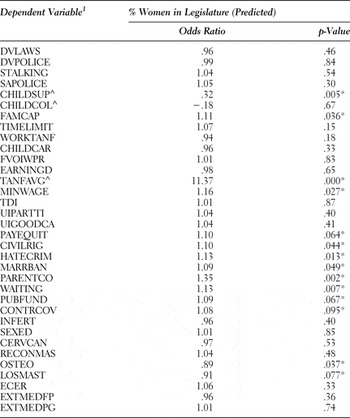
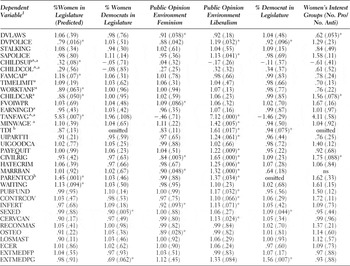
To see if there is a simple correlation between descriptive and substantive policy representation, Table 4 reports the results from 34 bivariate regressions of state policy on the predicted value of the percentage women in state legislatures. The small n leads to the expectation of heterogeneous (and large) variance in stochastic terms, and so we estimated parameters with standard errors corrected for heteroscedasticity. Table 4 reveals that, of the 34 simple regressions, 14 report p-values that would be regarded as significant at the 10% level, which is not unreasonable given the small n. However, signs on two significant variables suggest that the presence of women in the legislature is correlated with inhibiting, rather than promoting, the passage of women-friendly policies. Both laws concern mandates regarding women's health (insurance companies required to provide coverage for osteoporosis screening and reconstructive surgery after mastectomy). Nonetheless, most of the significant results suggest that the presence of women in legislatures is associated with more women-friendly public policy, including higher Temporary Assistance for Needy Families (TANF) benefits (each additional percent is associated with $11.00 more per month), a (slightly) higher percentage of women who receive child support, a minimum wage that exceeds the federal standard, the presence of pay equity laws, and the presence of several laws supporting the rights of gays and lesbians and women's reproductive rights.
Regressions of policy choice on descriptive representation (logistic or multiple regression) (n = 50)

1See Table 1 for variable descriptions.
∧Regression; the other estimates are from a logistic regression, where coefficients less than one mean a negative impact.
*Significant at p < 0.1.
These correlations may reflect the presence of other variables that are likely to account for both the presence of women in the legislature and the passage of the laws. Differences among the U.S. states in public opinion, political parties, and relevant interest groups could possibly explain the observed association between the presence of women in state legislatures and policy outcomes. The next set of results in Table 5 shows whether there is an association between women legislators and policy choice, controlling for indicators of these common causes.
Regressions of policy choice on independent variables (logistic odds ratio or regression coefficent; p-value in parentheses; robust standard errors; n = 47)

1See Table 1 for variable descriptions.
∧Regression; the other estimates are from a logistic regression, where coefficients less than one mean a negative impact.
aControlling for resources (median income) had no impact on these results.
bBecause there is little variance in the outcome, the model with all independent variables is overdetermined. The reported results reflect estimates with stable results for women legislators and as many other controls as possible.
• Significant at p < 0.1.
Of the 34 policies considered, once we control for two indicators of public opinion, political party, and interest groups, the choice of states to adopt them appears to be significantly related to the percentage of women in the state legislature in eight cases: Domestic Violence Training Required for New Police Recruits, Percentage of Single-Mother Households Receiving Child Support or Alimony, TANF Benefits Extended to Children Born or Conceived While Mother Is on Welfare, TANF Benefits Extended for 24 Months Before Recipient Required to Work, Transitional Child Care Provided to TANF Recipients for More Than 12 Months, Average Size of TANF Benefit, Access to Abortion Services Without Parental Consent or Notification, and Access to Abortion Services Without a Waiting Period.Footnote 12
The magnitude of these impacts is not trivial. For example, each additional percent of women in the legislature raises the percentage of single-women households that receive child support by .3%, relative to an average of 37%. About half the states extend TANF benefits to children born or conceived while their mother was receiving TANF, and each additional percent of women in the legislature increases these odds by 18%. For each additional percent of women in the legislature, the average monthly TANF benefit of $324 increases by $5.83. Only 16% percent of states adopt laws protecting access to abortion services without parental consent, but women legislators matter here, too: For each additional percent, the odds of protecting access increase by 45%. Women legislators also protect access to abortion by not requiring a waiting period. Slightly more than 55% of states do not require a waiting period, and the odds increase by 13% (with marginal significance) from the presence of women legislators.
The sign is negative for three of the eight policies, however, indicating that a higher percentage of women in the state legislatures correlates with lower anticipated benefits for women (Domestic Violence Training Required of Police) and two of the poverty policies (TANF Benefits Extended for 24 Months Before Recipient Required to Work, Transitional Child Care Provided to TANF Recipients for More Than 12 Months). These impacts are also not “small.” For example, the odds of requiring domestic violence training for new police are significantly lower (by 21%) for each additional percent of women in the state legislature; the odds of extending TANF benefits for 24 months before requiring recipients to work and for providing transitional child care to TANF recipients drop by 11% and 12%, respectively, for each additional percent of women in the state legislature.
Among the other variables in the model, party explains very little of the variance in the pattern of adoption across the states, since the percentage of the legislature that was Democratic and the percentage that was female and Democratic are significant for only six policies and positive in only two of the six (Mandatory Sex Education in Schools and Medicaid Coverage Extended to Pregnant Women Beyond the Federal Minimum).
The relative number of feminist to antifeminist women's organizations in a state also explains very little of the pattern of policy adoption of the separate states. The number of feminist organizations minus the number of antifeminist organizations explains the adoption of three policies: Domestic Violence Training Required for New Police Recruits, Transitional Child Care Provided to TANF Recipients for More Than 12 Months, and Civil Rights Legislation Prohibits Discrimination Based on Sexual Orientation and/or Gender Identity. The sign is in the expected direction only for the civil rights policy.
Public opinion is the most consistent explanation for variance across the states in their adoption of these women-friendly public policies: The two measures are significant in 21 of the 34 policies, though negatively related in 5. Pro-feminist public opinion in the state appears inversely related to women-friendly public policy on five of six policies for which the p-values were significant. Opinion liberalism appears consistent with expectations; it is significantly and positively related to public policy on the training of police, wages, welfare benefits, disability and unemployment insurance, the civil rights of gays and lesbians, and some health-care and abortion policies. These findings are consistent with the considerable literature pointing to a link between public opinion and policy (see Erickson, Wright, and McIver 1993 and Gray et al. Reference Gray, Lowery, Fellowes and McAtee2004 inter alia.) That not all of the policies are explained by the ideological persuasion of the public in left–right terms likely alludes to the complexity of many of these policies, which are not easily mapped onto a traditional left–right continuum.
DISCUSSION AND CONCLUSION
We set out to investigate the relationship between women's descriptive and substantive representation, following a theoretical argument that increasing the numbers of women in office would lead to public policy more favorable to women. Advancing Caiazza's model, our model considers the power of the presence of women in each state's legislature to effect the adoption of 34 separate policies identified as pro-woman by women's organizations in the 1990s. It controls for the strength of the Democratic Party, the public opinion context, and the strength of feminist women's organizations in the state. To limit the effect of omitted variables, we developed an instrument to measure women's descriptive representation based on predicting the average percentage of women in a state's legislature from the number of female candidates over the decade and the number of seats in the state legislature.
We find evidence that stronger women's descriptive representation led to state-level policy in favor of women in the American states in the 1990s on 5 of the 34 policies. Controlling for the other variables, our regressions reveal that when women's descriptive representation in the state's legislature rose, the rates of single-mother-headed households receiving child support or alimony increased, the likelihood of TANF benefits being extended to children born or conceived while their mother was on welfare improved, the average size of TANF benefits increased, and the access of women to abortion services without a waiting period or parental consent or notification expanded. In three other cases, increasing women's representation in the state legislatures appears to inhibit, rather than promote, favorable policies. Controlling for other variables, each additional percent of women in the legislature lowers the odds of adopting a policy that extends TANF benefits for 24 months before requiring work, provides transitional child care to TANF recipients for more than 12 months, and requires domestic violence training for new police recruits. For a few of the significant and positive results, the difference made by women legislators was impressive. For example, each additional percent female in the legislature decreased the odds of avoiding parental consent legislation for minors seeking abortion by 45%. Each additional percent female in the legislature also increased the average monthly TANF benefit in the state by $5.83.
That increasing the numbers of women in states legislatures was not related to the majority of these women-friendly public policies likely illustrates the complexities of these policy arenas. Criminal justice policy, for example, is clearly not just a women's issue but incorporates dimensions of race, crime rates, fear of crime, and other variables unique to each particular policy. Women's health policy choices may be best explained by the political clout of age, religion, and interest groups such as hospitals, insurers, and doctors, as well as other variables (Tolbert and Steuernagel Reference Tolbert and Steuernagel2001). For welfare and work-related issues, the operative variables may well be race, economics (including labor market opportunities for women), political party competition, and other factors relevant to poverty policy (Iversen and Rosenbluth 2006; Rodgers, Beamer, and Payne Reference Rodgers, Beamer and Payne2008; Soss et al. Reference Soss, Schram, Vartanian and O'Brien2001). In addition, where women's descriptive representation is related to policy, further research needs to determine why having more female legislators in these instances was significant (see Berkman and O'Connor Reference Berkman and Robert1993 and Tolbert and Steuernagel Reference Tolbert and Steuernagel2001 for similar results). Nor can our research explain why women's descriptive representation is related to policy on access to abortion services without either parental consent or a waiting period, for example, but not other abortion-related policies.
Our model focuses on policy rather than process because policy has the greatest impact on women's lives. Since our model focuses only on (some) policy outputs, it does not account for other aspects of the policy process. We know from previous studies that increasing the numbers of women in legislatures may affect the types of legislation sponsored/cosponsored, the priorities of legislators (both male and female), and the support of particular pieces of legislation (even though the legislation may not pass) (see, inter alia, Bratton 2005; Dodson Reference Dodson2006; Dolan 1997; Reingold Reference Reingold2000; Swers Reference Swers1998, 2002; Thomas Reference Thomas1991, Reference Thomas1994). In short, the effect of women's descriptive representation may be on elements of the policy process, and we tested simply the outcome of the process.
We also recognize the hazards of drawing any causal conclusions from what is basically a cross section of 47 U.S. states. Ideally, to study whether increases in descriptive representation bring about increases in substantive representation, one needs evidence over time that actually examines change in both variables, holding confounding variables constant. There is, however, as noted, considerable precedent for studying policy outputs across the U.S. states in exactly the fashion we undertake. And, in this case, even the minimal test of a causal claim requires that descriptive representation of women's political power and substantive policy choice “go together,” or be associated, when confounding variables are held constant.
We also believe it important to remind the reader that the policies we evaluated are “women-friendly” in the sense that leading women's interest groups have designated them as such. Building on Caiazza's study, we resort to her list of policies, developed by the IWPR, and add others deemed within women's interests by the National Council of State Legislatures. Whether these policies benefit women or whether a legislator can be pro-woman but oppose these policies is an empirical question that this study does not test. For example, it is possible that requiring insurance companies to pay for a certain length of stay after a mastectomy or cover certain services may raise the cost of coverage beyond the reach of the most needy women, thereby harming women more than helping them, or that raising the minimum wage reduces employment and total wages for the lowest-skilled workers, many of whom are women (Neumark and Wascher Reference Neumark and Wascher2008). We do not determine this here, but it is important for those interested in helping women to identify policies that really do help women, especially those who are likely to need that help. That women's interest organizations advocate for the passage of these policies triggers the causal mechanisms linking women's descriptive and women's substantive representation in a political process more than the direct actual impact of the policies on women does. In other words, the interest group activity in favor of these policies may be more important to the theory linking types of women's representation than the extent to which the policies are good for women. Furthermore, no theory exists to link women's descriptive representation to policy that is harmful to women, or even regressive, conservative, or nonfeminist. Therefore, for the purposes of this study, we accept the designation of these policies as women-friendly, though this may constitute an underlying limitation of our conclusions. Future research may need to consider how the election of women to state legislatures affects women's quality-of-life indicators in the separate states.
We find some evidence to support the hypothesis that descriptive representation of women leads to women-friendly public policy, but it may also lead to policy that is not regarded by many women's groups as women-friendly. Liberal public opinion appears to be a more consistent predictor of the adoption of women-friendly public policy than the percentage of women in the state legislatures.
Overall, this research raises more questions than it asks. Of 34 policies that are thought to be women-friendly, the presence of women in the legislature predicts the adoption of five and the nonadoption of three. It is not clear why this pattern emerges. However, it is noteworthy that the five policies that the presence of women legislators promotes are not especially highly correlated with one another. States that adopt one of these five policies are not especially likely to adopt another one; the average correlation among these five is 0.06. For the three policies that the presence of women discourages, the same average correlation is negative, at −0.06. It follows that the best way to examine the substantive impact of the descriptive representation of women is likely to require the separate examination of each policy or distinctive policy area, like welfare.