Introduction
Termites are an important component of savannah ecosystems throughout Africa. They have been recognized both as ecosystem engineers (Dangerfield et al., Reference Dangerfield, McCarthy and Ellery1998) and keystone species (Paine, Reference Paine1969). In the tropics, they perform a pivotal role as mediators of ecological processes in the soil (Jones and Eggleton, Reference Jones and Eggleton2000). Decomposition of organic matter takes place within termite nests and mineral nutrients are, therefore, concentrated and trapped in these relatively few sites for at least as long as the nests are active (Kooyman and Onck, Reference Kooyman and Onck1987). In their quest for cellulose, termites may cause significant damage to crops, trees, and houses, particularly in developing countries. With the spread of agriculture and destruction of natural forests, termites have increasingly become a problem (Edwards and Mill, Reference Edwards and Mill1986; Wood and Pearce, Reference Wood and Pearce1991). The most important termite pest genera in Africa include: Odontotermes, Macrotermes, Pseudacanthotermes, Microtermes, Ancistrotermes, Allodontermes, Amitermes, Trinervitermes, and Hodotermes (Mailu et al., Reference Mailu, Gitonga and Fugoh1995; Mitchell, Reference Mitchell2002). Odontotermes spp. build low-lying mounds, generally 10−20 m in diameter, no more than 0.5 m high (Darlington and Bagine, Reference Darlington and Bagine1999), and exert a strong influence over savannah soil structure formation, maintenance, and functioning (Vivian-Smith, Reference Vivian-Smith1997).
Control of termites has depended on use of organochlorine insecticides (aldrin, dieldrin, chlordane, and heptachlor), as small-scale African farmers found these insecticides effective and affordable (Wightman, Reference Wightman, Veeresh, Rajagopal and Viraktamath1991). However, due to relatively high human toxicity and unacceptable environmental consequences (including lack of specificity in controlling only the pest species), these insecticides were banned. Less toxic and persistent insecticides (such as chlorpyrifos, isofenphos, and permethrin) replaced them (Wood et al., Reference Wood, Bednarzik and Aden1987). These insecticides also lack specificity in controlling only the pest species (Mullié and Keith, Reference Mullié and Keith1993; Peveling et al., Reference Peveling, Rasolomanana, Raholijaona Rakotomianina, Ravoninjatovo, Randimbison, Rakotondravelo, Raveloson, Rakotoarivony, Bezaka, Ranaivoson, Rafanomezantsoa and Zehrer2001). This situation has necessitated research to find effective yet safe alternatives for termite control. Several natural enemies, including entomopathogenic fungi (EPF), have been under consideration as potential biological control agents. One isolate of M. anisopliae (Metschnikoff) Sorokin (Hypocreales: Clavicipitaceae) was commercialized under the name Bioblast™ in the USA (now discontinued). In Australia, an improved formulation of M. anisopliae has been commercialized under the name Bio Green™ (Milner, Reference Milner2000). In Kenya, work carried out at the International Centre of Insect Physiology and Ecology (icipe) has identified an isolate of M. anisopliae ICIPE 30 as virulent to termites, and it is being developed as a biopesticide for termite control (Sekamatte, Reference Sekamatte2001; Maniania et al., Reference Maniania, Ekesi and Songa2002).
Since M. anisopliae has been isolated from a wide variety of insect species (Zimmermann, Reference Zimmerman2007), its application for control of termites could, therefore, affect the populations of non-target species. Termites interact with a number of organisms; and, in particular, are often associated with ants, which are their most significant enemies (Hölldobler and Wilson, Reference Hölldobler and Wilson1990; Cornelius et al., Reference Cornelius, Grace, Ford and Davidson1995). Ants are effective termite predators and are an important disturbance factor in resource exploitation by termites (Gonçalves et al., Reference Gonçalves, Reis, DeSouza and Ribeiro2005). The present study was, therefore, carried out to investigate the effects of M. anisopliae applied to control Odontotermes termites on the diversity and abundance of non-target species, in particular ants that are found in association with Odontotermes spp. mounds.
Materials and methods
Sites
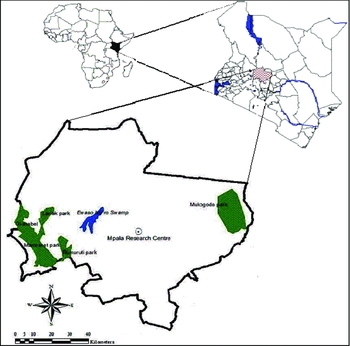
The work was carried out at icipe, Nairobi and at the Mpala Research Centre (MRC), Laikipia District, in central Kenya, at latitude 0o15'N, longitude 36o50'E and 1800 m above sea level (Fig. 1). Average yearly rainfall at MRC is 500−550 mm. Rainfall is low in the months of December to February, and has three small peaks in the months of April, August, and November. Mean high temperatures range from 25 to 30 °C, and mean low temperatures between 12 and 17 °C. July and August are often the coldest months. MRC is located on a level area of black cotton soil with impeded drainage.
Location of Mpala Research Centre in Laikipia District, Kenya (in green).

Entomopathogenic fungus
Metarhizium anisopliae isolate ICIPE 30 used in the present study was isolated in 1989 from a larva of the stemborer, Busseola fusca Fuller (Lepidoptera: Noctuidae). Sekamatte (Reference Sekamatte2001) and Maniania et al. (Reference Maniania, Ekesi and Songa2002) demonstrated its efficacy against termites in the field. Conidia were mass-produced on whole rice substrate in Unicorn production bags (35 × 60 cm; (Unicorn Import & Manufacturing Corporation, Garland, Texas, USA)) (R. J. Milner, unpublished observation). Rice was autoclaved for 1 h at 121 °C and inoculated with a 3-day-old culture of blastospores. Inoculated rice was then incubated for 21 d at 20−26 °C, 40−70% RH, and allowed to dry for 5 days at room temperature. Conidia were harvested by sifting the substrate through a sieve (295-μm mesh size). Harvested conidia were stored in a refrigerator (4−6 °C) until required. Viability of conidia was then determined on SDA using the standard technique as developed by Goettel and Inglis (Reference Goettel, Inglis and Lacey1997).
Pathogenicity of M. anisopliae to selected non-target insects
Bioassays were carried out in the laboratory to evaluate the pathogenicity of M. anisopliae on two species of ants, C. mimosae Santschi, 1914 and a Camponotus sp. The two species were selected due to their abundance and availability at the experimental site. Spores of M. anisopliae were harvested from 3-week-old fungal cultures by scraping. Spores were then suspended in 20 ml sterile distilled water containing 0.02% Triton X-100 and vortexed for 5 min to produce a homogeneous conidial suspension. Concentrations of 3.0 × 10⁵, 3.0 × 10⁶, and 3.0 × 10⁷ conidia/ml were obtained through serial dilutions. Suspension (10 ml) was sprayed onto filter paper using Burgerjon's spray tower (Burgerjon, Reference Burgerjon1956). For the controls, filter paper was sprayed with sterile 0.02% Triton X-100. Test insects were then transferred onto the filter paper and allowed to walk on it for 20 min. They were then transferred to 90-cm Petri dishes and maintained at room temperature (23−28 °C and 60−75 RH). The experiment consisted of 20 insects per replicate and was repeated three times. Mortality was recorded daily for 14 d. Dead insects were surface-sterilized using a solution of 3% sodium hypochlorite, then put in 70% alcohol for 2 s and rinsed three times in sterile distilled water. Insects were placed in Petri dishes lined with moistened filter paper to promote fungus growth on the cadaver surface. Treatments were randomized and replicated four times.
Field trials
Forty (40) termite mounds were selected, and half were randomly assigned for treatments with M. anisopliae while the others served as untreated controls. Two to three grams of dry conidia of M. anisopliae were applied into the termite mounds by forcing the conidia through ca 1 m of tubing inserted into the mounds through a vent using a bicycle pump. Only a single application was made in August of 2007.
Data collection
Data were collected from termite mounds, hereafter referred as ‘on-mound’, and twice the diameter distance from the mound edge, hereafter referred as ‘off-mound’. Insects were sampled every three months and this continued for 18 months after introduction of the fungus. Two sampling methods were used: pitfall trapping and sweep-netting.
(i) Pitfall trapping. Plastic cups (5.4 cm diameter × 5.5 cm height) were placed into the ground so that their rims were flush with the soil surface. The cups were filled with soapy water and positioned at four main compass directions around the edge of each mound. An additional four were placed between each in the centre of the mound. The layout was repeated at a distance twice the diameter of the mound from the mound edge. Contents from pitfall traps were collected after 48 h and taken to the laboratory at MRC. Collected samples were rinsed with clean tap water through a domestic sieve, sorted, and transferred into Nalgene bottles with ethanol for preservation. Recovered ants were identified down to the order level.
(ii) Sweep-netting. Sweep-netting consisted of swinging a net in 1-m widths through the understory while walking. The sweeps cut across mounds in two parallel lines on opposite sides of the mound diameter for a standard number of times depending on the mound size. The same procedure was used for off-mound sampling. Contents were emptied into containers and taken to the laboratory for processing and classifying.
Statistical analysis
To examine whether exposure to M. anisopliae affected diversity of ants, species diversity indices were generated from the pitfall and sweep samples using the Species Diversity module of Ecosim (Gotelli and Entsminger, Reference Gotelli and Entsminger2005). The Shannon index of diversity and Berger–Parker dominance index were obtained. Diversity indices were analysed as separate response variables using repeated measures ANOVA with ‘mound’ or ‘off-mound’ and collection date as main effects using JMP® 7.0.2 software. Confidence limits were obtained using least squares. The least square means (LSM) Student's t-test was then used to compute individual pairwise comparisons of least squares in the model.
Results
Pathogenicity of M. anisopliae towards Crematogaster mimosae and Camponotus spp.
Mortality of 23.3 ± 1.6% was recorded in the control while mortality of 28.5 ± 1.1% was recorded in fungus-treated C. mimosae, which was not significantly different. In Camponotus spp., high mortality was recorded in both the control (60%) and fungus treatments (50%). No mycosis was observed on dead insects.
Abundance and diversity of ants before mound treatment
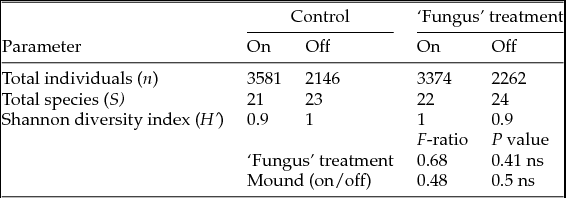
A total of 11,363 ants were collected prior to treatment. There was no significant difference in abundance of ants between the control (5727) mounds and mounds designated to be treated (5636) (F 1 = 0.68, P = 0.41) (Table 1). Similarly, there was no evidence of variation in abundance of ants between on- (6955) and off-mounds (4408) (F 1 = 0.48, P = 0.5). Average diversity ranged from 0.9 to 1.0 with C. mimosae being the dominant ant species constituting about 23% of the total ants collected (Table 1).
Ant abundance, species richness, and diversity indices before application of treatments in July 2007

Level of significance set at P < 0.05, df = 1. ns, not significant.
Abundance and diversity of ants after application of treatments
Statistical analysis showed that application of the fungus did not have a significant effect on ant diversity (F 1 = 0.0162, P = 0.8989). Similarly, non-significant values were obtained when diversity results of on- and off-mounds were compared (F 1 = 2.021, P = 0.1558). However, there was evidence of variation in diversity of ants across sampling dates (F 5 = 10.616, P < 0.0001).
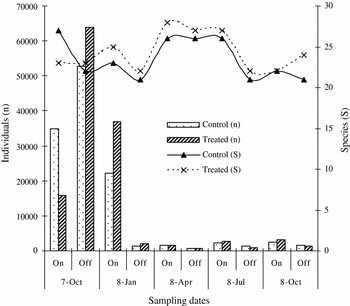
Ant abundance and diversity varied according to sampling dates (Fig. 2). In the control mounds, the highest number of individuals was recorded off-mound during the month of October 2007 (52,692), followed by on-mound over the same month (34,956). The least number of individuals were collected off-mound during the months of January (1325), April (581), and July (1352) in 2008 (Fig. 2). In contrast, the highest Shannon diversity index was obtained in April 2008 (on- and off-mounds). The lowest indices were obtained in October 2007 off-mound where Dorylus affinis represented 95.4% of the ants collected. Crematogaster mimosae remained predominant on and off untreated mounds in April, July and October 2008, representing 25–35.8%.
Ant abundance, species richness, and the Shannon diversity indices obtained from control and treated mounds across the sampling periods.

In fungus-treated mounds, the highest total number of individuals (63,936) was recorded off-mound in October 2007 (2 months after application of M. anisopliae). The lowest number of individuals was recorded in April 2008 (751), although the number increased in subsequent sampling months of July (1013) and October 2008 (1433) (Fig. 2).
The highest number of species was recorded from samples collected in April 2008 (28) which corresponded to the highest Shannon index (1) (Fig. 2). Diversity (H′) was generally low in collections made in the month of October 2007 and January 2008. Inversely, the highest number of total ant collections was made during the months of October 2007 (79,705) and January 2008 (38,965) (Fig. 2).
The composition of the ant community varied across the sampling dates. Dorylus affinis constituted a significant proportion (95.2%) of the total collection made in October 2007 while C. mimosae remained predominant in April, July, and October 2008 where it constituted between 27 and 46.6% of the total collection.
Discussion
Laboratory bioassays and field studies did not reveal negative effects of M. anisopliae on ants commonly associated with Odontotermes sp. mounds. A number of studies have been carried out to investigate the effects of M. anisopliae on non-target organisms both in the laboratory and under field conditions. Rath et al. (Reference Rath, Worledge, Koen and Rowe1995) reported that incorporation of M. anisopliae into the soil to control the subterranean scarab, Adoryphorus couloni, did not reduce the numbers of non-target invertebrates. The review done by Zimmerman (Reference Zimmerman2007) deduced that M. anisopliae is safe with minimal risks to non-target organisms. Ekesi et al. (Reference Ekesi, Maniania, Ampong-Nyarko and Onu1999) and Maniania et al. (Reference Maniania, Sithanantham, Ekesi, Ampong-Nyarko, Baumgärtner, Löhr and Matoka2003) made similar observations where they found that application of M. anisopliae ICIPE 69 on cowpea crops for the control of Megalurothrips sjostedti and onion crops for the control of Thrips tabaci had no adverse effect on the populations of non-target organisms such as ants, spiders, earwigs, and predatory beetles.
Although an increase in ant abundance was observed after the fungus application, this was not accompanied by an increase in species richness, suggesting that ecological changes caused by application of M. anisopliae might have favoured some ant species. For instance, Dorylus spp. (D. molestus and D. affinis) dominated the community in the months of October 2007 and January 2008. The Dorylus sp. also known as safari ants, driver ants, or army ants, are nomadic and form seasonal temporary ant hills. When food supplies dwindle, they leave the hills and form marching columns of up to 50,000 ants (Gotwald, Reference Gotwald1995; Hepburn and Radloff, Reference Hepburn and Radloff1998). Infection of termites by EPF can result in behavioural changes such as sluggishness before insect death (Rath, Reference Rath2000; Culliney and Grace, Reference Culliney and Grace2000). The infection might have rendered the termites weak, thereby becoming easy targets/prey of predatory ants. Thus, application of M. anisopliae appears to have directly affected the population of termites and, indirectly favoured some predatory ant species such as Dorylus spp. This might explain why Dorylus spp. dominated the ant community after fungus application. Availability of food within the experimental mounds could have attracted ants to this study site. However, it should be noted that the increase in ant populations was observed in both control and treated mounds. Due to the invasive nature of Dorylus species, they appear to have a potential for dispersal and re-distribution between plots (Matteson, Reference Matteson, Lomer and Prior1992). They did not discriminate between fungus-infected and uninfected termites. Vosseler (Reference Vosseler1905) reported that army ant colonies change their bivouac sites (being temporarily camped in a more or less exposed position) whenever the surrounding food supply is exhausted and this could have led to the indiscriminate spread across all the termite mounds regardless of whether M. anisopliae had been used or not.
On the other hand, the abundance of C. mimosae considerably reduced in October 2007 and January 2008, coinciding with the increase in the numbers of Dorylus species. Crematogaster mimosae numbers were higher on the mounds and decreased with increase in distance away from mounds (off mounds). This was observed in both treated and untreated mounds. The trend in C. mimosae population fluctuations may be explained by the tendency of Dorylus species to sweep almost all forms of animal life on their way including insects and sluggish ground dwelling creatures (Hölldobler and Wilson, Reference Hölldobler and Wilson1990). It has been observed that the presence of Dorylus spp., though a menace to people, can be considered beneficial to certain human communities, as they perform a pest prevention service in farming communities. Dorylus species are capable of feeding on crop pests (from insects to rats) (Gotwald, Reference Gotwald1995; Hepburn and Radloff, Reference Hepburn and Radloff1998).
Conclusion
An ecosystem previously dominated by a keystone species, an ecosystem engineer, and a detritivore (the termite) was for a few months swapped with another keystone species, ecosystem engineer, and predator, Dorylus spp. of ants. Howe and Westley (Reference Howe and Westley1988) asserted that if a competitive keystone disappears, other plants or animals that play similar roles in the community prosper; and these results corroborate this finding. They also indicate that M. anisopliae isolate ICIPE 30 can safely be used for the control of Odontotermes species, as it does not show any effect on the selected non-targets that interact with termites under field conditions.
Acknowledgements
We would like to acknowledge the financial support received from the National Science Foundation (NSF), USA (and icipe, Kenya for managing the funds, hosting this research and providing mentorship and technical support when needed).