Introduction
As the onset of most major mood or psychotic disorders occurs in adolescence or early adulthood (Jones, Reference Jones2013) it is the prime time for deployment of early intervention strategies. However, community samples demonstrate that early syndromal presentations are characterised by complex clinical profiles (Angst et al., Reference Angst, Cui, Swendsen, Rothen, Cravchik, Kessler and Merikangas2010; Kelleher et al., Reference Kelleher, Keeley, Corcoran, Lynch, Fitzpatrick, Devlin and Cannon2012; Wigman et al., Reference Wigman, van Nierop, Vollebergh, Lieb, Beesdo-Baum, Wittchen and van Os2012). In cohorts focused on the early phases of these conditions, the rate of progression to major mood or psychotic disorders is low (Iorfino et al., Reference Iorfino, Scott, Carpenter, Cross, Hermens, Killedar and Hickie2019). Consequently, it is difficult to identify individuals at increased risk of onset of these more severe illness states. Improving early identification is an important priority as increased duration of illness is associated with poorer outcomes (Marshall et al., Reference Marshall, Lewis, Lockwood, Drake, Jones and Croudace2005; McCraw, Parker, Graham, Synnott, & Mitchell, Reference McCraw, Parker, Graham, Synnott and Mitchell2014), and early intervention has been shown to reduce conversion to full-threshold (FT) disorders (Correll et al., Reference Correll, Galling, Pawar, Krivko, Bonetto, Ruggeri and Kane2018; Vallarino et al., Reference Vallarino, Henry, Etain, Gehue, Macneil, Scott and Scott2015). However, as the nature of effective treatments or prevention strategies may differ between psychotic disorders (PDs) and bipolar disorders (BDs) (Alvarez-Jimenez, Parker, Hetrick, McGorry, & Gleeson, Reference Alvarez-Jimenez, Parker, Hetrick, McGorry and Gleeson2011; Yatham et al., Reference Yatham, Kennedy, Parikh, Schaffer, Bond, Frey and Berk2018), it is also important to distinguish those risk variables that are shared or are unique for the two conditions.
BDs and PDs are both highly heritable (Sullivan, Daly, & O'Donovan, Reference Sullivan, Daly and O'Donovan2012), with partially overlapping genetic risk (Forstner et al., Reference Forstner, Hecker, Hofmann, Maaser, Reinbold, Muhleisen and Nothen2017). Family studies indicate that family history of these disorders increases not only homotypic risk for development of the same disorder, but also heterotypic development of multiple mental illness conditions (Sandstrom, Sahiti, Pavlova, & Uher, Reference Sandstrom, Sahiti, Pavlova and Uher2019). Conversely, there is also evidence for some specificity of psychotic, mood, and manic heritability (Vandeleur, Merikangas, Strippoli, Castelao, & Preisig, Reference Vandeleur, Merikangas, Strippoli, Castelao and Preisig2014). Risk factors for psychosis onset include subclinical psychotic symptoms, depressive or anxiety symptoms, sleep disturbances, low social and occupational functioning, social adjustment difficulties, neurodevelopmental disorders, substance misuse, and trauma (Hartmann, Nelson, Ratheesh, Treen, & McGorry, Reference Hartmann, Nelson, Ratheesh, Treen and McGorry2018; Khandaker, Stochl, Zammit, Lewis, & Jones, Reference Khandaker, Stochl, Zammit, Lewis and Jones2014; Oliver et al., Reference Oliver, Reilly, Baccaredda Boy, Petros, Davies, Borgwardt and Fusar-Poli2019; Ruhrmann et al., Reference Ruhrmann, Schultze-Lutter, Salokangas, Heinimaa, Linszen, Dingemans and Klosterkötter2010). Risk factors for BD include depressive symptoms or depressive disorders, subclinical manic symptoms, subclinical psychotic symptoms, anxiety symptoms, sleep disturbance, poor psychosocial functioning, substance misuse, trauma, suicidal behaviour, family history of BD or other mood disorder, family history of substance abuse, and early age of onset of mood disorder (Faedda et al., Reference Faedda, Serra, Marangoni, Salvatore, Sani, Vazquez and Koukopoulos2014; Faedda et al., Reference Faedda, Baldessarini, Marangoni, Bechdolf, Berk, Birmaher and Correll2019; Hartmann et al., Reference Hartmann, Nelson, Ratheesh, Treen and McGorry2018; Iorfino et al., Reference Iorfino, Hermens, Cross, Zmicerevska, Nichles, Groot and B2018; Musliner & Ostergaard, Reference Musliner and Ostergaard2018; Ratheesh et al., Reference Ratheesh, Davey, Hetrick, Alvarez-Jimenez, Voutier, Bechdolf and Cotton2017).
Longitudinal or prospective risk factor research has been conducted in cohorts that have been selected for elevated risk (e.g. due to family history, or the presence of subclinical symptoms), typically focusing directly on one specific illness outcome (i.e. onset of BD or PD) with the explicit goal of capitalizing on an expected higher transition rate. That is, typically such studies have investigated psychotic-like experiences (PLE) in ‘at-risk’ to psychosis studies or manic-like experiences (MLE), depressive syndromes, or family history of BD in ‘at-risk’ to bipolar studies. Clinical studies have often preferentially recruited subjects who are already presenting with ‘attenuated’ psychotic or bipolar syndromes.
By contrast, community-based or primary care recruitment strategies focus on young people in earlier phases of illness, expressing more non-specific anxiety or depressive syndromes. Such cohorts are presumed to be at much lower (at least short-term) risk of progression to major mood or psychotic disorders (Carpenter et al., Reference Carpenter, Iorfino, Cross, Nichles, Zmicerevska, Crouse and Hickie2020; Iorfino et al., Reference Iorfino, Scott, Carpenter, Cross, Hermens, Killedar and Hickie2019). Specifically, in adolescents and young adults, evidence from community samples suggests that emergence of BD is associated with earlier onset, longer duration, and greater number of mood episodes; presence and persistence of subthreshold symptoms; childhood disorders; and greater impairment (Beesdo et al., Reference Beesdo, Hofler, Leibenluft, Lieb, Bauer and Pfennig2009; Tijssen et al., Reference Tijssen, van Os, Wittchen, Lieb, Beesdo, Mengelers and Wichers2010a; Tijssen et al., Reference Tijssen, van Os, Wittchen, Lieb, Beesdo, Mengelers and Wichers2010b). The emergence of PDs in community samples is associated with subthreshold symptoms, abnormal neurodevelopment, early life adversity, and substance use (Kaymaz et al., Reference Kaymaz, Drukker, Lieb, Wittchen, Werbeloff, Weiser and van Os2012; Kounali et al., Reference Kounali, Zammit, Wiles, Sullivan, Cannon, Stochl and Lewis2014; Mennigen & Bearden, Reference Mennigen and Bearden2019).
While there is substantial evidence supporting subclinical psychotic symptoms as a predictor of FT psychosis (Fusar-Poli et al., Reference Fusar-Poli, Bonoldi, Yung, Borgwardt, Kempton, Valmaggia and McGuire2012; Linscott & van Os, Reference Linscott and van Os2013), subthreshold psychotic symptoms are also predictive of other poor clinical and functional outcomes (Beck et al., Reference Beck, Andreou, Studerus, Heitz, Ittig, Leanza and Riecher-Rossler2019; Kelleher et al., Reference Kelleher, Devlin, Wigman, Kehoe, Murtagh, Fitzpatrick and Cannon2014; Scott et al., Reference Scott, Martin, Parker, Couvy-Duchesne, Medland and Hickie2020). Psychotic symptoms are also reported as a risk factor for the development of BD (Faedda et al., Reference Faedda, Baldessarini, Marangoni, Bechdolf, Berk, Birmaher and Correll2019; Musliner & Ostergaard, Reference Musliner and Ostergaard2018; Ratheesh et al., Reference Ratheesh, Davey, Hetrick, Alvarez-Jimenez, Voutier, Bechdolf and Cotton2017; Scott et al., Reference Scott, Martin, Parker, Couvy-Duchesne, Medland and Hickie2020), and comorbid PLE and MLE are associated with a higher risk of transition to BD than MLE alone (Kaymaz et al., Reference Kaymaz, van Os, de Graaf, Ten Have, Nolen and Krabbendam2007).
Previous longitudinal studies have generally not assessed risk factors to the onset of both BD and PDs in the same primary-care based and clinically-broad cohort. One exception to this is a small body of work comparing neurodevelopmental antecedents of BDs and PDs (Parellada, Gomez-Vallejo, Burdeus, & Arango, Reference Parellada, Gomez-Vallejo, Burdeus and Arango2017). However, it is not clear whether any of these developmental abnormalities are specific or unique predictors of FT disorders. The present study aims to address this gap in knowledge by comparing the clinical characteristics associated with onset of FT BD or PDs in young people presenting to mental health care. As the same population is at risk for these two different outcomes (onset of BD and onset of PDs), it is important to understand which elements of risk are general and which are specific to each outcome.
Method
The cohort studies being undertaken by our group are approved by The University of Sydney Human Research Ethics Committee (project numbers 2008/5453 and 2012/1626). For this, and all related studies, participants (or their guardians if under 16 years of age) provided written informed consent for use of their routinely collected clinical data for research purposes. The procedures contributing to this work comply with the ethical standards of the relevant national and institutional committees on human experimentation and with the Helsinki Declaration of 1975, as revised in 2008.
Participants
Participants were drawn from the Brain and Mind Centre's Optymise cohort. This cohort includes 6743 individuals aged 12–30 years old who presented to the Brain and Mind Centre's ambulatory-care based youth mental health clinics and were recruited to a research register between June 2008 and July 2018 (Carpenter et al., Reference Carpenter, Iorfino, Cross, Nichles, Zmicerevska, Crouse and Hickie2020). These clinics include both primary care and more specialised psychiatric services, which primarily attract young people with a range of mental health problems including subthreshold and FT mental disorders. All participants received clinician-based case management and relevant psychological, social, and/or medical interventions as part of standard care. Individuals may be self-referred, referred via a family member or friend, or else via the community including external general practitioner, school, or university. Recruitment to the research register involved consent for routinely collected clinical data to be used for research purposes. The present study includes 2901 individuals from the Optymise cohort with data entered in phase 1 and 2 of data entry (completed in 2019). Participants were included in the longitudinal analysis if the total duration of follow up was at least 28 days.
Data collection
Detailed description of the data collection methods is reported in the Optymise cohort profile (Carpenter et al., Reference Carpenter, Iorfino, Cross, Nichles, Zmicerevska, Crouse and Hickie2020). Briefly, data on specific illness course characteristics were extracted from clinical and research files at predetermined time points and entered into a standardised clinical proforma. The first available clinical assessment at the mental health service was taken as the baseline time point for each participant and the date of this assessment was used to determine each of the follow-up time points: 3 months, 6 months, 12 months, 2 years, 3 years, 4 years and 5 years. If there was no clinical information available for any time point (i.e. the participant did not attend the service during that time) then that entry was left missing. A ‘time last seen’ (TLS) entry was also used to capture clinical information from the most recent presentation to the clinical service, which did not always align with one of the pre-specified time points. All clinical files from the preceding time points, up to and including the current time point were used to inform and complete the current proforma entry. These clinical files were manually read and assessed by a team of trained clinical researchers. Clinical files included all available notes and records from standard clinical care, and research files included various assessments as part of participation in sub-studies (which may include structured or unstructured clinical interviews and the use of symptom rating scales). Data were then extracted from these clinical files by the clinical researchers and entered into the proforma as required.
Clinical raters used all available information from clinical notes to assign best estimate diagnoses according to DSM-5 (American Psychiatric Association, 2013). For BD, this included designation of specific Bipolar I or Bipolar II disorders, while for PDs this included all disorders listed in DSM-5 under ‘schizophrenia spectrum and other psychotic disorders’ (i.e. schizophrenia, schizoaffective disorder, schizophreniform, brief PD, substance or medication-induced PD, and other specified schizophrenia spectrum or PD). We note the similarity of this approach to that employed in other large family and epidemiological studies dealing with complex and comorbid anxiety, mood, and BDs (Merikangas et al., Reference Merikangas, Cui, Heaton, Nakamura, Roca, Ding and Angst2014). Inter-rater reliability estimates generally indicated moderate (kappa > 0.4) to substantial (kappa > 0.6) agreement, with an excellent agreement (kappa > 0.8) for some variables [reported in detail in (Carpenter et al., Reference Carpenter, Iorfino, Cross, Nichles, Zmicerevska, Crouse and Hickie2020)].
The measures from the proforma used in the present study include current psychiatric presentation, demographic features, social and occupational function [measured by the Social and Occupational Functioning Assessment Scale, SOFAS (Goldman, Skodol, & Lave, Reference Goldman, Skodol and Lave1992)], at-risk mental states (PLE, MLE, and circadian disturbance), self-harm and suicidal behaviours, alcohol or substance use, physical health comorbidities, childhood-onset syndromes, and family history of mental illness in first degree relatives. More detailed information on these measures is available in the Optymise cohort profile (Carpenter et al., Reference Carpenter, Iorfino, Cross, Nichles, Zmicerevska, Crouse and Hickie2020), and in online supplementary Appendix A.
Psychotic-like experiences (PLE) were defined as the presence of any psychotic symptoms including perceptual abnormalities, bizarre ideas, disorganised speech, psychotic-like unusual language or thought content, or psychotic-like disruptive or aggressive behaviour. Manic-like experiences (MLE) were defined as the presence of any manic/hypomanic symptoms including abnormally elevated mood or irritability; increased motor activity, speech, or sexual interest; manic-like disruptive or aggressive behaviour; manic-like unusual language or thought content; increased goal-directed behaviour; or decreased need for sleep.
For any cases where both FT bipolar I or II and PDs occurred, only the primary disorder (at baseline) or the disorder that emerged first (across follow-up) was considered.
Statistical analyses
Analyses were performed using R statistical software (version 3.6.0). Univariate comparisons of baseline characteristics in those with a FT BD, FT PD, or neither at baseline are reported in online Supplementary Table S1 to provide information about factors associated with these conditions cross-sectionally. Univariate analyses were also performed to provide initial comparisons of those with a new-onset FT BD, new-onset FT PD, or neither disorder across follow-up. These comparisons were conducted using Analysis of Variance (with Bonferroni corrected pairwise comparisons) for continuous variables and χ2 tests for categorical variables. A two-sided significance level of α < 0.05 was used for these analyses.
For those participants with no FT BD nor FT PD at baseline, a multistate Markov model [msm package version 1.6.8 (Jackson, Reference Jackson2011)] was fitted to determine which baseline demographic and clinical characteristics were associated with the time course of transitions. This analysis modelled competing risks for the development of FT BD or FT PD. Competing risks analysis accounts for the risk of transition to other mutually exclusive or intermediate events in estimates of risk, reducing bias that would be present in separate survival analyses. For example, survival analysis may estimate risk of death due to a specific disease over time, but does not account for the fact that some individuals may instead die of other causes. Transition to either of these competing states (death due to disease, death due to other causes) may depend on time as well as individual characteristics.
The Markov model quantifies the risk of transition to each state for each individual by their unique transition intensity (based on baseline clinical and demographic characteristics). The msm package fits the model to longitudinal panel-observed data, where individuals are followed up and classified intermittently but the exact time of transition is unknown. Therefore, data are assumed to be interval censored (i.e. the exact time of transition lies between the two adjacent time points). Of the total, 99% of transitions occurred within 6 years of baseline, so time points beyond 6 years were removed from the modelling analysis (this cut-off was also deemed valid because <2% of the baseline sample have completed full follow-ups past this point).
The model including covariates (baseline demographic and clinical characteristics) was compared to a model with no covariates (i.e. modelling only the effect of time) using a likelihood ratio test to determine if the covariate model had improved goodness of fit. Adjusted hazard ratios and 95% confidence intervals were estimated to determine the change in probability of transitions for each variable at baseline relative to a reference value or absence of that characteristic. Reference values for continuous variables were one standard deviation of the baseline distribution. Survival probability plots were generated to model the empirical and fitted time-to-transition for demographic and clinical variables with a significant impact on transition probability using the survival package (version 2.44-1.1).
Results
Of the 6743 individuals in the Optymise cohort, 2901 had data entered during phase 1 and 2 of data entry (completed in 2019) and so were included in the present study. Included participants were 18.8 ± 3.8 years old at baseline, and 58.8% were female. The mean (± standard deviation) duration of follow up was 22.6 ± 22.8 months. At the entry to care, 209 (7.2%) of the 2901 young people already met criteria for a FT BD (90 cases, 3.1%) or FT PD (119 cases, 4.1%). Supplementary analyses report the prevalence of key demographic and clinical phenomena as a function of whether they had already developed a FT BD or PD at baseline (online supplementary Table S1). The high prevalence of anxious and depressive phenomena, as well as the moderately high rates of PLE, MLE, circadian disturbance, deliberate self-harm, suicide attempts, and alcohol, cannabis and stimulant use, are notable.
Of those with no FT BD or PD at baseline, 2330 had data available for at least 28 days duration and were included in the multistate modelling analysis. New onset of FT bipolar I (n = 15) and II (n = 85) disorder occurred in 100 individuals (4.3%) and new-onset PDs occurred in 51 individuals (2.2%), indicating a total of 151 (6.5%) new-onset cases of either disorder. Breakdowns and demographics of specific new-onset and baseline FT bipolar and psychotic diagnoses are reported in Table 1. The median ± IQR time to transition to bipolar I or II disorder was 1.00 ± 1.65 years, and the median ± IQR time to transition to PDs was 1.09 ± 1.51. Over 75% of transitions occurred within the first 2 years of follow up. Univariate comparisons of demographic and clinical characteristics in those with new-onset FT bipolar and psychotic diagnoses and those with neither diagnosis across follow-up are reported in Table 2.
Breakdown and demographics of baseline and new-onset full-threshold bipolar and psychotic diagnoses

*Note 2 baseline cases and 1 new-onset case met criteria for 2 different psychotic disorders. Age is reported as mean ± standard deviation and Sex as count (percentage).
Comparisons of demographic and clinical variables at the entry to care in those with New-onset full-threshold bipolar diagnoses, emerging full-threshold psychotic disorder diagnoses or neither of these conditions across follow up

ANOVA pairwise comparisons are Bonferroni adjusted. Table reports mean ± standard deviation or counts (percentage). SOFAS: Social and Occupational Functioning Assessment Scale
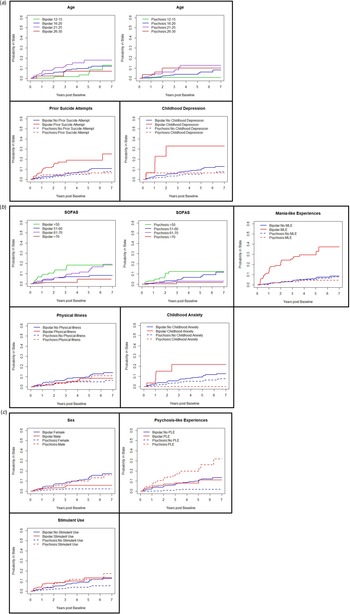
The multistate model including covariates provided a significantly better fit than a model without covariates (χ2 = 394.11, p < 0.001). The model identified seven factors associated with new-onset of BD and six factors associated with new-onset of a PD. Only three of these factors (older age, prior suicide attempts, and childhood depressive disorder) were shared. Adjusted hazard ratios and 95% confidence intervals for all factors included in the model are reported in Table 3. Figure 1 shows the Kaplan-Meier survival curves for significant covariates.
Kaplan–Meier Survival Curves for Transition to Bipolar and Psychosis for Covariates with Significant Hazard Ratios in the Multi-state Model. SOFAS, Social and Occupational Functioning Assessment Scale. (a) Factors associated with transition to both states; (b) Factors uniquely associated with transition to Bipolar Disorder; (c) Factors uniquely associated with transition to Psychotic Disorders.

Adjusted Hazard Ratios and 95% Confidence Intervals for new onset of Bipolar Disorder or Psychotic Disorder in multi-state modelling analysis

SOFAS, Social and Occupational Functioning Assessment Scale.
Bold values indicate significant adjusted hazard ratios. Adjusted hazard ratios for continuous variables are calculated for reference value of 1 standard deviation of the baseline distribution (age: 3.60 years; SOAFS: 8.95 points).
Discussion
This study reports factors associated with the transition to FT BD or FT PD in a large clinical cohort of young people presenting to primary-care-based, early intervention services. The present findings extend our previous report on factors associated with transition to transdiagnostic clinical stages in this sample (Iorfino et al., Reference Iorfino, Scott, Carpenter, Cross, Hermens, Killedar and Hickie2019) by examining factors associated with the longitudinal transition to two different specific outcomes (namely the illness states of BD and PDs). At the first clinical assessment, most young people have various anxiety and depressive syndromes with only 7.2% having FT BD or PDs. Over the follow-up period transition to FT bipolar or psychotic syndromes is not common (6.5% of cases) with new-onset BDs (4.3%) occurring twice as commonly as progression to PDs (2.2%). The majority of transitions occurred in the first 2 years after the presentation to care.
Multi-state modelling allowed for investigation of risk factors associated with one outcome (i.e. FT BD or FT PD) while taking into account risk for the competing state. The findings demonstrate three factors associated with risk to both illness states, namely older age at presentation to care, prior suicide attempts, and childhood-onset depressive syndromes. Further, a number of factors were uniquely associated with risk of transition to BD (lower social and occupational functioning, MLE, reduced incidence of physical illness, and childhood-onset anxious syndromes) and PD (male sex, PLE, and stimulant use). This study is uniquely placed to compare the utility of these common or specific risk predictors in the same cohort that is early in the course of illness and not pre-selected for being at high-risk to onset of either BD or PDs. Several of the risk factors identified in the present study are consistent with previous reports of risk for transition to PDs (subclinical psychotic symptoms, depressive symptoms) (Hartmann et al., Reference Hartmann, Nelson, Ratheesh, Treen and McGorry2018; Oliver et al., Reference Oliver, Reilly, Baccaredda Boy, Petros, Davies, Borgwardt and Fusar-Poli2019; Ruhrmann et al., Reference Ruhrmann, Schultze-Lutter, Salokangas, Heinimaa, Linszen, Dingemans and Klosterkötter2010) and BD (subclinical manic symptoms, depressive and anxiety symptoms, poor psychosocial functioning, early age of onset of mood disorder) (Faedda et al., Reference Faedda, Baldessarini, Marangoni, Bechdolf, Berk, Birmaher and Correll2019; Faedda et al., Reference Faedda, Serra, Marangoni, Salvatore, Sani, Vazquez and Koukopoulos2014; Hartmann et al., Reference Hartmann, Nelson, Ratheesh, Treen and McGorry2018; Musliner & Ostergaard, Reference Musliner and Ostergaard2018; Ratheesh et al., Reference Ratheesh, Davey, Hetrick, Alvarez-Jimenez, Voutier, Bechdolf and Cotton2017).
A key finding is that prior suicide attempts were associated with an increased risk for both BD and PDs. We have reported previously in this sample that suicide attempts are associated with a range of negative clinical and functional outcomes (Iorfino et al., Reference Iorfino, Hermens, Cross, Zmicerevska, Nichles, Groot and B2018) including increased likelihood of being diagnosed with BD. However, we did not previously find associations between prior suicide attempts and transition to later transdiagnostic clinical stages (Iorfino et al., Reference Iorfino, Scott, Carpenter, Cross, Hermens, Killedar and Hickie2019). Together with the current analysis, this indicates that suicidal behaviour may represent a more specific risk for BD and PDs and may suggest that these individuals should receive more intensive, prolonged or targeted interventions. Suicidal thoughts and behaviour are commonly regarded as outcome measures in those with established mental illness (DeVylder, Lukens, Link, & Lieberman, Reference DeVylder, Lukens, Link and Lieberman2015; Schaffer et al., Reference Schaffer, Isometsa, Azorin, Cassidy, Goldstein, Rihmer and Yatham2015), however, this study highlights the importance of also considering their predictive value in relation to multiple outcomes (Goldman-Mellor et al., Reference Goldman-Mellor, Caspi, Harrington, Hogan, Nada-Raja, Poulton and Moffitt2014).
Reduced social and occupational functioning is consistently reported as a risk factor for PDs (Hartmann et al., Reference Hartmann, Nelson, Ratheesh, Treen and McGorry2018; Oliver et al., Reference Oliver, Reilly, Baccaredda Boy, Petros, Davies, Borgwardt and Fusar-Poli2019; Ruhrmann et al., Reference Ruhrmann, Schultze-Lutter, Salokangas, Heinimaa, Linszen, Dingemans and Klosterkötter2010). In BD, functioning is reported to deteriorate after onset but has also been identified as a risk factor in some studies (Birmaher et al., Reference Birmaher, Merranko, Goldstein, Gill, Goldstein, Hower and Keller2018; Hafeman et al., Reference Hafeman, Merranko, Axelson, Goldstein, Goldstein, Monk and Birmaher2016; Hafeman et al., Reference Hafeman, Merranko, Goldstein, Axelson, Goldstein, Monk and Birmaher2017; Nadkarni & Fristad, Reference Nadkarni and Fristad2010). In this multi-state model, reduced baseline function was a more specific risk for BD than for PDs. This novel finding should be explored further. For example, functioning at presentation to care may be less discriminative than functioning at later time points, which is likely to be more indicative of the failure to respond to initial interventions and potential underlying risk for more severe mental states. Additionally, changes in functioning over time are likely to be informative alongside absolute measures of current functioning. In line with this, decline in functioning has also been found to be a predictor of transition from prodromal to full-threshold psychosis (Cannon et al., Reference Cannon, Yu, Addington, Bearden, Cadenhead, Cornblatt and Kattan2016).
An early age of onset of depressive and anxiety disorders has previously been linked to increased risk for BD (Faedda et al., Reference Faedda, Serra, Marangoni, Salvatore, Sani, Vazquez and Koukopoulos2014; Hartmann et al., Reference Hartmann, Nelson, Ratheesh, Treen and McGorry2018). The present study extends this to suggest that childhood onset of depressive syndromes is also associated with increased risk for PDs. Accordingly, the age of onset of depressive symptoms should be considered in evaluating risk for both outcomes in the context of other risk factors. In contrast to some previous research (Hartmann et al., Reference Hartmann, Nelson, Ratheesh, Treen and McGorry2018; Khandaker et al., Reference Khandaker, Stochl, Zammit, Lewis and Jones2014), an association between neurodevelopmental or behavioural disorders and risk for PDs was not found in the present study.
Previously reported associations between family history and increased risk for BD and PDs (Faedda et al., Reference Faedda, Baldessarini, Marangoni, Bechdolf, Berk, Birmaher and Correll2019; Sandstrom et al., Reference Sandstrom, Sahiti, Pavlova and Uher2019; Van Snellenberg & de Candia, Reference Van Snellenberg and de Candia2009; Vandeleur et al., Reference Vandeleur, Merikangas, Strippoli, Castelao and Preisig2014) were not found in the multistate modelling analysis in the present study. However, significant associations were found between family history and the presence of baseline BD and PDs. This may be partially due to reporting bias- those presenting with a clear family history may be more likely to receive a full-threshold diagnosis at baseline. It is also possible that those with more familial risk are more likely to present to care in a full-threshold state, as they have an earlier age of onset of disorder (Baldessarini et al., Reference Baldessarini, Tondo, Vazquez, Undurraga, Bolzani, Yildiz and Tohen2012; Barajas, Ochoa, Obiols, & Lalucat-Jo, Reference Barajas, Ochoa, Obiols and Lalucat-Jo2015). Another unexpected finding was that the incidence of physical illness was negatively associated with BD. However, in the present study, these measures were based on clinical records and in this unselected sample reflected low base rates of family history and physical illness. Therefore, more systematic evaluation in independent cohorts is necessary to clarify these findings.
Previous research has led to the development of multiple instruments designed to characterise a psychosis ‘high-risk state’ (Fusar-Poli et al., Reference Fusar-Poli, Bonoldi, Yung, Borgwardt, Kempton, Valmaggia and McGuire2012; Fusar-Poli et al., Reference Fusar-Poli, Rutigliano, Stahl, Davies, Bonoldi, Reilly and McGuire2017) (Fusar-Poli et al., Reference Fusar-Poli, Bonoldi, Yung, Borgwardt, Kempton, Valmaggia and McGuire2012). Although less developed, bipolar at-risk criteria have been proposed (Bechdolf et al., Reference Bechdolf, Ratheesh, Cotton, Nelson, Chanen, Betts and McGorry2014; Correll et al., Reference Correll, Olvet, Auther, Hauser, Kishimoto, Carrion and Cornblatt2014; Scott et al., Reference Scott, Marwaha, Ratheesh, Macmillan, Yung, Morriss and Bechdolf2017). However, in light of the present findings, these separate tools may not adequately consider the shared risk for both disorders. While there is support for the validity of some of the predictors included in these tools, it may be important to refine the tools with some factors being more specific for either BD or PDs. The use of more comprehensive tools in clinical practice is a promising avenue for the improvement of mental health care in young people.
The findings also highlight the relative strength of homotypic risk for BD and PDs conferred by subclinical symptoms, with MLE and PLE being the strongest indicators of risk for their respective full-threshold disorders. While there is increasing evidence that these subclinical states may be general indicators of risk for more severe psychopathology or increased comorbidity (Angst et al., Reference Angst, Cui, Swendsen, Rothen, Cravchik, Kessler and Merikangas2010; Kelleher et al., Reference Kelleher, Keeley, Corcoran, Lynch, Fitzpatrick, Devlin and Cannon2012; Saha, Scott, Varghese, & McGrath, Reference Saha, Scott, Varghese and McGrath2011; Scott et al., Reference Scott, Martin, Parker, Couvy-Duchesne, Medland and Hickie2020; Wigman et al., Reference Wigman, van Nierop, Vollebergh, Lieb, Beesdo-Baum, Wittchen and van Os2012), the present study supports the use of these clinical phenomena as markers of increased risk for each specific syndrome. A more controversial question is whether these clinical phenomena could then be used as the basis (alone or in combination with the other factors identified here and in other studies) for earlier initiation of more specific secondary prevention strategies (e.g. mood-stabilizing agents such as lithium carbonate). Specific predictive algorithms that make use of these identified factors (notably age of onset, functional impairment at baseline, childhood onset disorders, suicide attempts) can be based on these data and then tested specifically in independent cohorts. A further consideration is that it appears (based on Fig. 1) that some risk factors (notably suicide attempt, childhood depression, MLE) are predictive of more rapid transition to BD in this setting and may similarly influence clinical decisions and the more active use of specific (medical, psychological or behavioural) secondary prevention strategies.
Limitations
This study of progression to major mood or psychotic disorders is based on young people who present to primary care-based early intervention services. Consequently, it does not reflect the relationships that may exist in those who do not present for care or those who are selected for the presence of other risk factors (e.g. family history) or ‘at-risk’ or ‘attenuated’ syndromes. Of note, we have recently reported on the homotypic and heterotypic relationships between sub-threshold and threshold psychotic, depressive and bipolar syndromes in adolescent and young adult twins recruited directly from the community (Scott et al., Reference Scott, Martin, Parker, Couvy-Duchesne, Medland and Hickie2020). As this study involves data extracted from clinical records, there is likely to be some underreporting of items due to the varied availability of clinical information, and the sample is biased at follow up time points towards those that continue to engage in clinical care. While those with more severe illness (i.e. those that do transition to BD or PDs) would be expected to continue to engage in care, those with milder illness may not. Thus, the sample may be biased towards greater proportional transition at later follow up timepoints. However, the multistate modelling analysis used here is suited to variable follow-up and interval censored data and should therefore account for this. The factors associated with transition may also differ in cohorts that are followed more systematically. To this end, at least one prospective study is now being conducted considering transition to both illness states in relation to a range of objective measures (Theodoridou et al., Reference Theodoridou, Heekeren, Dvorsky, Metzler, Franscini, Haker and Rossler2014). The confidence intervals for some hazard ratios were large, particularly for PD, likely due to the relatively small number of transitions to this state. The present study considered risk for FT BD and PDs as defined by the DSM (American Psychiatric Association, 2013). Baseline factors were used as covariates in the model to identify important factors that are present at first presentation to mental health care. However, other factors associated with transition may emerge across the course of care (including exposure to specific interventions or new risk factors), thus future research should also consider covariates at multiple timepoints and how these, or changes in these, relate to the time course of transitions. In addition, some factors associated with transition may not have been measured here. This includes some risk-factors that have been identified in other research such as neurocognitive measures, specific symptoms (e.g. unusual thought content), and familial characteristics (e.g. age at parental onset).
Conclusion
This study provides a detailed consideration of clinical factors associated with the transition to full-threshold bipolar or psychotic states in young people presenting to primary-care-based early intervention services. These clinical factors are evaluated in terms of both unique and shared risk to these two separate outcomes. While the presence of some factors was expected (e.g. PLE, MLE), others were novel, including suicide attempts, childhood onset depression, and lower social and occupational functioning. The findings have implications for the use of various risk factors in risk calculation tools and the identification of those at increased risk for increased monitoring and intervention. Finally, the findings should be interpreted in light of the relatively low incidence of transition in this primary-care based cohort to FT BD or PDs.
Supplementary material
The supplementary material for this article can be found at https://doi.org/10.1017/S0033291720003840
Acknowledgements
We would like to thank all the young people who have participated in this study, and all the staff in the Youth Mental Health Team at the Brain and Mind Centre, past and present, who have contributed to this work. This work was partially supported by grants from the National Health & Medical Research Council including: Centre of Research Excellence (No. 1061043), Australia Fellowship (No. 511921 awarded to Prof Hickie), and Clinical Research Fellowship (No. 402864 awarded to Prof Naismith). Dr Carpenter was supported by the Caroline Quinn Research Grant.
Author contribution
JSC, JS, FI, DFH, SPMC, SLN, AJG, EMS, and IH were involved in the conception and design of the study. JSC, JS, FI, JJC, NH, and IH were involved in planning of the analyses. JSC conducted the analyses; all authors were involved in interpretation of the analyses. JSC wrote the first draft of the manuscript. All authors contributed to and approved the final manuscript.
Conflict of interest
Professor Jan Scott has received UK Grant funding from the Medical Research Council (including for projects on actigraphy and BDs) and from the Research for Patient Benefit programme (PB-PG-0609-16166: early identification and intervention in young people at risk of mood disorders). Professor Sharon Naismith has received honoraria for an educational seminar for Lundbeck and is a consultant for Eisai. A/Prof Elizabeth Scott is the Medical Director, Young Adult Mental Health Unit, St Vincent's Hospital Darlinghurst, Discipline Leader of Adult Mental Health, School of Medicine, University of Notre Dame, Research Affiliate, The University of Sydney and Consultant Psychiatrist. She has received honoraria for educational seminars related to the clinical management of depressive disorders supported by Servier and Eli-Lilly pharmaceuticals. She has participated in a national advisory board for the antidepressant compound Pristiq, manufactured by Pfizer. She was the National Coordinator of an antidepressant trial sponsored by Servier. Professor Ian Hickie has been a Commissioner in Australia's National Mental Health Commission since 2012. He is the Co-Director, Health and Policy at the Brain and Mind Centre (BMC) University of Sydney. The BMC operates early-intervention youth services at Camperdown under contract to headspace. Professor Hickie has previously led community-based and pharmaceutical industry-supported (Wyeth, Eli Lily, Servier, Pfizer, AstraZeneca) projects focused on the identification and better management of anxiety and depression. He is the Chief Scientific Advisor to, and an equity shareholder in, InnoWell. InnoWell has been formed by the University of Sydney and PwC to administer the $30M Australian Government Funded Project Synergy. All other authors declare no conflict of interest.