




No CrossRef data available.
Religion, Race, and Gender Differences in Political Ambition
Published online by Cambridge University Press: 29 March 2006
Abstract
Existing studies of political ambition tell two different stories, male and female. Most research on political ambition focuses on the desire of men and women to hold political office at the state or national level and examines the ambitions of those already employed in the labor force. Scholarly inattention to ambition among activists at the local, neighborhood level may lead us to erroneous conclusions about people's motivations for engaging in politics, particularly along racial lines. A focus on those already in the workforce may distort our understanding of the factors that drive the political ambitions of women in particular. This study confirms that men and women have distinct paths of family socialization, qualifications, high school and college socialization, and life situations on the trail to ambition. It also shows that the local context changes the explanations for ambition. In particular, race, combined with the holding of conservative religious beliefs, varies in its impact upon white and minority women's expressions of ambition for future public office. In addition, the experience of sex discrimination has the countersocialization effect of increasing women's ambition.Previous versions of this paper were presented at the 2003 meetings of the Midwest Political Science Association, Chicago, Illinois and the 2005 meetings of the Southern Political Science Association, New Orleans, Louisiana. I would like to thank William G. Jacoby, Marcia Moore, the editors and anonymous reviewers for their generous comments in the preparation of this manuscript. Also thanks to Kay Lehman Schlozman and David Campbell for their comments and redirection on a much earlier version of this work.
Information
- Type
- Research Article
- Information
- Copyright
- © 2005 The Women and Politics Research Section of the American Political Science Association
On a regular basis, ambitious individuals step forward out of a broad pool of local civic leaders and activists, campaign workers and contributors, concerned citizens, lawyers, and business and professional occupations to seek government office. One of the puzzles of the U.S. political process is that men step forward to seek elective office more than women do.1
The eligibility pool is commonly defined as including lawyers, managers, professional and technical occupations, educators, and political activists (Darcy, Welch, and Clark 1994; Fox and Lawless 2004; Thomas 1998).
Contributing to this ongoing puzzle is scholarly inattention to ambition at lower levels of political and civic involvement. Evaluations of ambition among potential office seekers below the state or national legislative level are nonexistent. The limited numbers of studies evaluating the eligibility pool focus on occupations and levels of activism that would be “most likely to yield political candidates for state legislative or congressional offices” (Fox and Lawless 2004, 24; also see Constantini 1990; Fox and Lawless 2003; Fox, Lawless, and Feeley 2001). These studies center on individuals in law, business, education, and politics. The activists in these studies include state and local executive directors, delegates to national conventions, and officers from state and county political parties, as well as national political interest groups and lobbies (Constantini, 1990; Fox and Lawless 2003, 2004).
In this study, I examine a unique portion of the eligibility pool—local political and civic activists—to evaluate the relationship of ambition and gender at activists' earliest stages of community involvement. Ambitious politicians frequently begin their careers as county or city officials (Prinz 1993). I examine this pool of local activists to test previous explanations for lower levels of female ambition. How well do existing explanations for political ambition explain the motivations of people at the local level? I show that the local activism path to government office shares some similarities to the ambition paths of higher-level activists, yet differs in terms of gender, race, and religious variables.
DEFINING AMBITION
The literature measures ambition in three ways. Observation of behavior is the first measurement. This approach stems from the definition employed by Joseph Schlesinger in Ambition and Politics (1966). For Schlesinger and those who followed him (Abramson, Aldrich, and Rohde 1987; Brace 1984; Rohde 1979), ambition is inferred from the office-seeking behavior of individuals. Under this theory, ambition is not revealed as a motive unless the opportunity for an office is available. Some argue that Schlesinger has produced an “opportunity” measurement and not an ambition measurement by focusing solely on behavior (Hibbing 1993).
The second measurement derives from investigating the motives for current activism. Edmund Constantini and Joel King (1984) were the first to examine the motivational framework for potentially ambitious political activists (see also Constantini 1990). They questioned California political activists and officeholders2
A total of 3,001 party leaders and activists were surveyed at four-year intervals from 1965 through 1981. The bulk of the sample was drawn from winning and losing slates of delegates to the Democratic and Republican presidential nominating conventions, although members of Congress, state legislators, and party county committee chairs were included in the sample.
See Constantini and King (1984, 86–87) and Constantini (1990, 746) for a complete description of their components.
The third measurement combines attitudinal measurements and observations of behavior. In these studies, respondents are asked whether they have considered running for office (Fox and Lawless 2003, 2004; Fox, Lawless, and Feeley 2001) . Although this work does not measure the strength of this ambition attitude, it has the advantage of following an affirmative ambitious response with a further query about the respondent's actual past attempts to seek office. I operationalize ambition in this article on the basis of these latter two variables.
MEASURING AMBITION IN THE CITIZEN PARTICIPATION STUDY
Data for this study are from the 1990 Citizen Participation Study (CPS) (Verba et al. 1990). A preliminary random telephone interview of 15,053 Americans selected 2,517 respondents for a second interview. This second wave oversamples political and civic activists, as well as blacks and Latinos. Of the second wave, 95% are activists in political, secular nonpolitical or religious realms, and 83% are involved in two or more of these categories (Verba, Schlozman, and Brady 1995, 83). This CPS weights the second wave of follow-up interviews to replicate a random national sample. This sample allows the examination of differences within a group of individuals who show a higher than average proclivity for civic and political activism. Despite their self-selection as civic participants, their ambition (or lack thereof) still reveals that gender, race, and religion produce significant differences among them.
The ambition measurement derives from the motives for involvement in each form of activism. The CPS explores motives for participating in a local, state, or national political campaign, contributing to a political campaign, being active or contributing to a political/civic organization, attending church, taking part in a protest, attending or joining a local board/council, being an informal neighborhood activist, voting, and contacting a public official. These subjects are citizen volunteers in local communities who receive no compensation for their activities. The CPS does not ask respondents about future plans to run for office, but rather examines the motivation framework for participation in a manner similar to that of Constantini and King. Activists are asked to rate their motives for involvement in eleven types of activism using a series of Likert-type questions.4
Respondents were asked if the motives were very important, somewhat important, or not important. See Verba, Schlozman, and Brady for a complete listing of the motivations (1995, 111–12).
Although ideally the same set of motives would be asked for each activity, results of pretesting led CPS researchers to drop the motives of seeking office or a government job for some activities. Verba, Schlozman and Brady acknowledge that in dropping some motive questions they may have “risked missing a possible motive for activity” (1995. n. 111).
Using Constantini and King's framework, a factor analysis was performed on each of the seven CPS activities containing office seeking (government job and political office) as a motive. The results are based on principal component analysis, followed by a varimax rotated factor solution.6
Not shown. Complete results of the factor analyses are available from the author at http://www.delta.edu/robertmoore/p&g.html.
This matches Carroll and Strimling's (1983) finding that female office seekers are more likely than their male counterparts to gain political experience by acquiring a government job or appointed government position before seeking public office. To exclude office seekers raises the possibility of missing the ambitious women who seek a government job as the next step in expressing their ambition on their way to running for political office. Rerunning the factor analysis but dividing respondents by gender reinforces this. For two activities, attending board meetings and informal activism, male respondents place seeking a government job and running for office into separate dimensions, while female respondents place them in the same dimension.
EXPLAINING LOWER AMBITION AMONG WOMEN
The discovery of lower levels of expressed and actualized ambition for women8
Previous examinations of this mismatch of ambition conclude that women are less ambitious for public office than men (Bledsoe and Herring 1990; Carroll 1994; Constantini and Bell 1984; Constantini and Craig 1977; Farah and Sapiro 1980; Fox 1997; Jennings and Farah 1981; Jennings and Thomas 1968). Constantini (1990) finds that the ambition gap between men and women, though persisting, has diminished.
A second explanation is the effect of socialization on women. Historically, the socialization process taught us that politics is the domain of men (Constantini and Craig 1977; Lee 1976). Richard Fox, Jennifer Lawless, and Courtney Feeley (2001) find evidence that involvement in high school student government helps to contradict this negative socialization for women, while the effect is negligible for men. The search for a countersocialization effect that negates or reverses the messages of the dominant culture has met with limited success (Clark, Hadley, and Darcy 1989; Fowlkes 1984). The frequently suggested countersocialization sources include a highly educated or politically active mother, and/or adult experiences including job prestige, and activism in women's rights organizations.
Although these historical patterns of gender-biased socialization are declining, women still express lower levels of political interest and engagement than men (Bennett and Bennett 1989) and demonstrate lower levels of political knowledge (Bennett 1988; Delli Carpini and Keeter 1996; Verba, Burns, and Schlozman 1997). Women consider themselves to be less qualified to understand political issues than do men (Jennings and Niemi 1981; Sapiro 1982). Even among civic activists, women express lower levels of political efficacy (Verba, Burns, and Schlozman 1997).
A third explanation for lower levels of ambition among women is that men and women approach their life situations and responsibilities differently. Some studies suggest that, in comparison with women, men are less constrained in their considerations of running for office by their household duties and/or their roles as husband and father. Men appear to run for office without regard to the age of their children (Fowler and McClure 1989; Fox 1997). These differences are offered as the reason women more frequently begin their political careers at an older age than do men, waiting until their children are grown (Carroll and Strimling 1983; Kirkpatrick 1974; Sapiro 1982). Susan Gluck Mezey's (1978) analysis of state legislators finds that men who run for office have more children and younger children than do their female counterparts. The presence of children living at home lowers the reports of ambition among women (Fox and Lawless 2003), although Barbara Burtway and Rita-Mae Kelly (1992) found female politicians to be no older than their male counterparts and to have more young children. Fox and Lawless (2004) conclude that successful professionals with careers in law, business education, or politics show no evidence that their life situation reduces ambition. Regardless of who is the dominant breadwinner or the number of wage earners in the family, women spend more time on household chores and raising children than do men (Burns, Schlozman, and Verba 2001; Galinsky and Bond 1996; Verba, Schlozman, and Brady 1995).
For activists at the local level, religion may provide an additional explanation for gender differences in political ambition. Conservative Christianity advocates gender roles that discourage wives from working or participating in full-time activities outside the home, at least while their children are young (Cook and Wilcox 1991; Fowler 1986; Sherkat 2000). This conservatism has also been found to be related to opposition against women running the country or running for president (Peek and Brown 1980). Charles Peek, George Lowe, and Susan Williams (1991) conclude that this gendered opposition is associated with women's conservative beliefs (as measured by views of the Bible). To the extent that women are more fundamentalist than are men, they may also express less ambition (Conover 1988; Cook and Wilcox 1991). Previous research on ambition has examined religious traditions, operationalized broadly as Protestant, Catholic, and Jewish (Fox, Lawless and Feeley 2001); other studies have measured support for feminist attitudes without regard to religious belief (Fox and Lawless 2003). Previous studies of ambition that focus on individuals in the “eligibility pool” (individuals employed in law, business, education, and politics) are unlikely to discern the influence of religion, as employed women are less likely to ascribe to conservative views that do not support women entering the labor force. Similar to the discouragement of leadership roles and working outside the home is the fundamentalist discouragement of higher education (Darnell and Sherkat 1997). As fundamentalism also reduces education levels, there is a possible interaction between conservative religious belief and lowered education attainment that reduces ambition for women. By examining local-level activists, many of whom are unpaid volunteers, we might expect religion to play more of a role in explaining gender differences in ambition.
Race identity in the local context may have significant import for the politically ambitious. Fox and Lawless argue that “if traditionally excluded groups are less likely to have [elected] role models to emulate, they may be less likely to consider running for office” (2005, 646). They find that in comparison to males and whites, “women and blacks are significantly more likely to state that their initial entrance into politics would be at the local level,” rather than the state or federal level (654 n.). This racial difference may reflect a greater concentration of African-American role models at the local level. African-American politicians are more likely to hold local offices, such as county commissioners, mayors, or city councilpersons, compared to statewide or congressional offices (Prinz 1993). It is possible to generalize from these results that, at the local level, activist minorities may report levels of ambition similar to, or even exceeding, those of white activists.
I expect that in addition to the previous explanations—qualifications, socialization, and life situations—for reduced ambition among women, local context will provide further explanatory leverage. I expect the qualifications explanation to find the least support, with the local activism route functioning as a replacement for credentials. I also hypothesize that life situations, measured by marital and parental roles, will have a reduced influence on ambitious activists, as the burdens of lifestyle accommodations expected of an officeholder are similar to those already embraced in the choice to be an activist. Further, I hypothesize that religious conservatism will reduce ambition among women, particularly among white women. This religious conservatism, which suppresses educational achievement, will also interact with education levels to reduce the likelihood of expressing ambition. Race will also affect ambition, as minorities at this local level will be more likely to express ambition than they do for state and national office. Following Sharyne Merritt (1977, 734), I expect no age differences between ambitious men and women in the local context.
RESULTS
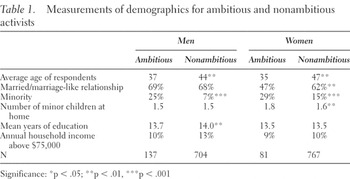
Within this pool of activists, regardless of gender, the ambitious form a distinct subgroup, with significant differences from their nonambitious counterparts. Table 19
An analysis was performed measuring the ambitious with unambitious respondents from all activities in the CPS (not shown). While the differences between marginals for the ambitious and unambitious were slightly changed, significance levels were unaffected, with the exception of increasing for a few comparisons.
Measurements of demographics for ambitious and nonambitious activists

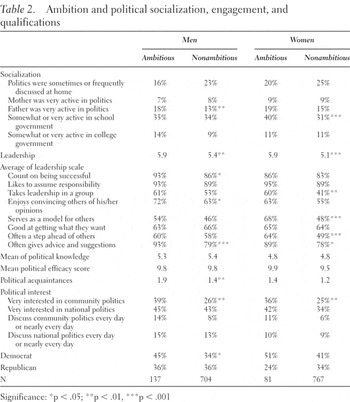
Significant differences in socialization, political engagement, and qualifications are found among all amibitious respondents (Table 2). Women, regardless of ambition, report having fewer political acquaintances than men and demonstrate lower levels of political knowledge than do men. Ambitious female activists do not differ significantly in socialization from other activist women, with the exception that ambitious women report higher levels of involvement in high school government than nonambitious women (40% as opposed to 31%). Ambitious women are more likely to perceive themselves as leaders and to possess individual leadership traits than nonambitious women. Ambitious men are 5% more likely than unambitious men to have a father who was very active in politics, and to have a larger network of political acquaintances. They also exhibit higher self-perceptions as leaders when compared to the unambitious male respondents. Ambitious men and women are more than 10% more likely to express interest in local politics than their nonambitious counterparts. There is little difference between ambitious men and nonambitious men in terms of interest in national politics, and no significant difference between women on this count.
Ambition and political socialization, engagement, andqualifications

Greater differences are evident when ambitious women are compared with ambitious men (not shown). Compared to their male counterparts, ambitious women are twice as likely to be African American (26%–13%, p = .05), more likely to have more preschool children (1.7–1.5, p = .05) and report having been more active in high school government (35%–40%, p = .01). Ambitious men, in contrast, have more political acquaintances (1.9–1.4, p = .05), are more likely to be married (69%–47%, p = .01), and exhibit higher levels of political knowledge (5.3–4.8, p = .01). Self-perceptions of leadership differ between ambitious men and women. Ambitious men score higher in being successful, in giving advice, and in convincing others of their opinions; ambitious women scored higher in serving as models, in leading by being a step ahead of others, in taking leadership in a group, and in giving advice. Ambitious men score higher in areas of persuasive leadership; ambitious women score higher in leading by example. There is no significant difference between the mean age of ambitious women and ambitious men (35–37 years, p = .21).
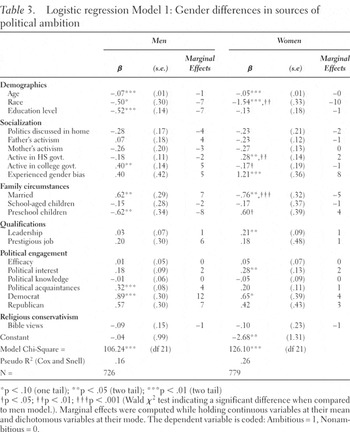
To evaluate the explanations for differences in gender and ambition, I ran separate logistic regression models for female activists and for male activists to measure factors influencing ambitious behavior.10
A complete description of the variables is available from the author at http://www.delta.edu/robertmoore/p&g.html.
Model 111
Approximately 8% of the responses in the CPS are missing income data. As the variable was not significant (including a dummy variable for missing cases) and its inclusion reduced the model's chi-square, it was removed from an initial model to limit the exclusion of a large number of cases. Remaining missing data are handled by listwise deletion, given their “valid inferences” under broad conditions for logistic regression (Allison 2002, 7). Another model (not shown) fitted with dummy variables for missing data failed to find any significance to the missing responses. Differences in subsets of the population arising from a nonrandom confining of the population sample (potentially produced by listwise deletion) are best handled by doing regressions on different subsamples and/or including interactions in the model (Winship and Radbill 1994). This was the process followed in Tables 3 and 4.
Logistic regression Model 1: Gender differences in sources of political ambition

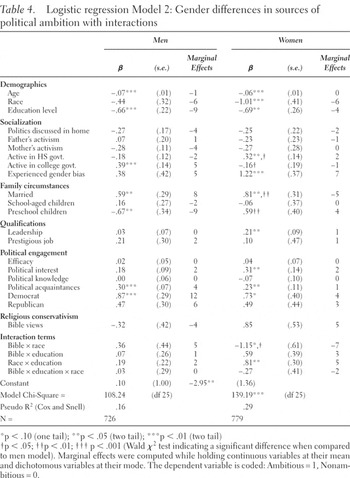
Logistic regression Model 2: Gender differences in sources of political ambition with interactions

Socialization also reveals a strong gender division and a twist on the issue of countersocialization. Parental activism and political discussion are not significant for either sex. School socialization reveals a division between involvement in student government in high school and in college. Consistent with Fox, Lawless, and Feeley's (2001) findings, each one-unit increase in women's involvement in high school government raises the likelihood of expressing ambition by 2%. On the other hand, each increase in men's involvement in college government raises their likelihood of ambition by 5%. The experience of gender bias increases the likelihood of women's ambition by 8%, while the gender bias variable is not significant for men.
The effects of family circumstances differ by gender. Marriage affects ambition for both sexes, but in opposite directions. Married men are 9% more likely to harbor ambition compared to single men, while married women are 5% less likely than single women to express ambition. A more surprising result is the effect on men who have preschool children in their home. The presence of these preschoolers drops the likelihood of men's ambition by 8%.
Political engagement, qualifications, and religion are also examined in the model. Democratic party identification and interacting with a network of political acquaintances contributes more to men's ambition than to women's. Qualifications for office also show a gender difference, as women who view themselves as leaders are more likely to express ambition. Following the lead of numerous studies (Ammerman 1982; Layman 1997; Manza and Brooks 1997; McKenzie 2001), attitudes toward the Bible are used to measure the degree of religious conservatism for each respondent. The Bible variable is not significant for either sex.
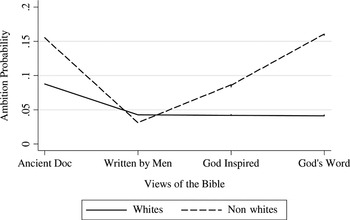
In Model 2 (Table 4), interaction terms were included to capture the effect of race and religion on the other variables. The interaction term for race and the Bible reveals that religion has a strong effect on the ambition of white women. For the average white woman, a one-unit increase in religious conservatism decreased the probability of ambition by 7%, and the total affect on the likelihood of their ambition, from the minimum value to its maximum while holding all other variables at their mean/mode, was −47%. Figure 1 shows the conditional effects for Bible attitudes divided by race. The influence of a supportive minority church environment is demonstrated in a curvilinear relationship between Bible views and ambition for minorities. Conservative religious views actually increase ambition for minority women. For white women, holding the most secular view of the Bible results in the highest probability of ambition. The probability declines for white women with each increase in their Bible conservativism. Unexpectedly, religious attitudes interacting with education levels do not affect ambition; the interaction term is not significant. Nor is the interaction of race, education, and religion a significant variable in Model 2. This may be attributable to the lack of influence of education, rather than a failure on the part of religious conservativism to reduce education levels. A lack of variance may also be biasing the interaction of religion and education, as obedient fundamentalists have been shown to complete mandatory high school education but not encourage college education (Darnell and Sherkat 1997). The effect of education is mitigated by race; each increase in education level for white women increases their likelihood of expressing ambition by 5%.

Conditional effects: Race, Bible views, and the probability of women expressing ambition. Conditional effects are computed while holding all other variables at their mean or mode.
Further gender differences are discovered by analysis of the Wald statistic. Marriage, early socialization experiences in high school and college, and the interaction of the religion variable with race are revealed to be the greatest and most highly significant differences in the explanations for men's and women's ambition.
EXPLANATIONS AND WOMEN'S AMBITION
The analysis reveals that all four of the explanations for gender differences in ambition maintain some validity for local-level activists. Socialization and family/life circumstance continue to provide some explanations for gender differences in levels of ambition. While parental models and discussion of politics may be different between activists and nonactivists, within this self-selected group of activists there is no variation between the ambitious and nonambitious. Women with ambition are not aided by the socialization variables in this model, with the exception of participatory experiences in high school government. Men, in comparison, are only aided by their college experiences. Family circumstances persist in having a mixed effect. Marriage, as previous studies have shown, has an opposite effect on the ambition of both sexes. Surprisingly, preschool children reduced male ambition but had no effect on female ambition.
Although for men ambition decreases with rising education, the relationship is reversed for white female respondents. Even if activism is an alternative path to credentials for political office, some ambitious women still experience the pressure to maintain higher credentials. In short, prior activism is not as powerful a resource for sustaining women's ambition as are traditional educational credentials.
Religious conservatism reveals a heretofore unmeasured negative effect on the ambition of white women and a reverse effect on minority women. The dual message of traditional sex roles and prejudice against female candidates has the expected effect on white women with conservative religious views. White women activists with fundamentalist or evangelical views demonstrate low levels of ambition, consistent with socialization against women running for office. For minority women, conservative religion encourages office seeking and ambition for public office. Studies of ambition that focus on the state or national level have failed to capture the degree to which religion affects the motivations of black versus nonblack women.
CONCLUSIONS
Before seeking office, these neighborhood-level ambitious activists are a distinct segment of the eligibility pool whose demographics, socialization, life circumstance, and political engagement set them apart from their fellow activists. Comparisons between the ambitious and unambitious civic activists reveal differences in race, age, political socialization, qualifications for office, family circumstance, and political engagement.
These results also suggest that local activists in the eligibility pool approach ambition in a manner similar to that of other likely officeholders, but with a few significant differences. Fox and Lawless' (2005) view that increased electoral role models increase ambition is supported by the high levels of ambition among minority activists. As the greatest number of electoral role models for minorities are found at the local rather than state and national level, researchers wishing to examine minority ambition may find this level particularly worthwhile. These ambitious activists also appear to place less emphasis on credentials such as education (for men and minority women) and job quality (both men and women). This study provides evidence that activism is used by the ambitious as an alternative route to qualifications necessary for seeking public office.
This snapshot of ambition at the local level suggests distinctive pathways of ambition for men and women. Men's ambition for local office develops from activism in college government, lower education levels, marriage (positive effect), preschoolers in the home, Democratic party identification, and more political acquaintances. For women, ambition develops out of activism in high school government, experiencing gender bias, marriage (negative effect), Democratic party identification, increased political interest, and self-perception as a leader. In short, ambition at the local level is gendered. Furthermore, ambition is racialized. Education increases ambition for white women. Conservative religious views increase minority women's ambition while suppressing it among white women.
Even among these local activists representing the roots of political ambition, there remain unanswered questions about women as future candidates. If the political participation of these women has already allowed them to weigh the costs of their political involvement, why is that not represented by greater expressions of ambition for these activists? If family socialization processes are not the sources of suppressed ambition, and school socialization can be a positive influence, what elucidates the differences in ambition at this level? The underexamined role of religion may provide much of that answer. Given that approximately one-quarter of the American population identifies with Evangelical Christianity, the significance of conservative religious views in suppressing women's ambition requires further investigation.
References
Abramson, Paul R.,
John H. Aldrich, and
David W. Rohde.
1987.
“Progressive Ambition among United States Senators:
1972–1988.”
Journal of Politics
49 (February):
3–25.Google Scholar
Allison, Paul D.
2002.
Missing Data.
Thousand Oaks, CA:
Sage.
Ammerman, Nancy T.
1982.
“Operationalizing Evangelicalism: An Amendment.”
Sociological Analysis
43 (Summer):
170–72.Google Scholar
Bennett, Linda L., and
Stephen Earl Bennett.
1989.
“Enduring Gender Differences in Political Interest: The Impact
of Socialization and Political Dispositions.”
American Politics Quarterly
17 (January):
105–22.Google Scholar
Bennett, Stephen.
1988.
“Know-Nothings Revisited: The Meaning of Political Ignorance
Today.”
Social Science Quarterly
69 (June):
476–90.Google Scholar
Bledsoe, Timothy, and
Mary Herring.
1990.
“Victims of Circumstances: Women in Pursuit of Political
Office.”
American Political Science Review
84 (March):
213–23.Google Scholar
Brace, Paul.
1984.
“Progressive Ambition in the House: A Probabilistic
Approach.”
Journal of Politics
46 (May):
556–71.Google Scholar
Burns, Nancy,
Kay Lehman Schlozman, and
Sidney Verba.
2001.
The Private Roots of Public Action.
Cambridge, MA:
Harvard University Press.
Burtway, Barbara J., and
Rita-Mae Kelly.
1992.
“Gender and Sustaining Political Ambition: A Study of Arizona
Elected Officials.”
Western Political Quarterly
45 (March):
11–25.Google Scholar
Carroll, Susan J.
1994.
Women as Candidates in American Politics.
2d ed. Bloomington:
Indiana University Press.
Carroll, Susan J., and
Wendy S. Strimling.
1983.
Women's Routes to Elective Office: A Comparison With
Men's.
New Brunswick, NJ:
Center for American Women and Politics (CAWP).
Clark, Janet,
Charles D. Hadley, and
Robert Darcy.
1989.
“Political Ambition Among Men and Women State Party Leaders:
Testing the Countersocialization Perspective.”
American Politics Quarterly
17 (April):
194–207.Google Scholar
Clogg, Clifford C.,
Eva Petkova, and
Adamantios Haritou.
1995.
“Statistical Methods for Comparing Regression Coefficients
Between Models.”
American Journal of Sociology
100 (March):
1261–93.Google Scholar
Conover, Pamela.
1988.
“Feminists and the Gender Gap.”
Journal of Politics
50 (November):
985–1010.Google Scholar
Constantini, Edmond
1990.
“Political Women and Political Ambition: Closing the Gender
Gap.”
American Journal of Political Science
34 (August):
741–70.Google Scholar
Constantini, Edmond, and
Julie Davis Bell.
1984.
“Women in Political Parties: Gender Differences in Motives
Among California Party Activists.” In
Political Women: Current Roles in State and Local Government,
ed.
Janet Flammang.
Beverly Hills, CA:
Sage,
58–81.
Constantini, Edmond, and
Kenneth H. Craig.
1977.
“Women as Politicians: The Social Background, Personality and
Political Careers of Female Party Leaders.” In
A Portrait of Marginality, ed.
Marianne Githens and
Jewel L. Prestage.
New York:
McKay,
178–95.
Constantini, Edmond, and
Joel King.
1984.
“The Motives of Political Party Activists: A Factor-Analysis
Exploration.”
Political Behavior
6 (January):
79–93.Google Scholar
Cook, Elizabeth Adell, and
Clyde Wilcox.
1991.
“Feminism and the Gender Gap—A Second
Look.”
Journal of Politics
53 (November):
1111–22.Google Scholar
Darcy, Robert,
Susan Welch, and
Janet Clark.
1994.
Women Elections and Representation.
2d ed. Lincoln:
University of Nebraska Press.
Darnell, Alfred, and
Darren E. Sherkat.
1997.
“The Impact of Protestant Fundamentalism on Educational
Attainment.”
American Sociological Review
62 (April):
306–15.Google Scholar
Delli Carpini, Michael X., and
Scott Keeter.
1996.
What Americans Know About Politics and Why It Matters.
New Haven, CT:
Yale University Press.
Farah, Barbara G., and
Virginia Sapiro.
1980.
“New Pride and Old Prejudice: Political Ambition and Role
Orientations Among Female Party Elites.”
Women and Politics
1 (June):
13–36.Google Scholar
Fowler, Linda L., and
Robert McClure.
1989.
Political Ambition.
New Haven, CT:
Yale University Press.
Fowler, R. Booth.
1986.
“The Feminist and Anti-Feminist Debate Within Evangelical
Protestantism.”
Women and Politics
9 (June):
27–50.Google Scholar
Fowlkes, Diane.
1984.
“Ambitious Political Women: Countersocialization and Political
Party Context.”
Women and Politics
5 (Winter):
11–26.Google Scholar
Fox, Richard L.
1997.
Gender Dynamics in Congressional Elections.
Thousand Oaks, CA:
Sage.
Fox, Richard L., and
Jennifer L. Lawless.
2003.
“Family Structure, Sex-Role Socialization and the Decision to
Run for Office.”
Women and Politics
24 (Winter):
19–48.Google Scholar
Fox, Richard L., and
Jennifer L. Lawless.
2004.
“Entering the Arena? Gender and the Decision to Run for
Office.”
American Journal of Political Science
48 (July):
264–80.Google Scholar
Fox, Richard L., and
Jennifer L. Lawless.
2005.
“To Run or Not to Run for Office: Explaining Nascent Political
Ambition.”
American Journal of Political Science
49 (3):
642–59.Google Scholar
Fox, Richard L.,
Jennifer L. Lawless, and
Courtney Feeley.
2001.
“Gender and the Decision to Run for Office.”
Legislative Studies Quarterly
26 (August):
411–35.Google Scholar
Galinsky, Ellen, and
James T. Bond.
1996.
“Work and Family: The Experiences of Mothers and Fathers in
the U.S. Labor Force.” In
The American Woman, 1996–1997, ed.
Cynthia Costello and
Barbara Kivimae.
New York:
W. W. Norton,
77–103.
Hibbing, John R.
1993.
“The Career Paths of Members of Congress.” In
Ambition and Beyond, ed.
Shirley Williams and
Edward Lascher.
Berkeley, CA:
Institute of Governmental Studies Press,
109–33.
Jennings, M. Kent, and
Barbara G. Farah.
1981.
“Social Roles and Political Resources: An Over Time Study of
Men and Women in Party Elites.”
American Journal of Political Science
25 (August):
462–82.Google Scholar
Jennings, M. Kent, and
Richard G. Niemi
1981.
Generations and Politics: A Panel Study of Young Adults and Their
Parents.
Princeton, NJ:
Princeton University Press.
Jennings, M. Kent, and
Norman Thomas.
1968.
“Men and Women in Party Elites.”
Midwest Journal of Political Science
7 (November):
469–72.Google Scholar
Kirkpatrick, Jeane J.
1974.
Political Woman.
New York:
Basic Books.
Layman, Geoffrey C.
1997.
“Religion and Political Behavior in the U.S.: The Impact of
Beliefs, Affiliations and Commitment from 1980–1994.”
Public Opinion Quarterly
61 (June):
288–316.Google Scholar
Lee, Marcia Manning.
1976.
“Why So Few Women Hold Public Office: Democracy and Sex
Roles.”
Political Science Quarterly
91 (Summer):
297–314.Google Scholar
Manza, Jeff, and
Clem Brooks.
1997.
“The Religious Factor in U.S. Presidential Elections,
1960–1992.”
American Journal of Sociology
103 (July):
38–81.Google Scholar
McKenzie, Brian D.
2001.
“Self Selection, Church Attendance and Local Civic
Participation.”
Journal for the Scientific Study of Religion
40 (September):
479–88.Google Scholar
Merritt, Sharyne.
1977.
“Winners and Losers: Sex Differences in Municipal
Elections.”
American Journal of Political Science
21 (November):
731–44.Google Scholar
Mezey, Susan Gluck.
1978.
“Does Sex Make a Difference? A Case Study of Women in
Politics.”
Western Political Quarterly
31 (December):
492–501.Google Scholar
Peek, Charles W., and
Sharon Brown.
1980.
“Sex Prejudice Among White Protestants: Like or Unlike Ethnic
Prejudice.”
Social Forces
59 (September):
169–85.Google Scholar
Peek, Charles W.,
George D. Lowe, and
Susan Williams.
1991.
“Gender and God's Word: Another Look at Religious
Fundamentalism.”
Social Forces
69 (June):
1205–21.Google Scholar
Prinz, Timothy S.
1993.
“The Career Paths of Elected Politicians: A Review and
Prospectus.” In
Ambition and Beyond: Career Paths of American Politicians,
ed.
Shirley Williams, and
Edward L. Lascher, Jr.,
Berkeley, CA:
Institute of Governmental Studies Press,
11–63.
Rohde, David W.
1979.
“Risk-Bearing and Progressive Ambition: The Case of the U.S.
House of Representatives.”
American Journal of Political Science
23 (February):
1–26.Google Scholar
Sapiro, Virginia.
1982.
“Private Costs of Public Commitments or Public Costs of
Private Commitments? Family Roles versus Political Ambition.”
American Journal of Political Science
26 (May):
265–79.Google Scholar
Schlesinger, Joseph A.
1966.
Ambition and Politics: Political Careers in the United
States.
Chicago:
Rand McNally.
Sherkat, Darren E.
2000.
“‘That They Be Keepers of the Home’: The Effect of
Conservative Religion on Early and Late Transitions into
Housewifery.”
Review of Religious Research
41 (March):
344–58.Google Scholar
Thomas, Sue.
1998.
“Introduction: Women and Elective Office: Past, Present, and
Future.” In
Women and Elective Office, ed.
S. Thomas and
C. Wilcox.
New York:
Oxford University Press,
1–14.
Verba, Sidney,
Nancy Burns, and
Kay Lehman Schlozman.
1997.
“Knowing and Caring About Politics: Gender and Political
Engagement.”
Journal of Politics
59 (November):
1051–72.Google Scholar
Verba, Sidney,
Kay Lehman Schlozman, and
Henry E. Brady.
1995.
Voice and Equality: Civic Voluntarism in American Politics.
Cambridge, MA:
Harvard University Press.
Verba, Sidney,
Kay Lehman Schlozman,
Henry E. Brady, and
Norman Nie.
AMERICAN CITIZEN PARTICIPATION STUDY,
1990
[Computer file].
ICPSR version.
Chicago:
University of Chicago, National Opinion Research Center (NORC)
[producer], 1995.
Ann Arbor, MI:
Inter-university Consortium for Political and Social Research
[distributor], 1995.
Winship, Christopher, and
Larry Radbill.
1994.
“Sampling Weights and Regression Analysis.”
Sociological Methods and Research
23 (November):
230–57.Google Scholar
Measurements of demographics for ambitious and nonambitious activists
Ambition and political socialization, engagement, andqualifications
Logistic regression Model 1: Gender differences in sources of political ambition
Logistic regression Model 2: Gender differences in sources of political ambition with interactions
Conditional effects: Race, Bible views, and the probability of women expressing ambition. Conditional effects are computed while holding all other variables at their mean or mode.
 You have
Access
- 11
- Cited by