The cross-border movement of people, goods, and information places individuals and firms under the jurisdiction of multiple states. This leads to transnational disputes in which the parties involved face different legal demands and multiple venues in which to resolve them.Footnote 1 With the rise of globalization, such conflicts over jurisdiction have spread across a range of sectors and issue areas, including criminal law, labor rights, family matters, intellectual property, migration, as well as product and service standards.Footnote 2
The resolution of these jurisdictional conflicts is important for global governance because it determines the rights and obligations of transnational actors that make globalization possible and often influences the distribution of economic and political resources among them. Moreover, the resolution of these conflicts shapes the allocation of governance authority: Whose law governs transnational activity, which legal institutions have the right to adjudicate disputes arising from such activity, and what regulatory bodies may enforce penalties? The answers to these questions matter not only to disputing parties—they also determine the extent to which a state can shape transnational interactions in accordance with its policy goals and preferences. The ability to apply, adjudicate, and enforce its laws in transnational disputes enhances the state's sphere of influence; an inability to do so curbs the scope, reach, and effectiveness of national rules and makes them vulnerable to forum shopping and a regulatory race to the bottom.Footnote 3
The literature on such globalization frictions has focused on two management strategies: national treatment or harmonization. On the one hand, as actors move from their own country to another country, they become subject to the national legal authority of that country. The jurisdictional conflict is resolved by having the actors play by the local rules, while sometimes allowing them to challenge those rules through international dispute-settlement mechanisms or international courts. On the other hand, states may work collectively—through international agreements or regulatory networks—to devise common standards that harmonize national rules. Once states have adopted the same rules, there are fewer chances to engage in forum shopping or regulatory arbitrage, and the jurisdictional conflict is mitigated.Footnote 4
We examine a third way to manage the jurisdictional frictions raised by globalization: deference. Deference is one state's acceptance of the exercise of jurisdiction by another state. States engage in deference by abstaining from exercising their legal authority or by validating another state's legal measures or decisions. For example, a state may abstain from prosecuting a criminal and, instead, extradite the fugitive to stand trial in a foreign country; or it might validate the consumer-safety standards of a foreign government, allowing the import and distribution of goods produced in accordance with those standards rather than its own. Deference occurs both through case-specific decisions by judges or regulators, and more formal agreements between states. Because the agreements often lay the foundation for the case-specific decisions that follow, these deference agreements are the focus of our inquiry. Such agreements play a key role across a host of global-governance issues, including transnational commercial disputes, product standards, extradition, antitrust, Internet governance, financial regulation, and migration.Footnote 5
Although deference is an extremely common tool of governance, it has received little systematic attention in the International Relations (IR) literature. Thus we know little about the political conditions under which a state may agree to defer to the legal rules, decisions, or enforcement authority of another state. In the legal literature, deference-based cooperation is seen as motivated by friendly diplomatic relations as well as by demand-side factors: extensive cross-border interaction in terms of trade, communication, or people that raises the potential costs of jurisdictional conflicts.Footnote 6 This literature has focused primarily on the potential benefits to such cooperation, while recognizing that placing the fate of citizens or firms in the hands of a foreign legal system raises potential political costs.Footnote 7 Yet such deference-impeding concerns and their political logic have neither been systematically theorized nor empirically evaluated.
Building on work emphasizing the importance of domestic institutions and norms for international cooperation,Footnote 8 we highlight fairness concerns as a key influence on deference agreements: country A is less likely to defer to country B if country A believes that its citizens or firms could face unequal or unjust treatment by country B's authorities. Issues of fairness are critical for exercising deference, because a state must be able to shield itself against the domestic political consequences associated with bias, regulatory failure, or shirking by the foreign government. In developing our argument, we focus on two dimensions of fairness: procedural and substantive. When deciding whether to engage in deference, a country considers both foreign authorities' ability to apply the rules and the content of the rules that will likely be applied.Footnote 9 Importantly, this evaluation is made in a relative manner: a state's domestic institutions and norms serve as a reference point for assessing the desirability of sovereignty sharing with another state.
We test our argument about the role of fairness in deference agreements by analyzing an original data set concerning the international efforts against parental child abduction. We chose this case for several reasons. First, and substantively, child abduction is one of the many underexplored dark sides of globalization, in which the ease of communication, transportation, and trade may not only improve lives, but can also seriously harm them. Every year, thousands of custody disputes spill across borders as one parent takes their child and moves with them to another country without the consent of the left-behind parent. Second, the regime against international child abduction offers a typical case of an agreement in which member states commit to deferring to each other. That agreement is the 1980 Convention on the Civil Aspects of International Child Abduction, promulgated by the Hague Conference on Private International Law (hereafter: the Hague Convention).Footnote 10 The convention requires the judicial and administrative authorities of the country of refuge to secure the child's prompt return to the country of origin. Fulfilling this requires deference: the authorities of the country of refuge accept that the custody dispute will not be decided by local law; rather, the dispute should be governed by the country of origin's laws and adjudicated there. Third, the Hague Convention allows us to easily observe and measure a commitment to deference because such a commitment does not arise automatically between convention members. Once a state accedes to the convention and becomes a new member, each of the preexisting members has to decide individually whether to accept the accession and exercise deference vis-à-vis the acceding state.
An event-history analysis of all acceding-country acceptances finds considerable support for our argument emphasizing the importance of procedural and substantive fairness considerations in the deference decision. We use the rule of law as an indicator of procedural fairness, and gender equality—captured by women's parliamentary membership—as a measure of substantive fairness in custody disputes. As the gap between the acceding and accepting country's rule of law grows by one point, the likelihood of acceptance drops by 26 percent. As the gap in women's parliamentary membership increases by one standard deviation, the likelihood of acceptance drops by 13 percent.
To our knowledge, this study offers the first systematic evaluation of deference agreements from a global perspective. As such, it makes a number of critical contributions to issues ranging from global governance to international law. A central concern of globalization is the management of the frictions produced by cross-border exchange. This study suggests that in addition to national treatment, international courts and dispute-settlement mechanisms, or international policy harmonization, distributed authority among domestic institutions can play an important role in managing these frictions.Footnote 11 By relying on the competence of domestic regulators, agencies, and courts, deference agreements can provide the infrastructure for international cooperation.Footnote 12 Our analysis of such agreements should push scholars to consider a broader array of domestic influences on cooperation beyond regime type.Footnote 13 Furthermore, this article makes an important empirical contribution by offering the first IR analysis of the efforts against international child abduction. The account we develop sheds light on the challenges of law-enforcement cooperation as borders erode.
Resolving Jurisdictional Conflicts Through Deference
A key challenge of globalization is the management of jurisdictional conflicts. Increasing cross-border movement and activity bring a variety of actors—individuals, families, firms, goods, or service providers—under the purview of multiple legal systems. What are the ways to resolve the conflict between states' competing and overlapping claims of legal authority?
States' management of such conflicts typically takes one of three approaches. The first is national treatment: a country exercises its national jurisdiction over firms' and individuals' behavior, regardless of their country of origin. This approach preserves the full legal authority and sovereignty of the state in question and rejects other countries' competing claims. A case in point is the World Trade Organization: members are allowed to enforce their product standards vis-à-vis imported goods, as long as those standards apply equally to locally produced goods.Footnote 14 National treatment may sometimes be complemented by a mechanism for international dispute resolution. Bilateral investment treaties, for example, typically subject foreign investors to the domestically applicable rules for investment, but allow the foreign investor to challenge the host country's treatment before an international arbitration body.Footnote 15
The preservation of a state's legal authority, to the exclusion of other states' authority, comes at a price. Most obviously, this approach might impede international integration. If goods must meet the product standards of each importing country, exporting firms bear significant costs hindering trade.Footnote 16 National treatment may also frustrate criminal or civil law enforcement. If suspects can escape the law of their own country by finding refuge under another country's legal system, it will be harder to prevent crimes and to punish those responsible for them. Similarly, a local court may hold a multinational corporation liable for human rights violations or environmental harm but if the judgment is not enforced by the country where the corporation's assets are located, the corporation will ultimately escape responsibility.Footnote 17
Harmonization presents an alternative to national treatment: states can overcome jurisdictional conflicts by agreeing on a common set of rules or, at least, establishing minimum standards. Examples include the harmonization of intellectual-property rules in the Agreement on Trade-Related Aspects of Intellectual Property Rights (TRIPS); the criminalization of corruption, money laundering, and human trafficking under the UN Convention against Transnational Organized Crime and its protocols; and the harmonization of banking-supervision standards through the Basel accords. Of course, establishing harmonized rules involves costs: the costs of negotiation as well as sovereignty costs.Footnote 18 Furthermore, a variety of factors—at the international or domestic level—might prevent states from converging on a set of harmonized rules.Footnote 19
Deference offers a third solution to the jurisdictional-overlap dilemma by calling on states to accept each other's authority to regulate or decide the issue at stake. Such deference can take one of two forms: abstention or validation. Deference through abstention means that the home country declines to apply its rules or exercise its jurisdiction; it allows the foreign country to exercise its jurisdiction over the matter and determine the legal outcome. Deference through validation means that the foreign country's legal measures or decisions are considered valid and effective within the home country's territory; the home country applies or enforces the measures as if they were issued by the home country's authorities. Deference is thus different from both national treatment and harmonization. Under national treatment, the home country maintains regulatory authority or jurisdiction, whereas deference involves an effective transfer of jurisdiction from the home country to the foreign country: the home country relinquishes its authority by forgoing the application of its laws or by giving force to the foreign country's laws. In other words, deference replaces home-country control with foreign-country control.Footnote 20 Like harmonization, deference entails a certain loss of sovereignty, but it allows states to maintain legal diversity and does not require convergence on a single rule.
Advocates of deference view it as a managed form of joint governance that allows a more effective division of labor between regulatory and judicial authorities across countries. It is “a proactive political choice to institutionalize and ‘mutualize’ extraterritoriality … a reciprocal allocation of jurisdictional authority to prescribe and enforce.”Footnote 21 The exercise of deference is sometimes made on an ad-hoc, discretionary basis, without a preexisting obligation. Such deference, often referred to in the legal literature as “comity,” is typically exercised by courts.Footnote 22 Our focus, however, is on written agreements through which states legally commit to defer to other states in future cases. Deference agreements have been employed as a mechanism for resolving jurisdictional conflicts in a variety of settings, including regulatory standards, civil and commercial disputes, family matters, and criminal issues. We briefly review these issue areas to give a sense of the broad and diverse uses of deference agreements.
Mutual recognition agreements (MRAs) for product and service standards are an important tool of global market integration that relies on deference through validation: a product or service that meets the technical standards or tests of a foreign country can be marketed in a home country that recognizes the validity of these standards or tests. This greatly simplifies an export process that would otherwise require firms to comply with multiple and costly requirements of testing and certification. In a common type of MRA, the home country recognizes the evaluation performed by Conformity Assessment Bodies (CABs) in the foreign country, making it unnecessary for the home country to conduct its own tests. MRAs span a variety of sectors, such as pharmaceuticals, telecommunications equipment, and toys, as well as process standards in accounting, Internet privacy, and financial services, among others. The number of these agreements has been rising over the years, and they cover a growing share of trade between developed countries.Footnote 23
Deference also underlies agreements on the recognition and enforcement of judgments issued by foreign courts in civil and commercial matters. In these agreements, states commit to recognizing decisions made by foreign courts, precluding relitigation of the dispute and deferring through abstention; or they may go further and commit to validation: enforcing foreign judgments by compelling defendants to comply with them. Foreign-judgment enforcement attempts to enhance legal certainty and efficiency, protect successful plaintiffs from evasion by defendants, and minimize the conflict that arises when parties bring suit in multiple judicial arenas. Litigants may seek to enforce foreign judgments in a variety of issue areas: from commercial disputes to human rights and environmental protection.Footnote 24 Agreements requiring foreign-judgment enforcement have been established both bilaterally and multilaterally. France, for example, has concluded enforcement treaties with nearly forty countries.Footnote 25 At the regional level, such agreements exist in Latin America, the Middle East, and Europe.Footnote 26
Of the various civil matters, the regulation of cross-border family issues has received considerable attention, giving rise to its own set of deference agreements on a bilateral, regional, or global basis. In these agreements, states may commit to giving effect to a family status acquired elsewhere, such as marriage or the adoption of a child.Footnote 27 Other agreements obligate states to enforce foreign judicial or administrative decisions on child supportFootnote 28 as well as judgments relating to other aspects of divorce and parental responsibility.Footnote 29
Finally, bilateral or regional deference agreements are common in the field of criminal law. Such agreements may establish deference through abstention. Most notably, by extraditing a fugitive to a foreign state, the home state relinquishes its authority to punish the offender.Footnote 30 Another example is the transfer of criminal proceedings between states.Footnote 31 Deference through validation is then manifested through the execution of penalties imposed by another state.Footnote 32
This categorization of deference agreements is not exhaustive: states may also exercise deference in other areas. In their antitrust cooperation agreement, for example, the United States and the European Union agreed to avoid conflict over enforcement activities by considering each other's interests in deciding whether or not to initiate an investigation.Footnote 33 The key point, however, is that questions of deference are ubiquitous in international relations, ranging from trade to human-rights litigation to criminal enforcement. Through deference, states seek to promote a variety of social goals: increased cross-border exchange; convenience, efficiency, and cost saving; and greater effectiveness of both civil and criminal law.Footnote 34 Given these benefits, one might ask: Why the significant variation in the exercise of deference? Why do states defer to some partners, but not others?
Explaining Variation in Deference
Despite deference's centrality to the handling and resolution of jurisdictional conflicts, we know little about how it is applied in practice. Legal scholars highlight two primary explanations of deference: diplomatic considerations of maintaining good relations with other nations, or a need for facilitating cross-border exchange.Footnote 35 Both explanations have clearly testable expectations. For diplomatic considerations, deference is a benefit bestowed by a sovereign on other countries with which it has friendly relations and a means to prevent a transnational dispute from upsetting those relations. Countries that are politically aligned might therefore be prone to participate in deference agreements as part of their larger cooperative endeavors. For cross-border exchange, deference is viewed as a workaround for the sovereignty-based state system in a world of globalization. Overlapping jurisdictional authority threatens transnational frictions that have the potential to disrupt globalization; deference is one strategy to minimize these frictions, enhance the efficiency and convenience of transnational exchange, and facilitate interdependence.Footnote 36 Following a more functionalist logic, this demand-side argument expects deference to arise between states that engage in significant transnational exchange and face a higher risk of friction.
Although emphasizing the benefits of deference to resolving jurisdictional conflicts, the legal literature recognizes that states sometimes decline to defer because of the potential political costs of deference. Such concerns, for example, may thwart the extradition of criminal suspects unlikely to enjoy a fair trial abroad, and they may block the enforcement of foreign judgments resulting from unfair trials.Footnote 37 To date, however, no econometric analysis has evaluated the influences that shape deference decisions.
A Domestic Institutional Account of Deference: Expectations of Fairness
Although deference may avert diplomatic disputes or respond to demand-side pressures, it raises concerns of potential political costs. Our argument focuses on the role that domestic institutions and norms play in allaying these concerns by reassuring a state that its citizens or firms will be treated fairly by the foreign government. In particular, we emphasize the importance of the relative assessment of procedural and substantive rules by the partner states in determining whether to commit to deference.
The exercise of deference puts one's citizens or firms under the authority of a foreign government: when a home country defers to a foreign authority through validation or abstention, the foreign authority gets to regulate or adjudicate the matter. This raises concerns of possible bias, regulatory failure, normative incongruence, or shirking. A home country's citizen could face foreign authorities that are biased because of corruption, prejudice, or political interference. If the foreign state does not conduct its regulatory or judicial processes effectively, the home country's citizen will suffer the consequences of regulatory failures, such as delays or bureaucratic errors. Concerns of normative incongruity arise when the home country's citizen is subject to foreign rules or decisions that are inconsistent with those of the home country, leading to outcomes that are undesirable or objectionable by the home country's standards. Finally, deference involves concerns about shirking: the foreign country may enjoy the home country's deference, but will itself refuse to defer to the home country in a reciprocal manner.
All these problems might result in a political blowback for the home country's government: corporations, individuals, and other actors may highlight the adverse consequences of deference and blame the government.Footnote 38 Regulators may face increased oversight or budgetary punishment by political principals, who seek to shift blame.Footnote 39 Furthermore, bias, regulatory failure, or shirking by a foreign government can produce political scandals that mobilize constituencies and put pressure on home-government officials.Footnote 40
We argue that states look at deference agreements through the notion of fairness: Will a state's citizens or firms receive an equitable and just treatment from the foreign authorities?Footnote 41 Expectations of fair treatment on the part of the foreign country will serve several goals. First, they diffuse concerns of bias and political interference and ease suspicions concerning bureaucratic weakness that might result in a regulatory failure. Second, foreign-country fairness increases the likelihood of a just outcome for the parties to the dispute: an outcome that is consistent with fundamental notions of justice and public policy in the home country.Footnote 42 Finally, a fair legal system will have a greater tendency to comply with its reciprocal commitment to defer. Compliance with that commitment is less likely to fall victim to bias, political interference, or regulatory failure.
How is one to evaluate the likelihood of a fair treatment by the foreign country? We argue that such an evaluation considers the foreign country's domestic legal institutions and norms. This argument follows studies that highlight the role of democratic institutions and procedures in facilitating international cooperative endeavorsFootnote 43 as well as studies that identify the role of democratic norms and values in promoting cooperation.Footnote 44 Much of this work focuses on individual-country characteristics and their impact on international cooperation: it suggests that democracies tend to cooperate more. Yet another line of work argues that it is not simply the characteristics of any single country that shape cooperation; rather, it is the relative relationship between institutions or norms in the partner countries. Leeds, for example, finds that democratic countries are more likely to cooperate with one another because of shared accountability mechanisms and similar costs to cooperation failure.Footnote 45 Applied to deference, we argue that the evaluation of fairness involves an assessment of the institutions and norms in the foreign country relative to those of the home country: a state uses its own regulatory and legal system as the reference point with which to evaluate a potential partner. This argument comports with psychological research indicating the subjective nature of fairness perceptions: individuals tend to judge fairness based on their own dispositions and circumstances.Footnote 46
Next, we argue that the fairness assessment includes both procedural fairness and substantive fairness.Footnote 47 Procedural considerations are commonly subsumed under the notion of the rule of law. These include issues such as the independence of the judiciary and regulatory agencies as well as the bureaucratic capacity to enforce rules; access to the courts and timeliness of decisions; and safeguards against undue external influence on the legal process in the form of political pressure or corruption. Also important are the relative procedural rules in the two states, such that one's citizens are assured an equivalent experience before a foreign authority. This is especially true for states that enjoy extensive due-process rights and a well-established rule of law, where it is more difficult for states with weaker institutions to ensure equivalence. Finally, of particular importance in transnational disputes is the treatment of foreign citizens or firms in an impartial manner, similar to the treatment of one's own nationals.
The decision to commit to deference is not only based on the procedural rules in place in the cooperating states, but also on the substantive norms that undergird them.Footnote 48 The greater the disparity in core norms between the two countries, the less likely it is for the home state to expect that its citizens or firms will receive fair treatment from the foreign legal system. This does not mean that the two states must have identical rules, but it does suggest that deference will be difficult between states that have disparate views on fundamental values such as human rights, legal equality, environmental protection, or labor standards.Footnote 49
Because a state uses its own institutions and norms as the reference point for evaluating other states, it is less likely to defer to states that fall below this reference point and thus cannot guarantee treatment that the evaluating state would deem fair.Footnote 50 In other words, country A will be less comfortable deferring to country B to the extent that country B's level of procedural or substantive fairness is weaker than country A's. A legal process whose procedure and substantive norms are below the notions of fairness in the home country might settle the dispute in a manner that is unacceptable to the home country and risk political blowback; the idea of subjecting one's nationals to a foreign legal system thus becomes less palatable. In addition, nonobservance of fairness standards makes it less likely that the foreign country will comply with its commitment to defer to the home country in the reverse circumstances, thereby increasing fears of shirking.
Our argument, focusing on the interaction of norms and institutions in the cooperating states, results in the following testable expectations:
E1
Country A is less likely to defer to country B to the extent that country B's rule of law is weaker than country A's.
E2
Country A is less likely to defer to country B to the extent that country B's protections for fundamental values are weaker than country A's.
We test these expectations within the context of the Hague Convention.
Cooperating Against Child Abduction Through Deference
At the center of our inquiry is the 1980 Hague Convention on child abduction. International child abduction is a situation in which one parent has moved with the child to another country, without the knowledge or consent of the left-behind parent. The primary victims of this type of abduction are the children, who suffer from the disruption of their stable routine, loss of contact with a parent, and the necessity to adapt to a new family and social environment. This experience may cause anxiety and trauma, as well as feelings of anger or guilt—sometimes with long-term effects.Footnote 51 Separated from their children, left-behind parents bear emotional distress and hardship; they also face the financial burden of searching for their children and seeking their return.Footnote 52
Studies of the Hague Convention's operation shed additional light on the child-abduction phenomenon. In 2008, applications for the return of 2,703 children were made among sixty members of the convention; this number has increased over time (the respective number in 2003 was 1,781), and it constitutes only a part of the global annual count of internationally abducted children.Footnote 53 The average age of an abducted child is six years. The proportion of male and female among abducted children is roughly equal, but not so among the abducting parents. In the majority of reported cases—some 70 percent—the abducting parent is the mother.Footnote 54 In many cases, these are mothers who have lived abroad during the marriage and, after the marriage failed, wished to return to a country where they could enjoy family and support networks. Concerned that they might not be permitted to leave the country of residence with their children, these mothers took unilateral action and removed the children.Footnote 55 About 50 percent to 55 percent of abducting parents—both fathers and mothers—choose to take their children to a country they are a national of.Footnote 56 In other cases, abducting parents may take their children to a country in which they can hide or enjoy a support network, even if it is not their country of nationality. A country of many migrants, the United States sees the largest number of reported outgoing and incoming abductions. In 2012, 1,144 children were abducted from the United States to a total of 112 countries; the major countries of refuge were Mexico (416 children), Canada (49), Britain (40), India (32), Peru (27), Germany (25), and Colombia (25). That same year, 473 children were abducted to the United States from 67 countries; the major countries of origin were Mexico (167 children), Britain (36), and Canada (33).Footnote 57
Abducting parents typically wish to obtain a right of custody in the country of refuge that would legalize the factual situation that they have created by removing the child. The Hague Convention's primary objective is to deter such action by restoring the preabduction status quo through the prompt return of the child to the country of origin, with the decision on custody to be made by that country's authorities. Indeed, the convention does not seek to regulate or determine the award of custody rights. It rests on the principle that custody rights should be debated before and decided by the authorities of the country where the child resided before the abduction.Footnote 58 The convention therefore requires the administrative or judicial authorities of the country of refuge to ensure the child's return. To that end, contracting states designate a Central Authority (typically, a unit within the ministry of justice or ministry of social affairs). In response to an incoming application for return, the Central Authority of the country of refuge is tasked with discovering the whereabouts of an abducted child; securing the voluntary return of the child; in case of failure of voluntary return, initiating or facilitating judicial proceedings aimed at obtaining the return of the child; and providing administrative arrangements to secure the child's safe return. A study of the convention's operation shows that approximately 50 percent of the applications for returning a child result in the child's being returned: in 20 percent of applications the return is voluntary, and in 30 percent the return follows a court order.Footnote 59
Despite considerable compliance, the convention is not free of controversy. One issue that has attracted much attention concerns abducting mothers who have fled domestic violence—only to be returned, with the child, to the violent environment they had left.Footnote 60 Moreover, high-profile abduction cases occasionally spill over into the popular press,Footnote 61 and three have reached the US Supreme Court in recent years.Footnote 62
Empirically, the Hague Convention is an appropriate ground for analyzing deference, because this principle is at the convention's core: the custody dispute is not to be decided in the country of refuge; it is to be settled by the authorities of the country of origin in accordance with its laws. Additionally, the convention has a broad and diverse membership: ninety-three countries (as of December 2014) that represent all regions of the world. The countries of Europe and the Americas constitute the majority of members; but the convention also has members in Africa, the Middle East, the Caucasus, South and East Asia, and the Pacific. The convention therefore allows us to examine how deference operates among countries that vary in legal characteristics, religion, and economic development.
The most important benefit of the Hague Convention as a research site is that it provides us with a clear, observable, and easily measurable indicator of deference that is common across dyads: the acceptance of new members of the convention. Normally, when a country joins a multilateral treaty, legal relations are automatically established between itself and all other members of the convention. The Hague Convention, however, establishes a unique membership process that allows countries to select their treaty partners, revealing their willingness to exercise deference toward those partners. More specifically, the convention distinguishes between two groups of countries. The first group consists of countries that were members of the Hague Conference on Private International Law at the time of the convention's adoption in 1980; these countries are entitled to ratify the convention. Most members of the convention, however, did not meet the condition for ratification and joined the convention through accession. The act of accession to the Hague Convention does not carry multilateral or bilateral consequences. Each state that joined the convention earlier—through ratification or accession—has to decide individually whether to engage in treaty relations with the acceding country. The same prerogative belongs to countries that ratified the convention at a later stage, even for accessions that took place before they joined the convention. The willingness to cooperate with the new member and return children to them is expressed through an acceptance of that member's accession: a formal act of depositing a declaration indicating the acceptance.Footnote 63 For our purposes, this process has the advantage of providing a measurable signal of the willingness to commit to deference.
The convention is a particularly good ground for testing our fairness hypothesis in deference agreements. One reason is that the convention addresses primarily a civil matter—a child-custody dispute—rather than a criminal issue. Given that legal systems process many more civil cases than criminal ones, deference in a civil matter is more representative of the universe of cases than deference in a criminal context.Footnote 64 Furthermore, a civil matter is a harder case for our argument than a criminal matter. In criminal law, the wrongdoer suffers punishment—oftentimes, imprisonment. Therefore, criminal justice requires higher standards of fairness compared with civil justice. For instance, the standard of proof in a criminal case—beyond a reasonable doubt—is higher than the balance of probabilities that must be proven in a civil case (that is, it is more likely than not that the defendant caused harm or loss). One would thus expect a greater insistence on fairness in criminal-law deference and a more relaxed approach in a civil matter such as child custody.
Additionally, the Hague Convention allows for a clean test of our fairness argument. Compared with many other deference agreements, this convention shows little explicit concern about cross-country differences in notions of fairness. Agreements on foreign-judgment enforcement, for example, often include an escape clause that permits a country to avoid enforcement of a foreign judgment that conflicts with its public policy or public order.Footnote 65 Such escape clauses open a wide door for refusing deference on procedural or substantive grounds. Although this signals our argument's plausibility, it makes it difficult to interpret the impact of fairness on the commitment to deference: states could agree to defer in principle, but then invoke the escape clause to address fairness issues as they arise.
The text of the Hague Convention does little to accommodate legal-fairness concerns. The obligation to return the child applies regardless of any legal differences between the child's country of origin and the country of refuge, and there is no broad public-policy exception that allows nonreturn; the inclusion of such an exception in the convention was considered and rejected. The primary exceptions have to do not with general concerns of law or policy, but with specific circumstances in which a return may not be in the child's best interests (for example, the child is already settled in the new environment or could face physical or psychological harm if returned). The convention does allow return to be refused if it is inconsistent with human rights; but beyond this specific concern, no other substantive or procedural attribute of the origin country's legal system can justify nonreturn.Footnote 66 In the absence of a broad public-policy escape clause, fairness concerns must be addressed at the commitment stage, which is the focus of our analysis.
We adapt the expectations developed in the theoretical section to the specific case of international child abduction and test them. In terms of procedural fairness (E1), countries will be less likely to defer to countries with a weaker rule of law than their own. In countries with a weaker rule of law, political intervention could scuttle fair decision making, the legal process might suffer considerable delays, and decisions might go unenforced. The likely result is a poorer legal experience for the left-behind parent seeking the return of their child and diminished prospects of a reciprocal return of children from such states. A weaker rule of law might also mean that foreigners do not enjoy equal treatment and international commitments are less likely to be observed; this would diminish the prospects of child return and raise the risk of political fallout in the child's country of origin. In terms of substantive fairness (E2), the majority of cases involve an abducting parent who is the mother. Following the return of the child, the mother will have to litigate the custody dispute in the country of origin. If that country fails to guarantee women's rights and equality, the mother may not be given a full opportunity to make her case, and rules governing custody might be biased against her. States that do protect women's equality will therefore be less likely to defer to countries where women's status is lower.
Ensuring respect for the rule of law and women's rights can serve to allay another concern that deference raises. A number of abduction cases involve mothers who are fleeing domestic violence. Return of the child, accompanied by their mother, could have the unintended consequence of putting the mother at risk of renewed violence and jeopardizing the child as well.Footnote 67 States may be less likely to defer to countries with a weaker rule of law and a poor record of women's rights because those are unlikely to provide adequate protections against domestic violence.
Data and Method
To empirically examine deference with respect to international child abduction, we constructed a data set on the acceptance of countries' accessions to the Hague Convention. The data set is in the dyad-year format. The first country in each dyad is a country that has joined the convention by way of accession (hereafter: acceding country). From Hungary—the first country to have acceded in 1986—through Lesotho, which acceded in 2012, the data set includes a total of fifty-six acceding countries. The second country in each dyad is the country that has to consider accepting the new member's accession (hereafter: accepting country). The accepting countries have themselves acceded to or ratified the convention prior to the accession of the country in question; an accession also has to be accepted by any country that has ratified the convention at a later stage, subsequent to the accession (for example, Mexico, which acceded in 1991, had to be accepted by Venezuela, which ratified later in 1996). In total, our data set includes 3,332 dyads; an acceptance has occurred in 2,073 of them. For each dyad, coverage begins in the year when the acceding country joined the convention, or, if the accepting country is a late ratifier, in the year of subsequent ratification. Once an acceptance is made, the dyad exits the analysis.
Our first explanatory variable—gap in the rule of law—is based on the Rule of Law indicator from the World Bank's Worldwide Governance Indicators. This indicator captures several procedural dimensions of the legal system, including speed of the judicial process and timeliness of decisions, judicial independence, enforcement of court orders, reliability of the police, and the treatment of nonnationals. The gap variable is constructed by subtracting the acceding country's Rule-of-Law value from the accepting country's. This difference is expected to have a negative effect on the acceptance of accessions: the weaker the acceding country's rule of law compared with the accepting country's, the less interested the accepting country should be in establishing treaty relations with and deferring to the acceding country. The second key variable measures substantive fairness, manifested by gender equality. The indicator is the percentage of parliamentary seats held by women, which has been widely used as a cross-national measure of women's status.Footnote 68 As with the rule of law, our variable measures the gap in women's parliamentary membership between the accepting and acceding country; it is expected to be negatively associated with accession acceptance.
Beyond these key variables, several additional influences can shape the willingness to exercise deference. Following demand-side arguments made in the literature, deference may be based on the potential magnitude of the abduction problem. The larger the number of parents whose children might be abducted abroad, the more important it is to establish a channel that would facilitate the parents' interaction with the foreign authorities. Because abductions typically follow a couple's separation or divorce, they might be more common as the national divorce rate rises. We thus control for the rate of divorce in the accepting country.Footnote 69 We also control for the stock of migrants residing in the accepting country. A large migrant population might raise the risk of abduction by migrants who would choose to take the child to their country of origin; it therefore increases the need for a mechanism to facilitate child return.Footnote 70 We also control for two additional factors that may be associated with an increased risk of abduction: the overall population size in the acceding or accepting countryFootnote 71 and the two countries' geographic proximity.Footnote 72
A refusal to exercise deference might spoil the relations with the foreign country in question, and the resulting political repercussions likely contribute to the deference decision. The more important these relations, the stronger the incentive to maintain them unharmed by committing to deference.Footnote 73 We use ideal point distance in UN General Assembly voting as an indicator of the political affinity between the acceding and accepting country.Footnote 74 Another type of affinity that may encourage deference is legal-system similarity. Countries find international cooperation more palatable when it is based on legal principles that match their own.Footnote 75 Thus, a shared legal tradition—either common or civil law—can make it easier for the accepting country to defer to the acceding country.Footnote 76
We also control for the accepting and acceding country's gross domestic product (GDP) per capitaFootnote 77 as well as for the accepting country's bureaucratic quality. The decision on acceptance comes on the heels of a bureaucratic process that includes the collection and evaluation of information on the acceding country. Bureaucratic efficiency can speed up this process and shorten the time to acceptance.Footnote 78 By contrast, Islam as the predominant religion in the accepting countryFootnote 79 might negatively affect the acceptance of accessions. According to Shari'a, if any of the child's parents is Muslim, the child must be raised as a Muslim. For a court in a non-Muslim country, a child born to a Muslim father and a non-Muslim mother might be half-Muslim or non-Muslim, entitled to be raised in the non-Muslim parent's religion.Footnote 80 This outcome would be contrary to Shari'a, leading to greater caution in accepting accessions and committing to the return of abducted children. Detailed variable description and descriptive statistics are in the online appendix.
To examine deference decisions under the Hague Convention, we employ event-history modeling that estimates the “risk” that an event of interest—the acceptance of a newly acceding state—will occur as time elapses. More specifically, we employ a Cox proportional hazards model to explore the variation in the time to acceptance between country dyads, including those dyads in which the acceding state was not accepted by the time the analysis ends. The Cox model has been widely used in the analysis of treaty ratification,Footnote 81 and it is also appropriate for the study of postratification events, such as the acceptance of treaty partners. The results are reported as hazard ratios that express the proportionate impact of a given variable on the decision to accept a newly acceding state. Values greater than 1 increase the likelihood of acceptance, and values smaller than 1 reduce that likelihood.Footnote 82
Results
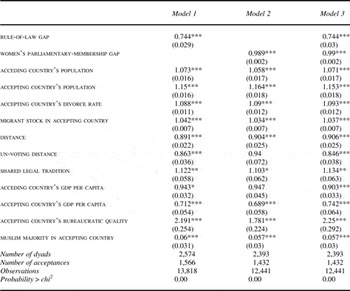
Table 1 presents the results of three Cox models, all estimating the effects of the independent variables on the time it takes for a newly acceding state to be accepted by other convention members. Models 1 and 2 introduce each of the key independent variables. Consistent with the theoretical expectation, Model 1 reveals a statistically significant and substantively large effect of the rule-of-law gap: as this gap increases by one point, the likelihood of acceptance diminishes by 26 percent. The weaker the rule of law of the acceding country compared with that of the accepting country, the stronger the accepting country's concerns are, manifested in a lower probability of acceptance. As Model 2 shows, a gap in women's parliamentary membership raises concerns of gender discrimination and also reduces the likelihood of acceptance. A one-point increase of this gap reduces the likelihood of acceptance by 1 percent; increasing the gap by one standard deviation diminishes the likelihood of acceptance by 13 percent. Model 3 combines the two independent variables, and the results hold. A gap in the rule of law has a negative, statistically significant, and substantively meaningful effect on the likelihood of acceptance; so does a gap in women's parliamentary membership.
Influences on the acceptance of accessions to the Hague Convention

Notes: Cox proportional hazards model. The table reports hazard ratios. Robust standard errors are in parentheses. The models include interaction terms with the natural log of time for those variables that are inconsistent with the proportional-hazards assumption. * p < .10; ** p < .05; *** p < .01.
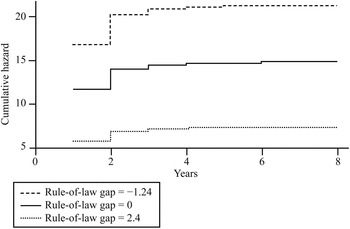
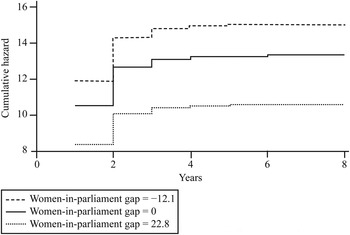
Overall, the statistical results provide considerable support for our theoretical expectations. Figures 1 and 2 display the substantive effect of the relationship by plotting the cumulative hazard for our fairness indicators: gaps in the rule of law and in women's parliamentary membership. In each figure, the cumulative hazard is shown at different levels of the indicator, based on Model 3.
Cumulative hazard of accession acceptance: Varying gap in the rule of law

Cumulative hazard of accession acceptance: Varying gap in women's parliamentary membership

Figure 1 shows how the gap in the rule of law affects the likelihood of acceptance. When the gap is negative (that is, the acceding country's rule of law is stronger than that of the accepting country), the cumulative hazard rises steeply (top line; -1.24 is the 10th percentile). The accepting country expects abduction cases to be handled in a procedurally fair manner, which facilitates the acceptance of the new partner. The middle line shows that when the acceding and accepting country have similar levels of the rule of law, the cumulative hazard of acceptance rises more moderately. When the acceding country's rule of law is weaker than that of the accepting country (bottom line; 2.4 is the 90th percentile), the cumulative hazard rises even more slowly. The accepting country is concerned that the rule-of-law weakness might hinder the return of children, and this reduces the willingness for acceptance. In Figure 2, the gap in women's parliamentary membership has a similar influence. A higher rate of women's political representation in the acceding country, compared with the accepting country (gap = −12.1, 10th percentile), increases the confidence that abduction cases will be treated in a substantively fair manner; the result is a steep cumulative hazard of acceptance. By contrast, lower political representation of women (gap = 22.8, 90th percentile) means that the acceding country does not meet the accepting country's standards of fairness with respect to gender equality.
The control variables generally perform as expected (see Model 3). The size of the population in the acceding or accepting country is positively associated with the likelihood of acceptance: a larger population raises the risk of abduction and increases the need for a legal mechanism to allow for children's return. A higher divorce rate and a larger migrant stock in the accepting country also make acceptance more likely: they raise the risk of abduction and the need for a mechanism to facilitate children's return. Geographic distance is negatively associated with acceptance: between countries that are distant there is a lower risk of abduction and less need for a mechanism to facilitate return. Greater distance in UN voting indicates a weaker political affinity and reduces the likelihood of accession acceptance. Legal affinity—a shared legal tradition—increases the chances of an acceptance's being made, as does greater bureaucratic quality in the accepting country. As expected, a Muslim majority considerably reduces the willingness to return children to foreign countries, thereby lowering the likelihood of acceptance.
Overall, our analysis finds support for the diplomatic-relations explanation of deference—captured through UN-voting affinity—as well as for demand-side explanations that highlight the magnitude of the abduction problem. We have also shown that deference is shaped by considerations of fairness: states are reluctant to defer to partners that fall below their procedural or substantive standards.
Robustness Checks
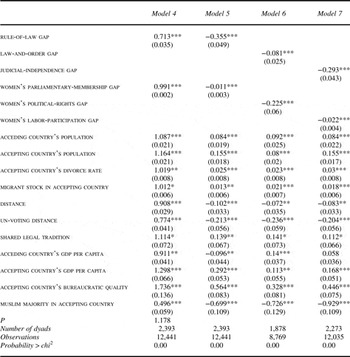
Our robustness tests vary both the method of estimation and the measures employed (Table 2). Model 4 reestimates Model 3 through a Weibull regression; the results are consistent with those produced by the Cox model. Model 5 exhibits similar results, this time through discrete event-history analysis, using a logistic regression combined with a cubic polynomial to adjust for time dependencies.Footnote 83 Models 6 and 7 are also discrete-time models, but employ alternative measures of the key covariates. In Model 6, the rule of law is measured through the Law and Order indicator from the International Country Risk Guide; the indicator for women's status is the Cingranelli-Richards (CIRI) measure of women's political rights, including the right to vote, run for political office, and hold elected or appointed government positions.Footnote 84 In Model 7, the rule-of-law measure is the judicial independence variable from the CIRI data set; women's social and economic status is measured through the share of women in the labor force.Footnote 85 The results resemble those obtained with the original measures. The gap between the acceding and accepting country in law and order or judicial independence is negatively associated with the acceptance of accessions; a difference in women's political rights or labor-force participation also has a negative influence on accession acceptance. We also reran our main model controlling for contact between the acceding and accepting country in the shape of bilateral trade flows; this did not affect our substantive findings.Footnote 86 Given the large number of children that are abducted into and out of the United States, we also conducted the analysis while omitting dyads that included the United States. Our results held on this subgroup.
Robustness checks: Weibull and discrete event-history analysis

Notes: Model 4 is a Weibull model; hazard ratios are reported. Models 5 to 7 are discrete-time models with cubic polynomials. Robust standard errors in parentheses. * p < .10; ** p < .05; *** p < .01.
Additional Evidence
In addition to the econometric analysis, qualitative evidence corroborates our hypothesized causal mechanism linking procedural and substantive fairness to deference on child abduction. As part of the accession process, acceding states are required to complete a standard questionnaire.Footnote 87 Several questions aim to verify new members' procedural fairness. For example, the questionnaire asks what measures exist to ensure that applications for the return of a child will be dealt with expeditiously at first instance and on appeal; what facilities—in particular, legal aid—are available to foreign applicants to assist them in bringing their applications before the courts; and what procedures exist for the enforcement of a return order. In addition, the questionnaire reveals concerns for substantive fairness in cases where the child has been returned and the local courts are to decide the custody dispute: newly acceding countries are asked about their substantive legal criteria for making custody determinations and, specifically, about any differences in the legal status of mothers and fathers in custody cases. This catalogue of questions offers a first cut at the concerns of convention members as they assess acceding countries.
Further evidence comes from the US State Department's annual evaluation of compliance with the Hague Convention. The department's Office of Children's Issues—which acts as the US Central Authority under the convention—submits annually to Congress a report on compliance by the country's convention partners.Footnote 88 The State Department considers a variety of procedural issues related to the handling of incoming applications for child return, including the speed with which the foreign Central Authority processes applications and whether it has procedures for helping left-behind parents to locate legal assistance; the timeliness with which the partner country's courts process convention cases; nonbias toward citizen parents over noncitizen parents; and the effectiveness of law-enforcement efforts to locate abducted children and to enforce court orders. The State Department also examines the substantive application of the convention's legal principles in return cases, including respect for the prohibition on custody-merits determinations and the proper employment of the convention's exceptions to return. Countries that fail to meet the procedural and substantive requirements could be designated as “Demonstrating Patterns of Noncompliance” with the convention or as “Non Compliant.”Footnote 89
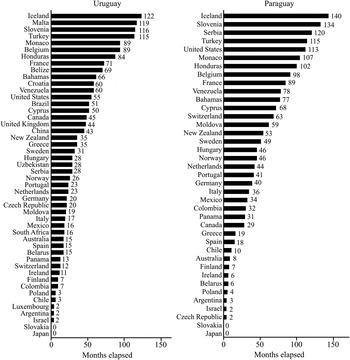
Finally, we illustrate the acceptance record of two acceding countries: Uruguay and Paraguay. We selected these two countries because they are similar in size, located in the same region, and joined the convention at approximately the same time: Paraguay in 1998 and Uruguay in 1999. The two countries, however, vary significantly on our variables of interest. In 2000, Uruguay's value on the Rule of Law scale was 0.53, whereas Paraguay's was −1.08. In Uruguay women occupied 12 percent of the seats in parliament and constituted 43 percent of the labor force, whereas the respective figures for Paraguay were 2.5 percent and 37 percent. Such differences, according to our theoretical argument, should lead to greater caution in accepting Paraguay's accession. Indeed, by March 2014, 75 percent of the relevant countries had accepted Uruguay as a treaty partner, whereas only 67 percent had done so for Paraguay. Furthermore, among countries that did accept Paraguay, acceptance typically took longer than it did for Uruguay (see Figure 3). The United States, for example, accepted Uruguay's accession after 55 months; it took more than twice that time—113 months—for the United States to accept Paraguay as a partner. The median time to accepting Uruguay was 27 months, compared with the median time of 41 months to the acceptance of Paraguay, which is 52 percent longer. All this demonstrates greater concerns and hesitations about deferring to Paraguay, consistent with our argument.
Time to the acceptance of Uruguay's and Paraguay's accession to the Hague Convention (as of March 2014)

Fairness and (Non)deference in Civil, Commercial, and Criminal Matters
Although our systematic evidence linking deference and fairness has focused on a specific civil-law matter—international child abduction—the underlying mechanism should be generalizable to the broader civil, commercial, and criminal domains. As states enter deference agreements for mutual recognition, foreign-judgment enforcement, or extradition, they examine issues of procedural and substantive fairness. This decision-making process includes a relative assessment in which states compare their own institutions and norms with those of potential partners. Preliminary evidence indeed suggests the broader applicability of our argument across a host of different policies and types of law.
Research on mutual-recognition agreements points to the importance of domestic institutions and norms in facilitating the legitimacy and trust necessary for such cooperation.Footnote 90 In his study of the negotiation over the 1997 US-EU MRA, which covered six sectors ranging from telecommunications to pharmaceuticals, Shaffer concludes, “Regulatory symmetry facilitates regulatory trust and confidence, enabling regulatory cooperation to occur.” He underscores the importance of both substantive and procedural similarities for such trust: “[Regulators] will only trust each other if they are assured that their regulatory counterparts have the necessary capacity to ensure the social goals of a coordinated regulatory program.”Footnote 91
Capital-market cooperation offers additional evidence of the role of fairness in such endeavors. In 2007, facing a number of failed harmonization projects, the US Securities and Exchange Commission (SEC) announced that it would shift its international cooperative approach from regulatory convergence to mutual recognition.Footnote 92 The SEC developed a framework for what it called “substituted compliance” in which foreign broker-dealers could apply for an exemption from SEC oversight by complying with a recognized foreign regulator's domestic oversight. A key component in reaching an MRA in securities would be the completion of a comparability assessment. The head of the SEC's international division at the time, Ethiopis Tafara, explained:
The objective of this exercise is to ensure that the regulatory oversight of the two different systems is sufficiently similar such that the SEC is not violating its legislative mandate to ensure compliance with the US federal securities laws and to protect investors, maintain competitive, orderly, fair, and efficient markets, and promote capital formation within the United States. Comparability helps make certain that an SEC exemption to a foreign financial service provider amounts to substituted compliance and does not open the US capital market to regulatory arbitrage or in any way reduce US market transparency.Footnote 93
The first such agreement was signed in August 2008 between the SEC and its Australian counterpart. An academic assessment of the negotiation underscores the importance of the relative symmetry between domestic institutions and norms in the two states for the success of the agreement.Footnote 94
In civil and commercial judgments, fairness concerns have been a stumbling block to US participation in bilateral enforcement agreements as well as to reaching a global agreement. Foreign countries object to several substantive and procedural features of US civil justice. In terms of substantive legal outcomes, jury awards are often deemed excessive, and punitive damages are seen as contrary to public policy.Footnote 95 Foreign countries have also shown uneasiness with procedural elements of the US legal system, including broad pretrial discovery rules, class action, contingency fees, and the wide extraterritorial jurisdiction asserted by US courts over foreign defendants.Footnote 96 Because of these concerns, the United States has never been party to any bilateral or multilateral treaty providing for the enforcement of judgments abroad. In the 1970s, the United States unsuccessfully tried to conclude a treaty with Britain that would be a model for additional bilateral agreements. Negotiations failed as a result of British manufacturers' and insurers' concerns over high US jury awards.Footnote 97 Concerns over the (un)fairness of the US legal system also contributed to the failure of the efforts to establish a global enforcement convention in the late 1990s and early 2000s.Footnote 98
Domestic US doctrine on foreign-judgment enforcement further underscores the importance of fairness. According to the Supreme Court's seminal decision in Hilton v. Guyot (1895), a US court will generally enforce a foreign judgment as a matter of comity if “there has been opportunity for a full and fair trial abroad … under a system of jurisprudence likely to secure an impartial administration of justice … and there is nothing to show either prejudice in the court, or in the system of laws under which it was sitting, or fraud in procuring the judgment.”Footnote 99 Similar fairness requirements appear in the main US legislation dealing with foreign judgments: the 1962 Uniform Foreign Money-Judgments Recognition Act (UFMJRA) and the 2005 Uniform Foreign-Country Money Judgments Recognition Act (UFCMJRA). Both model laws require nonenforcement of a foreign judgment that “was rendered under a system which does not provide impartial tribunals or procedures compatible with the requirements of due process of law.”Footnote 100 Moreover, the UFMJRA and UFCMJRA allow nonenforcement of a foreign judgment that arises from substantive unfairness—when the judgment “is repugnant to the public policy of this state or of the United States,” that is, it undermines public health, public morals, or basic individual rights.Footnote 101 Concern for the right of free speech led Congress to enact the SPEECH Act in 2010.Footnote 102 The act aims to curb “libel tourism”: the practice of pursuing a defamation case against US authors or publishers in countries favorable to such cases. The judgments resulting from these cases are typically inconsistent with the restrictive US approach to defamation claims, in accordance with the country's First Amendment. The SPEECH Act therefore makes foreign defamation judgments unenforceable in US courts, unless the foreign law provides at least as much protection for freedom of speech as the First Amendment.Footnote 103
Finally, in criminal law, extradition treaties often explicitly highlight substantive-fairness concerns with the inclusion of a double-criminality requirement: extradition may be granted with respect to offenses that are punishable in both the requesting country and the requested country.Footnote 104 Moreover, substantive-fairness concerns act to prevent the extradition of fugitives to states that might impose penalties deemed inhumane or in violation of physical-integrity rights.Footnote 105 Most notably, many countries reject extradition requests from countries that impose the death penalty if the latter fail to assure that the death penalty will not be sought.Footnote 106 The United States, among other countries, has no extradition treaty with China, partly because of concerns about due process, human rights violations, and excessive punishment in the Chinese legal system.Footnote 107
International deference is replete with questions of procedural and substantive fairness that recur across areas of law. Due process and impartiality of the judiciary are procedural requirements in the adjudication of commercial disputes, family disputes such as child abduction, as well as criminal cases. Substantive fairness also has a common theme: the protection of fundamental rights and values, whose content varies across issues—from gender equality in family disputes through free speech in defamation cases to physical-integrity rights in criminal matters. Across these domains, fairness determinations are rooted in relative assessments that contrast domestic institutions and norms to those in other states.
Conclusion
Jurisdictional conflicts are at the heart of globalization politics. With the growing exchange of goods, people, and information, firms and citizens increasingly find themselves subject to multiple rules overseen by different regulatory and judicial authorities. At a minimum, such conflicts create uncertainty for companies and individuals and reduce the efficiency and effectiveness of the legal system. Such conflicts also open up the possibility for forum shopping as actors from one country try to leverage rules in another to destabilize their legal status quo, and they raise the specter of a race-to-the-bottom.Footnote 108
Much of the research that examines the globalization/authority nexus focuses either on international dispute settlement or policy harmonization. On the one hand, national treatment in combination with international dispute-settlement bodies (public and private) offers a channel to resolve jurisdictional conflicts.Footnote 109 On the other hand, harmonization projects in which states adopt parallel legal rules preempt them.Footnote 110 In this study, we hope to elevate a third, underrecognized pathway for managing globalization frictions: deference. The central idea behind deference is that domestic legal structures provide the means through which to manage jurisdictional conflicts. Governments, regulators, administrative agencies, and courts defer to the authority of foreign counterparts and in so doing resolve the problems associated with these conflicts. Deference then sidesteps the tricky problems associated with the other two approaches: creating a legitimate international legal authority, or the political backlash to harmonization projects that suppress domestic regulatory autonomy or cultural difference.
Although deference is exercised across a range of policy domains—from securities regulation to criminal law—little research has attempted to systematically explain variation in deference at the global level. Given the potential risks of such sovereignty sharing, it is critical to understand states' decisions to cooperate through deference agreements. In this article, we have developed a novel causal argument rooted in differences between domestic institutions and norms in the cooperating states. More specifically, we focus on the expectation that such sovereignty sharing will produce a fair result—both procedurally and substantively. Our analysis of the Hague Convention provides considerable support for our argument in what is, to our knowledge, the first global empirical study of deference agreements. A preliminary review of deference in the civil, commercial, and criminal domains suggests the broader applicability of our fairness argument. Just as harmonization or international dispute settlement have been used in some domains and not others, future research will be necessary to consider areas in which deference is or is not appropriate as a global governance tool. Similarly, future work should consider not only the factors that promote deference agreements but also the drivers of deference decisions made by regulators or courts in individual cases.
In addition to elevating deference in globalization politics, this study has implications for other important debates in IR. First, the article underscores the critical interaction between domestic and international law. Legal and international relations scholars have long built a silo between the domestic and international legal spheres, focusing extensively on the role of international courts.Footnote 111 Yet deference rests on the idea that domestic law can serve as a central component of global governance. As such, our analysis of deference agreements is in keeping with a growing literature that has highlighted this interaction.Footnote 112
Second, our argument stresses the importance of domestic institutions and norms in one country relative to another and thus opens up an important research agenda in line with similar arguments concerning the relationship between democracy and cooperation.Footnote 113 Although complementing such work on democracy, our study also offers a more fine-grained understanding of the domestic institutions and norms that may contribute to cooperation, and it allows for variation in the cooperativeness of democracies. In focusing on these more nuanced institutional relationships, we hope to spark a broader debate about the relationship between domestic institutions and cooperation.
Third, and finally, our research makes an important contribution to the study of global cooperation against parental child abduction. Although thousands of children are abducted annually, no research in IR has been devoted to this problem. We hope to spur further analysis of this topic that looks not only at the acceptance of accessions under the Hague Convention, but at judicial decision making in national courts and the actual outcomes of abduction disputes. Such research will be useful not only for policy-makers engaged with the politics of child abduction, but hopefully for the parents and children as well.
Supplementary Material
Supplementary material for this article is available at http://thedata.harvard.edu/dvn/dv/ http://dx.doi.org/10.1017/S0020818316000023.