Introduction
Most research on ruminal fermentation has been carried out with fistulated animals, although these studies are expensive and laborious. Moreover, with the rumen being a very complex system, it is difficult to study its function under strictly controlled conditions. These problems, together with the increased public awareness of the animal rights and the need for decreasing the number of fistulated animals used for experimental purposes, have contributed to the development of in vitro devices for simulating ruminal fermentation. Many types of artificial rumen apparatus have been described in the literature, but two of the most widely used are the continuous-flow fermenters (Hoover et al., Reference Hoover, Crooker and Sniffen1976; Miettinen and Setälä, Reference Miettinen and Setälä1989) and the semi-continuous-flow Rusitec system (Czerkawski and Breckenridge, Reference Czerkawski and Breckenridge1977). The two systems have several functional differences, such as the dilution rate, the solids retention time, the amount of feed delivered daily, the frequency of feeding and others that can affect the fermentation variables. In general, higher dilution rates, feeding rates and feeding frequencies are used in continuous-flow fermenters than in Rusitec fermenters. Although both types of fermenters are used in many laboratories, there is no standardization among systems and direct comparisons between them have not been, to date, carried out. In addition, comparisons between in vivo and in vitro rumen fermentation are limited, and to the best of our knowledge all of them have been conducted in cows (Hannah et al., Reference Hannah, Stern and Ehle1986; Mansfield et al., Reference Mansfield, Endres and Stern1995).
In previous studies conducted at our laboratory (Carro et al., Reference Carro, Lebzien and Rohr1992; Gómez et al., Reference Gómez, Tejido and Carro2005) we noticed that changes in the fermentation due to changes in the dietary forage : concentrate ratio in Rusitec fermenters did not reproduce the changes usually found in vivo. Whereas the simulation of rumen fermentation was quite satisfactory for high-forage diets, fermentation of high-concentrate diets resulted in unphysiological acetate : propionate ratios, with values higher than 4.0. In contrast, physiological values have been reported in continuous-flow fermenters fed high-concentrate diets (Shriver et al., Reference Shriver, Hoover, Sargent, Crawford and Thayne1986; Calsamiglia et al., Reference Calsamiglia, Cardozo, Ferret and Bach2008). The aim of this work was, therefore, to compare ruminal fermentation and efficiency of microbial growth in Rusitec and single-flow continuous-culture fermenters (SFCCF) fed two diets differing in their forage : concentrate ratio. Both systems were run under the conditions that are usually utilized in each of the participant laboratories. Since the experimental diets had been used in an in vivo trial carried out previously, in vitro results were compared to those obtained in sheep in order to evaluate the potential of both fermentation systems (FS) for simulating in vivo ruminal fermentation. Results from the in vivo trial have been published elsewhere (Carro et al., Reference Carro, Valdés, Ranilla and González2000).
Material and methods
Dietary treatments and in vivo trial
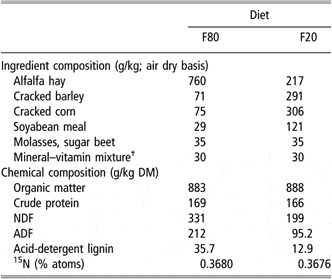
The dietary treatments consisted of two different forage : concentrate ratios in a complete diet. The diet was composed of alfalfa hay and concentrate in the proportions (g/100 g; dry matter (DM) basis) of 80 : 20 (F80) and 20 : 80 (F20). Concentrate was based on cracked barley grains, cracked corn grains, soyabean meal, sugar beet molasses and a mineral–vitamin mixture. Alfalfa hay was chopped to about 1 cm size and concentrate samples were ground through a 4 mm sieve. Both ingredients were separately weighed and mixed before being fed to the fermenters. Composition of experimental diets is shown in Table 1.
Ingredient and chemical composition of experimental diets

DM = dry matter.
†Composition: NaCl (990 g/kg), Mn (2.40 g/kg), Cu (0.32 g/kg), Zn (0.32 g/kg), I (0.007 g/kg), Co (0.04 g/kg), 9000 IU of vitamin A, 1500 IU of vitamin D and 40 IU of vitamin E per kg.
In the in vivo trial, four healthy mature Merino sheep fitted with a permanent rumen cannula were offered daily 1.06 kg DM of the corresponding diet in two equal portions at 0900 and 2100 h. The experiment was conducted according to a crossover experimental design, and ruminal parameters, diet digestibility, ruminal dilution rate and microbial protein synthesis were determined. A detailed description of experimental procedures is given in Carro et al. (Reference Carro, Valdés, Ranilla and González2000).
In vitro Rusitec trial
One 14-day trial using a Rusitec unit consisting of eight fermenters with an effective volume of 550 ml each was conducted at the University of León. Dietary treatments were assigned randomly, so that each diet was fed to four fermenters, and the general incubation procedure was as described by Czerkawski and Breckenridge (Reference Czerkawski and Breckenridge1977). Four rumen-cannulated sheep (52.4 ± 2.91 kg live weight) were used as rumen contents donors. Two sheep were fed diet F80 and the other two received diet F20 for 15 days before commencing the in vitro trial. On the first day of the trial, ruminal contents were collected from each sheep immediately before feeding in the morning, pooled by diet and transferred to the corresponding fermenters within 30 min. Each fermenter was inoculated with 300 ml of rumen fluid, 200 ml of artificial saliva and 80 g of rumen solid content supplied into a nylon bag.
Each fermenter received daily 15.6 g DM of the corresponding diet fed into nylon bags (15 × 8 cm2; 100-μm pore size) at 0900 h. A continuous infusion of artificial saliva (McDougall, Reference McDougall1948; pH = 8.4; NaHCO3 9.8 g/l, Na2HPO4 3.72 g/l, NaCl 0.47 g/l, KCl 0.57 g/l, CaCl2·2H2O 0.053 g/l and MgCl2·6H2O 0.128 g/l) at a rate of 600 ml/day was maintained through the fermenters receiving the F80 diet. The composition of the artificial saliva was modified (pH = 7.0; NaHCO3 6.5 g/l, Na2HPO4 1.86 g/l, NaCl 0.47 g/l, KCl 0.57 g/l, CaCl2·2H2O 0.053 g/l and MgCl2·6H2O 0.128 g/l) for the fermenters fed the F20 diet in order to achieve a pH value similar to that found before feeding in the rumen of donor sheep fed this diet, but the flow was maintained at 600 ml per day. Changes in the saliva composition were based on previous results (Carro et al., Reference Carro, Lebzien and Rohr1995). Each fermenter was flushed with 2 l of CO2 both before and after feeding, in order to remove the gases produced during the fermentation and the air introduced in the gas-space during feeding, respectively.
Liquid effluent was collected daily in flasks containing a solution of H2SO4 (20 ml per 100 ml) to maintain pH values below 2. On day 9, a dose of 2.2 mg of 15N (95% enriched SO4 [15NH4]2; Sigma Chemical, Madrid, Spain) was added into each fermenter to label the ammonia-N pool. Then a solution of SO4 [15NH4]2 was added to the artificial saliva to achieve a rate of 550 mg of 15N per 100 g of dietary N.
On days 9, 10 and 11, the pH of fermenters fluid was determined immediately before feeding, and the following samples were collected: 1 ml of effluent was added to 1 ml of deproteinizing solution (100 g of metaphosphoric acid and 0.6 g of crotonic acid per liter) for volatile fatty acids (VFA) analysis, and 5 ml of effluent was stored at −20°C for ammonia-N analysis. The 48 h nylon bag from each fermenter was collected daily, washed twice with 40 ml of artificial saliva and then washed in the cold rinse cycle (20 min) of a washing machine. Disappearance of DM after 48 h of incubation was calculated from the weight lost after oven drying at 60°C for 48 h, and residues were analyzed for NDF to determine the disappearance of NDF. On day 12, 4 ml of fluid fermenter contents was taken at 0, 3, 6, 9 and 12 h after feeding, the pH was immediately measured and samples for VFA and ammonia-N analyses were taken as previously described, with the exception that samples for ammonia-N determination (1 ml fluid) were mixed with 1 ml 0.5 M HCl to prevent ammonia-N losses. On days 13 and 14, 5 ml of saturated HgCl2 was added to the overflow flasks, which were kept at 4°C by a cold-water bath to impede microbial growth. During these days and for each vessel, the daily liquid effluent was collected, mixed and homogenized in a blender at low speed for 1 min. One sample (about 300 ml) was frozen and lyophilized for determination of DM, non-ammonia N (NAN) and 15N enrichment. Approximately 500 ml of effluent was used for isolation of liquid-associated microbial pellets (LAM) by differential centrifugation as described by Ranilla and Carro (Reference Ranilla and Carro2003).
The contents of the nylon bags removed on days 13 and 14 were used to determine the growth of solid-associated microorganisms (SAM). One portion of solid content (about 20%) was lyophilized for the determination of DM, NAN and 15N enrichment, and the remaining portion was used for the isolation of SAM pellets. This portion was incubated with a saline solution (8.5 g NaCl/l) of methylcellulose (1 g/l) at 38°C for 15 min with continuous shaking (Ranilla and Carro, Reference Ranilla and Carro2003), and then filtered through two layers of nylon cloth (40-μm pore size). The filtrate was stored at 4°C, and the solid residue was resuspended in cold (4°C) saline solution of methylcellulose and chilled at 4°C for 24 h. Following treatment (24 h), the samples were homogenized for 10 s with a Waring Blender, filtered through two layers of nylon cloth (40-μm pore size) and the filtrate was removed and mixed with that obtained the previous day. The pooled filtrate from the two sampling days was centrifuged at 20 000 × g for 25 min at 4°C to obtain SAM pellets. Diets were also analyzed for their natural 15N concentration, and this value was used for background correction before 15N infusion.
In vitro single-flow continuous-culture fermenters trial
One 14-day incubation trial was carried out at the Estación Experimental del Zaidín of Granada using eight SFCCF (Miettinen and Setälä, Reference Miettinen and Setälä1989) with an effective volume of 750 ml each. Fermenters were inoculated with 700 ml of rumen contents collected from four rumen-cannulated sheep (55.3 ± 3.20 kg live weight) following the experimental procedure previously described for Rusitec fermenters. Two sheep were fed diet F80 and the other two received diet F20 for 15 days before commencing the trial.
Dietary treatments were assigned randomly, so that each diet was fed to four fermenters. Each fermenter received daily 27 g DM of the corresponding diet in two equal portions at 0800 and 2000 h. Fermenters were continuously under CO2 flux to maintain anaerobic conditions, and the overflow from each fermenter was collected into a flask maintained at 4°C by a cold-water bath to impede microbial growth. Flow-through of the fermenters was maintained by continuous infusion of artificial saliva at a rate of 850 ml/day. Composition of both types of artificial saliva and pattern of 15N infusion (550 mg of 15N per 100 g of dietary N) were as those described for the Rusitec trial.
On days 9, 10 and 11, the pH of fermenters fluid was determined immediately before the morning feeding, the weight and volume of effluents were recorded, and aliquots for VFA and ammonia-N analyses were collected as previously described. On day 12, the content of each fermenter was sampled (about 5 ml) at 0, 3, 6, 9 and 12 h after feeding, the pH was immediately measured, and samples for VFA and ammonia-N analyses were taken and processed as described for the Rusitec trial.
On days 13 and 14, the effluent was collected and homogenized in a blender at low speed for 1 min. One sample (about 300 ml) was frozen and lyophilized for the determination of DM, NAN and 15N enrichment. Approximately 500 ml of effluent were treated with a saline solution of methylcellulose following the procedure described for the Rusitec trial before isolation of a microbial pellet (mixture of SAM and LAM) by differential centrifugation following the procedures described above.
In both in vitro trials animal management and ruminal sampling were carried out by trained personnel in strict accordance with the Spanish guidelines (Act no. 1201/2005 of 10 October 2005) for experimental animal protection.
Analytical procedures
DM, ash and N were determined according to the Association of Official Analytical Chemists (AOAC, 1999). Analyses of NDF, ADF and acid-detergent lignin were carried out according to Van Soest et al. (Reference Van Soest, Robertson and Lewis1991) using an ANKOM220 fiber analyzer unit (ANKOM Technology Corporation, Fairport, NY, USA). Sodium sulfite and heat-stable amylase were used in the analysis of NDF, and both NDF and ADF were expressed inclusive of residual ash. Concentrations of VFA and ammonia-N in rumen fluid were analyzed as previously described (Carro and Ranilla, Reference Carro and Ranilla2003).
Preparation of samples for 15N analysis of effluents and microbial pellets from in vitro trials has been reported by Carro and Miller (Reference Carro and Miller1999). Analyses of 15N were performed by isotope ratio mass spectrometry (VG PRISM II, IRMS; VS Isotech, Warrington, UK) connected in series to a DUMAS-style N analyzer (EA 1108; Carlo Erba, Milan, Italy).
Calculations and statistical analysis
Daily SAM synthesis in Rusitec was estimated by multiplying total NAN production in nylon bag residues in the ratio 15N : N in residues/15N : N in SAM. Daily LAM synthesis was estimated by multiplying total NAN production in the effluent by the ratio 15N : N in residues/15N : N in LAM, and total daily microbial production was calculated as the sum of the flows of SAM and LAM. Total daily microbial N synthesis in SFCCF was estimated by multiplying total NAN production in the overflow by the ratio 15N : N in digesta/15N : N in microbial pellets. The amount of organic matter (OM) apparently fermented in both types of fermenters was estimated using the equation proposed by Demeyer (Reference Demeyer1991). In SFCCF, the amount of DM truly digested was calculated as proposed by Hoover et al. (Reference Hoover, Crooker and Sniffen1976).
Data from in vitro trials were analyzed by ANOVA according to a 2 × 2 factorial arrangement of treatments. The model included diet, FS (SFCCF and Rusitec) and the diet × FS interaction. Differences between treatments were declared at P < 0.05. When a significant diet × FS interaction was detected, data for each diet were analyzed independently. There were four replicates for each FS.
Differences between diets detected for each FS (in vivo, SFCCF and Rusitec) were assessed by a one-way ANOVA. The GLM procedures of SAS (2001) were used for all statistical analyses.
Results
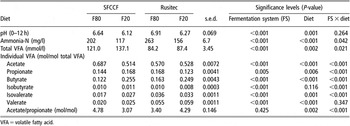
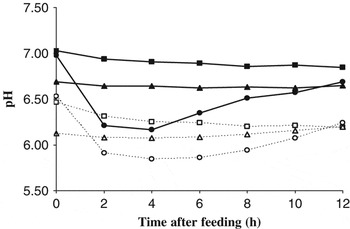
Mean values of pH and concentration of ammonia-N and VFA in both types of fermenters are presented in Table 2. Mean values of pH over the 12 h postfeeding were higher (P < 0.001) in Rusitec than in SFCCF, with diet F80 showing higher values (P < 0.001) than diet F20 in both types of fermenters. As shown in Figure 1, pH values remained fairly stable throughout the day in both in vitro systems and were always higher than 6.0 for both diets. Compared to SFCCF, pH values in Rusitec fermenters at 0, 2, 4, 6, 8 and 10 h after feeding were higher (P < 0.01), although no differences (P = 0.065) between FS were detected at 12 h.
Mean values of liquid dilution rate, solids retention time, pH and concentration of ammonia-N and volatile fatty acid (VFA) in single-flow continuous-culture (SFCCF) and Rusitec fermenters fed two diets containing alfalfa hay and concentrate in the proportions of 80 : 20 (F80) and 20 : 80 (F20)

VFA = volatile fatty acid.
Changes of pH after feeding (0h) in fluid 2 from sheep rumen (•, ○), Rusitec fermenters (▪, □) and single-flow continuous culture fermenters (▵, ▵) fed a high-forage (F80; full symbols, continuous lines) or a low-forage (F20; open symbols, dashed lines) diet. S.e.d. values of the ANOVA comparing both in vitro systems were 0.097, 0.082, 0.073, 0.075, 0.071, 0.069 and 0.069 for 0, 2, 4, 6, 8, 10 and 12h after feeding, respectively.

Ammonia-N concentration was affected (P < 0.001) by both FS and diet, and a significant FS × diet interaction (P = 0.042) was detected. In both in vitro systems ammonia-N concentration was lower (P < 0.001) for diet F20 than for diet F80, and values were higher (P < 0.001) in Rusitec than in SFCCF.
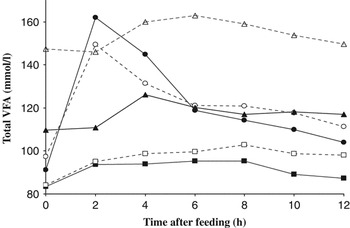
Concentration of total VFA in the effluents was affected by FS (P < 0.001) and diet (P = 0.002), with Rusitec fermenters showing the lowest values for both diets. In Rusitec fermenters VFA concentration increased slightly 2 h after feeding and remained fairly stable from 2 to 8 h after feeding (Figure 2). Maximal VFA concentrations in SFCCF were observed at 4 and 6 h after feeding for F80 and F20 diets, respectively. Concentration of VFA was higher (P < 0.001) in SFCCF than in Rusitec fermenters at all sampling times.
Changes in total volatile fatty acid (VFA) concentrations after feeding (0h) in fluid from sheep rumen (○, •), Rusitec fermenters (□, ▪) and single-flow continuous culture fermenters (▵, ▵) fed a high-forage (F80; full symbols, continuous lines) or a low-forage (F20; open symbols, dashed lines) diet. S.e.d. values of the ANOVA comparing both in vitro systems were 9.9, 10.9, 9.5, 6.4, 6.6, 7.8 and 8.9 for 0, 2, 4, 6, 8, 10 and 12h after feeding, respectively.

Molar proportions of all individual VFA were affected by FS (P = 0.002 to P < 0.001), and significant FS × diet interactions (P < 0.001) were detected for all VFA except for valerate (P = 0.337). With diet F80, Rusitec fermenters showed lower (P < 0.05) proportions of acetate and isobutyrate and higher (P < 0.05) proportions of propionate, butyrate, isovalerate and valerate than SFCCF. There were no differences (P = 0.186) between FS in the molar proportion of butyrate with diet F20, but Rusitec fermenters showed higher (P < 0.05) proportions of acetate, isovalerate and valerate than SFCCF.
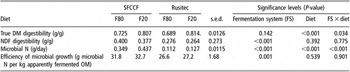
Mean values of diet digestibility and microbial growth are shown in Table 3. Whereas there were no differences (P = 0.145) between SFCCF and Rusitec in true DM digestibility values, NDF digestibility was lower (P < 0.001) in Rusitec compared with SFCCF. In both in vitro systems, the F20 diet showed a higher (P < 0.01) true DM digestibility than diet F80, but no differences (P > 0.05) between diets were detected in NDF digestibility. Both daily microbial N flow and growth efficiency (calculated as g microbial N/kg OM apparently fermented) were higher (P = 0.001) in SFCCF compared with Rusitec fermenters. In both in vitro systems diet F20 supported a higher (P < 0.01) microbial growth than diet F80, but there were no differences (P = 0.539) between diets in the efficiency of microbial growth.
Mean values of true dry matter (DM) and NDF digestibilities, microbial N production and efficiency of microbial growth in single-flow continuous-culture (SFCCF) and Rusitec fermenters fed two diets containing alfalfa hay and concentrate in the proportions of 80 : 20 (F80) and 20 : 80 (F20)

OM = organic matter.
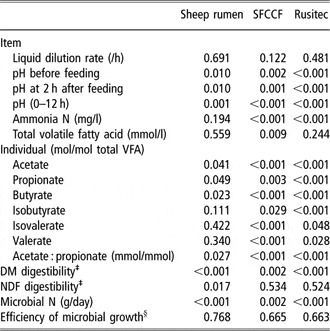
In order to compare the differences between diets detected by both types of fermenters with those found in sheep, P-values of the ANOVA for sheep rumen and fermenters are shown in Table 4. In vitro differences between diets in liquid dilution rate, pH, and microbial N flow and growth efficiency were similar to those observed in sheep, although P-values of ANOVA were in general lower for fermenters compared to sheep. On the contrary, some other parameters as ammonia-N concentrations and proportions of individual VFA (with the exception of butyrate) were not affected (P = 0.076 to 0.422) by diet in sheep rumen, but significant (P = 0.048 to <0.001) differences between diets were found in both in vitro systems. Whereas no differences in NDF digestibility between diets were detected in both types of fermenters (P = 0.534 and 0.524 for SFCCF and Rusitec, respectively), values in sheep were higher (P = 0.017) for diet F80 compared to diet F20.
Level of significance (P-value) of diet effect in three fermentation systems (sheep rumen, single-flow continuous-culture (SFCCF) and Rusitec fermenters) fed two diets containing alfalfa hay and concentrate in the proportions of 80 : 20 and 20 : 80Footnote †

VFA = volatile fatty acid; DM = dry matter.
† Sheep data have been reported by Carro et al. (Reference Carro, Valdés, Ranilla and González2000).
‡ Data for the in vivo trial are values of total tract apparent digestibility.
§ Efficiency of microbial growth was calculated as g microbial N/kg organic matter apparently fermented in both in vitro systems. In the in vivo trial, efficiency of microbial growth was calculated as g microbial N/kg apparently digestible organic matter intake.
Discussion
Comparison of in vitro systems
In general, coefficients of variation of the measured parameters were similar in both in vitro systems, values ranging from 0.3% to 5.0% and from 0.3% to 4.8% for SFCCF and Rusitec, respectively. For most of the measured variables there were differences between the two in vitro systems, and significant FS × diet interactions were detected.
The higher pH values found in Rusitec at all sampling times are in accordance with the lower VFA concentrations observed in these fermenters for both diets. Since the same artificial saliva was used in both in vitro systems for each diet, the higher pH values in Rusitec fermenters could be explained by their ‘saliva/feed’ ratio (38.5 ml/g) compared to SFCCF (33.3 ml/g). Several factors could have possibly contributed to the observed differences in total VFA concentrations. The amount of diet fed to fermenters in relation to their ruminal fluid content was higher for SFCCF (36.0 g/l of ruminal fluid) than for Rusitec fermenters (28.4 g/l), which could have contributed to the higher concentrations of VFA observed in SFCCF. The other factor to take into account might be the microbial concentration in the ruminal fluid, which possibly was higher in SFCCF. Although microbial concentrations were not measured in this study, the daily microbial N flow was higher with both diets in SFCCF (Table 3). When the ratio ‘microbial N production/ruminal fluid volume’ was calculated, differences between both in vitro systems became evident, values being higher for SFCCF (465 and 583 mg/l for diet F80 and F20, respectively) than for Rusitec (204 and 231 mg/l). These estimates would indicate a higher microbial concentration in SFCCF than in Rusitec.
There were pronounced differences in the molar proportions of individual VFA between the two in vitro systems. Changes in molar proportions of individual VFA may reflect a shift in microbial species or alteration of microbial metabolism with changing culture conditions. The shifts in proportions of the major VFA could be due to differences in pH and solids retention time (Schadt et al., Reference Schadt, Hoover, Miler Webster, Thayne and Licitra1999; Calsamiglia et al., Reference Calsamiglia, Ferret and Devant2002). Solids retention time was higher for Rusitec fermenters (prefixed at 48 h for both diets) than for SFCCF (22.0 and 22.4 h for diet F80 and F20, respectively). Schadt et al. (Reference Schadt, Hoover, Miler Webster, Thayne and Licitra1999) reported that decreasing solid retention time from 30 to 20 h in dual-flow continuous-culture fermenters decreased the molar proportion of acetate and increased that of butyrate with a diet high in nonstructural carbohydrate, but no changes in the molar proportions of the main VFA were detected with a diet containing 848 g alfalfa hay per kg. In a study with Rusitec fermenters fed a diet containing 700 g of concentrate per kg, Martínez et al. (Reference Martínez, Ramos, Tejido, Ranilla, Giraldo and Carro2006) observed that reducing the concentrate retention time from 48 to 24 h decreased the molar proportions of acetate and butyrate, and increased those of propionate, with the acetate : propionate ratio changing from 3.54 to 2.52. These results would indicate that reducing concentrate retention time is a suitable way to modify ruminal fermentation in Rusitec fermenters, and that the unphysiological acetate : propionate ratios found when high-concentrate diets were incubated (Blanchart et al., Reference Blanchart, Durant, Barry, Bouiller-Oudot and Jouany1989; Carro et al., Reference Carro, Lebzien and Rohr1992; Gómez et al., Reference Gómez, Tejido and Carro2005) might have been due to the high retention time of concentrate feeds prefixed in these fermenters (48 h).
Efficiency of microbial growth values was in the range of those previously reported for similar diets in SFCCF (Meng et al., Reference Meng, Kerley, Ludden and Belyea1999; Molina-Alcaide et al., Reference Molina-Alcaide, Moumen, Martín-García and Carro2008) and Rusitec fermenters (Blanchart et al., Reference Blanchart, Durant, Barry, Bouiller-Oudot and Jouany1989; Gómez et al., Reference Gómez, Tejido and Carro2005; Giraldo et al., Reference Giraldo, Ranilla, Tejido and Carro2007). Rumen microbial yield and efficiency of microbial growth depend on microbial growth rate and maintenance requirements (Hespell and Bryant, Reference Hespell and Bryant1979), both varying with bacterial species and environmental conditions, such as diet, pH, dilution rate and solids retention time (Stern and Hoover, Reference Stern and Hoover1979; Meng et al., Reference Meng, Kerley, Ludden and Belyea1999; Dewhurst et al., Reference Dewhurst, Davies and Ferry2000). The lower microbial N flow found in Rusitec fermenters compared to SFCCF can be explained by the lower amount of diet supplied to Rusitec fermenters, since the yield of microbial biomass is related to the amount of substrate available (Czerkawski and Breckenridge, Reference Czerkawski and Breckenridge1977; Dewhurst et al., Reference Dewhurst, Davies and Ferry2000). The higher solids retention time in Rusitec could also have contributed to the lower efficiency of microbial growth found in these fermenters, as longer solids retention time has been reported to decrease cell growth rate in continuous cultures (Crawford et al., Reference Crawford, Hoover and Junkins1980; Schadt et al., Reference Schadt, Hoover, Miler Webster, Thayne and Licitra1999). In addition, Rusitec fermenters were fed only once a day, and more frequently feeding have been shown to increase the efficiency of microbial growth (Hespell and Bryant, Reference Hespell and Bryant1979; Stern and Hoover, Reference Stern and Hoover1979). Finally, it has to be mentioned that the different source of inoculum used in both in vitro trials could also contribute to explain the observed differences between fermenters, although it has been shown that marked changes are produced in the microbial populations developed in the fermenters during the incubation period (Slyter and Putnam, Reference Slyter and Putnam1967).
In vitro–in vivo comparison
Since fermenters are frequently used to investigate the ruminal fermentation of different diets, we decided to analyze the differences between diets detected by the two in vitro systems used in this study, and to compare them with those detected in sheep in a previous study (Carro et al., Reference Carro, Valdés, Ranilla and González2000). Both SFCCF and Rusitec detected the same differences between diets found in vivo for liquid dilution rate, pH values, microbial N flow and growth efficiency (Table 4). In general, P-values of ANOVA were higher in vivo compared to both in vitro systems, which was due to the higher variability found for most of the measured variables in sheep (values ranging from 2.0% to 12%) compared to fermenters. The lack of differences between diets in liquid dilution rates observed in vitro was expected, since the flow of saliva was preset to be similar in all fermenters. Ruminal dilution rate is affected by many factors, the diet fed to animals being one of them. In the in vivo trial, however, liquid dilution rate was not significantly affected by the diet, possibly due to the moderate level of feeding (Carro et al., Reference Carro, Valdés, Ranilla and González2000).
There were discrepancies in the differences between diets detected in vivo and in vitro for other measured variables. The lack of differences observed in ammonia-N concentrations in vivo is in accordance with the similar crude protein of both diets (Table 1). The lower values found for diet F20 in both in vitro systems are difficult to explain, although they could be related to either a higher capture of ammonia-N by ruminal microorganisms in F20-fed fermenters or a lower proteolytic activity in ruminal fluid. Proportions of acetate, propionate and butyrate were affected by diet in all FS, but differences in the interpretations of results were detected for Rusitec fermenters. Whereas in vivo and in SFCCF the acetate proportion was lower and that of propionate and butyrate was higher for diet F20, in Rusitec the fermentation of diet F20 resulted in a lower proportion of propionate compared to diet F80. As a consequence of these changes, acetate/propionate ratios were lower for diet F20 compared to diet F80 in vivo (2.73 and 3.97; Carro et al., Reference Carro, Valdés, Ranilla and González2000) and in SFCCF (3.07 and 4.80). In contrast, acetate : propionate ratios were higher for diet F20 than for F80 (4.29 and 3.40) in Rusitec, and the values were considered unphysiological for high-concentrate diets. The observed differences in the molar proportions of VFA between in vivo and the fermenters could be partially explained by the lack of absorption from the fermenters (Blanchart et al., Reference Blanchart, Durant, Barry, Bouiller-Oudot and Jouany1989), whereas the full amount of VFA produced was collected in fermenters, in vivo ruminal content was sampled every 2 h and VFA concentrations were determined without accounting for the absorbed VFA. The relatively high proportions of butyrate produced at the expense of propionate in Rusitec fermenters fed diet F20 are difficult to explain, but confirm the results observed previously (Gómez et al., Reference Gómez, Tejido and Carro2005).
The DM digestibility was higher for diet F20 compared to F80 with the three FS, but whereas NDF digestibility was lower for diet F20 in vivo, no differences were detected in both types of fermenters. This could be related to the high pH values observed in the fermenters, which were higher than 6.0 for both diets at all sampling times. In contrast, ruminal pH remained below 6.0 for 1.7 and 14.6 h per day in sheep fed diets F80 and F20, respectively (Carro et al., Reference Carro, Valdés, Ranilla and González2000). A linear decrease in fiber digestibility with increasing time at pH below 6.0 has been reported by Cerrato-Sánchez et al. (Reference Cerrato-Sánchez, Calsamiglia and Ferret2007), which could explain the lower NDF digestibility observed in vivo for diet F20 compared to F80.
Important differences between sheep rumen and fermenters were detected in the pattern of pH change after feeding (Figure 1). Whereas pH values in fermenters remained fairly stable throughout the day and values were always higher than 6.60 and 6.10 for diets F80 and F20, respectively, rumen pH in vivo dropped shortly after feeding, reaching the minimum values about 4 h after feeding (6.17 and 5.85 for diets F80 and F20, respectively; Carro et al., Reference Carro, Valdés, Ranilla and González2000). The relatively high pH values observed in vitro after feeding are due to the high buffer capacity of the artificial saliva infused into the fermenters. Although the composition of the saliva infused into the fermenters fed the diet F20 was modified to reduce its buffer capacity, the patterns of pH change observed in vivo were not reproduced in the fermenters. Some types of fermenters are equipped with an automatic system that controls and maintains rumen pH at programmed values by the infusion of HCl or NaOH (Calsamiglia et al., Reference Calsamiglia, Ferret and Devant2002), which would allow a precise simulation of patterns of change previously determined in vivo. Differences between in vivo and in vitro systems in the daily input of feed and saliva should also be taken into account when analyzing the reasons for the higher pH values observed in the fermenters. Saliva production in sheep was estimated as the difference between water outputs from the reticulo-rumen (absorption through the wall and water outflow) and inputs (drinking and feed water) as described by Ranilla et al. (Reference Ranilla, Carro, Valdés, Giráldez and López1997), and values were 6.28 and 5.28 l/day for diet F80 and F20, respectively (Carro et al., Reference Carro, Valdés, Ranilla and González2000). ‘Saliva/feed’ ratio was therefore about 6.0 and 5.0 ml/g in sheep fed the diet F80 and F20, respectively, and 33.3 and 38.5 ml/g for both diets in SFCCF and Rusitec fermenters, respectively. These values indicate that a relatively lower amount of saliva was produced in vivo compared to that infused in the fermenters, which could help to explain the higher pH values in the fermenters, since a lower saliva production would result in a lower buffering capacity within the rumen.
The pattern of change in VFA concentrations after feeding in fermenters differed markedly from that in vivo (Figure 2). Concentrations of total VFA in vivo increased markedly 2 h after feeding and decreased thereafter to reach minimum values at 12 h sampling. In contrast, in Rusitec and SFCCF VFA concentrations increased slightly at 2 and 4 h after feeding, respectively, and remained fairly stable until 10 h after feeding. These results and those of pH would indicate that a more stable fermentation took place in fermenters compared to that in vivo. Finally, although higher VFA concentrations could be expected in the in vitro systems compared to in vivo because of the lack of absorption in the former (Mansfield et al., Reference Mansfield, Endres and Stern1995), in the present study total VFA concentrations in SFCCF were similar to those in vivo (128 and 119 mmol/l for diets F80 and F20, respectively; Carro et al., Reference Carro, Valdés, Ranilla and González2000), but Rusitec fermenters showed lower values with both diets. The higher ‘feed/ruminal liquid’ ratio used in SFCCF compared to that in Rusitec could partially explain the lower VFA concentrations found in Rusitec fermenters.
Conclusion
For most of the measured parameters there were differences between the fermentation in the two in vitro systems. Some of these discrepancies could be attributed to the observed differences in pH values, solids retention time and ‘feed/ruminal liquid’ ratio. The different conditions in the fermenters might have caused a selection of microbial strains. Studies identifying the changes in microbial populations through the incubation process in both types of fermenters fed diets of different composition are needed to understand the observed differences.
Compared to in vivo, both systems showed a more stable fermentation, with no fluctuations in pH and only small increases in VFA concentrations after feeding. Although both in vitro systems detected differences between diets similar to those found in vivo for several variables, results for ammonia-N, VFA proportions and fiber digestibility were contrasting and changed the interpretation of results. In general, the fermentation of the F20 diet was quite satisfactory in SFCCF, but unphysiological VFA proportions were observed in Rusitec fermenters. A more precise control of pH in both types of fermenters, and a reduction of concentrate retention time in Rusitec could probably contribute to improve the simulation of the in vivo fermentation, particularly when high-concentrate diets are used.
Acknowledgments
The authors wish to acknowledge the financial support received from the Spanish C.I.C.Y.T. (Projects AGL2004-04755-C02-01 and AGL2004-04755-C02-02).