Introduction
Carbapenem-resistant Enterobacterales (CRE) are a challenge in infectious disease control due to the limited availability of effective treatment options. Reference Xu, Shang and Li1 The World Health Organization (WHO) has classified CRE as a critical priority pathogen, emphasizing the need for systematic surveillance. Reference Sati, Carrara and Savoldi2
In South Korea, a mandatory notification system provides a population-level CRE data set. However, while annual reports document a continuous increase in case counts, resistance data are usually reported independently from specific facilities and remain unintegrated with notification trends. Reference Ha, Song, Park and Park3 This fragmentation precludes the identification of the primary healthcare settings responsible for the national increase.
Long-term care facilities (LTCFs) may be an important component of this epidemiology. Global evidence identifies LTCFs as reservoirs for CRE transmission and persistence. Reference Chen, Jean and Lee4 In South Korea, evaluating this impact is increasingly urgent due to the country’s rapidly aging population, and their contribution to the national CRE burden remains poorly characterized.
To address these limitations, this study integrates national notification data with facility-stratified resistance reporting from 2020 to 2024. Specifically, we characterize the trajectory of the CRE burden, compare resistance patterns across distinct healthcare settings, and evaluate whether the current surveillance architecture is designed to detect institutional reservoirs.
Material and methods
Data sources
Annual CRE notification counts and population denominators for 2020–2024 were retrieved from the Korean Statistical Information Service (KOSIS). 5 CRE is a Category 2 notifiable disease in South Korea, with notifications made per patient classification: patients with bloodstream isolates and carriers identified from non-blood clinical specimens. Repeat cultures within the same classification do not generate additional notifications. The aggregate data therefore combine clinical infection and colonization.
Facility-stratified imipenem resistance data for Escherichia coli, Klebsiella pneumoniae, and Enterobacter cloacae were retrieved from the Korean Antimicrobial Resistance Monitoring System (KARMS). 6 KARMS aggregates susceptibility data generated by five designated clinical reference centers using automated systems. A 3-month deduplication window is applied to exclude repeat isolates from the same patient, species, and specimen type within that period. Susceptibility results are interpreted according to Clinical and Laboratory Standards Institute (CLSI) breakpoints. Imipenem was selected as the representative carbapenem because it was the only agent with continuous data throughout the study period.
Statistical analysis
National CRE notifications and crude incidence per 100,000 were modeled by ordinary least squares (OLS) linear regression, with projection to 2030 as a scenario estimate (95% prediction intervals). Facility-level imipenem resistance trends were assessed by OLS regression and Mann–Kendall tests. Resistance proportions between LTCFs and small/medium hospitals were compared by two-sample z-tests; risk ratios (RR) with 95% confidence intervals were calculated by the Katz log method.
Results
National CRE trend
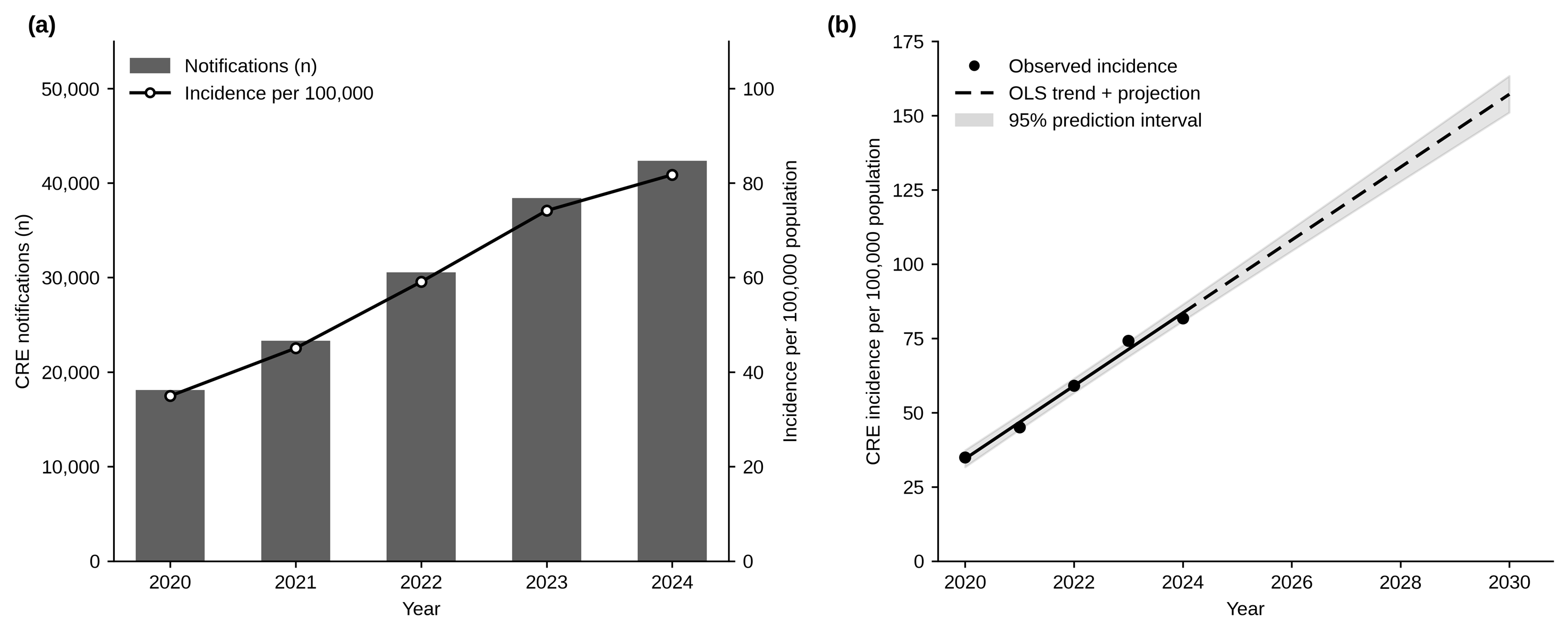
CRE notifications increased from 18,113 in 2020 to 42,347 in 2024, a 133.8% increase with a compound annual growth rate of 23.7% (OLS slope: +6,356 notifications/year, 95% CI 5,203–7,509; R 2 = .990; P = .0004). Surveillance-based incidence per 100,000 rose from 34.95 to 81.74, with a slope of +12.27 per 100,000 per year (Figure 1a). The curve showed no sign of plateau. Extrapolation of the OLS trend projects a surveillance-based incidence of approximately 157 notifications per 100,000 by 2030 (95% prediction interval: 118–196), assuming continuation of the current trajectory without intervention (Figure 1b).
National CRE trends, South Korea, 2020–2024. (a) Annual CRE notification counts and crude incidence per 100,000 population. (b) Observed CRE incidence per 100,000 with OLS trend line extended to 2030 and 95% prediction interval.

Imipenem resistance by healthcare facility and pathogen
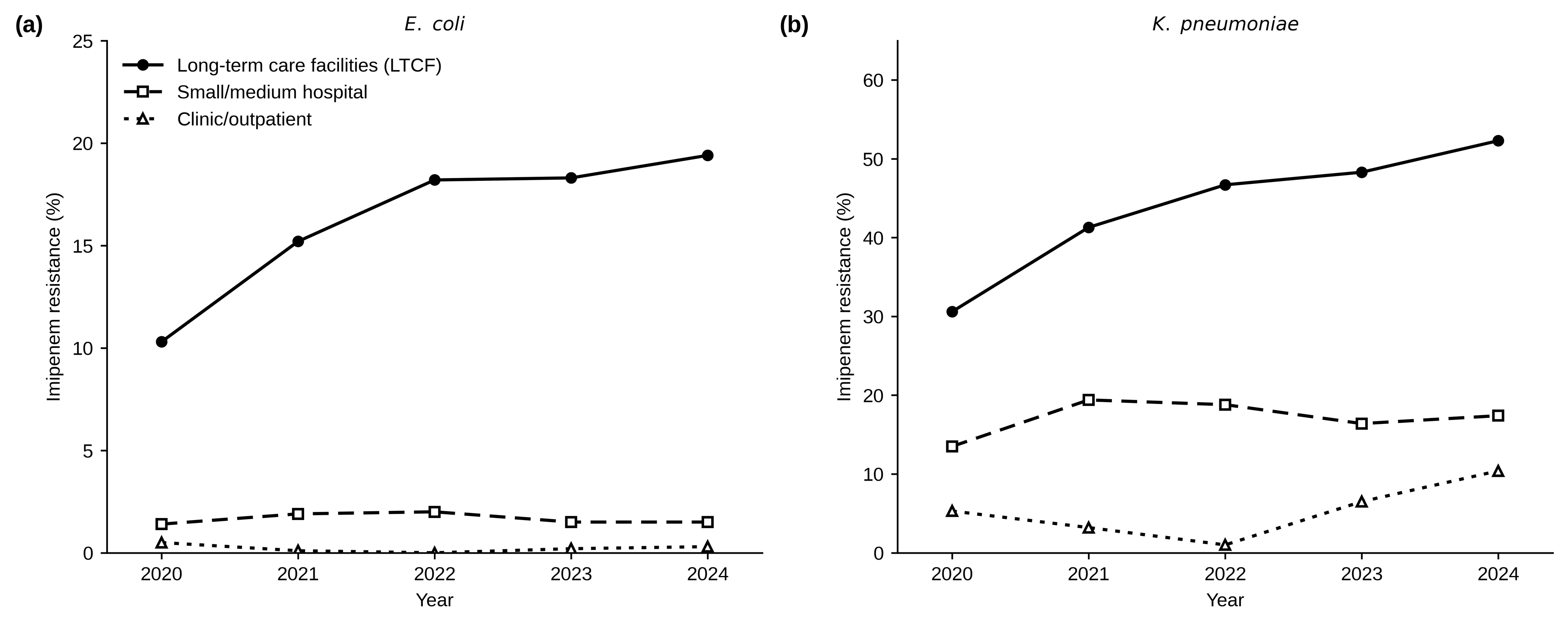
Imipenem resistance differed consistently across facility types, with LTCFs exhibiting higher resistance than small/medium hospitals in every year and across all three species examined. Figure 2 shows the trends for the species with a statistically significant within-period increase.
Imipenem resistance (%) by healthcare facility type, South Korea, 2020–2024. (a) Escherichia coli; (b) Klebsiella pneumoniae.

For E. coli, imipenem resistance in LTCFs rose from 10.3% to 19.4% (slope +2.13 percentage points per year, R 2 = .834, P = .030). Resistance in small/medium hospitals remained stable at 1.4–2.0% (slope −0.02 pp/year, P = .851). The 2024 LTCF-to-small/medium hospital risk ratio was 12.93 (95% CI 12.03–13.90; P < .0001).
For K. pneumoniae, imipenem resistance in LTCFs increased from 30.6% to 52.3%, exceeding the threshold at which more than half of all isolates are resistant. The trend was highly significant (slope +5.04 pp/year, R 2 = .903, P = .013). Resistance in small/medium hospitals showed no clear trend (13.5–19.4%; slope +0.48 pp/year, P = .593). The 2024 risk ratio was 3.01 (95% CI 2.91–3.11; P < .0001).
For E. cloacae, imipenem resistance in LTCFs increased from 12.4% to 22.0%, with a 2024 risk ratio of 6.10 (95% CI 5.03–7.41; P < .0001). The within-period trend did not reach significance (slope +2.01 pp/year, R 2 = .689, P = .082), potentially due to limited power in the smaller isolate series. Imipenem resistance in clinic/outpatient settings remained below LTCF levels across the study period for all three species (Supplementary Table).
Discussion
South Korea shows one of the fastest-growing CRE notification trends among high-income countries, with no inflection during 2020–2024. If the current trajectory continues, the burden could nearly double again by 2030.
Across the species and years examined, imipenem resistance was consistently higher in LTCFs than in small/medium hospitals and clinics, identifying LTCFs as CRE reservoirs within the Korean healthcare system. For K. pneumoniae, the majority of LTCF isolates were resistant to imipenem in 2024, with resistance increasing by approximately five percentage points annually. Similar observations have been reported internationally, where LTCFs are increasingly recognized as reservoirs of CRE. Reference Chen, Jean and Lee4
Prolonged antibiotic exposure likely contributes to this pattern. In Korean LTCFs, antibiotic use among treated patients is about three times more prolonged than in acute-care hospitals. Reference Kim, Chae, Shin, Kim, Lee and Kim7 Because the Korean notification system combines clinical infection and colonization, colonized patients in these facilities also remain a source of transmission and a reservoir for future infections.
Even with this evidence, resistance patterns are difficult to detect at the facility level. An outbreak investigation at a Korean LTCF demonstrated that coordinated intervention can contain transmission once a problem is recognized. Reference Park, Son and Choe8 However, recognition requires visibility, and KARMS reports estimates only by facility type, not by individual institution. Beyond this, comparison with other healthcare settings such as tertiary hospitals is not possible because they are monitored by separate surveillance systems (Kor-GLASS and KONIS) that operate under different frameworks. 6 Patients frequently move between long-term and acute-care facilities, but this movement cannot be tracked across surveillance systems, making it difficult to identify how resistance spreads between settings. This could leave accumulation within individual facilities unnoticed until an outbreak triggers investigation.
Case fatality among notified cases was 2.0% in 2024, whereas a multicenter Korean cohort reported 29.3% 30-day mortality among clinically confirmed infections. Reference Lee, Jung and Lee9 The difference reflects the combination of infection and colonization in the notification system. Changes in screening practices may also influence case detection, particularly because active surveillance can identify asymptomatic carriers. Reference Williams, Chevrier and Elligsen10 Neither factor reduces the magnitude of the increase but affects the clinical interpretation of the notifications.
Other limitations apply. The surveillance data are aggregated and do not include carbapenemase typing or facility-level antibiotic consumption. The observation window is five years. These constraints affect the interpretation of the findings, and the 2030 projection should be read as a scenario estimate rather than a forecast.
These findings identify LTCFs as an under-recognized component of the Korean antimicrobial resistance surveillance system. Facility-specific resistance reporting, surveillance integration, and screening at transitions between long-term and acute care are needed to detect institutional reservoirs that aggregated reporting currently obscures.
Supplementary material
The supplementary material for this article can be found at https://doi.org/10.1017/ice.2026.10520.
Acknowledgments
None.
Financial support
None reported.
Competing interests
All authors report no conflicts of interest relevant to this article.