Publicly reported hospital-acquired conditions (HACs) are used to compare hospitals in the United States based on specific safety-related outcomes and are linked to hospital reimbursement by the Centers for Medicare and Medicaid Services.1 Central-line–associated bloodstream infection (CLABSI) and catheter-associated urinary tract infection (CAUTI), as defined by the National Healthcare Safety Network (NHSN), are 2 of 6 infection measures that may place a hospital under the HAC reduction program penalty, accounting for 34% of the score. The NHSN standardized infection ratio (SIR) adjusts for facility- and patient-level factors that may affect the patient risk for infection.2 The SIR was chosen to compare different patient groups or populations, and it serves to help account for factors that are not visible when pooled mean infection rates are used. However, a limitation of the device-days–based SIR (dSIR) (and similarly infection rates based on device days) is that it only addresses the risk for patients who are exposed to a device and not necessarily the risk to the whole population on a unit or in a hospital.Reference Fakih, Greene and Kennedy3 Interventions aimed at reducing unnecessary central-line or urinary catheter use would likely reduce utilization in lower acuity patients preferentially and, hence, the dSIR would reflect a higher risk population after such interventions. The standardized utilization ratio (SUR) was recently developed to adjust for patient- and facility-related factors associated with device use.4 A key component for mitigating device risk is to reduce exposure to the device, whether preventing placement or shortening duration of use. Infection prevention teams review both the dSIR (reflecting infection) and SUR (reflecting utilization) to assess the areas of opportunity. However, paradoxical increases in infection rates (and subsequently dSIR) may be seen if interventions result in significant reduction in catheter use, shifting the population of those with a device to a higher-risk population.Reference Wright, Kharasch, Beaumont, Peterson and Robicsek5 Alternatively, facilities that are not focused on reducing unnecessary device use may select for a lower-risk group of patients with indwelling devices, potentially leading to a underestimation of device infection risk for these facilities. We calculated a population SIR (pSIR) metric that accounts for both dSIR and SUR, thus reflecting both the care of the device and interventions to reduce utilization.
Methods
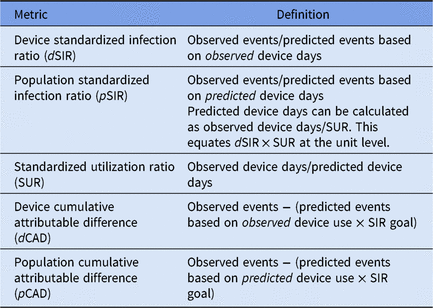
In total, 84 hospitals from a single system (≤100 beds: n = 40; 101–300 beds: n = 25; >300 beds: n = 19) for calendar years 2016 and 2017 were included in this analysis. The population SIR (pSIR) combines the device SIR (dSIR) and device standardized utilization ratio (SUR). The pSIR addresses the entire population, risk-adjusted to the predicted device use. The pSIR was calculated as the observed events divided by predicted events based on predicted device days. Predicted device days can be calculated as observed device days divided by the SUR, which would equate with dSIR×SUR at the unit level. We examined the differences between the dSIR and the pSIR for both CLABSI and CAUTI. The observed and predicted events were compiled at the unit level and were then aggregated to facility- and system-level SIRs for calendar years 2016 and 2017. In addition, we calculated the cumulative attributable differences (CADs) based on both metrics to a baseline SIR of 1.Reference Soe, Gould, Pollock and Edwards6 The definitions of SIR, SUR, and CAD are summarized in Table 1.
Definitions of the Device and Population Standardized Infection Ratios (SIR), the Standardized Utilization Ratio (SUR), and the Cumulative Attributable Difference (CAD)

The CLABSI and CAUTI dSIRs and pSIRs were compared to their corresponding urinary catheter and central-line SURs at the hospital level to determine the impact of the pSIR adjustment and its relation to the SUR. Scatterplots of the dSIR and SUR illustrate the relationship between infections and device utilization, allowing for the identification of hospitals that have shifted to a higher risk population (high SIR combined with low SUR) or who have not adequately addressed appropriate device utilization (low SIR combined with high SUR). The study underwent institutional review board evaluation and was deemed to be exempt from further review.
Results
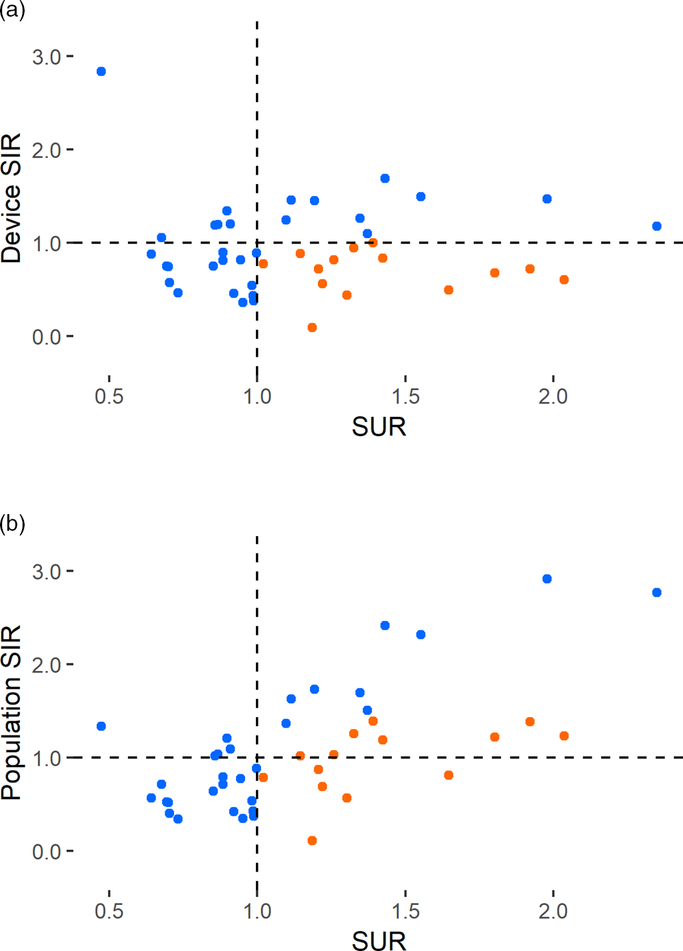
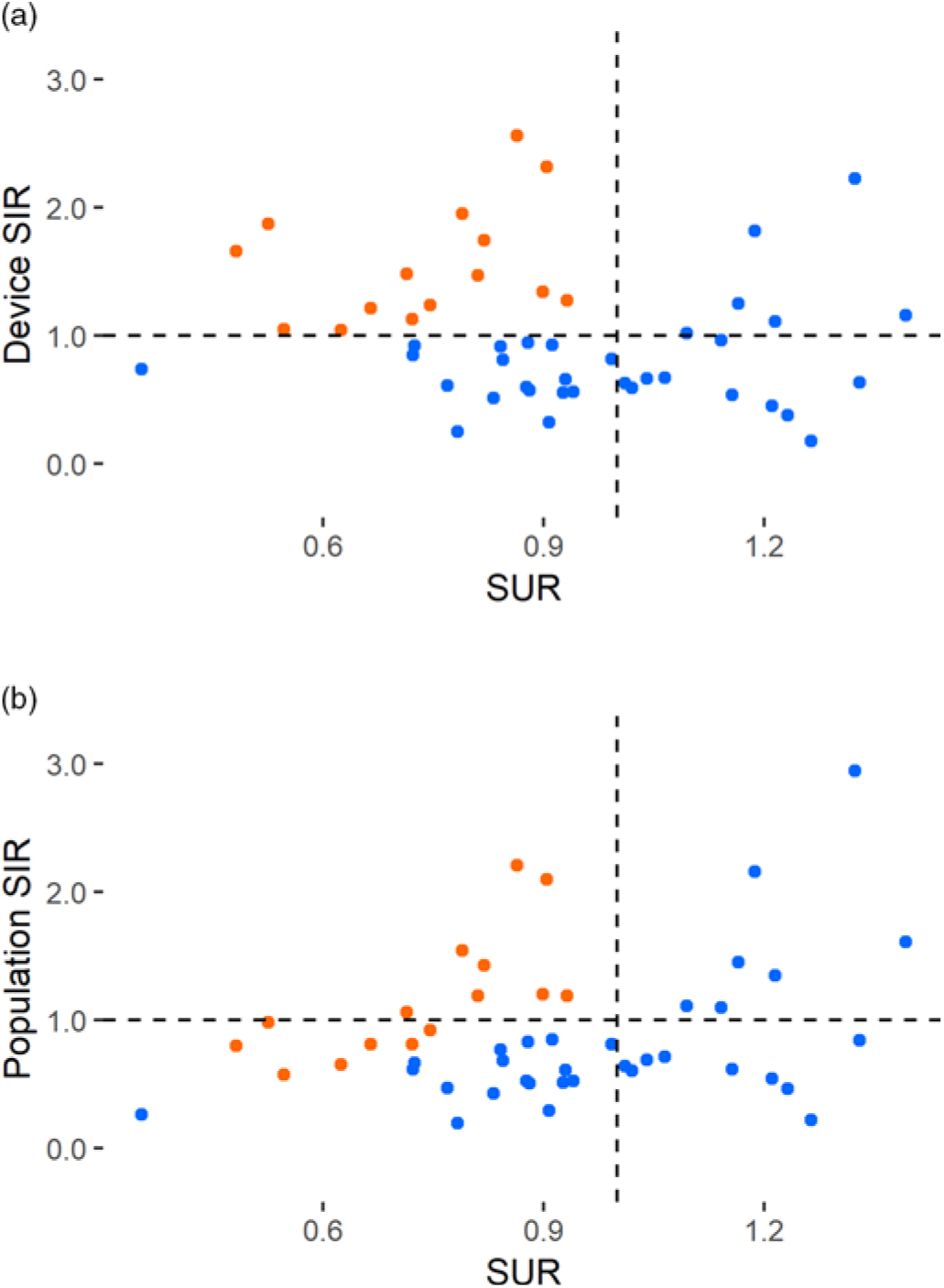
The central-line SUR was 1.02 for 801,172 central-line days, with a dSIR of 0.76 and a pSIR of 0.78 (a 1.6% relative increase). The CAD for CLABSI to a target SIR of 1 was −179.67 for the dSIR compared to −179.75 for the pSIR (a 0% relative change). Figure 1 depicts the relationship between central-line SUR and CLABSI dSIR divided by pSIR. The scatterplot includes noncritical access hospitals with a predicted CLABSI event > 1 and SIR >0. Overall, 14 hospitals (orange dots, Fig. 1), had a SUR > 1 and dSIR < 1. However, when plotted against pSIR, 8 of these 14 hospitals had a pSIR > 1, thus changing the qualitative assessment of performance of these hospitals.
Standardized utilization ratio (SUR) versus standardized infection ratio (SIR) for central-line–associated bloodstream infection (CLABSI). (a) Compares device SIR (dSIR) to SUR: orange dots are hospitals with SUR > 1 but dSIR < 1. (b) Compares population SIR (pSIR) to SUR: orange dots represent corresponding pSIR for hospitals with SUR > 1 but dSIR < 1 shown in Fig. 1a.

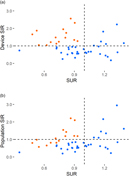
The urinary catheter SUR was 0.90 for 757,504 urinary catheter days, with a dSIR of 0.84 and a pSIR of 0.76 ( a 10.0% relative decrease). The CAD for CAUTI to a target SIR of 1 was −135.04 for the dSIR compared to −203.66 for the pSIR (a 50.8% increase in prevented events). Figure 2 depicts the relationship between urinary catheter SUR and CAUTI dSIR divided by pSIR. The scatterplot includes non–critical access hospitals with a predicted CAUTI event > 1 and SIR >0. Overall, 15 hospitals (orange dots) had a SUR < 1 and dSIR > 1. However, 7 of these hospitals had a pSIR < 1 and would be reclassified using the population metric.
Standardized utilization ratio (SUR) compared to standardized infection ratio (SIR) for catheter-associated urinary tract infection (CAUTI). (a) Compares device SIR (dSIR) to SUR: orange dots are hospitals with SUR < 1 but dSIR > 1. (b) Compares population SIR (pSIR) to SUR: orange dots represent corresponding population pSIR for hospitals with SUR < 1 but dSIR > 1 shown in Fig. 2a.
Evaluation of pSIR and pCAD in facilities with highest observed events
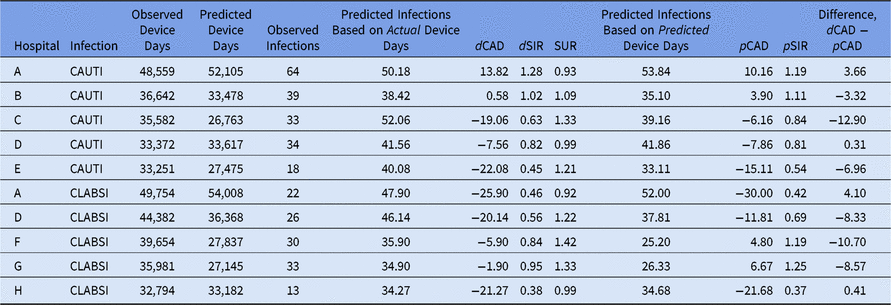
Overall, 10 examples of facilities with the highest observed events for both CLABSI (n = 5) and CAUTI (n = 5) were evaluated. Hospitals with a wider variation in SUR tended to have a greater difference in dSIRs versus pSIRs and CADs (Table 2). We present 2 different scenarios for how the pSIR potentially can add important information to hospitals on their performance. Scenario 1 describes hospital C for CAUTI events, with 33 observed events with 52.06 predicted based on actual device days, for a dSIR of 0.63 and a dCAD of −19.06. Based on dSIR, hospital C would be considered a high performer for CAUTI prevention. However, the SUR is 1.33 (33% higher than predicted use of urinary catheters). Accounting for the overuse of urinary catheters, the predicted infections based on predicted device days is 39.16 events (12.9 fewer events than predicted based on actual device days). In this case, the pSIR is 0.84 (~33% higher) and the pCAD decreased to −6.16. The pSIR, therefore, is more appropriately higher than the dSIR since the pSIR incorporates utilization into its assessment. Scenario 2 describes hospital A for CLABSI events, with 22 observed events with 47.9 events predicted based on actual device days, for a dSIR of 0.46 and a dCAD of −25.9. Based on dSIR, this hospital is considered a high performer for CLABSI prevention. In addition, the SUR is 0.92 (8% lower than predicted). Accounting for the better use of central lines, the predicted infections based on predicted device days are 52 events, 4.1 more events than predicted based on actual device days. In this case, the pSIR is 0.42 (~8.7% lower) and the pCAD improved to 30 events avoided. On the other hand, pSIR does not provide additional meaningful information to dSIR when the SUR is close to 1. Hospitals D (for CAUTI) and H (for CLABSI) have a SUR of 0.99, and their dSIRs and pSIRs are almost identical, respectively.
Comparison of the Device Standardized Infection Ratio (dSIR) and the Population SIR (pSIR) at the Facility Level for Central-Line–Associated Bloodstream Infection (CLABSI) and Catheter-Associated Urinary Tract Infection (CAUTI) for Facilities with the Most Observed Events

Note. dCAD, device cumulative attributable difference; SUR, standardized utilization ratio; pCAD, population cumulative attributable difference.
Discussion
The SIR was introduced as a measure to evaluate the progress of healthcare-associated infection at the unit, hospital, state or national level.Reference Soe, Gould, Pollock and Edwards6 The dSIR helps address the variation related to risk that was not accounted for with rates historically. However, the use of the dSIR assumes that the population is stable over time and that practices for utilization of devices are not changing in a radical manner. With more attention to the appropriate use of devices, hospitals are working on alternatives or avoidance of use of devices when they are not necessary.Reference Cawcutt, Hankins, Micheels and Rupp7, Reference Saint, Greene and Krein8 This may potentially select a higher-risk population with devices, although the device use for the whole population is reduced.Reference Fakih, Greene and Kennedy3, Reference Wright, Kharasch, Beaumont, Peterson and Robicsek5 The introduction of the SUR by the Centers for Disease Control and Prevention (CDC) has helped hospitals identify units with high device utilization.4 However, intervening to reduce device use may not necessarily reduce the dSIR. In addition, there is no financial or national quality incentive for hospitals to improve their SUR. With the national efforts to improve outcomes related to device use, there has been focus on identifying more inclusive metrics that reflect those interventions, including the impact on the total population.Reference Advani and Fakih9 The proposed pSIR provides a measure that includes the risk for those who have the device while also accounting for efforts to avert any exposure to the device. The pSIR marries both the dSIR and SUR and can help hospitals better focus on what will help reduce the harm to their entire patient population. The pSIR addresses both the impact of efforts to reduce device use and practices that may lead to overuse of devices.
More recently, a significant effort has been invested in the choice of appropriate devices for patient care. The “MAGIC” recommendations have clearly helped identify where peripheral lines, midlines, and peripherally inserted central lines are used.Reference Chopra, Flanders and Saint10 Adoption of guidelines that encourage alternative options may change central line utilization in hospitals and promote other devices with lower risk of mechanical and infectious complications. Such changes may result in a smaller denominator of central lines used and higher risk for those with devices (eg, higher acuity with more frequent line access) not captured by the current SIR adjustments. Similarly, the external urinary devices, which are excluded from the urinary catheter denominator for CAUTI, are becoming more attractive to use for both men and women who do not have obstructive symptoms.Reference Gray, Skinner and Kaler11 The introduction of these devices into patient care may also affect the dSIR for CAUTI depending on their adoption and patient selection.
The population cumulative attributable difference is another metric that may help hospitals and units evaluate whether their efforts have led to a reduction in clinical events. Similar to pSIR, the pCAD accounts for successful efforts to reduce device use and, conversely, for situations where an increase in device use occurs, adjusting the risk to predicted device days. Presenting the number of prevented or excess events compared to goal helps teams better have a concrete understanding of the risk to their patients.
The population SIR has some limitations. We postulate that a reduction in utilization may lead to a selection of a higher risk population with devices. The effect of avoiding devices on device associated infections may be different if the focus is preventing placement compared to reducing duration of use. Earlier studies have focused on reduction in device utilization but have not closely monitored the duration of use per patient.Reference Saint, Greene and Krein8, Reference Meddings, Rogers, Krein, Fakih, Olmsted and Saint12 The daily risk for infection associated with devices is not the same for patients early in their device use compared to those with prolonged use or frequent access. In addition, the population SIR does not capture the other infectious events that may occur with alternative devices (eg, midlines or external urinary catheters). Furthermore, the same definitional limitations present for the dSIR apply to the pSIR.Reference Fakih, Gould and Trautner13 The CDC NHSN definitions were created for surveillance and may not always reflect the clinical events that may be prevented. In addition, the risk adjustment used for both SIR and SUR may not fully capture population risk or device need for certain facilities with unique populations.Reference Jackson, Leekha and Magder14
In conclusion, the pSIR is an attractive metric with which to account for interventions designed to reduce device use. The pSIR is a new proposed metric that combines both the dSIR and SUR. It may serve as a complement to the dSIR, especially for units or hospitals with sizable changes in utilization.
Author ORCIDs
Mohamad G. Fakih, 0000-0002-2258-8015
Acknowledgments
None.
Financial support
No financial support was provided relevant to this article.
Conflicts of interest
All authors report no conflicts of interest relevant to this article.