Introduction
Temporal lobe epilepsy (TLE) is associated with cell loss in the hippocampus and surrounding areas often resulting in memory difficulties (see Bell & Giovagnoli, Reference Bell and Giovagnoli2007, for review). The vastly changing view also shows that neuroanatomical abnormalities in patients with TLE extend far beyond memory function (Bell, Lin, Seidenberg, & Hermann, 2011). For example, Lin et al. (Reference Lin, Salamon, Lee, Dutton, Geaga, Hayashi and Thompson2007) demonstrated that TLE patients show up to 30% decrease in cortical thickness, with noticeable thinning of frontal poles, frontal operculum, orbitofrontal, lateral temporal and occipital regions. As a result patients with TLE exhibit a pattern of distributed cognitive impairments including executive functions and language (Bell et al., Reference Bell, Lin, Seidenberg and Hermann2011; Howard et al., Reference Howard, Andrés, Broks, Noad, Sadler, Coker and Mazzoni2010).
The purpose of this study was to investigate the extent to which memory differences might be related to a metamemory impairment. Some studies looking at metamemory in TLE have suggested a link between disrupted self perceptions of memory performance and mood disturbances, often leading to underestimations when using memory self-report questionnaires (Baños et al., Reference Baños, LaGory, Sawrie, Faught, Knowlton, Prasad and Martin2004; Elixhauser, Leidy, Meador, Means, & Willian, Reference Elixhauser, Leidy, Meador, Means and Willian1999; Vermeulen, Aldenkamp, & Alpherts, Reference Vermeulen, Aldenkamp and Alpherts1993). Other studies using memory span and metamemory tasks have suggested possible deficits in Feeling-of-Knowing (FOK) tasks (Prevey, Delaney, & Mattson, Reference Prevey, Delaney and Mattson1988; Prevey, Delaney, Mattson, & Tice, Reference Prevey, Delaney, Mattson and Tice1991). More recently, neuropsychological studies have examined metacognition in TLE focusing on the use of experimental tasks in episodic memory (Andrés, Mazzoni, & Howard, Reference Andrés, Mazzoni and Howard2010; Howard et al., Reference Howard, Andrés, Broks, Noad, Sadler, Coker and Mazzoni2010). Howard et al. (Reference Howard, Andrés, Broks, Noad, Sadler, Coker and Mazzoni2010) explored experimentally metamemory monitoring and control processes in TLE patients on a verbal episodic memory task. Howard et al. showed that TLE patients presented with a clear episodic memory deficit, and yet intact metamemory monitoring (Judgments-of-learning and FOKs) and control (study-time) processes were observed. These findings suggested that TLE patients’ episodic memory deficits could not be explained by a metamemory impairment.
Andrés et al. (Reference Andrés, Mazzoni and Howard2010) also showed a normal level of metacognitive sensitivity in TLE patients when making global post-study predictions and allocating amounts of study-time to four lists of varying objective difficulty. More specifically, accuracy in post-study predictions improved in TLE patients and control participants compared to pre-study predictions. Both groups were able to upgrade their metamemory predictions after study. Interestingly, TLE patients’ accuracy was overall higher than controls. Furthermore, both groups allocated their study-time to reflect the different characteristics of the lists, spending a greater amount of time on the semantically unrelated and difficult lists.
Therefore, in two previous studies looking at episodic memory and metamemory in TLE patients, we have shown a dissociation between memory impairment and intact metamemory, which is in keeping with previous results showing similar dissociations in amnesic (Janowsky, Shimamura, & Squire, Reference Janowsky, Shimamura and Squire1989; Shimamura & Squire, Reference Shimamura and Squire1986), aging (e.g., Connor, Dunlosky, & Hertzog, Reference Connor, Dunlosky and Hertzog1997), and Alzheimer's disease (AD) (Moulin, Perfect, & Jones, Reference Moulin, Perfect and Jones2000a) populations.
The main purpose of this study was to determine whether the level of metacognitive sensitivity previously observed in global JOLs in patients with TLE (Andrés et al., Reference Andrés, Mazzoni and Howard2010), could also be established when making item-by-item JOLs, which reflect online monitoring processes. Specifically, we aimed at examining the effect of repetition on item-by-item JOLs and study-time in control participants and TLE patients. In a sensitivity approach, participants are said to be “metacognitively sensitive” when they adjust their item-by-item JOLs and study-time to reflect awareness of word pair repetition. We also aimed at studying metamemory at retrieval, by using FOK judgments at recognition.
Previous research has suggested that other clinical groups such as AD patients do not benefit at test to the same extent as controls when the to-be-remembered stimuli are repeated at encoding (e.g., Moulin, Perfect, & Jones, Reference Moulin, Perfect and Jones2000b, for review). Moulin et al. (Reference Moulin, Perfect and Jones2000b) explored whether metacognitive factors at encoding (monitoring and control processes), were responsible for repetition-based deficits measured by item-by-item JOLs and study-time allocation. They conducted a study where 12 items were presented once, twice or three times for future recall and recognition. Participants were requested to self-pace their study-time and make item-by-item JOLs when studying the items. The purpose of this procedure was to see whether AD patients would be sensitive to the repetition of items during study and as a consequence regulate their JOLs and decrease study-time with increased item repetition. AD patients spent less time studying repeated items but did not increase their JOLs accordingly, despite explicit memory performance being affected by repetition, leading to conclude that AD patients were sensitive to item repetition in terms of their study-time but not when making item-by-item JOLs.
We partly adopted the procedure of Moulin et al. (Reference Moulin, Perfect and Jones2000b) to examine the effect of online monitoring and control when repetition was manipulated at encoding. The specific aim was to examine whether TLE patients would benefit from repetition to the same extent as controls. Repeated items should be more likely to be recalled than those presented less frequently. Moreover, an increase in word pair repetitions should be reflected in an increase in item-by-item JOLs and in a decrease in study-time in controls. Furthermore, item-by-item JOLs should be influenced less than global JOLs (Andrés et al., Reference Andrés, Mazzoni and Howard2010) by general beliefs about memory abilities, and reflect more accurately monitoring and awareness of ongoing learning.
Method
Participants
Fourteen TLE patients were recruited from Derriford Hospital's (Plymouth Hospitals NHS Trust), and 14 control participants were recruited from the University of Plymouth's School of Psychology undergraduate and Paid Supporters Group. TLE patients and non-student controls from the Paid Supporters Group received a small remuneration to cover any travel or parking expenses. Undergraduate participants received participation points as part of their course credit.
TLE patients were considered suitable for investigation based on the following screening criteria: (1) TLE out-patients; (2) aged between 18 and 65 years; (3) English as their native language; (4) normal hearing and normal/corrected vision; (5) a minimum of 8 years education; (6) evidence of an abnormal EEG recording and/or MRI/CT scan to confirm condition and epileptic focus; (7) dosage and type of anti-epileptic drugs (AEDs) stable for a minimum of 1 month; (8) no presence of any current or past psychiatric disorders (including alcohol, substance abuse, or clinical depression); (9) no other degenerative or cognitive disease that may prevent them from participating (e.g., learning disability, aphasia); (10) not undergone corrective surgery for their epilepsy; (11) not experienced a seizure in the past 24 hr before testing (determined on day of testing).
Demographic Characteristics
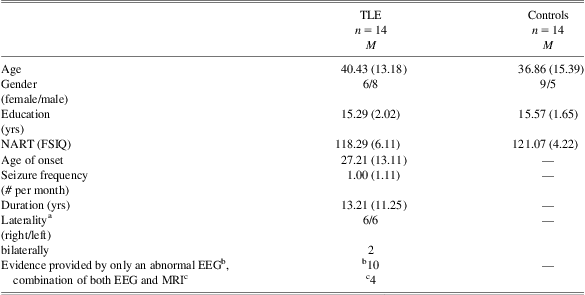
Participants’ demographic and clinical characteristics can be found in Table 1. Control and TLE participants did not significantly differ in terms of age [F(1,26) = .44; MSE = 205.28; p = .52; η 2p = .02], years of formal education [F(1,26) = .17; MSE = 3.40; p = .69; η 2p = .01], gender [F(1,26) = 1.26; MSE = .26; p = .27; η 2p = .05], and full scale IQ (FSIQ) [F(1,26) = 1.97; MSE = 27.53; p = .17; η 2p = .07]. Eight (57%) of the TLE patients were diagnosed as having complex partial seizures, five (36%) experienced complex partial seizures with secondary generalization and one (7%) other patient was classified as having both complex partial and simple partial seizures. Five (36%) patients were seizure freeFootnote 1 at the time of testing. Nine (64%) were on monotherapy and five (36%) on polytherapy (maximum combination of 3 AEDs). All TLE patients had idiopathic TLE.
Demographic characteristics and epilepsy features for TLE and control groups (standard deviations are in parentheses)
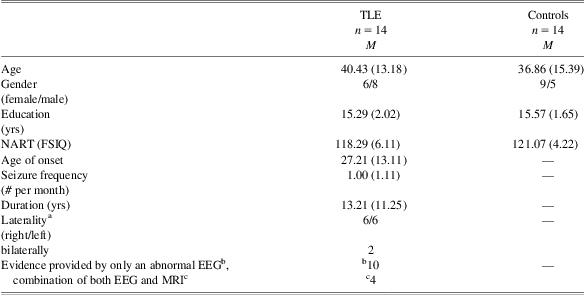
aThe small sample size precludes examination of laterality further within the memory and metamemory findings.
Neuropsychological Evaluation
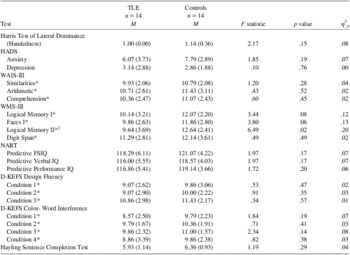
All participants completed a standard neuropsychological test battery in two sessions (see Table 2 for a summary of the individual tests).
Summary of the neuropsychological test battery results. (standard deviations are in parentheses)

Harris Test of Lateral Dominance (Harris, Reference Harris1974); HADS = Hospital Anxiety and Depression Scale (Zigmond & Snaith, Reference Zigmond and Snaith1983); D-KEFS = Delis-Kaplan Executive Function System (Delis, Kaplan, & Kramer, Reference Delis, Kaplan and Kramer2001); WAIS-III = Wechsler Adult Intelligence Scale 3rd Edition (Wechsler, Reference Wechsler1997a); WMS-III = Wechsler Memory Scale 3rd Edition (Wechsler, Reference Wechsler1997b); NART = National Adult Reading Test (Nelson & Willison, Reference Nelson and Willison1991); Hayling Sentence Completion Test (Burgess & Shallice, Reference Burgess and Shallice1997).
*Age-Adjusted Scaled Scores.
2Four TLE patients (29%) achieved a scaled score of ≤6 on the Logical Memory II subtest indicating they were impaired on this test of delayed memory recall.
Stimuli/Materials
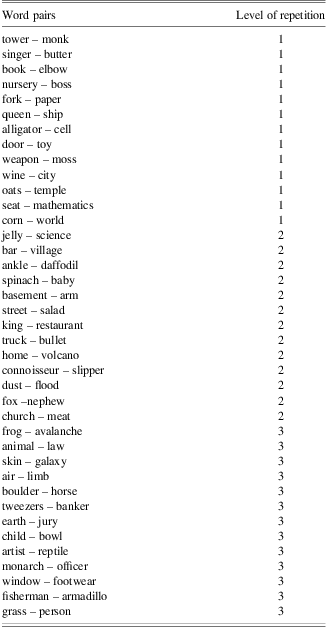
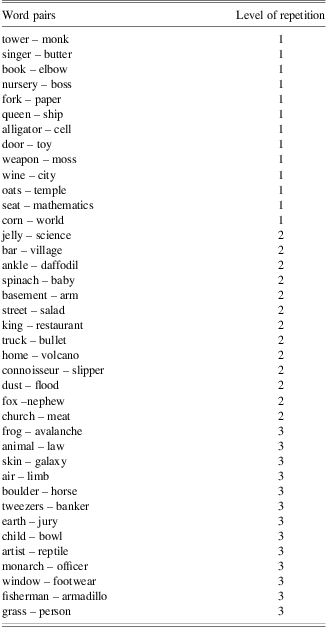
Since memory difficulties are less severe in TLE patients than in AD patients, the word list consisted of 39 semantically unrelated word pairs (instead of only 12 words, as in Moulin et al. Reference Moulin, Perfect and Jones2000b). All words were selected from Rubin and Friendly's (Reference Rubin and Friendly1986) recall norms. Words with a similar level of recallability (according to recall norms) were chosen. Mean recallability proportion for cue and target words was 0.60 (range, 0.53 to 0.67). All 39 word pairs (see Annex) were matched for recallability. Cue and targets were unrelated. There were three levels of pair repetition (one, two, and three presentations). Thirteen pairs were assigned to each level. The three levels of repetition meant that there were a total of 78 trials (13 × 1 + 13 × 2 + 13 × 3). The list was constructed so that pair repetition was distributed randomly throughout, ensuring that repeated word pairs did not follow in succession, but repetition was evenly spread throughout the list. The word pairs were programmed into Microsoft Office PowerPoint 2003 and run on a laptop computer. Word pairs were presented one at a time in the centre of the screen (Arial font size 44, black on white background). Presentation time (study-time) of word pairs was self-paced to measure study-time allocation in seconds.
Procedure
All participants gave written consent before taking part in the study. The protocol was approved by the Cornwall and Plymouth Research Ethics Committee (NHS REC) and by the University of Plymouth, Faculty of Science Human Ethics Committee.
JOL Task
Participants were instructed that a series of different word pairs were going to be presented on a computer screen, with some pairs being repeated during the study phase. They were asked to study the pairs and try to remember as many as possible. Following study, they would be presented with the first word of all the pairs (cue word) and asked to recall the second word of the pair (target word) if known. Participants could study each word pair for as long as necessary to increase their chances of recall, and if they came across a pair previously studied they could use this as another opportunity to study the item. Participants were warned not to rely on specific pairs being repeated during the study phase, to ensure that they spent the necessary time to encode the items if pairs were only presented once.
Study-time for each word pair was recorded by the computer to calculate study-time allocation. Word pairs were presented one at a time and participants used the spacebar to declare recall readiness and proceed onto the next item. A practice block consisting of four word pairs was given before test to ensure that participants understood the procedure. Practice pairs were not included in the recall phase.
Immediately after studying a word pair, participants were asked to rate how certain they believed they would recall the second part of that particular pair, if presented with only the first word as a cue (Judgment-of-Learning, JOLs). Item-by-item JOLs were requested on a 6-point scale set at 20% intervals (0% = definitely will not recall, 20% = 20% sure, 40% = 40% sure, etc., 100% = definitely will recall). Once participants had finished studying a particular pair, the JOL ratings were presented on the screen as a prompt to rate the pair just studied. JOL ratings were given verbally and were recorded by the researcher on a record sheet. At the time of making a JOL the word pair was no longer visible.
Following the study phase, participants were given a cued recall test in which the first word of each of the 39 pairs (e.g., alligator - ?) were presented, one at a time for 5 s. While the first word of the pair was visible on the screen, participants were instructed to respond verbally if they knew the corresponding target word. Responses were recorded by the researcher.
FOK Task
Following the cued recall phase, participants were instructed that they would be given an opportunity to correctly recognize the target words for all non-recalled or incorrectly recalled pairs. First, participants were asked to give a FOK judgment for every non recalled or incorrectly recalled pair. FOK judgments were made by presenting the cue word and the same 6-point scale described for JOLs (from 0% to 100% at 20% intervals), but this time they had to rate whether they would be able to recognize the second word of the pair when the cue (e.g., alligator - ?) was presented along with four possible alternatives, one of which was the target word. The recognition task was presented after the FOK judgments had been completed for all non-recalled pairs. Participants were informed that they would be presented with the cue word along with four words, one of which would be the target word. Distracters were target words to other pairs from the list. Before the recognition phase, it was emphasized that participants should not guess at a particular word, and refrain from responding unless they thought it was the correct word. Participants were given 8 s to read the four alternatives and choose the answer. Responses were recorded by the researcher.
To summarize, the study comprised of four phases; study, cued recall, FOK judgments and recognition. In the study phase, metamemory control was measured by the overall study-time allocated to each level of item repetition and metamemory monitoring was measured by participants’ individual JOLs at each level of item repetition. The effects of word pair repetition on study-time, JOLs and retrieval were examined.
Results
Neuropsychological Test Battery
The results from the neuropsychological test battery are presented in Table 2. The neuropsychological test which yielded a significant difference between TLE patients and control participants included the Logical Memory II subtest [F(1,26) = 6.49; MSE = 9.71; p < .05; η 2p = .20], where control participants outperformed TLE patients.
No significant differences were obtained on the NART FSIQ scores [F(1,26) = 1.97; MSE = 27.53; p = .17; η 2p = .07], verbal IQ scores [F(1,26) = 1.97; MSE = 23.52; p = .17; η 2p = .07], and performance IQ scores [F(1,26) = 1.72; MSE = 21.29; p = .20; η 2p = .06], or number of years of education [F(1,26) = .17; MSE = 3.40; p = .69; η 2p = .01], indicating that both groups were properly matched. In addition, no significant differences were obtained on anxiety [F(1,26) = 1.85; MSE = 11.13; p = .19; η 2p = .07], and depression scores [F(1,26) = .10; MSE = 5.90; p = .76; η 2p = .00].
Memory Performance
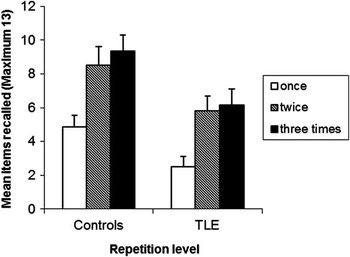
Recall performance for each level of repetition between groups is illustrated in Figure 1. Cued recall performance was analyzed first. A 2 (group) × 3 (item repetition) repeated measures analysis of variance (ANOVA) revealed a main effect of group [F(1,26) = 5.96; MSE = 26.90; p < .05; η 2p = .19], indicating that control participants performed better than TLE patients. There was a main effect of item repetition [F(2,52) = 47.28; MSE = 2.86; p < .001; η 2p = .65], revealing that recall increased with repetition. The analysis failed to find an interaction between group and item repetition [F(2,52) = .45; MSE = 2.86; p = .64; η 2p = .02], suggesting that both groups behaved similarly in terms of their recall performance across the different levels of repetition. Both groups benefited from repetition of the to-be-remembered word pairs.
Mean recall performance for the three levels of repetition between groups. Error bars relate to standard error.

Analysis of Metamemory Monitoring and Control
The amount of study-time allocated to each word pair (recall readiness) and the item-by-item JOL data could be analyzed in two ways: the average study-time and JOL rating at each level of item repetition for all pairs (i.e., first presentation of a pair compared with the 2nd presentation of the same pair compared with its third presentation), and by comparing the effect of repetition for the 13 pairs that were presented for all three repetition levels. However, as highlighted by Moulin et al. (Reference Moulin, Perfect and Jones2000b), it is important to note that in the first approach, using the frequency of presentation (means at each level of item repetition), type of items and repetition would be confounded as all 39 items were presented once, but 26 were presented twice and 13 were shown three times. For that reason, the analysis of the raw data was conducted using both methods to ensure consistency of results. Both methods showed consistent results but for conciseness only results on the set of word pairs presented three times are reported in this study.
Metamemory Control: Allocation of Study-Time/Recall Readiness
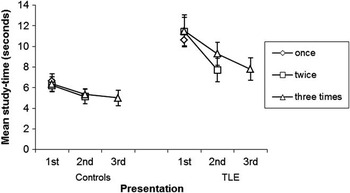
Figure 2 shows the amount of time allocated to studying word pairs across the three presentation levels. The study-time allocated in seconds for the set of pairs presented three times was analyzed using a 2 (group ) × 3 (repetition level) repeated measures ANOVA and revealed a main effect of group [F(1,26) = 9.66; MSE = 33.95; p < .01; η 2p = .27], with TLE patients spending significantly longer studying the pairs compared with controls (Controls: Range M = 5.00 (Sec); SD = 2.77 to M = 6.36 (Sec), SD = 2.68; TLEs: Range M = 7.79 (Sec); SD = 4.08 to M = 11.50 (Sec); SD = 5.84). A main effect of repetition [F(2,52) = 9.89; MSE = 4.66; p < .001; η 2p = .28], indicated that study-time decreased with increased repetition. The non-significant interaction [F(2,52) = 2.09; MSE = 4.66; p = .13; η 2p = .07], revealed that groups behaved similarly in allocating study-time across the three levels of repetition. As a result, both controls and TLE patients were sensitive to item repetition and controlled their study-time accordingly, spending less time studying word-pairs as repetitions increased.
Mean study-time allocation across the three presentation levels between groups. Error bars relate to standard error.

Metamemory Monitoring: Judgments-of-Learning (JOLs)
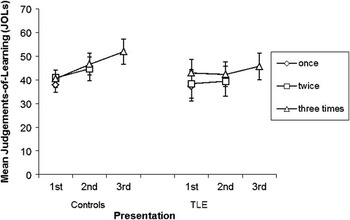
Figure 3 shows the JOL ratings across the three presentation levels. As with the study-time data, the set of word pairs presented three times was analyzed for the item-by-item JOLs. A 2 (group) × 3 (repetition level) repeated measures ANOVA revealed no main effect of group [F(1,26) = .16; MSE = 946.87; p = .70; η 2p = .01], indicating that both groups made similar JOLs overall. A main effect of JOLs across repetition [F(2,52) = 5.30; MSE = 67.60; p < .01; η 2p = .17] indicated that word pairs that were seen more times were rated as easier to recall. The interaction did not approach significance [F(2,52) = 2.18; MSE = 67.70; p = .12; η 2p = .08]. Both groups were equivalent in their JOL ratings across repetition, that is, both control participants and TLE patients were sensitive to repetition and rated word pairs as more likely to recall as the number of repetitions increased.
Mean Judgment-of-Learning ratings across the three presentation levels between groups. Error bars relate to standard error.

Goodman-Kruskal Gamma correlations between JOLs and recall performance for the set of 13 word pairs presented three times were calculated to determine JOL accuracy between groups.Footnote 3 One-sample t tests revealed that Gamma correlations for the set of pairs presented three times were significantly different from zero for the TLE patients on the third presentation [t(12) = 4.04; p < .01] but not on the first [t(12) = 1.71; p = .11] or second presentations [t(12) = 1.99; p = .07], whereas in control participants the first [t(10) = 1.90; p = .09], second [t(10) = 1.05; p = .32], and third presentations [t(10) = 2.03; p = .07] were not significantly different from zero. TLE patients were metacognitively competent when making their final JOLs on the third presentation. Independent-samples t tests revealed JOL Gamma correlations were not significantly different between control participants (first: M = .36, SD = .63; second: M = .18, SD = .55; third: M = .29, SD = .47) and TLE patients (first: M = .29, SD = .62; second: M = .30, SD = .54; third: M = .48, SD = .43) on the first [t(22) = .27; p = .79], second [t(22) = −.55; p = .59] or third [t(22) = −1.06; p = .30] presentations, indicating that the accuracy of JOL ratings across repetition levels for the set of word pairs presented three times was similar in the two groups.
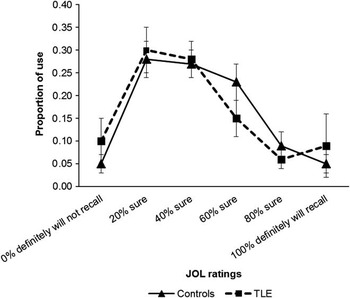
Finally, to test whether the two groups used JOL ratings differently, a 2 (group) × 6 (6-point ratings) repeated measures ANOVA was carried out on the number of times (proportions of use) each JOL rating was used (see Figure 4). The results showed no main effect of group [F(1,26) = .06; MSE = 9.39; p = .80; η 2p = .00], indicating that overall use of ratings did not significantly differ between groups. A main effect of ratings F(5,130) = 11.93; MSE = 246.88; p < .001; η 2p = .31] showed that some ratings were more frequently used than others. Finally, the interaction between group and rating type did not reach significance [F(5,130) = .58; MSE = 246.88; p = .72; η 2p = .02], an indication that the distribution of JOL ratings across the entire list was similar in the two groups.
Judgment-of-Learning ratings’ proportion of use in TLE patients and controls. Error bars relate to standard error.

Metamemory Accuracy: Feeling-of-Knowing (FOKs)
Goodman-Kruskal Gamma correlations between the FOK judgments and recognition performance were calculated for both groups. One-sample t tests revealed that FOK Gamma correlations were significantly different from zero for control participants [t(13) = 2.85; p < .05] and revealed a trend in TLE patients [t(13) = 1.96; p = .07]. Independent-samples t tests revealed FOK Gamma correlations were not significantly different in the control participants (M = .45; SD = .58) and in TLE patients (M = .28; SD = .53); [t(26) = .78; p = .44], indicating that both groups behaved similarly in terms of their FOK ratings relating to actual recognition performance.
Recognition
An independent-samples t test compared the proportion of correctly recognized items between control participants and TLE patients, revealing that control participants (M = 69.96; SD = 20.64) recognized a significantly greater percentage of target words than TLE patients (M = 50.15; SD = 24.86), [t(26) = 2.29; p < .05].
Discussion
The purpose of the present study was to investigate the effects of repetition on online monitoring in TLE patients. Item-by-item JOLs and FOKs were used to assess online monitoring processes and study-time allocation was used to measure metacognitive control processes. In the present study, TLE patients performed significantly lower than controls in recall and recognition of the word pairs, confirming the results from previous studies (Andrés et al., Reference Andrés, Mazzoni and Howard2010; Howard et al., Reference Howard, Andrés, Broks, Noad, Sadler, Coker and Mazzoni2010). The specific aim of this study was to explore the effects of repetition on online monitoring in TLE patients to understand whether the level of metacognitive sensitivity previously observed in global JOLs (Andrés et al., Reference Andrés, Mazzoni and Howard2010) could also be established when making item-by-item JOLs. In particular, the current study involved examining the effect of online monitoring when repetition was a factor at encoding. Successful monitoring and control of extrinsic cues (as word pair repetition) should indicate awareness of processes operating at encoding (see Moulin, Reference Moulin2002, for review). Importantly, the recall analysis revealed that performance overall increased with repetition in both groups, indicating that repetition was a useful variable in this design, empirically reflecting different levels of learning.
However, TLE patients and control participants differed in their memory performance, as well as on the WMS-II Logical Memory II sub-scale, with control participants outperforming TLE patients.
Interestingly, TLE patients mean scores on several of the neuropsychological measures were within the average range. This finding along with a mean seizure frequency of one per month suggests that this sample of patients had a mild form of TLE. Despite revealing findings in which TLE patients performed significantly lower than controls, it would be interesting to investigate in future research whether the current results could generalize to a more severe group of refractory TLE patients.
Metacognitive control was measured by the study-time (Mazzoni & Nelson, Reference Mazzoni and Nelson1995) allocated to word pairs across the three levels of repetition. It was predicted that the amount of study-time allocated would be dependent upon the number of pair repetitions. Intact metacognitive control processes would be revealed in decreased study-time with increased number of presentations at encoding. The results showed that TLE patients spent overall significantly longer studying the word pairs. It is important to note here that the neuropsychological measures depending on speed of processing (e.g., RTs in the Stroop and Design Fluency and Hayling task) were equivalent in both groups, indicating that they were well matched on speed measures in general and that the differences in study-time were specific to metamemory measures. It is possible that the greater study-time in TLE patients reflects a compensatory method. For instance, TLE patients may have been aware of their lower memory performance at encoding, and trying to compensate for this, spent longer studying the to-be-remembered material to enhance their chances at recall. In line with this, Andrés et al. (Reference Andrés, Mazzoni and Howard2010) showed that TLE patients adjusted their global JOL postdictions (memory predictions made after study and before recall) more accurately than controls. After adjustment, the postdictions of TLE patients were extremely accurate, with no significant difference between their prediction and their performance. In contrast, in the same study control participants significantly underestimated their performance. Andrés et al. argued that their results reflected awareness of memory difficulties in TLE patients. The greater study-time in TLE patients observed in the current study would be compatible with that hypothesis. It is important to note that the increase in study-time in TLE patients of course did not succeed in equating patients and controls in their memory performance, a phenomenon identified as the labor-in-vain effect (Nelson & Leonesio, Reference Nelson and Leonesio1988).
Importantly, the current results also showed that study-time decreased with further repetitions and there was no difference between control participants and TLE patients, indicating that both groups were sensitive to word pair repetition and controlled their study-time accordingly. Metacognitive control was unimpaired in TLE patients.
Online metacognitive monitoring was measured by item-by-item JOLs across the three levels of repetition. Preserved online metacognitive monitoring would suggest an increase in JOL ratings with increased presentation of word pairs. The results showed no effect of group, indicating that both groups made similar JOLs overall. The extrinsic factor (repetition) of the to-be-remembered list did have an effect on JOL ratings, whereby the more often an item was presented the higher the JOL. Of particular importance here is that groups were equivalent in their JOLs across repetition. The finding provides evidence that metamemory monitoring, measured by item-by-item JOLs, were intact in TLE patients. Moreover, TLE patients and control participants were sensitive to repetition at encoding, rating pairs as more likely to be recalled as the number of presentations increased.
Our results also showed similar FOK ratings in TLE patients and control participants, confirming the results of Howard et al. (Reference Howard, Andrés, Broks, Noad, Sadler, Coker and Mazzoni2010). Prevey et al. (Reference Prevey, Delaney and Mattson1988) and Prevey et al. (Reference Prevey, Delaney, Mattson and Tice1991) instead showed differences in these ratings. It is nevertheless crucial to clarify that, in the present study we calculated Gamma correlations for FOK, which are the most commonly used measures of relative metamemory accuracy (Benjamin & Díaz, Reference Benjamin and Díaz2008; Nelson, Reference Nelson1984). Gamma correlations reflect the ability to discriminate between which items will or will not be recalled and whether judgments are predictive of actual performance, and showed no significant differences between controls and patients. There are additionally important differences between our studies and the studies by Prevey et al. First, their memory task was a span task, which does not assess typical episodic long-term memory, but serial short-term and working memory. Second, the memory task used to assess FOK was a fact retrieval task, commonly used in those years, testing semantic memory. Thus, the data of Prevey et al. have little to say about possible monitoring deficits in episodic memory in TLE patients. Third, no difference between groups was found in span recall prediction, only in actual span recall, and the conclusion about impaired monitoring in patients is an inference based on this rough comparison not supported by any data analysis.
A potential limitation of this study was the small sample size. Future research should focus on obtaining a larger sample size which would allow for examination of laterality within the memory and metamemory results and determine whether there are differential impairments. Furthermore, a larger sample would determine whether left TLE patients show metamemory results similar to those reported by Prevey et al. (Reference Prevey, Delaney and Mattson1988) in which right TLE were nearly as accurate as controls in predicting their verbal encoding ability. However, as noted above, there are important differences between our studies and those by Prevey et al. which would have to be taken into consideration. Future research should also explore whether in TLE patients the time spent studying influences JOL ratings as shown in normal populations, whereby memorizing effort is used as a cue for changing JOL ratings (control-affects-monitoring hypothesis; Koriat, Ackermen, Lockl, & Wolfgang, Reference Koriat, Ackerman, Lockl and Wolfgang2009). In particular, exploring the effect of repetition on JOLs would be a way to assess the control-affects-monitoring hypothesis.
This study adds to the body of literature on monitoring and control in clinical populations, showing that significantly lower memory performance can occur without any accompanying deficit in metacognitive monitoring and control processes. Together with our previous studies (Andrés et al., Reference Andrés, Mazzoni and Howard2010; Howard et al., Reference Howard, Andrés, Broks, Noad, Sadler, Coker and Mazzoni2010), these results may indicate that some type of frontal impairment; as it is the case in Korsakoff amnesic (Shimamura & Squire, Reference Shimamura and Squire1986), Parkinson's (Souchay, Isingrini, & Gil, Reference Souchay, Isingrini and Gil2006) patients, or reduced global connectivity, as is the case in Alzheimer's patients (see Souchay, Reference Souchay2007, for a review); might be necessary to observe a metamemory deficit in clinical populations.
In summary, our findings revealed significantly lower memory performance in a sample of TLE patients (see also Andrés et al., Reference Andrés, Mazzoni and Howard2010; Howard et al., Reference Howard, Andrés, Broks, Noad, Sadler, Coker and Mazzoni2010), while their online metamemory monitoring and control processes were intact. Both groups benefited from repetition at encoding (repeated items were recalled more frequently), allocating less time and increasing their JOLs with increased repetition. Thus, explicit memory performance, study-time and item-by-item JOLs were affected by item repetition. TLE patients and controls were sensitive to repetition at encoding. In keeping with our previous studies, the current study indicates a dissociation between memory performance and metamemory abilities in TLE patients. Therefore, the cumulative findings provide evidence that monitoring and control processes are intact in TLE patients, suggesting that metamemory difficulties cannot explain the significantly lower memory performance observed in the sample of TLE patients tested.
Acknowledgments
This work is based on Charlotte Howard's doctoral dissertation which was conducted at the University of Plymouth in the School of Psychology. The research was funded by an Economic and Social Research Council (ESRC) Collaborative Awards in Science and Engineering (CASE) Studentship (PTA-033-2006-00006) obtained by Giuliana Mazzoni, in collaboration between the University of Plymouth and Derriford Hospital, Plymouth Hospitals NHS Trust. Pilar Andrés was the main supervisor of the project, and she's currently supported by grant PSI2010-21609-C02-02. We thank Paul Broks, Rupert Noad, Martin Sadler, and Debbie Coker for their help with patient recruitment. The authors also thank the out-patients from Derriford Hospital, Plymouth Hospitals NHS Trust who participated in this study, the psychology undergraduates from the School of Psychology at the University of Plymouth and members from the Paid Supporters Group. This full manuscript has not been published either electronically or in print anywhere else. The authors do not have any conflict of interest.
Disclaimer
The University of Plymouth, Plymouth Hospitals NHS Trust and the authors accept no responsibility for any use which may be made of the results, or any reliance which may be placed on such results or information given in connection with them.