Introduction
Food quality as well as availability may vary tremendously throughout an environment, both spatially and temporally (Hebets et al., Reference Hebets, Wesson and Shamble2008). Being the key determinant of an organism's fitness, food influences life history traits of several insects, at the individual, species and inter-specific levels (Blanckenhorn, Reference Blanckenhorn2000). All living organisms continuously attempt to sustain stable population dynamics against ephemeral food resources (Choi et al., Reference Choi, Kim, La, Chang, Kim, Jeong, Park, Joo, Kim and Jeong2016). The frequency and magnitude of food resources also varies with time and season resulting in alternations of low- and high-resource availability (Ostfeld & Keesing, Reference Ostfeld and Keesing2000). Unlike routine fluctuations, sometimes occurs ‘ephemeral events of resource superabundance’ also known as ‘resource pulses’, which produce drastic changes in resource utilization (Holt, Reference Holt2008; Chaudhary et al., Reference Chaudhary, Kumar, Mishra and Omkar2016).
Animals require a certain amount of energy and nutrients for metabolism, growth and reproduction (Sterner & Elser, Reference Sterner and Elser2002; Wilder & Rypstra, Reference Wilder and Rypstra2007). Nutritional conditions of both mating partners play an important role in their mating behaviour (Arnqvist & Rowe, Reference Arnqvist and Rowe2005; Fisher & Rosenthal, Reference Fisher and Rosenthal2006). Mating behaviour includes all the pre- and post-mating events surrounding insemination (Chaudhary et al., Reference Chaudhary, Mishra and Omkar2015, Reference Chaudhary, Kumar, Mishra and Omkar2016). The pre-mating mechanisms involve mate location, mate recognition, mate reception, time taken to commencement of mating (TCM) and latent period (LP). The post-mating mechanisms may be displayed as mate guarding (Chaudhary et al., Reference Chaudhary, Mishra and Omkar2015), sperm competition (Simmons, Reference Simmons2001), cryptic female choice (Arnqvist, Reference Arnqvist2014) and sperm precedence (de Jong et al., Reference de Jong, Brakefield and Geerinck1998; Chaudhary et al., Reference Chaudhary, Kumar, Mishra and Omkar2016). Amongst mating behaviours, post-copulatory mate guarding is the most widely occurring phenomenon in insects (Alcock, Reference Alcock1994). Males of a wide range of species spend considerable time and energy to control the mating activities of females (Alcock, Reference Alcock1994; Chaudhary et al., Reference Chaudhary, Mishra and Omkar2015). Such behaviour is commonly referred to as the mate guarding (Chaudhary et al., Reference Chaudhary, Mishra and Omkar2015).
Some male insects must forage for resources, and their success at food gathering may be significantly linked to their ability to engage in reproductive activities (Yuval et al., Reference Yuval, Holliday-Hanson and Washing1994; Frey-Roos et al., Reference Frey-Roos, Brodmann and Reyer1995). The pheromone emission during courtship is also directly correlated with the quality and quantity of food (Landolt & Sivinski, Reference Landolt and Sivinski1992). Males of most of the insects increase their ejaculate size in relation to the food resources to overcome the sperm competition and provide the nutrients to females in the form of seminal fluid or spermatophore phylax that regulates the oviposition pattern of female (Vahed, Reference Vahed1998; Edvardsson, Reference Edvardsson2007). Ejaculate size is also known to be dependent upon the quality and quantity of food during the rearing of adults (Fox, Reference Fox1993; Ivy et al., Reference Ivy, Johnson and Sakaluk1999). It has been found that males mate more frequently when fed on protein-rich food than those that are protein deprived, and females who copulate with the former are less likely to copulate again than females who mate with the latter (Blay & Yuval, Reference Blay and Yuval1997; Yuval et al., Reference Yuval, Kaspi, Shloush and Warburg1998). Not only this, but females also show decreased mating frequency in poor diet conditions (Clutton-Brock & Parker, Reference Clutton-Brock and Parker1995). Both the quality and quantity of food diversify with the changing environment have important effects on the fitness of individuals (Sterner & Elser, Reference Sterner and Elser2002).
The amount of food consumed by males and females affect different parameters of reproductive behaviour, including ornament size (Andersson, Reference Andersson1994), mate choice (Cotton et al., Reference Cotton, Small and Pomiankowski2006), sexual courtship display rate (Kotiaho et al., Reference Kotiaho, Alatalo, Mappes, Nielsen, Parri and Rivero1998) fecundity and egg viability (Wilder & Rypstra, Reference Wilder and Rypstra2007). While most studies of the effects of feeding on reproduction have examined the effect of food quantity, some recent studies have also provided evidence that food quality or nutritional status of animals may also be important for reproductive activities (Wilder & Rypstra, Reference Wilder and Rypstra2007). For example, male crickets with low concentrations of nutrients or those provided with low-quality food court females less intensely and are less attractive as mates (Wilder & Rypstra, Reference Wilder and Rypstra2007). However, not much is known about how the mating behaviour of predatory species responds to food quality and if there are interactive effects of male and female food quality on mating activities and egg production.
Previous studies have established that ladybird beetles are polyandrous (Omkar & Mishra, Reference Omkar and Mishra2014; Colares et al., Reference Colares, Michaud, Torres and Silva-Torres2015) and display mate choice (Mishra & Omkar, Reference Mishra and Omkar2014). They store sperms in spermatheca for extended periods (Hodek, Reference Hodek1973) that increases the chance for sperm competition. In Menochilus sexmaculatus, prolonged mating durations beyond a limit that does not increase the reproductive output has been termed as mate guarding (Chaudhary et al., Reference Chaudhary, Mishra and Omkar2015). Recent studies have indicated that this increased mating duration plays an important role in reducing last male sperm precedence (Chaudhary et al., Reference Chaudhary, Kumar, Mishra and Omkar2016) and is plastic in nature in response to the presence of competitor (Chaudhary et al., Reference Chaudhary, Mishra and Omkar2017).
In light of the above facts, we performed an experiment evaluating the effect of varying food resource conditions (bean aphid, Aphis craccivora Koch; Hemiptera: Aphididae) on the mating behaviour and reproductive output. For this study, we abruptly change the ladybirds from their post-emergence condition (scarce, optimal or abundant prey biomass) to three different pre-mating conditions (scarce, optimal or abundant prey biomass); post-mating the females were again placed in three post-mating conditions (scarce, optimal or abundant) to record pre- and post-copulatory behaviours, in addition to fecundity and per cent egg viability. We hypothesized that the consequences of nutritional variation are not restricted to the pre-mating behaviour only, and that even post-mating behaviour would exhibit plasticity when faced with varying food resources. We also predict that the varying food resources would not only modulate immediate behaviours but would also influence reproductive output. This has been not studied before in ladybirds in reference to their copulatory and reproductive behaviour.
Materials and methods
Stock maintenance
Adult males and females of M. sexmaculatus were collected from the agricultural fields of Lucknow, India (26°50ʹN, 80°54ʹE) and paired randomly in plastic Petri dishes (9.0 cm × 1.5 cm). They were reared under constant abiotic conditions (27 ± 2°C; 65 ± 5% relative humidity; 14:10 light:dark) in Environmental Test Chambers (Yorco B.O.D. Super Deluxe, York Scientific Industries Pvt. Limited) on a daily replenished supply of A. craccivora Koch reared on bean (Dolichos lablab L.; Fabaceae) in a polyhouse maintained at 22 ± 1°C; 65 ± 5% R.H. and 14L:10D photoperiod. The eggs laid were collected every 24 h and observed for hatching. The neonates obtained were reared individually in the conditions outlined above to produce a stock population.
Experimental design
Our experiments were divided into two parts. The first and second part of the experiment was performed to evaluate the pre-copulatory time (TCM, LP), and post-copulatory parameters [mate-guarding duration (MGD), fecundity and per cent egg viability], under fluctuating food conditions.
The three food resource conditions selected were scarce, optimal and abundant by providing 2, 10 and 15 mg of aphids per adult per day, respectively.
Evaluation of pre- and post-copulatory behaviour
Randomly selected similar sized (8.92 ± 1.05 mg) newly emerged ladybird adults from the stock culture were placed individually in Petri dishes (size as above) under scarce (n = 180; 90 males and 90 females), optimal (n = 180; 90 males and 90 females) and abundant (n = 180; 90 males and 90 females) prey resource conditions for 10 days (abiotic conditions similar to that of stock). These conditions were considered as post-emergence conditions (Poe). During this period, six adults of M. sexmaculatus from the scarce prey resource condition died within 10 days of emergence; more ladybird species were added to the experimental setup from the stock culture to equalize the sample size.
The adults from each prey supply were divided into three equal groups and shifted for the next 24 h onto any one of three pre-mating conditions (Prm): scarce (30 males and 30 females), optimal (30 males and 30 females) or abundant (30 males and 30 females) prey conditions. After 24 h, different mating pairs were formed based on the pre-mating regimes, viz. scarce × scarce, optimal × optimal and abundant × abundant.
For each mating treatment, TCM, LP and MGD were recorded. Each treatment was replicated 30 times (n = 30).
TCM is defined as the time in minutes taken by the male to first mount the female after its introduction to the arena; LP is defined as the duration between mounting and the first stroke after the insertion of the aedagus (recorded in seconds). MGD is calculated as the complete mating duration minus 30 min (recorded in minutes, based on Chaudhary et al., Reference Chaudhary, Mishra and Omkar2015).
Evaluation of reproductive output
For further evaluation of post-copulatory behaviour, the mated females from the above treatments were isolated and placed individually in Petri dishes and provided with any one of three different post-mating conditions (Pom; scarce, optimal or abundant) of prey resource under above abiotic conditions. These abiotic and biotic conditions were maintained for the next 5 days and daily oviposition and consequent per cent egg viability were recorded. All treatments were conducted in ten replicates.
Statistical analysis
The data were checked for normality using the Kolmogorov–Smirnoff test. Means were separated using Tukey's test when data were normally distributed and variances were homogeneous (Bartlett's test for equal variances). TCM, LP, MGD, fecundity (total oviposition over 5 days per replicate) and per cent egg viability (number of viable eggs × fecundity/100) as dependent variables were subjected to multivariate analysis of variance (MANOVA) followed by Tukey's post hoc comparison of means, with: (i) post-emergence, (ii) pre-mating and (iii) post-mating conditions as independent factors. All statistical analyses were performed using MINITAB 16 (Minitab Inc., State College, PA, USA).
Results
Pre- and post-copulatory behaviour
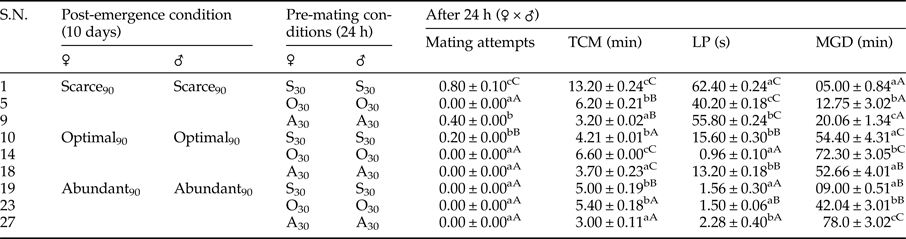
General MANOVA revealed a significant effect of food regimes (scarce, optimal and abundant) at post-emergence (F Poe = 08.04; P = 0.003; df = 1, 89) and at pre-mating conditions (F Prm = 10.84; P = 0.041; df = 1, 89) and their interaction also significantly influenced the number of mating attempts (F Poe×Prm = 7.87; P = 0.008; df = 1, 89). Scarce post-emergence condition was shown to increase the number of mating attempts prior to successful mating; conversely no such detrimental effect was observed on mating pairs reared on optimal and abundant post-emergence conditions (table 1). Scarce pre-mating conditions also seemed to have a slight additive effect on the number of mating attempts, though optimal and abundant conditions had an ameliorative effect.
Effect of prey resource fluctuation on pre- (TCM and LP) and post-mating (MGD) behaviour of Menochilus sexmaculatus.

S.N., serial number; TCM, time to commencement of mating; LP, latent period; MGD, mate-guarding duration; S, scarce; O, optimal; A, abundant.
Values are mean ± SE.
Small and large alphabets compare mating attempts, TCM, LP and MGD in different pre-mating conditions per post-emergence condition, based on Tukey's post hoc comparison of means.
Similar effect of post-emergence (F Poe = 12.76; P = 0.038; df = 1, 89) and pre-mating conditions (F Prm = 5.83; P = 0.008; df = 1, 89), and their interactions (F Poe×Prm = 6.09; P = 0.002; df = 1, 89) were evident on TCM. TCM was found to be influenced more by post-emergence condition than by pre-mating conditions. Improved prey resource under pre-mating conditions seemed to reduce the stress of post-emergence conditions. TCM was similar under optimal and abundant pre-mating conditions irrespective of post-emergence conditions. Maximum TCM was found when females and males of scarce post-emergence conditions were provided with scarce pre-mating conditions (table 1).
LP was also significantly influenced by the post-emergence (F Poe = 10.06; P = 0.078; df = 1, 89) and pre-mating food conditions (F Prm = 3.54; P = 0.438; df = 1, 89) and their interactions (F Poe×Prm = 6.93; P = 0.018; df = 1, 89). LP varied from 40.20 ± 1.80 to 62.40 ± 0.24 s, 1.20 ± 0.18 to 0.96 ± 0.30 s and 1.50 ± 0.06 to 2.28 ± 0.01 s under scarce, optimal and abundant post-emergence conditions, respectively. LP was also maximum when the mates experienced scarce pre-mating food conditions preceded by scarce post-emergence food conditions. Unlike TCM, post-emergence and pre-mating food conditions had a strong additive effect on LP (table 1).
In case of MGD, it varied significantly with post-emergence (F Poe = 7.83; P < 0.001; df = 1, 89), pre-mating (F Prm =13.40; P < 0.001; df = 1, 89) conditions and their interactions (F Poe×Prm = 8.56; P = 0.0001; df = 1, 89). It varied from 5.00 ±0.84 to 20.06 ± 1.34 min, 52.66 ± 4.06 to 72.30 ± 3.05 min and 9.00 ± 0.51 to 78.0 ± 3.02 min under scarce, optimal and abundant post-emergence conditions, respectively. Maximum MGD was 78.00 ± 3.02 min when mating occurred between females and males from abundant post-emergence condition and were further kept on abundant pre-mating condition. Interestingly, MGD was highest when post-emergence and pre-mating conditions matched except for under matching of scarce conditions (table 1).
Reproductive output
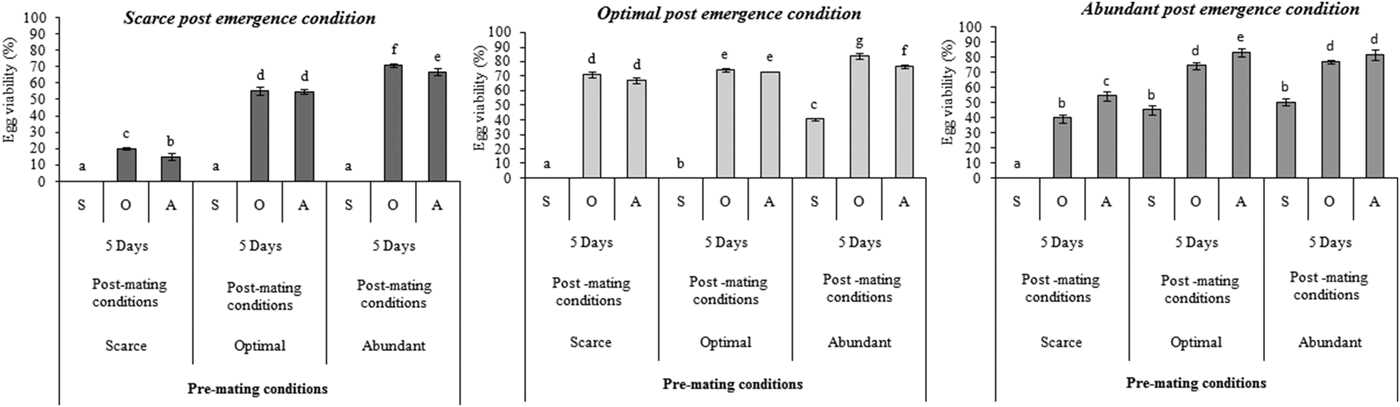
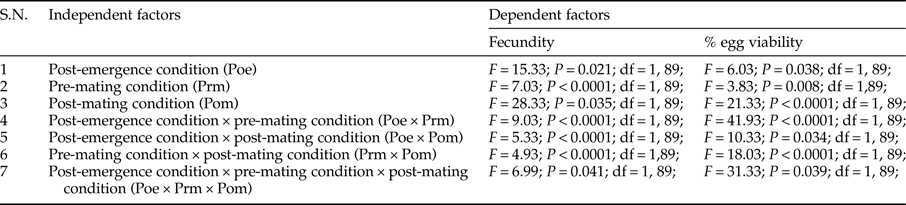
General MANOVA further revealed a significant effect of post-emergence, pre-mating and post-mating conditions on fecundity and per cent egg viability. Interaction between post-emergence and pre-mating conditions, post-emergence and post-mating conditions, and pre-mating and post-mating conditions, post-emergence, pre-mating and post-mating conditions also showed significant effect on fecundity and per cent egg viability of M. sexmaculatus (table 2). There was no egg laying under scarce post-mating conditions, regardless of the post-emergence and pre-mating conditions that the adults had been previously subjected to (fig. 1). Maximum per cent egg viability was found on optimal and abundant post-mating conditions of both optimal and abundant post-emergence conditions in comparison to scarce post-emergence condition (fig. 2).
Effect of food resource fluctuation on fecundity of Menochilus sexmaculatus (S, scarce; O, optimal; A, abundant; small letters compare the fecundity of different experimental conditions, based on Tukey's post hoc comparison of means; similar letters indicates lack of significant difference).

Effect of food resource fluctuation on per cent egg viability of Menochilus sexmaculatus (S, scarce; O, optimal; A, abundant; small letters compare the per cent egg viability of different experimental conditions, based on Tukey's post hoc comparison of means; similar letters indicates lack of significant difference).

Results of multivariate analysis of variance (MANOVA) showing the effects of post-emergence condition (Poe), pre-mating condition (Prm) and post-mating condition (Pom) on time to commencement of mating and latent period of Menochilus sexmaculatus (F-values are significant at P < 0.05).

S.N., serial number.
Discussion
Adults reared under optimal and abundant prey resource after post-emergence conditions established mating in a single attempt, while those on scarce food condition took multiple attempts to successfully mate, probably owing to their poor fitness. This reluctance could be a result of poor fitness of males, in terms of poor cuticular hydrocarbon profile (Chapman et al., Reference Chapman, Liddle, Kalb, Wolfner and Partridge1995; Ferveur, Reference Ferveur2005), reduced ejaculate size or less spermatophore phylax of males. Under more suitable conditions, males have been found to transfer larger ejaculates, potentially achieved by an increased rate of ejaculate transfer in comparison to low nutritional status of males (Perry & Rowe, Reference Perry and Rowe2010). In cases where females show low receptivity owing to poor fitness of males, increased number of mating attempts by such males may be the only way to convince females of their vigour and thereby procure a mating (Rowe, Reference Rowe1992).
Similar trends to those observed in mating attempts were also in TCM and LP. Maximum TCM and LP were observed in pairs reared under scarce post-emergence conditions, particularly if the female and male were exposed to scarce pre-mating conditions. These findings clearly indicate that the rearing conditions are more important than the experimental condition for the mating behaviour of ladybirds. The delay in the onset of mating between the partners of scarce post-emergence condition and scarce pre-mating condition may be a form of avoidance by both partners to enter into the mating which may be costly to them in terms of increased energy expenditure under poor nutritional state (Omkar & Mishra, Reference Omkar and Mishra2005). It has been previously suggested that variation in both mate quality and mate choice costs will influence TCM and LP (Parker, Reference Parker1983). The negative correlation between TCM and duration of copulation observed in this study finds support in a previous study on Drosophila (Singh & Singh, Reference Singh and Singh2014).
A recent study in M. sexmaculatus demonstrates that males perform post-copulatory mate guarding in the form of prolonged mating durations (Chaudhary et al., Reference Chaudhary, Mishra and Omkar2015), which significantly influences paternity share via last male sperm precedence as indicated by the phenotype of the offspring (Chaudhary et al., Reference Chaudhary, Kumar, Mishra and Omkar2016). Mate-guarding behaviour has been shown to vary considerably according to food resource (Burdfield-Steel & Shuker, Reference Burdfield-Steel and Shuker2014). Our study, which investigates the effects of fluctuating prey resource on pre- and post-copulatory behaviour, also found similar effects on MGD, fecundity and per cent egg viability in M. sexmaculatus. With scarce rearing conditions, MGD decreased in comparison to optimal and abundant rearing conditions. The decreased mate-guarding modulation under low nutrient condition might be attributed to (a) rapid ejaculation (Perry & Rowe, Reference Perry and Rowe2010), and/or (b) lower energy levels due to initial multiple unsuccessful mating attempts. Adults reared on abundant food under post-emergence achieved higher MGD than their counterparts. While resource stress during development is known to lead to lower lifetime fitness via its detrimental effects on body size and energy reserves, which are independent of the adult nutrient availability (Dmitriew & Rowe, Reference Dmitriew and Rowe2011). Our study indicates that adult nutrient availability also influences mating behaviour.
The increased mating success incurred by adults reared on abundant food supply under post-emergence condition may reflect the condition-dependent response (Perry & Rowe, Reference Perry and Rowe2010). Previous studies have shown that well-fed individuals are at profit in several respects when compared with individuals from food-limited condition. Organisms reared on abundant food have higher probability of being selected as mates, receive higher number of matings and have longer mating durations and higher reproductive output (Hebets et al., Reference Hebets, Wesson and Shamble2008; Eraly et al., Reference Eraly, Hendrickx and Lens2009). A few studies have also shown that males reared on abundant food transfer larger ejaculates with more accessory gland proteins and thus are preferred over low condition males (Gwynne & Simmons, Reference Gwynne and Simmons1990; Perry et al., Reference Perry, Sharpe and Rowe2009).
Fecundity proved a much better predictor of reproductive success following different food resource condition than egg viability. Minimum oviposition was observed by females reared on a scarce post-mating food irrespective of the fact that they were reared on different post- and pre-mating conditions. The reduction in fecundity of offspring of low-food parents observed in our study is in accordance with the finding of Townsend et al. (Reference Townsend, Pettigrove and Hoffmann2012) on Chironomus tepper. Previous study has shown that intake and optimal allocation of nutrients to the gonads can subsequently reinforce the individual fecundity (Zhao et al., Reference Zhao, Li, Zhang, Chen and Zhang2014). Males may ejaculate more sperm into well-fed females either because it pays them to ‘spend’ more reproductive resources on matings that provide greater reproductive potential, or because heavier (longer lived and more attractive) females mate more frequently and have larger spermathecal size (Gage, Reference Gage1998). This is in accordance with the previous studies reporting that clutch size and oviposition rate to be influenced by the food available to females at the time of oviposition (Dixon, Reference Dixon2000). However, the strength of correlation between body size and reproductive success is also known to be modified by factors, viz. food (Dixon, Reference Dixon2007), and presence of predators (Blanckenhorn, Reference Blanckenhorn1998), climate (Gotthard et al., Reference Gotthard, Berger and Walters2007) and age (Amin et al., Reference Amin, Bussière and Goulson2012). In the absence of sufficient quantity of prey, a reduction in the number of progeny produced was reported (Omkar & Pervez, Reference Omkar and Pervez2003).
Food stress in early life stages produces individuals that perform better under food-limited resource conditions than in energy-abundant resource conditions, as has been observed in humans and other mammals (Ozanne & Hales, Reference Ozanne and Hales2005). However, growth and reproductive performance are adversely affected. Studies have shown that adult stages of beetles are capable of surviving prolonged food stress (Omkar & Pervez, Reference Omkar and Pervez2003) but their reproductive success is hampered in comparison to beetles provided with ad libitum aphids (Koch, Reference Koch2003; Dmitriew & Rowe, Reference Dmitriew and Rowe2007).
To summarize, prey resource conditions experienced during post-emergence may result in developing adaptations for future food fluctuating condition. However, plasticity of food resource is not limited to particular stages only as the adult females are also under constant selection pressure during ovipositional periods. Thus, our study reveals that (i) food resource is of paramount importance and any change imposes immediate effects on ladybirds: (ii) adults reared on scarce prey post-emergence had reduced mating and reproductive success despite the fact that their pre-mating and post-mating stages were reared on ad libitum food; (iii) post-emergence and pre-mating conditions showed significant influence on TCM, LP and MGD; (iv) highest MGD was found when post-emergence and pre-mating conditions were abundant; (v) despite the post-emergence and pre-mating conditions, post-mating condition also showed significant effect on fecundity and per cent egg viability; (vii) post-emergence conditions play a more important effect on pre- and post-copulatory behaviour than their pre- and post-mating conditions; (viii) pre- and post-copulatory behaviour of M. sexmaculatus showed plasticity in fluctuating food condition.
Acknowledgements
Desh Deepak Chaudhary is thankful to the Department of Science and Technology, New Delhi for an INSPIRE fellowship (IF130333, No. DST/INSPIRE Fellowship/2013/443). Other authors express their thanks to the Department of Higher Education, Govt. of U.P. for financial assistance under the Centre of Excellence programme.