INTRODUCTION
Albinism is a genetically inherited condition produced by an autosomal recessive gene in the homozygous state in which the pigmentation protein melanin is either absent or non-functional (Westerman & Birge, Reference Westerman and Birge1978; Reum et al., Reference Reum, Paulsen, Pietsch and Parker-Stetter2008). Mutations that affect enzymes involved in the metabolism of melanin can inhibit production, resulting in either partial or complete loss of coloration. In most fish, the absence of colour is related to mutations in the genes of the tyrosinase family, in which the skin of albinos lacks melanin and eye development is also affected (Wang et al., Reference Wang, Hou, Zhang, Zhao, Jiang, Sun, An and Li2007). Among teleost fishes, total or partial albinism has been observed in more than 20 species of teleosts worldwide (Wakida-Kusunoki & Amador-del-Ángel, Reference Wakida-Kusunoki and Amador-del-Ángel2013).
The anguillid eels of the genus Anguilla Schrank, 1798 are widely distributed throughout the world. These eels have a catadromous life history, migrate between inland or coastal growth habitats and have offshore spawning. Nineteen species of Anguilla have been reported worldwide, 11 of which occur in tropical regions (Ege, Reference Ege1939; Arai et al., Reference Arai, Aoyama, Limbong and Tsukamoto1999; Watanabe et al., Reference Watanabe, Aoyama and Tsukamoto2009). Of the 11 species found in tropical areas, seven species or subspecies occur in the western Pacific around Indonesia and Malaysia (Ege, Reference Ege1939; Castle & Williamson, Reference Castle and Williamson1974; Arai et al., Reference Arai, Aoyama, Limbong and Tsukamoto1999). Recently, Arai et al. (Reference Arai, Chino, Zulkifli and Ismail2012, Reference Arai, Chin, Kwong and Siti Azizah2015), Arai (Reference Arai2014a) and Arai & Wong (Reference Arai and Wong2016) reported two tropical eel species Anguilla bengalensis bengalensis and Anguilla bicolor bicolor in the western parts of Peninsular Malaysia.
This paper describes the first record of albinism in a tropical anguillid eel, Anguilla bengalensis bengalensis, from Malaysia.
MATERIALS AND METHODS
An albino anguillid eel was collected by local people, by hook and line, from the Perak River in the state of Perak, located in the northern region of Peninsular Malaysia on 14 February 2015 (approximately 4°45′N 100°57′E). The specimen was transported to the laboratory just after its death in the collector's aquarium (approximately two weeks after collection).
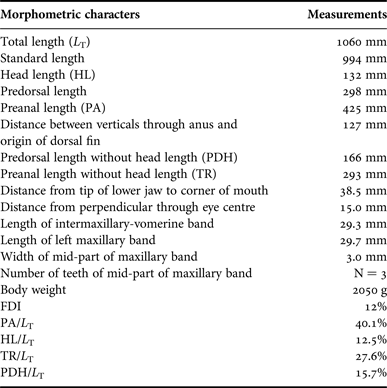
The external morphometric characteristics were measured following Ege (Reference Ege1939) and Watanabe et al. (Reference Watanabe, Aoyama and Tsukamoto2004), and the data are shown in Table 1. The fin difference index (FDI), which is the distance between the verticals from beginning of the dorsal fin (Z) to the anus (ano-dorsal length) relative to the total length (L T) (Ege, Reference Ege1939), was calculated as follows: FDI = 100 Z L T−1.
Morphometric characters of an albino Anguilla bengalensis bengalensis collected from the Perak River, northern Peninsular Malaysia, on 14 February 2015.

Arai et al. (Reference Arai, Chin, Kwong and Siti Azizah2015) and Arai & Wong (Reference Arai and Wong2016) suggested that accurate tropical eel species identification needs to be validated by molecular genetic analysis after morphological observation. Thus, the mitochondrial gene, cytochrome oxidase c subunit 1 (COI), and a nuclear gene, 18S rRNA, were used for species identification of the collected specimen.
DNA was extracted from the specimen's dorsal fin clip using a Gentra Puregene Tissue Kit (QIAGEN, USA), following the manufacturer's protocol. The concentration and quality of the DNA was estimated using a BioPhotometer Plus spectrophotometer (Eppendorf, Germany). Both mitochondrial COI and 18S rRNA genes were amplified using primer pairs (Table 2) to confirm the species identity of the collected specimen. Polymerase chain reaction (PCR) amplifications were performed in a total 25 µl reaction, comprising 1× Invitrogen Platinum Taq Buffer, 1.5 mM MgCl2, 10 pmol of each primer, 0.25 mM of each deoxynucleotide triphosphate, 1.5 U of Taq DNA polymerase and 100 ng of genomic DNA. The PCR regime was as follows: initial denaturation at 94°C for 2 min; 34 cycles of denaturation at 94°C for 45 s, annealing at 55°C for 50 s and elongation at 72°C for 1 min; the regime ended with the final elongation step at 72°C for 5 min. PCR amplicons were purified using a QIAquick® PCR Purification Kit (QIAGEN, USA), labelled using a BigDye Terminator v.3.1 Cycle Sequencing Kit (Applied Biosystems Inc., USA) and sequenced bi-directionally on an ABI PRISM 3730xl Genetic Analyser. Generated sequence trace files were manually assembled and end-trimmed using the SeqMan program (DNASTAR Inc., USA). The end-trimmed contigs were compared for percentage similarity with the reference sequences in the NCBI database using BLASTn. The sequences were submitted to the NCBI with the registered accession numbers KP897130 (COI) and KP897131 (18S rRNA).
Primer sequences, amplicon sizes and sources used in this study.
RESULTS AND DISCUSSION
An albino adult female eel was identified and validated as Anguilla bengalensis bengalensis by both morphological and molecular genetic analyses. The 18S amplified fragment was deposited in the NCBI database as the first 18S rRNA gene sequence for Anguilla bengalensis bengalensis. The L T and body weight of the albino specimen was 1060 mm and 2050 g, respectively (Table 1). The examined eel had a partial albino phenotype, with hypomelanism on the entire surface of the body except for the eyes, which had normal pigmentation (Figure 1). Interestingly, pigmentations sporadically appeared on the head, dorsal and tail parts, but the ventral body surface was unpigmented (Figure 1). Yellowish spots also appeared on the head and rostrum parts (Figure 1). The pectoral, dorsal, anal and caudal fins were whitish pink in colour and devoid of any pigmentation (Figure 1). The normal coloration of Anguilla bengalensis bengalensis exhibits a brownish to black marbling on the back, with a greyish-yellow background (Figure 2). The mottled colour and the long dorsal fin distinguish the eel from all other anguillid species, except for Anguilla marmorata. However, the present specimen did not possess a mottled colour on the body surface (Figure 1).
Partial albino specimen of Anguilla bengalensis bengalensis with a normal eye colour (1060 mm L T) collected in Malaysia.
Normal specimen of Anguilla bengalensis bengalensis (690 mm L T) collected in Malaysia.
To our knowledge, this is the first report of partial albinism in the genus Anguilla and for tropical fish species from Malaysian natural waters. The occurrence of albinism in specimens of Anguilla could be caused by three factors: (1) contamination effects; (2) random genetic alterations; or (3) genetic alteration due to small population size. The incidence of albinism can be artificially increased in fish by exposing the eggs to heavy metals (Oliveira & Foresti, Reference Oliveira and Foresti1996). However, spawning areas of the catadromous eels, including those of Anguilla bengalensis bengalensis, are located in the open ocean. Thus, any contamination effects on the eels can potentially be excluded, since the open ocean is generally not contaminated by any chemicals. Overfishing could have led to a reduction in the effective population size, favouring inbreeding and the expression of the gene for albinism (Sanabria et al., Reference Sanabria, Quiroga and Laspiur2010). Currently, Anguilla bengalensis bengalensis is not a target species for fisheries and aquaculture like other temperate eel species such as Anguilla anguilla, Anguilla rostrata and Anguilla japonica (Arai, Reference Arai2014b, Reference Araic). Thus, Anguilla bengalensis bengalensis does not face overfishing like other temperate eel species do. The potential for genetic alteration due to small population size in the species is also not supported. However, future studies on the genetic variability of Anguilla bengalensis bengalensis in the distribution region are needed to evaluate the hypothesis. The albinism in Anguilla bengalensis bengalensis is most likely caused by random genetic alteration.
The lack of coloration in albinos may make them more susceptible to predation than normally pigmented conspecifics. Pathological traits such as sensory or nervous deficiencies, anaemia, low fertility, higher susceptibility to disease and poor vision may decrease the viability of albinos (Leal et al., Reference Leal, Schulz, Lehmann, Machado and Ott2013). Behavioural interactions with conspecifics may also be impaired (Acevedo & Aguayo, Reference Acevedo and Aguayo2008). On the other hand, albinism has little influence on fish with nocturnal habits, such as anguillid eels, since these nocturnal animals reduce the likelihood of being detected by visual predators. Partial albinism may not be a handicap in the life of the present specimen, because the eel could still potentially grow to more than 1 m L T, just like a normal adult eel.
ACKNOWLEDGEMENT
This study was financially supported by the Ministry of Higher Education Malaysia under the Fundamental Research Grant Scheme (Vot No. 59281).