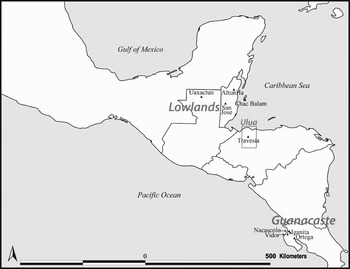
Here we present results from a study of Late Classic (a.d. 600/650–800/850) marble vases from the lower Ulua River Valley in northwestern Honduras (Figure 1). Ulua marble vases have long been viewed as evidence of a local Uluan tradition (Gordon Reference Gordon1920, Reference Gordon1921; Schaffer Reference Schaffer1992; Stone Reference Stone1938), and the circulation of the vases outside the valley has been taken to indicate long-distance ties with foreign communities (Joyce Reference Joyce1986:324; Luke Reference Luke2002). Isotopic data from marble vases and marble sources suggest that marble procurement focused on one primary local source, with two potential secondary local sources; these results suggest centralized production (Luke et al. Reference Luke, Tykot and Scott2006). The high-frequency distribution of vases at or near the Late Classic center of Travesia (Henderson Reference Henderson, Chase and Chase1992a:164; Luke Reference Luke2002:104–110) and the worked marble blocks and debitage at Travesia (see Lincoln Reference Lincoln1979a) make this the most likely area where vases were produced (Luke Reference Luke2005). This paper places the vases in a regional context, exploring the Ulua marble-vase style and the stable-isotope results of 69 vases to provide a more complete understanding of how production may have been organized throughout the period circa a.d. 600/650–800/850, verified by ceramic cross-ties and stylistic analyses (Luke Reference Luke2002, Reference Luke2005). Over this approximately 200-year period of production, the deliberate choices made to update the style as necessary, and the apparent emphasis on one procurement source for the duration of production (Luke et al. Reference Luke, Tykot and Scott2006), point to the typical model of centralized production patronized by an elite. Our analyses of the vases in their regional context, however, suggest a more nuanced understanding of centralized production of luxury goods, with explanations beyond pure economic or political aggrandizement by an elite group. We consider the importance of perceived common history within the context of material-culture production, particularly for items that serve to symbolize identity of a place and/or people, to understand the social and ritual value of a luxury good.
Map of Mesoamerica showing the Ulua Valley and the distribution of Ulua-style marble vases in the central Maya Lowlands and Guanacaste.

To situate the reader of this paper, we begin with an overview of craft production in Mesoamerica, moving to a discussion of the history of the lower Ulua Valley. The contextual and stylistic analyses of Ulua marble vases are then explored, setting the stage for the chemical results of the various styles of vases from specific geographic locations. What follows is a discussion of the implications of this research for our current understanding of luxury production in the lower Ulua Valley, highlighting the value of corroborating stylistic and chemical results with an understanding of local settlement histories and other forms of material culture.
PRODUCTION OF PORTABLE LUXURY GOODS IN MESOAMERICA
Of central concern is the question of how the production of luxury goods contributes to our understanding of evolving social and political networks in the context of regional development. Craft-specialization paradigms explore how portable goods are integral to the basic social relations of a community. Within these theoretical approaches, luxury goods are usually linked to groups vying for prestige and artisans attached to elite patrons or institutions (see Brumfiel and Earle Reference Brumfiel, Timothy K, Brumfield and Earle1987; Clark and Parry Reference Clark and Parry1990; Costin Reference Costin1991, Reference Costin, Costin and Wright1998, 2001a, 2001b). Ulua marble vases fit the basic criteria for a luxury good: specialized skills required for fine craftsmanship, with sacred knowledge necessary to carve the imagery; limited distribution in high-status and/or ritual contexts; and limited procurement zones, requiring knowledge of procurement location(s). Luxury goods are usually objects used on occasions that underlie fundamental desires to compete in specific sociopolitical arenas, the luxury good symbolizing wealth and prestige of a specific group. Yet archaeological data from the Ulua Valley have not suggested major competition among communities, even during periods of population expansion and site development (Henderson Reference Henderson, Danien and Sharer1992b:165; Henderson and Joyce Reference Henderson and Joyce2000; Joyce Reference Joyce1991:33–34, 117–118, 151). The production of Ulua marble vases at Travesia during the Late to Terminal Classic period, then, indicates a fundamentally different type of paradigm, with luxury-good production not necessarily indicative of (a) regional political power but, rather, indicative of a way that one community sought to exemplify its growing social prominence. Through stylistic and chemical data, we argue that the decision by one community to focus on a specific artifact—Ulua-style marble vases—began during the initial phases of sociopolitical expansion in the valley, pointing to the importance of establishing a site-specific material tag that became refined overtime to celebrate the centrality of Travesia.
Studies from Mesoamerica show that groups with access to luxury items and sacred knowledge represent the upper echelon of society, commonly referred to as “elites” (see papers in Chase and Chase Reference Chase and Chase1992) and may include nobles, priests, merchants, and/or artisans, attesting to the multifaceted organization in which socially as well as politically prominent elites operate on different levels in a single community (Foias and Bishop Reference Foias and Bishop1997:288; Joyce Reference Joyce, Richards and Van Buren2000; McAnany Reference McAnany, Sabloff and Henderson1993:69–71; Webster Reference Webster, Chase and Chase1992). Artisans are part of this broad network and have access to skills and sacred knowledge expressed through aesthetic choices of objects, argued to function as cultural capital—items linked with “prestige, honor, and a reputation for competence” (Inomata Reference Inomata2001:324; see Bourdieu Reference Bourdieu and Nice1984). Production of luxury craft goods demands that artisans, their patrons, and the wider community consider seriously the use and acceptance of style and imagery to convey identity and status to local and foreign groups (Joyce Reference Joyce1991:134–135, Reference Joyce and Graham1993b, Reference Joyce, Richards and Van Buren2000; Reents-Budet Reference Reents-Budet, Costin and Wright1998; see also Dietler and Herbich Reference Dietler, Herbich and Stark1998; Janusek Reference Janusek2002:37, 54–56; Wiessner Reference Wiessner, Conkey and Hastorf1990). The context of production—the local networks and history—are critical for understanding just how luxury goods come to be produced, used, and discarded in any given political, social, economic, and ritual system (Dietler and Herbich Reference Dietler, Herbich and Stark1998; Henderson Reference Henderson, Chase and Chase1992a:158–160). In this way, luxury craft production plays a vital role in the development and maintenance of a community's social fabric, particularly in how this community communicates visually through the circulation of portable goods within its immediate boundaries and networks as well as with neighboring and, if applicable, distant communities.
In ancient Mesoamerica, strict adherence to a labor-intensive iconographic program on some types of polychrome ceramics points to deliberate control of imagery by a specific group or groups and may suggest the presence of tight-knit workshops attached to royal courts (Ball Reference Ball, Sabloff and Henderson1993; Becker Reference Becker2003; Foias and Bishop Reference Foias and Bishop1997:282; Fry Reference Fry2003; LeCount Reference LeCount1999; Reents-Budet Reference Reents-Budet1994, Reference Reents-Budet, Costin and Wright1998; Reents-Budet et al. Reference Reents-Budet, Bishop, MacLeod and Reents-Budet1994; Reents-Budet et al. Reference Reents-Budet, Bishop, Taschek and Ball2000). Yet not all polychromes are indicative of high-ranking elites. In fact, the widespread occurrence of many styles in multiple, different social contexts (elite, commoner, residential trash, etc.) suggests that polychromes may not be the best indicators of elites; they may, instead, be better indicators of social groups, where artistic styles and programs would have conveyed acceptance with (or exclusion from) a specific group—certainly what we would expect in social and political arenas where competition was fierce. Competition among Late Classic Mayan sites is well documented in textual evidence, often embedded with political propaganda, even in the recasting of history; building programs and the production of elaborate monuments correlate to specific events and celebrate the rise in power of a specific ruler and/or family (see Simon and Grube Reference Martin and Grube2000). Thus, in the central Maya Lowlands, differentiation in ceramic styles may refer to social and political units “within which most polity formation and expansion took place” (Ball Reference Ball, Sabloff and Henderson1993:256). Joseph Ball expands on the social implications: the existence of discrete workshops, both palace and village traditions, indicates “a highly fragmented sociopolitical landscape characterized by great need to symbolize local identities and signify formal ties of relation” (Ball Reference Ball, Sabloff and Henderson1993:263).
Yet not all fancy material culture was produced in centralized workshops in Mesoamerica, nor does it correspond to highly competitive communities. While some finewares are clearly restricted in distribution in the central Maya Lowlands, others clearly represent, as Ball writes, “the products of geographically local producer-communities consisting of multiple individuals or workshops specializing in multiform, multitype finish groups” (Ball Reference Ball, Sabloff and Henderson1993:253). Copador ceramics, diagnostic of the Copan Valley (Beaudry Reference Beaudry1984), and Sulaco ceramics from El Cajon (Beaudry et al. Reference Beaudry, Bishop, Henderson, Hirth and Kolb1989) indicate numerous artisans sharing generally accepted suites of icons across a broad landscape without centralized workshop organization. Data from the Petexbatun further indicate that more centralized production may have focused only on specific form classes (Foias and Bishop Reference Foias and Bishop1997), which confirm earlier studies from Palenque (Rands and Bishop Reference Rands, Bishop and Fry1980) and Tikal (Fry Reference Fry and Fry1980, Reference Fry2003). These conclusions indicate that fine-grained stylistic and chemical analyses are necessary to understand fully the organization of production of specific types of material-culture remains in any given region, and that by understanding how and why objects were produced, we will be able to understand more about the social and political structure of a given system.
The ceramic evidence from the Ulua region shows a number of independent producers, indicating that the general organization of polychrome production was decentralized (Joyce Reference Joyce1991:131–139, Reference Joyce and Graham1993b:84–85, Reference Joyce2004). While iconographic programs of Ulua polychromes may mark specific communities and their networks, local and foreign (Henderson Reference Henderson, Danien and Sharer1992b:165–167; Joyce Reference Joyce1988, Reference Joyce1991:117, 132–135; Sheptak Reference Sheptak and Robinson1987), the imagery demonstrates shared aesthetic templates, which would have served to unite community groups through a common use of symbolic media. Constant transfer of knowledge, particularly for objects used in public settings by prominent members of society, illustrates social connections, rather than political or economic hierarchies (Joyce Reference Joyce2004). Based on the current understanding of settlement and ceramic data, Late Classic communities in the lower Ulua Valley were not necessarily competing for political power with an eye toward regional control of territory (Henderson and Joyce Reference Henderson and Joyce2000; Joyce Reference Joyce1991:117). This mutual identification process in Late Classic ceramic production continues into the Terminal Classic period; similarities across technologies, forms, and styles illustrate valley-wide networks (Lopiparo Reference Lopiparo2003). Yet within this broad sharing of templates, there are also signs of emerging stylistic traditions that may be specific to workshops and sites (Joyce Reference Joyce2004).
Rosemary Joyce's research (2004) shows that by the late seventh century, distinctive regional polychrome traditions are clear, at least between the Comayaga and Ulua regions, and that within the broad regional tradition, specific sites appear to expand on specific styles. By the eighth century, human figures reappear on cylindrical Ulua polychromes, and there is an increased distribution of Ulua polychromes in burials, perhaps an indication, as Joyce (Reference Joyce2004) argues, for a focus on specific individuals. The appearance of figures and the shifts in distribution patterns may in fact indicate increasingly differential uses of polychromes (Joyce Reference Joyce2004). Furthermore, the themes present on several groups of Ulua polychromes (i.e., late) show increasingly close relationships to the central Maya area (Joyce Reference Joyce and Graham1993b, Reference Joyce2004; Robinson Reference Robinson1978; Sheptak Reference Sheptak and Robinson1987; Viel Reference Viel1978).
Clear evidence for centralized production of Ulua marble vases in a region where centralized control of the arts appears to be limited suggests the increasing prominence of Travesia (Henderson Reference Henderson, Chase and Chase1992a:164–166). If one group at Travesia used Ulua-style marble vases to mark identity and, in doing so, began to differentiate itself from other sites in the region, yet did not seek political control over territory, how do we begin to understand the reasons for production of a luxury good? The patterns of polychrome production and circulation discussed earlier indicate groups differentially identifying themselves, yet within broad regional traditions. The distinctive shift in material (i.e., marble) and imagery carved on Ulua marble vases provides evidence for distinct groups. The use of stylistic analyses of Ulua-style marble vases and chemical signatures for a subset of these vases illustrates how one artifact came to symbolize a specific community in the valley and abroad over a 200-year period.
LOWER ULUA VALLEY
The Lower Ulua Valley is located in a broad alluvial flood plain, with the Ulua River flowing more or less through the central part of the valley, emptying into the Caribbean Sea. The material correlates for the Classic period demonstrate strong ties to the central Maya lowlands (Joyce Reference Joyce1986, Reference Joyce1991, Reference Joyce, Langeback and Cardenas-Arroyo1996; Sheptak Reference Sheptak and Robinson1987) as well as to the less complex communities in central Honduras and further south into Lower Central America (Joyce Reference Joyce and Graham1993b; Lange Reference Lange, Lange and Stone1984, Reference Lange and Lange1992; Stone Reference Stone1963, Reference Stone1972, Reference Stone1977). Communication with both the central Maya heartland and communities to the south waxed and waned in antiquity, with ties to the region of Guanancaste in northern Costa Rica vibrant during the initial periods of the Late Classic, followed by a shift to stronger ties with the central Maya Lowlands via a Caribbean coastal network during the height of the Late Classic and into the Terminal Classic (Joyce Reference Joyce1986).
The typical Maya versus non-Maya criteria for defining ancient cultural areas in Mesoamerica become critical when discussing the Ulua region. Linguistic data point to a Lenca-speaking people (Campbell Reference Campbell, Campbell and Mithun1979; Chapman Reference Chapman1978; Henderson Reference Henderson1977; Joyce Reference Joyce1988, Reference Joyce1991:15–21; Stone Reference Stone and Steward1948). Archaeologically, the Ulua area shares much with the greater sphere of the Maya world (see Henderson Reference Henderson1997), with clear localized renditions that situate settlement layout (see Joyce Reference Joyce1991; Joyce et al. Reference Joyce, Hendon, Lopiparo, Bowser and Zedeño2008) and polychrome production (Joyce Reference Joyce and Graham1993b; Henderson Reference Henderson, Danien and Sharer1992b; Henderson et al. Reference Henderson, Sterns, Wonderley and Urban1979; Viel Reference Viel1978) within distinctive local traditions, often with considerable history.
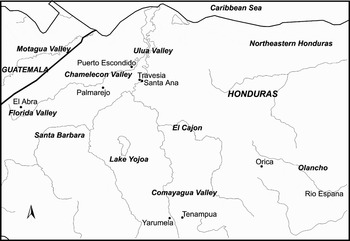
During the Late Classic period, the lower Ulua Valley experienced unprecedented population growth. Spaced more or less equally throughout the valley, a number of large centers functioned as regional hubs, including Curruste, Travesia, and la Gucamaya (Figure 2; Henderson Reference Henderson, Danien and Sharer1992b:167; Joyce Reference Joyce1991:117). Architectural features illustrate clear public building programs at these centers. Travesia includes a monumental plaza area framed by temples and a ballcourt (Stone Reference Stone1941). Research by Jeanne Lopiparo (Reference Lopiparo2003:252–269) shows that the celebration of these centers with regard to local landscape features, Travesia a focal point for other sites. While it is unclear exactly how large Travesia was in the Late Classic period, data indicate that it was not substantially larger than any of the other centers (Henderson and Joyce Reference Henderson and Joyce2000; Joyce and Sheptak Reference Joyce and Sheptak1983; contra Stone Reference Stone1941). Yet it did have worked-stone-faced architecture, rare at other centers, and standing sculpture, also rare at other centers. So clearly, Travesia occupied a significant location in the social networks of the valley, and its strategic location on the banks of the Ulua River afforded it access to the main north–south networks.
Map of the Ulua Valley, northwestern Honduras.

The celebration of place at Travesia began at least by the Late Classic period, with the central core area of the site aligned at the convergence of the axis points of the three tallest mountains surrounding the valley. The largest and most central of these mountains is Santa Barbara, located to the south (Lopiparo Reference Lopiparo2003:260; Joyce et al. Reference Joyce, Hendon, Lopiparo, Bowser and Zedeño2008). Travesia functioned as an “axis-mundi” for the valley (Lopiparo Reference Lopiparo2003:262) and served as a reference point for other sites in the region, culminating in a distinctly localized sense of place and history (Joyce et al. Reference Joyce, Hendon, Lopiparo, Bowser and Zedeño2008). One group at Travesia expressed importance of landscape and place making on a portable good: Ulua marble vases. The imagery carved on the exterior of the vases represents a manifestation of the centrality of the Santa Barbara Mountain in the lives of people living at Travesia. The production of these vases, then, took into consideration the importance of localized conceptions of the landscape, the material quality of the vases (i.e., white marble), and contemporary stylistic canons (see Luke, n.d.).
Archaeological work at Travesia began in the early twentieth century, and businessmen and local archaeologists prospected for Ulua marble vases (Luke Reference Luke2006:36–46); Doris Stone was the first to focus specifically on mapping and excavating structures (Stone Reference Stone1941), followed by others (Joyce Reference Joyce1991:30; Lincoln Reference Lincoln1979a, Reference Lincoln1979b; Sheehy Reference Sheehy1978). Over the years, the site has been heavily plundered, most actively for Ulua marble vases (Luke and Henderson Reference Luke, Henderson, Brodie, Kersel, Luke and Tubb2006). Of specific interest for our purposes is the high frequency of finds of marble vases in the core as well as in outlying areas of Travesia. Approximately 170 whole vases and fragments of marble vases are known from museum and excavation collections around the world, the vast majority excavated and/or reported prior to 1940. Of these, about 30% have at least site-level provenience. Between 1910 and 1940, Wittkugel, a German, Lincoln G. Valentine (prospecting for G. B. Gordon, then at the University of Pennsylvania Museum), and Stone all reported whole and fragmentary marble vases from Travesia (see Luke Reference Luke2002:104–108; Luke and Henderson Reference Luke, Henderson, Brodie, Kersel, Luke and Tubb2006:159–161). During the same period, a number of whole and fragmentary marble vases were recovered (the majority with site provenience reported by Stone) from small, wealthy hamlets in the lower Ulua Valley, often very close to Travesia. A vase was not found during professional archaeological excavations in the valley again until 1996, when a rim fragment was discovered at Puerto Escondido (Luke Reference Luke2002:112).
While certain evidence of an Ulua marble vase workshop is absent in the valley (or elsewhere), the strongest evidence points to Travesia. In rubble fill in the core area, Charles Lincoln excavated both unworked and worked blocks of marble (Lincoln Reference Lincoln1979a: 12–13). Marble vases average 13 cm in height and 13 cm in diameter; they are typically taller than they are wide. The measurements of the marble blocks and other marble fragments excavated by Lincoln strongly suggest a marble workshop at Travesia (Luke Reference Luke2005). Chemical results corroborate the high-frequency distribution of marble vases at Travesia, indicating that production of Ulua-style marble vases took place in one location (Luke et al. Reference Luke, Tykot and Scott2006).
Vases have been found also in neighboring regions (Luke Reference Luke2002:117–123), yet unlike the finds in the valley proper, vases found in neighboring regions are often associated with centers: a fragment was excavated at the regional El Cajon center of Salitron Viejo (Hirth and Hirth Reference Hirth, Hirth and Lange1993:178); fragments were reported from illicit digging at Tenampua and Yarumela, both prominent sites in the Comayagua region (Luke Reference Luke2002:119–120); an almost complete vase was recovered in Orica (eastern Honduras; Luke Reference Luke2002:121–122); and a whole vase was found at the prominent site of El Abra in the La Entrada region (Nakamura Reference Nakamura1987:8); in the summer of 2004, a whole vase was excavated at the of Palos Blancos in the Palmarejo Valley (Davis-Salazar and Wells Reference Davis-Salazar and Wells2007; Rivera Reference Rivera2005).
Outside the valley and its neighboring regions, Ulua marble vases mark close ties between Travesia and distant communities, and the rich contexts abroad affirm the high-status afforded to these vases by foreign centers. Vases have been found in central plaza areas at Uaxactun (Kidder Reference Kidder1947:36–37), Altun Ha (Pendergast Reference Pendergast1982:43, 114–115, Reference Pendergast1990:233, 236–238), and San Jose (Thompson Reference Thompson and Eric1939:167) in the central Maya Lowlands and in elaborate caches at Nacascolo (Stone Reference Stone1963:357, Reference Stone1977:59), Iguanita (Fredrick Lange, personal communication 2002), and Ortega (Ferrero Reference Ferrero1981:88) in Guanacaste; this pattern of distribution at high-status sites follows that known for other Late Classic white-stone-vase traditions in Mesoamerica (Luke Reference Luke, Rowan and Ebeling2008). The distribution of Ulua-style marble vases at prestigious centers in the central Maya Lowlands, as well as at prominent sites in Guanancaste, confirms that prominent groups outside the valley had access to these vases. Furthermore, in both spheres, portable, and often elaborate, stone vases were produced in local traditions (i.e., not following the Ulua style). In Guanacaste, vessels with dual lug handles that protrude from the rim and/or side of the vessel are made of local stone, often with upper borders, yet lacking detailed relief carving on the exterior (Anne-Louise Schaffer, personal communication 1998); similar vases with dual lug handles, yet lacking the exterior carving as well as the delicate, thin walls, are known from northeastern Honduras (Carrie Dennett, personal communication 2007). In the central and northern Maya Lowlands, extremely delicate vessels produced from white alabaster and travertine mark a restricted luxury good (Luke Reference Luke, Rowan and Ebeling2008). Thus, the attraction to Ulua marble vases in these foreign contexts must have resided in their link to a specific region and style. None of the other traditions portray the distinctive carved imagery on the obverse and reverse sides and the elaborate dual lug handles (see Luke Reference Luke, Rowan and Ebeling2008 n.d.). In this way, style played an important role in marking identity, particularly new styles and materials, at home and abroad. Shifts in the types of styles of Ulua marble vases circulating at local, neighboring, and regional levels offer a way to track the development over time of vase production in the Ulua Valley, specifically with regard to procurement and workshop location and innovation at Travesia.
CORPUS OF ULUA MARBLE VASES
First documented in the late nineteenth century (Gordon Reference Gordon1898; Hamy Reference Hamy1896), Ulua marble vases are best known from the work of G. B. Gordon (Reference Gordon1920, Reference Gordon1921), Doris Stone (Reference Stone1938), and, more recently, Anne-Louise Schaffer (Reference Schaffer1992). All documented vases are carved from white marble, and a handful show remains of colorful stucco (Luke Reference Luke and Lazzarini2003b). The vases can be classified broadly into five stylistic groups that span the period from circa a.d. 600/650 to 800/850 (Luke Reference Luke2002, Reference Luke2005; Luke and Tykot Reference Luke and Tykot2001). Vases are delicate, with thin sides and bases—clearly meant to be handled with care. The majority of vases have two dual-lug zoomorphic handles that separate the obverse and reverse sides. On the exterior of the vases, a central program is framed by a geometric band border. The imagery is very regular, with a central program focused on scrolls, which usually form the building blocks of profile and/or frontal zoomorphic heads. Surrounding these figures may be an intricate pattern of winged and/or paw scrolls, often associated with vertical scale motifs. Over time, the execution of the scroll became more complex, with greater definition achieved through sculpturing of the marble in relief and incised lines, giving depth to the imagery. The refinement of the scrollwork is paralleled in the increasingly high-quality sculpturing of the handles. The final stages of vase production show zoomorphic handles almost completely in the round. In the final phase of production, then, the Ulua carver demonstrates mastery in sculpturing marble with fluid line and even depth, creating vases that look as though they are carved from a smooth, creamy butter.
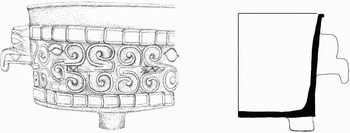
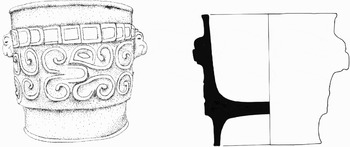
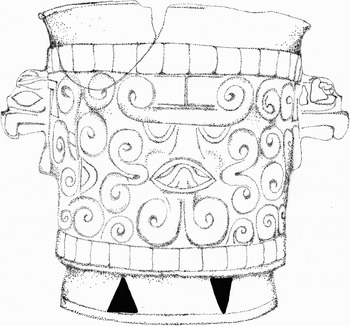
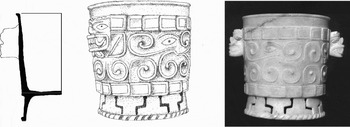
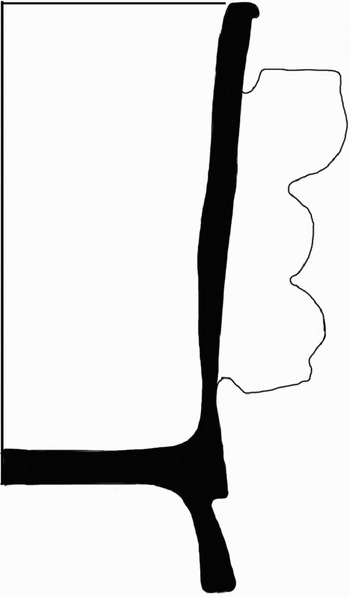
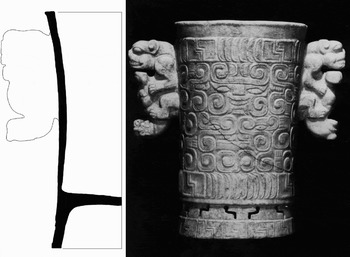
While there is certainly flexibility within groups, over time stylistic conventions were strictly followed, adhering to contemporary canons as reflected in local Ulua polychrome ceramic traditions (Luke Reference Luke2005). Five main stylistic groups of Late Classic Ulua marble vases can be identified (Luke Reference Luke2002:55–86). Handle treatment (or lack thereof) constitutes the primary defining characteristic of the tradition. All but one group has lug zoomorphic handles: bird, bat, and monkey; feline; or composite (feline and serpent imagery). The stylistically earlier vases typically have bird, bat, and monkey handles with scale borders and a single row featuring profile zoomorphic head(s) in the main program (Figures 3–5); the later vases typically have feline or composite handles and more complex main programs (e.g., frontal and profile zoomorphic heads) framed by voussure and interlocking key, chevron, and/or mat borders (Figures 3–8, 10–11).
Ulua marble vase with bird handles (Group 1). Height: 9.2 cm; diameter: 19 cm. Middle American Research Institute, Tulane University, New Orleans. Drawing by Christina Luke.

Ulua marble vase with bird handles (Group 1). Height: 8.4 cm; diameter: 10.6 cm. Peabody Museum of Archaeology and Ethnology, Harvard University, Cambridge, MA. Drawing by Christina Luke.

Ulua marble vase with bird handles and stucco (Group 1). Popul Vuh Museum, Guatemala City. Drawing by Christina Luke.

Ulua marble vase with bat handles (Group 2). Height: 13 cm; diameter: 12.1 cm. Middle American Research Institute, Tulane University, New Orleans. Drawing by Christine Luke. Photograph courtesy of Middle America Research Institute.

Ulua marble vase with feline handles (Group 3). Height: 18.8 cm; diameter: 16.7 cm. Middle American Research Institute, Tulane University, New Orleans.

Ulua marble vase with feline handles (Group 4). Height: 25.08 cm; diameter: 16.193 cm. Museum of Archaeology and Anthropology, University of Pennsylvania.

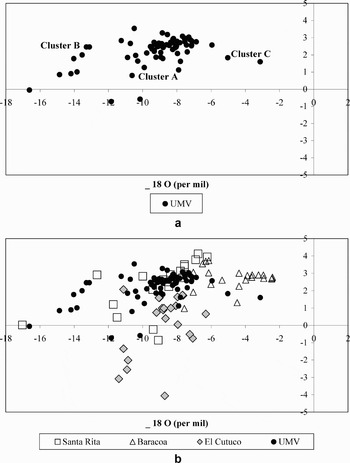
(a) Stable-isotope data for Ulua marble vases; (b) stable-isotope data for Ulua marble vases and sources.

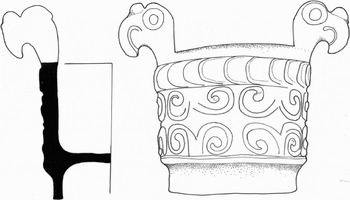
Ulua marble vase with bird handles (Group 1). Height: 7.2 cm; diameter: 7.30 cm. Chrysler Museum of Art, Norfolk, VA. Drawing by Christina Luke.

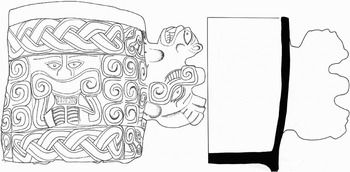
Ulua marble vase with composite feline-serpent handles (Group 4). Height: 15.4+ cm; diameter: 16 cm. Museo Etnografico Castello D' Albertis, Genoa, Italy. Drawing by Christina Luke.

Among the earliest Late Classic Ulua marble vases are those without handles that include vertical and/or horizontal mat motifs that alternate with sculptured scroll motifs around the body of the vase (Group 5), following contemporary conventions for early Ulua polychromes (Luke Reference Luke2005; Rosemary A. Joyce, personal communication 2001). These marble vases are most often tall cylinders with ring bases, although a number lack base treatment.
Marble vases with bird handles are the next in the sequence (Group 1; Figures 3–5), as shown by their archaeological association with and stylistic links to Red Class Ulua Polychromes, particularly Lug Head: Paloma (Luke Reference Luke2002:149–152; see Joyce Reference Joyce and Graham1993b, Reference Joyce2004). The body of the bird may be incised on and/or protrude from the body of the vessel. Scale borders frame the main program. Scrolls arranged in a grid-like pattern are carved on the body of the vase and often constitute the building blocks for profile zoomorphic heads, usually facing each other in a single row. These zoomorphs consist of a series of scrolls that form the ear, lower jaw, lips, and/or a “breath” or “mist.”
There are stylistic variations within this “bird” group. The earliest stratigraphically documented vase from Lagartijo (Joyce, personal communication 2001) has a ring support (Figure 4), a local Uluan Early Classic ceramic tradition. Excavated by Gordon in the late nineteenth century, its context has been revisited by Joyce. According to her research, the associated Ulua polychromes indicate that the vase dates to the period between a.d. 600 and 650. This marble vase depicts the initial stages of the style. It has relatively simple sculptural qualities. Only an upper border frames the central program, and the handles and scrolls lack sophistication and depth.
The majority of the other vases with bird handles have tripod supports, most likely an influence from Teotihuacan, as argued for contemporary Ulua polychromes with slab feet (Joyce Reference Joyce2004). Scale borders frame a series of scrolls and zoomorphic profile heads. A subgroup of the bird-handle vases includes vases with ring supports, which most likely represent period revivals, produced at some point later in time (Figure 5). In this group, the handles show greater depth, and the central program is much more developed, including a frontal zoomorphic head characteristic of later phases. The windows (triangles or stepped-terrace motifs) cut into the ring bases are also stylistically late.
Those vases with bat and monkey handles make up the next in the sequence (Group 2) (Figure 6)—following the development of Ulua polychromes (Lug Head: Bombero; see Joyce Reference Joyce, Henderson and Beaudry-Corbett1993a; Viel Reference Viel1978). The iconographic program remains the same, with profile images created from a series of volutes and framed by scale borders. Both tripod and ring supports are common in this group, yet the shift from tripod supports to ring supports most likely signals a decline of Teotihuacan influence, resulting in a preference for a local Ulua tradition favoring ring supports. These supports have cut-out step frets or triangle windows and additional motifs, such as scales or ropes, along the base.
Vases with feline handles mark a break in the stylistic repertoire (Groups 3 and 4; Figures 7–8, 11)—most notably, a shift in border types and greater depth in the execution of the handles. No longer is the handle reserved primarily for the creature's head. The body may be sculptured in high relief, as well. Voussures (repeating half-moon motifs, after Viel Reference Viel1978) and interlocking key motifs replace scales for the upper and lower borders, which continue to frame the central program. Scrolls are rendered with greater definition and depth. In many examples, the execution of the scroll shows mastery of skill and layout. Multiple profile zoomorphic heads are represented as mirror images of each other (Figure 7). Other vases show a frontal zoomorphic head with flanking profile zoomorphs (Figure 8). Ring bases with their hallmark step-fret or triangle cut-out windows are more common than tripod supports.
Vases with a zoomorphic head superimposed over the body of the feline handle are the final group discussed here (Group 4). The feline body is fully represented on the handle, as in the preceding group, usually with a bound tail, yet now a profile of a zoomorph head covers the lower portion of the feline body (Figure 11). A frontal zoomorph head is commonly depicted in the main program, again flanked by scrolls, and the entire program is framed by voussure, interlocking key and/or mat borders. The most common support is the ring base with step-fret windows.
DISTRIBUTION OF STYLES IN MESOAMERICA
As discussed earlier, among the most salient points regarding the distribution of Ulua marble vases is their wide geographic area. Vases are found to the south of the Ulua Valley in the broad region of Guanacaste and, in equal numbers, to the north in the central Maya Lowlands (Luke Reference Luke2002; Luke and Tykot Reference Luke, Tykot, Herrmann, Herz and Newman2002). While other artifact classes illustrate the exchange of ideas across this broad landscape—most notably, jade and ceramic traditions (see Joyce Reference Joyce and Graham1993b, Reference Joyce, Langeback and Cardenas-Arroyo1996)—Ulua marble vases demonstrate the physical transfer of artifacts.
The known distribution pattern of vases in the valley shows that only the center of Travesia and those sites affiliated with it appear to have had access to Ulua-style marble vases. Thus, communication with sites in the immediate area focused on a small network of sites, with Travesia acting as their center node, perhaps reflective of shared social and ritual occasions among these communities. Furthermore, all stylistic groups are represented in the known corpus from the valley itself, pointing to a long period of community-based identification and a deliberate shift in style over time by a small group of artisans and their patrons. In the central valley, approximately 30% of the known corpus is from the Travesia area, including the sites of Travesia, Santa Ana, and La Mora. Additional vases are from smaller hamlets, presumably part of the greater Travesian network. These include the elaborate assemblage from Peor es Nada (Stone Reference Stone1938:39, 55–56, Reference Stone1972:141) with two marble vases, several polychromes, and a number of exquisitely carved jades. The corpus from Santa Ana is similar, with two marble vases, a delicately carved jade hand, and an imported gold figure (Luke Reference Luke2002, Reference Luke2005).
To the west of the valley, the vases from El Abra in La Entrada (Nakamura Reference Nakamura1987) and Palos Blancos in the Palmarejo Valley, a smaller valley within the greater Naco region (Davis-Salazar and Wells Reference Davis-Salazar and Wells2007; Rivera Reference Rivera2005), which are both local centers, span a long time period. The Palos Blancos vase with bat handles, scale borders, and profile zoomorphs in the main program is stylistically earlier than the vase from El Abra with feline handles, voussure borders, and frontal and profile zoomorphs in the main program. Vases that lack site-specific contexts from this area include one fragment from Stone's work along the Chamelecon River (Luke Reference Luke2002:118), as well as two vases attributed to the Motagua Valley (Gary Walters, personal communication 2003; archives from the Popol Vuh Museum, Guatemala City). Like the vase from Palos Blancos, the Chamelecon fragment is stylistically early, with the telltale scale border. The vases attributed to the Motagua stylistically date to the middle of the production period, with subtle variation in their programs (see later). The wide range of vase styles to the west indicates a long period of interaction between these regions and the Ulua Valley, which is not surprising given other material markers typical of the Ulua Valley in the region.Footnote 1
To the east of the Ulua Valley, the vases reported from Salitron Veijo (Hirth and Hirth Reference Hirth, Hirth and Lange1993:178), Tenampua, Yarumela—all significant centers—as well as farther east in Olancho from the Rio España and Orica areas (Luke Reference Luke2002:121–122) span the entire stylistic range. The vases from Rio España and Tenampua (Luke Reference Luke2002:119–121) have voussure borders, elaborate volutes, and front-facing zoomorphic heads in the main program—stylistically late markers. The vase from Orica is earlier, with its tripod supports, scale borders, and bat handles (Luke Reference Luke2002:337). The range in stylistic variability documents ongoing regional alliances from the seventh century through the ninth century a.d.
When we look closely at the styles of vases found outside the neighboring regions, a different pattern emerges. Vase styles are period-sensitive, following established shifts in long-distance networks—specifically, an early focus on lower Central America and a later focus toward the central Maya Lowlands.
Lower Central America
To the south of the Ulua Valley, those vases from the prominent coastal hub of Nacascolo (Stone Reference Stone1977:59, Reference Stone1963:357), Vidor (Lange, personal communication 2000), Ortega (Ferrero Reference Ferrero1981:88), and, reportedly, Iguanita (Lange, personal communication 2002) are diagnostic of the earlier phases of production. Vases with bird handles and scale borders have tripod supports, and those with feline handles lack the depth and fine-line sculpturing found on the larger cylindrical vases, particularly those with frontal zoomorphic heads in the main program and ring supports—completely undocumented in Guacanaste. What is more, most of those known from the region have subtle stylistic variations, such as unique handle placement and/or peculiar ways of portraying imagery in the main program.
Central Maya Lowlands
To the north, those Ulua vases that have been excavated in the central Maya Lowlands from the sites of Uaxactun (Kidder Reference Kidder1947:36–37), Altun Ha (Pendergast Reference Pendergast1982:43, 114–115, Reference Pendergast1990:233, 236–238;), San Jose (Thompson Reference Thompson and Eric1939:167), and Chac Balam (Guderjan Reference Guderjan1995) are stylistically late. The fragment from Uaxactun, one fragment from Altun Ha with voussure borders, and a feline handle fragment from Chac Balam on Ambergris Caye all date stylistically to the later period of production; this later date is confirmed by the very Late or early Terminal Classic contexts for these vases (Luke Reference Luke2002:125–128).
Discussion
Similarities in aesthetic choices, particularly for polychromes and jades, between the Ulua Valley and lower Central America and the central Maya Lowlands point to a shift in social networks during the later phases of the Late Classic period (Hirth and Hirth Reference Hirth, Hirth and Lange1993; Joyce Reference Joyce1986, Reference Joyce, Langeback and Cardenas-Arroyo1996). Both marble-vase and polychrome distributions indicate an exchange network, circa a.d. 600/650–700/750, operating between the Ulua Valley and communities to the south (see Joyce Reference Joyce1986, Reference Joyce and Graham1993b). The marble vases from these regions are marked by motifs that are found in the initial period of production and less sophisticated carving, as well as other stylistic peculiarities. By the later phases of Ulua marble-vase production, circa a.d. 700/750–850, a northern Caribbean route linking the Ulua Valley to the central Maya Lowlands overshadows the southern route, following the changes and routes of other artifact classes and ideas (see Joyce Reference Joyce1986). Ulua-style marble vases found to the north are stylistically late. The long period of marble-vase production and the relatively standardized forms and iconography over time suggest that the artisans responsible for producing the vases were located in one location and adapted their stylistic choices to contemporary period canons, which is confirmed through chemical analyses.
STABLE-ISOTOPE RESULTS
A number of marble sources are found in Honduras, many now depleted, leaving only the parent limestone. With petrographic and stable-isotope analyses, we have been able to determine three potential sources for ancient procurement zones, yet there is overlap among these sources (Luke et al. Reference Luke, Tykot and Scott2006). The tight cluster of the chemical signatures of the vases is the strongest evidence for limited sources (Luke et al. Reference Luke, Tykot and Scott2006:25). To date, we have stable-isotope data for 69 marble vases in the Late Classic Ulua style. The sampled vases include examples from all stylistic groups and most geographic regions. This broad sample allows us to test whether differences in style and circulation patterns are apparent in the procurement of marble; that is, did sources shift as styles and/or communication routes changed?
Stable-isotope analyses indicate that vases do have similar isotopic ratios (Figure 9a). The majority of vases sampled (58, or 84% of the sample size) form a tight group, referred to as Cluster A. Cluster B includes eight vases (12% of the sample size). Finally, three fragments (4% of the sample size) fall outside these two cluster groups into Cluster C (Luke et al. Reference Luke, Tykot and Scott2006).
The concentration of 58 vases in Cluster A suggests that a single marble source was used to produce this corpus of Ulua-style marble vases: an ancient quarry. The two other clusters may indicate a secondary procurement location and/or an expanded procurement zone in the main source, probably the Santa Rita quarry (Luke et al. Reference Luke, Tykot and Scott2006). Overlap of the chemical results of the majority of the vases sampled with a single procurement zone indicates that artisans most likely procured marble primarily from one known source (Luke et al. Reference Luke, Tykot and Scott2006). With a firm understanding of the various styles and the significance of their distribution over time (discussed earlier), we now turn to an analysis of their chemical signatures.
Cluster A includes vases from all major stylistic groups with provenience from multiple sites, including vases excavated from the Ulua Valley, lower Central America, and Chac Balam on Ambergris Caye. Of note is the vase in Figure 10. Attributed to Costa Rica, this vase is stylistically very odd: it is the only vase documented with handles that protrude from the rim itself rather than from the side of the vase. Furthermore, while two rows of scrolls wrap around the exterior, the scrolls do not form zoomorphs. This is not the only stylistically odd vase in this main cluster. Chemical results from a vase in the shape of a jar (the only known example) with spider handles (see Luke Reference Luke2002:341), which is attributed to the Ulua Valley (archives, Middle American Research Institute H.17.1–38.57), fall firmly in this main group. Finally, worthy of mention here is the earliest documented vase (Figure 4, discussed earlier). Its chemical signature falls securely within the main cluster. The range of styles represented in the other vases within this main cluster span the entire chronological period, including vases in Figures 7–8. The implication is that the same marble source was used throughout the entire period of production. It provides strong evidence for local vase production, with subsequent gift giving to foreign and neighboring communities, rather than the production of Ulua-style marble vases in other regions using foreign stone, particularly given that those regions to the north and south had local stone-vase traditions of their own, using local stone.
Stylistic and distributional data from those vases with chemical results in Clusters B and C indicate that over time procurement choices may have expanded to accommodate workshop demands. Cluster C includes two fragments from Altun Ha. One of the Altun Ha fragments includes a voussure border, which points to a late, rather than early, date. It is tempting to suggest a shift in procurement zones, particularly a preference for the northern Baracoa source, during the period in which relationships strengthened with the central lowlands; yet the vase from Chac Balam (discussed earlier), also stylistically late with its feline handle, is clearly from the main source, and without the corresponding data for the Uaxactun or San Jose fragments, we cannot determine the significance of the Baracoa source or whether the later shift in exchange networks may have had a significant impact on marble procurement.
Here our analysis turns specifically to Cluster B. The eight vessels forming Cluster B include vases from all stylistic groups, yet about half have subtle aesthetic nuances, examined here in detail. In a recent article, we suggested that this Cluster B may represent either a secondary zone in the main procurement source (i.e., Cluster A) or a separate source, perhaps used to supplement the main source (Luke et al. Reference Luke, Tykot and Scott2006:24–25). On further analysis, we suggest here that Cluster B most likely represents an additional procurement area within the procurement zone represented by Cluster A.
Vases with bird handles are part of Cluster B. One vase (Figure 3) represents the quintessential tripod, bird-handle vase with profile zoomorphs in the main program and scale borders. The other bird-handle vase (Figure 5), however, belongs to the subgroup of period-revival vases with front-facing zoomorph heads in the main program (discussed earlier); only three vases are documented in this style (Luke Reference Luke2002:72, 74, 92), and unfortunately, we were given permission to sample only one vase in this style for chemical study (Figure 5). What is interesting about this specific vase are the triangle cut-outs, rare on most vases, as well as the vertical-profile zoomorphic heads flanking the frontal zoomorph head rather than the characteristic horizontal zoomorphic profile heads. Furthermore, this vase is one of the few vessels with stucco remains (see Luke Reference Luke and Lazzarini2003b). Thus, the data from these two bird-handled vases from Cluster B span the initial period of production through the later phases, indicating that the source was used over a long period.
Vases with bat handles are also represented in Cluster B. One vase (Figure 6) is typical of this stylistic group. The bat handles frame the main program of a single row of profile zoomorphic heads between two scale borders and a ring base with cut-out step frets. Chemical results from one vase from Orica (a considerable distance east of the Ulua Valley) fall within Cluster B, as well, but unlike the previous vase, this vase is stylistically odd: tripod supports on a vase that is taller than it is wide are not the norm (see Luke Reference Luke2002:337). In addition, the central program is more grid-like (less fluid) than other vase programs, and the profile figures are vertical rather than horizontal. The matching isotope values with the other Ulua-style marble vases, as well as Ulua sources, point to marble procurement in the Ulua Valley rather than from local sources, which is particularly interesting given that marble sources near Orica are abundant, and Formative-period marble and other stone-vase traditions are known from the region (Luke Reference Luke2002; Luke and Tykot Reference Luke, Tykot, Herrmann, Herz and Newman2002; Luke et al. Reference Luke, Joyce, Henderson, Tykot and Lazzarini2003).
Vases from Cluster B with feline handles are also unusual. On one vase (Luke Reference Luke2002:361), the handle forms are characteristic of this group (felines with up-turned and bound tails), yet the central program does not fit well within the typology. The zoomorphic heads are missing, and the scrolls form S shapes rather than single scrolls that either form the zoomorphic head or surround it. Furthermore, the scale borders on this vase are not typically associated with feline handles. On the other feline-handle vase from Cluster B (Figure 11), the composite handles follow stylistic convention, yet the front arms/paws on the frontal zoomorphic head are unique. Most frontal heads lack arms, which are present on this vase, and have a forehead cleft, which is missing on this specific vase (Luke Reference Luke2005, in press b). Furthermore, the mat motif used for the upper and lower borders is larger than the typical Ulua marble-vase border. Finally, in mere size, this vase is larger than most.
DISCUSSION
The results presented here indicate that, stylistically, Ulua-style marble vases form a cohesive corpus, suggesting a focused workshop area. The chemical data from the vases confirm that there is most likely one major source for them. How, then, do we make sense of Clusters B and C, which fall outside the tight main cluster (Cluster A)? The variation in vases from Cluster B suggests a secondary source and/or workshop. As Dorie Reents-Budet suggests for Maya polychromes, the height of production should correspond to the most variation in styles and the expansion of workshops to meet demand. In our original analysis, we suggested that a similar scenario could explain what we see in Cluster B (Luke Reference Luke2002; Luke et al. Reference Luke, Tykot and Scott2006:25)—an additional source used to supplement the primary source, perhaps even a different workshop, during an up-tick in production. While certainly a viable analysis, the detailed look at the vases in Cluster B suggests that this source was most likely used over the entire period of production, not just during the height of production, and hence weakens the argument for procurement expansion during a period of intensification. One would not expect the full range of styles to be produced from a source used to supplement production during high demand periods; rather, we should see stylistic variation. While we certainly do see stylistic variation in this group, we see also stylistic variation in Cluster A. Furthermore, Ulua-type vases from all periods are found in Cluster B, including styles that do not show variation, arguing for procurement over a long period, not just during a flurry of production.
The long-standing tradition of carving vases from marble in the valley set the stage for the expansion of the Late Classic tradition (Luke et al. Reference Luke, Joyce, Henderson, Tykot and Lazzarini2003). The Formative and Early Classic traditions draw on a variety of different sources of white stone, including sources other than marble. Over time, local knowledge of the most preferred stone sources would have passed through artisan communities, particularly knowledge of the best marble. Artisans and their patrons seeking to expand on a regional tradition used the highest-quality sources. Furthermore, it cannot be coincidence that these sources were that ones that have been, and continue to be, most preferred by the large marble companies (1930 to present). This analysis also explains why artisans located at Travesia would have relied on sources some distance away rather than closer sources.
Knowledge of local resources may have been shared, particularly among communities that were not necessarily vying for political control, the case in the Ulua Valley. Under this model, knowledge of clay and temper sources, as well as links to networks for securing other resources, would have been transmitted among communities, particularly during the Late Classic period. Recall that centers and hamlets appear to have shared similar approaches to iconography (Joyce Reference Joyce1991:132–134) and settlement layout (Joyce Reference Joyce1991:117; Joyce et al. Reference Joyce, Hendon, Lopiparo, Bowser and Zedeño2008; Lopiparo Reference Lopiparo2003). Thus, it seems reasonable to suggest that knowledge of local resources, including marble, would have been shared.
Archaeological data indicate that the various centers located in the valley had their own, distinctive communication networks. Specific networks linking sites in the valley to neighboring regions and/or more distant areas suggest that no one center had control over internal or external relationships, which suggests very fluid and open systems of communication. We can thus imagine merchants and other officials coming and going relatively freely; artisans or those responsible for procuring specific types of resources would have been allowed to do so unrestricted.
The centrality of Travesia in the valley does, however, suggest that it may have held sway over certain types of social networks, resources, and production of specific types of material culture. Certainly, its location in the heart of the most densely populated part of the valley, on the banks of the largest river in the area, points to this specific site as a natural node. As Lopiparo (Reference Lopiparo2003) suggests, the centrality of Travesia indicates its status as a sacred hub. Travesian artisans capitalized on earlier stone-vase traditions, specifically marble-vase production, for a variety of different reasons, most likely linked to the symbolism of white stone. In producing an artifact from a known material, yet now embedding highly charged imagery in the stone, Travesia visually identified itself from other centers in the valley (Luke Reference Luke2005, n.d.). Marble procurement from the best source(s) enabled artisans to produce high-quality vases. The long-standing traditions of carving white stone vases suggest that artisans at Travesia expanded on known practices of carving white stone, working out the fine details of iconographic programs over time. A relatively small, part-time workshop would have relied on a master carver and a few apprentices. A large, full-time workshop does not appear to be viable, given that over a 200-year period, relatively few vases were produced. Recall that approximately 170 vases (fragments and whole vases) are known in museum and excavation collections. Thus, we can imagine only a limited number of vases produced each generation.
The procurement of marble most likely focused on one primary area in the main quarry. New artisans or others responsible for quarrying the stone—presumably relatively small, easily portable blocks—may have focused on a secondary area within the main quarry. The subtle stylistic variations in those vases from Clusters B and A suggest a number of different interpretations. Perhaps the vases with stylistic oddities were “mistakes.” Those vases missing key parts of the imagery may have been given as gifts to counterparts some distance away, presuming those counterparts would not fully understand what was “missing.” Alternatively, vases may have been produced with specific patrons or areas in mind (e.g., the argument for Plumbate styles and circulation; O'Shepard Reference O'Shepard1948:144–146), perhaps functioning as gifts to strategic allies. The role of the royal gift is to solidify relations with prominent members in neighboring and distant regions. The adoption of only certain parts of Ulua polychrome imagery on locally produced Guanacaste Galo polychromes (Lange Reference Lange and Lange1992:121–122) indicates specific and deliberate preferences (Joyce Reference Joyce and Graham1993b:90; Lange Reference Lange and Lange1992:121–122). Thus, it seems likely that artisans at Travesia may have produced vases with a foreign clientele in mind.
Anticipating the power of a gift to a foreign counterpart, a patron may have commissioned a marble vase for a specific person or site, perhaps following distance canons. The result would have been Ulua marble vases produced in styles more suited to the areas of destination rather than the styles preferred at home. Most likely, we are seeing the archaeological and stylistic evidence of a developing tradition of elaborate marble vases. When production of marble vases began, ties to the south were stronger; thus, vases may have been produced to please clients in Olancho and farther south in Guanacaste. The increasingly sophisticated carving style corresponds to a shift in exchange networks, favoring connections to the north (with the central and northern Maya Lowlands), and changes in the iconography indicate greater influence from this sphere during the later periods of production (Luke, n.d.). The development of the craft, then, corresponds to changing social relationships.
This process of involvement with foreign regions argues for Travesia as an established center interacting closely with distant communities, similar to other centers in the valley, particularly Curruste's relationship with sites in Belize (Sheptak Reference Sheptak and Robinson1987). The development and enhancement of the Ulua marble style argues for Travesia focusing closely on production of a specific type of material culture that would clearly set it apart from other centers. While site identity may have been marked through specific polychrome styles, a general suite of images appears to have been shared, at least until the close of the Late Classic period (Sheptak Reference Sheptak and Robinson1987:298). By the end of the Late Classic, Travesia's focus shifted to the northern sphere, as shown by those marble vases found at Uaxactun, San Jose, and Altun Ha. The high-quality craftsmanship and strict framework on marble vases argues for increasing oversight and decisions regarding the patronage of these vases.
Based on the evidence, marble-vase production took place at one location over a period of approximately 200 years: Travesia. The stylistic and chemical data alone would point to a restricted, centralized workshop that controlled the procurement of marble, the imagery carved on the exterior of the vase, and the circulation of the vases, typical criteria of a palace workshop of a very wealthy and powerful site. When considered in the context of the dynamic Late Classic Uluan landscape, though, there is no evidence that Travesia held valley-wide economic or political power. Rather, the production of the vases began during the period of population expansion in the valley, with Travesia acting as a centering node. The continued, yet limited, production of vases over time at the site, with variations made to suit current aesthetic choices, indicates that the vases functioned as identity markers of this cosmic center, the associated iconography and white marble linking the vases to the sacred natural and created landscapes (Luke, n.d.). Given that other sites in the valley did have strong contacts with one another, as well as with communities in distant locations, it is difficult to argue that Travesia held political control over the region. Yet Travesia, unlike other centers, does appear to have had more extensive networks with foreign counterparts. The localized circulation in the valley suggests a closed network that may slowly have gained prominence abroad and in turn contributed to at least an increasingly powerful social position in the valley. Thus, the role of Travesia as a social and ritual hub, what Lopiparo (Reference Lopiparo2003:264) argues is a “privileged place at the center of coordinate networks,” appears to be confirmed through this analysis of marble vases. The long period of marble-vase production provides one example of a material correlate of this cosmological place. Whether distant communities understood the local significance of Travesia or local and neighboring communities encouraged the celebrated status of Travesia abroad, Ulua marble vases made it possible for the site to be “seen” in distant regions.
CONCLUSION
This study confirms that combining stylistic, distributional, and chemical data for a specific artifact type can help us understand the social and political networks of a region as well as the organization of production. In this case, we have evidence for a luxury good used by one community to affirm social prominence in a valley. At this point, all data suggest that Travesia was not a region-wide political center. The centralized production of a clear luxury good, then, indicates patronage by a social group that sought to affirm the identity of a sacred center by producing a portable luxury good that drew from long-standing traditions of material transformed through iconography. The extensive ties of Travesia abroad, marked through the circulation of marble vases, confirm its social prominence in the valley. Over the period of production, standardized and deliberate shifts in Ulua marble-vase programs demonstrate increasing skill and attention to specific types of imagery by the artisan. During these shifts in styles, the procurement zones remained stable, corroborating the stylistic data with the chemical data and affirming centralized production from the initial to final periods of production.
Resumen
Las vasijas de mármol del estilo Ulua representan uno de los bienes de lujo más destacados de la Mesoamérica antigua. Producidas durante el período clásico tardío (ca. 600/650–800/850 d.C.), estas vasijas funcionaban como objetos de valor con alto significado social en el valle inferior del río Ulua de Honduras, tanto como en regiones aledañas como el valle del Chamelecon, La Entrada y Palmarejo al oeste, y Comayagua, El Cajón y Olancho al este. Los nexos de larga distancia para el intercambio y la adquisición de estas vasijas extendieron hacia el sur hasta Guanacaste, Costa Rica, en el extremo sureste de Mesoamérica y hacia el oeste a las tierras bajas mayas centrales. Los contextos conocidos de estas vasijas en el valle del Ulua y más allá confirman que la élite ponía alto valor social y político en ellas por medio de una circulación restringida y, presuntamente, el uso limitado.
Aquí presentamos un estudio de los canones estilísticos de las vasijas y la distribución de los estilos distintos. Por medio de una comparación de los patrones de distribución de estilos específicos de vasijas de mármol estilo Ulua con las cronologías conocidas de vasijas policromas estilo Ulua, podemos comenzar a entender el largo periodo de producción de las vasijas de mármol. Una comparación de estos datos con los resultados de análisis químico de un grupo seleccionado de vasijas indica la producción especializada en el sitio de Travesía, ubicado en el corazón del valle inferior del Ulua, en las riberas del río, la ruta de comunicación principal de la región.
La época de la producción de las vasijas corresponde a un período intensivo de crecimiento demográfico en el valle. La decisión tomada por la élite de Travesía de producir un bien de lujo portátil distinto en material e iconografía a otros bienes indica un intento a declarar su identidad cultural regional. La distribución restringida de las vasijas, tomando en cuenta especialmente su ausencia completa de otros centros del valle del Ulua, indica más aún que los artesanos y sus patrones imponían fronteras simbólicas por medio de la saturación de la cultura material con formas específicas de significado. Además, los nexos de larga distancia indican que estos objetos simbólicos de valor de Travesía fueron cotizados en el extranjero, aún en las cortes reales de los mayas.
Los datos estilísticos, químicos y de distributión de las vasijas de mármol estilo Ulua parecen apoyar una interpretatión de una corte real patrocinando un grupo de artesanos en Travesía. Sin embargo, considerando los patrones de asentamiento del valle, no parece que Travesía buscaba el control político de la región. Mas bien, parece que este sitio celebraba su centralidad por medio de una variedad de distintas expresiones, incluyendo la producción de vasijas finas de mármol. El prestigio que fue otorgado a estas vasijas de lujo, entonces, resulta de historias locales de nexos sociales y políticos que vinculaban distintas comunidades en vez de dividirlas. Estos resultados indican que los estudios de la cultura material en la arqueología deben considerar las relaciones entre distintos nexos sociales locales y la organización de la producción de artesanías como fuerzas de integración y no como procesos de división.
ACKNOWLEDGMENTS
This study could not have been completed without support, guidance, and friendship of many institutions and colleagues. The Honduran Institute of Archaeology and Anthropology has supported the project over the years, providing access to sources and collections. Marlyin Beaudry-Corbett, Carrie Dennett, John S. Henderson, Rosemary A. Joyce, and two anonymous reviewers provided critical feedback on the research presented here. The research has been funded by the Geological Society of America; the National Science Foundation; the Foundation for the Advancement of Mesoamerican Studies, Inc.; Sigma Xi; and various internal grants from Cornell University.
We thank also the many museums that allowed access to their collections to study the stylistic characteristics of each vase and, in many cases, to take samples for chemical analyses. The curators, conservators and research staff who gave their time to locate vases as well as corresponding paperwork were instrumental. First we extend special thanks to Anne-Louise Schaffer, former curator at the Museum of Fine Arts, Houston, TX, and Dr. E. Wyllys Andrews, director of the Middle American Research Institute, Tulane University, New Orleans, LA. They offered great support at the initial stages of the research. From this initial work we were then able to gain support from museums in the United States, Canada, Costa Rica, England, France, Honduras, Italy, Germany, and Guatemala: American Museum of Natural History, New York, NY; Baltimore Museum of Art, Baltimore, MD; British Museum, London, England; Chrysler Museum of Art, Norfolk, VA; Cleveland Museum of Art, Cleveland, OH; Cornell University, Ithaca, NY; Dallas Museum of Art, Dallas, TX; Denver Art Museum, Denver, CO; Denver Museum of Natural History, Denver, CO; Dumbarton Oaks, Washington, D.C.; Instituto Hondureño de Antropologia e Historia, Tegucigalpa, Honduras; Lowe Art Museum, University of Miami, FL; Michael Carlos Museum, Emory University, Atlanta, GA; Museum of Ethnology, Genoa, Italy; Museum of Mankind, Paris, France; Museum of Metropolitan Art, New York, NY; Museum of Fine Arts, Houston, TX; Museum für Völkerkunde, Berlin, Germany; Mint Museum, Charlotte, NC; Museo de Antropologia e Historia, San Pedro Sula, Honduras; Museo Nacional de Costa Rica, San Jose, Costa Rica; Museo Popol Vuh, Universidad Francisco Maroquin, Guatemala City, Guatemala; National Museum of the American Indian, Smithsonian Institution, Washington, D.C.; New Orleans Museum of Art, New Orleans, LA; Peabody Museum of Archaeology and Ethnology, Harvard University, Cambridge, MA; Princeton University Art Museum, Princeton University, Princeton, NJ; Royal Ontario Museum, Toronto, Canada; Sainsbury Centre for Visual Arts, University of East Anglia, Norwich, England; Smithsonian, Washington D.C; The Saint Louis Art Museum, St. Louis, MO; University Museum of Manchester, England; University of Pennsylvania Museum of Archaeology and Anthropology, Philadelphia, PA.