INTRODUCTION
A fundamental issue in marine ecology is explaining the patterns of a species' distribution and abundance, together with the processes that are associated with these patterns (Eriksson & Jakobsson, Reference Eriksson and Jakobsson1998; Magurran et al., Reference Magurran, Khachonpisitsak and Ahmad2011). For this, local studies on species spatial distribution are needed as a starting point for delineating a species' relationship with its surroundings biotic and abiotic factors, population boundaries and population ecology (Gage, Reference Gage2004).
The Mediterranean is considered to be a biodiversity hot-spot with a high level of endemism, as well as an assortment of temperate and subtropical elements (Coll et al., Reference Coll, Piroddi, Steenbeek, Kascher, Lasram, Aguzzi, Ballesteros, Bianchi, Corbera, Dailianis, Danovaro, Estrada, Froglia, Galil, Gasol, Gertwagen, Gil, Guilhaumon, Kesner-Reyes, Miltiadis-Spyridon, Koukouras, Lampadariou, Laxamana, López-Fé de la Cuadra, Lotze, Martin, Mouillot, Oro, Raicevich, Rius-Barile, Saiz-Salinas, San Vicente, Somot, Templado, Turon, Vafidis, Villanueva and Voultsiadou2010). This is mainly related to its narrow connection to the Atlantic Ocean, its west–east orientation and is geological history (Boudouresque, Reference Boudouresque2004). Thus, the current biological diversity of the Mediterranean is due to the interactions between ecological factors, as well as the historical processes that shaped the Mediterranean Basin throughout the course of history (Templado, Reference Templado, Goffredo and Dubinsky2014). Within the generally high diversity found in the Mediterranean Sea, some studies suggest that the Alborán Sea, the westernmost basin of the Mediterranean Sea, is a regional hot-spot of biodiversity (e.g. the Alborán Sea) because of the coexistence of species from three marine biogeographic provinces (Mediterranean, Lusitanian and Mauritanian regions) and because of the endemic species restricted to this zone (Coll et al., Reference Coll, Piroddi, Steenbeek, Kascher, Lasram, Aguzzi, Ballesteros, Bianchi, Corbera, Dailianis, Danovaro, Estrada, Froglia, Galil, Gasol, Gertwagen, Gil, Guilhaumon, Kesner-Reyes, Miltiadis-Spyridon, Koukouras, Lampadariou, Laxamana, López-Fé de la Cuadra, Lotze, Martin, Mouillot, Oro, Raicevich, Rius-Barile, Saiz-Salinas, San Vicente, Somot, Templado, Turon, Vafidis, Villanueva and Voultsiadou2010; Aguilar et al., Reference Aguilar, Akissou, Templado, Romani and Briand2011).
Oculina patagonica (De Angelis D'Ossat 1908) is a zooxanthellate scleractinian coral that can only be found in the Mediterranean Basin. In particular, it has been found in abundance in the Western Mediterranean Basin in Italy (Rodolfo-Metalpa et al., Reference Rodolfo-Metalpa, Richard, Allemand, Bianchi, Morri and Ferrier-Pagès2006), the Gulf of Lyon (Zibrowius, Reference Zibrowius1974) and the coasts of the Iberian Peninsula, mostly in the south-eastern and eastern coasts (Zibrowius, Reference Zibrowius1980; Zibrowius & Ramos, Reference Zibrowius and Ramos1983; Ramos, Reference Ramos-Esplà and Ramos1985; Fine et al., Reference Fine, Zibrowius and Loya2001; Serrano et al., Reference Serrano, Coma, Ribes, Weitzmann, García and Ballesteros2013; Rubio-Portillo et al., Reference Rubio-Portillo, Vázquez-Luis, Izquierdo Muñoz and Ramos Esplá2014). In the Eastern Mediterranean Basin, it has been cited in abundance on the coasts of Lebanon (Bitar & Zibrowius Reference Bitar and Zibrowius1997), Israel (Fine et al., Reference Fine, Zibrowius and Loya2001) and Greece (Salomidi et al., Reference Salomidi, Katsanevakis, Issaris, Tsiamis and Katsiaras2013). In less abundance, colonies have been found in Algeria, Tunisia (Sartoretto et al., Reference Sartoretto, Harmelin, Bachet, Bejaoui, Lebrun and Zibrowius2008) and Turkey (Çinar et al., Reference Çinar, Bilecenoglu, Öztürk and Can2006). Oculina patagonica has been cited as a species that is non-native to the Mediterranean Sea (Zibrowius, Reference Zibrowius1983). Transoceanic transport of planula of the species via the Strait of Gibraltar to the Western Mediterranean has been considered to be the most probable means of introduction (Zibrowius, Reference Zibrowius1974). Nevertheless, the origin of the species is still dubious. The unsolved situation exists in that the original description of O. patagonica is based on fossil materials from Holocene deposits on the temperate coast of South America. However, nowadays, no living specimens are to be found in Patagonia (Serrano et al., Reference Serrano, Coma, Ribes, Weitzmann, García and Ballesteros2013).
Oculina patagonica is commonly found on rocky foreshores and in caves with water depths of 0–10 m. It is present in artificial habitats, although, it can be found in natural habitats as well (Ramos-Esplà, Reference Ramos-Esplà and Ramos1985; García-Raso et al., Reference García-Raso, Luque, Templado, Salas, Hergueta, Moreno and Calvo1992; Fine et al., Reference Fine, Zibrowius and Loya2001). This coral has been recorded in natural substrate where the population densities were generally scarce (Fine et al., Reference Fine, Zibrowius and Loya2001; Sartoretto et al., Reference Sartoretto, Harmelin, Bachet, Bejaoui, Lebrun and Zibrowius2008; Coma et al., Reference Coma, Serrano, Linares, Ribes, Díaz and Ballesteros2011). However, recently, a rapid expansion of the coral's populations has been recorded, and the coral has been cited as the main component of a natural community (Sartoretto et al., Reference Sartoretto, Harmelin, Bachet, Bejaoui, Lebrun and Zibrowius2008; Coma et al., Reference Coma, Serrano, Linares, Ribes, Díaz and Ballesteros2011; Salomidi et al., Reference Salomidi, Katsanevakis, Issaris, Tsiamis and Katsiaras2013; Serrano et al., Reference Serrano, Coma, Ribes, Weitzmann, García and Ballesteros2013; Rubio-Portillo et al., Reference Rubio-Portillo, Vázquez-Luis, Izquierdo Muñoz and Ramos Esplá2014). Oculina patagonica has the ability to live and reproduce under varying and diversified environmental conditions, such as a wide range of water temperatures, salinity, UV radiation, turbidity and strong wave energy (Fine et al., Reference Fine, Zibrowius and Loya2001). Therefore, it has been considered as an ‘opportunistic dominant settler’ that overgrows the calcareous structures of serpulids, vermetids, barnacles, etc. It also competes with algae and other soft organisms at its growing edge (Sartoretto et al., Reference Sartoretto, Harmelin, Bachet, Bejaoui, Lebrun and Zibrowius2008). This coral has been cited as rapidly expanding along the Iberian coasts (Coma et al., Reference Coma, Serrano, Linares, Ribes, Díaz and Ballesteros2011). Therefore, local studies are of importance in order to establish the habitat preferences of the species, as well as its abundance and habitat acquisition characteristics.
Because of all these aspects, the main objective of our survey was to assess the distribution and abundance of O. patagonica in the Northern Alborán Sea (Andalusia Region, Southern Iberian Peninsula). This area, together with the coasts of Morocco (Northern African coasts, Southern Alborán Sea), comprises the southernmost region of the Mediterranean Sea in which the species lives.
MATERIALS AND METHODS
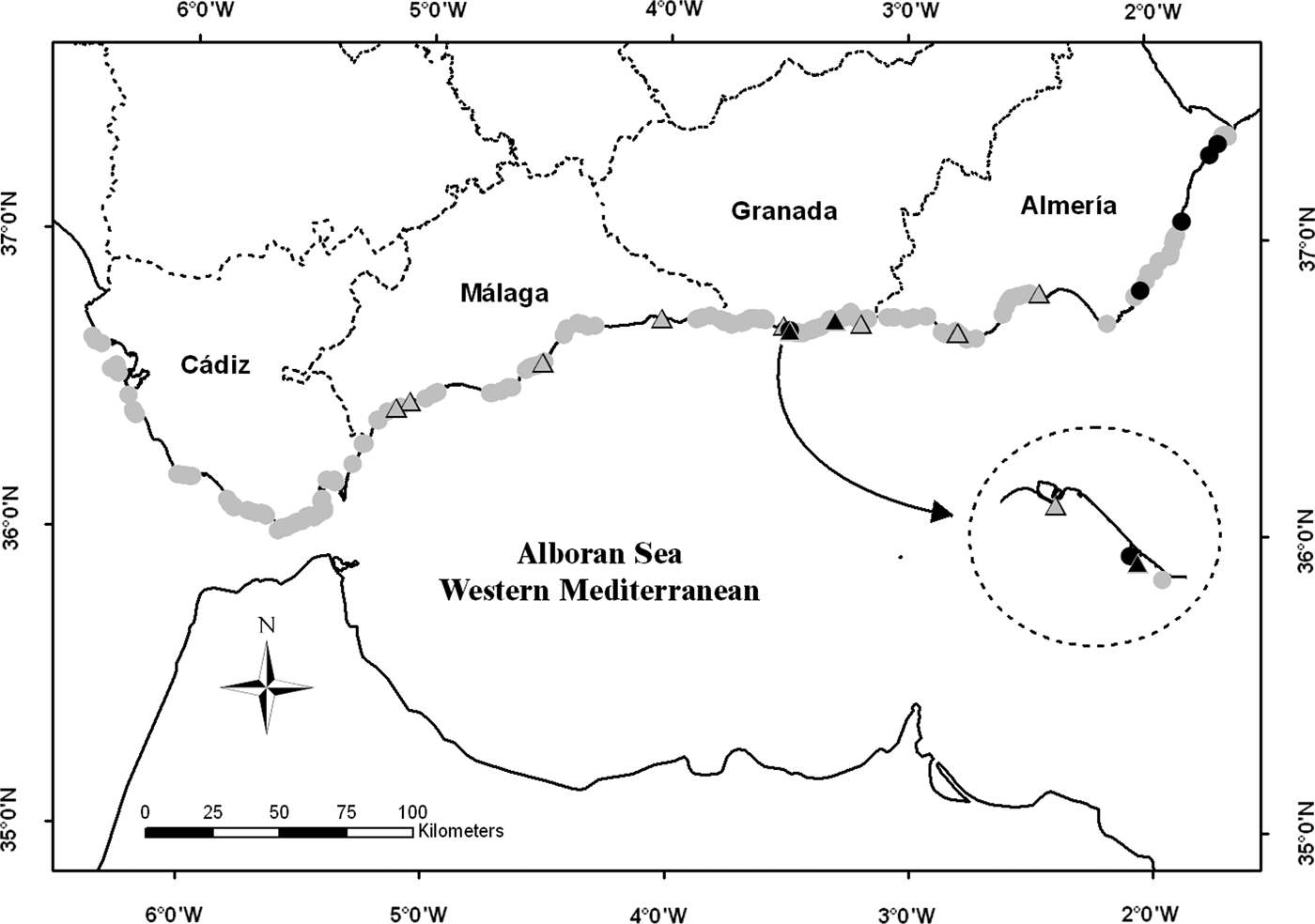
The survey was performed along the rocky shores of the Andalusia coasts (Southern Iberian Peninsula, Northern Alborán Sea). The sampling area covered a total of 693 km of coastline between the province of Cádiz (36°38.38′N 06°24.71′W) and the province of Almería (37°21.181′N 1°39.303′W). In order to estimate the abundance and distribution of Oculina patagonica (Figure 1), we sampled a total of 195 sites, spaced at a distance of 1 km from each other (Figure 2). Of these sites, ten were artificial substrate (breakwater) and 185 were natural habitats. We designed a systematic and stratified sampling technique, following Benedetti-Cecchi et al. (Reference Benedetti-Cecchi, Airoldi, Abbiati and Cinelli1996), by using 1 × 1 m2 quadrats, which were launched four times at three different depths: 0–3, 3–6 and 6–12 m. Therefore, we considered a total of 585 sampling stations. At each station, the presence and/or abundance of the species, the date, substrate composition and geographical location were recorded. When colonies of O. patagonica were present, we estimated their abundance by visual observations of the percentage of coral coverage in the grid of quadrats (25 × 25 cm2) in the sampling station; we also quantified the number of colonies found at each quadrat. Each time, two SCUBA divers independently performed the visual estimations in order to reduce the sampling bias.
Oculina patogonica on the Almería coastal line (natural habitat). Source: María del Mar Otero Villanueva (IUCN).

Cartography of Oculina patagonica presence along the shoreline that we studied. The grey circles show the sampling points for natural habitat; the grey triangles show the sampling points for artificial substratum; the black circles show the O. patagonica presence in natural habitats; and the black triangles show O. patagonica presence in artificial substratum.
RESULTS AND DISCUSSION
In this manuscript, we describe the first survey of the distribution and abundance of Oculina patagonica along the entire coast of the Northern Alborán Sea (Andalusia Region, Southern Iberian Peninsula), which corresponds to the southernmost region of the known distribution range of the coral. In this area, previous studies have focused on the local presence of the species and/or abundance (CMA, 2012; Serrano et al., Reference Serrano, Coma and Ribes2012), but these studies only focused on some localities of the Andalusia region. Concerning other regions along the known distribution range of the species in the Mediterranean, studies have been performed on the coasts of Catalonia and Valencia (north-east and east of the Iberian Peninsula, respectively) (Serrano et al., Reference Serrano, Coma, Ribes, Weitzmann, García and Ballesteros2013; Rubio-Portillo et al., Reference Rubio-Portillo, Vázquez-Luis, Izquierdo Muñoz and Ramos Esplá2014), as well as the Murcia coast (Algerian basin, south-east Iberian Peninsula) (Coma et al., Reference Coma, Serrano, Linares, Ribes, Díaz and Ballesteros2011).
From the 693 km of the Andalusian coastline surveyed, O. patagonica was only present in 7 out of 195 sampling sites (Figure 2). These sites were located in the provinces of Granada and Almería, in the easternmost regions along the Andalusian coasts and at the depth range of 0–3 m. Therefore, it is possible to conclude that O. patagonica is restricted to the eastern shores of the Alborán Sea.
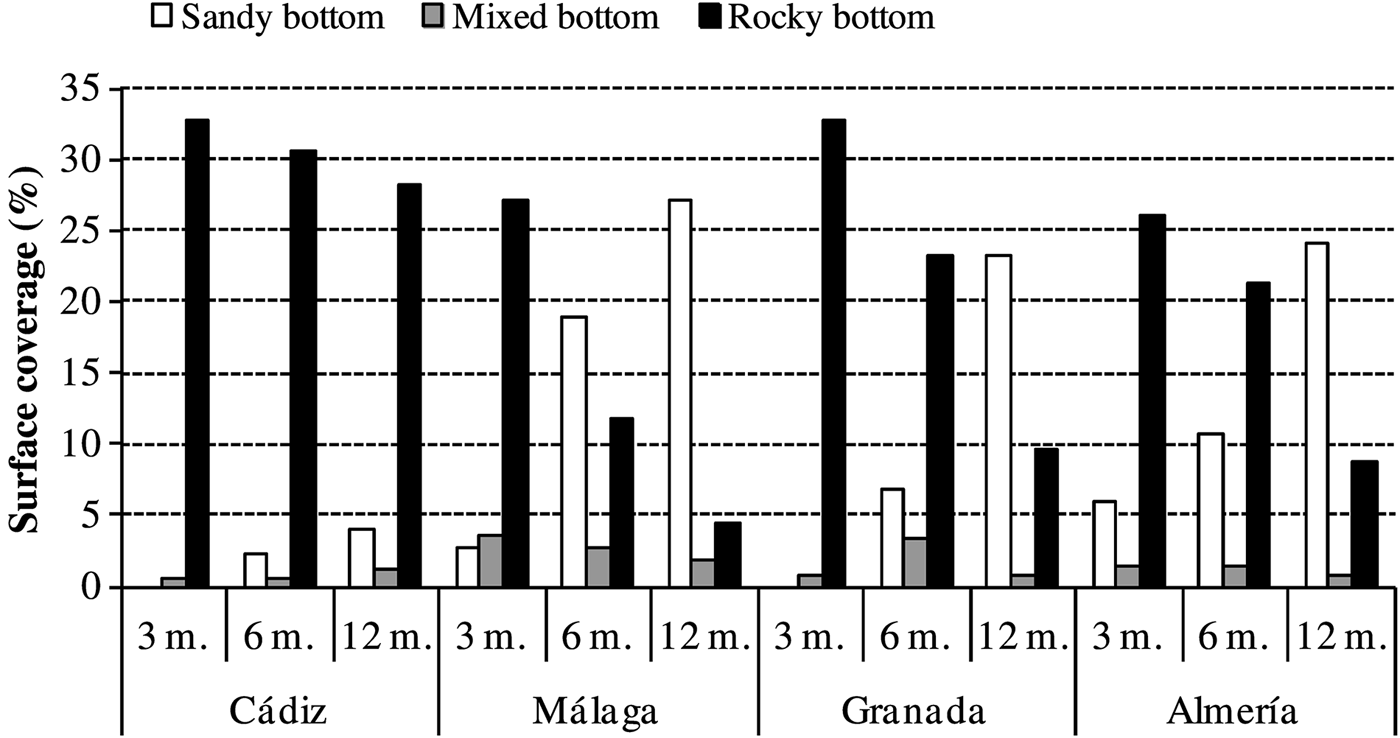
The distribution patterns of O. patagonica on the northern coasts of the Alborán Sea seem to depend mainly on hard substrate availability, as well as the sea surface temperature, which might play a secondary role in the distribution patterns of the species. In the stations in which the coral was found as present, the annual mean sea water temperature was in the range of 18–21°C. Considering the availability of hard substrate, it should be noted that the distribution of rocky shores along the sampling area is not uniform. Given the need of the planulae of O. patagonica for a hard substrate in which it can settle down, the discontinuity found in rocky substrates is an important factor to take into consideration for the distribution patterns of the species. Even though rocky shore bottoms were the most predominant substrata in all provinces, we observed the presence of sandy bottom and mixed bottoms (66.7, 29.1 and 4.2% across the whole sampling region, respectively, as shown in Figure 3). The area of Cádiz (westernmost side of the study area) showed the greatest coverage of rocky bottoms, followed by Granada, Almería (easternmost sides of the study area) and, in a lesser extent, Málaga. Therefore, there is a continuum on the eastern side of the Andalusia coasts (Almeria and Granada areas) that might facilitate the settlement of planulae in hard substrates. Mixed and sandy bottoms predominate the central area of Malaga, separating this region from the rocky shores on the western shores of the sampling area (Cadiz area). Rocky substrates were predominant at 3 m, in all provinces, followed by depths of 6 and 12 m (Figure 3).
Percentage of bottom type per provinces and depth.
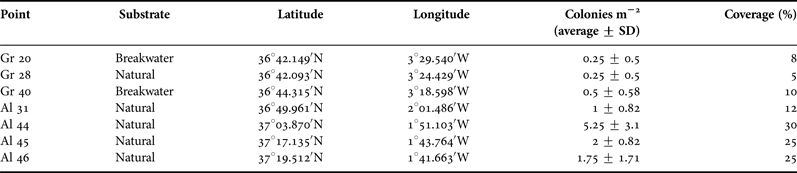
We found O. patagonica in two stations with artificial substrate (breakwater as a sandy shore defence), while the presence points corresponded with natural substrates (vertical and horizontal rocky shore). When the species was present, the colonies' abundance ranged between 5.25 ± 3.1 and 0.25 ± 0.5 colonies m−2, while the coverage surface ranged between 5 and 30%. Both measurements were higher in Almería than those quantified on the Granada coastal line (Table 1). Therefore, both localities seem to correspond to the limit of distribution of the species in the Northern Alborán Sea. A decrease in species abundance and its distribution limits is a common feature in marine invertebrates and other passive dispersal species (Holt, Reference Holt2003; Astanei et al., Reference Astanei, Gosling, Wilson and Powell2005; Casado-Amezua et al., Reference Casado-Amezua, Goffredo, Templado and Machordom2012). In contrast to other studies, most of the substrates for O. patagonica were found to correspond with natural rocky surfaces, whilst there were only two localities with artificial substrates in which the species was found (breakwater as a sandy shore barrier). Oculina patagonica has the characteristics of an opportunistic species (Serrano et al., Reference Serrano, Coma, Ribes, Weitzmann, García and Ballesteros2013), inhabiting many natural sites and harbours along hundreds of kilometres of coastline in south-east Spain. However, it has been observed that a high capacity of this species settles on artificial harbours and polluted areas (Zibrowius, Reference Zibrowius1992). Therefore, artificial substrata might be another factor that supports dispersal (Serrano et al., Reference Serrano, Coma, Ribes, Weitzmann, García and Ballesteros2013). This has already been observed by Rubio-Portillo et al. (Reference Rubio-Portillo, Vázquez-Luis, Izquierdo Muñoz and Ramos Esplá2014); these authors asserted that a harbour could be a focal point of dispersion in the Valencia Region. Local studies on the Andalusian coasts showed that the species may colonize artificial reefs (CMA, 2012). We also found the presence of this species on artificial reefs, although, the species was in a lower abundance. This could be because the two stations that correspond to artificial reefs in which the species was found corresponded with the westernmost distribution range of the species, not only on the Andalusian coasts but also in the Mediterranean Sea.
Sampling sites where colonies of Oculina patagonica were found (Gr, Granada; Al, Almería), the substrate type, geographic location (ED 50; WGS84), number of colonies per square meter (including average and standard deviation (SD)) and coverage percentage.
Whilst high coverage and abundance of O. patagonica has been observed in artificial habitats, coverage of natural substrata is generally low (Fine et al., Reference Fine, Zibrowius and Loya2001; Sartoretto et al., Reference Sartoretto, Harmelin, Bachet, Bejaoui, Lebrun and Zibrowius2008; Coma et al., Reference Coma, Serrano, Linares, Ribes, Díaz and Ballesteros2011). However, recently, it has been reported in communities in which O. patagonica is the dominant species (Serrano et al., Reference Serrano, Coma and Ribes2012), as it has been observed in Torre Pirulico, south-east Spain (37°4′70″N 1°50′59″W). These communities may act as a focus for local dispersion. This local dispersion may have happened in Almería's littoral zone, where these populations were observed, and close to this area, where we have observed the highest abundance in natural substrates (point Al_194 – 37°03.870′N 1°51.103′W). Coma et al. (Reference Coma, Serrano, Linares, Ribes, Díaz and Ballesteros2011) revealed a local-scale pattern of an increase in the abundance of coral colonies as a consequence of the opportunistic capacity of the species to colonize different types of substrata. Furthermore, these authors asserted that sea urchins' abundance, as grazers of macroalgae and, thus, creators of empty habitats, can play an important role regarding the expansion of this opportunistic species.
Routine monitoring programs are required for people to gain better knowledge of the population dynamics of any species (Bramanti et al., Reference Bramanti, Vielmini, Rossi, Stefano and Santangelo2011; Calvo et al., Reference Calvo, Simó, Coma, Ribes, Pascual, Sabatés, Gili and Pelejero2011). In the case of O. patagonica, these programmes would be useful for detecting a possible widening of the species distribution at local or regional scales. Given the uncertain origin of the species, this is also helpful for disentangling ecological and taxonomical issues and, even more so, for a better understanding of the long-term effects that this opportunistic species has on the ecosystem. These studies must be accompanied by temperature serial analyses and control stations in MPAs or additional strategic localities. All of the data collected in this study, together with long serial data, can be evaluated and provides evidence for changes in coastal areas.
ACKNOWLEDGEMENTS
Our research was supported by the regional government of Andalucía. We thank the General Office of Marine Protected Area from Spanish Estate (National Ministry of Environment). The authors kindly acknowledge the Asociación Hombre y Territorio (http://www.hombreyterritorio.org), including A.J. Ibáñez Yuste and S. Iglesias, for their help during the fieldwork, as well as Rafael Gálvez César for the elaboration of the maps and María del Mar Otero Villanueva (IUCN) for the picture of the species. P. Casado-Amezúa was granted a scholarship from the German Academic Exchange program (DAAD).