Introduction
True flies (Diptera) display a broad range of mating systems, including the congregation of many individuals in mating swarms (Wilkinson and Johns Reference Wilkinson and Johns2005). Swarming behaviour occurs in several families of flies and is thought to increase mate encounter rates and mate choice opportunities (Downes Reference Downes1969). Within mating swarms, sex ratios typically tend to be male-biased, offering female flies increased mating opportunities. Females typically join the swarm to mate and leave once mated, while males stay in the swarm (Downes Reference Downes1969). As a result, female flies’ mating success is influenced by both the aggregation’s density (as expressed by the number of individuals per unit volume) and the male-to-female proportions (Rhainds Reference Rhainds2010). In addition to the role it plays in mating dynamics, group density can also affect females’ postmating oviposition behaviour. In certain species, female crowding can increase the length of the preoviposition period (Ambrose et al. Reference Ambrose, Sahaya Rani and Vennison1988), and ovipositional substrates where conspecific eggs are present may deter females (Elsensohn et al. Reference Elsensohn, Aly, Schal and Burrack2021). However, these trends can be reversed in some species (Judd and Borden Reference Judd and Borden1992; Ulmer et al. Reference Ulmer, Gillott and Erlandson2003; Desurmont et al. Reference Desurmont, Weston and Agrawal2014).
The seedcorn maggot, Delia platura (Meigen) (Diptera: Anthomyiidae), is currently recognised as an agricultural pest with a near-cosmopolitan range and a high diversity of larval hosts, both living and dead (Griffiths Reference Griffiths1993). Being highly polyphagous, the larvae of D. platura will feed on many species of cultivated vegetables and field crops, with infestations that can reach nearly 100% of sampled plants, depending on the crop (Hough-Goldstein and Hess Reference Hough-Goldstein and Hess1984; Griffiths Reference Griffiths1993; Howard et al. Reference Howard, Allan and Seaman1994; Soroka and Dosdall Reference Soroka and Dosdall2011; Guerra et al. Reference Guerra, Keil, Stevenson, Mina, Samaniego and Peralta2017; Erazo-Garcia et al. Reference Erazo-Garcia, Sotelo-Proaño, Ramirez-Villacis, Garcés-Carrera and Leon-Reyes2021). The species can act as a primary or secondary invader of host plants and can even complete its development in decaying organic matter (Finch Reference Finch1989). Delia platura is a member of the Seedcorn Maggot Complex, along with Delia florilega (Zetterstedt), which has females that are morphologically similar and larvae that are identical to those of D. platura (Brooks Reference Brooks1951; Savage et al. Reference Savage, Fortier, Fournier and Bellavance2016). In Ontario, Canada, mixed swarms of D. platura and D. florilega have been observed, and although the identification of females to species was not possible due to morphological similarities, a much higher proportion of males was observed (Miller and McClanahan Reference Miller and McClanahan1960).
Savage et al. (Reference Savage, Fortier, Fournier and Bellavance2016) identified two genetic clusters within D. platura that were separated by a minimum p-distance of 4.45% for the barcoding gene, cytochrome c oxidase 1 (CO1; Folmer region), and exhibiting different geographical distributions; the provisionally named H-line has a primarily Holarctic range, whereas the N-line is restricted to the Nearctic and Central American regions. Eastern Canada currently appears to be the only region where these two lines overlap (Savage et al. Reference Savage, Fortier, Fournier and Bellavance2016). Biological differences have also been reported in southwestern Québec; Van der Heyden et al. (Reference Van der Heyden, Fortier and Savage2020) showed that N-line larvae appeared in sampled crops almost 2.5 weeks before the H-line, and Savage et al. (Reference Savage, Fortier, Fournier and Bellavance2016) found the H-line to be 2.5 times more abundant than the N-line in cruciferous crops (Brassica spp. Linnaeus (Brassicaceae)), but the opposite trend was observed in onions (Allium spp. Linnaeus (Amaryllidaceae)).
Because intraspecific distance for CO1 in muscoid flies (including Delia) is typically below 2.5% (Renaud et al. Reference Renaud, Savage and Adamowicz2012; Savage et al. Reference Savage, Fortier, Fournier and Bellavance2016) and considering that other named cryptic species with distribution or life history differences typically exhibit less interspecific distance (Derocles et al. Reference Derocles, Plantegenest, Rasplus, Marie, Evans, Lunt and Le Ralec2016), we suspect that, despite their identical morphology, the two genetic lines of D. platura represent distinct biological entities (i.e., lines with different biological traits). A better understanding of the biological attributes of the two genetic lines of D. platura is especially relevant considering that a vast body of regional literature has been produced on various aspects of the natural history and control of this pest species: data and recommendations based on local studies involving one line (or even a mix of both) may, however, not be transferable to other settings or localities.
A more thorough understanding of the biological traits of the two genetic lines of D. platura would facilitate the development of production (breeding and rearing) and control methods tailored to each line. For example, the sterile insect technique is a control method that has been successfully applied to other Delia species in Canada and abroad (Ticheler et al. Reference Ticheler, Loosjes and Noorlander1980; Fortier Reference Fortier2021). Delia platura is generally thought to mate only once, similar to its close relative, the onion maggot, Delia antiqua (Meigen) (Martin and McEwen Reference Martin and McEwen1982), which makes D. platura a prime candidate for the use of the sterile insect technique. Additionally, the optimal radiation dose using Cobalt60 has been determined for D. platura (Kim et al. Reference Kim, Cho, Kim, Lee and Byun2001). However, to our knowledge, no field trials have yet been conducted to evaluate the performance of the sterile insect technique for the control of the seedcorn maggot. As the effectiveness of this technique relies on knowledge of certain characteristics of the target insect, including mating patterns and spatial distribution (Barclay Reference Barclay2005; Oléron Evans and Bishop Reference Oléron Evans and Bishop2014; Ikegawa and Himuro Reference Ikegawa and Himuro2017), we are especially interested in the mating habits of the two genetic lines. Hough-Goldstein et al. (Reference Hough-Goldstein, Hess and Cates1987) studied the effect of D. platura group size (density) and sex ratio on female insemination and fecundity (egg hatchability) and noted an increased proportion of inseminated females in male-biased sex ratios, whereas fecundity seemed to be unaffected by group composition. However, the authors did not assess whether the effect of sex ratio depended upon group size, and if it did, by how much. Additionally, the identity of the genetic line(s) studied by Hough-Goldstein et al. (Reference Hough-Goldstein, Hess and Cates1987) remains unknown.
Because the H- and N-lines of D. platura have only recently been identified, describing and comparing their mating systems will ensure that future experimental work on their life history traits and mating compatibility is properly designed to account for potential differences. The specific aim of the present study was therefore to investigate the effect of group density, sex ratio, and their interaction on D. platura H- and N-line female mating probability and preoviposition period.
Methods
Delia platura colonies
Colonies of the H- and N-lines of D. platura (one colony per line) were established from wild flies collected in the Montérégie region of southern Québec, Canada and maintained under constant conditions (20 °C, 60% relative humidity, 16:8-hour light:dark photoperiod) at Collège Montmorency (Laval, Québec, Canada) for approximately two years before the experiment. Wild gravid females were isolated in individual arenas and allowed to lay eggs on a substrate of soil and germinating bean seeds for approximately one week. The female CO1 haplotype was determined using a high-resolution melting polymerase chain reaction assay, following Van der Heyden et al. (Reference Van der Heyden, Fortier and Savage2020), to determine the identity of their offspring. In this way, each colony was established with the offspring of several females. High-resolution melting was also used to periodically test random individuals from each colony to ensure no cross contamination had taken place.
Colonies were maintained with an artificial larval diet, similar to Ishikawa et al. (Reference Ishikawa, Mochizuki, Ikeshoji and Matsumoto1983), and adults were supplied with distilled water, a diet that consisted of a dry mixture of milk powder, icing sugar, autolysed yeast extract, brewer’s yeast, and soy flour in a 10:10:1:1:1 ratio, and a rutabaga (Brassica napus Linnaeus) oviposition site.
Experimental stocks
Eggs from each main colony were harvested periodically (16 and 17 times for the H- and N-lines, respectively) over the course of 10 months and reared in containers of artificial diet. Following 16–18 days of development, pupae were harvested, sieved with 1.7-mm mesh to remove small individuals, and placed in individual plastic vials to be used as adults for the experiment (see Supplemental material, Fig. S1 for an explanation of the sieve-size choice). Voucher specimens were deposited in the Bishop’s University Insect Collection (Sherbrooke, Québec, Canada).
Experimental design
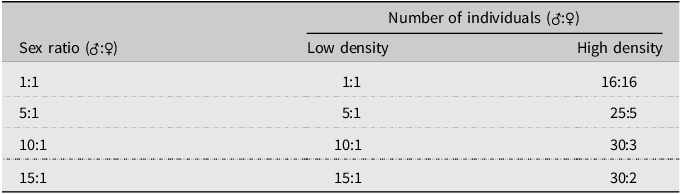
A single experiment was conducted to evaluate the effect of group composition on female mating probability and time to first fertile egg-laying (called “preoviposition period” hereafter). For the experimental design described below, each treatment was replicated 10 times for each of the two lines. The experiment initially was designed as a randomised complete block design, but because replicates of certain treatments were lost due to manipulation errors or females dying, the randomised complete block design could not be entirely respected. The replicates that were lost were re-evaluated to ensure a balanced experimental design. The treatments comprised different group compositions, consisting of four sex ratios in either low- or high-density groups (hence, 8 treatments × 2 lines × 10 replicates = 160 experimental units; Table 1). Groups were formed of individuals having emerged within 24 hours of each other and placed in a cylinder-shaped, approximately 1-L mating arena (Supplemental material, Fig. S2). Flies were supplied with distilled water via a dental wick and with adult diet ad libitum. An ovipositional substrate consisting of a 2.0- to 2.5-g piece of rutabaga placed on damp filter paper was supplied and replaced every two days. The experiment was conducted under the same rearing conditions as the main colonies (20 °C, 60% relative humidity, 16:8-hour light:dark photoperiod).
Treatments (group compositions) tested for their effect on female mating probability and preoviposition period in the N- and H-lines of Delia platura.

Oviposition
Starting from the day on which groups were formed (day 0), oviposition was evaluated every two days by transferring the eggs laid on the ovipositional site to a petri dish with a humid filter paper and counted. Each evaluation day, dead males were replaced with virgin males of variable age (average number of males replaced for each treatment is shown in Supplemental material, Fig. S3). If dead females were found, evaluation was cancelled, and another replicate of that group composition was formed as a replacement.
Mating probability
As soon as fertile egg-laying was confirmed, all females within a treatment replicate were euthanised (placed in a freezer at –20 °C for approximately 24 hours). Females were then stored in 70% ethanol until dissection. To obtain a measure of the proportion of mated females within the group (mating probability), all three spermathecae of each female within a group were dissected to confirm the presence of sperm masses (Avanesyan et al. Reference Avanesyan, Jaffe and Guédot2017) for all 600 females in the experiment.
Preoviposition period
Throne and Eckenrode (Reference Throne and Eckenrode1986) observed nearly 100% egg hatchability following 2–3 days of development at 20 °C for D. platura. The identity of the line involved in their study is unknown, however. To consider possible variation in egg developmental times between the lines, we evaluated egg fertility following six days of incubation in a petri dish. Eggs were deemed fertile if they had hatched. If no fertile eggs were laid, evaluation ceased after 42 days.
Statistical analysis
Some treatment replicates were lost due to sampling errors or dead females and had to be repeated; therefore, not all treatments could be conducted following a formal randomised complete block design. As a result, replicate (block) ID was not included as a random variable in the following models, which were all fitted within the R environment (version 4.1.1; https://www.R-project.org/). All code used for data handling and statistical analyses can be found in Supplementary material, Script 1.
Mating probability
Female mating probability was modelled using a generalised linear model with a binomial error distribution and a complementary log–log (cloglog) link function. Delia platura line (H, N), density (high, low), sex ratio (number of males per female), and their three-way interaction were included as covariates. As the number of males inherently increases female mating probability (more males = more mating opportunity), the log (number of males) was included as an offset term. The model was fitted using the glmmTMB package, version 1.2.2 (Brooks et al. Reference Brooks, Kristensen, van Benthem, Magnusson, Berg and Nielsen2017), and model diagnostics were inspected using the DHARMA package, version 0.4.3 (Hartig Reference Hartig2021).
Preoviposition period
The length of the preoviposition period was modelled using a Cox proportional hazards model. Delia platura line (H, N), density (high, low), sex ratio (number of males per female), and their three-way interaction were included as covariates. The model was fitted using the coxph formula within the survival package, version 3.2-13 (Therneau Reference Therneau2021). Model diagnostics were inspected using the cox.zph, ggcoxzph, and ggcoxdiagnostics functions from the survminer package, version 0.4.9 (Kassambara et al. Reference Kassambara, Kosinki and Biecek2021).
Results
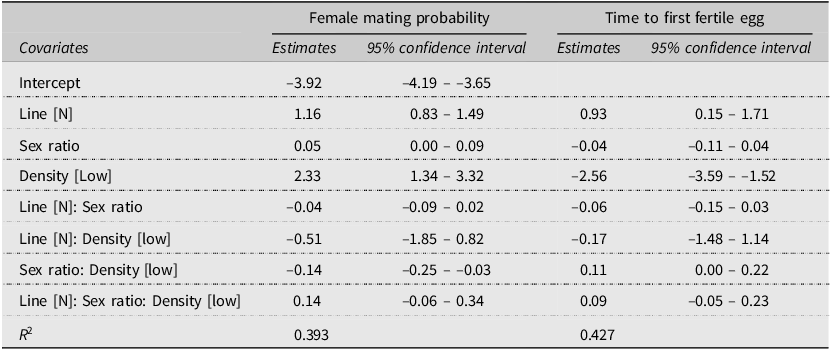
Regression coefficients and their 95% confidence intervals for mating probability and preoviposition period are reported in Table 2. Confidence intervals of coefficients are statistically significant if they do not overlap zero. However, individual effects with confidence intervals overlapping zero are also deemed statistically significant if they are part of a statistically significant interaction. Given that the effect size of a variable cannot be interpreted without taking into account the interactions in which it occurs, we focussed on the interpretation of the biologically significant effects displayed by the plotted model predictions in Figure 1.
Output of statistical analyses for sex ratio and density experiment. Estimates/hazard ratios and corresponding 95% confidence intervals of the effects of Delia platura line (H and N), group sex ratio, group density and their interactions on mating probability (generalised linear model) and preoviposition period (Cox proportional hazards). 8 treatments × 2 lines × 10 replicates = 160 experimental units

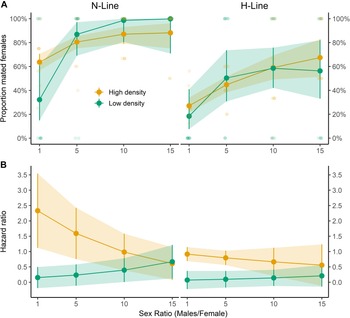
Effect of Delia platura line, density, and sex ratio on mating success and preoviposition period: A, model predictions of effect of Delia platura line, density, and sex ratio on proportion of mated females and B, hazard ratio of the preoviposition period. A higher hazard ratio indicates a shorter preoviposition period. Error bars depict 95% confidence intervals.

Mating probability
The overall mean proportion of mated females was 63.18 ± 40.21% (standard deviation). The N-line had a higher proportion of mated females compared to the H-line and also had an approximately 20% higher baseline mating probability (intercept; Fig. 1A; Table 2). Whereas none of the females in the H-line 1:1 group mated, 40% of N-line females mated within the same treatment. At both low and high densities, the proportion of mated females of each line increased similarly with the proportion of males to females, reaching between 90 and 100% at a ratio of 10 males to one female for the N-line and around 60% at the same ratio for the H-line.
Preoviposition period
The overall mean of the preoviposition period was 9.60 ± 4.63 days, with a mean of 9.38 ± 3.72 days and 9.88 ± 5.59 days for the N-line and H-line, respectively. Although the Cox proportional hazards model supported the fact that groups of N-line females generally laid a first fertile egg more rapidly (higher hazard ratio) than did those of the H-line, the preoviposition period also varied with both the sex ratio and group size, albeit differently between lines (Fig. 1B; Table 2). Groups took more time to lay a first fertile egg (lower hazard ratio) in the low-density treatments, but in the N-line, the preoviposition period tended to decrease as the male-to-female sex ratio increased. In the high-density treatment, laying time increased with increasing sex ratios, especially for the N-line, which resulted in similar laying times for both density treatments at the highest male-to-female sex ratio.
Discussion
The effect of group density and sex ratio on female mating probability and preoviposition period was investigated for the N- and H-lines of D. platura. Female mating probability increased as the number of males per female increased for both lines, but females from the N-line had a higher mating probability than those of the H-line under all treatments. The preoviposition period decreased as the ratio of males to female increased at low density only for the N-line, whereas the opposite trend was observed at high density for both lines. These results suggest differences between the mating systems of the two lines that could possibly act as reproductive barriers and which will need to be accounted for in the development of control techniques that rely on mating compatibility, such as the sterile insect technique. The development of new seedcorn maggot control methods, such as the sterile insect technique, must take these potential barriers into account as the success of the approach relies on mating compatibility between released individuals and the target population.
Mating probability
Within mating swarms, sex ratios typically tend to be male-biased, offering females increased mating opportunities. In our study, female mating probability was increased in both D. platura lines in response to increased male-to-female ratios rather than group density, a result congruent with trends observed in other arthropod species (Karlsson et al. Reference Karlsson, Eroukhmanoff and Svensson2010; Vahl et al. Reference Vahl, Boiteau, de Heij, MacKinley and Kokko2013). These trends also corroborate field observations of D. platura forming mating swarms (Miller and McClanahan Reference Miller and McClanahan1960; A. Bush-Beaupré, unpublished data).
An increase in female mating probability under male-biased sex ratios could be due to an increase in male mating–related activity, such as locomotion (Bahrndorff et al. Reference Bahrndorff, Kjaersgaard, Pertoldi, Loeschcke, Schou, Skovgård and Hald2012) and courtship (Leftwich et al. Reference Leftwich, Edward, Alphey, Gage and Chapman2012; Marie-Orleach et al. Reference Marie-Orleach, Bailey and Ritchie2019). Although male–male interactions, and thus aggressions, are more likely to occur under male-biased sex ratios, thereby reducing male mating success (Enders Reference Enders1993), male–male competition in our group treatments for both genetic lines could have switched from interference (aggression) to scramble competition as the group sex ratio became increasingly male-biased (Weir et al. Reference Weir, Grant and Hutchings2011).
Although male-biased sex ratios may cause an increase in female resistance behaviour (Carrillo et al. Reference Carrillo, Danielson-François, Siemann and Meffert2012), a decrease in such behaviour may also be observed as male insistence increases (Lauer et al. Reference Lauer, Sih and Krupa1996). If female resistance had increased to the point of overcoming male insistence in male-biased mating groups, mating probability would have decreased. This may be particularly true for the N-line because mating probability plateaued near 100%. However, mating probability plateaued at around 60% for H-line females, possibly indicating an increase in female resistance proportional to the overall increase in male insistence, assuming that male–male competition did not hinder their mating behaviour.
It is, however, possible that male behaviour may not have been the defining factor in the mating interactions observed. The increase in female mating probability could simply be due to an increase in the number of available males to choose from, a main characteristic of swarming behaviour (Downes Reference Downes1969). Female mate choice can be affected by multiple factors. For example, males in mating pairs tended to be larger than males sampled at random in swarms of the mayfly, Epeorus longimanus (Eaton) (Ephemeroptera: Heptageniidae) (Flecker et al. Reference Flecker, Allan and McClintock1988), and in the yellow dung fly, Scathophaga stercoraria Linnaeus (Diptera: Scathophagidae), larger males copulated and mate-guarded more under male-biased sex ratios (Otronen Reference Otronen1996). Even though we sieved pupae with 1.7-mm mesh for our experimental stocks, this did not entirely eliminate size variability. Females of both D. platura lines could therefore have chosen the larger males to mate with if these latter were more successful in winning male–male competitions, as Benelli et al. (Reference Benelli, Donati, Romano, Ragni, Bonsignori, Stefanini and Canale2016) observed in the olive fruit fly, Bactrocera oleae (Rossi) (Diptera: Tephritidae).
The low proportions of mated females in our smallest group composition (1 male and 1 female) were unexpected, especially for the H-line, in which no mating occurred within 42 days in all 10 replicates compared to 4 of 10 females for the N-line. This result is surprising because females remaining unmated even in the presence of a male would appear to be disadvantageous. However, lifelong female virginity is not uncommon in insects. According to a review by Rhainds (Reference Rhainds2019), a higher rate of lifelong virginity is observed in females that are flightless, short-lived, choosy, small, and have a long prereproductive maturation period (when coupled with a high rate of mate encounters leading to an increased rate of mating rejection). Lifetime female virginity is also affected by reproductive asynchrony, female-biased sex ratios, low population density at a large scale (Allee effect), and high population density at a fine scale (signal jamming). In the present study, D. platura females could fly, were relatively large, and were long-lived (over 42 days), and some had a short preoviposition period (an average of 10 days out of the 42-day trial period). Furthermore, the long duration of the experimental trials (up to 42 days) mitigated the potential effects of reproductive asynchrony, the sex ratio in the low-density treatment (1:1) was not female-biased, the relatively small size of the experimental arenas likely negated a putative Allee effect, and fine-scale population density was low. These facts suggest that H-line females are choosy towards the male with which they mate. The long duration of the trial additionally enforces this supposition because females are predicted to reduce their choosiness as they age as so to ensure fertilisation during their lifetime (Kokko and Mappes Reference Kokko and Mappes2005). With 6 of 10 N-line females remaining unmated in the 1:1 group composition, females of this line may also be choosy but to a lesser extent than H-line females are. Although the results obtained here suggest high mate selectivity in H-line females, this choosiness was not explicitly evaluated. As such, laboratory experiments in which females are offered a choice between males with different trait values (such as size or wing length) are needed to support or refute this hypothesis.
It is pertinent to note, however, that dense swarms (exceeding the volume of the arenas used in our experimental treatments) were frequently observed in the main colony cage of the H-line and were rarely witnessed for the N-line (A. Bush-Beaupré, unpublished data). It is therefore possible that the arena size was too small to allow H-line males to form a swarm, thus leading to a low mating probability. In addition, it is possible that the single male in the 1:1 male:female group treatment was not stimulated into courtship due to a lack of other males with which to form a swarm. A similar study conducted on D. platura by Hough-Goldstein et al. (Reference Hough-Goldstein, Hess and Cates1987) investigated the effect of group composition on mating dynamics and reported a mating probability of around 70% in a 15:15 male:female group composition, as well as some successful mating ranging from 0 to 25% in their 1:1 treatments, depending on the experiment. These results are highly congruent with those reported in the present study for the N-line and, although Hough-Goldstein et al. (Reference Hough-Goldstein, Hess and Cates1987) did not deposit voucher specimens or specify the capture locality of their founding stocks, we suspect that they worked with that genetic line. Considering that the two lines of D. platura differ in their mating systems (and possibly in other biological traits), there are clear limitations to the extrapolation and application of results obtained in studies where the line(s) identity was not determined and voucher specimens are unavailable for a posteriori determination. We therefore recommend that future work on D. platura involves the determination of the genetic line(s) under study.
Preoviposition period
In both D. platura lines, the fastest fertile oviposition (highest hazard ratio; Fig. 1B) was observed in the 16:16 group composition. A decrease in the time to first fertile oviposition was observed as the number of females within a group increased at high densities for both lines, whereas in the low-density treatment, the delay to first fertile egg seemed to decrease slightly as the number of males per female increased for the N-line. Although a higher number of females could have increased the probability that females with an intrinsically faster rate of oviposition were present in the group, the difference in the preoviposition period between the two lines suggests that this was not the main factor affecting the speed at which females lay their first fertile eggs. Additionally, if the preoviposition period was fully explained by the number of females within a group, we would expect a much shorter preoviposition period in the group with 16 females compared to the group with only five females. This was not the case for either line in our study. As such, the total number of females within a group does not fully explain the rate at which they lay their first fertile eggs.
The presence and oviposition of conspecific females can have different effects on oviposition behaviour, depending on the group. In some species, female crowding can increase the preoviposition period (Ambrose et al. Reference Ambrose, Sahaya Rani and Vennison1988). In the present study, the group with the most females (16:16) had the shortest preoviposition period in both lines. In the viburnum leaf beetle, Pyrrhalta viburni (Paykull) (Coleoptera: Chrysomelidae), females spent less time searching and selecting for an oviposition site when conspecific egg masses were present, thus reducing the preoviposition period (Desurmont et al. Reference Desurmont, Weston and Agrawal2014). Because we included a single oviposition site per experimental arena regardless of treatment, the presence of conspecific eggs may have been one of the factors explaining the shorter preoviposition period that we observed at high densities in the two lines of D. platura.
Because neither of the D. platura lines laid fertile eggs before the interval of day 4–6, we can infer that ovipositional maturity was reached no sooner than the first 4–6 days of their lifespan. This result is comparable to the average preoviposition period measured in the closely related Delia florilega (6.5 days; Kim and Eckenrode Reference Kim and Eckenrode1987). The average preoviposition period for both lines of D. platura was approximately 10 days, concurring with results obtained by McClanahan and Miller (Reference McClanahan and Miller1958), which ranged between 10 and 20 days. The minimum length of the preoviposition period observed in the present study (between 4 and 6 days) suggests that the absence of oviposition reported by Mlynarek et al. (Reference Mlynarek, Macdonald, Sim, Hiltz, McDonald and Blatt2020) for D. platura females aged 2–4 days exposed to different developmental stages of onion (Allium cepa) for 48 hours in a no-choice experiment may not have been due to a rejection of the oviposition substrate but caused instead by the fact that females had not yet reached ovipositional maturity.
Our results are congruent with results obtained by a companion experiment conducted on the reproductive compatibility of the two D. platura lines (Bush-Beaupré et al. Reference Bush-Beaupré, Bélisle, Fortier, Fournier, MacDonald and Savage2023). In the aforementioned study, the mating probability of intraline crosses (H-line males with H-line females and N-line males with N-line females) was compared to that of interline crosses (H-line males with N-line females and vice-versa) using a group composition of 30 males with two females. The mating probability of both lines in Bush-Beaupré et al. (Reference Bush-Beaupré, Bélisle, Fortier, Fournier, MacDonald and Savage2023) was equivalent to the mating probability obtained in the 30 males to two females group composition of the present study (approximately 80 and 70% for the N- and H-lines, respectively). Additionally, females of both lines in Bush-Beaupré et al. (Reference Bush-Beaupré, Bélisle, Fortier, Fournier, MacDonald and Savage2023) also had a mean preoviposition period of approximately 10 days. The congruence between the results reported in both studies emphasises their replicability and adds robustness to our estimate of the conditions that maximise mating probability in D. platura.
Applications
The results presented here highlight the need for further investigation into differences in biological and behavioural traits of the two lines of D. platura. In addition, the results emphasise the importance of considering the effects of sex ratio and density on the insect’s mating dynamics when designing lab and field experiments. Such trait differences may influence the methods required for efficient control of either line in crop productions. Considering that mating is optimal in male-biased groups for both lines of D. platura, the development of control methods such as the sterile insect technique or the release of individuals carrying pathogens would need to account for the high degree of sexual selection present in such group contexts (Cator et al. Reference Cator, Wyer and Harrington2020), especially considering the apparent high degree of choosiness of H-line females. As such, special care must be taken to ensure that released males will join and compete within swarms (Hendrichs et al. Reference Hendrichs, Robinson, Cayol and Enkerlin2002; Hassan et al. Reference Hassan, Zain, Basheer, Elhaj and El-Sayed2014) and be attractive to females (Shelly et al. Reference Shelly, Whittier and Kaneshiro1994). To further develop the potential for the sterile insect technique as a control method for the seedcorn maggot, we recommend that future studies investigate what landscape markers and environmental conditions influence swarm formation in each D. platura line, as well as the ability of released sterile males to join and compete within swarms of each target line. The results obtained in the present study also highlight the need for additional research into the mating dynamics of the two D. platura lines, including mate choice, competition for mates, and the effect of conspecifics on egg-laying dynamics.
Supplementary material
To view supplementary material for this article, please visit https://doi.org/10.4039/tce.2023.21.
Data accessibility statement
Data used for this manuscript can be found at: https://doi.org/10.5683/SP3/83WSVT.
Acknowledgements
The authors are grateful to the following students, research technician, and research professional, Maria Magdalena Virlan, Marianne Allard, Marc-André Villeneuve, and Chelsey Paquette, for help with data collection, as well as Andrew MacDonald for statistical consultations. The authors also thank the reviewers for suggestions that improved the manuscript. This work was funded by Agriculture and Agri-Food Canada, the Fruit and Vegetable Growers of Canada (Canadian AgriScience Cluster for Horticulture program) #ASC-18/19 – Activity 8, and Bishop’s University.
Author contributions
Allen Bush-Beaupré: conceptualisation (lead), data curation (lead), formal analysis (lead), investigation (lead), methodology (lead), visualisation (lead), writing – original draft preparation (lead), and writing – review and editing (lead); Jade Savage: conceptualisation (equal), funding acquisition(equal), supervision (equal), and writing – review and editing (equal); Anne-Marie Fortier: conceptualisation (equal), funding acquisition (equal), supervision (equal), and writing – review and editing (equal). François Fournier: conceptualisation (equal), funding acquisition (equal), supervision (equal), resources (lead), and writing – review and editing (equal); Marc Bélisle: conceptualisation (equal), supervision (equal), and writing – review and editing (equal).
Competing interests
The authors declare they have no conflict of interest.