The rise of the Republican Party has received ample attention from political scientists and historians. Across the literatures, there is agreement that the Kansas-Nebraska Act of 1854 precipitated the formation of the organization, which attracted former Whigs, Free Soilers, Know-Nothings, and moderate Democrats. In the words of Rosenstone et al. (Reference Rosenstone, Behr and Lazarus1996), the passage of the act created an environment where “Free Soilers recognized that their party was neither vital enough nor broad enough to defend the abolitionists' cause” (55) and where “[t]he reemergence of the slavery issue . . . precipitated the death of the Whig Party” (56). Those who remained in the Whig Party in the short term were, as Ostrogorski (Reference Ostrogorski1974 [1910]) put it, “like reptiles which have been crushed and whose severed joints still give signs of life” (47). These former Whig elites, desiring a new political home, often gravitated into the Republican Party to save their political careers (Aldrich Reference Aldrich1995: 144–56).
These historical accounts, then, tend to focus on the breakdown of the Whigs because of ideological divisions. This led to a partisan realignment in the 1850s and the triumph of the Republican Party (Clubb et al. Reference Clubb, Flanigan and Zingale1980; Gienapp Reference Gienapp1987; Sundquist Reference Sundquist1973). Others argue that the party's creation was an intersection of mass ideology and elite behavior (Holt Reference Holt1978) and that slavery was not necessarily at the core of the realignment (Holt Reference Holt, Silbey and McSeveney1972). Regardless of the specifics, the utility of the Whig Party as an organization disappeared in the mid-1850s.
This article argues that an alternative account can provide additional insight into the ascendance of the Republican Party. Building from theories of party system formation and electoral coordination, I propose that the success of the Republican Party was grounded in the inability of the Whig parties in New England to effectively coordinate voters' activities in state elections prior to 1854. This was largely due to high levels of antislavery and antislavery extension voting for the Liberty and the Free Soil parties. To support this argument, I utilize ratios of a second loser's vote percentage to a first loser's vote percentage, known as SF ratios (Cox Reference Cox1997). Focusing on this measure at the county level for gubernatorial elections in the region, I find that there was not a Duverger-style pattern of two parties dominating in particular areas; voters were becoming increasingly less clear about which party was the most effective second option as third-party support increased. Additional evidence shows that the Whig Party was not affected in any consistent pattern by Liberty and Free Soil Party voting at the county level across states, thus making it hard for Whig elites to coordinate in the region.
This lack of strategic voting, coupled with a weak to nonexistent connection between Whig and Liberty/Free Soil voting, allows me to present a counterfactual argument that suggests that Whig elites could have chosen other pathways to getting elected, prior to the rise of the Republican Party, had the distribution of strategic voting and Whig to Liberty/Free Soil votes been different. It was not that antislavery sentiment was the basis for the creation of the Republican Party, as other accounts have argued. Instead, the distribution of voting for antislavery parties led to electoral coordination issues for the Whigs that did not have a readily apparent solution in the 1840s and early 1850s in New England, where such third-party voting was strong. Together, the findings expand our understanding of theories of party development while offering insights into the use of strategic voting and the distribution of votes to better understand American political history.
A New Perspective
The significance of the rise of the Republican Party for the course of American politics cannot be understated. The establishment of two dominant parties atop the national political system since 1864 is proof of these organizations' abilities to adapt to the changing socioeconomic environment. Minor-party challenges have come and gone, and neither major party has been seriously threatened at the national level.
Given the stability of this arrangement, it is perhaps not surprising that the creation of the Republican Party has been a focal point of scholarship. The mixture of former Northern Whigs, antislavery or antislavery expansion Democrats, and former Free Soil and Liberty Party activists helped to create an organization that had a broad platform that attracted wide-ranging support above the Mason-Dixon Line. Because of this, the era has been characterized as the realignment of the 1850s or 1860 (Burnham Reference Burnham1970: 12–15; Gienapp Reference Gienapp1987).
The period has been described as a “mass-based revolt” (Gienapp Reference Gienapp1987: 446), and one in which politicians had to either “revive loyalty to the old parties or to build new parties that could attract jaded and distrustful voters” (Holt Reference Holt1978: 138; see also Gienapp Reference Gienapp1987: 446–47). The Whig Party, especially in New England, found it hard to cope with the serious differences between its northern and southern factions on the issue of slavery, even when there was agreement on other policies such as internal development (Holt Reference Holt1999). Additionally, the growing strength of the antislavery/antislavery extension Free Soil Party, which attracted abolitionists in its transition from the Liberty Party, was not likely to go away. This also affected Democrats, many of whom were opposed to slavery but remained tied to the organization.
As James Sundquist classically put it, “the rising antislavery sentiment of the North was bound to have its political vehicle; if the Whigs declined to be that vehicle, the Free Soil party would be, and the Whigs would find themselves supplanted” (Sundquist Reference Sundquist1973: 62). Mass sentiment had to be channeled into an organization that would allow election-oriented politicians to remain politically competitive. The formation of a national Republican Party in 1856, following the creation of the party in Wisconsin (or Michigan) in 1854, established such a broad-based coalition behind the idea of “free labor,” mingling antislavery sentiment with a nativist vision of hard-working Protestantism and temperance (Foner Reference Foner1970).
However, painting this era as a period of intense sectional conflict overlooks the fact that a good number of New England political elites from 1840 to 1860 did try to focus on national problems other than slavery-related issues; keeping politicians within the party fold, even after a flare up of sectional issues, was important (Silbey Reference Silbey1967). Because many voters formed close associations with parties during this highly partisan period, attempts by elites in the 1850s to attract citizens who ventured off to vote for minor parties, voted for the other major party, or stayed away from elections (Voss-Hubbard Reference Voss-Hubbard2002) seemed quite logical. Framed differently, the twenty or so years in New England prior to the onset of the Civil War can be seen as a struggle between elite and popular interests on how to best organize in order to achieve success at the ballot box.Footnote 1
Previous studies tend to emphasize mass ideological sentiment at the expense of political strategy. The two are related, but the relationship between them is often blurred. By combining approaches from political science with the perspectives of historians, I argue that the development of the Republican Party needs to be seen less in terms of ideology and more in terms of elite strategy when confronted by antislavery, ideological third-party voting.
The argument is based on the premise that political parties function by creating a platform that combines various issue positions to attract voters, though this has become harder since modern elections have become increasingly candidate centered (Aldrich Reference Aldrich1995; Mayhew Reference Mayhew1974; Wattenberg Reference Wattenberg1991). In the 1800s, however, political party organizations were much stronger. For example, they produced their own ballots to distribute to voters, granting the party elites more control over the selection of candidates (Ware Reference Ware2000). Even so, there was an element of candidate interests in the development of tickets and party priorities, especially since party-line voting was not a requirement (for a late-nineteenth-century discussion, see Reynolds and McCormick Reference Reynolds and McCormick1986). In fact, local and sectional interests could, and did, dominate some issues, forcing politicians to cross party lines. Though parties were strong in this era, party elites and politicians shaped a party's priorities.
This was a problem for antebellum politicians in New England. There were high levels of partisan voting, yet parties were a conglomeration of local and state interests that politicians had to be in tune with. This was further complicated by the growth in antislavery sentiment, which was a generally national-level issue. For political elites interested in staying in the public eye and/or representing their constituents' interests, navigating this environment required balancing policy positions between local, state, and national interests.
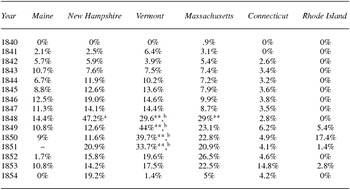
This tension was exacerbated by the growth in minor parties, first with the Liberty Party and then with the Free Soil Party. From 1841 to 1854, these antislavery and/or antislavery extension parties grew in strength and were able to attract voters throughout New England (see Appendix Table 1). Though it is true that antislavery sentiment played a weaker role in the minds of some New England Whigs than it did in the growing midwestern states without established parties (Ostrogorski Reference Ostrogorski1974 [1910]), the fact that it translated into minor-party voting made it problematic for Whigs, especially because these politicians often wanted to focus on other issues (Aldrich Reference Aldrich1995).
In some states, the Whigs continued to succeed while the Democrats continued to lag behind (e.g., Vermont). In other states, the Whigs continued to lose elections after the appearance of these two parties, leading to Democratic dominance (e.g., New Hampshire). In still other states, the minor parties were able to capture enough of the vote in some years that, if their gubernatorial votes were to mainly go to one of the two major parties, the election could have swung to the losing party (e.g., Connecticut). This variation leads to the basis of my argument: the political environment of New England from the early 1840s through the rise of the Republican Party in the mid-1850s was an era that can be characterized by a lack of electoral coordination.
The lack of electoral coordination can be reframed in terms of strategic voting. Often studied in the context of elections in single-member districts, where a simple plurality of the vote wins the seat (so-called “first-past-the-post” electoral systems), voters normally organize around two parties. This is an essential component of Duverger's Law (Duverger Reference Duverger1954), which seeks to explain why two major parties tend to exist in nations that use this style of election. To measure strategic voting, the concept of SF ratios, or the ratio created from the second loser's vote proportion to the first loser's vote proportion in a particular district, was developed (see Cox Reference Cox1997 for a good example of its usage). When voters have a hard time determining which party's candidate is the legitimate second option, a situation arises in which voters cannot easily determine how to strategically vote. In an ideal world in which it is clear which party's candidate is not competitive, voters will choose between the top two candidates; this corresponds to Duverger's Law (Reference Duverger1954). The SF ratio in this situation would be 0. Departures away from 0, and up to its natural boundary at 1, indicate a ratio in which voters are less certain about the most competitive second-party option.Footnote 2
Because of the SF ratio's comparability across electoral systems, it has been used in numerous circumstances. In Chhibber and Kollman's (Reference Chhibber and Kollman2004) comparative work on the formation of national, federal party systems, SF ratios were used to discuss constituency-level competition in the United States, Canada, Great Britain, and India (52–57). Moser and Scheiner (Reference Moser and Scheiner2009) use the ratio to test strategic voting as it relates to ticket splitting in mixed-member systems. They find that strategic voting does occur, at times, but that it requires “the availability of sufficient information to distinguish between viable and non-viable candidates” (60). In a recent study by Crisp et al. (Reference Crisp, Olivella and Potter2012), the authors argue that the entry of new political parties creates coordination issues.
SF ratios are used here in a similar vein. The argument is that Whigs in New England lacked the ability to coordinate voters in certain areas with the establishment of the Liberty and the Free Soil parties. These new political entrants created state-level environments in which coordination of voters became increasingly difficult (see Reference Crisp, Olivella and Potteribid.) and where it became much harder to convey information about potentially successful candidates to the public (see Mosier and Scheiner Reference Moser and Scheiner2009). It is not that ideology did not play a role, but the inclusion of a new political party (parties) made it hard for the Whigs to maintain themselves in the long term when local and regional coordination were difficult (in addition to the party's national-level divide). When Whig politicians realized that voters could not strategically vote effectively in statewide elections, they had a reason to look at other party options to improve coordination.
Data
The data used in this study are the county-level vote percentages for all political parties in gubernatorial elections in New England (Maine, New Hampshire, Vermont, Massachusetts, Connecticut, and Rhode Island) from 1840 through 1847 and 1849 through the mid-1850s (Dubin Reference Dubin2003). The year 1848 is excluded because it is the bridging year between the abolitionist Liberty Party (1841–47) and the antislavery extension Free Soil Party (1848–54), which ran former President Martin Van Buren as its presidential candidate in 1848. Additionally, governors were elected yearly in this region during this era, providing a number of time points to study.
New England is the focus of this study because the Republican Party would have had serious problems succeeding as a Northern party without support in these states. It was an established regional voting bloc, unlike the burgeoning midwestern states (Ostrogorski Reference Ostrogorski1974 [1910]), and it was a center of political and economic power. There were also consistently high levels of minor-party voting in New England, compared to the levels of minor-party voting in other areas of the North.
SF ratios are constructed using the percentage of the vote received for the second losing gubernatorial candidate to the first losing gubernatorial candidate in a county. In most cases, this was a Liberty/Free Soil candidate and another major party candidate, though in a handful of elections another non–major party candidate was present and considered in the calculations if needed.Footnote 3
Two points about the data need to be addressed before moving forward. First, state-level elections need to be the focus considering the importance of this level of government in an era of highly decentralized federalism. States were the center of political activity, and political parties differed across states; the centralization of the American party system did not occur until well after the Civil War (Chhibber and Kollman Reference Chhibber and Kollman2004). Because the governor's office was the highest elected state position, it should be the emphasis of this study of voter coordination.
Additionally, because national politics was an amalgam of different state polities, the state politicians were often motivated by national-level concerns. For example, the Whig Party of Massachusetts's 1849 state convention, which was organized in a year without federal races, selected candidates based on national issues like slavery. As the address adopted by the party stated in the second paragraph, so as to ensure that the Massachusetts public understood what was to come, “all our elections are in a great degree influenced by national questions, and for many years the respective parties have selected their candidates for State offices with as much reference to their opinions upon general politics, as to their views of State policy” (Whig Party of Massachusetts 1849: 3). Even in the mid-1840s, this was the case in other states. Vermont Governor William Slade discussed the threat of slavery as part of his two inaugural addresses in 1844 and 1845 (Slade Reference Slade1844, Reference Slade1845), and Governor Horace Eaton adamantly declared, “Against slavery itself, as a system wrong in practice and wrong in principle, Vermont has taken the ground of irreconcilable hostility; and she must and will continue to maintain it” (Eaton Reference Eaton1846: 5). By this time, state politics was a reflection of national debates.
Second, SF ratios are usually computed at the district level for legislative offices. However, this departure from the traditional method, by using counties, makes sense given the era. As noted earlier, antebellum political parties printed and distributed ballots. The gubernatorial race, being the top statewide race, was much more likely to dictate overall ballot selection in most elections. This is further supported by the fact that county-level organizations formed the base of state parties. This makes measuring SF ratios for gubernatorial elections at the county level an appropriate method for calculating strategic voting during this time period.Footnote 4
Results
The first step is to establish that there was a lack of strategic voting. Just because minor-party support was stronger in some states than in others does not mean that more than two parties were competitive in any one county. It could be that political parties decided not to compete in particular counties if election efforts were better focused on a more populous and/or more supportive county. A strategic political party would not attempt to win over those who are unreceptive to its message in a location where voters are already more likely to vote for two other parties. This would produce SF ratios closer to 0 than it would at .5 or 1.
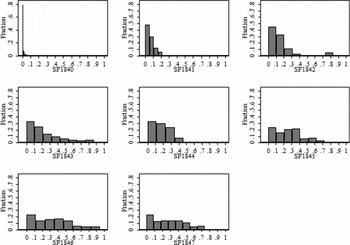
The ratios in Figure 1 show that there was a gradual departure away from 0 values as Liberty Party voting increased from 1841 to 1847. By 1845–47, the fraction of counties with a 0 value dropped below 30 percent while the proportion of counties with SF ratios of .3 to .5 increased in response. While not visible in this figure, the counties where SF ratios remained low (0 or close to it) tended to be located in Connecticut and Rhode Island (though in the latter, the state's party system was in flux due to the Dorr Rebellion [see Mowry Reference Mowry1901]). Including the five Rhode Island counties gives us a conservative estimate; if excluded, the distributions shift further away from 0. From this, it appears that the major parties were not abandoning particular counties as the Liberty Party's strength across New England slowly increased.
SF Ratios, at the county-level in New England, 1840–47.

This means that the major parties were facing coordination issues in New England prior to the 1848 election. Given that the Whigs were not a national organization until the 1840 election (Holt Reference Holt1999; see also Marshall Reference Marshall1967), these findings suggest that the party never gained a solid footing in the region before third-party, antislavery voting became a fixture in elections. Though the SF ratios do not show a complete breakdown in coordination, the situation in 1848 revealed weaknesses in the Whig organizations.
With the presidential election of 1848 completed and the ascendancy of the Free Soil Party, strategic voting continued to decline, as can be seen in Figure 2. From 1849 to 1854, the distribution includes more counties with SF ratios between .7 and 1, which is an indication of counties where voters could not coalesce around a clear-cut, second-party option. While there is a slight uptick in the 0 to .1 distributions from 1849 to 1951, these decrease in 1852 and 1853. This was due to Vermont, where the Democrats and Free Soil parties merged for those three elections after 1848. Though it helped solve electoral coordination problems at the state level in the short term, this relationship ended in 1852 with the upcoming presidential race. In 1852 and 1853, the distributions are relatively flat, indicating a significant lack of strategic voting.
SF Ratios, at the county-level in New England, 1849–57.

This is important because the salience of antislavery sentiment fluctuated throughout the 1840s and 1850s. For example, the Wilmot Proviso in 1846 pushed slavery to the forefront of the policy agenda while the Compromise of 1850 temporarily removed the topic from national political discourse. In New England, though, the SF ratios do not reveal an abandonment of antislavery, minor-party voting in gubernatorial elections that would have led to a more orderly, two-party environment when the issue's importance declined at the national level. Instead, there was steady growth in third-party voting, which created more severe voter coordination issues. Elites may have desired to move on to other topics, but this did not register with New England voters.
Thus, as the era progressed, more and more voters were unable to navigate the confusing electoral environment. This caused some Whig politicians to consider alternative party options, especially those with strong abolitionist tendencies. This had, to some degree, already started as the Free Soil Party gained power. However, the Kansas-Nebraska Act in 1854 stimulated antislavery forces throughout the North to call meetings to discuss uniting.
As these “republican” meetings formed throughout the country in 1854, they first made headway in New England, in Vermont and Maine. A joint Whig-Republican ticket in the former state helped to elect Stephen Royce governor, aided by most of the Free Soilers; he would run again in 1855 strictly as a Republican (Dubin Reference Dubin2003). This move was supported by Erastus Fairbanks, the last Whig governor of the state in 1852 (who would later be elected governor as a Republican in 1859), and Carlos Coolidge, a former Whig governor who joined the new party and served as a state senator from 1855 to 1857. As the dominant force in the state, and in reaction to a deal brokered by antiprohibitionists and Free Soilers that gave the governorship to a Democrat in 1853 (Markowitz n.d.), the Whig elites needed to move swiftly to consolidate power in this distinctly abolitionist state. With the national Whig organization weakened, and with calls resounding for a new organization, it made sense for Vermont Whigs to join the Republican fold because it helped to improve their reelection prospects.
The Maine Whigs also converted to the Republican Party relatively quickly, spurred by individuals such as Whig Congressman Isaiah Washburn, who called on antislavery forces to unite. Given the factionalism of both the Whigs and the Democrats in the state, and the growing national sentiment for a new party, it made sense for Washburn to agitate for the Republican Party and to gain power within the new organization. Traditional Whig politicians tried to oppose the selection of free soil-minded candidates, but voters rallied behind the new Republican candidates in state elections in the mid-1850s (Holt Reference Holt1999: 874–75).
Though the Whig Party had been dominant in Vermont while the Democrats had been competitive in Maine (see Dubin Reference Dubin2003), the Republican Party took hold in both states because of electoral coordination issues. It then spread throughout New England, with Massachusetts being the hold out until after 1857. As the last frame in Figure 2 attests to, voter coordination improved significantly with the arrival of the Republican Party.
This interpretation could be criticized because it overlooks nativism and temperance, two issues that some argue were key to the rise of the party in the region. In many ways, then, the decline of the Whigs and the rise of the Republicans are viewed as relatively distinct. However, I argue that the voter coordination issues caused by the Free Soil and Liberty parties were more critical than these specific issues for both the decline of the Whigs and the rise of the Republicans.
Of course, this argument requires explanation. These antislavery parties decreased certainty among voters about viable party options, which then led politicians to consider alternative ways of organizing to reliably achieve electoral victory. In the 1850s, the rise of the American Party in several states, along with a handful of pro-temperance candidates, was fueled by the electoral uncertainty created by these antislavery third parties; nativism and temperance did not create the divide. This is not to say that these issues were irrelevant, as they were both related to antislavery sentiment during this period of deeply religious Protestantism.
For nativism, the American Party in Massachusetts, the strongest of such parties, was a mixture of Free Soilers, Democrats, and Whigs who abandoned their parties to capitalize on this new political cleavage (Baum Reference Baum1978). Because of their strong antislavery beliefs, Free Soilers and abolitionist Whigs left the organization once it became clear that it was not to be an antislavery party (Reference Baumibid.). This shows that those who caused the electoral uncertainty in the first place (Liberty Men and Free Soilers) often perpetuated the problem by moving into new political parties that they felt would solve the voter coordination problems; figuring out how to attract voters was not solely a Whig or Democratic problem. The American Party, then, was somewhat successful in Massachusetts because of antislavery voters and politicians. In New Hampshire, Free Soil politicians took over the American Party (Renda Reference Renda1997: 35) and made it staunchly abolitionist. However, this did not stop those politicians, along with Whig and former Whig politicians, from shifting into the Republican Party by 1856 (Reference Rendaibid., 55–69); the Know-Nothings “had become Republicans in disguise” (Reference Rendaibid., 62). Nativism, while important, did not lead to the rise of the Republican Party; rather, antislavery sentiment was behind it.
For temperance, Free Soilers and Whigs both tried to capitalize on this issue. However, it did not inhibit the development of the Republican Party in Vermont and Maine, two states where temperance was a hot-button issue. In New Hampshire, some Whig and Free Soil candidates focused on prohibition (Reference Rendaibid., 42–48), but again, this did not stop these politicians from eventually working together in the American and Republican parties. Considering that successful political parties are policy bundlers (Roemer Reference Roemer, Shapiro, Stokes, Wood and Kirshner2009), it is perhaps not surprising that this issue was handled well within the new Republican organization. Thus, while nativism and temperance were important considerations, they did not create the voter coordination issues that brought about the Whig Party's demise and that caused politicians to question how to stay electorally competitive.
However, the distributions of SF ratios cannot explain whether the Whig Party suffered more or less in areas with higher Liberty and Free Soil voting. Why is this important? While the SF ratios show a gradual decline in strategic voting, which is critical to elites, how the elites can organize across states is related to how the votes for the minor party of interest are distributed. It would have been easier for Whig politicians to handle minor-party threats if they were affected in the same manner by the Liberty and Free Soil parties across states. A similar threat could have enabled election-minded politicians to strategize better about how to win office within the region. Dissimilarities in how the threat affected the party would make it difficult for state parties to come together on a plan to cope with the emergence of the antislavery and antislavery expansion parties.
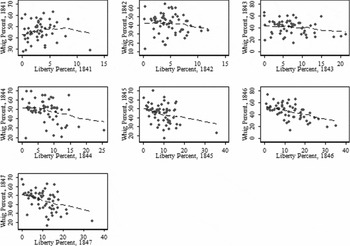
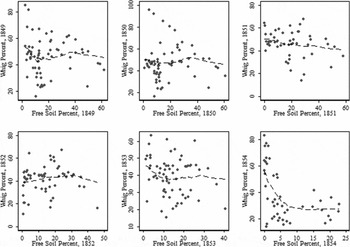
To test the issue of threat, mean-smoothed Lowess scatterplots are displayed in Figure 3 for the 1841–47 period and in Figure 4 for the 1849–54 period. The Liberty Party vote or Free Soil vote percentage is on the x-axis and the Whig Party vote percentage is on the y-axis. Two points can be made about both figures. First, there is often little relationship between Liberty/Free Soil and Whig voting in any particular year, except for 1846 and 1847 (negative relationships) and 1854 (nonlinear). In other words, county-level Whig Party voting across New England was not consistently affected by the presence of the Liberty and Free Soil parties. Second, the mean-smoothed curves are produced by wide disparities between Liberty/Free Soil and Whig voting. For example, at approximately 11 percent Liberty voting in 1847, the possible Whig vote by county ranged anywhere from under 20 percent to more than 60 percent, with a number of counties somewhere in between. This is a key point to note, as 1847 was a year with a negative relationship between the two vote percentages. The disparities also existed in years with no noticeable trend, too.
Lowess-Smoothed Scatterplots of Whig and Liberty Vote Percentages, 1841–47.

Lowess-Smoothed Scatterplots of Whig and Free Soil Vote Percentages, 1849—54.

Thus, the results bring to light two main findings about voting in New England in the 1840s and early 1850s. First, voter coordination declined from 1841 to 1847 and became more severe between 1849 and 1855, caused largely by the development of the Liberty and Free Soil parties. Political elites, in this environment, needed to seek out better ways to get elected once the major parties, but especially the Whig Party, failed to meet their needs. Second, the lack of voter coordination caused by the Liberty and Free Soil parties did not systematically affect Whig vote percentages across the New England states. Because there was no consistent trend of increasing antislavery voting leading to subsequent declines in Whig voting, electoral coordination became harder for Whig politicians to accomplish through the existing party organizations. Without a consistent, clear threat affecting the party and its politicians in each state, the choices available to party elites were limited; only the formation of the Republican Party was able to solve this dilemma. However, this issue requires further elaboration, as it speaks to broader theoretical concerns about the development of political parties.
A Counterfactual Argument
The results indicate that the Whig Party in antebellum New England was unable to effectively coordinate voters. This led to the adoption of the Republican Party, which solved the coordination problem. This then decreased electoral uncertainty, but in a larger sense, it exacerbated regional tensions and helped to spark the Civil War.
Some readers might believe that these findings are just a minor addition to the broader literature on the subject. However, a counterfactual argument about what the distribution of SF ratios and the relationship between Whig and Liberty/Free Soil vote percentages could have looked like serves to place these findings in a different light. While counterfactuals are not common in the political science literature, they have been used at times (Capoccia and Kelemen Reference Capoccia and Kelemen2007; Lebow Reference Lebow2000; Tetlock and Belkin Reference Tetlock and Belkin1996). Importantly, two of the best examples were used in a historical context, specifically the election of 1860 (Jenkins and Morris Reference Jenkins and Morris2006; Tabarrok and Spector Reference Tabarrok and Spector1999).Footnote 5
The argument usually put forth is that the Republican Party's formation and growth was caused by the Whigs factionalizing over regional issues, and especially slavery. This means that abolitionist and antislavery expansion policies are the key prerequisites for the acceptance of the party in New England; ideology is the cause of the Whig Party's demise. Even in Aldrich's (Reference Aldrich1995) interpretation, strategic politicians were forced to switch parties because of the ideological and regional divide that split the Whig Party. This schism in the national Whig Party, and the passage of the Kansas-Nebraska Act, made the Republicans an appealing option.
However, if ideological differences within the national Whig Party caused politicians to abandon it and seek shelter in the Republican Party, then it would have to be the case that this outcome would have occurred regardless of the lack of strategic voting or the distribution of antislavery, third-party voting within and across states. As long as antislavery sentiment was strong, especially among Whig and potential Whig voters, the transition in organizations would have occurred.
But, let us now approach this topic counterfactually while staying as close to historical circumstances as possible. There are two components that will be “adjusted” if the amount of opposition to slavery is held consistent in the population: strategic voting and the effect of antislavery, third-party voting on Whig support. The findings in the previous section uncovered a lack of strategic voting at the county level but no obvious county-level relationships between Whig and Liberty/Free Soil voting across states. This led to the conclusion that state Whig parties faced different electoral environments, thus making it difficult to organize the party regionally.
Historical evidence supports this interpretation. In Vermont, the Free Soilers ran slates of candidates with the Democrats from 1849 to 1851 to try and contest the Whig's dominance at the gubernatorial level. Similar plans were attempted in Rhode Island and Massachusetts. Yet, this plan of action was not suited for states where Democrats did not need minor-party support to win office. A good example here is the Whig-Free Soil coalitions in New Hampshire. Other elites claimed that they would abandon the Whig Party for a new antislavery organization (Holt Reference Holt1999), but none of this came to fruition immediately; it took longer to develop and required the Kansas-Nebraska Act of 1854 to spur action. Thus, in the 1840s and early 1850s, there was no obvious solution to overcome the lack of strategic voting and the wide disparities across states in how minor-party support affected the major parties in New England.
Now let us consider a single counterfactual scenario that brings together both strategic voting and the distribution of Whig to Liberty/Free Soil votes. In it, there is a lack of strategic voting; unlike reality, Whig votes decline whenever Liberty Party or Free Soil voting increases. The various state Whig parties in this scenario would have faced similar threats from antislavery voting and a lack of strategic voting. Thus, only one component is adjusted, preventing the counterfactual from straying too far from its historical starting point.
One limitation of this approach is that contingent events influence real-world decisions, yet these cannot be emulated. For example, the introduction of the Kansas-Nebraska Act in 1854 and the caning of Charles Sumner in 1856 helped create and then solidify the Republican Party, yet these events are not predictable. Readers, then, should approach this counterfactual by assuming that antislavery sentiment remains important throughout this era while keeping in mind that unforeseen, critical events could affect elite decision making.
Within this framework, the counterfactual leads to several possible solutions that would have advantaged Whig politicians and allowed them to regain control of elections: win over the Liberty/Free Soil voters and elites, possibly by loosening the connections between the state Whigs and the national organization; consider moving into the upstart political organization(s), thereby abandoning the Whig organization(s); merging with the upstarts, thus bringing components of the old and new parties together; or simply create a new organization altogether.
The most conservative strategy would be to win back antislavery voters, so directing attention here seems best. It also has historical relevance, as some prominent Whigs, among them William Seward of New York, tried to revitalize the national party deep into the 1850s. Foner (Reference Foner1970) goes so far as to state, “Between 1850 and 1854, northern Whigs believed that the slavery question had truly been driven from national politics” (193); even through 1854, he claims, “most of the northern national Whigs hoped that their party could be reconstructed” (194). In retrospect, these views were shortsighted. Without a consistent threat to Whigs across states, and with decreasing levels of strategic voting in the region, no ready solution was available to unite antislavery politicians.
Within the context of the counterfactual, though, such a strategy might have worked. The strategy would have been to convince antislavery voters and politicians alike that the state Whig parties adhered to their views on slavery. Had the threat of Free Soil voting been consistent across states, the work of Whig politicians would have been made easier in the region; Democrats were gaining while antislavery forces suffered. With Free Soil advocates willing to consider other partisan options, and with Whig organizations an established option, the reconciliation could have been made.
Of course, this would have been a hard argument to sell to antislavery voters in New England when the Whig organization was national and known for running presidential candidates with a moderate bent and a military past. To do this successfully, elites in New England would have had to differentiate themselves from, and potentially weaken their ties with, the national party organization. Because elections were state affairs anyway, this was not untenable. It might have avoided alienating conservatives like Massachusetts Senator Daniel Webster, who floated the idea of a moderate, Unionist party in 1850 (Holt Reference Holt1999: 674–79). Remember too that some staunchly abolitionist Whigs, such as Seward, were reluctant to leave the party. By further decentralizing the party to help it survive, then, conservatives and antislavery types might have been placated.
In reality, though, such a solution seems unlikely. Webster's call for a Unionist party was based on the belief that the slavery issue had to be put to rest. Had his urging been made as Unionists abandoned the major parties for a third party, the option would have been more appealing. However, those creating the voter coordination issues were antislavery Free Soil Party members, and a middle-of-the-road party that was silent on slavery would have been abhorrent to those in the third party and those considering joining it.
The Free Soil leaders did not have a better grasp of the situation, though. Salmon P. Chase, a former Democrat and Free Soil Senator from Ohio, noted to Charles Sumner, a former Whig and Free Soil Senator from Massachusetts, that events in early 1851 would change the political landscape, pushing traditional Democrats into the Free Soil camp. In fact, Chase claimed, “It will not be long before the gentlemen who are always for compromise, will be ready for some scheme of emancipation by which the masters will be indemnified” (Chase and Denison Reference Chase and Denison1903: 234). Such thoughts ignored the various state-to-state relationships between Free Soil and major-party voting; some Free Soilers and Democrats would like this scheme, others much less.
Discussions with Whig leadership occurred, too, soon after the 1852 election. Chase briefly mentions a meeting that took place in Washington, D.C., in a letter to Edward Hamlin, an antislavery journalist from Ohio: “Sumner and Seward dined with me today. Sumner is for agitation, Seward for lying low” (Reference Chase and Denisonibid., 248). Sumner, the former Whig-turned-Free Soil who became a Massachusetts Senator with Democratic support, wanted to push for a new partisan alignment; Seward still believed, as noted earlier, that the Whigs were a better vehicle for antislavery politicians. With antislavery leaders generally thinking in terms that made sense for each person's state, no reconciliation could be made (though all those mentioned would become prominent Republicans).
In the counterfactual, though, a compromise solution with one of the major parties seems likely, especially because Chase stated emphatically to Sumner, “In fact I should not myself be willing to fight in a mere free soil party at the present time. I should be too uncertain whither [sic] it would drift” (Reference Chase and Denisonibid., 234). With Free Soil voting affecting the Whigs more than the Democrats, there is ground to argue that conservative Whigs like Webster and abolitionist Whigs like Seward would have been willing to concede to some Free Soil demands, and Free Soilers like Sumner and Chase would have been willing to join the party. Though Chase preferred the Democrats, it is likely that he, along with other Free Soil politicians, would have accepted a new working relationship with the Whigs, given that he was a strategic, election-minded politician.
Still, the state-level elites in the counterfactual could have gone further, establishing single-state parties that were separate from the national Whig Party. Similar arrangements have developed in other nations. In western Canada, the provincial party organizations developed separately from the national parties due to feelings of alienation and regional isolation (Blake et al. Reference Blake, Elkins and Johnston1985; Uslaner Reference Uslaner1990: 964–65). This is not improbable in New England in the 1850s, and it would have allowed states to develop their own party systems while retaining the Whigs and Democrats as national parties (or decide on new national-level parties). State-level candidates that chose to run for the House would have decided on a separate national-level partisan identity, much like what exists currently in the province of British Columbia. Especially with fusion candidacies between Free Soilers and major parties occurring in some states, such a solution might have aided in the resolution of internal state coordination issues while also improving the situation across the region (and the North in general). For example, Sumner's career of shifting partisan alliances clearly displays the behavior of a strategic, election-oriented politician; he would have been, along with others, open to different partisan identifications at different levels of government.
This is also reasonable if we remember that American party politics, up to this point, had been one of partisan change and shifting political organizations. States had experienced unique party systems. Connecticut and Rhode Island, for example, all had party systems for a period of time where the cliques and labels that existed did not correspond to those being used at the national level (Mowry Reference Mowry1901; Purcell Reference Purcell1918). At the extreme, South Carolina had no party organizations at the state level. Additionally, a separation between state/regional parties and the national party would occur within the Democratic Party in 1860, with the Northern and Southern Democrats choosing to run separate presidential candidates.Footnote 6 Though this only occurred in the 1860 election in the run-up to the Civil War, it is possible to envision such a divide lasting longer than one election and forcing elites and voters to adapt to the new structure of the party system. In other words, figuring out how to handle elections was not as institutionalized as it is today. Politicians could have chosen a number of paths to increase their electability that would appear foreign compared to the trajectory that American party development did take.
It is difficult to envision Whig elites waiting until 1854 for the Republican Party to develop had their electoral chances been hindered consistently, across election years and states, by the Liberty/Free Soil parties. First, waiting would indicate that Whig politicians were not strategic. This seems highly unlikely given what we know about politicians generally and politicians of this era; even the Free Soil leaders were thinking in strategic, organizational terms about winning elections. Second, it would not fit the profile of early American parties, which were conglomerations of state parties that had not become firmly implanted as a constant feature in elections. The Whig Party, national only since 1840, was expendable to elites if better arrangements could be brokered; many Whigs in New England had been Anti-Masons, National Republicans, and even Federalists. It just happened that New England elections were not easy to coordinate when antislavery, third-party voting inconsistently affected county and state parties.
Therefore, the counterfactual shows how Whig leaders could have reacted to a consistent electoral threat by reforming the party in the region by detaching the state parties from the national organization or by creating unique, single-state parties. Additionally, the Whigs could have merged with one of the third parties, created a routine norm of fusing ballots, or come up with some other method for organizing across states. Critically for this counterfactual, none of these outcomes are likely compromises for Whig politicians in New England given what did happen; they only work as logical solutions using the hypothetical assumptions. The lack of voter coordination and the lack of a consistent relationship between Whig and third-party voting across the region made it difficult to decide on a way to decrease electoral uncertainty while appealing to the growing number of minor-party voters.
Therefore, ideology was not the main reason for the rise of the Republican Party. Instead, it was the distribution of ideologically motivated, third-party voting that helped establish the Republican Party in the region. When it became clear to most Whigs in New England that this new party option could help them to win office by bringing them together with Free Soilers and moderate Democrats, it became an easy choice that would not force the elites to create a new political party in just New England or be the outsiders within the Whig Party. Though some Whig politicians waited to ensure that the Republicans could compete before changing parties (see Canon and Sousa Reference Canon and Sousa1992), the shift to the new party can be labeled as rapid. As Holt (Reference Holt1999) so adeptly states, former Whigs-turned-Republicans “had no intention of deserting it” once they joined because, “Why should ex-Whigs in the Republican Party, who had long hated Democrats, leave it when it so clearly appeared to be a winner?” (980). The answer, of course, is that they did not leave it, and it was because of the organization's ability to unite antislavery voters and politicians while bringing coordination back to state elections.
Conclusion
The goal of this article is to address how the inability of the Whigs to coordinate voters in New England elections from 1840 to the early 1850s spurred the rise of the Republican Party. Using the SF ratio statistic, I show how county-level gubernatorial voting became increasingly less coordinated across the time period as third-party voting increased for the generally antislavery Liberty and Free Soil parties, leading to a decline in strategic voting. This voting, though, did not systematically influence Whig Party voting, which was the major party that was ideologically closest to these minor parties. This, I argue, limited the abilities of Whig elites to choose other party options prior to the appearance of the Republican Party. Using counterfactual thinking, I defend the findings by showing how Whig elites could have found a solution to the electoral uncertainty had the Liberty and/or Free Soil voting affected each state Whig Party in the region in a similar manner. It was not necessarily that ideology was the main motivation for the realignment in the mid-1850s; instead, it was a practical adaptation made by strategic political actors who were sensitive to the distribution of antislavery voting.
For the study of political parties, this article presents a new way to think about how party organizations develop by considering alternative approaches to maintaining electoral order. Though not a tabula rasa, the political environment of the 1840s and 1850s was quite new, and how political actors could (or would) align themselves was not set in stone. While it is true that the Republican Party solved these coordination issues in New England after 1854, the solution could have been quite unique under different distributions of Liberty and Free Soil voting. Creating unique state-level parties, separating state Whig parties completely from their national counterpart, shifting wholesale into the Free Soil Party, or merging after 1848 to create a new party were all options that seemed possible had the Whig Party in New England suffered consistently, across states, at the hands of the minor-party threats.
This could be seen as clashing with most accounts of the era, which argue that the 1840s through the 1850s was a highly partisan era in which “parties framed meaningful choices for the voters, reinforced a sense of real divisiveness in America, played to it, articulated it, and shaped it” (Silbey Reference Silbey1985: 56). However, I would argue that the findings here tend to highlight an oversight made by many scholars: while a highly partisan era, the political organizations were not so ingrained in patterns of social behavior to be seen as permanent. Unlike the politics of modern America, partisanship did not stem from long-standing associations with these parties that were passed down from generation to generation, or from a society whose oldest members remembered the same system in their childhood. Political elites were willing to alter or create new parties if the situation presented itself, and voters and activists were inclined to accept new organizations, too. The Whigs, followed by the Free Soilers, the American Party, and the Republicans, are all examples of such movements in this period.
The findings also relate to the study of factionalism in American political parties. Reiter (Reference Reiter1996, Reference Reiter2004) noted that the Whigs, while short-lived, suffered from high levels of factionalism from the outset. Ultimately, he argues, this would lead to the breakdown of the party. The results here, though, suggest that the actions taken by the core Northern faction of the Whig Party in New England could have taken different patterns had the distribution of antislavery voting been different across the states, because a lack of strategic voting created electoral uncertainty. While Reiter is correct in asserting that factionalism was important to the demise of the Whigs, how the faction was affected by Liberty and Free Soil voting would have led to potentially distinct actions, as presented in the counterfactual. In thinking about factions during other periods, then, scholars should be cognizant of how the broader electoral environment affects the development, maintenance, and success of factions in altering a political party or parties.
Finally, the findings also indicate that thinking about strategic voting at other critical junctures of American political history could help us to refine our understandings of the pathways of party development. Though strategic voting is often overlooked in United States politics, focusing on the geographic variations in the distribution of strategic voting when third-party voting begins to increase could lead us to understand why changes in party dynamics are fast, slow, or never materialize. In the 1840s and early 1850s, it was not that New England politicians did not try to bring order to the political arena and reestablish two main parties; the problem was that there was no “golden bullet” solution to the crisis. In some states, Whigs lost votes as Liberty/Free Soil voting increased; in others, the opposite was the case. Even within states, variation existed, with certain counties featuring close three-way races while others were one-party dominant. Without thinking in terms of strategic voting at a level that is relevant to the time period, scholars can overlook much of the local variation that was so critical to politics up until the New Deal era. Thus, by keeping in mind the value of strategic voting, elite responses, and the coordination of voting across states, scholars can gain new insights into the development of the American party system.
Liberty/Free Soil Voting for Governor, by State and Election Year