Appropriate utilisation of medical technology is essential, in part, for successful reform of the healthcare delivery system. In outpatient paediatric cardiology clinics, the echocardiogram often serves as the “gold standard” for the diagnosis of many conditions, and is also a routinely used, but relatively expensive, tool.Reference Campbell, Douglas, Eidem, Lai, Lopez and Sachdeva 1 The dilemma for practicing physicians is in achieving a reasonable balance of utilisation to ensure that the true cardiac pathology is not missed, while also being mindful about both the expenditure as well as the saving of the healthcare dollar. A recent survey of primary-care physicians reported that 42% felt that their patients received too much care in their own practice, whereas only 6% felt that their patients received too little care.Reference Sirovich, Woloshin and Schwartz 2
Evaluation of heart murmurs is one of the most common reasons for referral to outpatient paediatric cardiology clinics.Reference Smythe, Teixeira, Vlad, Demers and Feldman 3 Although echocardiography serves as the central tool for diagnosing CHD, in the large majority of children, a heart murmur is innocent and does not represent underlying cardiac pathology. Previous studies have demonstrated high yield for the combination of clinical auscultation, chest radiography, and electrocardiography in correctly diagnosing an innocent murmur;Reference Smythe, Teixeira, Vlad, Demers and Feldman 3 – Reference Newburger, Rosenthal, Williams, Fellows and Miettinen 5 however, competing with this have been technological advances, increased emphasis on the use of more complex technical modalities during fellowship training, parental and primary-care provider anxiety, the ease of use combined with the non-invasive nature of ultrasound, and rising medical-legal concerns. With these competitive factors, the utilisation of echocardiography seems to be increasing. Appropriate utilisation criteria for echocardiography have existed for adult patients.Reference Douglas, Khanderia and Stainback 6 Appropriate use criteria for echocardiography in outpatient paediatric cardiology have only recently been released.Reference Campbell, Douglas, Eidem, Lai, Lopez and Sachdeva 1 These criteria were created based on data as well as the input of an expert panel; however, data for the actual utilisation of echocardiography in the diagnosis of innocent murmurs are lacking. In order both to build consensus and to continue to develop best practices beyond the initial appropriate use criteria, an important next step is to create a benchmark against which future quality improvement attempts can be measured. Therefore, we sought to evaluate the utilisation of echocardiography in patients discharged with a primary diagnosis of innocent murmur from two large paediatric cardiology centres.
Materials and methods
Study design
We carried out a retrospective cohort study to compare the utilisation of echocardiography for patients with a final diagnosis of innocent heart murmur, evaluated at two large paediatric cardiology centres from 1 July, 2007 to 31 October, 2010. Encounters for patients evaluated by a paediatric cardiologist in an outreach or permanent outpatient clinic, in which an evaluation and management code was generated, and discharged with a sole diagnosis of innocent murmur (ICD-9 785.2) were included in this analysis. Encounters involving physicians that evaluated fewer than 50 patients with an innocent heart murmur during the study interval were excluded from the analysis. We reviewed the utilisation of echocardiography overall as well as by the age group of the patients and by the experience of the provider, as demonstrated by years of service, which were equal to years out of training. This study was reviewed by the Institutional Review Boards at both institutions, and was deemed to be exempt.
Location
The study included patients seen by paediatric cardiologists at the Children’s Healthcare of Atlanta Sibley Heart Center Cardiology (Sibley Heart Center Cardiology) and the Division of Cardiology at the Children’s Hospital of Philadelphia (Children’s Hospital of Philadelphia Division of Cardiology). Sibley Heart Center Cardiology is a wholly owned subsidiary of Children’s Healthcare of Atlanta and functions as a separate business entity. Its providers’ income is not dependent upon either patient volume or upon ordering of tests. As of 2010, there were 38 paediatric cardiologists at Sibley Heart Center Cardiology, all of whom were also concurrently members of the paediatric faculty at the Emory University School of Medicine, and 33 of whom saw patients in the outpatient clinics during the time of this evaluation. Sibley Heart Center Cardiology operates 18 outpatient clinics – 11 permanent and 7 outreach – throughout Georgia, with access to immediate echocardiography available in each clinic. The Children’s Hospital of Philadelphia Division of Cardiology is affiliated with the Perelman School of Medicine at the University of Pennsylvania. There were 58 paediatric cardiologists in the division in 2010, with 57 cardiologists seeing any number of patients in the outpatient clinics. The cardiologists at the Children’s Hospital of Philadelphia Division of Cardiology are salaried faculty members of the university, whose income is also not dependent on either patient volume or on ordering of tests. The Children’s Hospital of Philadelphia Division of Cardiology operates a full-time clinic at the main hospital as well as 13 satellite clinics in Southeastern Pennsylvania and New Jersey. Immediate echocardiography is available at all clinics through the Children’s Hospital of Philadelphia Division of Cardiology system as well.
Statistical analyses
We used χ2 tests to compare echocardiography utilisation by centre according to overall percentage of utilisation, utilisation by patient age group (0–28 days, 29 days–1 year, >1–5 years, and >5 years of age), and utilisation by provider years of service (0–5 years, >5–10 years, >10–15 years, >15–20 years, and >20 years). We used the F-test for equality of variances to compare the percentage of utilisation of echocardiography by physician within each centre in order to account for the notable variability within each centre by physician. All analyses were performed using SAS 9.3 (Cary, North Carolina, United States of America), and p<0.05 was considered significant.
Results
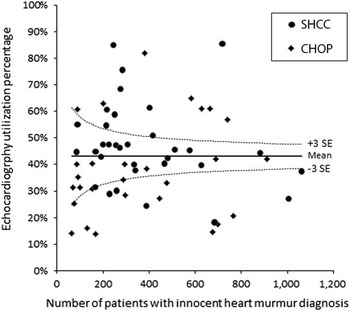
Of the 23,114 (Sibley Heart Center Cardiology 12,815 and Children’s Hospital of Philadelphia Division of Cardiology 10,299) eligible visits in which the sole discharge diagnosis was “innocent murmur”, echocardiography was performed in a combined total of 9951 encounters (Sibley Heart Center Cardiology 5790 and Children’s Hospital of Philadelphia Division of Cardiology 4161). There were 33 out of 38 total cardiologists at the Sibley Heart Center Cardiology and 28 out of 58 total cardiologists at the Children’s Hospital of Philadelphia Division of Cardiology who saw >50 patients with innocent murmurs during the study period. The combined median utilisation of echocardiography by individual physician was 43.1%, with a statistically significant difference in overall utilisation of echocardiography by centre (Sibley Heart Center Cardiology 45.2% and Children’s Hospital of Philadelphia Division of Cardiology 40.4%, p<0.001). There was wide variability in the utilisation of echocardiography by individual physician for the evaluation of murmurs at both centres, with an overall range of 13.9–85.5% (Sibley Heart Center Cardiology 18.3–85.5%, median 45.4%; Children’s Hospital of Philadelphia Division of Cardiology 13.9–81.8%, median 34.7%, p=0.45) (Figs 1 and 2).
Utilisation of echocardiography by individual physician for children diagnosed with innocent heart murmurs displayed from lowest to highest utilisation, demonstrating marked variability among physicians at both Sibley Heart Center Cardiology (SHCC) and the Children’s Hospital of Philadelphia Division of Cardiology (CHOP), with no statistical difference in the overall variability between the two centres (p=0.45).

Funnel plot demonstrating each physician’s echocardiography utilisation, displaying expected variability based on the overall mean and the number of echocardiographic studies that a physician performed. Each dot represents one physician’s total number of patients seen with a diagnosis of innocent heart murmur (x-axis) and that physician’s corresponding overall echocardiography utilisation rate for those patients (y-axis). The heavy line represents the overall mean, and the dotted lines show the upper and lower 3 standard error bounds. There was wide variability, with many physicians at both Sibley Heart Center Cardiology (SHCC) and the Children’s Hospital of Philadelphia Division of Cardiology (CHOP) having echocardiography utilisation rates outside the expected range.

Children in their first month of life represented the age group with the highest utilisation of echocardiography (62.3% overall), with this group also representing the greatest difference in utilisation of echocardiography between the two centres (Sibley Heart Center Cardiology 74.8% versus Children’s Hospital of Philadelphia Division of Cardiology 52.8%, p<0.001). Similarly, there was a significant difference in usage of echocardiography between the two centres for those patients aged between 29 days and 1 year (50.0% overall, with Sibley Heart Center Cardiology 55.7% versus Children’s Hospital of Philadelphia Division of Cardiology 44.2%, p<0.001). Children aged >1–5 years had the lowest utilisation of echocardiography (32.7% overall, Sibley Heart Center Cardiology 34.3% versus Children’s Hospital of Philadelphia Division of Cardiology 30.9%, p=0.001). There were no significant differences between the two centres in the use of echocardiography for patients aged >5 years (Table 1).
Utilisation of echocardiography by age group in patients with innocent murmurs.

CHOP=Children’s Hospital of Philadelphia Division of Cardiology; Echo=utilisation of echocardiography; SHCC=Sibley Heart Center Cardiology
* χ2 test used to compare utilisation of echocardiography
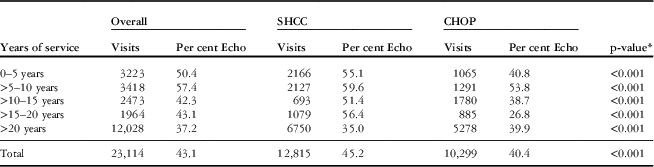
In the analysis of utilisation of echocardiography according to years of service after training, utilisation was the highest among physicians who had >5–10 years of service (57.4%) and was the lowest among physicians with >20 years of service (37.2%). By comparing the centres, there were differing results as to which centre had physicians with higher utilisation of echocardiography for given years of service. Physicians at Sibley Heart Center Cardiology had higher utilisation of echocardiography at all levels of service <20 years; however, physicians at the Children’s Hospital of Philadelphia Division of Cardiology had higher utilisation of echocardiography among those with >20 years of service (Table 2).
Utilisation of echocardiography by physician years of service in patients with innocent murmurs.

CHOP=Children’s Hospital of Philadelphia Division of Cardiology; Echo=utilisation of echocardiography; SHCC=Sibley Heart Center Cardiology
* χ2 test used to compare utilisation of echocardiography
Discussion
In this study, the first one to demonstrate and to compare the utilisation of echocardiography in two large paediatric cardiac centres, we found that the overall utilisation of echocardiography for children with an ultimate diagnosis of innocent heart murmur was 43.1%. There was also a large range in the variation of this utilisation by individual provider from 13.9 to 85.5%. These findings provide valuable benchmarking data demonstrating the use of echocardiography for children with this specific diagnosis. Although appropriate usage criteria for echocardiography have recently been published for paediatric and CHD,Reference Campbell, Douglas, Eidem, Lai, Lopez and Sachdeva 1 these data can now be used alongside these criteria in order to benchmark where there is median utilisation, to demonstrate that there is wide variability in the utilisation of echocardiography among providers, and to highlight areas where attempts to achieve appropriate utilisation may be aimed.
It is striking to see the overall similarities between these two large paediatric cardiology practices. Both the physicians at Sibley Heart Center Cardiology and at the Children’s Hospital of Philadelphia Division of Cardiology had similar overall utilisation of echocardiography for the evaluation of children referred for heart murmurs, and also demonstrated similar degrees of variability among providers. Except for a modest uptick in use by early career providers with 5–10 years of experience, there was also an overall similar decrease in utilisation in the two centres based on the providers’ years of experience. This makes sense in the overall expectation that increasing years of practice leads to improved clinical skills; however, this must be interpreted with caution, as this analysis only reviews a specific time frame; a more helpful comparison would be demonstrated if this assessment was performed in different decades or eras, thus showing whether the downward trend in use with increased experience was consistent. The actual reason for the increase of utilisation among early career providers with 5–10 years of experience is unclear. This may be an aberration associated with the time period that was specifically reviewed, and comparison with a different time frame would be appropriate. It is also interesting to note that, among the most senior cardiologists in Philadelphia, a large number of them had previously been in private practice; it is unclear whether this is a true factor in the utilisation of echocardiography, such as whether their practice incentivised their employees based on the volume of procedures or whether it was merely a coincidence.
Our study also looked at the frequency of ordering echocardiographic studies in the evaluation of innocent murmurs in newborns, infants, older children, and adolescents. Between both centres, there was a similar trend in the frequency of the ordering of echocardiography based on the age of the patient. There was higher utilisation in neonates, followed by a steady decrease in utilisation over the first 5 years of life, and then a modest increase in patients >5 years of age. The difference in the utilisation of echocardiography across patient age groups likely reflects the varying differential diagnoses and disease incidence related to patient age, as well as heightened parental or provider concerns about infants. This is also consistent with the greater incidence of innocent murmurs occurring in toddlers and pre-school aged children. Previous studiesReference Smythe, Teixeira, Vlad, Demers and Feldman 3 , Reference McCrindle, Shaffer, Kan, Zahka, Rowe and Kidd 7 , Reference Mackie, Jutras, Dancea, Rohlicek, Platt and Béland 8 have shown that the typical diagnoses missed by not performing echocardiography are minor, including small atrial septal defects, small ventricular septal defects, small patent ductus arteriosus, and mild pulmonary valve stenosis. Most cardiologists would agree that these are not life-threatening conditions, and that these lesions would either resolve spontaneously or be of little clinical significance in the long run. The question then becomes how much is “allowed” to be missed, as cardiologists are ostensibly the final arbiters of whether a murmur is innocent or pathologic. A general belief among families and primary-care providers is that the cardiac consultation excludes all forms of cardiac pathology; however, initially uncommon lesions that are clinically silent, such as anomalous origin of the coronary artery, or developmental lesions, such as hypertrophic cardiomyopathy, are not likely to be diagnosed in routine cardiology evaluations, unless there is some other suspicion. Nevertheless, with medical-legal concerns and heightened parental anxiety in this information age, there may be a perception that cardiologists are allowed very little leeway in this regard.
The question of the appropriate utilisation of echocardiography in the evaluation of heart murmurs is an important one. Danford et alReference Danford, Nasir and Gumbiner 9 reported in 1993 that echocardiography was not a cost-effective screen for murmur evaluation. We speculate that the increase in utilisationReference Levin, Rao, Parker, Frangos and Sunshine 10 , Reference Blecker, Bhatia and You 11 seen recently in both adult and paediatric cardiology is multifactorial, including technology availability, parent/family concern, increased media awareness, and increased referral patterns from primary-care providers. With the discovery of “new” disorders that are associated with sudden cardiac death in the young, there has been increased awareness not only among care providers but also among family members. Although many of these disorders are relatively rare, particularly in comparison with the common findings of an innocent murmur, the death of a youngster often shakes a community and leads to numerous referrals for evaluation and, ultimately, reassurance. Moreover, one might also assume that the increased utilisation is a negative side-effect of a fee-for-service medical system. Although this is a fair point to consider, a counter to this argument would be that if finances were the driving concern, then all patients presenting for evaluation of a heart murmur would have been evaluated using echocardiography. Furthermore, in the end, increased utilisation of other medical resources has not been demonstrated to create increased health among the community to whom it is provided.Reference Welch, Miller, Welch, Fisher and Wennberg 12
Variability in testing has been demonstrated among cardiologists caring for adult patients.Reference Welch, Miller, Welch, Fisher and Wennberg 12 – Reference Lucas, Sirovich, Gallagher, Siewers and Wennberg 14 The variation in ordering tests among internal medicine cardiologists has repeatedly been shown to be associated with behaviours and attitudes across various regions, whether the patient population includes Medicare beneficiariesReference Lucas, Wennberg and Malenka 13 or not.Reference Lucas, Sirovich, Gallagher, Siewers and Wennberg 14 Our study only looked at two practices within two specific regions, the Northeast and the South, and therefore was not able to discern greater local or regional variation; larger review studies would be needed to assess the same. On the other hand, we feel that this large degree of variability bolsters the importance of the need for appropriate use guidelines, which should help in streamlining the evaluation of these children and potentially contain costs in the long run. These data then should be used as an initial benchmark to help guide the introduction of the paediatric appropriate use criteria. The primary limitations of this study pertain to the use of claims data. Although this methodology affords the opportunity to study large numbers of encounters in an efficient manner, it restricted our analyses to aggregate billing data. Patient-level clinical data were not available. Furthermore, this methodology allows one to answer questions only relating to final diagnoses; because chief complaints are not coded, questions as to overall utilisation for murmur and the sensitivity or specificity of echocardiography are not answerable with these data. It also does not allow for the assessment of the pre-test diagnostic skills of the provider; however, if, as previously discussed,Reference Smythe, Teixeira, Vlad, Demers and Feldman 3 – Reference Newburger, Rosenthal, Williams, Fellows and Miettinen 5 paediatric cardiologists are ostensibly the practitioners who are best suited to make a clinical diagnosis of an innocent murmur without the need for echocardiography, this should not actually be a true concern. This study evaluates utilisation at what are, essentially, two academic medical centres. We do not have data from programmes, either academic or private practice, which may incentivise their providers based, in part, on the volume of the studies performed or directly on the total revenue brought into their practice. It is unknown how this would affect the amount of utilisation, but one could surmise that it might increase median utilisation across the providers in the practice. It may also actually decrease overall variation in utilisation, as the providers would likely consistently test at a higher frequency. Finally, the referral patterns of primary-care providers may influence the utilisation of echocardiography for the assessment of murmurs. In locations in which providers only refer those cases in which a murmur is highly suspicious for cardiac pathology, the use of echocardiography may be higher compared with those areas in which primary-care providers refer nearly all children with heart murmurs for cardiac consultation. For example, although providers at the Children’s Hospital of Philadelphia Division of Cardiology were less likely to perform echocardiography for infants than providers at Sibley Heart Center Cardiology, it is notable that infants represented 28.5% (2933/10,299) of all children with innocent heart murmurs at the Children’s Hospital of Philadelphia Division of Cardiology, but only 22.7% (2911/12,815) at Sibley Heart Center Cardiology, a finding that suggests that referral patterns may differ by age group in different locations.
A particular fact that needs to be kept in mind within the limits of this study is that, although it is tempting to claim that the number of 43% of patients with a final diagnosis of an innocent murmur who also underwent echocardiography demonstrates over-utilisation, this study only serves to benchmark this data. There have not been previous attempts to show this type of utilisation. Previous articles do suggest that paediatric cardiologists should be fairly proficient in the diagnosis of an innocent murmur without the need for imaging.Reference Smythe, Teixeira, Vlad, Demers and Feldman 3 – Reference Newburger, Rosenthal, Williams, Fellows and Miettinen 5 Nevertheless, these data should act merely as the launching point for further attempts to work towards appropriate utilisation of echocardiography in the outpatient setting.
In summary, nearly half of all the children evaluated in the outpatient clinic who had a final sole diagnosis of an innocent murmur underwent echocardiography. This was consistently demonstrated at these two large paediatric cardiology centres. Among the paediatric cardiologists in the two centres, however, the range of utilisation of echocardiography was quite wide, reinforcing the concept that appropriate use criteria are necessary to help limit practice variation and to decrease what may be unnecessary testing. These data can be used to inform further the recently released paediatric appropriate use criteria and to benchmark quality initiatives aimed at educating younger providers and reinforcing the clinical skills of all providers.
Acknowledgement
None.
Financial Support
This research received no specific grant from any funding agency, commercial, or not-for-profit sectors.
Conflicts of Interest
None.
Ethical Standards
The authors assert that all procedures contributing to this work comply with the ethical standards of the Federal Policy for the Protection of Human Subjects, and with the Helsinki Declaration of 1975, as revised in 2008, and has been approved by the institutional committees of both Emory University and the Children’s Hospital of Philadelphia as being exempt.