INTRODUCTION
Increased reliance on domesticated foods was a fundamental change in the history of humankind. Some theories propose that climate changes led to this dietary transition (e.g., Binford Reference Binford, Binford and Binford1968; Brooke Reference Brooke2014; Richerson et al. Reference Richerson, Boyd and Bettinger2001). Others offer cultural and adaptive explanations to account for a reliance on increased levels of food production (e.g., Flannery Reference Flannery1986:19–28; Hayden Reference Hayden1990). Rather than mutually exclusive, climate and cultural explanations can both be correct, as each group of proponents focuses on a different scale of understanding. Climate change can provide ultimate causes whereas local adaptation explains the proximate causes of incipient food production (see Laland et al. Reference Laland, Sterelny, Odling-Smee, Hoppitt and Uller2011; and, of course, Flannery Reference Flannery1986:518–519). Climate change after the Younger Dryas may have been the ultimate cause of domestication in many regions of the world (Bellwood Reference Bellwood2005:20). However, identifying ultimate causes provides only a starting point to understand what and how things happened in the past. Prime mover models (that generally address ultimate causation) have long been criticized by archaeologists for not providing complete explanations of cultural change (e.g., Zeder Reference Zeder2009). However, an incomplete explanation is different from an incorrect one. Climate change and resulting environmental reactions, as well as demography, epidemic disease, or volcanic eruptions, clearly do all affect human evolution. The unique position of archaeology is that our data provide the detailed evidence that allows us to explore proximate human causes for past behavioral change in addition to the more straightforward ultimate causes that generally come from climate and geologic proxy data.
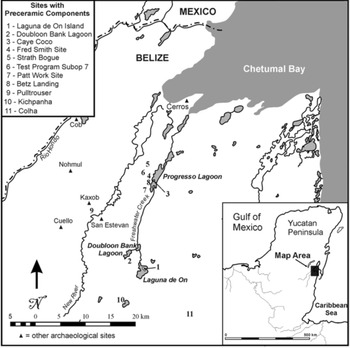
In this article, I propose that two global climatic events—the end of the Younger Dryas (at ~11.7 ka b.p.) and the end of the 4.2 ka b.p. event (at ~3.9 ka b.p.)—could provide the ultimate causes of changing human adaptation that Mesoamerican archaeologists recognize as the beginning and end of the Archaic period. Next, I review the evidence of Archaic period occupation in the tropical lowland region of what is today northern Belize (Figure 1). This review includes regional reconnaissance and excavation initiated by MacNeish (MacNeish and Nelken-Terner Reference MacNeish and Nelken-Terner1983a, Reference MacNeish and Nelken-Terner1983b; Zeitlin Reference Zeitlin1984), work by numerous scholars at Colha (Hester et al. Reference Hester, Iceland, Hudler and Shafer1996; Iceland Reference Iceland1997; Valdez et al. Reference Valdez, Sullivan, Buttles and Aebersold2021), as well as excavation and paleo-environmental reconstruction by Pohl and colleagues (Reference Pohl, Pope, Jones, Jacob, Piperno, deFrance, Lentz, Gifford, Danforth and Josserand1996) in Pulltrouser Swamp. Then I turn to evidence that my colleagues and I have produced of Archaic period occupation in the Freshwater Creek drainage (Rosenswig Reference Rosenswig2004; Rosenswig and Masson Reference Rosenswig and Masson2001; Rosenswig et al. Reference Rosenswig, Pearsall, Masson, Culleton and Kennett2014). A discussion of pan-Mesoamerican adaptive changes that occurred at ~3.9 ka b.p. and at ~3.0 ka b.p. are also included in the musings that follow. The former corresponds to what archaeologists recognize as the transition from the Late Archaic to Early Formative period—with evidence of Mesoamerica's earliest documented ceramic-using villages in a handful of regions. The latter date corresponds to the transition from the Early to Middle Formative period, when the earliest cities and first conical mounds were built in Mesoamerica. Around 3.0 ka b.p. was also when ceramic-using villagers are first documented in the Maya lowlands (Lohse Reference Lohse2010). My use of the labels Archaic and Formative is therefore not strictly temporal, but adaptive. This highlights the fact that Archaic- and Formative-adapted peoples coexisted in Mesoamerica throughout the fourth millennium b.p., forming a mosaic of different adaptations (Arnold Reference Arnold, Skibo and Feinman1999; Clark and Cheetham Reference Clark, Cheetham and Parkinson2002; Rosenswig Reference Rosenswig2006a, Reference Rosenswig and Lesure2011).
Archaic period sites in northern Belize. Map by the author.

Agriculture is defined here as a social process, not a biological one. Foraging peoples can consume cereal grains and other domesticates (that they grow themselves or trade with neighbors), but if this does not result in changes to mobility, social institutions, or population levels, then it would be misleading to call them agriculturalists. Smith (Reference Smith2001) provides a description of the expansive middle ground between people who consume only wild foods and those dependent exclusively on domesticated species. As he points out: “Whether the agricultural boundary is drawn as a specific ‘percentage contribution of domesticates’ line, or defined as a relatively broad clinal zone of transition (e.g., 40–60 percent), it is clear that placement of societies relative to this border will not be a simple task” (Smith Reference Smith2001:10). For example, ceramic-using villagers are first documented in Mesoamerica's lowlands on the Soconusco and Gulf of Mexico coasts during the Early Formative period (3.0–3.9 ka b.p.). However, these early villagers had a diet similar to their Late Archaic predecessors, who were consuming a similar range of domesticates at similarly low levels. Agriculturalists are not documented in either region until nearly a millennium later, when population levels increased significantly, monumental architecture became a defining characteristic of stratified societies. The literature on this transition at ~3.0 ka b.p. is laid out elsewhere (e.g., Arnold Reference Arnold2009; Blake Reference Blake2015; Clark et al. Reference Clark, Pye, Gosser, Lowe and Pye2007; Killion Reference Killion2013; Rosenswig Reference Rosenswig2006b, Reference Rosenswig2012; Rosenswig et al. Reference Rosenswig, VanDerwarker, Culleton and Kennett2015).
There were many pulses of increased use of domesticated plants in Mesoamerica through the Archaic and Formative periods. Further, the type of intensive agriculture that forms the basis of ethnographically known Mesoamerican societies was probably not established until the Late Formative period, between 2.3 ka and 1.7 ka b.p. Early varieties of maize were first grown in what is now known as the Maya lowlands during the Archaic period, and there were successive pulses of increased consumption at approximately 5.0 ka b.p., 4.0 ka b.p., 3.0 ka b.p., and 2.3 ka b.p. A reliance on maize likely only surpassed Smith's (Reference Smith2001) clinal zone of agricultural transition (i.e., 40–60 percent) by the last of these pulses, with the Late Formative period and the dramatic cultural changes instituted. If I had to guess, I would say that maize reached 40 percent in some regions by 3.0 ka b.p., and by ~2.3 ka b.p. approached 60 percent of the diet. Each of the earlier pulses of maize consumption (i.e., 5.0 ka and 4.0 ka b.p.) occurred within the mixed subsistence strategies of tropical lowland horticulturalists.
DEFINING MESOAMERICA'S ARCHAIC PERIOD
End of the Younger Dryas at 11.7 ka b.p.
Mesoamerica's Archaic period lasted for many millennia, beginning after the Younger Dryas (Piperno and Smith Reference Piperno, Smith, Nichols and Pool2012) when precipitation increased and the more predictable Holocene environment was established (Hodell et al. Reference Hodell, Anselmetti, Ariztegui, Brenner, Curtis, Gilli, Grzesik, Guilderson, Muller, Bush, Correa-Metrio, Escobar and Kutterolf2008). This environmental transition was followed by the first documented squash, Mesoamerica's earliest domesticated food plant (Smith Reference Smith1997). In the Near East, production of domesticated species also began at approximately this time (i.e., the Pre-Pottery Neolithic A), when rye, emmer wheat, einkorn wheat, and barley were domesticated (Bar-Yosef Reference Bar-Yosef2011:S181–182). Lentils were also first transported out of their natural habitat at that time and were cultivated and stored (Weiss et al. Reference Weiss, Kislev and Hartmann2006). In regions with species amenable to domestication, a limited number of plants and animals had their physiology altered to better suit the needs of humans (Diamond Reference Diamond1997:104–175). The end of the Younger Dryas thus may be the ultimate cause of early domestication in a variety of unrelated regions of the world (Bellwood Reference Bellwood2005:20; Brooke Reference Brooke2014:131–153). This claim is uncontroversial and has become archaeological common wisdom (e.g., Flannery Reference Flannery1986:514).
The 4.2 ka b.p. Event
The end of another global climatic disturbance—the three-century-long 4.2 ka b.p. event—also corresponds to significant environmental and cultural changes in many areas of the world. Increasing paleoclimatic data suggest that global drought conditions in the northern hemisphere were severe and prolonged (200–300 years) and began at around 4.2 ka b.p. (e.g., An et al. Reference An, Tang, Barton and Chen2005; Arz et al. Reference Arz, Lamy and Patzold2006; Dixit et al. Reference Dixit, Hodell and Petrie2014; Nakamura et al. Reference Nakamura, Yokoyama, Maemoku, Yagi, Okamura, Matsuoka, Miyake, Osada, Adhikari, Dangol, Ikehara, Miyairi and Matsuzaki2016). The 4.2 ka b.p. event led to rapid climate change in the tropical Americas, as it is recorded as an abrupt change in speleothems (stalagmite) records from Peru and Brazil (Bustamante et al. Reference Bustamante, Cruz, Vuille, Apaestegui, Strikis, Panizo, Novello, Deininger, Sifeddine, Cheng, Moquet, Guyot, Santos, Segura and Edwards2016), in Andean ice cores (Davis and Thompson Reference Davis and Thompson2006), and in the biogeochemical composition of peat bogs in Peru (Schittek et al. Reference Schittek, Forbriger, Mächtle, Schäbitz, Wennrich, Reindel and Eitel2015). With precise dating techniques, the synchronicity of these global changes is now widely accepted (Booth et al. Reference Booth, Jackson, Forman, Kutzbach, Bettis, Kreig and Wright2005). In fact, the signal is so pervasive in climate records that it has been suggested as a marker to define the boundary between the Mid and Late Holocene (Walker et al. Reference Walker, Berkelhammer, Björck, Cwynar, Fisher, Long, Lowe, Newnham, Rasmussen and Weiss2012). The onset of the 4.2 ka b.p. event further corresponds to the societal collapse of the Akkadian Empire in Mesopotamia, the end of Old Kingdom Egypt, as well as political collapse in the Levant and Indus Valley (Bar-Matthews and Ayalon Reference Bar-Matthews and Ayalon2011; Carolin et al. Reference Carolin, Walker, Day, Ersek, Sloan, Dee, Talebian and Henderson2019; Weiss Reference Weiss2016; Welc and Marks Reference Welc and Marks2014). The ultimate cause of cultural collapse of multiple Old World civilizations thus appears to be climatic (of course, mitigated through proximate causes of overpopulation, political exploitation, administrative ineptitude, and so on).
Mesoamerican archaeologists have begun to grapple with the implications of this global climatic change that corresponds with the end of our Archaic period (e.g., Awe et al. Reference Awe, Ebert, Stemp, Brown and Garber2021; Ebert et al. Reference Ebert, May, Culleton, Awe and Kennett2017; Kennett et al. Reference Kennett, Thakar, VanDerwarker, Webster, Culleton, Harper, Kistler, Scheffler and Hirth2017), and I have been going on about it for a while (e.g., Rosenswig Reference Rosenswig2006b, Reference Rosenswig2015). Climate records from coastal Chiapas and Guatemala (Kennett et al. Reference Kennett, Piperno, Jones, Neff, Voorhies, Walsh and Culleton2010; Neff et al. Reference Neff, Pearsall, Jones, de Pieters and Freidel2006) and the Peten Lakes (Rosenmeiner et al. Reference Rosenmeiner, Hodell, Brenner and Curtis2002) reflect this climatic event to some degree. Other records from the Maya lowlands detect the onset of dryer conditions at 4.5 ka b.p. (Mueller et al. Reference Mueller, Islebe, Hillesheim, Grzesik, Anselmetti, Ariztegui, Brenner, Curtis, Hodell and Venz2009), and I suspect this is just chronological impression in the time sequencing of this climate proxy record. While climate as the ultimate cause is not universally accepted across the discipline, all Mesoamerican archaeologists would agree that the beginning of a Formative adaptation—that includes permanent villages and the earliest use of ceramic containers—occurred sometime around 4.0 ka b.p. At a minimum, the 4.2 ka b.p. event correlates suspiciously with the timing of such behavioral changes.
A Mixed Horticultural Adaptation: 3.9–3.0 ka b.p.
The years after 3.9 ka b.p. correspond to a new cultural adaptation in a limited number of areas in Mesoamerica. This transition to a Formative way of life did not occur rapidly or universally, but instead was a progressive, millennium-long phenomenon (Clark and Cheetham Reference Clark, Cheetham and Parkinson2002; Rosenswig Reference Rosenswig and Lesure2011). Increased sedentism and the adoption of ceramic containers in various places in Mesoamerica thus followed a centuries-long drought. However, to understand what happened to people in Mesoamerica after ~4.0 ka b.p., we must also account for local cultural responses to climate change (also known as proximate causes). In the case of a handful of rich estuarine and lacustrine environments with abundant aquatic resources (e.g., the Chantuto of the Soconusco region, as well as inhabitants of the Santa Luisa site in north-central Veracruz on the Gulf Coast, and sites on the edges of Lake Chalco in the Basin of Mexico), people were increasingly sedentary during the Late Archaic period (reviewed in Rosenswig Reference Rosenswig2015:127–128, 131–136). These relatively sedentary peoples would have relied on aquatic resources even more during the two or three centuries of drought conditions ushered in by the 4.2 ka b.p. event as vegetation was negatively impacted, further reducing their level of mobility. There is emerging evidence that Mesoamerican peoples also intensified production of domesticates such as maize (which does well in seasonally dry environments) at this time, by changing its physiology to increase the caloric content of each cob (e.g., Kennett et al. Reference Kennett, Thakar, VanDerwarker, Webster, Culleton, Harper, Kistler, Scheffler and Hirth2017). Changing the physiology of maize to increase caloric content compared with teosinte was already long under way (e.g., Piperno and Flannery Reference Piperno and Flannery2001), but changes at ~4.0 ka b.p. and again at ~3.0 ka b.p. likely each represented a pulse of increased caloric productivity of maize cobs. Therefore, a handful of regions in Mesoamerica with access to aquatic resources were more sedentary and may have had higher population densities during the Late Archaic period. Then, after the 4.2 ka b.p. event it was in a subset of these areas that the earliest ceramics are documented early in the fourth millennium b.p.
We do not yet have enough evidence to be definitive about any of this, but the following is my hypothesis to account for the proximate cultural changes of what happened in the centuries around 4.0 ka b.p. After centuries of drought, intensified subsistence practices in some areas of Mesoamerica was the new normal. Therefore, increased rainfall after ~3.9 ka b.p. resulted in the possibility of producing more food for the same amount of work. What was the result of this increased output? Part of this increased output resulted in the population increase evident with the onset of the Formative period, and part likely dissipated into decreased workload. Some part of this surplus, however, was transferred to cultural activities, such as increased feasting and use of fancy ceramic containers, as Clark and Blake (Reference Clark, Blake, Brumfiel and Fox1994) long ago proposed for the Soconusco region of southern Mexico. Clark and Blake's (Reference Clark, Blake, Brumfiel and Fox1994) model of Soconusco aggrandizers engaging in competitive feasts to win prestige is often cited, as it carefully explains the proximate causes of incipient hierarchy, as well as plausibly accounts for the motivation to adopt the earliest, and highly decorated, ceramic vessels in the region. Yet the model never explained why changes occurred when they did. Why, at 3.9 ka b.p., did aggrandizers first emerge in the Soconusco? I propose that the end of the 4.2 ka b.p. event could provide the ultimate cause for why the transition occurred when it did (see also Rosenswig Reference Rosenswig2015:118–120, 143–147). In contrast, in the Maya lowlands, increased sedentism and the use of ceramic containers are not documented until nearly a millennium later, at ~3.0 ka b.p. Importantly, 3.0 ka b.p. was another pulse of intensification, when increased maize consumption changed many aspects of culture in other areas of Mesoamerica, such as the Soconusco (Rosenswig Reference Rosenswig2010; Rosenswig et al. Reference Rosenswig, VanDerwarker, Culleton and Kennett2015). So the proximate behavior could have been very different in the Maya lowlands at ~3.0 ka b.p. than in the Soconusco at ~4.0 ka b.p., when the first ceramics were adopted in each region. As these are the two regions of Mesoamerica where I undertake fieldwork, I cannot help but focus on comparisons between them.
A Pulse of Increased Food Production in Mesoamerica: ~3.0 ka b.p.
Use of maize during the sixth through third millennia b.p. (i.e., Late Archaic and Early Formative periods) was part of a long-lasting, mixed horticultural subsistence strategy that persisted little changed through the adoption of ceramic technologies (Arnold Reference Arnold, Skibo and Feinman1999; Blake Reference Blake2015; Clark et al. Reference Clark, Pye, Gosser, Lowe and Pye2007; Killion Reference Killion2013; Rosenswig Reference Rosenswig2006b). As discussed in the introduction, Late Archaic and Early Formative period peoples all relied on what Smith (Reference Smith2001) refers to as low-level food production. At around 3.0 ka b.p., the importance of maize production increased in some areas of Mesoamerica as part of an overall intensification of food production that also included reliance on fewer animal species, such as deer and dogs (e.g., Rosenswig Reference Rosenswig2007). It is more likely that the organization of society in places like the Soconusco was transformed by a reliance on maize and other domesticates than that the morphology of these domesticates was changed by human selection (Rosenswig Reference Rosenswig2012; Rosenswig et al. Reference Rosenswig, VanDerwarker, Culleton and Kennett2015).
Although not highlighted in discussions regarding the origins of agriculture in the Tehuacán Valley, 3.0 ka b.p. also corresponds to a significant transition in the intensity of domesticate use there. The most dramatic increase in domesticated plant use (and decrease in wild plant remains) is documented in Tehuacán during the period from 3.0 ka to 0.75 ka b.p., the end of the Ajalpan phase (MacNeish Reference MacNeish and Byers1967: Figure 186; with a revised phase dating from MacNeish Reference MacNeish, Evans and Webster2001). The timing of increased consumption of domesticated food plants was therefore coeval in the Tehuacán Valley and the Soconusco—two areas of Mesoamerica that could not be more different in terms of their respective environments (arid highland valley versus tropical lowland jungle) or the types of sites from which dietary evidence was recovered (cave versus village).
Three thousand b.p. further corresponds to major settlement shifts in many areas of Mesoamerica, after which sedentary villagers are first documented in environments where they had been absent during the fourth millennium b.p. On Mexico's Gulf Coast, five separate settlement survey projects independently document an increase in the occupation of upland environments by ceramic-using villagers at this time (e.g., Arnold Reference Arnold2009; Borstein Reference Borstein2001:189; Killion and Urcid Reference Killion and Urcid2001; Kruger Reference Kruger1996:112–117; Symonds et al. Reference Symonds, Cyphers and Lunagómez2002:Figure 4.3). Ceramic-using villagers only inhabited river margins and other lower-lying zones prior to 3.0 ka b.p., and Arnold (Reference Arnold2009:398) argues that increased maize productivity meant that “[p]ermanent settlements and politico-economic relationships that did not rely on floodplain resources became increasingly viable, undermining the control exerted by the extant leadership and their dominant ideology.” A similar expansion of ceramic-using villagers into upland zones at 3.0 ka b.p. is documented in Tlaxcala (Lesure et al. Reference Lesure, Borejsza, Carballo, Frederick, Popper and Wake2006), on the Oaxacan coast (Joyce and Goman Reference Joyce and Goman2012), in the Valley of Oaxaca (Drennan Reference Drennan1976), and in the central Depression of Chiapas (Lowe Reference Lowe1998, Reference Lowe, Lowe and Pye2007). Exploitation of more marginal environments using new technology (or plant species) is a classic measure of intensification (Boserup Reference Boserup1965).
Changes at ~3.0 ka b.p. are also evident in the lowland Maya area, as it is around this date that ceramic-using villagers are first documented in Belize and in the neighboring Peten region of Guatemala (Lohse Reference Lohse2010). Rather than expanding from more fertile fluvial and alluvial soils into less agriculturally productive upland environments (as with the Gulf Coast, Soconusco, Central Chiapas, Tlaxcalan, and Oaxacan cases), the centuries around 3.0 ka b.p. were when ceramic-using villagers are documented in large swaths of the Maya lowlands for the first time (Rosenswig Reference Rosenswig2015:101–102, Reference Rosenswig and Walker2022). The persistence of a non-ceramic-using adaptation is well-documented in northern Belize, even though maize and a variety of other species, including manioc, had long been cultivated by mobile foragers in the region (e.g., Pohl et al. Reference Pohl, Pope, Jones, Jacob, Piperno, deFrance, Lentz, Gifford, Danforth and Josserand1996; Rosenswig et al. Reference Rosenswig, Pearsall, Masson, Culleton and Kennett2014). Recent work at Ceibal (Inomata et al. Reference Inomata, MacLellan, Triadan, Munson, Burham, Aoyama and Yonenobu2015) and Cival (Estrada-Belli Reference Estrada-Belli2011) also documents the earliest ceramic-using villagers in northeastern Guatemala at ~3.0 ka b.p. Ceramic-using villagers are therefore first documented in the Eastern Lowlands of Guatemala and Belize at approximately the same time as previously unoccupied upland zones were settled in various parts of Mexico. Together, these changing settlement patterns reflect a pan-regional population expansion that occurred at the same time as maize consumption increased. However, I suspect that the residents of the Maya lowlands were using the new varieties of maize less intensively than their Soconusco and Gulf Coast neighbors during the first part of the third millennium b.p.
Garber and Awe (Reference Garber and Awe2008) argue that the earliest ceramically defined Cunil phase began at 3.1 or 3.2 ka b.p. (see also Awe et al. Reference Awe, Ebert, Stemp, Brown and Garber2021; Ebert et al. Reference Ebert, May, Culleton, Awe and Kennett2017), and Hammond (Reference Hammond2005) has similarly argued for a start date of 3.2 ka b.p. for the Swasey phase. Lohse's (Reference Lohse2010) assessment of dates from Belize and adjacent areas of Guatemala questions the interpretation that places the earliest ceramics before 3.0 ka b.p. Recently, Inomata et al. (Reference Inomata, Triadan, Vázquez López, Fernandez-Diaz, Omori, Méndez Bauer, Hernández, Beach, Cagnato, Aoyama and Nasu2020) published dates of 3.2 ka b.p. associated with ceramic deposits in Tabasco, Mexico near La Venta, which they propose resemble those ceramics from Guatemala more so than those from surrounding sites on the Gulf Coast. The exact date of the earliest ceramics in the Maya lowlands is still contested, but seems to be within a century or two of 3.0 ka b.p. This was long after ceramic-using villagers had settled in most areas of Mesoamerica. The precise century of the first ceramics in the southern Maya lowlands does not impact the millennium-scale patterns described in this article.
A Recent Argument for Intensive Agriculture in Southern Belize at 4.0 ka b.p.
Kennett et al. (Reference Kennett, Prufer, Culleton, George, Robinson, Trask, Buckley, Moes, Kate, Harper, O'Donnell, Ray, Hill, Alsgaard, Merriman, Merridith, Edgar, Awe and Gutierrez2020) recently claimed that maize was a staple crop in southern Belize soon after 4.0 ka b.p. Based on carbon and nitrogen isotope results from skeletal material recovered in two rock shelters, they define a pre-maize phase (9.6–4.7 ka b.p.) from 17 individuals, a transitional phase of mixed foraging-horticulture (4.7–4.0 ka b.p.) from 10 individuals, and a phase during which maize was a dietary staple (4.0–1.0 ka b.p.) based on the results from 23 individuals. High C4 pathway absorption documented in carbon isotope results is employed as a proxy for maize consumption, and more than 25 percent of the diet is the threshold over which staple agricultural consumption is attributed.
As these results are apparently at odds with the interpretation of Mesoamerican patterns summarized in the previous section, I evaluate them in some detail. First, maize contributing 25 percent to the diet is significantly more than earlier in the Archaic period, but considerably less than Smith's (Reference Smith2001) 40–60 percent threshold, and much less than what Classic period and modern Maya agriculturalists consumed (see Awe et al. Reference Awe, Ebert, Stemp, Brown and Garber2021). Second, the odd 4.0–1.0 ka b.p. periodization used in Awe et al. (Reference Awe, Ebert, Stemp, Brown and Garber2021) collapses three millennia of changes that subsumes the final millennium of the Late Archaic period (i.e., 4.0-3.0 ka b.p.) as well as the entire Formative (3.0–1.7 ka b.p.) and Classic (1.7–1.0 b.p.) epochs each comprised of various phases. The interpretation of the majority of burials in this study (47 of 50) is consistent with the conventional wisdom presented earlier in this article. The pre-4.7 ka b.p. lack of evidence for maize consumption and the transitional 4.7–4.0 ka b.p. period of low-level maize consumption by mixed-foraging horticulturalists are both expected. Further, the 20 individuals with staple maize dependence dating to the Late Formative and Classic periods are also consistent with expectations. There are only three individuals from the Mayahak Cab Pek rock shelter that date to the millennium between 4.0 ka and 3.0 ka b.p.—identified by Kennett et al. (Reference Kennett, Prufer, Culleton, George, Robinson, Trask, Buckley, Moes, Kate, Harper, O'Donnell, Ray, Hill, Alsgaard, Merriman, Merridith, Edgar, Awe and Gutierrez2020:Figure 2) as MNCP.17.2.10b, MHCP.98.3AN.5, and MHCP.14.1.3—who have unexpectedly high C4 levels: High, but within the range of mixed-subsistence horticulturalists.
Depositional context of the Mayahak Cab Pek rock shelter have yet to be fully described. It is therefore worth noting Prufer et al.'s (Reference Prufer, Robinson and Kennett2021:447) description that after 4.0 ka b.p., all depositional contexts contain pottery fragments. If these three burials, dated to the beginning of the fourth millennium b.p., have ceramics associated with them, then C4 levels are not their only unexpected characteristic. So is having ceramics 800–1,000 years earlier than surrounding areas of Belize and Guatemala. However, we are also told that “between 3800 and 2000 cal b.c., sustained mortuary activity increases” (Prufer et al. Reference Prufer, Robinson and Kennett2021:448), indicating that post-depositional disturbance in those levels was extensive in the small 160 km2 protected areas of this rock overhang.
Rock shelters are not typical or frequently used locations for mobile or sedentary societies, so they pose interpretive challenges. Were these overnight camps for local hunting expeditions (as the site is still used for today: Prufer et al. Reference Prufer, Robinson and Kennett2021:446), stopovers for migrating peoples, or sacred burial grounds? Further, could the function of caves and rock shelters have changed by season, decade, or millennium, and then changed back again and again? Determining the range of activities undertaken in rock shelters makes the interpretation of the deposits documented therein difficult. Human interments recovered from under a house floor or in a cemetery at the edge of town provide clear association with a particular community or corporate group. In contrast, human remains found in a rock shelter simply do not. The preservation afforded by caves and rock shelters is alluring, but the interpretive challenges of understanding the behavioral meaning of these contexts is greater than village contexts.
If we accept that the three individuals interred at the Mayahak Cab Pek rock shelter with an unprecedentedly high level of 25 percent maize consumption represents a widespread pattern in southern Belize, then what does it mean to have an isolated pocket of foragers consuming a lot of maize at ~4.0 ka b.p.? What might the proximate causes be for the increased maize consumption in this region? The ultimate explanation for the change in C4 levels could well be increased rainfall at the end of the 4.2 ka b.p. event, as I have outlined previously. I am certainly open to reconstructing an increasingly complex mosaic of differing adaptations across Mesoamerica at this time (e.g., Rosenswig Reference Rosenswig2010:13–46, 2011). I therefore look forward to these authors fleshing out their arguments by enumerating the proximate causes for this localized pulse of maize consumption.
Let us now turn to the archaeological record of the fifth to third millennia b.p. in northern Belize, where Archaic period occupation is currently better documented than elsewhere in the Maya lowlands.
LATE ARCHAIC PERIOD IN NORTHERN BELIZE
Belize Archaic Archaeological Reconnaissance
Following up on his work in the Highlands, MacNeish started the Belize Archaic Archaeological Reconnaissance (BAAR) project in the early 1980s (MacNeish and Nelken-Terner Reference MacNeish and Nelken-Terner1983a; Zeitlin Reference Zeitlin1984). Three seasons of fieldwork documented nine Archaic sites in the northern half of Belize (MacNeish and Nelken-Terner Reference MacNeish and Nelken-Terner1983b:Figure 1). BAAR excavations were undertaken at a number of these sites, including Betz Landing on the west shore of Progresso Lagoon (Figure 1), where a total of 46 m2 was excavated. No features were reported from the excavations at Betz Landing, but a “reddish-brown soil” was located 20–40 cm below the surface, with dates from the mid- to late fourth millennium b.p. (Zeitlin Reference Zeitlin1984:364, Table 1, Figure 2). These three dates all fall within what we now know to be the Late Archaic period (Rosenswig et al. Reference Rosenswig, Pearsall, Masson, Culleton and Kennett2014:Table 1). However, when these data were originally reported, ceramic-using villagers were thought to have been present at Cuello by the beginning of the fourth millennium b.p. (Marcus Reference Marcus1983:459), so the Betz Landing occupation was not attributed to the Archaic period.
Colha
One of the best-studied sites from the Archaic period in the lowland Maya area is Colha. Occupation persisted at this location until the Postclassic period, due to its location within one of the highest-quality chert-bearing zones in Mesoamerica (Hester et al. Reference Hester, Iceland, Hudler and Shafer1996; Iceland Reference Iceland1997; Iceland and Hester Reference Iceland, Hester, Hester, Minelli and Salvatori1996; Kelly Reference Kelly1993; Shafer and Hester Reference Shafer and Hester1983; Valdez et al. Reference Valdez, Sullivan, Buttles and Aebersold2021. Two formal superimposed lithic production areas were documented at Colha. The deeper aceramic deposits provide evidence of uniface production (debris and refits) and are buried beneath a ceramic-bearing surface from the Formative period, with burin spall cores and other diagnostic Formative lithic production debris (Hester Reference Hester, Hester, Shafer and Eaton1994:3; Hester et al. Reference Hester, Iceland, Hudler and Shafer1996:47). The preceramic levels at Colha contained “large amounts of patinated lithic material including constricted unifaces, biface and macro-blade fragments, and debitage, but no ceramics,” with associated radiocarbon dates that range between the fourth and fifth millennia b.p. (Hester et al. Reference Hester, Iceland, Hudler and Shafer1996:45). Unfortunately, no domestic features were documented at Colha. However, in the adjacent Cobweb Swamp, a pollen record shows maize cultivation and forest disturbance as early as 4.5 ka b.p. and intensifying after 3.5 ka b.p. (Jacob Reference Jacob1995; Jones Reference Jones1994). The Colha project also undertook work at the Kelly site (40 km to the south, where the BAAR had reported two Lowe Points) and specialized quarry production was documented (Iceland Reference Iceland1997:62–72). More recent excavation in this area near Burrell Boom continues to recover Archaic tools (McAnany et al. Reference McAnany, Murata, Thomas, Lopez Varela, Finamore and Buck2004).
Recent work at Colha indicates that a mixed forager-horticulturalist adaptation continued at the site from the Archaic into the Middle Formative period (see Valdez et al. Reference Valdez, Sullivan, Buttles and Aebersold2021). So, as in the Soconusco and on the Gulf Coast, decreased mobility and the adoption of ceramic containers did not result in significant dietary changes for about a millennium.
Pulltrouser Swamp
Pohl et al. (Reference Pohl, Pope, Jones, Jacob, Piperno, deFrance, Lentz, Gifford, Danforth and Josserand1996) undertook a paleoecological program of coring and excavations at Pulltrouser Swamp and a number of other nearby wetland areas. This team compiled over 40 radiocarbon dates and documented maize and manioc pollen at Cob Swamp deposited by 5.0 ka b.p., as well as chipped stone from deposits dated to 4.0–2.0 ka b.p. High proportions of tree pollen indicate that maize was grown in an environment dominated by high-canopy, tropical forest with minor disturbance (Pohl et al. Reference Pohl, Pope, Jones, Jacob, Piperno, deFrance, Lentz, Gifford, Danforth and Josserand1996:362). As mentioned, pollen analysis from nearby Cobweb Swamp indicates that only after 3.5 ka b.p. was forest disturbance extensive, with an increase in maize and particulate charcoal in lake cores (Jacob Reference Jacob1995; Jones Reference Jones1994). The dating of both environmental records and archaeologically excavated lithic data is thus consistent with small-scale horticultural societies planting crops in northern Belize by 5.0 ka b.p., with increased environmental impacts occurring 1,500 years later.
Diagnostic Late Archaic Chipped Stone Tools from Belize
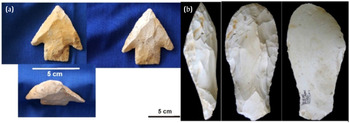
Two lithic tool types traditionally defined Archaic period sites in northern and central Belize: unifacial tools made of macro-flakes as well as stemmed and barbed knives (Awe et al. Reference Awe, Ebert, Stemp, Brown and Garber2021; Stemp and Awe Reference Stemp and Awe2013). Constricted unifaces (Figure 2) are the most well-known of these tools, and use-wear analysis suggests that they were employed to dig soil and cut wood (Iceland Reference Iceland1997:227–229). Both activities are consistent with a horticultural adaptation. Constricted unifaces show a high degree of morphological variability, as they were used and resharpened so that many examples no longer retain a constriction (presumably to strengthen hafting) and are oval in shape. Iceland (Reference Iceland1997:219) documents a high degree of morphological variability in the form of constricted unifaces and 12 percent of his sample of 117 of tools are “pear-shaped,” so that the side notching was lost and replaced with a narrowing of the haft end of these examples. Beyond Belize, similar tools are also known in the Caribbean from the fifth and fourth millennia b.p. (Fitzpatrick Reference Fitzpatrick2011; Wilson et al. Reference Wilson, Iceland and Hester1998).
Examples of (a) a Lowe point and (b) a constricted uniface from the Freshwater Creek drainage. Photographs by the author.

Lowe and Sawmill points are another lithic tool form traditionally associated with the Late Archaic period in Belize (Figure 2a). Two Lowe points were tentatively dated by Kelly (Reference Kelly1993:215) based on a mid-fourth millennium b.p. radiocarbon date from a hearth exposed in an orange soil on the surface 5 m away from a surface-collected example. Pohl et al. (Reference Pohl, Pope, Jones, Jacob, Piperno, deFrance, Lentz, Gifford, Danforth and Josserand1996:Table 1) report another Lowe point at Pulltrouser associated with wood dated to 3810 ± 90 b.p. Due to the limited number of dates and their questionable association with Lowe points, it is more judicious to say that these tools are not dated in northern Belize. In southern Belize, Prufer and colleagues (Reference Prufer, Alsgaard, Robinson, Meredith, Culleton, Dennehy, Magee, Huckell, Stemp, Awe, Capriles and Kennett2019) recently published two complete and two fragmentary Lowe-like points with associated dates that place them at the very end of the Pleistocene or early in the Holocene. As these authors note, MacNeish had long ago called Lowe and Sawmill points “Pedernales-like” in reference to morphologically similar stemmed points he was familiar with in Texas from the fourth millennium b.p. (MacNeish and Nelken-Terner Reference MacNeish and Nelken-Terner1983a:78). Scholars have used the Pedernales-like designation to characterize points found in Oaxaca, Tehuacán, and Honduras, as well as Belize, thus cross-dating all to the fifth and fourth millennia b.p. (reviewed in Rosenswig Reference Rosenswig2015:126–130). If Lowe-like points in southern Belize were first used during the Early Holocene, we still need to determine an end date for this tool form. An additional Lowe-like point recovered in 2019 from another rock shelter in southern Belize was dated as much as 1,300 years more recent (6.9–6.6 ka b.p.), so the dating of these tools is still emerging (Prufer et al. Reference Prufer, Robinson and Kennett2021:Figure 8). Another issue that also requires resolution is whether Lowe and Sawmill points were contemporaries or sequentially used, as both point forms likely served similar purposes, as originally argued by Kelly (Reference Kelly1993) and, more recently, by Lohse (Reference Lohse2020).
FRESHWATER CREEK DRAINAGE
Orange Soils and Patinated Lithics
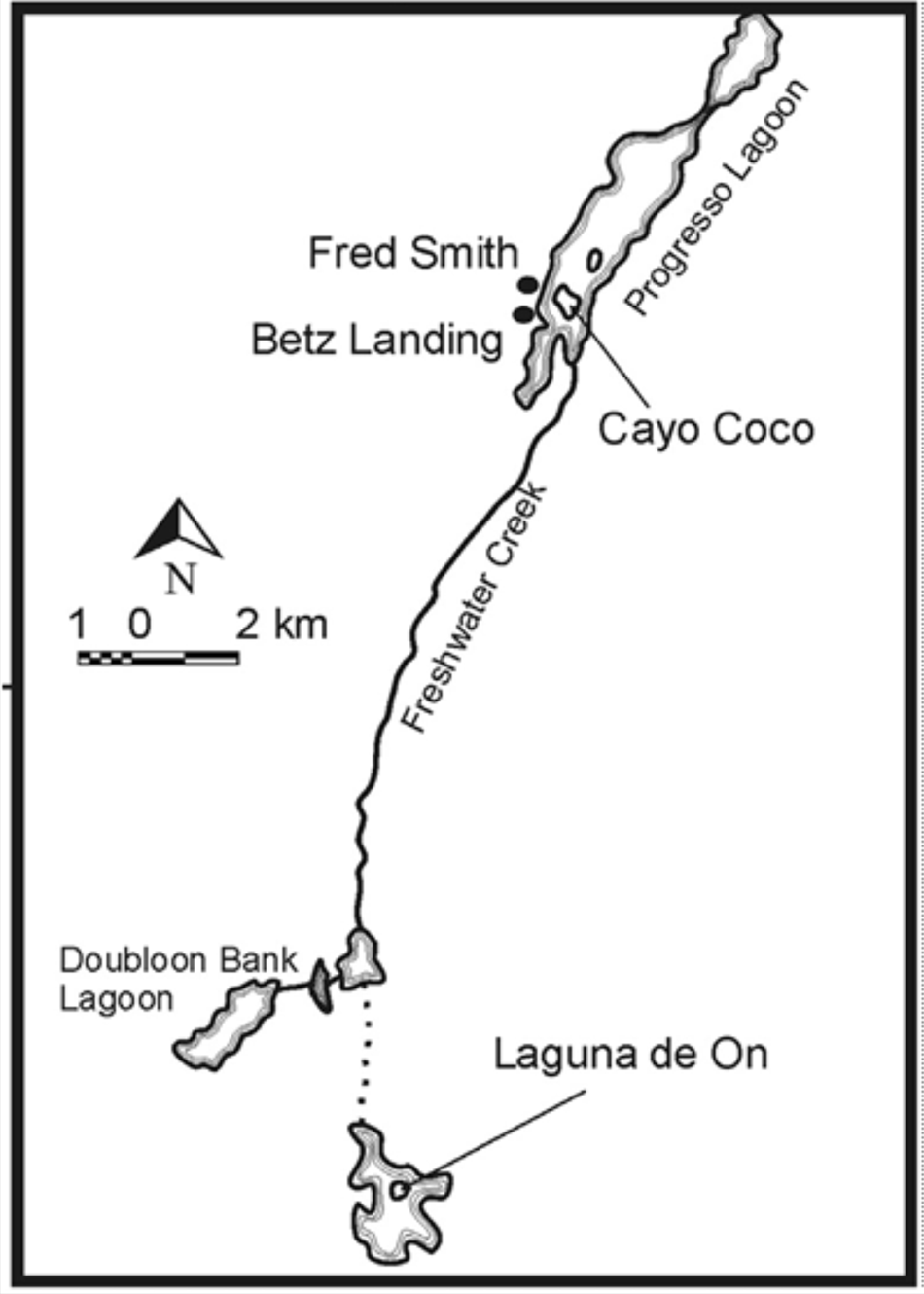
Archaic period deposits around Progresso Lagoon are found in a distinctive orange soil that appears not to have been formed through sedimentary processes. Where encountered, these orange soils are always located directly above limestone bedrock. We do not yet fully understand why this orange soil is associated with Archaic occupation, but when modern construction activities expose it, we have consistently found patinated lithics and an absence of ceramics. Eight Archaic-age sites are currently published from the Freshwater Creek drainage, six of which are from orange soils on the west side of Progresso Lagoon (Rosenswig Reference Rosenswig2004; Rosenswig and Masson Reference Rosenswig and Masson2001). These sites provide a glimpse of the buried universe of Archaic period settlement (Figure 3).
Freshwater Creek drainage and the location of Archaic sites. In the scale bar, 1 km is divided into 200 m segments to the left, and 2 km is divided into 1 km segments to the right. Map by the author.

A new phase of research began in 2019 and documented two dozen new sites with orange soils through systematic augering. Excavations at three of them revealed aceramic deposits containing patinated lithics. With National Science Foundation funding for five more seasons of work in hand, we hope to generate a detailed regional picture of Archaic period adaptation and land use, combined with new paleo-environmental records from pollen and charcoal taken from adjacent lakes.
Settlement locations include island sites at Laguna de On Island and Caye Coco; shoreline sites at Doubloon Bank Lagoon, as well as Fred Smith and Betz Landing at Progresso Lagoon, and upland sites including Strath Bogue, Patt Work site, and Progresso Test Program: Subop 7 (Figure 1). At all of these sites, heavily patinated stone tools were recovered. Patination results from the chemical exchange of calcium carbonate from the underlying limestone to form an outer rind on the surface of chert tools. The patina ranges from 1 to 5 mm in thickness and gives these Archaic tools a distinctive clean, white appearance that obscures the natural color of the lithic material from which they were made. In contrast, Formative and Classic period chert tools from the area can have a light patina “wash” that does not obscure the character of the raw material. Together, distinctive orange soil and heavily patinated lithics make identification of Archaic period sites at Progresso Lagoon quite simple.
Caye Coco
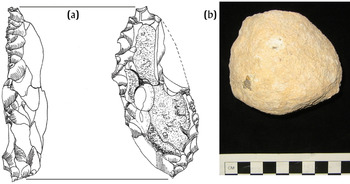
At Caye Coco, the distinctive orange aceramic soil stratum is approximately 15 centimeters thick and is located between 60 and 80 centimeters below the ground surface over an area of at least 150 square meters (Rosenswig et al. Reference Rosenswig, Pearsall, Masson, Culleton and Kennett2014). Pit Feature 1 originated 60 cm below the ground surface on the west side of this aceramic deposit, underlying a Terminal Classic artificial terrace. Pit Feature 2 was documented 24 m to the west of Pit Feature 1 and right next to a posthole documented within the orange soil. A patinated, plano-convex unifacial tool (Figure 4a), as well as a hammerstone (Figure 4b) and numerous patinated flakes, were recovered from within the same stratigraphic layer of orange soil, 15 cm thick, from which Pit Feature 2 descends into the limestone bedrock.
(a) Plano-convex unifacial tool and (b) hammerstone from Archaic deposits at Caye Coco. Drawing and photograph by the author.

Radiometric dating of the preceramic deposits at Caye Coco is enigmatic. Two carbonized wood samples were AMS radiocarbon dated from Pit Feature 2. These dated wood samples were recovered from a floated soil sample and botanical remains were hand-picked from light fractions using metal forceps. The calibrated two-sigma ranges of the Pit Feature 2 dates are 8.32–8.18 ka b.p. (UCIAMS-17908) and 6.73–6.56 ka b.p. (UCIAMS-17909). The two dates from Pit Feature 2 are earlier than those from other Archaic sites known from the area. Dating carbon from flotation is not ideal and these dates from the same feature are from two millennia apart. I do not claim, therefore, that such early dates indicate evidence of occupation (or maize use) in northern Belize at this time. Bioturbation clearly brought these two dated wood samples into Pit Feature 2. It would not surprise me if these were samples of old wood and the Archaic of the Freshwater Creek sites date to millennia later, such as the 5.0–3.0 ka b.p. documented by the Colha and Pulltrouser pollen data. That said, a mid-seventh millennium b.p. occupation of Caye Coco with maize use (see below) would be roughly contemporaneous with patterns reported from the Gulf Coast lowlands (Pope et al. Reference Pope, Pohl, Jones, Lentz, Von Nagy, Vega and Quitmyer2001). While bioturbation may also be responsible for the Gulf Coast dates (Sluyter and Dominguez Reference Sluyter and Dominguez2006; but see response by Pohl et al. Reference Pohl, Piperno, Pope and Jones2007), maize use on the Gulf Coast and in northern Belize during the seventh millennium b.p. is consistent with maize reported in the Balsas by 8.7 ka b.p. (Piperno et al. Reference Piperno, Ranere, Holst, Iriarte and Dickau2009) and coastal Chiapas by 6.5 ka b.p. (Kennett et al. Reference Kennett, Piperno, Jones, Neff, Voorhies, Walsh and Culleton2010). Maize use at such an early time in the Maya lowlands is certainly possible, but not conclusive.
Fred Smith
Excavations were also undertaken at the Fred Smith site on the west shore of Progresso Lagoon, 400 m across the water from Caye Coco and 500 m to the north of Betz Landing (Figure 3). When we encountered the site during the summer of 2001, the area of approximately 800 square meters had been stripped of topsoil by heavy machinery in preparation for house construction (Rosenswig et al. Reference Rosenswig, Pearsall, Masson, Culleton and Kennett2014). The bulldozing had exposed orange soils and heavily patinated lithic material was abundant in the disturbed area. Systematic surface collections at the Fred Smith site recovered a total of 358 patinated lithic objects, including 10 unifacial tools, two expedient bifaces and two formal biface fragments, as well as numerous flakes and shatter. Excavations of an undisturbed portion of the site documented more of the orange aceramic soil horizon in which patinated lithics were recovered and ceramics were absent. Unlike Caye Coco, the aceramic orange soil of this site began directly below the active topsoil, at 20 cm below the current ground surface and approximately 30 to 40 centimeters above the bedrock. In the undisturbed zone of the Fred Smith site there is no indication of a buried orange soil visible from the surface.
Without modern land disturbance, we would not have been aware of the existence of the Fred Smith site. This pattern of buried aceramic orange soils containing patinated lithics was also documented in the area as a result of mechanical earthmoving activities at the Patt Work site. In other fortuitous instances, the orange soils and Archaic lithics were documented at the bottom of test pits excavated to document later period sites (e.g., Strath Bogue and Test Program Subop 7).
Orange soils are not an indication of Archaic period sites north and south of Progresso Lagoon. The quantity of orange soil increases as one moves north towards the modern city of Corozal, but we have not found an Archaic site in this area. North of the international border in the southern part of Quintana Roo, Mexico orange soils are even more abundant and periodic examination of highway construction activities over the past two decades has never encountered patinated lithics. Furthermore, to the south of Progresso Lagoon there are no orange soils around the Freshwater Creek; Archaic tools were recovered in white clays at Laguna de On and Doubloon Bank Lagoon (Figure 3). The local geology is complex and we do not yet understand why orange soils and patinated lithics co-occur around Progresso Lagoon.
Laguna de On Island
Laguna de On Island was the first place we documented patinated Archaic lithic tools and debitage below the Postclassic occupation of the island (Rosenswig and Masson Reference Rosenswig and Masson2001). These Archaic period deposits were documented at the base of an initial 1 × 1 m unit and contained macro-flake tools, including a heavily resharpened uniface that was probably originally constricted. We extended the excavation to a 1 × 4 m trench that documented cultural deposits more than 2 m deep. A program of test augering around this unit at Laguna de On revealed that there were at least two more such Postclassic intrusions into aceramic clays on the island to the south and east of the 1 × 4 m trench (Rosenswig et al. Reference Rosenswig, Pearsall, Masson, Culleton and Kennett2014). The depth of these clays in some test auger holes was significantly greater than surrounding test auger locations, indicating that at least two other Postclassic pits into bedrock exist on the island.
Starch Evidence of Domesticates
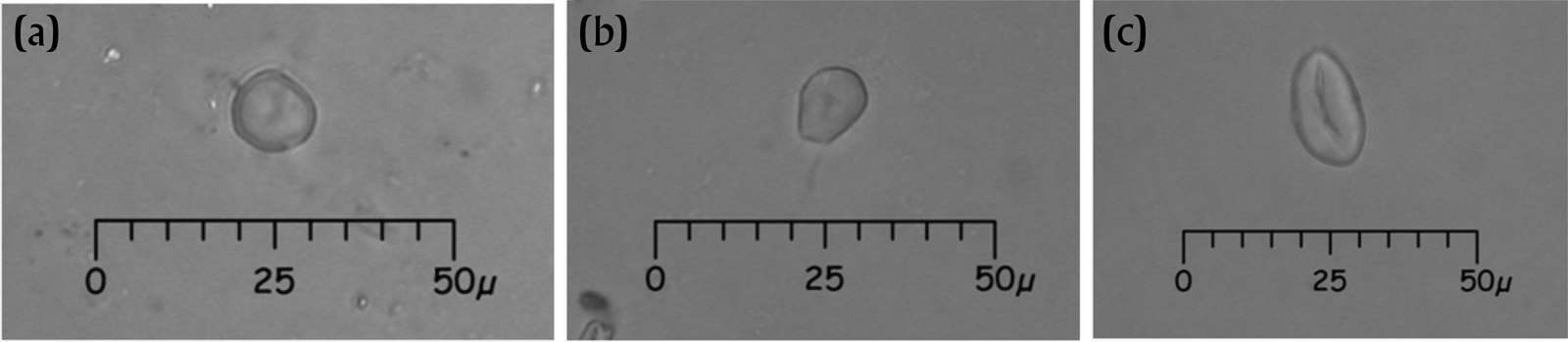
Starch remains were recovered from all seven tools we tested from the Freshwater Creek drainage (Rosenswig et al. Reference Rosenswig, Pearsall, Masson, Culleton and Kennett2014). Maize was the most common starch recorded. There are 57 securely identified maize granules, along with an additional 24 granules that resemble maize. Maize starch granules are simple, with a central, open hilum and a distinct and continuous double border (Figure 5a). Maize with hard endosperm (pop and flint) is characterized by many starch granules with pressure facets, while soft (flour) endosperm maize has more granules that are smooth. Both types of granules (faceted and smooth) are present in both hard and soft endosperm maize, and both types were present on the Freshwater Creek tools studied. This indicates that multiple varieties of maize were already under cultivation in northern Belize during the Archaic period.
(a) Maize, (b) manioc, and (c) chili pepper starch remains from the Archaic period at Freshwater Creek, northern Belize. Photographs by Deborah Pearsall for the Belize Archaic Project (Rosenswig et al. Reference Rosenswig, Pearsall, Masson, Culleton and Kennett2014).

Starch remains from manioc, chili pepper, beans, and squash were also present in small numbers on some tools. Capsicum starch was recovered from the seven tools tested. Domesticated chili peppers produce large, flattened starch granules that are circular in outline, with a shallow central depression visible in the flat view. Two manioc starch granules were recovered, both from the Caye Coco. Domesticated manioc produces compound starch; granules have an open, centric hilum and usually one to three basal facets. Several kinds of less diagnostic starches were also recovered from the tools. Four Fabaceae (bean family) granules were documented from a formal biface recovered at the Fred Smith site. Starch granules of domesticated Phaseolus and Canavalia beans are large, elliptical to irregular in outline, and somewhat flattened in side view, with pronounced irregular, linear fissures. The granules recovered in this study were small, but of similar form, suggesting the bean family. A single Cucurbitaceae (squash family) starch granule was recovered from the Caye Coco. This starch grain is an oblong hemisphere with a deeply indented base (bell-shaped), which is found in a number of genera in the squash family. Starch results from the Archaic period tools in the Freshwater Creek provide preliminary association between tools and early economic plant use from the lowland Maya area.
Regional Patterns of Archaic Lithic Use
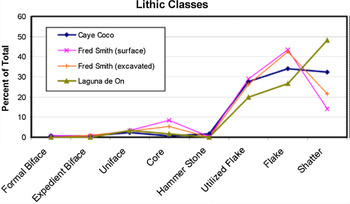
A total of 778 patinated lithics were recovered from Caye Coco, the Fred Smith site (from the surface and excavated contexts) and from Laguna de On Island. Figure 6 provides a graphical comparison of the four lithic assemblages. The proportion of different lithic classes from the surface and excavated samples at the Fred Smith site is virtually identical. This overlap suggests that the systematically collected surface assemblage unearthed by heavy machinery originated from the same context as the tools from intact deposits sampled by our controlled excavations.
Lithic patterns from three Archaic sites in the Freshwater Creek drainage. Graph by the author.

The lithic assemblages from the Fred Smith site on the shore of Progresso Lagoon differ from the lithic materials recovered from the islands of Caye Coco and Laguna de On. The Fred Smith assemblage contains more cores and more flakes than the island settlements, but the numbers of cores in all locations are low. The sites of Caye Coco and Laguna de On contain more shatter than Fred Smith, but shatter is present at all sites in proportions of 14–21 percent at Fred Smith, and 32–48 percent at Caye Coco and Laguna de On. Shatter in this study is defined as blocky debris that lacks clear flake attributes, especially a striking platform. These observations suggest that lithic artifacts were being reduced differentially on the two islands compared to the Fred Smith site. More tools may have been broken or more expedient production occurred on the islands. The overlap in all tool types, especially materials other than flakes and shatter, is more significant in characterizing the use of the lithic assemblage. Tool patterns link all three sites to a similar Archaic technological tradition.
Sites with systematically different lithic patterns may reflect diverse activities undertaken, especially when these sites were from different locations on the local landscape. Crops such as maize may have been preferentially planted on large islands like Caye Coco (measuring 24 ha) or smaller Laguna de On (measuring 0.38 ha), as they would have been protected from grazing animals, such as deer. However, these plots of island land were relatively small and areas along the shore were likely also cultivated. The use of islands as protected locales would have been particularly advantageous for mobile horticulturalists who foraged at distant locations while their crops grew. Archaic peoples in northern Belize were comfortable in a variety of habitats, including aquatic and wetland zones, and the planting of crops was one of many subsistence activities. The sample of known sites remains small, but these preliminary patterns provide an initial regional glimpse of Archaic peoples’ adaptation to the local landscape.
Colha is located approximately 25 kilometers from the southern end of Progresso Lagoon. Traveling down Freshwater Creek to Laguna de On by canoe and then walking overland the 10 km to Colha (Figure 1) would have made these lithic raw material sources easily accessible to mobile peoples. With NAA data, Iceland (Reference Iceland1997:230–231) documented finished constricted unifaces found at sites outside the chert-bearing zone with no access to local raw material with which to make the tools. The Archaic period stone tools from the Freshwater Creek drainage conform to Iceland's observations. One reason for the concentration of discovered Archaic-age sites in northeastern Belize may have been the lure of this chert resource for preceramic peoples. Of course, the concentration of this raw material in the area could simply be providing a more easily identifiable material record for archaeologists compared to contemporary groups in other areas using tools made of more perishable materials. Archaic period evidence from the Freshwater Creek drainage provides a glimpse of how the tools made of Colha chert were being used for horticultural activities in surrounding areas.
DISCUSSION
What makes the lowland Maya area distinct during the fourth millennium b.p. is that it was the last large region of Mesoamerica where ceramics and village life are documented. For eight of nine centuries, a mobile way of life without ceramic containers persisted, while incipient chiefs emerged in ever-larger villages in places such as the Soconusco, Valley of Oaxaca, and Basin of Mexico, and while the precocious center of San Lorenzo rose and fell. Elsewhere, I outline two competing hypotheses that account for the proximate cause of the earliest evidence of ceramics and village life in the Maya lowlands at ~3.0 ka b.p. (Rosenswig Reference Rosenswig and Walker2022)—that is, either that local foragers adopted ceramic containers and lived in more sedentary villages, or else people with such an adaptation migrated in from the south and west. I conclude that a long-standing, local population of mobile forager-horticulturalists in northern Belize adopted ceramic containers and reduced their residential mobility in the centuries around 3.0 ka b.p., only once maize productivity had increased enough to sustain forager-horticulturalists in a tropical lowland environment known to be lacking in carbohydrates (Rosenswig Reference Rosenswig and Walker2022:11–20).
If Kennett et al.'s (Reference Kennett, Prufer, Culleton, George, Robinson, Trask, Buckley, Moes, Kate, Harper, O'Donnell, Ray, Hill, Alsgaard, Merriman, Merridith, Edgar, Awe and Gutierrez2020) isotope results of 25 percent of diet coming from C4 plants indicate that the entire local population of southern Belize consumed so much maize early in the fourth millennium b.p., then the end of the 4.2 ka b.p. event may be the ultimate cause of this dietary change. However, there is not yet evidence that reduced mobility, permanent villages, or ceramic technology accompanied this change of diet documented among the three individuals buried in the Mayahak Cab Pek rock shelter. Working out the proximate human behavior that accounts for small groups of mobile, non-ceramic-using peoples consuming diets with 25 percent C4 plants may attest to the variability in adaptations found across Mesoamerica at this time.
Dietary reconstructions of the residents of northern and central Belize indicate that low levels of C4 plants were consumed until the end of the Middle Formative period (3.0–2.3 ka b.p.). Carbon and nitrogen isotope results from skeletons at Cahal Pech in central Belize indicate that low levels of C4 plants were consumed prior to 2.4 ka b.p. (Powis et al. Reference Powis, Stanchly, White, Healy, Awe and Longstaffe1999). Further, individuals in different areas of the site consumed different quantities of maize and reef fish based on faunal and botanical analyses (Powis et al. Reference Powis, Stanchly, White, Healy, Awe and Longstaffe1999:374). Such variability emphasizes the perils of employing a single deposition context to generalize about an entire population. Isotope and faunal data also demonstrate that residents of Cahal Pech transported reef fish 110 km upriver from the Caribbean Sea. At Cuello in northern Belize, and within 20 km of Progresso Lagoon (Figure 1), a sample of 54 human burials generated isotope results that actually show a decrease in C4 levels through the Middle Formative period (Tykot et al. Reference Tykot, Van der Merwe, Hammond and Orna1996). Furthermore, of five domestic dogs sampled from Formative period Cuello, three have no evidence of C4 consumption, whereas two others have levels significantly above that of any humans at the site. The authors propose that these canids may have been fattened up with maize to be served at feasts (Tykot et al. Reference Tykot, Van der Merwe, Hammond and Orna1996:358). The salient point is that isotope results from central and northern Belize indicate that maize and other C4 plants were not dietary staples until quite late in the Formative period—possibly not until the Late Formative period after 2.3 ka b.p.
Diets were variable across Mesoamerica during the third and fourth millennia b.p., and even within the small modern nation of Belize. The same types of plants and animals (both wild and domestic) were consumed by all, but in varying proportions. Preliminary evidence from the Freshwater Creek drainage documents people living without ceramic containers or permanent villages who were nonetheless cultivating a range of domesticates—including maize, manioc, chili peppers, beans, and squash. Such cultivation was occurring at low levels and did not affect other aspects of settlement patterns or material culture. These “archaically-adapted peoples” occupied islands, shorelines, and upland locations and used an array of stone tools, including unifacial hoes, bifacial knives, hammerstones, expedient and formal oval bifaces, as well as frequently used flakes as expedient cutting tools. Comparisons from Caye Coco, Laguna de On, and Fred Smith suggest that different relative proportions of activities were carried out at island and shore sites. Such regional evidence will be required to understand Archaic period adaptation and to make meaningful behavioral comparisons with subsequent ceramic-using villagers who are currently much better-known.
CONCLUSION
The transition from an Archaic to a Formative adaptation in Mesoamerica was “messy,” as a mixture of adaptations changed at different rates in different places. Foragers had already become increasingly sedentary by the fifth millennium b.p. in a handful of regions, such as the lowland estuaries of the Soconusco and Gulf Coast, as well as around highland lakes such as those in the Basin of Mexico. In such environments, reduced mobility accompanied subsistence practices that focused on low-level food production and the exploitation of aquatic resources. Some of these regions of increased Archaic period sedentism were later where ceramic-using villagers are first documented after rainfall levels increased at ~3.9 ka b.p. The number of regions in Mesoamerica where sedentary villagers using ceramic containers are documented then increased throughout the fourth millennium b.p. During this millennium, ceramic-using villagers were found almost exclusively close to sources of permanent water and stable food resources contained therein. Then, in the centuries around 3.0 ka b.p., ceramic-using villagers across Mesoamerica expanded their range from estuary, river, and lake margins into adjacent upland areas. This time period was also when Formative-adapted peoples were documented in the Maya lowlands for the first time—between ~3.2 ka and 2.8 ka b.p., depending on the area.
Understanding why long-lasting Archaic adaptations were replaced by a more settled village lifestyle that included new tools (such as containers made of fired clay) is a central comparative anthropological issue. In northern Belize (as elsewhere), regional patterns of the final few millennia of the Archaic period need to catch up with what is currently understood of the earliest ceramic-using villagers in order to reconstruct the behavioral changes that occurred. Maize and other domesticates were long-used in the region, so their presence alone cannot explain a reduction in mobility or adoption of ceramic technology. It may, in fact, be the other way around—that sedentism and ceramic use were the causes for forager-horticulturalists to apply selective pressure on the domesticated plants they were already eating to increase calories or other nutritional content of what had been, up to that point, only a minor supplementary food source. Determining the proximate, behavioral causes of forager interaction with the plants they were domesticating will require regional archaeological data to document local adaptation and variability of dietary and settlement choices.
RESUMEN
El cuarto milenio a.C. provee un caso interesante de poblaciones móviles sin cerámica en las tierras bajas mayas, al mismo tiempo que en otras partes de Mesoamérica se documentan aldeas donde se usaba la cerámica. En lugar de preguntar por qué los recipientes cerámicos y la vida aldeana tardaron tanto en llegar a las tierras bajas mayas, la pregunta se puede invertir para postular que una adaptación mixta de horticultura y recolección fue tan efectiva que persistió más tiempo que en otros lugares. Se propone que el evento 4.2 ka a.P. fue la última causa del aumento del sedentarismo y la primera adopción de recipientes cerámicos en un número limitado de regiones de Mesoamérica. Estas reflexiones se basan en las comparaciones de datos de la región de Soconusco en el sur de México y la evidencia del norte de Belice en Colha y Pulltrouser Swamp, así como en la cuenca de Freshwater Creek. Se supone que el comportamiento próximo debe tener en cuenta las adaptaciones locales y los diferentes ritmos de cambio en cada región de Mesoamérica. Por lo tanto, la adaptación regional en el norte de Belice durante el período arcaico tardío proporciona la evidencia con la que se puede reconstruir la adaptación local. Las excavaciones y la prospección regional documentan un horizonte de suelo anaranjado distintivo en la zona de la laguna Progresso, asociado con herramientas silíceas con pátinas y la ausencia de cerámica. Los conjuntos de herramientas de piedra de los componentes precerámicos en la región indican una separación espacial del uso y reafilado de herramientas en el sitio de la costa versus los dos sitios de las islas. Los gránulos de almidón recuperados de estas herramientas de piedra indican que las poblaciones precerámicas del norte de Belice cosecharon maíz y varias otras especies de plantas domesticadas. Estos datos son consistentes con estudios paleoambientales locales que documentan un período prolongado de actividad hortícola durante el quinto y cuarto milenio antes de la adopción de la cerámica. Los conjuntos líticos y la información dietética asociada de múltiples sitios brindan atisbos de los datos necesarios para reconstruir la adaptación del período arcaico tardío a partir de una sola región local. Estos datos serán necesarios para comprender las causas próximas de la transición a una vida aldeana más sedentaria.
ACKNOWLEDGMENTS
Stimulating conversations over the past two decades with Kazuo Aoyama, Flip Arnold, Jaime Awe, Mike Blake, Kat Brown, Richard Burger, David Cheetham, John Clark, Anabel Ford, Jim Garber, Norman Hammond, Takeshi Inomata, Doug Kennett, Jon Lohse, Marilyn Masson, Hector Neff, James Stemp, Fred Valdez, Barbara Voorhies, and Harvey Weiss have all contributed to my ideas in this article. I also acknowledge Joyce Marcus and three anonymous reviewers whose comments on earlier versions of the article made the finished product better, and Nan Gonlin for her patience. None of these people are to be held responsible for any flaws, which are solely my own.