Introduction
The Ordovician is a crucial period for the early evolution of stromatoporoids, manifested by their first-known appearance (Li et al., Reference Li, Li and Kiessling2017; Jeon et al., Reference Jeon, Li, Oh, Choh and Lee2019) and early diversification (Webby, Reference Webby, Webby, Paris, Droser and Percival2004). Stromatoporoids achieved one of their highest-diversity and widest-circumequatorial distributions throughout the late Middle to Late Ordovician times, as many as 26 genera on a global scale (Webby, Reference Webby1979c, Reference Webby1980, Reference Webby1994, Reference Webby, Webby, Paris, Droser and Percival2004, Reference Webby and Selden2015a; Stock et al., Reference Stock, Nestor, Webby and Selden2015). Among them, labechiids, which are grouped by common internal morphological characteristics of cyst plates, denticles, and pillars, were predominant stromatoporoids (Webby, Reference Webby and Selden2015a).
After the appearance of the pioneering genus Cystostroma in the early Floian in South China (Li et al., Reference Li, Li and Kiessling2017; Jeon et al., Reference Jeon, Li, Oh, Choh and Lee2019), 12 labechiid genera demonstrate stromatoporoid diversification in the late Darriwilian from North China, Sibumasu, Siberia, Tasmania, and Laurentia (Stock et al., Reference Stock, Nestor, Webby and Selden2015), in conjunction with significant global-scale development of reef-building organisms, including bryozoans, sponges, and corals (Carrera and Rigby, Reference Carrera, Rigby, Webby, Paris, Droser and Percival2004; Webby, Reference Webby, Webby, Paris, Droser and Percival2004, Reference Webby and Selden2015a; Ernst, Reference Ernst2018; Servais and Harper, Reference Servais and Harper2018). During this period, stromatoporoid species in different terranes show a high level of endemism (Nestor and Webby, Reference Nestor, Webby, Harper and Servais2013; Stock et al., Reference Stock, Nestor, Webby and Selden2015). Subsequently, provincial species gradually dispersed to other neighboring regions, resulting in an increased diversity level, with 19 genera recorded in the Katian (Webby, Reference Webby, Webby, Paris, Droser and Percival2004; Stock et al., Reference Stock, Nestor, Webby and Selden2015).
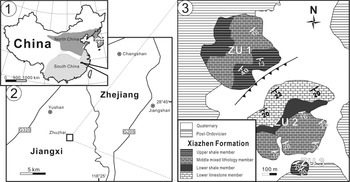
Upper Ordovician carbonate successions of South China yield skeletal-dominated reefs within the Jiangshan−Changshan−Yushan (JCY) triangle area near the border between Jiangxi and Zhejiang provinces of southeastern China (Chen et al., Reference Chen, Rong, Qiu, Han, Li and Li1987; Webby, Reference Webby, Kiessling, Flügel and Golonka2002; Zhang et al., Reference Zhang, Chen, Yu, Goldman and Liu2007; Lee et al., Reference Lee2012; Li et al., Reference Li, Li and Kiessling2015; Fig. 1.2). Stromatoporoids are among the most common reef components, in both volume and abundance, through the Upper Ordovician succession of South China, but these taxa have not been studied in detail. Only brief information is available in previous geological and stratigraphic studies (Chen et al., Reference Chen, Rong, Qiu, Han, Li and Li1987; Chen, Reference Chen1995, Reference Chen1996; Bian et al., Reference Bian, Fang, Huang and Fan1996; Webby, Reference Webby, Kiessling, Flügel and Golonka2002; Zhang et al., Reference Zhang, Chen, Yu, Goldman and Liu2007; Lee et al., Reference Lee2012). As a result, South China was not considered significant in terms of the biogeographic patterns of Ordovician stromatoporoids in recent publications (e.g., Nestor and Webby, Reference Nestor, Webby, Harper and Servais2013; Stock et al., Reference Stock, Nestor, Webby and Selden2015). It has been postulated that South China and Australia (especially New South Wales) may have had a close biogeographical relationship during Late Ordovician time, judging from the occurrence of few common clathrodictyid stromatoporoids (Lin and Webby, Reference Lin and Webby1988, Reference Lin and Webby1989), but species-level taxa of labechiids have not been evaluated.
(1) Geographic map of China showing South China. (2) Enlargement of the study area near the border between Jiangxi and Zhejiang provinces. The Zhuzhai section is indicated by the white square. (3) Geological map of the Xiazhen Formation, which is divided into three subsections: ZU 1, ZU 2, and ZU 3.

A recent study of Late Ordovician stromatoporoids revealed a total of 11 stromatoporoid genera from the Xiazhen Formation and indicated that South China was also one of the loci for the diversification of early stromatoporoids (Jeon et al., Reference Jeon, Liang, Park, Choh and Lee2020a), in accordance with extensive reef developments during the Great Ordovician Biodiversification Event (Servais and Harper, Reference Servais and Harper2018). Labechiids in the formation belong to eight genera and are much more diversified than the clathrodictyids (Jeon et al., Reference Jeon, Liang, Park, Choh and Lee2020a). In this study, we carried out detailed species-level taxonomic work and report 16 labechiid species from the Xiazhen Formation. Judging from the occurrences of labechiid species, we propose a paleobiogeographic relationship between peri-Gondwanan terranes and others during the Ordovician Period.
Geological setting
The Upper Ordovician Xiazhen Formation at Zhuzhai, Yushan County, is one of the best-exposed Ordovician carbonate successions in the JCY area. It is well known for the occurrence of diverse invertebrate marine organisms, including spiculate sponges and stromatoporoids, corals, bryozoans, brachiopods, trilobites, and graptolites (Chen et al., Reference Chen, Rong, Qiu, Han, Li and Li1987; Chen, Reference Chen1995, Reference Chen1996; Kwon et al., Reference Kwon, Park, Choh, Lee and Lee2012; Lee et al., Reference Lee2012; Lee, Reference Lee2013; Dai et al., Reference Dai, Liu, Lee, Peng and Miao2015; Lee et al., Reference Lee, Elias, Choh and Lee2016a, Reference Lee, Park, Tien, Choh, Elias and Leeb, Reference Lee, Elias, Choh and Lee2019; Liang et al., Reference Liang, Elias, Choh, Lee and Lee2016; Sun et al., Reference Sun, Elias, Choh, Lee, Wang and Lee2016; Zhang, Reference Zhang2016; Park et al., Reference Park, Lee, Hong, Choh, Lee and Lee2017; Zhang et al., Reference Zhang, Xia, Taylor, Liang and Ma2018; Jeon et al., Reference Jeon, Liang, Park, Choh and Lee2020a, Reference Jeon, Liang, Lee and Kershawb). The formation has been interpreted as a mixed carbonate–siliciclastic ramp-type platform (Park et al., Reference Park, Lee, Liang and Choh2021), which developed along the northern margin of the Cathaysian landmass of South China (Li et al., Reference Li, Kershaw and Mu2004; Zhang et al., Reference Zhang, Chen, Yu, Goldman and Liu2007).
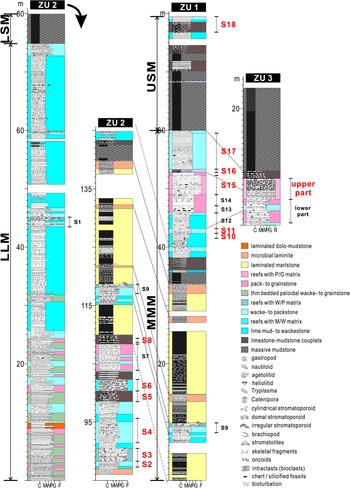
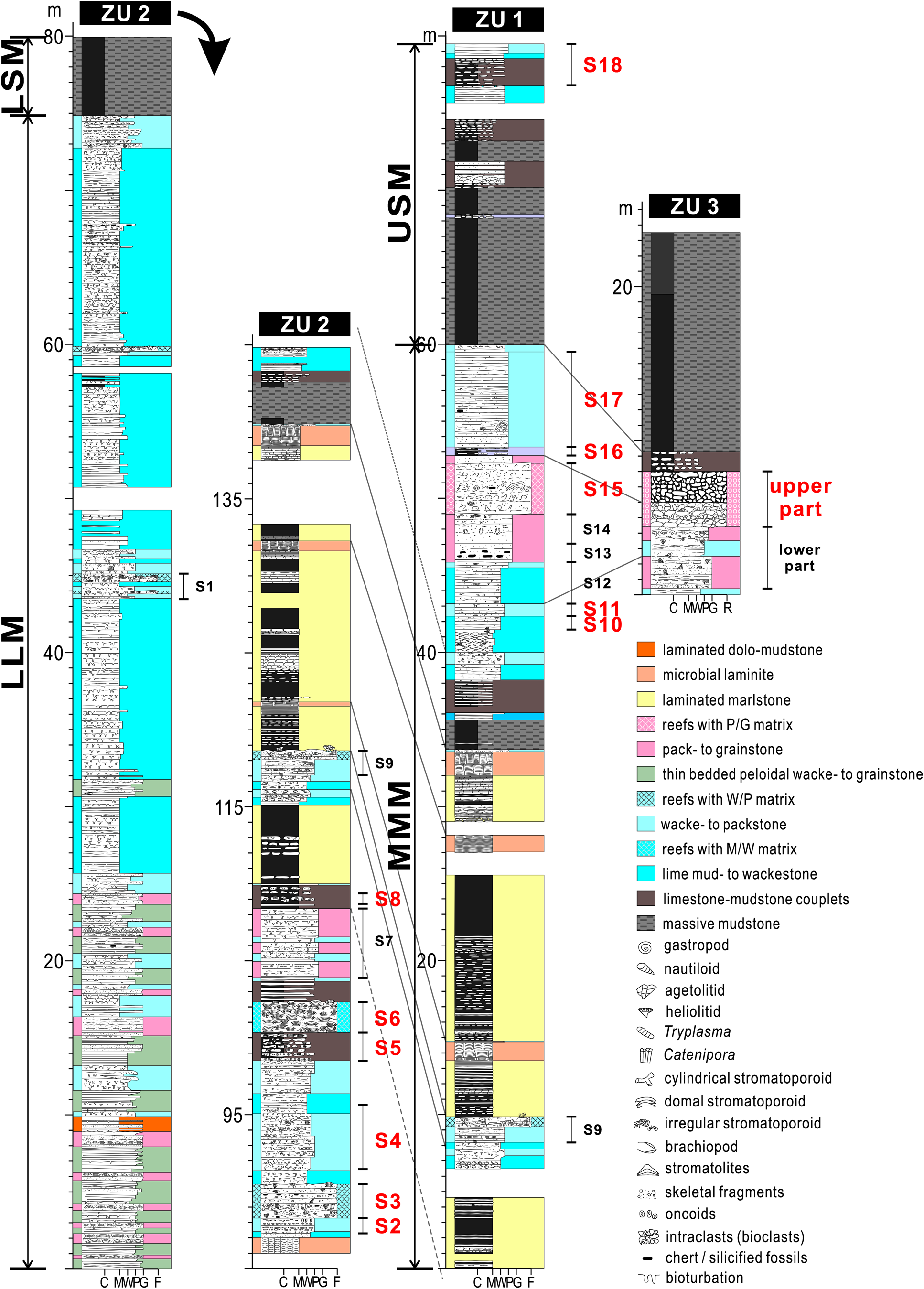
The measured section of the Xiazhen Formation is approximately 190 m thick and exposed at three small hills (named subsections ZU 1, ZU 2, and ZU 3; Fig. 1.3) separated by Quaternary sedimentary deposits (Lee et al., Reference Lee2012). The stratigraphy of the formation at Zhuzhai has been revised according to detailed lithological and paleontological data (see Lee et al., Reference Lee2012) and adopted in the present study (Fig. 2). The formation was divided into the lower limestone member, the lower shale member, the middle mixed-lithology member, and the upper shale member in ascending order, judging from different lithofacies (Lee et al., Reference Lee2012; Fig. 2).
Stratigraphic column of the Xiazhen Formation with the 18 stromatoporoid-bearing intervals. The red-colored intervals indicate where labechiid stromatoporoids were found mostly together with clathrodictyids, except S6 and S8 intervals. The black-colored intervals indicate where only clathrodictyid stromatoporoids were found. C = claystone; M = mudstone or lime mudstone; W = wackestone; P = packstone; G = grainstone, F = floatstone or framestone; R = rudstone; LLM = lower limestone member; LSM = lower shale member; MMM = middle mixed-lithology member; USM = upper shale member. Modified after Lee et al. (Reference Lee2012) and Park et al. (Reference Park, Lee, Liang and Choh2021). A large version of this figure is presented in Supplementary Data 1.
The Xiazhen Formation has been estimated to be middle to late Katian in age, judging from corals and the rough correlation with the Sanqushan and Changwu formations (Zhang et al., Reference Zhang, Chen, Yu, Goldman and Liu2007). A recent discovery of the graptolite Anticostia uniformis (Mu and Lin in Mu et al., Reference Mu, Li, Ge, Chen, Lin and Ni1993) in the upper shale member of ZU 1 (see Chen et al., Reference Chen, Kim, Choh, Lee and Chen2016, fig. 1b for detailed specimen location) indicated that the upper part of the Xiazhen Formation ranges from the Dicellograptus complanatus Biozone to the Paraorthograptus pacificus Biozone (Diceratograptus mirus Subzone) of the late Katian (Chen et al., Reference Chen, Kim, Choh, Lee and Chen2016). Overall, the Xiazhen Formation is most likely to be the mid to late Katian in age.
Materials and methods
The occurrence and abundance of stromatoporoids in the Xiazhen Formation are largely governed by depositional environment (e.g., water depth, substrate adaptability, siliciclastic sediment input, depositional energy level). Stromatoporoids are not only common in patch reef environments but also present in non-reef environments. The general co-occurrence of stromatoporoids and calcareous algae in the formation indicates that stromatoporoids lived within the photic zone. Labechiid stromatoporoids exhibited shorter stratigraphic ranges compared with those of tabulate corals and clathrodictyid stromatoporoids (see Liang et al., Reference Liang, Elias, Choh, Lee and Lee2016; Sun et al., Reference Sun, Elias, Choh, Lee, Wang and Lee2016; Jeon et al., Reference Jeon, Liang, Park, Choh and Lee2020a).
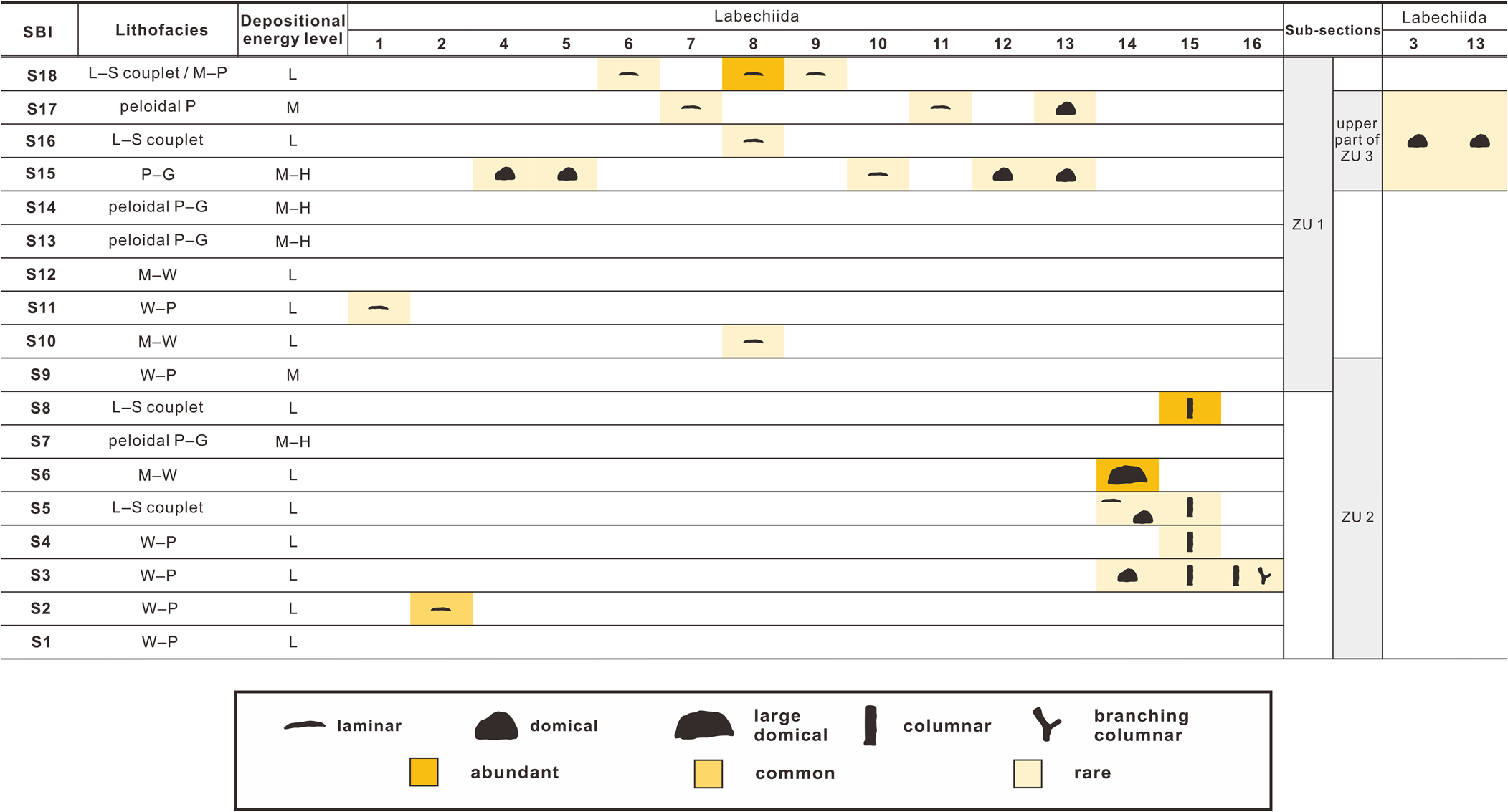
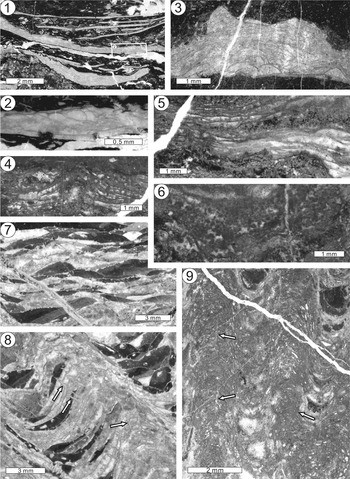
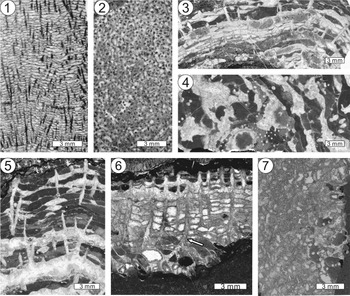
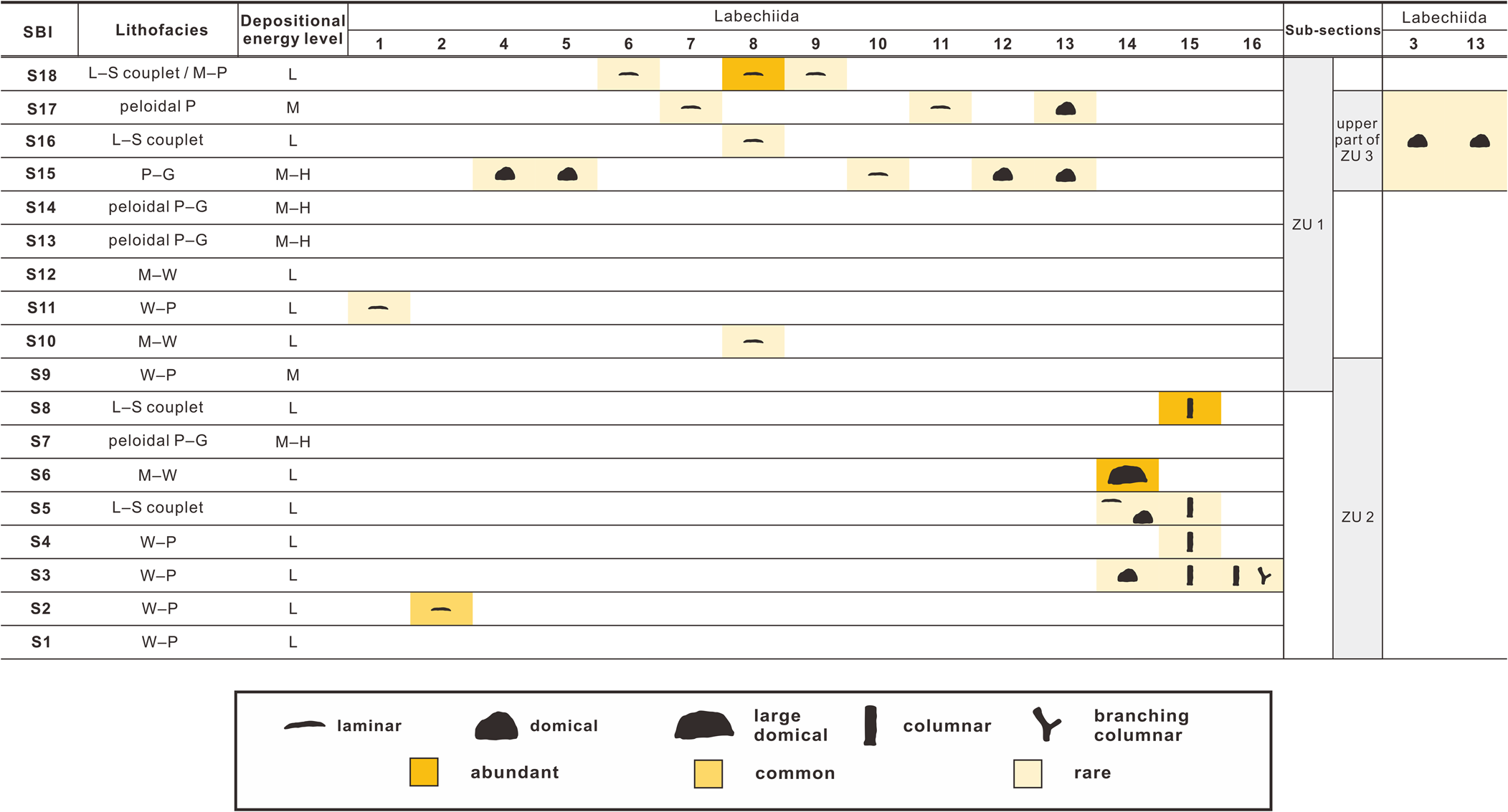
Eighteen stromatoporoid-bearing intervals are recognized from the Xiazhen Formation at Zhuzhai (Jeon et al., Reference Jeon, Liang, Park, Choh and Lee2020a; labelled S1 to S18; Figs. 2, 3). Among approximately 420 randomly collected stromatoporoid specimens, approximately 110 are labechiid stromatoporoids collected from the S2 to S8 intervals in subsection ZU 2 (more than 70 specimens), S8 to S18 in subsection ZU 1 (40 specimens), and the upper part of subsection ZU 3 (three fragmented specimens, indicative of transportation before burial) (Fig. 2). Transverse and longitudinal thin sections of the stromatoporoid specimens were prepared for species identification. Most specimens are well preserved; a few poorly preserved specimens were studied by the “white card technique” to enhance views of stromatoporoid internal structures (e.g., Delgado, Reference Delgado1977; Zenger, Reference Zenger1979; Folk, Reference Folk1987; Jeon et al., Reference Jeon, Li, Oh, Choh and Lee2019; Fig. 4.2, 4.3). The suprageneric taxonomic assignments and terminology used in this study follow those of Webby (Reference Webby and Selden2015b, Reference Webby and Seldenc).
Lithofacies, interpreted energy level, and distributions of labechiid stromatoporoids and growth forms from each stromatoporoid-bearing interval of the Xiazhen Fomation. SBI = stromatoporoid-bearing interval; M = mudstone; W = wackestone; P = packstone; G = grainstone; L–S couplets = limestone–shale couplets; L = low-energy depositional environment; M = medium-energy depositional environment; H = high-energy depositional environment; 1 = Rosenella sp.; 2 = Cystostroma sp.; 3 = Pseudostylodictyon poshanense; 4 = Pseudostylodictyon sp.; 5 = Labechia altunensis; 6 = Labechia shanhsiensis; 7 = Labechia variabilis; 8 = Labechia zhuzhainus n. sp.; 9 = Labechia sp.; 10 = Labechiella beluatus n. sp.; 11 = Labechiella gondwanense n. sp.; 12 = Labechiella regularis; 13 = Stylostroma bubsense; 14 = Stylostroma ugbrookense; 15 = Thamnobeatricea gouldi; 16 = Sinabeatricea luteolus n. gen. n. sp.
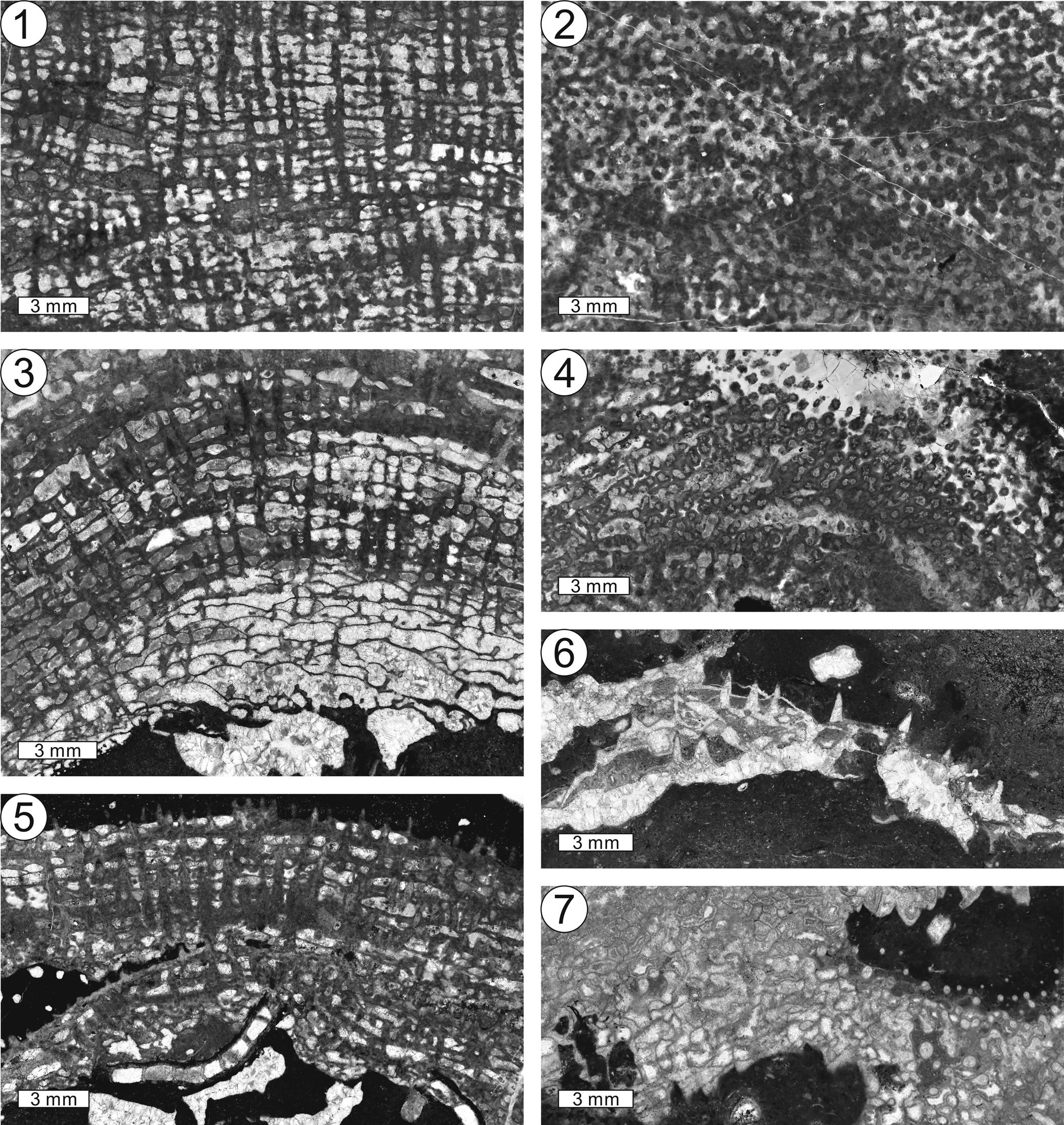
(1–3) Cystostroma sp. from the S2 interval of the formation. (1) Longitudinal section showing Cystostroma sp. encrusted on shelly skeletal fragments, NIGP 168771-1. (2) Enlarged photograph noted in white rectangular area in (1). (3) Longitudinal section of Cystostroma sp. with variable size of cysts, NIGP 175160. (4–6) Longitudinal and tangential sections of Rosenella sp. from the S11 interval, NIGP 168772. (7, 8) Pseudostylodictyon poshanense Ozaki, Reference Ozaki1938 from the upper part of rudstone interval of ZU 3, NIGP 175161. (7) Longitudinal section showing skeletal phase without mamelon columns. (8) Longitudinal section showing skeletal phase with mamelon with vertically punctuating vertical skeletal structure, seems to be pillars (white arrows). (9) Longitudinal section of selectively silicified Pseudostylodictyon sp. from the S15 interval. Note the white arrows indicating the vertically punctuating stout vertical skeletal structures that seem to be pillars, NIGP 168773.

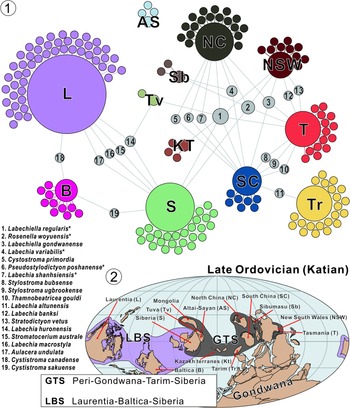
Network analysis, which provides a clear visible network diagram to understand paleobiogeographic links and connections with specific nodes and edges, has been applied in both modern biology and paleobiology (e.g., Sidor et al., Reference Sidor, Vilhena, Angielczyk, Huttenlocker, Nesbitt, Peecook, Steyer, Smith and Tsuji2013; Huang et al., Reference Huang, Zhan and Wang2016, Reference Huang, Jin and Rong2018; Kiel, Reference Kiel2017; Rojas et al., Reference Rojas, Patarroyo, Mao, Bengtson and Kowalewski2017; Fang et al., Reference Fang, Burrett, Li, Zhang, Zhang, Chen and Wu2019). The occurrences of Ordovician stromatoporoids are organized as a binary dataset (i.e., terranes and labechiid species) and imported into the network analysis software Gephi version 0.9.2 (Bastian et al., Reference Bastian, Heymann and Jacomy2009). Lines in the diagram (called “edges” in network analysis terminology) connect a source node (terrane) to a target node (labechiid species). A target node linked to only a single source node represents an endemic labechiid. A cosmopolitan species is represented by a multiconnected node. The size of a target node reflects the degree of cosmopolitanism, and larger node size indicates a higher degree of cosmopolitanism. There are several options within Gephi for displaying the data, and the layout option called Force Atlas 2 was applied here for the diagram layout. The following parameters within Gephi were used in this study: scaling, 2.0; gravity, 1.0; edge weight influence, 1.0; number of threads, 7; tolerance, 1.0; and approximation, 1.2.
The dataset of the Ordovician labechiid stromatoporoids for the network analysis was compiled from previous publications as well as this study, including 181 labechiid species from peri-Gondwanan regions, including South China, North China (Yabe and Sugiyama, Reference Yabe and Sugiyama1930a, Reference Yabe and Sugiyamab; Endo, Reference Endo1932; Ozaki, Reference Ozaki1938; Sugiyama, Reference Sugiyama1941; Dong, Reference Dong1982; Kano et al., Reference Kano, Lee, Choi and Yoo1994; Jeon et al., Reference Jeon, Park, Choh and Lee2017, Reference Jeon, Li, Oh, Choh and Lee2019), Sibumasu (Webby et al., Reference Webby, Wyatt and Burrett1985), Australian terranes (Webby, Reference Webby1969, Reference Webby1971, Reference Webby1979b, Reference Webby1991; Percival et al., Reference Percival, Webby and Pickett2001; Pickett and Percival, Reference Pickett and Percival2001), and Tarim (Dong and Wang, Reference Dong and Wang1984), Laurentia (Galloway, Reference Galloway1957; Galloway and St. Jean, Reference Galloway and St. Jean1961; Kapp and Stearn, Reference Kapp and Stearn1975; Webby, Reference Webby1977; Bolton, Reference Bolton1988; Nestor et al., Reference Nestor, Copper and Stock2010; Copper et al., Reference Copper, Stock and Jin2013), Baltica (Nestor, Reference Nestor1960, Reference Nestor1964; Bogoyavlenskaya, Reference Bogoyavlenskaya1973; Webby, Reference Webby1979a), Siberia (Yavorsky, Reference Yavorsky1955, Reference Yavorsky1961; Nestor, Reference Nestor1976; Khromykh, Reference Khromykh2001), Altai-Sayan Fold Belt (Khalifina, Reference Khalfina and Khalfina1960), Tuva (Bogoyavlenskaya, Reference Bogoyavlenskaya1971), and Kazakh terranes (Yavorsky, Reference Yavorsky1961; Karimova and Lessovaya, Reference Karimova, Lesovaya, Kim, Salimova, Kim and Meshchankina2007). A few Ordovician labechiid species are not added in this study due to problematic taxonomic assignment (e.g., Bol'shakova and Ulitina, Reference Bol'shakova and Ulitina1985; Jiang et al., Reference Jiang, Sun, Bao and Wu2011), inaccessibility of original publications, or impoverished occurrence of data. Due to insufficient biostratigraphic precision (i.e., conodonts, graptolites) from carbonate successions, stromatoporoid study relies on relatively coarse temporal resolution. Thus, in this study, we compiled all the data within the Ordovician, using the updated genera-level taxonomic revision of Webby (Reference Webby and Selden2015c).
Repository and institutional abbreviation
All labechiid stromatoporoid specimens and thin sections in this study are housed in Nanjing Institute of Geology and Palaeontology (NIGP), Chinese Academy of Sciences, Nanjing, China.
Systematic paleontology
Phylum Porifera Grant, Reference Grant and Todd1836
Class Stromatoporoidea Nicholson and Murie, Reference Nicholson and Murie1878
Order Labechiida Kühn, Reference Kühn1927
Family Rosenellidae Yavorsky in Khalfina and Yavorsky, Reference Khalfina and Yavorsky1973
Cystostroma Galloway and St. Jean in Galloway, Reference Galloway1957
Type species
Cystostroma vermontense Galloway and St. Jean in Galloway, Reference Galloway1957.
Cystostroma sp. indet.
Figure 4.1– 4.3
Reference Jeon, Liang, Park, Choh and Lee2020a Cystostroma; Jeon et al., p. 200, fig. 5a.
Occurrence
The S2 interval of the Xiazhen Formation (Upper Ordovician, Katian) at Zhuzhai, Yushan County, Jiangxi Province, China.
Description
Skeletons are thin laminar, less than 3 mm high (0.8 mm on average), exclusively encrusting on fragmented shells.
Most of the skeletons are poorly preserved and fragmented. In longitudinal section, cyst plates are moderately convex, of variable cyst sizes, ranging from 0.13 to 0.35 mm high (n = 13, species average 0.19 mm) and from 0.31 to 0.71 mm wide (n = 13, species average 0.44 mm). Cyst width/height ratio ranges from 1.42 to 3.80, average 2.38 (n = 13). Denticles, latilaminae, and mamelons are not observed.
Materials
Two specimens, NIGP 168771 and 175160, from the S2 interval.
Remarks
The distinguishable characteristic of the present specimens of this taxon is that the cyst size is more variable than in other species from peri-Gondwanan regions (Cystostroma sp. in Webby et al., Reference Webby, Wyatt and Burrett1985 and Cystostroma primordia Jeon et al., Reference Jeon, Li, Oh, Choh and Lee2019). C. primordia, which is the earliest known species of Cystostroma, possessed the smallest cysts, ranging from 0.04 to 0.20 mm high and from 0.09 to 0.39 mm long (Jeon et al., Reference Jeon, Li, Oh, Choh and Lee2019). Cysts in Cystostroma sp. from Sibumasu range from 0.2 to 0.6 mm high and from 0.7 to 1.0 mm wide (Webby et al., Reference Webby, Wyatt and Burrett1985), bigger than both C. primordia and the Xiazhen species. Denticles were not found in all peri-Gondwanan species.
Genus Rosenella Nicholson, Reference Nicholson1886
Type species
Rosenella macrosystis Nicholson, 1886 (Nicholson, Reference Nicholson1886a).
Rosenella sp. indet.
Figure 4.4–4.6
- Reference Jeon, Liang, Park, Choh and Lee2020a
Rosenella; Jeon et al., p. 200, fig. 5b, c.
Occurrence
The S11 interval of the Xiazhen Formation (Upper Ordovician, Katian) at Zhuzhai, Yushan County, Jiangxi Province, China.
Description
The skeleton is thin laminar, 31 mm wide and 9 mm high. It was preserved in upside-down position, encrusted by another stromatoporoid (Ecclimadictyon). In longitudinal section, cysts are small, low profile, and long, ranging from 0.17 to 0.53 mm high (n = 12, species average 0.31 mm) and from 0.99 to 2.91 mm wide (n = 12, species average 1.89 mm). Cyst width/height ratio ranges from 3.60 to 13.13, with an average of 6.6 (n = 12). Denticles are sporadically developed, appearing as small dots in transverse sections. Latilaminae are not observed. Mamelon-like up-growths are found, approximately 2 mm in height.
Materials
One specimen of NIGP 168772 from the S11 interval.
Remarks
Rosenella woyuensis Ozaki, Reference Ozaki1938 and R. amzassensis Khalfina, Reference Khalfina and Khalfina1960 differ in having much larger cysts. The cysts of R. amzassensis commonly range from 1 to 3 mm high and 1 to 9 mm wide but in rare cases are up to 5 mm high (Khalfina, Reference Khalfina and Khalfina1960); the cysts of R. woyuensis range from 0.3 to 0.5 mm high and 0.4 to 12 mm wide (Ozaki, Reference Ozaki1938; Webby, Reference Webby1969, Reference Webby1991; Webby et al., Reference Webby, Wyatt and Burrett1985).
Genus Pseudostylodictyon Ozaki, Reference Ozaki1938
Type species
Pseudostylodictyon poshanense Ozaki, Reference Ozaki1938.
Remarks
The original description of genus Pseudostylodictyon mentioned the existence of vertical elements, which penetrate through two or even more thinner and low cyst plates (Ozaki, Reference Ozaki1938, p. 209). Vertical elements are best described as pillars, but not well matched with the rosenellid family group, which mainly comprises cyst plates and accessory denticles. However, subsequent descriptions of the stromatoporoid genus previously attributed to Pseudostylodictyon and its species did not mention the existence of pillars (e.g., Galloway, Reference Galloway1957; Galloway and St. Jean, Reference Galloway and St. Jean1961; Webby, Reference Webby1969; Kapp and Stearn, Reference Kapp and Stearn1975). The most specific characters of long and low cyst plates and mamelon columns have been considered the most important distinguishable features of this genus (e.g., Galloway, Reference Galloway1957; Galloway and St. Jean, Reference Galloway and St. Jean1961). The most recent description of the type specimens (NIGP 121556a, b; Pseudostylodictyon poshanense) described this penetrating vertical structure as “a vague impression of one or two, more continuous, upwardly and outwardly radiating, pillar-like structures” and “weakly developed pattern of concentrically arranged cyst plates, outwardly radiating structures, mainly denticles and a few incomplete pillar” (Webby, Reference Webby and Selden2015a, p. 719). Our materials from the Xiazhen Formation, which are identified as Pseudostylodictyon poshanense and Pseudostylodictyon sp., have well-developed pillar-like structures (see Fig. 4.8, 4.9) restricted to mamelon columns. Such features in Pseudostylodictyon poshanense imply that the genus Pseudostylodictyon may not be included in the family Rosenellidae and therefore raises the question as to defining the difference between genera Stylostroma and Pseudostylodictyon. Thus, a follow-up study is required to investigate the presence of pillars in other Pseudostylodictyon species.
Pseudostylodictyon poshanense Ozaki, Reference Ozaki1938
Figure 4.7, 4.8
- Reference Ozaki1938
Pseudostylodictyon poshanensis Ozaki, p. 208, pl. 24, fig. 2, pl. 25, fig. 1a−e.
Type specimen
Syntype, longitudinal section of the Pseudostylodictyon poshanense skeleton (NIGP 121556) from the Machiakou Formation (Middle Ordovician, Darriwilian), north of Woyu, Boshan County, Shandong Province, China (Ozaki, Reference Ozaki1938, pl. 24, fig. 2; pl. 25, fig. 1a−e).
Occurrence
The upper part (rudstone interval) of subsection ZU 3 of the Xiazhen Formation (Upper Ordovician, Katian) at Zhuzhai section, Yushan County, Jiangxi Province, China.
Description
The specimens are transported fragments (thus difficult to determine growth form), up to 30 mm wide and 45 mm high. Mamelon columns are regularly spaced, 5.52–9.75 mm apart and 4.51–6.72 mm in diameter. Latilaminae are not found.
Cysts are commonly long and low, and range 0.19–1.67 mm high (n = 64, species average 0.57 mm) and 0.59–4.32 mm wide (n = 64, species average 1.80 mm). Cyst width/height ratio ranges from 0.38 to 8.53 (n = 64, species average 3.65). Cysts, composed of mamelon columns, closely spaced, range 0.19–1.60 mm high (n = 44, species average 0.45 mm) and 0.60–3.57 mm wide (n = 44, species average 1.49 mm). Cyst width/height ratios are from 1.30 to 6.38 (n = 44, species average 3.70). Sediment-filled cysts are common, particularly placed between mamelon columns. Vertical elements commonly penetrate through two to three cysts, thus corresponding to the concept of “pillar” in labechiids. These pillar-like structures are slender and only restricted in mamelon columns (Fig. 4.8); they range 0.46–2.11 mm high (n = 11, species average 0.99) and 0.10–0.21 mm in diameter (n = 11, species average 0.16), with flanged and hollow preservation. Denticles are well developed (Fig. 4.7, 4.8).
Materials
Two specimens, NIGP 175161 and 175162, from the upper rudstone interval of subsection ZU 3 of the Xiazhen Formation (Upper Ordovician, Katian) at Zhuzhai section, Yushan County, Jiangxi Province, China.
Remarks
The most recent description of the type specimens of Pseudostylodictyon poshanense skeleton (NIGP 121556) includes vertical elements, which are presented as “vague pillar-like structures” (Webby, Reference Webby and Selden2015a, p. 719). These vague structures seem to be due to the oblique section of mamelon columns in the limited material available and caused the incomplete morphological shape of pillars. However, subsequent study of Pseudostylodictyon species did not describe pillar-like structures (e.g., Galloway, Reference Galloway1957; Galloway and St. Jean, Reference Galloway and St. Jean1961; Webby, Reference Webby1969; Kapp and Stearn, Reference Kapp and Stearn1975). Further interspecific comparison of internal morphological features of each Pseudostylodictyon species is required.
Pseudostylodictyon sp. indet.
Figure 4.9
- Reference Jeon, Liang, Park, Choh and Lee2020a
Pseudostylodictyon; Jeon et al., p. 200, fig. 5d.
Occurrence
The S15 interval of the Xiazhen Formation (Upper Ordovician, Katian) at Zhuzhai section, Yushan County, Jiangxi Province, China.
Description
The specimens are fragmentary, with evidence of small domical growth forms, encrusted by other stromatoporoid (Clathrodictyon) and spiculate sponges. Fragmentary specimens are up to 20 mm wide and 30 mm high. Mamelon columns are regularly spaced, 5.52–5.74 mm apart and 3.47–4.86 mm in diameter.
Most of the cyst plates are silicified and poorly preserved. Cysts are long, low, and variable, ranging from 0.11 to 0.48 mm high (n = 29, species average 0.19 mm) and from 0.44 to 1.55 mm wide (n = 29, species average 0.85 mm). Cyst width/height ratio ranges from 0.38 to 8.53 (n = 29, species average 4.65). Sediment-filled cysts commonly occur between mamelon columns. Stout pillar-like vertical structures pass through two or more cyst plates. These structures are restricted to mamelon columns, ranging from 0.52 to 2.70 mm high (n = 14, species average 1.21 mm) and from 0.13 to 0.23 mm in diameter (n = 14, species average 0.17 mm).
Materials
Two specimens, NIGP 168773 and 175163, from the S15 interval of the Xiazhen Formation (Upper Ordovician, Katian) at Zhuzhai section, Yushan County, Jiangxi Province, China.
Remarks
The present specimens have cysts of various sizes but possess smaller cysts and stouter pillars than those of Pseudostylodictyon poshanense.
Family Labechiidae Nicholson, Reference Nicholson1879
Genus Labechia Milne-Edwards and Haime, Reference Milne-Edwards and Haime1851
Type species
Monticularia conferta Lonsdale, Reference Lonsdale and Murchison1839.
Labechia altunensis Dong and Wang, Reference Dong and Wang1984
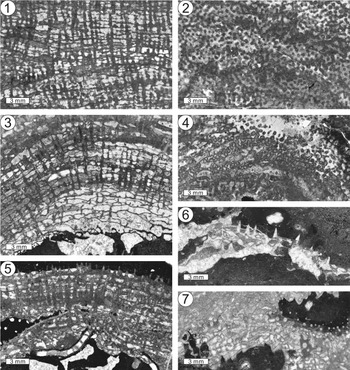
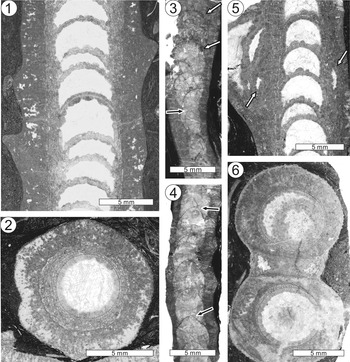
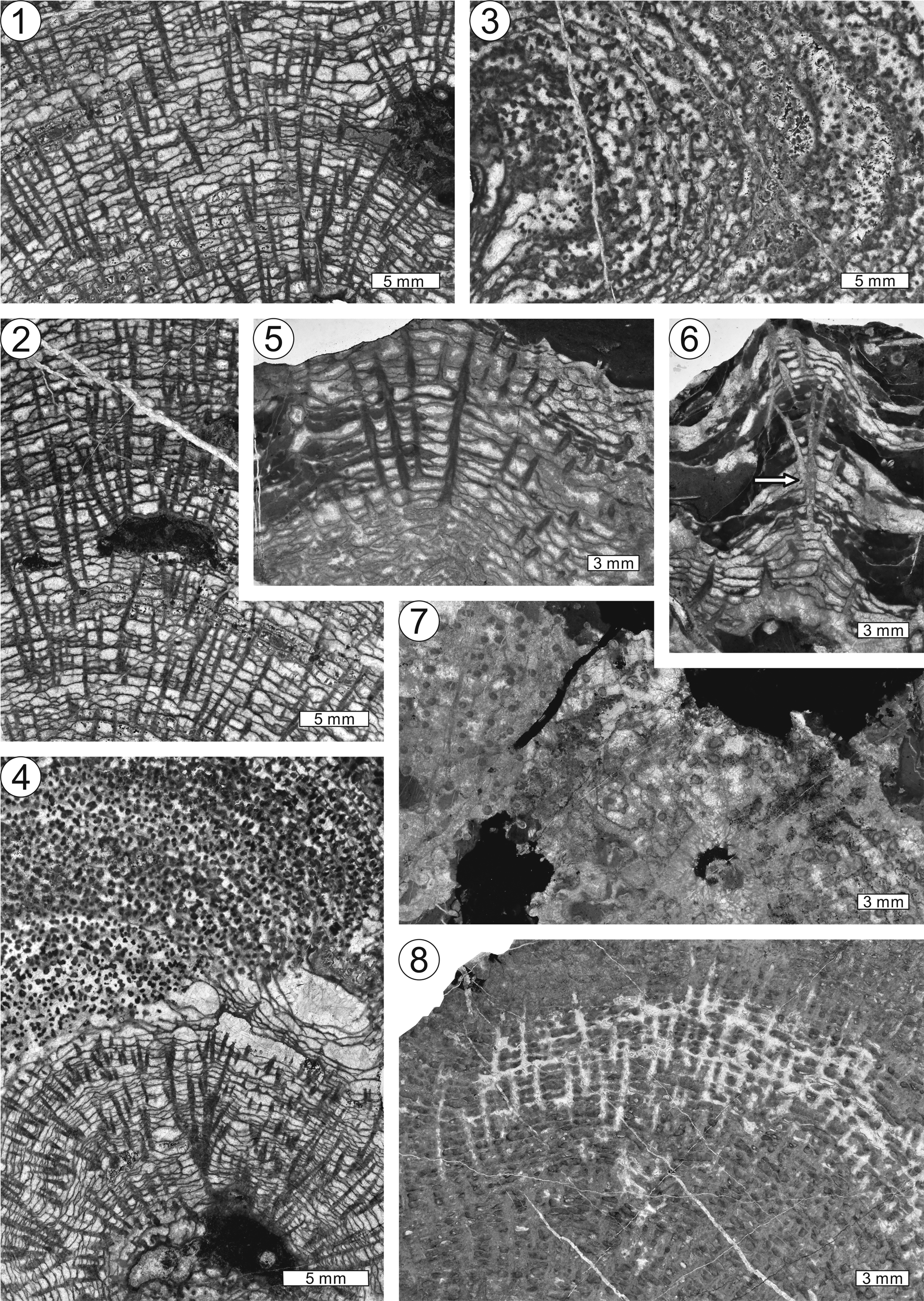
Figure 5.1, 5.2
- Reference Dong and Wang1984
Labechia altunensis Dong and Wang, p. 248, pl. 1, fig 3a, b.
- Reference Dong and Wang1984
Labechia sibirica Yavorsky; Dong and Wang, p. 247, pl. 1, fig 1a, b.
(1, 2) Longitudinal and tangential sections of Labechia altunensis Dong and Wang, Reference Dong and Wang1984 from the S15 interval, NIGP 175164-1. (3–5) Longitudinal and tangential sections of Labechia variabilis Yabe and Sugiyama 1930 (Yabe and Sugiyama, Reference Yabe and Sugiyama1930a) from the S17 interval, NIGP 168778-1, 5, 3, respectively. Branching and slender pillars are also seen in (5). (6, 7) Longitudinal and tangential sections of Labechia shanhsiensis Yabe and Sugiyama, 1930 (Yabe and Sugiyama, Reference Yabe and Sugiyama1930a) from the S 18 interval, NIGP 175165-1, 3, respectively. The white arrow in (6) indicates a curved pillar, perhaps due to geotropic growth.

Type specimen
Syntype, one thin section of Labechia altunensis (NIGP 70384) from the Malieziken Group (probably upper Darriwilian to lower Sandbian), eastern Ruoqiang County, Xinjiang Province, China (Dong and Wang, Reference Dong and Wang1984, pl. 1, fig 3a, b).
Occurrence
The S15 interval of the Xiazhen Formation (Upper Ordovician, Katian) at Zhuzhai section, Yushan County, Jiangxi Province, China.
Description
The specimens are fragmented, thus the original growth form is unknown. Latilaminae, mamelon columns, and astrorhizae are not found.
Cysts are relatively small, round, and regular in shape and range from 0.19 to 0.47 mm high (n = 67, species average 0.30 mm) and 0.29 to 1.86 mm wide (n = 67, species average 1.86 mm). Cyst plates have low to moderate convexity, and cyst width/height ratio ranges from 1.55 to 6.43 (n = 67, species average 3.17). Pillars are vertically and continuously well developed with downward-opening growth lines (also often referred to as “cone-in-cone structure”) and range 1.17–5.44 mm high (n = 14, species average 2.58 mm) and 0.10–0.37 mm in diameter (n = 155, species average 0.18 mm). Tops of the pillars are moderately round, but slightly sharp shapes are also seen.
Materials
One specimen, NIGP 175164, from the S15 interval.
Remarks
Two Labechia species (i.e., Labechia altunensis and Labechia sibirica Yavorsky, Reference Yavorsky1955 [see Dong and Wang, Reference Dong and Wang1984]) from the Middle Ordovician of Tarim Basin are closely similar to the present species. Labechia sibirica is first reported from the uppermost Silurian of the Stony Tunguska River, Siberian Platform (Yavorsky, Reference Yavorsky1955). Although this Silurian species has pillar thicknesses (about 2 mm; Yavorsky, Reference Yavorsky1995) similar to the former two species, it is distinguishable with bigger cysts, ranging from 0.40 to 1.0 mm high (Yavorsky, Reference Yavorsky1955), than those earlier species. The specimen of Labechia sibirica (NIGP 70382) described by Dong and Wang (Reference Dong and Wang1984) possesses morphological measurements of both cysts (ranging from 0.2 to 0.5 mm high and from 0.3 to 1.4 mm wide) and pillars (0.1–0.2 mm in diameter) that are very similar to Labechia altunensis in Dong and Wang, Reference Dong and Wang1984 and the present study. Judging from the possession of key morphological characteristics and numeric features of Labechia altunensis in the specimens of Labechia sibirica (NIGP 70382), i.e., small, round, and regular-shaped cysts, continuously developed solid pillars, and identical measurements, it is herein regarded as being conspecific with Labechia altunensis.
Labechia variabilis Yabe and Sugiyama, Reference Yabe and Sugiyama1930
Figure 5.3–5.5
- Reference Yabe and Sugiyama1930a
Labechia variabilis Yabe and Sugiyama, p. 54, pl. 17, figs. 1−9, pl. 18, fig. 1, pl. 21, figs. 5–7.
- Reference Ozaki1938
Labechia variabilis; Ozaki, p. 211, pl. 28, fig. 1a−d.
- Reference Dong1982
Cystistroma donnellii Etheridge; Dong, p. 578, pl.1, figs. 1, 2.
- Reference Dong1982
Cystistroma canadense Nicholson and Murie; Dong, p. 578, pl. 1, figs. 3, 4.
- Reference Dong1982
Rosenella cf. woyuensis Ozaki; Dong, p. 579, pl.1, figs. 5, 6.
- Reference Dong1982
Labechia changchiuensis Ozaki; Dong, p. 579, pl. 2, figs. 1, 2.
- Reference Webby, Wyatt and Burrett1985
Labechia variabilis; Webby et al., p. 161, fig. 3a−e.
- Reference Jeon, Park, Choh and Lee2017
Labechia yeongwolense Jeon et al., p. 336, fig. 4f–h.
- Reference Jeon, Liang, Park, Choh and Lee2020a
Labechiella; Jeon et al., p. 201, fig. 6b.
Type specimen
Syntype 37679a, b, 37680a, b, 37682a, b, c in Tohoku University, Japan (Yabe and Sugiyama, Reference Yabe and Sugiyama1930a, p. 54, pl. 17, figs. 1–9, pl. 18, fig. 1, pl. 21, figs. 5–7).
Occurrence
The S17 interval of the Xiazhen Formation (Upper Ordovician, Katian) at Zhuzhai, Yushan County, Jiangxi Province, China.
Description
The skeletons are laminar, up to 50 mm high and 180 mm wide. Latilaminae, mamelon columns, and astrorhizae are not found.
Cysts range from 0.40 to 1.72 mm high (n = 69, species average 0.81 mm) and from 1.33 to 6.02 mm wide (n = 69, species average 2.71 mm). Cyst plates have low to moderate convexity, and their cyst width/height ratios range from 1.76 to 6.21 (n = 69, species average 3.42). The preservation of cysts is variable from normal cement-filled to dissolved spar-filled and sediment-filled spaces.
Pillars are sporadically developed and short, ranging from 1.33 to 4.77 mm high (n = 25, species average 2.56 mm) and from 0.21 to 0.80 mm in diameter (n = 84, species average 0.41 mm). In tangential sections, pillars appear as ellipsoidal to circular shapes. Preservation is variable and selective as solid, hollow and flanged, and dissolved unflanged pillars.
Materials
Four specimens: NIGP 168778 and 175166–175168 from the S17 interval.
Remarks
Labechia variabilis was first known from the Middle Ordovician Toufangkou and Shanpingchou formations (upper Darriwilian) of northeastern China and the Sangsori “Series” (Sandbian to Katian; see Lee et al., Reference Lee, Choh, Lee, Ree and Lee2017, p. 217 for the problem of stratigraphic nomenclature in North Korea) of northern Korean Peninsula (Yabe and Sugiyama, Reference Yabe and Sugiyama1930a). One of the key characteristic features of this species is round, stout, and small pillars, which are not persistently developed. Its wide range of skeletal variation, together with the poor quality of old illustrations in Yabe and Sugiyama, Reference Yabe and Sugiyama1930a, caused taxonomic confusion, particularly between Labechia and Labechiella,. Recent confirmation of the syntypes deposited in Tohoku University and detailed comparisons with subsequently reported Labechia species through China (deposited in NIGPAS, Nanjing; Dong, 1982) and Korea (deposited in National Heritage Center of the Cultural Heritage Administration in Korea, Daejeon; Jeon et al., Reference Jeon, Park, Choh and Lee2017) prove that they are conspecific with Cystistroma donnellii Etheridge, Reference Etheridge1895 (Dong, Reference Dong1982), Cystistroma canadense Nicholson and Murie, Reference Nicholson and Murie1878 (Dong, Reference Dong1982), Rosenella cf. R. woyuensis Ozaki, Reference Ozaki1938 (Dong, Reference Dong1982), Labechia changchiuensis Ozaki, Reference Ozaki1938 (Dong, Reference Dong1982), Labechia yeongwolense Jeon et al., Reference Jeon, Park, Choh and Lee2017, and Labechiella sp. in Jeon et al. (Reference Jeon, Liang, Park, Choh and Lee2020a), judging from the morphological characteristics and numerical measurements.
Labechia shanhsiensis Yabe and Sugiyama, Reference Yabe and Sugiyama1930
Figure 5.6, 5.7
- Reference Yabe and Sugiyama1930a
Labechia shanhsiensis Yabe and Sugiyama, p. 56, pl. 18, figs. 2−4.
Type specimen
Syntype 37685a, b, c, d in Tohoku University, Japan (Yabe and Sugiyama, Reference Yabe and Sugiyama1930a, p. 56, pl. 18, figs. 2−4).
Occurrence
The S18 interval of the Xiazhen Formation (Upper Ordovician, Katian) at Zhuzhai, Yushan County, Jiangxi Province, China.
Description
Skeleton is thin laminar, up to 18 mm high and 115 mm wide. Latilaminae, mamelon columns, and astrorhizae are not found.
Cysts range 0.33–1.25 mm high (n = 96, species average 0.57 mm) and 0.18–3.89 mm wide (n = 96, species average 1.29 mm). Cyst plates have moderate to high convexity, and cyst width/height ratio ranges 0.31–6.98 (n = 96, species average 2.29). Pillars are consistently well developed with long and slender shapes, ranging from 1.62 to 7.84 mm high (n = 32, species average 3.32 mm) and from 0.17 to 0.52 mm in diameter (n = 45, species average 0.36 mm) and exclusively preserved as flanged and hollow with downward-opening growth lines. In some cases, pillars are curved, perhaps indicating geotropic growth (white arrow in Fig. 5.6). In the tangential section, pillars are a well-rounded circular shape.
Materials
One specimen of NIGP 175165 from the S18 interval.
Remarks
Labechia shanhsiensis described by Yabe and Sugiyama (Reference Yabe and Sugiyama1930a) has slightly thinner pillars (0.10–0.21 mm in diameter) than the present specimens, and this is considered as the intraspecific variation.
Labechia zhuzhainus Jeon new species
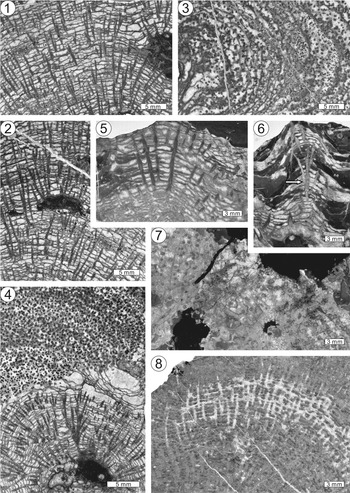
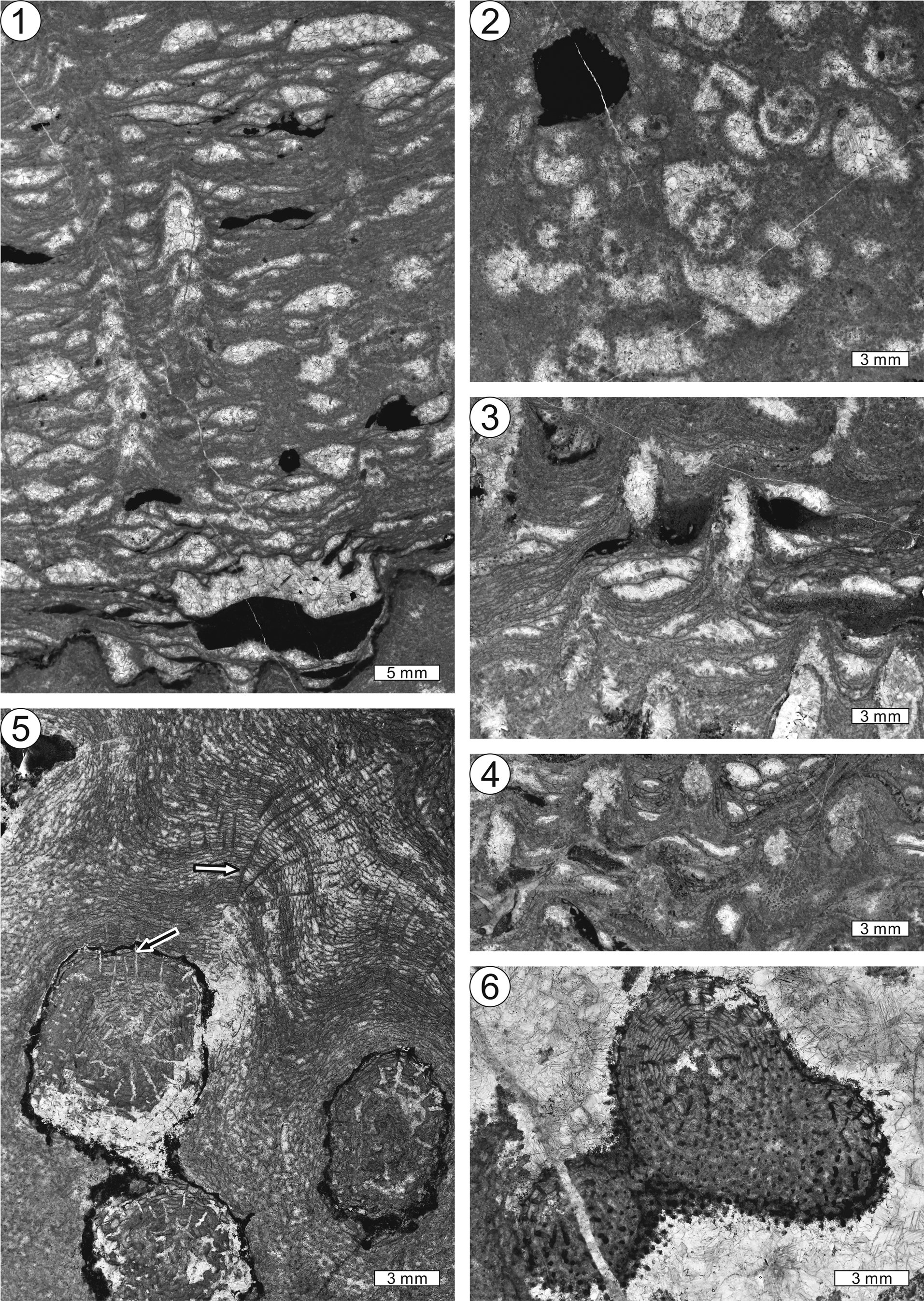
Figure 6.1–6.5
Type specimen
Holotype NIGP 175169, paratype NIGP 168777 and 175170.
(1, 2) Longitudinal and tangential sections of Labechia zhuzhainus Jeon n. sp. from the S18 interval, holotype NIGP 175169. (3, 4) Longitudinal and tangential sections of Labechia zhuzhainus n. sp. from the S18 interval, paratype NIGP 168777. Note the skeletal variation in (3). (5) Longitudinal sections showing Labechia zhuzhainus n. sp. encrusted on tabulate coral Catenipora from the S18 interval, paratype NIGP 175170. Note that the coral and stromatoporoid were not in a symbiotic intergrowth association. (6, 7) Longitudinal and tangential sections of Labechia sp. from the S18 interval, NIGP 175184 and NIGP 175185-1, respectively.
Diagnosis
A species of Labechia with low to moderately convex cyst plates and well-developed continuous stout pillar; cysts range from 0.09 to 0.99 mm high (species average 0.52 mm) and from 0.46 to 3.99 mm wide (species average 1.62 mm), with cyst width/height ratio from 1.00 to 22.04, in general, 3.31; pillars range from 1.03 to 5.18 mm high (species average 2.44 mm) and from 0.08 to 0.80 mm thick (species average 0.35 mm).
Occurrence
The S10 and S16−S18 intervals of the Xiazhen Formation (Upper Ordovician, Katian) at Zhuzhai, Yushan County, Jiangxi Province, China.
Description
Skeletons are laminar, up to 40 mm high and 130 mm wide, having either smooth or ragged skeletal margins. The internal structures are commonly silicified. Latilaminae, rhythmic changes, mamelon columns, and astrorhizae are not found. It is commonly encrusted on tabulate coral Catenipora, perhaps causing its growth termination (Fig. 6.5), but no evidence of intergrowth association is seen.
Cysts range 0.09–0.99 mm high (n = 132, species average 0.52 mm) and 0.46–3.99 mm wide (n = 132, species average 1.62 mm). Cyst plates have low to moderate convexity, and cyst width/height ratio ranges from 1.00 to 22.04 (n = 132, species average 3.31). Pillars are persistent, stout, and short, ranging from 1.03 to 5.18 mm high (n = 82, species average 2.44 mm) and from 0.08 to 0.80 mm in diameter (n = 314, species average 0.35 mm), dominantly preserved as solid form. Branching pillars are not found.
Etymology
Labechia zhuzhainus, from Zhuzhai, a regional name of the place where this species commonly occurs.
Materials
Eleven specimens, NIGP 168777 and 175169–175178, from the S18 interval; four specimens, NIGP 168779–168782, from the S16 interval; one specimen, NIGP 175183, from the S10 interval.
Remarks
Labechia zhuzhainus is distinguishable with its persistently developed pillars, comparable to Labechia altunensis and Labechia shanhsiensis from this formation. However, the internal structure of Labechia zhuzhainus has larger cysts than Labechia altunensis (cysts ranging from 0.19 to 0.47 mm high and from 0.29 to 1.86 mm wide; pillar ranging from 0.10 to 0.37 mm in diameter). Labechia shanhsiensis possesses a similar cyst size to Labechia zhuzhainus, but it is differentiated by shapes of pillars; Labechia zhuzhainus has rounder and stouter pillars than Labechia shanhsiensis.
Labechia sp.
Figure 6.6, 6.7
Occurrence
The S18 interval of the Xiazhen Formation (Upper Ordovician, Katian) at Zhuzhai, Yushan County, Jiangxi Province, China.
Description
Skeletons are thin laminar, up to 4 mm high and 72 mm wide. One specimen (NIGP 169634) encrusts the growth surface of Clathrodictyon and shows irregularly developed physical contacts between those two species, with deformed internal structures.
Cysts range 0.35–1.93 mm high (n = 15, species average 0.72 mm) and 0.60–3.52 mm wide (n = 15, species average 1.43 mm). Cyst plates have moderate to high convexity, having cyst width/height ratio from 1.00 to 3.85 (n = 15, species average 2.04). Pillars are generally preserved as flanged and hollow, with blade-like sharp top margin, ranging from 1.03 to 5.18 mm high (n = 82, species average 2.44 mm) and from 0.15 to 0.66 mm in diameter (n = 65, species average 0.29 mm).
One specimen (NIGP 169634), interpreted as spatial competition with a species of Clathrodictyon (Jeon et al., Reference Jeon, Liang, Lee and Kershaw2020b), shows a variety of internal skeletal morphologies and variations of cysts and pillars in both structure and size. Deformed cysts are up to 2.08 mm high and 5.76 mm wide with irregular thickness. The shape of pillars is also variable, ranging from sharply triangular to stoutly round. Most pillars are preserved as hollow and flanged, but solid pillars are also present.
Materials
Three specimens, NIGP 169634, 175184, 175185, from the S18 interval.
Remarks
The present species is distinguishable with its blade-like sharp and short pillars. However, owing to the thin shape and small size of the entire skeleton, with a wide range of internal skeletal morphological features, the species remains in open nomenclature.
This is the only Labechia species showing paleoecological interaction (in this case, competition) with Clathrodictyon, with Labechia probably a paleoecological subordinate to Clathrodictyon (Jeon et al., Reference Jeon, Liang, Lee and Kershaw2020b).
Genus Labechiella Yabe and Sugiyama, Reference Yabe and Sugiyama1930
Type species
Labechia serotina Nicholson, 1886 (Nicholson, Reference Nicholson1886b).
Labechiella beluatus Jeon new species
Figure 7.1–7.4
Type specimen
Holotype NIGP 175187, paratype NIGP 175188.
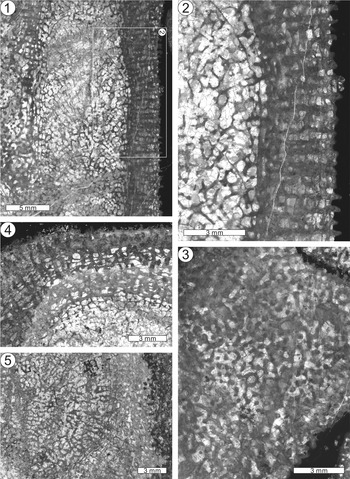
(1–3) Longitudinal and tangential sections of Labechiella beluatus Jeon n. sp. from the S15 interval, holotype NIGP 175187-1, 2, respectively. Note very large, well-developed, and persistent pillars. (4) Gradual skeletal change from longitudinal to tangential view of Labechiella beluatus n. sp. from the S15 interval, paratype NIGP 175188-1. Note the existence of multibranching pillars. (5–7) Longitudinal and tangential sections of Labechiella gondwanense Jeon Jeon n. sp. from the S17 interval, holotype NIGP 175186-1, 2, 14, respectively. White arrow in (6) indicates a branching pillar developed in mamelon-like up-growth of the skeleton. (8) Longitudinal view of selectively silicified Labechiella regularis (Yabe and Sugiyama, Reference Yabe and Sugiyama1930) (Yabe and Sugiyama, Reference Yabe and Sugiyama1930a) from the rudstone interval of upper ZU 3, NIGP 175190.
Diagnosis
A species of Labechiella with moderately convex cyst plates and very large persistent pillars; cysts range from 0.25 to 0.84 mm high (species average 0.84 mm) and from 0.30 to 11.08 mm wide (species average 2.56 mm); cyst width/height ratio ranges from 0.58 to 7.48 (species average 3.02); pillars range from 0.26 to 0.93 mm high (species average 5.37 mm) and from 0.15 to 0.54 mm in diameter (species average 0.32 mm).
Occurrence
The S15 interval of the Xiazhen Formation (Upper Ordovician, Katian) at Zhuzhai, Yushan County, Jiangxi Province, China.
Description
Skeletons are fragmented, perhaps pieces of large laminar in growth forms, up to 50 mm high and 110 mm wide. Latilaminae, rhythmic changes, mamelon columns, and astrorhizae are not found.
Cysts range 0.25–0.84 mm high (n = 186, species average 0.84 mm) and 0.30–11.08 mm wide (n = 186, species average 2.56 mm). Cyst plates have moderate convexity, and cyst width/height ratio ranges 0.58–7.48 (n = 186, species average 3.02). Pillars are very large and persistently distributed, ranging from 0.25 to 0.84 mm high (n = 186, species average 0.84 mm) and from 0.30 to 11.08 mm in diameter (n = 186, species average 2.56 mm). Branching pillars are commonly seen.
Etymology
Labechiella beluatus, from Latin béluae, meaning beast, wild animal, monster, in referring to persistently well-developed large pillars.
Materials
Three specimens, NIGP 175187–175189, from the S15 interval.
Remarks
This new species is distinguishable from previously known Ordovician Labechiella species in that the former has very large and multibranching pillars.
Labechiella gondwanense Jeon new species
Figure 7.5–7.7
- Reference Webby1969
Labechia variabilis Yabe and Sugiyama; Webby, p. 650, pl. 121, figs. 1, 2.
- Reference Webby1991
Labechiella variabilis (Yabe and Sugiyama); Webby, p. 198, figs. 3a−d, 4e−f.
- Reference Jiang, Sun, Bao and Wu2011
Cystistroma donnellii (Etheridge, Reference Etheridge1895) Jiang et al., p. 302, pl. 1, figs 1, 2.
Type specimen
Holotype NIGP 175186.
Diagnosis
A species of Labechiella with low to moderately convex cyst plates and persistently well-developed slender pillars with slightly developed downward-opening growth lines; cysts range from 0.45 to 1.07 mm high (species average 0.78 mm) and from 1.47 to 10.01 mm wide (species average 3.27 mm); cyst width/height ratio ranges from 1.71 to 11.08 (species average 4.16); pillars range from 0.44 to 9.53 mm high (species average 4.58 mm) and from 0.16 to 3.81 mm in diameter (species average 0.45 mm).
Occurrence
The S17 interval of the Xiazhen Formation (Upper Ordovician, Katian) at Zhuzhai, Yushan County, Jiangxi Province, China.
Description
Skeleton is laminar, up to 19 mm high and 90 mm wide. Latilaminae and astrorhizae are not found. Mamelon-like upward growth is seen.
Cysts range 0.45–1.07 mm high (n = 52, species average 0.78 mm) and 1.47–10.01 mm wide (n = 52, species average 3.27 mm). Cyst plates have low to moderate convexity, and cyst width/height ratio ranges from 1.71 to 11.08 (n = 52, species average 4.16). Pillars are continuously well developed with slightly developed downward-opening growth, ranging from 0.44 to 9.53 mm high (n = 26, species average 4.58 mm) and from 1.47 to 10.01 mm in diameter (n = 52, species average 3.27 mm). Branching forms are intensely developed with particular mamelon-like upward growth. Pillars are commonly preserved as solid, but hollow and flanged pillars are also found.
Etymology
Named after its wide distribution throughout peri-Gondwanan regions, including North China, South China, and Australia, during the Middle to Late Ordovician interval.
Materials
One specimen, NIGP 178186, from the S17 interval.
Remarks
Previously known Labechiella variabilis (Yabe and Sugiyama, Reference Yabe and Sugiyama1930) (Yabe and Sugiyama, Reference Yabe and Sugiyama1930a) in Webby (Reference Webby1969, Reference Webby1991) are fairly different from the original description of type specimens of Labechia variabilis by Yabe and Sugiyama, Reference Yabe and Sugiyama1930a. The former species is characterized by its flat and gently convex cyst plates and vertically persistent long pillars (Webby, Reference Webby1969, Reference Webby1991), which is consistent with the concept of genus Labechiella, rather than Labechia (Webby, Reference Webby and Selden2015a). Both species from New South Wales and Tasmania have branching pillars (Webby, Reference Webby1969, Reference Webby1991), which is similar to the present specimens from the Xiazhen Formation. However, Labechia variabilis is characterized by variable cyst size with low to moderate convexity and sporadically developed stout, short pillars, but branching pillars have not been confirmed (Yabe and Sugiyama, Reference Yabe and Sugiyama1930a; Ozaki, Reference Ozaki1938; Dong, Reference Dong1982; Jeon et al., Reference Jeon, Park, Choh and Lee2017; present study). Therefore, this formerly known species from New South Wales and Tasmania is considered to be an independent species of Labechiella from Labechia variabilis Yabe and Sugiyama 1930, and we named it Labechiella gondwanense Jeon n. sp. on the basis of its morphological characteristics of Labechiella and numerical similarity of internal structures.
Cystistroma donnellii (Etheridge, Reference Etheridge1895) in Jiang et al. (Reference Jiang, Sun, Bao and Wu2011) is far from the concept of genus Cystistroma (see Webby, Reference Webby1969, p. 652, pl. 122, figs. 3–8, pl. 123, figs. 1–5 for Cystistroma donnellii and Webby, Reference Webby and Selden2015c, p. 785 for genus Cystistroma), judging from its plain and parallel cyst plates (see Jiang et al., Reference Jiang, Sun, Bao and Wu2011, p. 302, pl. 1, fig. 1). This species has rather thick and straight pillars, punctuating up to two parallel cyst plates. The morphological features are close to the concept of genus Labechiella and share morphological and numerical similarity with current Xiazhen material. Thus, herein, this Cystistroma species from North China is regarded as being conspecific with Labechiella gondwanense.
Labechiella regularis (Yabe and Sugiyama, Reference Yabe and Sugiyama1930)
Figure 7.8
- Reference Yabe and Sugiyama1930a
Labechia regularis Yabe and Sugiyama, p. 56, pl. 18, figs. 5, 6, pl. 21, fig. 8.
- Reference Yabe and Sugiyama1930a
Labechia regularis var. tenuis Yabe and Sugiyama, p. 57, pl. 21, figs. 9−10.
- Reference Yabe and Sugiyama1930b
Labechia regularis var. tenuis Yabe and Sugiyama, p. 9, pl. 3, fig. 1, pl. 4, figs. 1, 2.
- Reference Ozaki1938
Labechia regularis; Ozaki, p. 210, pl. 26, fig. 2a−d.
- Reference Yavorsky1955
Labechia regularis; Yavorsky, p. 59, pl. 24, figs. 4, 5.
- Reference Webby1969
Labechia regularis; Webby, p. 649, pl. 120, fig. 1, pl. 121, figs. 3−6, pl. 124, figs. 1, 2.
- Reference Bogoyavlenskaya1971
Tuvaechia regularis; Bogoyavlenskaya, p. 35, pl. 2, fig. 1a, b.
- Reference Webby1991
Labechiella regularis; Webby, p. 200, fig. 3g.
- Reference Kano, Lee, Choi and Yoo1994
Labechiella regularis; Kano et al., p. 453, figs. 3, 4a−e.
- Reference Jeon, Park, Choh and Lee2017
Labechiella regularis; Jeon et al., p. 335, fig. 4a−c.
Type specimen
Syntype 37684 in Tohoku University of Japan; others are probably missing (Yabe and Sugiyama, Reference Yabe and Sugiyama1930a, pl. 18, figs. 5, 6, pl. 21, fig. 8).
Occurrence
The S15 interval of subsection ZU 2 and the upper part (rudstone interval) of subsection ZU 3 of the Xiazhen Formation (Upper Ordovician, Katian) at Zhuzhai, Yushan County, Jiangxi Province, China.
Description
Skeletons are low domical, up to 55 mm high and 220 mm wide. Latilaminae, mamelons, and astrorhizae are not found.
Cyst plates are regularly spaced, gently parallel to slightly concave to other cyst plates, which shares morphological similarity with laminae. The height of cysts ranges from 0.21 to 0.73 mm (n = 155, species average 0.39 mm). The marginal edge of cyst plates is obscure because of silicified preservation. Distances between pillars are 0.25–2.44 mm (n = 155, species average 0.92 mm). Pillars are persistent, long, and vertically well developed although they are variably preserved as solid or hollow without any outlines. Pillars range 1.91–9.43 mm high (n = 70, species average 4.23 mm) and 0.21–0.52 mm in diameter (n = 70, species average 0.36 mm).
Materials
Three specimens: NIGP 175190 from the upper part of subsection ZU 3, NIGP 175191, 175192 from the S15 interval.
Remarks
Labechiella regularis has the widest distribution among other Ordovician labechiid species. It occurs in many peri-Gondwanan regions, including North China (Yabe and Sugiyama, Reference Yabe and Sugiyama1930a; Ozaki, Reference Ozaki1938; Jeon et al., Reference Jeon, Park, Choh and Lee2017), South China (present study), and Australia (Webby, Reference Webby1969, Reference Webby1991), the Siberian Platform (Yavorsky, Reference Yavorsky1955), and Tuva (Bogoyavlenskaya, Reference Bogoyavlenskaya1971) during the late Middle to Late Ordovician interval. Among them, the Xiazhen materials are particularly close to Labechiella regularis from the Upper Ordovician of the Stony Tunguska and Kotuy rivers (Yavorsky, Reference Yavorsky1955), central New South Wales (Webby, Reference Webby1969), and Tasmania (Webby, Reference Webby1991), whereas the materials from Tuva exhibit thinner pillars, ranging from 0.10 to 0.15 mm (Bogoyavlenskaya, Reference Bogoyavlenskaya1971). Labechiella regularis from the Upper Ordovician strata of Mongolia, described by Bol'shakova and Ulitina (Reference Bol'shakova and Ulitina1985), is not consistent with the original description and illustration of Yabe and Sugiyama (Reference Yabe and Sugiyama1930a). The Mongolian samples possess much thinner cysts and slender pillars compared with previously reported materials (see Bol'shakova and Ulitina, Reference Bol'shakova and Ulitina1985, p. 48, pl. 2, fig. 1a, b), and it seems to be an independent species of Labechiella, rather than Labechiella regularis.
Family Stylostromatidae Webby, Reference Webby1993
Genus Stylostroma Gorsky, Reference Gorsky1938
Type species
Stylostroma crissum Gorsky, Reference Gorsky1938.
Stylostroma bubsense Webby, Reference Webby1991
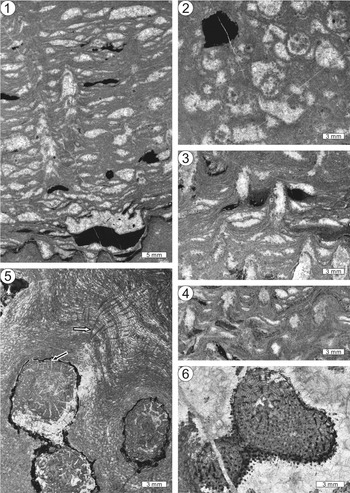
Figure 8.1–8.4
- Reference Webby1991
Stylostroma bubsense Webby, p. 204, figs. 6d−e, 7a−b.
- Reference Jeon, Liang, Park, Choh and Lee2020a
Pachystylostroma; Jeon et al., p. 200, fig. 5g.
Type specimen
Holotype UTGD 94659 from the lower part of the Gordon Limestone at Bubs Hill, and one paratype UTGD 94660 from the Dogs Head Formation of the middle Chudleigh Subgroup between Overflow Creek and Sassafras Creek, 1.5 km northwest of Ugbrook (Webby, Reference Webby1991, p. 204, figs. 6d,e, 7a,b); deposited in University of Tasmania, Australia.
(1, 2) Longitudinal and tangential sections of Stylostroma bubsense Webby, Reference Webby1991 from the S15 interval, NIGP 175193-1, 5, respectively. Note well-developed, but also sporadically developed, mamelon columns in (1). (3, 4) A variety of longitudinal skeletal phases of Stylostroma bubsense from the S17 interval, NIGP 175194 and 175195, respectively. (5, 6) Longitudinal and tangential sections of Stylostroma ugbrookense Webby, Reference Webby1991 from the S6 and S3 intervals, NIGP 175202 and 175225-1, respectively. Note variable preservation of pillars, ranging from hollow (black arrow) to solid (white arrow) pillars in (5).
Occurrence
The S15 and S17 intervals of the Xiazhen Formation (Upper Ordovician, Katian) at Zhuzhai, Yushan County, Jiangxi Province, China.
Description
Skeletons are distinctively mammillate with domical growth form, up to 40 cm high and 100 cm wide but mostly less than 46 mm high and 90 mm wide. The mamelon columns are regularly placed, up to 12.26 mm apart (species average 6.97 mm), ranging from 6.14 to 26.35 mm high (n = 10, species average 13.06 mm) and from 1.45 to 3.42 mm in diameter (n = 22, species average 2.51 mm). A certain phase without any mamelon columns is also observed.
Cysts are variable in both size and shape, ranging from 0.20 to 3.44 mm high (n = 153, species average 1.08 mm) and from 0.57 to 10.40 mm wide (n = 153, species average 3.17 mm). In general, it has moderate convexity, but elongated, flat, or highly convex cyst plates also commonly occur, and cyst width/height ratio ranges 1.36–7.59 (n = 153, species average 3.27). Intermamelon cyst plates are rather more irregularly and widely placed than in the non-mamelon skeletal phase.
Denticles are the most predominant vertical elements. Pillars are generally short and less continuous and range 0.27–2.70 mm high (n = 14, species average 1.21 mm) and 0.09–0.23 mm in diameter (n = 14, species average 0.17 mm). Preservation is variable from solid to hollow and spar-filled forms.
Materials
Ten specimens, NIGP 168776 and 175193–175201.
Remarks
The present Xiazhen specimens of Stylostroma bubsense share close morphological similarity with the Tasmanian specimens (Webby, Reference Webby1991). Both specimens exhibit elongate to moderately convex cyst plates. The distributions of pillars are also similarly intensively developed in mamelon columns, while sparsely distributed in other skeletal phases (Webby, Reference Webby1991).
Stylostroma bubense is also comparable to Pachystylostroma mammillatum Webby, 1979 (Webby, Reference Webby1979a). However, due to lack of key characteristics of the genus Pachystylostroma (i.e., cysts of variable size, with alternating gently wavy cyst plates with wall thickness ranging from thin to very thick; Nestor, Reference Nestor1964, Webby, Reference Webby and Selden2015a), the former Pachystylostroma mammillatum has been revised as a species of Stylostroma: Stylostroma mammillatum (Webby, Reference Webby1979) (Webby, Reference Webby1979a; see Webby, Reference Webby1991, p. 201). It differs in exhibiting more commonly developed pillars than the present specimens. In addition, its mamelons do not exhibit any vertical elements, i.e., denticles and pillars (Webby, Reference Webby1979a).
Stylostroma ugbrookense Webby, Reference Webby1991
Figure 8.5, 8.6
- Reference Webby1991
Stylostroma ugbrookense Webby, p. 202, figs. 5a−e, 6a−c.
- Reference Jeon, Liang, Park, Choh and Lee2020a
Stylostroma; Jeon et al., p. 200, fig. 5f.
Type specimen
Holotype UTGD 94648 and nine paratypes (UTGD 90521, 94649, 98500−98506) from the upper part of the Dogs Head Formation (Upper Ordovician, early Katian) of the Gordon Group of Ugbrook in Mole Creek area and Gunns Plains of Tasmania, Australia (Webby, Reference Webby1991, p. 202, figs. 5a−e, 6a−c); deposited in University of Tasmania, Australia.
Occurrence
The S3, S5, and S6 intervals of the Xiazhen Formation (Upper Ordovician, Katian) at Zhuzhai, Yushan County, Jiangxi Province, China. It occurs commonly in the S6 interval, with domical growth form up to 40 cm high and 100 cm wide; it is rare in S3 and S5, with laminar growth form up to 5 cm high and 13 cm wide.
Description
Skeletons are laminar to low domical growth forms, up to 40 cm high and 100 cm wide, and they have slightly to highly wavy laminar forms. Mamelons are generally slender, regularly spaced, up to 18 mm apart (but normally around 9 mm), and vertically aligned, probably owing to geotropic growth. Non-mamelon skeletal phase also occurs. Undulating sediment-filled spaces between mamelon columns are commonly observed but do not have lateral continuity. Latilaminae are seen, up to 70 mm, but not common.
Cysts are generally small, ranging from 0.11 to 0.57 mm high (n = 255, species average 0.27 mm) and from 0.20 to 14.33 mm wide (n = 255, species average 2.39 mm). Cyst plates have low to moderate convexity, ranging in cyst width/height ratio from 1.00 to 30.93 (n = 255, species average 8.11). Cysts, in the area between two mamelon columns, are slightly to moderately larger than those that occur in mamelon columns and non-mamelon skeletal phases. Pillars are slender and well developed through the skeleton, but also absent in some parts of the skeleton, which is composed of only cyst plates and denticles. Pillars are more dominantly developed with outward curved direction in mamelon columns. Pillars range 0.54–6.36 mm high (n = 132, species average 2.40 mm) and 0.13–0.39 mm in diameter (n = 132, species average 0.21mm). In tangential sections, pillars show “distinctive composite, stellate branching patterns” (Webby, Reference Webby1991, p. 202), thus astrorhizae. Preservation is variable, even within a single skeleton, ranging from solid to hollow, with or without outlined walls, and spar-filled pillars.
Materials
Twenty-five specimens: NIGP 168775 and 175202–175223 from the S6 interval, NIGP 175224 from the S5 interval, and NIGP 175225 from the S3 interval.
Remarks
The materials from Tasmania exhibit cysts with variable size and shape, ranging from 0.1 to 0.3 mm high and from 0.6 to 1.2 mm wide, and well-developed pillars, ranging up to 12 mm high and 0.20 mm in diameter (Webby, Reference Webby1991), which is closely similar to the present Xiazhen materials. However, in the present material, a skeletal phase without any vertical element, which is composed only of cyst plates, is also observed. This difference is considered intraspecific variation.
Family Aulaceratidae Kühn, Reference Kühn1927
Genus Thamnobeatricea Raymond, Reference Raymond1931
Type species
Thamnobeatricea parallela Raymond, Reference Raymond1931.
Thamnobeatricea gouldi Webby, Reference Webby1991
Figure 9
- Reference Webby1979c
Cryptophragmus? sp. Webby, p. 98, fig. 5c.
- Reference Webby1991
Thamnobeatricea gouldi Webby, p. 220, figs. 14a–f, 16b.
- Reference Jeon, Liang, Park, Choh and Lee2020a
Aulacera; Jeon et al., p. 200, fig. 5e.
(1–6) Longitudinal and tangential sections of Thamnobeatricea gouldi Webby, Reference Webby1991. Note the ontogenetic variation of cyst plates. (3, 4) Black arrows indicate the sharp marginal top of cyst plates in the early growth stage, and white arrows indicate mature round cyst plates. (5) The occurrence of unusual large cyst plates (white arrows) in the later zone results in branching skeletons. (1) NIGP 175236-1 from the S8 interval. (2) NIGP 175237 from the S8 interval. (3) NIGP 175232 from the S3 interval. (4) NIGP 175233 from the S3 interval. (5) NIGP 175238 from the S8 interval. (6) NIGP 175249 from the S5 interval.

Type specimen
Holotype, deposited in University of Tasmania, Australia (UTGD 94654) and two paratypes (UTGD 81647, 98525) from the upper part of the Lower Limestone Member of the Benjamin Limestone (Gordon Group) in the Florentine Valley, Tasmania (Webby, Reference Webby1991, p. 220, figs. 14a–f, 16b).
Occurrence
The S2−S5 and S8 intervals of the Xiazhen Formation (Upper Ordovician, Katian) at Zhuzhai, Yushan County, Jiangxi Province, China.
Description
Skeletons are long, continuous, dominated by single columnar growth form, and up to 160 mm high and 11 mm wide (commonly 8 to 10 mm). Branching form is rarely observed. They are preserved in a variety of orientations and mostly fragmented. Astrorhizae are not found.
Internal skeletal structure is composed of axial, lateral, and outer recrystallized lateral zones, which can be distinguished by the presence and size of cyst plates. The axial zone occupies more than 50% of the diameter, composed of slightly overlapping large cyst plates. Cysts range from 1.58 to 5.79 mm high (n = 75, species average 2.96 mm) and from 1.04 to 8.41 mm wide (n = 75, species average 4.72 mm). Cyst plates have moderate to high convexity, and cyst width/height ratio ranges from 0.34 to 3.73 (n = 75, species average 1.59). Lateral zone is composed of up to five cyst plates, ranging from 0.29 to 2.20 mm, mostly approximately 1 mm. Cysts in the lateral zone are smaller than those in the axial zone, ranging 0.12–1.30 mm high (n = 276, species average 0.26 mm) and 0.21–1.58 mm wide (n = 276, species average 0.61 mm). Cyst plates have moderate convexity, and cyst width/height ratio ranges from 0.91 to 4.56 (n = 276, species average 2.39). Denticles are rarely developed, and pillars are not found. Branches developed from the abnormally large cyst plates in the lateral zone (Fig. 9.5). Outer lateral zone, which does not exhibit any internal structure, composed of coarse calcite spar replacement, ranging from 0.54 to 2.82 mm, mostly around 1.50 mm, with distinctive nodular external surfaces. The outer surface is also characterized by sporadically developed denticles.
Cyst plates vary from sharp-leaf or pointed-top shapes to overlapping bubble-like forms as the skeleton grew (Fig. 9.3, 9.4). The lateral zone, which is composed of small cysts, is rudimentary in early growth, but the outer coarse-calcite-recrystallized lateral zone is persistent.
Materials
Five specimens, NIGP 175231–175235, from the S3 interval, six specimens, 168774 and 175226–175230 from the S4 interval, NIGP 175249 from the S5 interval, and thirteen specimens, NIGP 175236–175248, from the S8 interval.
Remarks
The present specimens are similar to Tasmanian specimens in terms of both skeletal features and measurements. However, the Tasmanian specimens (particularly UTGD 90454; see Webby, Reference Webby1991, fig. 16b) commonly show branching form, which is rare in the specimens of the Xiazhen Formation. This seems to indicate intraspecific variation in different environmental conditions.
Genus Sinabeatricea Jeon new genus
Type species
Sinabeatricea luteolus new genus new species.
Diagnosis
Branching columnar aulaceratid composed of two skeletal zones; in the axial zone, an open radiating fibrously reticulate network occupying about 60% of the diameter, surrounded by low to moderately convex cyst plates, and penetrated by short and stout pillars; round papillae well developed, representing tops of individual pillars on the terminal growth surface; astrorhizae unknown.
Occurrence
The S3 interval of the lower Xiazhen Formation (Upper Ordovician, Katian) at Zhuzhai section, Yushan County, Jiangxi Province, China.
Etymology
Latin, Sina, China. Billings (Reference Billings and Logan1857) did not state the derivation of his genus name Beatricea, which has been revised as a junior synonym of Aulacera Plummer, Reference Plummer1843. It probably derived from the Latin word Beatrix, bringer of happiness.
Remarks
The internal structure of Sinabeatricea n. gen. is divided into two skeletal zones, the central axial columnar zone and the outer surrounding lateral zone, which is a typical characteristic of aulaceratid stromatoporoids. Aulaceratid genera were reported from peri-Gondwana, Laurentia, and Siberia (i.e., Aulacera, Thamnobeatricea, Sinodictyon Yabe and Sugiyama, 1930 (Yabe and Sugiyama, Reference Yabe and Sugiyama1930a), Ludictyon Ozaki, Reference Ozaki1938, Alleynodictyon Webby, Reference Webby1971, Quasiaulacera Copper, Stock, and Jin, Reference Copper, Stock and Jin2013) but not from Baltica. This group possesses large, convex-up, and widely spaced cyst plates with or without denticles in their axial zones. Sinabeatricea is differentiated from previously known aulaceratid genera by possession of the open reticulate skeletal elements in the axial column, while other genera possess large, convex, widely spaced, overlapped cyst plates in the axial column (Webby, Reference Webby and Selden2015c). This unique axial zone is surrounded by moderately convex cyst plates with continuous, stout, and short pillars, similar to other aulaceratid genera, possessing common skeletal characteristics of Labechia.
The diversification of aulaceratid stromatoporoids occurred intensively in the Middle Ordovician interval, and their early diversification was epichoric (Nestor and Webby, Reference Nestor, Webby, Harper and Servais2013; Stock et al., Reference Stock, Nestor, Webby and Selden2015). Aulaceratid labechiids initially diversified only in North China, recorded by five genera, and none of them are known from the other contemporary terranes of late Darriwilian age (Nestor and Webby, Reference Nestor, Webby, Harper and Servais2013; Stock et al., Reference Stock, Nestor, Webby and Selden2015; Webby, Reference Webby and Selden2015a). However, those North Chinese Darriwilian provincial aulaceratids are not known in the Upper Ordovician succession of North China. Together with the highest diversity peak of Ordovician stromatoporoids in the Katian, seven aulaceratid genera are known, mostly from Australia (Webby, Reference Webby1971, Reference Webby1991) and Laurentia (Cameron and Copper, Reference Cameron, Copper, van Soest, van Kempen and Braekmann1994; Copper et al., Reference Copper, Stock and Jin2013). This probably indicates that their subsequent diversification was related to worldwide dispersion during the Middle to Late Ordovician interval. It is postulated that aulaceratids were highly diverse in Laurentia and Siberia (personal communication, P. Copper, 2020), but only a few species have been reported (Copper et al., Reference Copper, Stock and Jin2013). Recent studies reveal that Greenland (Harper et al., Reference Harper, Jin and Rasmussen2014) and Siberia (Dronov et al., Reference Dronov, Kushlina and Harper2016) are also promising for aulaceratid research, and further detailed study is needed.
Sinabeatricea luteolus Jeon new genus new species
Figure 10
Type specimen
Holotype NIGP 175250, paratypes 175251 and 175252.
(1–3) Holotype NIGP 175250 of the longitudinal section of Sinabeatricea luteolus Jeon n. gen. n. sp. from the S3 interval of the Xiazhen Formation. (2) Enlarged photograph of the marked rectangular area of (1) with typical skeletal characteristics of labechiids. (3) Tangential section of the lateral zone. (4, 5) Skeletal variations from the open reticulate network in the axial zone to cyst with pillars in the lateral zone from the S3 interval, paratypes NIGP 175251 and 175252, respectively.

Diagnosis
A species of Sinabeatricea with open radiating reticulate network of 16–20 mm in diameter in the axial zone, occupying up to about 60% of the diameter of the fossil; the reticulate network surrounded by lateral zone and composed of low to moderately convex cyst plates penetrated by short and stout pillars; cyst plates ranging from 0.19 to 0.69 mm high and from 0.11 to 1.80 mm wide; pillars ranging from 1.04 to 3.75 mm high and from 0.18 to 0.68 mm in diameter.
Occurrence
The S3 interval of the lower Xiazhen Formation (Upper Ordovician, Katian) at Zhuzhai section, Yushan County, Jiangxi Province, China.
Description
Skeletons are restricted to columnar growth form, up to 40 mm in diameter. Height is indeterminable because the specimens are preserved as fragmented stems with a variety of orientations. Mamelons and astrorhizae are not found.
Internal skeletal structure is divided into two skeletal zones, axial and lateral. Those skeletal zones are differentiated by open reticulate skeletal structure and cyst plates with well-developed pillars. The axial zone is composed of open radiating reticulate skeletal structure, ranging from 0.09 to 0.15 mm thick. The axial zone grades to the lateral zone, which is composed of cyst plates and continuous well-developed pillars. Cysts range from 0.19 to 0.69 mm high (n = 43, species average 0.35 mm) and from 0.11 to 1.80 mm wide (n = 43, species average 0.73 mm). Cyst plates have low to moderate convexity, and cyst width/height ratio ranges from 0.42 to 5.04 (n = 43, species average 2.12). Pillars are round and persistently well developed, generally penetrate fewer than four cyst plates, and range from 1.04 to 3.75 mm high (n = 58, species average 2.27 mm) and from 0.18 to 0.68 mm (n = 99, species average 0.31 mm) in diameter. Preservation is solid and partially silicified.
Etymology
Sinabeatricea luteolus: from Latin lūteolus, yellowish, in referring to its distinctive color.
Materials
Five specimens, NIGP 175250–175254, from the S2 interval.
Remarks
This species is distinguishable from other known aulaceratid species by a distinctive axial zone with open reticulate skeletal structure surrounded by moderately convex cyst plates that are penetrated by short and stout pillars. This meshwork structure has not been observed in other aulaceratid species or other labechiid groups. The basal part of the skeleton has not been found; thus, it is difficult to compare with other taxa and to assess how this columnar species initially grew. A further study of better-preserved specimens is required to reveal its growth characteristics.
Paleobiogeographic pattern of Ordovician labechiid stromatoporoids
A total of 181 species are recorded in publications and this new study, which is a relatively large number of taxa, and may represent most, if not all, of the total stromatoporoid low-level taxa (species) of this part of the Ordovician record. However, this study cannot address the validity of this range of taxa, so the full complement of recorded taxa is used in analysis here. Thus, the analyzed 181 species belong to 22 genera of labechiid stromatoporoids that occurred throughout 12 terranes. Most of the stromatoporoid species were endemic and occur only within a single terrane. Laurentia shows the highest species-level diversity among all terranes. However, in terms of generic level, 14 labechiid genera have been reported from peri-Gondwanan regions, particularly South China and Australian regions, possessing the highest genetic diversity level (compiled data from Webby in Stock et al., Reference Stock, Nestor, Webby and Selden2015, present study, and other compiled references). The result of the network analysis (Fig. 11) shows that the Ordovician stromatoporoids can be grouped into two faunal provinces, the peri-Gondwana–Tarim–Siberia (GTS) and Laurentia–Baltica–Siberia (LBS), judging from the occurrences of characteristic genera (i.e., Labechiella and Stromatocerium) and co-occurring stromatoporoid species.
(1) Network analysis diagram of Ordovician labechiid stromatoporoids using the layout Force Atlas 2 in Gephi version 0.9.2 (also see text) during the Ordovician. The listed species are labechiids co-occurring in two or more terranes. North China Darriwilian provincial species are indicated with an asterisk. (2) Two major faunal provinces of labechiid stromatoporoid distribution during the Ordovician. Paleogeographic reconstruction modified from Cocks and Torsvik (Reference Cocks and Torsvik2021). Note that the global stromatoporoid distribution is restricted to tropical to subtropical climatic zones.

GTS Province
The GTS Province is characterized by the co-occurrence of Rosenella woyuensis, Pseudostylodictyon poshanense, Labechia shanhsiensis, Labechia variabilis, and Labechiella regularis (Fig. 11). Their earliest reports are from the Middle Ordovician carbonates (upper Darriwilian) of North China (Yabe and Sugiyama, Reference Yabe and Sugiyama1930a; Ozaki, Reference Ozaki1938; Dong, Reference Dong1982). The North China fauna reached its greatest diversity during the late Darriwilian. This stromatoporoid assemblage was initially provincial in North China during the Middle Ordovician but became widely distributed to adjacent regions during the Late Ordovician. This identifiable, successive stromatoporoid fauna is herein termed North China Darriwilian provincial assemblage. The GTS Province is also characterized by the wide distribution of Labechiella, comparable to that of Stromatocerium in Laurentia, Baltica, and a certain part of Siberia.
The occurrences of Labechia altunensis and Stylostroma-related species indicate that Tarim was close to South China and Tasmania in biogeographic relations during the Late Ordovician, as it has also been observed from other fossil groups (e.g., Han et al., Reference Han, Zhang, Yang, Sun, Zhou, Zhao and Wang2017; Tang et al., Reference Tang, Wang, Xu, Jiang, Yang, Zhan and Zhang2017; Fang et al., Reference Fang, Burrett, Li, Zhang, Zhang, Chen and Wu2019; Sproat and Zhan, Reference Sproat and Zhan2019).
Although the Mongolian species in Bol'shakova and Ulitina (Reference Bol'shakova and Ulitina1985) require further reevaluation of taxonomy, species of Labechiella, Lophiostroma, and Ludictyon occur in the Upper Ordovician strata of Mongolia, indicating that Mongolia had a close biogeographic affinity with peri-Gondwanan terranes (especially North China) and Siberia (Nestor and Webby, Reference Nestor, Webby, Harper and Servais2013; Stock et al., Reference Stock, Nestor, Webby and Selden2015).
LBS Province
The LBS Province represents the highest-diversity species level of labechiid stromatoporoids and only a few species shared among Laurentia, Baltica, and Siberia. LBS province is also characterized by the occurrence of Stromatocerium (e.g., Galloway, Reference Galloway1957; Galloway and St. Jean, Reference Galloway and St. Jean1961; Bogoyavlenskaya, Reference Bogoyavlenskaya1973; Nestor, Reference Nestor1976; Bolton, Reference Bolton1988; Khromykh, Reference Khromykh2001). Baltica has distinctively low species-level diversity, which is possibly due to the late arrival of early labechiid stromatoporoids. In addition, columnar aulaceratid stromatoporoids were not found to occur in Baltica, but they have been reported from both Laurentia and Siberia (e.g., Yavorsky, Reference Yavorsky1955; Galloway, Reference Galloway1957; Galloway and St. Jean, Reference Galloway and St. Jean1961; Bolton, Reference Bolton1988; Copper et al., Reference Copper, Stock and Jin2013).
In Siberia, the labechiid assemblage is characterized by a mixture of both Laurentian and peri-Gondwanan species, judging from the occurrence of Stromatocerium, gigantic Aulacera, and Labechiella (particularly Labechiella regularis) and other co-occurring labechiids such as Rosenella woyuensis, Labechia huronensis, Labechia macrostyla, Stromatocerium australe, and Aulacera undulata (Fig. 11.1). This reflects the bilateral migration patterns from both peri-Gondwana and Laurentia, which correspond to the study of possible oceanic currents during the Middle to Late Ordovician interval (e.g., Servais et al., Reference Servais, Danelian, Harper and Munnecke2014; Pohl et al., Reference Pohl, Nardin, Vandenbroucke and Donnadieu2016).
Discussion
Stromatoporoids indicate shallow, tropical to subtropical waters (Nestor and Webby, Reference Nestor, Webby, Harper and Servais2013; Stock et al., Reference Stock, Nestor, Webby and Selden2015). Ordovician labechiid stromatoporoids are specifically regarded as temperature sensitive and thermophilic (Nestor and Stock, Reference Nestor, Stock, Ezaki, Mori, Sugiyama and Sorauf2001; Webby, Reference Webby, Webby, Paris, Droser and Percival2004). In the past several decades, the paleobiogeographic study of Ordovician stromatoporoids in both regional and global scales provided the basis for understanding their distribution patterns and biogeographic affinities among different terranes (e.g., Webby, Reference Webby1980, Reference Webby, Webby and Laurie1992; Lin and Webby, Reference Lin and Webby1989; Nestor and Webby, Reference Nestor, Webby, Harper and Servais2013; Stock et al., Reference Stock, Nestor, Webby and Selden2015). However, these studies did not pay enough attention to South China due to a lack of sufficient investigation of stromatoporoids from this terrane, as only few genera have been reported from South China before (e.g., Lin and Webby, Reference Lin and Webby1989; Nestor and Webby, Reference Nestor, Webby, Harper and Servais2013; Stock et al., Reference Stock, Nestor, Webby and Selden2015). Recent investigation (Jeon et al., Reference Jeon, Liang, Park, Choh and Lee2020a) revealed a diverse stromatoporoid fauna in the Xiazhen Formation, indicating that South China was also a favorable region for the diversification of stromatoporoids, similar to other peri-Gondwanan regions. As many as 19 genera of labechiid stromatoporoids globally occurred in the Katian, attaining the highest generic diversity level during the entire evolutionary history of labechiids (Webby, Reference Webby, Webby, Paris, Droser and Percival2004; Stock et al., Reference Stock, Nestor, Webby and Selden2015). In geographic ranges, they also attained the widest circum-equatorial distribution (Webby, Reference Webby, Webby, Paris, Droser and Percival2004). Due to the obvious higher generic diversity level, the peri-Gondwanan region, including Australia and South China and some other terranes, has been proposed to be the diversification center for Late Ordovician stromatoporoids (Nestor and Webby, Reference Nestor, Webby, Harper and Servais2013; Stock et al., Reference Stock, Nestor, Webby and Selden2015; Jeon et al., Reference Jeon, Liang, Park, Choh and Lee2020a).
Pseudostylodictyon poshanense, Labechia shanhsiensis, Labechia variabilis, and Labechiella regularis are found in the Xiazhen Formation. These species occurred first in the upper Darriwilian of North China, which possessed the most diverse and distinctive Darriwilian labechiid fauna, including 24 species in 9 genera (Yabe and Sugiyama, Reference Yabe and Sugiyama1930a, Reference Yabe and Sugiyamab; Endo, Reference Endo1932; Ozaki, Reference Ozaki1938; Sugiyama, Reference Sugiyama1941; Dong, Reference Dong1982; Kano et al., Reference Kano, Lee, Choi and Yoo1994; Jeon et al., Reference Jeon, Park, Choh and Lee2017, Reference Jeon, Li, Oh, Choh and Lee2019), and are herein defined as North China Darriwilian provincial species. Among these early North Chinese species, Rosenella woyuensis and Labechia variabilis also occur in the coeval succession of Sibumasu (Unit J of the Lower Setul Limestone of the Langkawi Islands, Malaysia; Webby et al., Reference Webby, Wyatt and Burrett1985), reflecting the close paleogeographic distance between North China and Sibumasu during the Ordovician (Burrett et al., Reference Burrett, Zaw, Meffre, Lai, Khositanont, Chaodumrong, Udchachon, Ekins and Halpin2014, Reference Burrett, Udchachon and Thassanapak2017). The subsequent occurrences of those species in South China and Australian regions indicate that the North China provincial species dispersed among peri-Gondwana regions during the late Middle Ordovician to Late Ordovician interval. Of these species, Labechiella regularis significantly shows the widest geographic distribution (Fig. 11.1), occurring in North China (Darriwilian of the Middle Ordovician; Yabe and Sugiyama, Reference Yabe and Sugiyama1930a; Ozaki, Reference Ozaki1938; Kano et al., Reference Kano, Lee, Choi and Yoo1994; Jeon et al., Reference Jeon, Park, Choh and Lee2017), Australian terranes (including New South Wales and Tasmania; Katian of Upper Ordovician; Webby, Reference Webby1969, Reference Webby1991), Kazakh terranes (Katian of Upper Ordovician; Karimova and Lesovaya, Reference Karimova, Lesovaya, Kim, Salimova, Kim and Meshchankina2007), and Siberia (Katian of Upper Ordovician; Yavorsky, Reference Yavorsky1955; Bogoyavlenskaya, Reference Bogoyavlenskaya1971; Khromych, Reference Khromykh2001). The dispersal patterns of other North China Darriwilian provincial labechiids, including Rosenella woyuensis, Pseudostylodictyon poshanense, Labechia variabilis, and Labechia shanhsiensis, are fairly similar to that of Labechiella regularis (Fig. 11.1). The distribution and dispersal patterns of North China provincial species show that co-occurring species of stromatoporoids occur more commonly in terranes that are geographically close together; thus, evaluation of co-occurring stromatoporoid species can be a useful criterion for establishment of the biogeographic realm of terranes (Fig. 11).
Together with those North China Darriwilian provincial labechiid species, other species also support a close paleobiogeographic affinity with Australia. It has been proposed that South China and Australia (including New South Wales and Tasmania) may have a close paleobiogeographic relationship, judging from the occurrences of a few clathrodictyid species (Stock et al., Reference Stock, Nestor, Webby and Selden2015). Our network analysis shows that South China shares many common labechiid species with central New South Wales and Tasmania (Fig. 11.1), including Labechiella gondwanense n. sp., Labechiella regularis, Stylostroma bubsense, Stylostroma ugbrookense, and Thamnobeatricea gouldi. Labechiella gondwanense occurs widely in North China (formerly Cystistroma donnellii in Jiang et al., Reference Jiang, Sun, Bao and Wu2011), South China, New South Wales (formerly Labechia variabilis in Webby, Reference Webby1969), and Tasmania (formerly Labechiella variabilis in Webby, Reference Webby1991) during the Katian. Until now, Tasmanian stromatoporoid faunas were thought to be closely related to those from Laurentia, judging from the shared occurrences of the labechiid genera Thamnobeatricea, Pachystylostroma, and Aulacera (Lin and Webby, Reference Lin and Webby1989; Webby, Reference Webby1991; Webby et al., Reference Webby2000; Stock et al., Reference Stock, Nestor, Webby and Selden2015). However, the finding of co-occurring labechiid species, including Stylostroma bubsense, Stylostroma ugbrookense, and Thamnobeatricea gouldi in both South China and Tasmania (Webby, Reference Webby1991; present study) indicates that the Tasmanian shelf had a much closer paleobiogeographic affinity with peri-Gondwanan regions than with Laurentia. It is noteworthy that New South Wales had a quite different labechiid assemblage from that of Tasmania (Webby et al., Reference Webby2000; Nestor and Webby, Reference Nestor, Webby, Harper and Servais2013) although they were geographically close to each other during the Late Ordovician. In the case of the Tasmanian labechiids, species of Pachystylostroma, Aulacera, and Thamnobeatricea are found, but these are not known from coeval successions of New South Wales. A species of Cystistroma was found to occur in New South Wales (Webby, Reference Webby1969) instead of Tasmania and South China. By contrast, Alleynodictyon commonly occurs in both Tasmania and New South Wales (Webby, Reference Webby1971, Reference Webby1991; Webby et al., Reference Webby2000), whereas it is not found in South China.
Although the exact location of Tarim during the Late Ordovician is still controversial, the paleobiogeographic studies of various fossil groups consistently show that Tarim and other peri-Gondwanan terranes share faunal affinities (Webby et al., Reference Webby2000; Stock et al., Reference Stock, Nestor, Webby and Selden2015; Han et al., Reference Han, Zhang, Yang, Sun, Zhou, Zhao and Wang2017; Tang et al., Reference Tang, Wang, Xu, Jiang, Yang, Zhan and Zhang2017; Sproat and Zhan, Reference Sproat and Zhan2019). In terms of stromatoporoids, judging from the occurrence of Labechia altunensis in South China and Tarim, Stylostroma in Tasmania (Webby, Reference Webby1991) and South China, and Stylostroma-related species in Tarim (formerly classified as Pseudolabechia by Dong and Wang, Reference Dong and Wang1984; ranges from probably late Darriwilian to early Sandbian; Webby et al., Reference Webby2000), those two terranes are closely related. This close biogeographic affinity is correspondingly supported by other fossil groups, including brachiopods (Sproat and Zhan, Reference Sproat and Zhan2019), distinctive conodonts Tasmanognathus (Zhen et al., Reference Zhen, Burrett, Percival and Lin2010) and Serratognathus (Wang et al., Reference Wang, Qi and Bergström2007; Zhen et al., Reference Zhen, Percival, Liu and Zhang2009), chitinozoans (Tang et al., Reference Tang, Wang, Xu, Jiang, Yang, Zhan and Zhang2017), and corals (Han et al., Reference Han, Zhang, Yang, Sun, Zhou, Zhao and Wang2017). However, it should be noted that North China Darriwilian provincial species (Rosenella woyuensis, Pseudostylodictyon poshanense, Labechia shanhsiensis, Labechia variabilis, and Labechiella regularis) occurred in many peri-Gondwanan regions (particularly South China and Australia) but not in Tarim, indicating a relatively large distance between North China and Tarim.
Rhynchonelliform brachiopods, which were one of the most common invertebrate fossil groups during the Great Ordovician Biodiversification Event, exhibit similar biogeographic patterns to those of the labechiid stromatoporoids. The South China rhynchonelliform brachiopods were generally composed of cosmopolitan species, having faunal similarity with the Kazakh terranes in the Sandbian (Harper et al., Reference Harper, Rasmussen, Liljeroth, Blodgett, Candela, Jin, Percival, Rong, Villas, Zhan, Harper and Servais2013; Cocks and Torsvik, Reference Cocks and Torsvik2021). During the middle to late Katian, the South China brachiopods exhibited a close relationship with those of the eastern Gondwanan (particularly New South Wales) fauna, reflecting the northern path via South China (Torsvik and Cocks, Reference Torsvik and Cocks2017), and this pattern became more evident by the middle to late Katian as South China likely intersected migration pathways defined by surface currents (Harper et al., Reference Harper, Rasmussen, Liljeroth, Blodgett, Candela, Jin, Percival, Rong, Villas, Zhan, Harper and Servais2013). This is rather similar to the biogeographic pattern of Late Ordovician labechiid stromatoporoids in that South China shares a number of co-occurring species with eastern Gondwanan regions (including New South Wales and Tasmania). A recently proposed new term, “Cathay-Tasman Province” (Cocks and Torsvik, Reference Cocks and Torsvik2021), correspondingly shows similar recognition of a faunal province (Fig. 11.2) judging from the studies of brachiopods and trilobites. However, it differs from the current GTS Province as the former does not include Siberia, Altai-Sayan Fold Belt, and Mongolia (see Cocks and Torsvik, 2021, fig. 6 and corresponding text). Graptolites and cephalopods, which are mobile organisms, reached a high diversity level in the Late Ordovician, exhibiting generally increasing endemism throughout the Katian, apparently different from the aforementioned benthic sessile organisms (Goldman et al., Reference Goldman, Maletz, Melchin, Fan, Harper and Servais2013; Fang et al., Reference Fang, Burrett, Li, Zhang, Zhang, Chen and Wu2019). During the Late Ordovician, the cephalopod assemblage of South China had biogeographic affinities with those from small terranes of peri-Gondwana (i.e., Sibumasu, Lhasa, Himalaya) located between South China and Australia, but it is remarkably different from that of Australia (Fang et al., Reference Fang, Burrett, Li, Zhang, Zhang, Chen and Wu2019). The pattern of cephalopod distribution is somewhat different from that of labechiid stromatoporoids, likely due to their different living strategies.
Overall, the Xiazhen labechiid assemblage is influenced by the northward rifting of South China along peri-Gondwana, forming a more favorable environmental condition for the development of stromatoporoids, judging from the combination of the succeeding North China Darriwilian provincial species and Australian (especially Tasmania) faunas. This labechiid assemblage reflects the idea that South China was likely the locus for the intersectional migrations of North Chinese Darriwilian and Australian labechiid species during the Late Ordovician. The high diversity level in these peri-Gondwanan terranes is possibly due to the strong dispersal ability and rapid speciation rate of the labechiid stromatoporoids during their early evolutionary history.
Conclusions
A diverse fauna of labechiid stromatoporoids is recorded from the Upper Ordovician Xiazhen Formation of South China, which represents one of the highest diversity levels among the terranes of the Late Ordovician. A total of 16 labechiid species belonging to eight genera are identified, including one new genus and four new species. The assemblage is characterized by a mixture of South China endemic species and North China Darriwilian provincial species (Pseudostylodictyon poshanense, Labechia shanhsiensis, Labechia variabilis, and Labechiella regularis), which were also commonly found in other coeval peri-Gondwanan terranes, especially New South Wales and Tasmania of Australia. The dispersal of North China Darriwilian labechiid provincial species through the Late Ordovician of peri-Gondwanan terranes shows that endemism declined as stromatoporoids achieved their widest Ordovician circumequatorial distribution. Moreover, the finding of Stylostroma ugbrookense and Thamnobeatricea gouldi from both South China and the Tasmanian shelf indicates that those two regions had a closer biogeographic affinity during Late Ordovician than previously thought. The northward shift of South China near to northeastern Gondwanan terranes provided migration pathways of early labechiid stromatoporoids, resulting in a highly diverse Xiazhen labechiid assemblage that shared strong affinities to those of North China and Australian regions (especially Tasmania) during the Late Ordovician.
Acknowledgments
This study was supported by grants from the Chinese Academy of Sciences (XDB26000000) and the National Natural Science Foundation of China (grant nos. 42030510, 41402013, and J1210006) to Y. Zhang and K. Liang and National Research Foundation of Korea (2019R1I1A1A01061336) to J. Park. Chinese Academy of Sciences (CAS) “One Belt and One Road” Master Fellowship, ANSO Scholarships for Young Talents, and the 2019 and 2020 Nanjing Municipal Government International Students Scholarship to J. Jeon are also acknowledged.
We deeply appreciate U. Toom (Tallinn University of Technology), N. Jun (Tohoku University), O. Obut (Trofimuk Institute of Petroleum Geology and Geophysics), and P. Smith (Australian Museum) for providing references and opportunities to check the Ordovician stromatoporoid type specimens from Estonia, China, Altai, and New South Wales of Australia. We are grateful to D.-J. Lee (Jilin University), X.-D. Wang (Nanjing University), S.-J. Choh (Korea University), M. Lee (Korea Polar Research Institute), and H. Park for their assistance in fieldwork and thin section preparation during the past decade. We thank C. Burrett (Mahasarakham University), an anonymous reviewer, and editor J. Botting for their helpful comments. The warm hospitality and assistance of the residents of Zhuzhai village during fieldwork are also greatly appreciated. This paper is a contribution to IGCP 735 “Rocks and the Rise of Ordovician Life: Filling knowledge gaps in the Early Palaeozoic Biodiversification.”
Data availability statement
Data available from the Dryad Digital Repository: https://doi.org/10.5061/dryad.8sf7m0cpg.