A mass-casualty incident (MCI) is an event that generates more patients at 1 time than locally available resources can manage through routine procedures. MCIs result from multiple causes which include ‘conventional MCIs’ (transportation incidents, burns, and severe weather events); exposure to chemical, biological, radiological, or nuclear agents due to an unintentional or accidental release or act of terrorism; and catastrophic health events (major explosions, major hurricanes, influenza pandemics, and others). With regards to MCIs, it seemed natural to think about disasters. Disasters are incidents where more than 10 people are killed or more than 100 are affected. 1 Disasters are the main cause of MCIs. Global trends indicate that the frequency of disasters worldwide have doubled, as disaster hazards are on the rise. Reference Swienton and Raymond2 Over the last 20 years, 7348 disasters were recorded by the Emergency Events Database (EM-DAT), and these disasters claimed approximately 1.23 million lives, with an average of 60000 deaths per annum. 3 MCIs are classified according to different levels depending on the number of victims: Level 1 = 5 - 10 victims, Level 2 = 11 - 20 victims, Level 3 = 21 - 100 victims, Level 4 = 101 - 1000 victims, and Level 5 = over 1000 victims. Reference Busby4
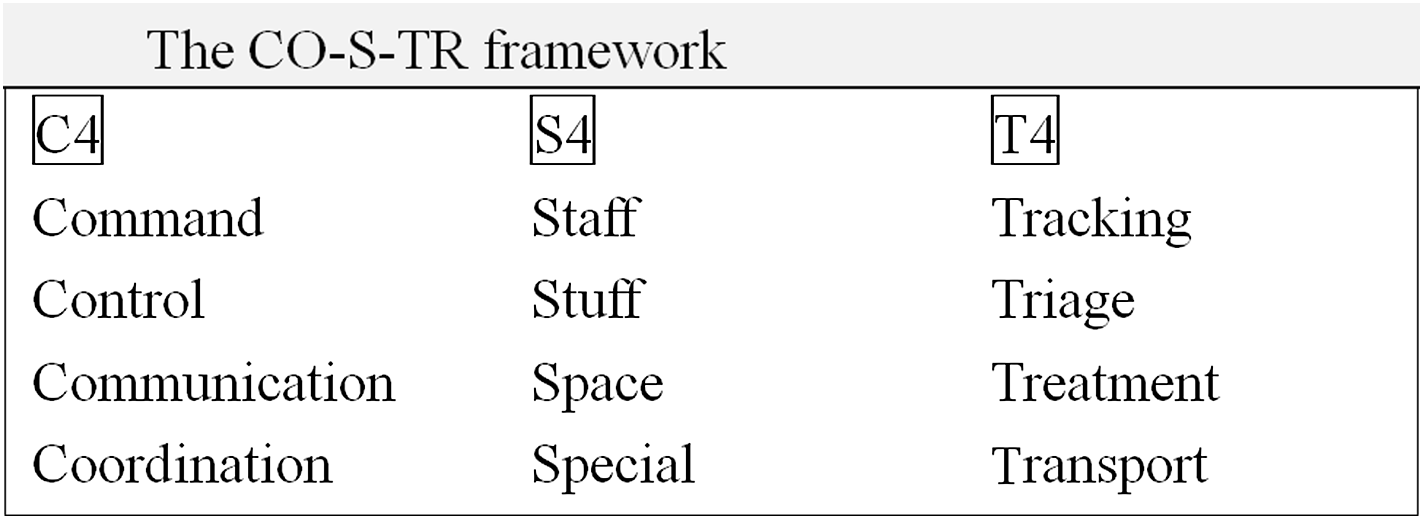
In order to cope with MCIs, exceptional emergency arrangements and additional or extraordinary assistance are required Reference Lomaglio, Ansaloni, Catena, Sartelli, Coccolini, Kluger, Coccolini, Catena and Ansaloni5 ; this is referred to as surge capacity. Surge capacity is a critical component of preparedness Reference Barbisch and Koenig6 ; it describes the ability of a health system to respond to a sudden increase in patient care demands. Reference Hick, Koenig, Barbisch and Bey7 In addition, surge capacity includes the staff, structure, and system (4S) that can help to develop optimized sustainable surge capacity. Reference Hick, Koenig, Barbisch and Bey7 Based on the 4S system, Hick et al. proposed the CO-S-TR tool, which can be incorporated into job action sheets or can stand alone as a reference or poster. Reference Hick, Koenig, Barbisch and Bey7 The CO-S-TR includes 3 main elements, each of which contains 4 sub elements (Figure 1). In addition, a brief, facility-specific mobilization checklist is designed to enable the rapid identification and prioritization of resource needs, the recognition of key objectives, and early stages of incident control. The tool provides a means to proactively determine what resources are needed and how to deploy them to minimize omissions and optimize outcomes. It is a practical tool for emergency response or surge capacity education. As suggested, the integrated and efficient response can only come about if the personnel involved are educated and trained in the unique procedures thought to be necessary in the response to these incidents. Reference Lomaglio, Ansaloni, Catena, Sartelli, Coccolini, Kluger, Coccolini, Catena and Ansaloni5 With regard to the emergency response training of MCIs, exercises are indispensable.
The CO-S-TR framework.

An exercise is a focused practice activity that places participants in a simulated situation requiring them to function in the capacity that would be expected of them during a real event. 8 By testing policies, plans, and training personnel, exercises for MCIs could help ensure that the organization or individuals is in a constant state of well-prepared readiness. Reference Moss and Gaarder9 To improve the surge capacity of medical institutes, comprehensive exercises are indispensable. There are 5 main types of comprehensive exercises: orientation seminars, drills, table-top exercises (TTXs), functional exercises, and full-scale exercises. 8 TTX acts as a bridge between simple and complex, narrow and broad, least expensive, and most costly to implement, and theoretical and realistic. In a TTX, the participants come together to take on their roles and work through an incident. The participants examine and resolve problems based on existing operational plans. They also identify where those plans need to be refined. The major elements of a TTX include policy-level personnel evaluating plans and procedures, resolving coordination and responsibility questions, and facilitating group discussion. Such exercises provide participants with an emergency scenario to analyze, thereby increasing their awareness of the roles and responsibilities of individuals who need to respond to, stabilize the situation, neutralize threats, and help others recover from emergencies. They are designed to prompt constructive discussion about existing emergency response plans as participants identify, investigate, and resolve issues. These features make TTXs a common training activity used during emergency preparedness and disaster education. The TTX is classified as a discussion-based exercise with little or no practice. In this study, we tried to reform the TTX by inviting the participants to discuss and respond in a simulated scenario. In recent years, a specific type of TTX has involved the use of reports and details from recent MCIs to challenge and assess a healthcare system or institution. Reference Moss and Gaarder9–Reference Skryabina, Betts and Reedy12 This type of TTX was proven to be valuable in testing plans and informing policy and practice during incidents. Reference Hirsch, Carli and Nizard13 Therefore, we developed a TTX training based on a real event that occurred in Shanghai in recent years, namely, a crush that occurred in Shanghai’s historic Bund district on December 31, 2014, that killed 36 people and injured 49 others. 14 The crush was categorized as a level-3 MCI. It is a representative MCI that happened in a megacity with tremendous social influence. The event was such as could arouse the participants’ memory and interest. The crush may also have triggered surge capacity of different level for some hospitals based on the status of shunted casualties. The healthcare system experienced challenges in its ability to provide an effective and coordinated response to this MCI in Shanghai. This tragedy highlighted the need for cohesive strategies that focus on management systems for major public health and medical responses. In this study, we aimed to develop a TTX training program based on this event, to apply it in practice, and to evaluate it.
Even though functional or full-scale exercises have many benefits, they are undoubtedly difficult for recently graduated medical staff to accomplish. The TTX allows for easy adaptability for various programs, departments, and disaster scenarios. Reference Sena, Forde and Yu15 This makes it a suitable tool for senior medical students or newly graduated medical staff. According to the National Disaster Life Support course manual, disaster exercises should be designed to test incident command and control, communications, logistics, laboratory coordination, and clinical capabilities, among others. Reference Swienton and Raymond2 This idea is consistent with the CO-S-TR model. Therefore, we tried to develop a scenario simulation TTX kit based on the CO-S-TR model and to evaluate the effectiveness of the TTX training among recently graduated medical staff in this study.
Development of the TTX program
The purpose of a TTX is to strengthen or evaluate readiness to manage a health emergency through facilitated group discussions. Therefore, it is paramount that exercises are designed to focus on issue areas that require concrete decisions over a limited period. The design and implementation of a TTX program determine its success or failure. In order to ensure the quality of the program in this study, a design group of 4 researchers with ample emergency care teaching experience was recruited, and these researchers took charge of the program development.
First, information on the sequence and casualties of the Shanghai New Year crush was collected through a literature review. A brief timeline of the incident was drawn. After the TTX protocol was drafted, an expert conference was held to discuss the purpose, content, format, and details of the program. Furthermore, the TTX program was based on the CO-S-TR model, Reference Hick, Koenig, Barbisch and Bey7 involving elements C4, S4 and T4. All 12 CO-S-TR elements were addressed within the TTX scenario. It was designed according to the 8 TTX design steps proposed by the World Health Organization: assess needs, define the scope, write a purpose statement, define objectives, compose a narrative, write major and detailed events, list expected actions, and prepare messages. 8 The core objectives that the participants were expected to achieve at the end of the TTX program were set according to the SMART (simple, measurable, achievable, realistic, and task oriented) system. The primary purposes of the TTX program are as follows: to strengthen and evaluate first aid strategies for MCIs (the participants are required to choose the proper first aid technique for each injury and attach the measure card to the injury models), to learn and verify management skills for MCIs, and to formulate and validate the assumptions and procedures for an emergency response plan.
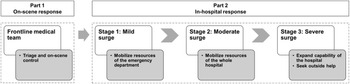
The TTX training program contains 2 parts: the on-scene emergency response and the in-hospital emergency response. The in-hospital part is divided into 3 stages: mild, moderate and severe surge status (Figure 2). During the on-scene response part, a frontline medical team with 7 crews is supposed to respond within 5 minutes after the initial crush. This part mainly focuses on site control: triage, emergency treatment, and transport are the key points, and emergency incident management on scene is another teaching element. In the in-hospital part, each stage corresponds to different surge levels. The parameters of the hospital beds, the extensible resources of each department and all kinds of medical resources are provided before the exercise, and the participants should deal with the injuries based on the available resources and the possible capability of overload. The injuries’ total needs will exceed the resources step-by-step. As the first batch of casualties arrives, the hospital enters the mild surge stage, and the resources of the emergency department should be mobilized to meet the demands. As the second batch of casualties arrives, the resources of the emergency department cannot meet the demand, and the whole hospital should be mobilized. As the third batch of casualties arrives, all hospital resources should be utilized. The extended capability of the hospital should be explored, and outside resources should be sought. All the casualties arrive at an increasing frequency. Once the injured patients arrive, the ambulance sirens continue to sound until the injuries are managed properly, while the instructors urge the participants to respond quickly to create tension. As the participants proceed through the event, they experience different degrees of overload and implement an emergency response accordingly.
The TTX process.

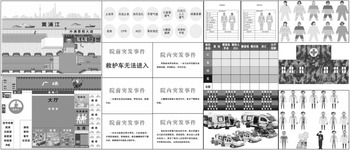
To ensure the effectiveness of the training program, all instructional props were designed and made specifically for the program (Figure 3). Diagrams of the layouts of the Bund district and the hospital were drawn by designers according to their actual layouts. The casualty models were made of acrylic with precast magnets and were designed to be able to stand, sit and lie down. In addition, the injury information cards, and emergency measure cards were all made of magnetic material so that they could be attached to the casualty models. The instructional props recreated the scene of the crush event and simulated all the injuries as much as possible. The instructors acted as bystanders, members of the media, and family members of injured patients so that the participants could practice in an authentic environment.
Instructional props.

Evaluation of the TTX program
Sample
Recently graduated medical staffs were recruited by convenience sampling, and all the medical staff voluntarily participated in this study.
Instruments
Self-designed questionnaire
Demographic items collected information on the participants’ gender, age, MCI training experience, and MCI response experience. In addition, a program evaluation questionnaire with 7 items was developed by the research group, focusing on both the degree of willingness for involvement and the perceived likeability of the TTX. The instructional props were evaluated on a 5-point scale ranging from highest involvement/willingness to lowest involvement/willingness or from strong dislike to strong like. The difficulty ratings of the TTX ranged from extremely easy to extremely difficult, and a score of 3 represented moderate difficulty.
Simulation design scale (SDS)
The SDS is a 20-item, 5-point Likert-scale instrument with 2 dimensions: the appropriateness of the researcher-developed simulations and the most important features of the simulations. Reference Jeffries16 The SDS was translated into Chinese and was found to have good properties in terms of the presence of features, r = 0.88, and the importance of features, r = 0.89. Reference Wang, Fitzpatrick and Petrini17
Educational practices in simulation scale (EPSS)
The EPSS is a 16-item, 5-point Likert tool used to measure the extent to which best practice principles in education are used in TTXs. The elements evaluated in the EPSS scale are active learning (10 items), diverse ways of learning (2 items), high expectations (2 items), and collaboration (2 items). The EPSS was translated into Chinese and was found to have good properties in terms of the presence of features, r = 0.87, and the importance of features, r = 0.94. Reference Wang, Fitzpatrick and Petrini17
Intervention and procedure
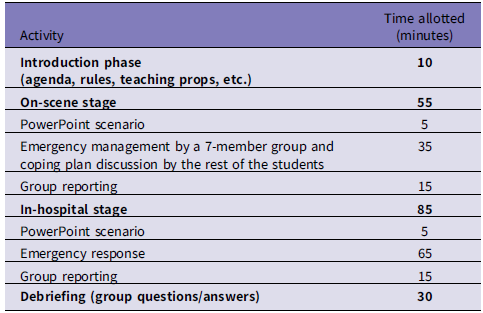
An experienced instructor who was familiar with the TTX was primarily in charge of the training course. Another 2 instructors were assigned to act as recorders, documenting actions taken during the TTX. The TTX began with a briefing to orient the participants to the TTX objectives, ground rules, communication, and simulation procedures. The scenario narrative was then presented in an intelligence briefing. The scenarios generally described the New Year’s Eve crush in Shanghai, taking the participants back to the ‘chaotic scene’ in Shanghai’s historic Bund district and the emergency department of 1 hospital, while describing other developments up to the present. The participants were instructed to use their knowledge of actual resources at Changhai Hospital. The instructor announced the beginning and the end of the exercise and introduced the first problem, along with subsequent pacing messages, to the participants. The instructors presented the messages 1 at a time to individual participants. The group then discussed the issues raised by the message. The group determined what, if any, additional information was needed and requested that information. They took some actions with the teaching props provided to them. In addition, the participants received messages presented by the instructor individually, thus, making decisions for the team. At the end of each stage, the instructor invited the students to give a group report. At the end of the class, the instructor organized a debriefing, and each student was invited to share his or her feelings and questions. The TTX lasted for 3 hours, and the specific time allocation is shown in Table 1.
Time allocation of the TTX

Data analysis
Data analysis was performed using SPSS 26.0 (IBM Corp., Armonk, NY, USA). Descriptive statistics (M, SD) were calculated. The demographic characteristics and the participants’ evaluations were summarized using frequencies, percentages, means, standard deviations, medians, and quartiles. Multivariate stepwise regression analysis was used to examine the influences of the instructional props, the participants’ ratings of the difficulty of the training course, the participants’ degree of involvement, and the participants’ EPSS scores and SDS scores regarding perceptions of the TTX training course. All statistical tests were 2-tailed, and the level of statistical significance was set at P < 0.05.
Results
Demographics
In total, 157 students were recruited for this study, and 148 valid questionnaires were collected. Most students were male (n = 139), and the mean age was 23.76 ± 0.74. Among the participants, only 12 (8.11%) had received disaster rescue training, and 2 (1.35%) had previously been involved in MCI rescue efforts.
Participant evaluations
The mean difficulty score of the TTX training was 3.69 ± 0.83, and both participant involvement and willingness to participate in the TTX were high, with mean scores of 4.46 ± 0.68 and 4.76 ± 0.51, respectively.
Simulation design features
All features in the simulation design were quite highly rated, all with mean scores higher than 4.50. Guided reflection/ feedback (M = 4.68, SD = 0.41) and fidelity (M = 4.66, SD = 0.57) were the top 2 highest-rated simulation design features, while objective/ information was the lowest rated.
Educational practices in simulation
All educational practices were highly rated, with mean scores higher than 4.50. Diverse ways of learning and collaboration were the top 2 highest-rated educational practices embedded in the simulation, while active learning was the lowest rated.
Regression analysis
The results of the multivariate stepwise regression analysis showed that the participants’ evaluations of the TTX training course were related to the EPSS score, difficulty rating, evaluation of the instructional props, and degree of participant involvement (F = 24.385, P < 0.001).
Discussion
An efficient response by the health care system, especially hospitals, is crucial to mitigating indirect loss of life and life-impacting injuries associated with MCIs. Reference TariVerdi, Miller-Hooks and Kirsch18 The development and implementation of a disaster management course for medical staff and students should therefore be a priority. TTXs require only a modest commitment in terms of time, cost, and resources, and are an effective method for reviewing plans, procedures, and policies. They are a good way to acquaint key personnel with emergency responsibilities, procedures, and 1 another. 8 It has been reported that TTX training programs should offer medical-related disaster education in a reasonable time frame through an interdisciplinary, multi-experiential course format, which might be helpful for disaster education programs targeted at other health care professionals. Reference Pfenninger, Domres and Stahl19 The TTX is intended to be an early step leading to functional and full-scale exercises for medical staff with inadequate emergency response capacity. Based on the CO-S-TR model, the TTX training program meets most of the disaster emergency response elements advocated by both the National Disaster Life Support Foundation in America and the Center for Disease Control and Prevention in China. Reference Swienton and Raymond2,20 This TTX program can not only be used to train medical staff or students, but can also be a formative assessment strategy that identifies lessons learned regarding strengths and challenges for policies, procedures, and participants. Reference Evans and Baumberger-Henry21 The program allowed the participants in this study to improve their medical skills concepts as well as apply resource allocation principles under the simulation of a scarcity of medical supplies. The TTX kit we developed is very practical and sophisticated, and it provides an effective strategy for MCI training in China. In addition, the TTX kit can be used for disaster planning and emergency preparedness evaluation.
After the exercise, the participants evaluated the training program highly. Most of the participants had a strong willingness to be involved in training programs. The degree of difficulty of the TTX training program was rated as above moderate, indicating that the exercise was of reasonable difficulty. All the participants were involved in the exercise to some extent, and many of them were highly involved during the whole course. The TTX training program was able to motivate the enthusiasm and involvement of the participants. The participants strongly liked the key elements of the courses, such as the instructional props and the different stages of the program.
Regarding the SDS, the guided reflection/ feedback and fidelity subscales had the highest scores; this is reasonable because the TTX took a discussion-based approach guided by the instructors, and the guided reflection/feedback was important. In this study, a facilitated ‘debriefing’ discussion was held after the exercise to solicit feedback and identify opportunities for improvement. The participants attached great importance to this step and highly valued it. The success of TTX training is determined by debriefing discussion, which can help participants determine the advantages and deficiencies of their current emergency response procedure, and revise it as needed. The TTX training program was developed based on the crush that occurred in Shanghai, and the layout of the exercise map, the casualties, the resources and the exact hospital involved in the TTX training program were all designed or determined according to the actual situation. Then, with the abundant instructional props, the exercise replicated the tragedy in some way. As a result, the exercise received high fidelity scores. The objective/ information feature received the lowest score in this study, which is in accordance with the findings of several studies. Reference Wang, Fitzpatrick and Petrini17,Reference Dobbs, Sweitzer and Jeffries22,Reference Smith and Roehrs23 A possible explanation may be that the participants had almost no MCI learning or response experience, and that they had little prior knowledge and knew little about the TTX training mode. During the exercise, they needed to focus on a large amount of information, and the information varied greatly from merely theoretical knowledge to treatment skills and clinical thinking. They may have felt confused about how to make use of the information they received and felt unpracticed in the training process.
In the evaluation of educational practice in simulations, the diverse ways of learning and collaboration subscales had the highest scores. This finding can be explained by the following: first, the methods commonly used to teach medical students include lectures, TTXs, simulation, and full-scale exercises. Reference Wanner and Jasper24 TTXs and full-scale exercises are rarely used for medical education. The TTX training program in this study was new to the participants. In addition, the TTX evaluated capabilities for triage, emergency treatment strategies, cooperation, disaster management skills, etc., through discussion, case analysis, and incident response. As a TTX involves a facilitated group discussion that simulates an emergency situation, participants are exposed to high pressure and are expected to deal with all the problems through teamwork during the exercise. The subscale with the lowest score was active learning. The reason may be that the participants had little experience with disaster response training, and the study was the first time they participated in a TTX; thus, they needed time to acclimatize and to actively participate. In addition, it was slightly difficult for them to make reasonable responses in a limited time.
The multivariate stepwise regression analysis indicated the possible factors related to the evaluation scores of the whole TTX training program; the perceived degree of difficulty, degree of involvement, perceived likeability of the instructional props, and the EPSS score were important. The first 3 factors are easy to explain because they were directly related to the participants’ experience during exercise. Regarding the EPSS scores, the scale measures the best practices in the exercise. For each item, participants indicate their perceptions about a statement that described the presence of educational best practices, Reference Franklin, Burns and Lee25 and a higher EPSS score illustrates both better practice and participant perceptions.
Conclusion
In conclusion, it is important for medical staff to conduct reasonable and timely emergency responses when an MCI occurs. Since it has been established that TTX training can help facilitate emergency response capabilities, we developed a TTX program based on an actual MCI in China to provide a realistic response experience. This program was found to be applicable and positively perceived.
Limitations
The study had some limitations. First, only recently graduated physicians were recruited. In the future, evaluation of the program should be performed with all kinds of physicians, nurses, medical administrative staff, and even medical students. Second, the instructors’ perspectives of the program were not evaluated. Finally, as no quantitative tool was developed to provide objective evaluation of the participants’ performance, the effectiveness of the TTX training cannot be determined.
Acknowledgment
The authors thank all the participants involved in the study for their cooperation and kind help to collect data.
Authors’ contribution
Lingjun Zhou and Jingjing Liu were responsible for the design and implementation of the study, Bingrui Li collected and analyzed the data, while Yan Huang and Jingjing Liu drafted the manuscript. Gui Li supervised the study implementation.
Ethical standards
Ethical approval was obtained from the NMU ethics board (number 20210310028). Participation in the study was voluntary and anonymous. The confidentiality of the information was ensured. Informed consent was obtained, and the participants could withdraw from the program at any time.