The goat casein genes are linked on chromosome 6 as a cluster spanning about 250 kb (Hayes et al.Reference Hayes, Petit, Bouniol and Popescu1993; Popescu et al. Reference Popescu, Long, Riggs, Schmutz, Fries and Gallagher1996). The three calcium-sensitive caseins, αs1-CN, β-CN, and αs2-CN, are coded by CSN1S1, CSN2, and CSN1S2 genes, whereas CSN3 codes for κ-CN, which plays an essential role in the casein micelle stabilization (Alexander et al. Reference Alexander, Stewart, Mackinlay, Kapelinskaya, Tkach and Gorodetsky1988).
Until now 18 alleles with different rates of αs1-CN synthesis have been characterized, which can be grouped into four classes: strong alleles (A, B 1, B 2, B 3, B 4, B′, C, H, L and M), with a milk αs1-CN content of 3·5 g/l; intermediate alleles (E and I) with 1·1 g/l; weak alleles (F and G), with 0·45 g/l; and null alleles (0 1, 0 2 and N) without αs1-CN resulting in an influence on the total protein content of the milk (reviewed in Caroli et al. Reference Caroli, Chiatti, Chessa, Rignanese, Ibeagha-Awemu and Erhardt2007; Park et al. Reference Park, Juárez, Ramos and Haenlein2007). The CSN1S1 alleles, whose frequencies vary widely among breeds (Moioli et al. Reference Moioli, D'Andrea and Pilla2007) were proposed to be included into breeding strategies to improve selection response (Sánchez et al. Reference Sánchez, Ilahi, Manfredi and Serradilla2005).
At CSN2 eight alleles (A, A1, B, C, C1, E, and 0, and 0′) are known and characterized at the DNA level (reviewed in Chessa et al. Reference Chessa, Rignanese, Küpper, Pagnacco, Erhardt and Caroli2008). Two CSN2 alleles (0 and 0′) are associated with a null content of the specific protein. A variant of β-casein was characterized by Moatsou et al. (Reference Moatsou, Mollé, Moschopoulou and Valérie2007) at the protein level, and named also E, but is characterized by an amino acid exchange different from the one occurring in CSN2*E (Caroli et al. Reference Caroli, Chiatti, Chessa, Rignanese, Bolla and Pagnacco2006).
The locus CSN1S2 is characterized by three levels of expression: A, B, C, E and F variants are associated with a normal content of αS2-CN (ca. 2·5 g/l), D with a lower content, and 0 with the lack of the specific casein (reviewed by Park et al. Reference Park, Juárez, Ramos and Haenlein2007).
Among ruminants, goats show the highest number of alleles at CSN3, with 15 single nucleotide polymorphisms identified at the DNA level, and resulting in 16 alleles (A, B, B′, B″, C, C′, D, E, F, G, H, I, J, K, L, M). 13 of them are characterized by variations at the protein level, whereas 3 alleles show silent mutations (reviewed in Prinzenberg et al. Reference Prinzenberg, Gutscher, Chessa, Caroli and Erhardt2005).
Caseins have direct relationships with milk quality, composition, and technological characteristics (Grosclaude et al. Reference Grosclaude, Ricordeau, Martin, Remeuf, Vassal and Bouillon1994; Martin, Reference Martin1993). As an example, milk coagulation properties, micellar size and mineralization, cheese yield, and sensory attributes are influenced by CSN1S1 polymorphisms associated with quantitative variations of αS1-CN synthesis (Pirisi et al. Reference Pirisi, Collin, Laurent, Scher and Parmentier1994; Remeuf et al. Reference Remeuf, Verdalet-Guzman and Lenoir1995; Lamberet et al. Reference Lamberet, Degas, Delacroix-Buchet and Vassal1996; Martin et al. Reference Martin, Ollivier-Bousquet and Grosclaude1999; Albenzio et al. Reference Albenzio, Santillo, d'Angelo and Sevi2009). Because of all their properties, caseins are an object for natural and artificial selection (Grosclaude et al. Reference Grosclaude, Ricordeau, Martin, Remeuf, Vassal and Bouillon1994; Ward et al. Reference Ward, Honeycutt and Derr1997). Moreover, casein polymorphisms should be considered at the haplotype level in biodiversity and phylogeny studies as well as for breeding strategies, due to the linkage among the casein genes (Mahé et al. Reference Mahé, Miranda, Queval, Bado, Zafindrajaona and Grosclaude1999; Beja-Pereira et al. Reference Beja-Pereira, Erhardt, Matos, Gama and Ferrand2002).
The aim of this study was to analyze the casein polymorphisms in the two most common dairy goats in Germany and compare them with a goat breed highly specialized for meat production, in order to get a more complete profile about casein haplotype variation in goats with particular attention to the phylogenetic point of view, and to the possible relations with the breed productive purpose.
Materials and Methods
Samples and Breeds
Blood samples were collected in Germany from two dairy goat breeds, Bunte Deutsche Edelziege (BDE; n=92) and Weiße Deutsche Edelziege (WDE; n=91), and the meat goat breed Buren (n=75).
Bunte Deutsche Edelziege and Weiße Deutsche Edelziege
The two dairy breeds BDE and the WDE are the most common goat breeds in Germany with 5450 respective 3340 registered herd book animals in 2001 (FAO, 2008). WDE has been developed by way of cross-breeding of Saanen with local German white breeds since 1880 (ZADI, 1996; FAO, 2008). In 1928 the different white goat populations were unified and named WDE as well as the brown goat populations in Germany were subsumed under the name Bunte Deutsche Edelziege (ZADI, 1996).
Buren goat
Also known as Boer goat, is a large framed goat, originates in South Africa (FAO, 2008). In the seventies of the last century the first goats were imported to Germany (ZADI, 1996). With 2241 head it is the third most common goat breed in Germany with main use for meat production (ZADI, 1996; FAO, 2008).
Genotyping of the German goat breeds
DNA was extracted according to Montgomery & Sise (Reference Montgomery and Sise1990). The choice of the alleles considered was based on their importance, availability of screening tests, occurrence and frequencies in different breeds from literature. The following methods were used for genotyping:
CSN1S1: PCR-SSCP (Caroli et al. Reference Caroli, Chiatti, Chessa, Rignanese, Ibeagha-Awemu and Erhardt2007) (Allele A/01, B/E, B′, F and N) and AS-PCR to type CSN1S1*E (Jansá-Pèrez et al. Reference Jansá-Pèrez, Leroux, Sanchez-Bonastre and Martin1994) and CSN1S1*01 (Cosenza et al. Reference Cosenza, Illario, Rando, Di Gregorio, Masina and Ramunno2003)
CSN2: PCR-SSCP (Chessa et al. Reference Chessa, Budelli, Chiatti, Cito, Bolla and Caroli2005) (Allele A, C, E, 0′) and PCR-RFLP (Cosenza et al. Reference Cosenza, Pauciullo, Gallon, Di Berardino and Ramunno2005) (Variant A1 and as described by Chessa et al. (Reference Chessa, Rignanese, Küpper, Pagnacco, Erhardt and Caroli2008) to detect C1 variant)
CSN1S2: PCR-SSCP (Chiatti et al. Reference Chiatti, Rignanese, Chessa, Bolla and Caroli2007) (Allele A, B, C and E), PCR-RFLP for typing CSN1S2*F (Ramunno et al. Reference Ramunno, Cosenza, Pappalardo, Longobardi, Gallo and Pastore2001a), and CSN1S2*D and 0 (Ramunno et al. Reference Ramunno, Longobardi, Pappalardo, Rando, Di Gregorio and Cosenza2001b)
CSN3: PCR-SSCP (Prinzenberg et al. Reference Prinzenberg, Gutscher, Chessa, Caroli and Erhardt2005) to typing the variants (or variant groups): A, B/B′, B″, C, C′, E, G, H, J, M, and D/I/K/L, for further discrimination of D/K/L/I different PCR-RFLP methods were used (Yahyaoui et al. Reference Yahyaoui, Coll, Sánchez and Folch2001; Prinzenberg et al. Reference Prinzenberg, Gutscher, Chessa, Caroli and Erhardt2005).
Genotyping of CSN3*D
A new Amplification Created Restriction Site (ACRS)-RFLP was used to distinguish the CSN3*D from the others alleles of the D/K/L/I group. In detail, a new pair of primers was designed for the amplification of a 127 bp fragment in exon 4 on the basis of the caprine sequence GenBank Accession No. X60763. The new primers were: CH CSN3*D ACRS Fw (5′-TGCTGTGAGAAAGATGAAAGARRC-3′) and CH CSN3*D ACRS Rv (5′-TAATTAGTGCAACTGGTCTCTGC-3′). The reverse primer creates an artificial restriction site for the enzyme HpaII. The total reaction volume was 169 μl, containing 12 μl of each primer (10 pmol), 18 μl dNTP's (2 mm), 6 U Taq-DNA polymerase (Eppendorf AG, Hamburg, Germany) and 18 μl buffer supplied by the manufacture were added. The temperature profile was 90 s for initial denaturation at 94°C, 35 cycles of 30 s each at 94, 56 and 72°C, and a final 5-min, 72°C elongation step. Digestion of 11 μl of the 127 bp PCR product with 1 U of HpaII endonuclease (Fermentas, Vilnius, Lithuania) over night at 37°C following the supplier's directions for buffer conditions. DNA was analyzed directly by electrophoresis in 3·5% agarose gel and stained with ethidium bromide and visualized by ultraviolet fluorescence.
Sequencing
Eight samples with unknown CSN1S1 pattern (F?, n=3; B?, n=4; A?, n=1) after PCR-SSCP and four CSN1S1 reference samples (AA, n=2; BB, n=2) were chosen for sequencing from BDE breed. The same primers and amplification conditions were utilized as for PCR-SSCP techniques (Caroli et al. Reference Caroli, Chiatti, Chessa, Rignanese, Ibeagha-Awemu and Erhardt2007). The length of the PCR fragments was 215 bp including the whole exon 9 (34 bp) and parts of intron 8 (44 bp) and intron 9 (137 bp). An ABI PRISM 377 automated sequencer and Big Dye Terminator chemistry (Applied Biosystems, Foster City, USA) were used. The resulting chromatograms were compared by the software ChromasPro version 1.33 (Technelysium Pty Ltd, Tewantin, Australia).
Statistical analysis
The Popgene program (Yeh et al. Reference Yeh, Yang and Boyle1999) was used to estimate the allele frequencies and the possible deviation from Hardy-Weinberg equilibrium from the German goats. The evaluation of the haplotype frequencies was carried out by EH program (Xie & Ott, Reference Xie and Ott1993), considering alleles with frequencies higher than 0·05.
Results and Discussion
A new CSN1S1 PCR-SSCP pattern
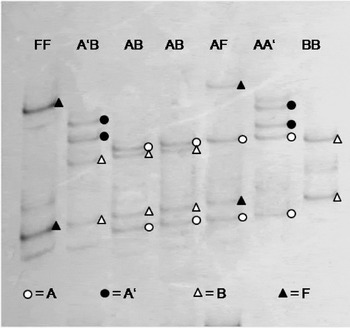
During the screening of CSN1S1 locus by PCR-SSCP an unknown pattern was found in samples from BDE (Fig. 1). This pattern shows an intermediate migration between F and A alleles and the different genotypes are clearly recognizable. The 215 bp long sequenced fragment shows a transversion t→c on position 9962 compared to variant A (GenBank Acc. No. AJ54710). This position is located in Intron 9. Presumably the new allele derived from CSN1S1*A, because the sequence corresponds to the CSN1S1*A allele, except for the described transversion. Therefore the new allele was named CSN1S1*A′.
Polymerase chain reaction-single strand conformation polymorphism (SSCP) analysis of goats CSN1S1, showing the new pattern CSN1S1*A′. The main band of each allele is indicated by a white circle (CSN1S1*A), a black circle (CSN1S1*A′), a white triangle (CSN1S1*B), and a black triangle (CSN1S1*F).

Allele frequencies
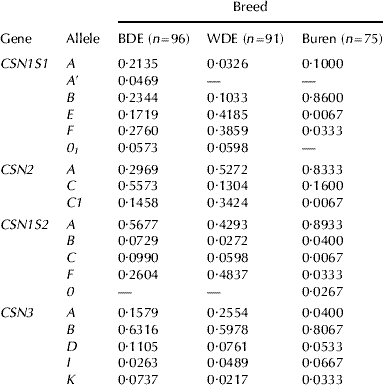
The observed allele frequencies at each casein locus in the three breeds are shown in Table 1. Hardy-Weinberg equilibrium was found at each casein locus in the different breeds. Of the 35 alleles identifiable in this study, 18 were detected in BDE and 17 in WDE and Buren.
Allele frequencies at CSN1S1, CSN2, CSN1S2, and CSN3 in Bunte Deutsche Edelziege (BDE), Weiße Deutsche Edelziege (WDE) and Buren goat

The highest number of CSN1S1 alleles was detected in BDE, where CSN1S1*F was the most common allele. The new variant CSN1S1*A′ was detected in BDE only, and could be breed-specific, since it has never been described before using techniques which could have identified it (Caroli et al. Reference Caroli, Chiatti, Chessa, Rignanese, Ibeagha-Awemu and Erhardt2007). It still has to be assessed at the protein level if A′ belongs to the strong CSN1S1 allele group. In WDE the predominant alleles were CSN1S1*E and F, with frequency values of 0·4185 and 0·3859 respectively.
The high frequency of faint and intermediate CSN1S1 alleles in BDE and WDE is in accordance with data on Alpine and Saanen from France and Italy as well as on other dairy goat breeds reviewed in Grosclaude et al. (Reference Grosclaude, Ricordeau, Martin, Remeuf, Vassal and Bouillon1994; Reference Grosclaude, Ricordeau, Martin, Remeuf, Vassal and Bouillon1997). This could be the result of the selection for higher milk yield, which was postulated by Barbieri et al. (Reference Barbieri, Manfredi, Elsen, Ricordeau, Bouillon, Grosclaude, Mahé and Bibé1995). On the other hand, increasing milk total protein content by selecting favorable CSN1S1 alleles could be the subject of breeding programs, as postulated by Grosclaude et al. (Reference Grosclaude, Ricordeau, Martin, Remeuf, Vassal and Bouillon1994). Nevertheless, the production of milk with special nutrition properties, i.e. hypoallergenic milk, could have a benefit from such kinds of CSN1S1 variants in goat milk (Bevilacqua et al. Reference Bevilacqua, Martin, Candalh, Fauquant, Piot, Roucayrol, Pilla and Heyman2001). To this purpose, it is worth pointing out that CSN1S1*0 1 allele was also present in WDE and BDE, as well as in some Northern Italy goat breeds (Caroli et al. Reference Caroli, Chiatti, Chessa, Rignanese, Bolla and Pagnacco2006), and in the Southern Italy Garganica (Albenzio et al. Reference Albenzio, Santillo, d'Angelo and Sevi2009), whereas it was absent in Buren goat and in the African breeds analyzed by Caroli et al. (Reference Caroli, Chiatti, Chessa, Rignanese, Ibeagha-Awemu and Erhardt2007).
CSN2*A was more frequent in WDE and Buren, in agreement with the results on African and Indian breeds (Caroli et al. Reference Caroli, Chiatti, Chessa, Rignanese, Ibeagha-Awemu and Erhardt2007; Chessa et al. Reference Chessa, Chiatti, Rignanese, Ibeagha-Awemu, Özbeyaz, Hassan, Baig, Erhardt and Caroli2007), while CSN2*C was the most common variant in BDE. This was also demonstrated in Italian dairy goat breeds (Chessa et al. Reference Chessa, Budelli, Chiatti, Cito, Bolla and Caroli2005). The silent C1 allele could be found in all three breeds, while CSN2*0′, E and A1 were not found in the samples analysed. So far, the CSN2*A1 silent allele was described only in an undefined genetic goat type reared in the province of Naples (Cosenza et al. Reference Cosenza, Pauciullo, Gallon, Di Berardino and Ramunno2005).
The Buren breed shows the highest number of observed variants at the CSN1S2 locus, with five alleles, including CSN1S2*0 which was not present in WDE and BDE. Only Sacchi et al. (Reference Sacchi, Chessa, Budelli, Bolla, Ceriotti and Soglia2005) found more polymorphism at this locus in two Southern Italy breeds (Maltese and Jonica) where CSN1S2*0 was also detected, but at a very low frequency (⩽0·007). Albenzio et al. (Reference Albenzio, Santillo, d'Angelo and Sevi2009) found a rather high frequency (0·19) of CSN1S2*0 in the Garganica population, where also CSN2*0 was found at the same frequency. CSN1S2*F was the most common allele in WDE, whereas it occurred at a frequency lower than 0·05 in the Buren as well as in three Western African goats (Caroli et al. Reference Caroli, Chiatti, Chessa, Rignanese, Ibeagha-Awemu and Erhardt2007). The same allele showed frequencies higher than 0·3 in four Northern Italy goats breeds, being almost monomorphic in the Orobica (Caroli et al. Reference Caroli, Chiatti, Chessa, Rignanese, Bolla and Pagnacco2006).
Five alleles were found at the CSN3 locus in the three breeds. CNS3*B, previously named CSN3*D (Sacchi et al. Reference Sacchi, Chessa, Budelli, Bolla, Ceriotti and Soglia2005), showed the highest frequencies, ranging from 0·59 (WDE) to 0·81 (Buren), in accordance with Italian (Sacchi et al. Reference Sacchi, Chessa, Budelli, Bolla, Ceriotti and Soglia2005; Caroli et al. Reference Caroli, Chiatti, Chessa, Rignanese, Bolla and Pagnacco2006) and African breeds (Caroli et al. Reference Caroli, Chiatti, Chessa, Rignanese, Ibeagha-Awemu and Erhardt2007). Differences in the frequency of the other alleles occurred among the breeds, as described in the previous works.
Differences in the allelic frequencies exist among breeds, especially studied for CSN1S1 (reviewed in Moioli et al. Reference Moioli, D'Andrea and Pilla2007). The high frequencies of CSN2*0 and CSN1S2*0 in the Garganica (Albenzio et al. Reference Albenzio, Santillo, d'Angelo and Sevi2009), as well as the occurrence of CSN2*0 1 and CSN1S2*0 in 5 and 3 Sicilian breeds (Gigli et al. Reference Gigli, Maizon, Riggio, Sardina and Portolano2008), confirm the particular incidence of the null alleles at these two casein genes in the Southern Italy breeds.
The highly predominant alleles in Buren breed were CSN1S1*B, CSN2*A, CSN1S2*A and CSN3*B, with frequencies higher than 0·8. Interestingly, these alleles were postulated as the ancestral in goats (Grosclaude et al. Reference Grosclaude, Ricordeau, Martin, Remeuf, Vassal and Bouillon1994; Chianese et al. Reference Chianese, Ferranti, Garro, Mauriello and Addeo1997; Grosclaude & Martin, Reference Grosclaude and Martin1997; Caroli et al. Reference Caroli, Chiatti, Chessa, Rignanese, Bolla and Pagnacco2006). In contrast to this results the German dairy breeds show higher frequencies of some mutated variants at the calcium sensitive casein fractions, i.e. CSN1S1*F and CSN1S1*E, CSN2*C and CSN2*C1, as well as CSN1S2*F. This may be the indirect result of the selection for milk quantity, as already postulated by Grosclaude & Martin (Reference Grosclaude and Martin1997). Moreover, the very high frequencies of strong and ancestral alleles in the Buren could be associated with nutritional advantage with respect to the young goats. This genetic situation, including the presence of null alleles, offers a potential for different breeding strategies in order to improve milk composition and cheese-making features (Albenzio et al. Reference Albenzio, Santillo, d'Angelo and Sevi2009) but also to consider the nutritional and health profile of caprine milk products in the near future (Michaelidou, Reference Michaelidou2008).
Haplotype Distribution and Evolution
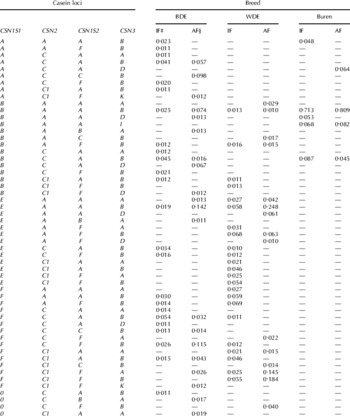
The estimated haplotype frequencies (>0·01) at the CSN1S1–CSN2–CSN1S2–CSN3 complex are shown in Table 2. The frequencies expected under the independence hypothesis (IF), which are calculated by simply multiplying the frequency of the different allele in each locus, were strongly different from the ones estimated by EH program from the data-set taking association into account (AF) as indicated by the χ2 test results (P<0·0001). A total of 30 and 13 haplotypes showed AF values higher than 0·01 and 0·05, respectively. Only 4 haplotypes were found in the Buren with AF values higher than 0·01, whereas a higher variability occurred in the other two breeds (20 and 15 haplotypes >0·01 in BDE and WDE, respectively).
Expected and estimated haplotype frequenciesFootnote † at the casein loci in Buren, Bunte Deutsche Edelziege (BDE), and Weiße Deutsche Edelziege (WDE). Only haplotypes with expected or estimated frequency higher than 0·01 at least in one breed are shown

† Alleles with frequency lower than 0·05 were not taken into consideration for the estimation
‡ IF=expected haplotype frequencies under the independence hypothesis
§ AF=estimated haplotype frequencies taking association into account
The haplotype distribution was highly different among breeds. The dominant haplotype in Buren was B-A-A-B (AF=0·809) postulated as ancestral in previous studies (Sacchi et al. Reference Sacchi, Chessa, Budelli, Bolla, Ceriotti and Soglia2005; Caroli et al. Reference Caroli, Chiatti, Chessa, Rignanese, Bolla and Pagnacco2006). This haplotype was also found predominant in almost all the African breeds considered by Caroli et al. (Reference Caroli, Chiatti, Chessa, Rignanese, Ibeagha-Awemu and Erhardt2007), although the maximum AF value observed for the West African Dwarf goat reared in Cameroon was 0·36 only.
It is noteworthy that CSN2*A was always associated with CSN1S1*B and CSN1S1*E, with AF values higher than IF. On the other side, CSN2*C was mainly associated with CSN1S1*A, CSN1S1*F, and CSN1S1*0, except for haplotypes B-C-A-B (IF>AF) and B-C-A-D (AF>IF). These results confirm the origin of CSN2*C from CSN2*A before the separation of the two CSN1S1 lineages A and B (Caroli et al. Reference Caroli, Chiatti, Chessa, Rignanese, Bolla and Pagnacco2006, Reference Caroli, Chiatti, Chessa, Rignanese, Ibeagha-Awemu and Erhardt2007). The recently described CSN2*C1 allele (Chessa et al. Reference Chessa, Rignanese, Küpper, Pagnacco, Erhardt and Caroli2008) was often associated with CSN1S1*F, in particular within haplotypes F-C1-F-B (AF=0·184) and F-C1-F-A (AF=0·145) in WDE breed, and F-C1-A-B (AF=0·043) in BDE.
Different recombination events involved CSN1S2 and CSN3 in the haplotype evolution, as already focused by Caroli et al. (Reference Caroli, Chiatti, Chessa, Rignanese, Bolla and Pagnacco2006). CSN3*D was found with high frequencies in four haplotypes, three of which described in the present work (A-C-A-D, B-C-A-D, E-A-A-D) and one found in the Orobica at a frequency higher than 0·35 (F-C-F-D). As already observed (Caroli et al. Reference Caroli, Chiatti, Chessa, Rignanese, Bolla and Pagnacco2006), this allele belongs to an evaluative lineage different from CSN3*B and CSN3*A. In all cases, two ancestral alleles occurred at the other casein loci in B-C-A-D, whereas a lower number of ancestral alleles are carried by A-C-A-D, E-A-A-D, and F-C-F-D haplotypes which could arise from B-C-A-D as a consequence of chromosome rearrangement mechanisms.
If considering the contribution of the three breeds to the evolutionary pathway according to Caroli et al. (Reference Caroli, Chiatti, Chessa, Rignanese, Bolla and Pagnacco2006; Reference Caroli, Chiatti, Chessa, Rignanese, Ibeagha-Awemu and Erhardt2007), WDE was integrated in CSN1S1 lineage B, dissimilarly from Buren and BDE. The latter two occurred within lineage A as well as in an intermediate position between the two lineages (because of the haplotypes: B-A-A-B, B-C-A-B, B-C-A-D).
Beside the positive effects of the strong alleles on milk protein content, beneficial effects were also described on protein yield, and fat content (Barillet, Reference Barillet2007) which increases the energy content of milk and therefore the nutritional value for the kid. On the other side the selection for milk yield over a long time in dairy goats, like in BDE and WDE, indirectly preferred casein haplotypes resulting in a lower protein and fat content (Grosclaude et al. Reference Grosclaude, Ricordeau, Martin, Remeuf, Vassal and Bouillon1994; Grosclaude & Martin, Reference Grosclaude and Martin1997). The deep divergence observed in the casein haplotype structure of a meat goat v. dairy breeds is a suggestive hint that different selection pressures might have strongly influenced the haplotype distribution in goat species.
We thank the goat breeders Klaudia Al-Samarraie, Prof. Dr. Dr. Matthias Gauly, Reinhard Heintz, Simone Leyendecker-Haas, Rita Meilinger-Balser, Bernd Merscher, Bodo and Eva Neubrech, Eberhard Prunzel, Dr. Diedrich Steffens, Vulkanhof, and Martinshof for providing the samples. Furthermore we are grateful to the VIGONI program from DAAD for the financial support.