INTRODUCTION
Family members are an essential resource for cancer patients, often serving as caregivers, liaisons, and proxy informants as well as offering support and participating in the decision-making process. Family members are second-order patients within a model of family-centered care (Rait & Lederberg, Reference Rait, Lederberg, Holland and Rowland1989). As patients increasingly seek to avoid hospitalization and stay at home as much as possible, the role of family caregivers has expanded. Some 70% of the time, a cancer patient's primary caregiver is the spouse, whereas for 20% it is the patient's children and 10% a more distant relative or friend (Sutherland, Reference Sutherland1956; Given & Given, Reference Given and Given1989; Ferrell et al., Reference Ferrell, Ferrell and Rhiner1991). The “family” is defined broadly as whomever the patient considers their family, kinship bonds not withstanding. Those who offer support to the patient and take a role in care provision can be considered “family.”
In this article, we present a model of communication skills training that guides the conduct of a routine family meeting in palliative care. We discuss implications of the module, course evaluation data from participants, and areas for future research.
The Resilient Family and the “At-Risk” Family
A resilient family is characterized as being able to adapt in times of adversity. The family is thus strengthened to the benefit of its members and community. Central characteristics of such a family include (a) cohesion, membership, and family formation; (b) economic support; (c) nurturance, education, and socialization; and (d) protection of vulnerable members (Patterson, Reference Patterson2002). When a member of a resilient family becomes ill, other members are able to regroup so that the care and protection of the ill member is ensured. Members of such families communicate effectively and resolve differences through their flexibility (Kissane, Reference Kissane, Bloch, Hafner and Harari1994). Resilient families utilize teamwork to come together in times of adversity and share an optimism and spirituality that they use to transcend any suffering involved (Walsh, Reference Walsh2002, Reference Walsh2003).
The characteristics of dysfunctional families, those at risk for morbid outcomes during bereavement, stand in stark opposition to those of the resilient family and include poor cohesion, poor communication, and poor conflict resolution (Kissane et al., Reference Kissane, Bloch and Burns1994, Reference Kissane, Bloch and Dowe1996). Dysfunctional families are classified as (a) fractured, argumentative, and help rejecting or (b) sullen, depressed, and help accepting. These classifications are subsequently predictive of psychiatric disorder of family members during bereavement. Located on a family classification continuum between the resilient and the dysfunctional family is an intermediate type, characterized by restricted cohesion, midrange communication, and high rates of psychosocial morbidity among its members.
Although the field of palliative care understands the need for a family-centered approach, it has struggled to produce an effective model to accomplish this goal. A meta-analysis of 26 palliative and hospice care team studies found a small positive effect size on patient symptom outcomes (26 studies, weighted mean 0.33, SE 0.12 [95% CI 0.10, 0.56]) but no proven benefit for caregiver or family outcomes (13 studies, weighted mean 0.17, SE 0.16 [95% CI -0.14, 0.48]; Higginson et al., Reference Higginson, Finlay and Goodwin2003). Kissane et al. (Reference Kissane, McKenzie and Bloch2006) developed a preventive model of family therapy to target families considered at risk for morbid outcomes during palliative care, while the cancer patient is alive, which was demonstrated in a randomized controlled trial to ameliorate distress of bereavement for survivors and support adaptation.
Prophylactic family therapy in the palliative care setting can be valuable for families identified as being at risk (Kissane et al., Reference Kissane, McKenzie and McKenzie2003). However, palliative care providers cannot routinely offer family therapy to patients and their families. Family meetings, however, can identify any limitations of family functioning and create an opportunity to offer referral to a professional who can engage the family in this way. Routine family meetings are an excellent way to identify and respond to the needs of the family.
Family Needs
Family meetings facilitate education of the patient and the family. Education about caregiving is a fundamental need of those families whose loved ones are ill at home and also whose relatives are in the hospital but may choose to die at home. Information is necessary to prepare caregivers about the various roles they will fill. These include symptom assessment and management, administration of medication, activities of daily living such as walking and dressing, liaising with doctors, preparing food, organizing transportation, and coordinating coverage when they are not available to care for the patient (Yang & Kirschling, Reference Yang and Kirschling1992; Barg et al., Reference Barg, Pasacreta and Nuamah1998; Aranda & Hayman-White, Reference Aranda and Hayman-White2001). Information about the emotional toll such caregiving will take is also beneficial, as well as the importance of self-care and respite, sharing the caregiver role, what to expect as dying approaches, how to manage death if it occurs at home, when to seek help, how to discuss death and dying with the patient, saying goodbye to their loved one, and the positive aspects of caring (Hudson et al., Reference Hudson, Aranda and McMurray2002).
Family meetings can help address challenges specific to palliative care, such as “conspiracies of silence,” where talking about prognosis with a patient is avoided for fear that such a discussion will worsen the illness and result in a loss of hope. Other challenges include when the patient/family does not want to bother the health care provider or rejects the health care provider's help (Harding & Higginson, Reference Harding and Higginson2003; Hudson et al., Reference Hudson, Aranda and Kristjanson2004). Health care systems have their own set of obstacles to achieving the goal of properly educating patients and families, including staffing shortages and the lack of educational materials, skill training, and a model of delivering education to patients and caregivers. Though caregivers desperately need information to adequately prepare for their various roles in assisting ill family members and avoiding exhaustion and burnout, such information remains caregivers' premier unmet need (Kristjanson et al., Reference Kristjanson, Leis and Koop1997; Milne, Reference Milne1999; Rose, Reference Rose1999).
Certain patients and their families need special assistance as the patient approaches the end of life. Typically those circumstances include families where the dying individual is a single parent whose children will be orphaned, an elderly parent of a disabled child, or part of a family that is isolated or disenfranchised in some way. The organization of a family meeting can be of great value in teasing out these issues and ensuring that the family is linked to resources it may need in preparation for and during bereavement.
The Comskil Model of Communication Skills Training
According to the Comskil conceptual model (Brown & Bylund, Reference Brown and Bylund2008), each consultation has a communication goal that is the desired outcome of the consultation. Communication strategies then are a priori plans that direct communication behavior toward the realization of the communication goal when used together. A communication strategy can be accomplished in more than one way using a variety of communication skills and process tasks. Communication skills are operationalized as discrete modes (concrete, teachable, and observable) by which a physician can further the clinical dialogue. The Comskil curriculum is comprised of 26 skills clustered into six categories: (a) establishing the consultation framework skills, (b) information organization skills, (c) checking skills, (d) questioning skills, (e) empathic communication skills, and (f) shared decision-making skills. Process tasks are operationalized as sets of verbal or nonverbal behaviors or dialogues (basic or complex) that create an environment for effective communication in the doctor–patient encounter.
Question Asking and Key Tasks in Conducting a family meeting
Questioning skills are particularly valuable in a family meeting. The facilitator(s) of such a meeting use questions to not only get each family member's opinion about a particular issue, but to ascertain what each family member thinks about the others and to subtly introduce ideas and potential solutions into the conversation. Thus, in addition to the communication skills and process tasks emphasized in the Comskil curriculum (Brown & Bylund, Reference Brown and Bylund2008), four advanced skills are introduced in this module. The first three advanced skills are questioning skills that ask (a) circular questions, (b) strategic questions, and (c) reflexive questions. The fourth skill is the use of a summary.
Circular questions can be used to explore the functioning of the family and maintain the neutrality of the facilitator. Each family member is asked to comment on aspects of other family members to promote understanding in the group as a whole. For example, in the style of Tomm (Reference Tomm1987a, Reference Tomm1987b, Reference Tomm1988), one could ask a patient's offspring, “How are your parents and sisters coping with Dad's illness? Who is most upset in your view?” (Kissane et al., Reference Kissane, Bylund and Brown2007).
Strategic questions are used to stimulate change within the family. The facilitator can embed an idea into the wording of the question so as to guide the family toward a particular outcome or some change in behavior. For example, one might ask the caregiver, “What change in his symptoms would need to occur for you to realize that admission to an inpatient hospice bed is necessary?” (Kissane et al., Reference Kissane, Bylund and Brown2007).
Reflexive questions promote greater family insight and serve as a catalyst. They invite the family to reflect on hypotheses so as to promote group problem solving and family efforts toward improvement. Examples of reflexive questions are, “What benefits might come from caring for him at home? In what ways might this be hard for you as a family group?” (Kissane et al., Reference Kissane, Bylund and Brown2007).
A final skill introduced in this module is an advanced information organization skill: summary of family-focused concerns. This skill can be useful to promote consensus within the family. When the facilitator gives a summary reflecting multiple (and perhaps conflicting) points of view from different family members, further problem solving is invited from the family while the facilitator maintains neutrality.
We suggest five key tasks to effectively conduct a family meeting: (a) setup of the meeting, (b) cofacilitation, (c) engaging in cultural sensitivity while avoiding collusion, (d) understanding the family's strengths and vulnerabilities, and (e) delivering resources as appropriate. Essential to the setup of the meeting is identifying whether the patient can or should participate and which family members and clinicians should attend. Identifying potential barriers ahead of time is also important. Cofacilitation reinforces the idea of a multidisciplinary team and can be helpful because different agendas can be addressed by those clinicians most familiar with each area. However, cofacilitators should discuss their respective roles and the structure of the meeting before it starts. Cultural sensitivity is crucial; the family's beliefs and understanding should be clarified in terms of the illness, its progression and seriousness, and appropriate goals of care. Points of both consensus and dissonance should be identified. Reaching an understanding of the reality of the family is also vital to being able to plan for the family's future. This could include the identification of family norms and traditions as strengths to be balanced with their uncertainties and concerns. Lastly, providing the family with educational materials and referrals as needed is essential. Based on this approach, we developed a module for teaching health care professionals how to conduct a family meeting.
Modular Content
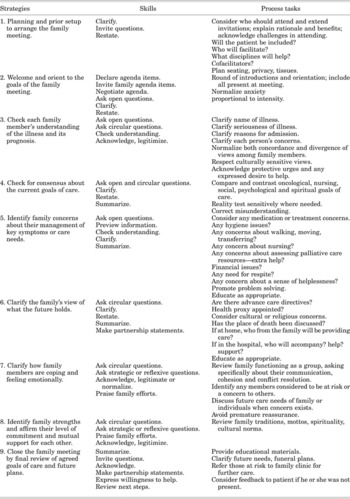
The Conducting a Family Meeting module consists of a goal and a suggested series of nine sequential strategies, each of which has both communication skills and process tasks associated with it (see Table 1 for the modular blueprint). The goal is to optimize the care of both patients with cancer and their families through the conduct of family meetings that promote communication and increase understanding about (a) the disease, (b) its course and prognosis, (c) the key goals of care, and (d) the assessment of each family's needs, strengths, coping, decision-making capacity, and wishes for the future. When a family meeting is conducted in the palliative care setting, the goal also includes the creation of a comprehensive care plan that the family understands and agrees with so as to facilitate teamwork and enhanced coping for all concerned.
Modular Blueprint for Conducting a Family Meeting

Communication strategies are a priori plans that direct communication behavior toward the realization of the communication goal. Communication skills are discrete modes (concrete, teachable, and observable) by which a physician can further the clinical dialogue. Process tasks are sets of verbal or nonverbal behaviors or dialogues (basic or complex) that create an environment for effective communication in the doctor–patient encounter.
Strategies 1 and 2 of the blueprint (Table 1) concern the preparatory organization of the family meeting and its introduction to the family. Strategy 1, planning and prior setup to arrange the family meeting, involves considering who should attend the meeting, whether the patient can and should be there, who will facilitate the meeting, which health care professionals can offer the most help, and logistics such as location and ensuring privacy. With the family gathered, Strategy 2, welcome and orient to the goals of the family meeting, points to the importance of making introductions, declaring an agenda for the meeting, inviting agenda items from the family, negotiating the agenda if necessary, and asking questions to get a better understanding of what the patient and the family are saying. This strategy makes use of two particular sets of skills taught in the Comskil curriculum, namely the Establishing the Consultation Framework and Questioning Skills.
Strategies 3 and 4 involve checking the family's understanding of the patient's situation and checking for consensus on care goals. Strategy 3, check each family member's understanding of the illness and its prognosis, urges the clinician to clarify elements of the illness with the family, including its name and seriousness, as well as elicit concerns while normalizing differing views and opinions and respecting cultural differences. The use of Questioning Skills, including asking open questions and circular questions, is recommended. In Strategy 4, check for consensus about the current goals of care, the clinician could compare and contrast goals of care from the vantage points of multiple disciplines, including oncological, nursing, social, psychological, and spiritual. Misunderstandings might be corrected along the way and Questioning Skills used to elicit more information and clarify as necessary. The clinician ultimately summarizes the goals of care for the family to make sure everyone comes away from the meeting with the same understanding of what was discussed.
Strategies 5 and 6 focus on identifying family concerns and clarifying their view of what is to come. The clinician will likely have to educate the family as this part of the family meeting unfolds. Family concerns about the manifestation and control of symptoms and care needs should be elicited as part of Strategy 5, identify family concerns about their management of key symptoms or care needs. Information Organization Skills, such as previewing information before providing it and summarizing information after delivering it are helpful in executing this strategy. Treatment and medication concerns, hygiene issues, activities of daily living, need for respite, and feelings of helplessness could be considered and problem solving promoted. The clinician should educate the family as appropriate as different topics of concern emerge. Strategy 6, clarify the family's view of what the future holds, creates a shared understanding of expectations and offers an opportunity to support the family through illness progression and uncertainty. The clinician should make use of partnership statements as emotionally charged topics such as advance care directives, health care proxies, place of death, and care provision are discussed. Cultural and religious concerns warrant attention.
Strategies 7 and 8 shift the focus to the family members' needs in terms of coping and support and affirming the strength and courage of the family as a whole. In Strategy 7, clarify how family members are coping and feeling emotionally, circular and strategic questions allow family members to reflect on how other individuals in the family may be feeling at the time while the clinician facilitates consideration of change. Empathic Communication Skills could be used here to convey support to family members who express particular emotions or experiences during the meeting. Family functioning can be reviewed, specifically aspects of communication, cohesion, and conflict resolution, as well as future care needs of the family. Additionally, the fact that members of the family might be at risk can be recognized. Strategy 8, identify family strengths and affirm their level of commitment and mutual support for each other, focuses on the family's strengths and ability to cope with the illness journey together. Reflexive questions, which invite the family to reflect on possibilities to improve their functioning as a unit, praising family efforts and empathic communication, are useful here. Reviewing family traditions, mottos, elements of spirituality, and cultural norms can be particularly helpful and powerful.
Finally, Strategy 9, close the family meeting by final review of agreed goals of care and future plans, summarizes and reviews the next steps that will occur after the meeting. Likely, a great deal has been covered during the meeting, and this is the clinician's opportunity to pull it all together in a meaningful way. The clinician should invite family members' questions, make partnership statements, and express a willingness to help in the future. Educational materials could be provided as appropriate and feedback to the patient (if she or he was not present) should be considered. Referrals could be made for family members identified as at risk during the meeting, and future needs of the family as a whole (e.g., funeral plans) can be clarified.
METHODS
Participants
Forty multi-specialty health care professionals working in the oncology setting, including primarily attending physicians from Memorial Sloan-Kettering Cancer Center (MSKCC) and other New York City Metropolitan-area hospitals, volunteered to participate in a communication skills training module on the topic of conducting a family meeting during the 2007–2008 academic year. The training module was created by and held at the Communication Skills Training and Research Laboratory (Comskil) at MSKCC. Participants were from the disciplines of medical, surgical, and radiation oncology, pediatrics, and palliative care; others included registered nurses, nurse practitioners, and physician assistants.
All participants attended the Conducting a Family Meeting module after having previously taken part in other core modules in the Comskil curriculum; these modules include Breaking Bad News, Shared Decision Making about Treatment Options including Clinical Trials, Responding to Patient Anger, Discussing Prognosis, Discussing the Transition from Curative to Palliative Care, and Shared Decision Making about DNR Orders. Twenty-three percent of participants took part in this module as a stand-alone course offered to those who had already completed the basic series of Comskil modules, whereas the remaining 77% participated in the module within a full two-day training course, where all of the Comskil modules are offered.
Conducting a Family Meeting Module
Participants were first shown a didactic presentation, which offered a summary of the current literature, recommended strategies for achieving the module's goal, and included exemplary video clips. The final author (D.W.K.) facilitated a “fishbowl” role play, in which a group of simulated (actor) patients take on the role of a family and module participants take turns engaging the family in a simulated family meeting. This allows participants the experience of being able to directly use the new strategies, skills, and process tasks in a safe and supportive environment and to watch their colleagues run the family meeting and learn vicariously. Frequent time-outs were taken to discuss what had occurred and for learners to reflect on the elements of the role play that have gone well, any challenges, and what they would like to focus on further. Learners received feedback from the facilitator, their peer group, and the simulated family members (in character).
Course Evaluations
At the conclusion of each module, participants completed an anonymous course evaluation form that contains eight statements about the workshop to be rated on level of agreement/disagreement using a 5-point Likert scale from 1 (strongly disagree) to 5 (strongly agree). The first two of these statements employed a retrospective pre–post methodology (Hill & Betz, Reference Hill and Betz2006): “1. Before this module, I felt confident in conducting a family meeting” and “2. Now that I have attended this module, I feel confident in conducting a family meeting.” The remaining six questions focused on posttraining attitudes about the skills learned and their applicability to the participants' clinical practice. The module evaluation also contained four items about the curriculum process (booklet, didactic teaching, exemplary video, role play observation) to be rated on a 3-point Likert scale from 1 (did not aid my learning at all) to 3 (aided my learning a lot) and one open-question item asking what, if anything, about the workshop might be improved.
RESULTS
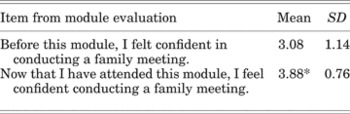
The use of a paired t-test (see Table 2) shows that learners' confidence in conducting a family meeting increased significantly as a result of participation in the workshop as measured by the retrospective pre and post questions (t = −5.551, df = 39, p < .001).
Participant Self-Efficacy Change Pre–Post

Potential scores range from 1 to 5.
*p < .001.
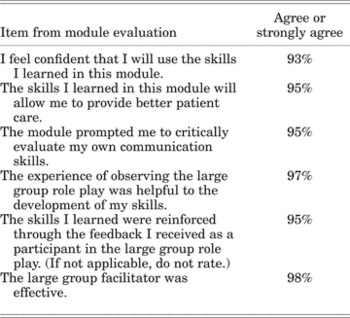
To interpret the results of the module evaluation data, we determined a rating of “agree” or higher to be an indication of satisfaction with the workshop and its effectiveness. Table 3 displays the percentages of workshop participants who agreed or strongly agreed with the six posttraining items. At least 93% of participants agreed or strongly agreed with these items. Additionally, at least 92% of participants found each of the four elements of the curriculum process (booklet, didactic teaching, exemplary video, role play observation) aided their learning somewhat or a lot, with 100% of learners reporting this to be the case for the exemplary video and role play observation. Three of the 40 participants answered the open-ended question, with two suggesting more time for role play practice.
Participant Ratings of Conducting a Family Meeting Workshop

DISCUSSION
As more cancer patients choose to die at home, family members take a more active role in end-of-life care for their loved ones. The importance of family meetings in this setting is great. They allow the opportunity for clinicians to not only impart information to patients and their families but also to assess the needs of families and then make appropriate referrals.
This module on conducting a family meeting is an example of how communication skills can be taught to health care professionals in a manner that participants find helpful. Whereas the didactic presentation with its exemplary videos introduces participants to the potentially relevant strategies, skills, and process tasks, the role play allows participants to practice these skills with a simulated patient and family in a safe arena, where they can receive constructive feedback from the trained facilitator and their peers.
Participants report a statistically significant increase in confidence about conducting a family meeting using a retrospective pre–post survey methodology. Although behavioral outcome measures would be a stronger indicator of efficacy than the perceived efficacy measure used here, this measure is satisfactory for this preliminary pilot of the acceptability of this communication skills training module. The literature on educational interventions supports the notion that participants are often unable to reliably assess their efficacy before an educational intervention, and retrospective pretest scores are lower than actual pretest scores (Rockwell & Kohn, Reference Rockwell and Kohn1989; Pratt et al., Reference Pratt, McGuigan and Katzev2001). Because confidence in performing a behavioral task (e.g., conducting a family meeting) is essential to actually performing that behavioral task (Miller, Reference Miller2002; Yudkowsky et al., Reference Yudkowsky, Downing and Ommert2006), we suggest that the increase in perceived self-efficacy seen in our data is indicative of the participants' increased ability to successfully conduct a family meeting in palliative care posttraining.
Among the limitations of this preliminary modular evaluation is the fact that participants were self-selected. Such participants may already be fairly good communicators and motivated to improve their skills in this area. Additionally, the self-efficacy data are captured at only one time point (directly after the module has ended), so it is not possible, using our current course evaluation methodology, to ascertain if the confidence is preserved longitudinally. Patient and family outcome data following a family meeting would be the optimal marker of training effectiveness.
Future research could follow participants and measure their self-efficacy over time. Another area for future research is to study behavioral outcomes of this intervention. This could be accomplished in at least two ways. Currently, most participants in Comskil training are recorded in clinic with real patients both before and after training. These video recordings are then coded so that communication strategy, skills, and process task usage before and after training can be compared. An alternative way to capture behavioral data pre- and posttraining is to hold standardized patient assessments (SPAs) at each time point. A SPA presents participants with a standardized scenario, which can eliminate some of the uncertainties inherent in recording and coding real patient consultations. A SPA allows one to present participants with a particular kind of visit with a particular kind of patient. Behavioral outcome data would allow us to more confidently gauge the impact of this communication skills intervention on participants' growth in ability. The gathering of data from patients whose health care professionals completed the module and their families would also be useful for learning about the intervention's impact on patient and family outcomes, such as satisfaction, preparedness, and quality of caregiver role delivery. These data would allow us to learn if the goal of this module, namely, the optimization of care, is being met.
In conclusion, we have developed a communication skills training module for health care professionals that improves confidence in the conduct of a family meeting. Participants believe this will allow them to provide better patient care. We intend to conduct further research that studies the behavioral outcomes for health care professionals, patients, and family members.
ACKNOWLEDGMENTS
Funding was provided by the Arthur Vining Davis Foundations, the Josiah Macy, Jr. Foundation, and the Kenneth B. Schwartz Center.