INTRODUCTION
Nematodes, like many organisms, are adapted to survive in unfavourable environmental conditions and different strategies are used by different species depending on their ecological niche. The free-living model nematode Caenorhabditis elegans will enter the dauer stage, a larval stage geared for survival, when unfavourable environmental conditions (such as crowding or lack of food) are encountered (Fielenbach and Antebi, Reference Fielenbach and Antebi2008). Animal and plant-parasitic nematodes frequently use a survival stage in order to synchronize their life cycle with that of their hosts in order to optimize their chances of successful invasion (Perry, Reference Perry1989). Animal parasitic nematodes are frequently activated after the parasite is exposed to conditions found in the gut of animals (high pH, increased CO2), while in the case of some plant-parasitic nematodes, hatching is activated by host root diffusates. The sequence of events from perception of the hatching stimulus to hatching varies considerably between species (Perry, Reference Perry1989). This linking of host and plant parasite is a form of quiescence and is restricted to species that are host-specific.
The life cycle of cyst nematodes begins when the vermiform second-stage juvenile (J2) hatches and invades the roots of host plants. Each individual nematode feeds on a group of cells in the pericycle, cortex or endodermis, transforming them into a syncytium or transfer cell. The nematode remains sedentary for the rest of its development, as it passes through 2 more juvenile stages to become either male or female. Males are active and leave the root to find and fertilize females. Females retain the eggs inside their bodies and the first moult from J1 to J2 occurs inside the egg. When the females are fully mature they die and their cuticle hardens and turns brown to become a protective cover (the cyst) around the eggs. In some species, most often those in temperate zones, the juvenile nematodes may enter diapause. Diapause can be facultative (responsive to host status) or obligate. Diapause is broken after exposure to a period of cold (winter) and in host-specific species diapause is followed by quiescence. However, other cyst nematodes enter diapause in order to avoid summer conditions as seen for Heterodera avenae in Australia (Banyer and Fisher, Reference Banyer and Fisher1971). If adverse conditions persist after diapause has ended, the larvae enter a quiescent state (Perry and Moens, Reference Perry, Perry and Wharton2011). Quiescence is defined as dormancy (lowered metabolism) under unfavourable conditions (no presence of host plants) with development readily resumed as conditions become favourable (hatching in presence of growing host roots). Nematodes in dormancy (diapause or quiescent) can survive longer (∼30 years in certain species) and are more resistant to nematicides (Spears, Reference Spears1968).
The potato cyst nematodes (PCN) Globodera pallida and G. rostochiensis are major plant-parasitic nematode pests of potato production and are found infesting fields as mixtures of both species or alone (Pylypenko et al. Reference Pylypenko, Uehara, Phillips, Sigareva and Blok2005). The G. pallida (and G. rostochiensis) life cycle includes both diapause and quiescent stages described above. It is thought that changes in the feeding site occurring as the host plant ages may influence the feeding female, which in turn may trigger biochemical changes in the juvenile that promote entry into diapause (Perry and Gaur, Reference Perrry and Gaur1996; Perry and Moens, Reference Perry, Perry and Wharton2011). The survival stage of Globodera pallida is not a true dauer stage, although other plant-parasitic nematodes such as Bursaphelenchus (Kikuchi et al. Reference Kikuchi, Cotton, Dalzell, Hasegawa, Kanzaki, McVeigh, Takanashi, Tsai, Assefa, Cock, Dan Otto, Hunt, Reid, Sanchez-Flores, Tsuchihara, Yokoi, Larsson, Miwa, Maule, Sahashi, Jones and Berriman2011) and Anguina (Bird and Buttrose, Reference Bird and Buttrose1974) do have dauer stages. However, some morphological characteristics of J2 cyst nematodes are similar to those of dauer stages including resistance to detergents, intestinal microvilli and numerous lipid storage vesicles (reviewed by Elling et al. Reference Elling, Mitreva, Recknor, Gai, Martin, Maier, McDermott, Hewezi, McK Bird, Davis, Hussey, Nettleton, McCarter and Baum2007). Gene expression studies do not support the idea of a broadly conserved gene expression pattern between the dauer stage in C. elegans and infective J2 of H. glycines (Elling et al. Reference Elling, Mitreva, Recknor, Gai, Martin, Maier, McDermott, Hewezi, McK Bird, Davis, Hussey, Nettleton, McCarter and Baum2007). However, the genes involved in control of the formation of dauer or other arrested life stages have not been characterized from the genome of cyst nematodes and it is not known whether such sequences are involved in the processes leading to hatching arrest in diapaused eggs when conditions are favourable for hatching.
Dauer formation has been extensively studied in C. elegans giving insights into the signalling pathways and molecular mechanisms that govern this developmental transition (Hu, Reference Hu and Riddle2007; Fielenbach and Antebi, Reference Fielenbach and Antebi2008). Identified components of the control of dauer formation include pathways that control sensory neuron structure and function including cGMP signalling and serotonergic neurotransmission, which impinge on TGF-β and insulin/IGF-1 signalling. These pathways converge on steroid hormone receptor transcriptional cascades, which are instrumental in the dauer decision (Fielenbach and Antebi, Reference Fielenbach and Antebi2008). Muscarinic agonists promote insulin release both in vivo and in vitro in mammals (Miller, Reference Miller1981; Hawdon and Schad, Reference Hawdon and Schad1993). Oxotremorine is a muscarinic agonist which has experimentally been shown to be important in the diapause removal from other nematodes (Tissenbaum et al. Reference Tissembaum, Hawdon, Perregaux, Hotez, Guarente and Ruvkun2000). Similar signalling pathways are present in Ancylostoma caninum and A. ceylanicum (Tissembuam et al. Reference Tissembaum, Hawdon, Perregaux, Hotez, Guarente and Ruvkun2000; Hawdon and Datu, Reference Hawdon and Datu2003; Brand and Hawdon, Reference Brand and Hawdon2004), but differences have been found with others including Nippostrongylus brasiliensis (Huang et al. Reference Huang, Chan, Smyth, Ball, Gounaris and Selkirk2010). Caenorhabditis briggsae, the closest relative to C. elegans that has been studied in some detail, lacks the beta-insulin molecule involved in signal transduction encoded by daf-28 and this is also true for Meloidogyne hapla (Opperman et al. Reference Opperman, Bird, Williamson, Rokhsar, Burke, Cohn, Cromer, Diener, Gajan, Graham, Houfek, Liu, Mitros, Schaff, Schaffer, Scholl, Sosinski, Thomas and Windham2008). It is therefore clear that divergence from the genetic pathway described for C. elegans is present within the phylum Nematoda.
Few studies on the signalling pathways involved in diapause/quiescence in plant nematodes have been performed. Atkinson et al. (Reference Atkinson, Taylor and Fowler1987) showed that exposure to the signalling molecules cAMP and cGMP (which are implicated in the dauer signalling pathway in C. elegans) reduced normal hatching (exit from the quiescent state) in the presence of root diffusates. However, these effects have not been studied in detail in G. pallida and the response of nematodes in diapause has not been analysed.
The objectives of this study were to (i) determine whether the muscarinic pathway is involved in recovery from diapause and/or quiescence in G. pallida, (ii) investigate the presence of genes in G. pallida and other plant-parasitic nematodes related to those implicated in dauer formation in C. elegans and (iii) to compare the responses of unhatched juveniles in diapause or quiescence upon stimulation with host root diffusate.
MATERIALS AND METHODS
Cultivation of G. pallida populations
Cysts from G. pallida (population Lindley) were multiplied as greenhouse cultures in 10 cm pots on the susceptible potato cultivar Désirée. Cysts were extracted from soil by thoroughly mixing infested soil with water in a plastic bucket and settling for 15 sec. The supernatant was poured through a 750 μm-pore sieve nested over a 250 μm-pore sieve. Cysts were collected from the finer mesh sieve and kept at 4 °C until use for hatching and gene expression experiments. Quiescent cysts and cysts in diapause were obtained from plants grown in 2009 and 2010, respectively, under identical conditions. Cysts from 2009 had been exposed to several months at 4 °C, conditions that are known to break diapause (Muhammad, Reference Muhammad1994).
Hatching experiments
To prepare potato root diffusate (PRD), roots of 3-week-old potato plants (cv. Désirée) growing in peat were washed, placed in 250 ml of distilled water and kept at room temperature (approximately 20 °C) for 2 h. The plant was removed and the water containing root diffusates was filtered through Whatman filter paper and a 0·45 μm syringe filter to remove contaminating micro-organisms. The resulting PRD was stored at 4 °C until required. Cysts selected for experiments were chosen on the basis of their size homogeneity. In previous work at JHI, hatch rates from both samples were in excess of 75% after 3 weeks in PRD (not shown). Before use, cysts were soaked at 20 °C for 5 days in sterile tap water. A 24-well plate assay system was used in the experiment containing groups of 10 cysts in each well. Each well was considered a biological replicate. After this period, the sterile tap water was removed and 1 ml of new solution (sterile distilled water or PRD) along with the agonist or antagonist of the muscarinic pathway, supplemented with antibiotics and fungicides (100 units/ml penicillin, 100 μg/ml streptomycin, 100 μg/ml gentamycin and 2·5 μg/ml amphotericin B) was added. Control treatments including all the antibiotics and fungicides alone were used to confirm that these did not affect hatching (data not shown). Oxotremorine was used as an agonist of the muscarinic pathway at concentrations of 0·1, 0·5 and 1 mM; while atropine was used as an antagonist at 1, 2·5 and 5 mM. 8Br-cGMP was used at 0·1, 0·5 and 1 mM to promote hatching as previously described for other nematodes (Tissembaum et al. Reference Tissembaum, Hawdon, Perregaux, Hotez, Guarente and Ruvkun2000). All experiments were carried out in the dark at 20 °C. All drugs and antibiotics/fungicides used were sourced from Sigma (St Louis, MO, USA). These concentrations of agonists/antagonists were as previously used in other nematodes for diapause recovery (Tissenbaum et al. Reference Tissembaum, Hawdon, Perregaux, Hotez, Guarente and Ruvkun2000; Hawdon and Datu, Reference Hawdon and Datu2003). Nematode hatching was determined daily and the solutions were not changed until 7 days. At this time the solutions and juveniles were removed and PRD was added to all the wells and hatching of the remaining eggs inside the cysts was observed for 2–3 additional days to assess mortality rates. Each treatment was done in triplicate, making 30 cysts per treatment, and each experiment was repeated twice.
Identification of G. pallida homologues of C. elegans diapause-related genes
Orthologues of C. elegans diapause-related genes from G. pallida were obtained using a reciprocal blasting strategy using the putative protein sequences from annotated genomes of G. pallida (ftp://ftp.sanger.ac.uk/pub/pathogens/Globodera/pallida/), Meloidogyne incognita (http://www.inra.fr/meloidogyne_incognita/genomic_resources), Meloidogyne hapla (http://supfam.cs.bris.ac.uk/SUPERFAMILY/cgi-bin/gen_list.cgi?genome=Mh) and Bursaphelenchus xylophilus (ftp://ftp.sanger.ac.uk/pub/pathogens/Bursaphelenchus/xylophilus/Assembly-v1.2/). A local installation of Galaxy (Goecks et al. Reference Goecks, Nekrutenko and Taylor2010) was used to run NCBI BLAST+ blastp (Altschul et al. Reference Altschul, Gish, Miller, Myers and Lipman1990), filter the results, and perform a Reciprocal Best Hit (RBH) analysis (custom Python script). For the RBH, threshold values of ⩾40% sequence identity, ⩾70% coverage, and ⩽0·001 were used, sorting on bit-score. The less stringent analyses used ⩾30% sequence identity, ⩾50% coverage, and ⩽0·001 e-value.
RNA extraction, primer design and real-time PCR
Dried cysts, cysts soaked for 5 days in distilled sterile water, cysts exposed 24 h to PRD and J2 s were studied from quiescent and diapaused nematodes. Eggs were released from cysts using a tissue homogenizer with a clearance of 0·46–0·54 mm between the glass pestle and the homogenizer tube. Cyst walls were removed from eggs by pouring the solution through a 100 μm-pore sieve nested over a 5 μm-pore sieve. Eggs were concentrated by decantation and centrifugation and kept at −80 °C until use.
Total RNA was extracted using the RNeasy® Plus Micro Kit (Qiagen, Hilden, Germany) following the manufacturer's instructions. DNA digestion was conducted on fiber glass during RNA extraction using an RNase-Free DNase set (Qiagen, Hilden, Germany) following the manufacturer's instructions. Total RNA was quantified using a Nanodrop 1000 Spectrophotometer (Thermo Scientific, Waltham, MA, USA) and approximately 700 ng of RNA was used for cDNA synthesis using QuantiTect® Reverse Transcription Kit (Qiagen, Hilden, Germany) following the manufacturer's instructions. The cDNA was diluted 1:20 with PCR grade water and then used in real-time PCR reactions containing iQ™ SYBR® Green Supermix (Bio-Rad, Hercules, CA, USA) with a primer concentration of 200 mM each and 5 μl of the diluted cDNA in a final volume of 15 μl. Cycling conditions consisted of 1 cycle of denaturing at 94 °C for 3 min followed by 40 cycles of 15 s denaturing at 94 °C, 30 s annealing at 55 °C and 30 s extension at 72 °C, finishing with an final extension of 5 min at 72 °C. All real-time PCR assays were performed using a Chromo 4™ Real-Time Detector (Bio-RAD, Hercules, CA, USA). PCR products obtained from the different extractions were verified by performing a melting curve analysis and visualization of PCR products on 1·5% agarose gels stained with SYBR® Safe DNA gel stain (Invitrogen Corp., Carlsbad, CA, USA) following the manufacturer's instructions in order to verify the size of the product obtained in the different extractions. All samples were run in triplicate and results were analysed using Gene Expression Macro™ ver. 1.1 (Bio-Rad, Hercules, CA, USA), software provided by the manufacturer.
To determine whether the expression of parasitism genes was activated by TRD in quiescent or diapaused eggs, the relative expression of 2 genes IVg9 (gb|GO249406.1|) and cellulase (gb|GO249479.1|), which are expressed in the dorsal and in the subventral pharyngeal glands, respectively (Jones et al. Reference Jones, Kumar, Pylypenko, Thirugnanasambandam, Castelli, Chapman, Cock, Grenier, Lilley, Phillips and Blok2009), was quantified in relation to eifA4 (translation initiation factor) (GPLIN_000384600 protein), from the G. pallida genome assembly, (ftp://ftp.sanger.ac.uk/pub/pathogens/Globodera/pallida/). Primers were designed using Primer3 v0.4.0 web server (Rozen and Skaletsky, Reference Rozen, Skaletsky, Krawetz and Misener2000) using the sequences obtained by Jones et al. (Reference Jones, Kumar, Pylypenko, Thirugnanasambandam, Castelli, Chapman, Cock, Grenier, Lilley, Phillips and Blok2009). The following primers were used for the amplification of IVg9 (IVG9-Fw-5′-tgaaggtgactcctctgctg-3′ and IVG9-Rv-5′-acaacgttttgccgaatgta-3′); cellulase (Cell-Fw-5′-ctaactcgtggaacggaggt-3′ and Cell-Rv-5′-ctggaaaagtgacgctgaac-3′) and eifA4 (eifA-Fw-5′-cgaaacaggaccaacaaatg-3′ and eifA-Rv-5′-gttcagatcagctccccaat-3′).
Observation of quiescent and diapaused juveniles
Cysts containing quiescent or diapaused J2 s were soaked in water for 5 days and subsequently transferred to PRD for 4 days. Eggs were extracted from mature individual cysts and J2 s were forced to hatch by gently pressing on the eggshell with a needle. Light observations were conducted using a Zeiss III compound microscope with Normarski differential inference contrast with up to 1000X magnification. Measurements were made using a micrometer attached to a binocular in a light microscope.
Statistics
In the hatching experiments, for each treatment, the area under the curve from the cumulative number of nematodes percentage hatch (AUCPH) was estimated by trapezoidal integration (Campbell and Madden, 1990). The AUCPH were analysed by ANOVA after log10 (X + 1) transformation. Treatment means of AUCPH were compared inside the water or PRD used for diluting the different compounds using Least Significant Difference test (LSD) at P ⩽0·05 (Gomez and Gomez, Reference Gomez and Gomez1984). Body measurements of juveniles under different conditions were analysed by ANOVA. Treatment means of the different experiments were compared using the Least Significant Difference test (LSD) at P ⩽0·05 (Gomez and Gomez, Reference Gomez and Gomez1984). In all cases the program Statistix 9.0 (NH Analytical Software, Roseville, MN, USA) was used for statistical calculations and transformations.
RESULTS
Hatching experiments
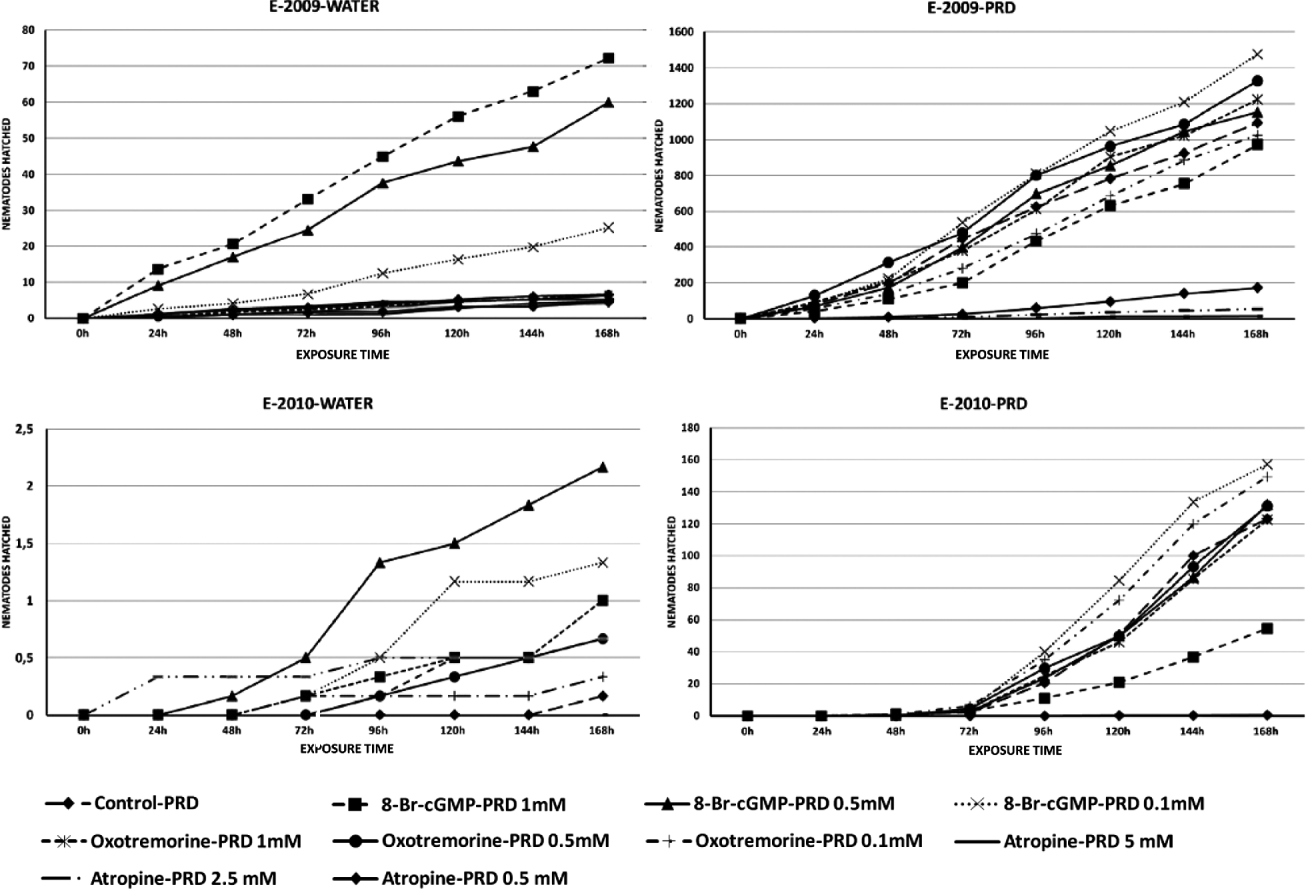
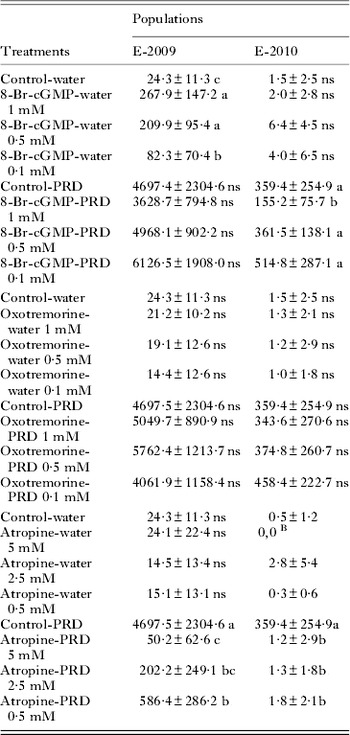
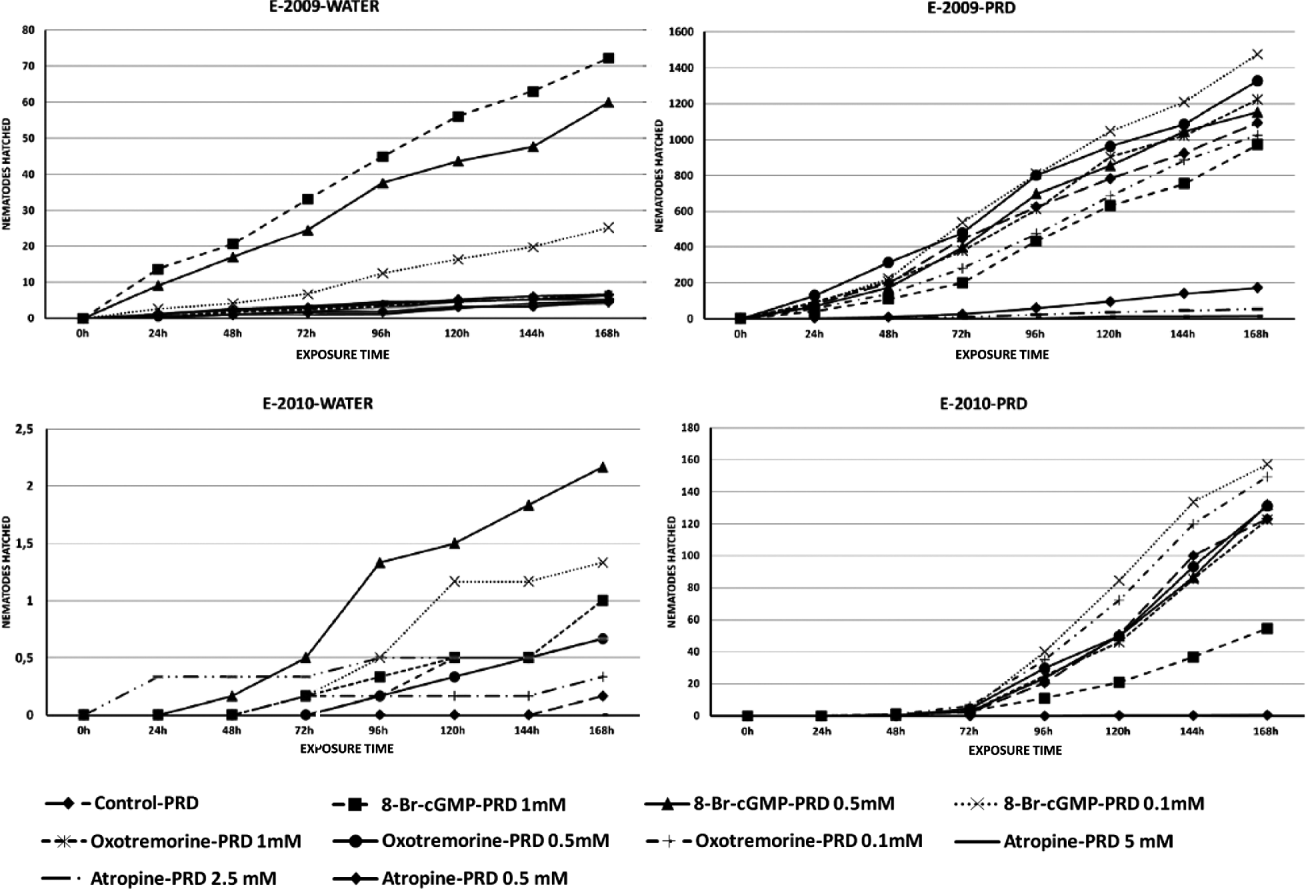
Hatching of quiescent (E-2009) and diapaused (E-2010) nematodes was significantly influenced (P ⩽ 0·05) by the application of PRD, although quiescent nematodes hatched to a far greater extent in response to PRD than those in diapause (Table 1, Fig. 1). Application of 8Br-cGMP in water to quiescent nematodes (E-2009) activated hatching in a dose-dependent manner; the highest hatching was obtained in 1 mM solution with the lowest hatching in the water treatment. Hatching of quiescent nematodes in PRD was not modified (P⩾0·05) by the application of 8Br-cGMP at any concentration (Table 1, Fig. 1). Diapaused nematodes (E-2010) were not influenced (P⩾0·05) at any level of the drug in water (Table 1, Fig. 1). However, the hatching of diapaused nematodes (E-2010) in PRD was significantly reduced (P⩽0·05) at the highest concentration (1 mM) of 8Br-cGMP but not influenced by any other level (Table 1, Fig. 1).
Hatching of 10 cysts of Globodera pallida over 7 days of incubation at 20 °C in different testing compounds diluted in water or in potato root diffusate (PRD). Data are means of 6 replications (2 different experiments) per treatment. (A) Population E-2009 with compounds diluted in water. (B) Population E-2010 with compounds diluted in water. (C) Population E-2009 with compounds diluted in PRD. (D) Population E-2010 with compounds diluted in PRD.
Area under graph from cumulative hatch of Globodera pallida over 7 days of incubation at 20 °C with different testing compounds diluted in water or in potato root diffusate (PRD)A

A Data are means of 6 replications (2 different experiments) per treatment combination consisting of 10 similar size cysts per well. For each treatment mean followed by the same lowercase letter do not differ significantly (P ⩾0·05) according to Least Significant Difference test (LSD). Letters refer to mean comparisons among compounds diluted in water or PRD and differences between treatments, respectively. Area under cumulative hatch transformed into log10 (X + 1) before analyses.
B Data not studied by ANOVA analysis because atropine treatment had no hatching.
Atropine partially inhibited hatching in PRD in quiescent nematodes and suppressed hatching in both water and PRD in diapaused nematodes (E-2010). Quiescent nematodes (E-2009) in PRD showed a greater reduction of hatching as the levels of atropine were increased. Application of atropine to diapaused nematodes (E-2010) reduced the rate of hatching in PRD at all levels studied (Table 1, Fig. 1). However, atropine at all concentrations reduced egg viability after the removal of drug solution and the addition of PRD, with highest reduction of viability at 5 mM atropine (data not shown).
Oxotremorine did not influence (P⩾0·05) the hatching of quiescent nematodes (E-2009) or diapaused nematodes (E-2010) at any level of the drug in water or PRD (Table 1, Fig. 1).
Identification of orthologues of C. elegans diapause genes in G. pallida, M. incognita, M. hapla and B. xylophilus
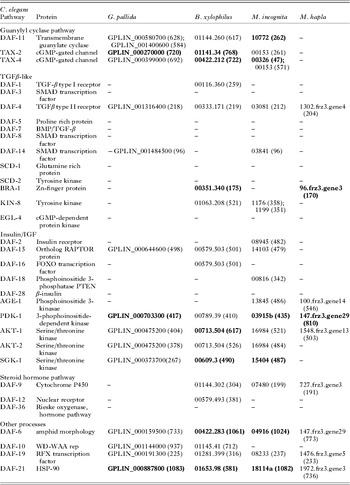
Few diapause-related genes were identified as orthologues by comparison between C. elegans, M. hapla, M. incognita, B. xylophilus and G. pallida sequences using a highly stringent RBH analysis. Only 3 potential G. pallida orthologues (tax-2, pdk-1 and daf-21) were identified in comparison to C. elegans. Analysis of B. xylophilus revealed more potential orthologs of C. elegans dauer genes (tax-2, tax-4, bra-1, akt-1, sgk-1, daf-6 and daf-21). Meloidogyne incognita contained six potential orthologs (daf-11, tax-4, pdk-1, sgk-1, daf-6 and daf-21), while M. hapla has only 2 potential orthologues (bra-1 and pdk-1) (Table 2). Bursaphelenchus xylophilus is the species with most genes related to diapause (orthologues and with high similarity) present in C. elegans (19 genes), followed by M. incognita (18 genes), G. pallida (14) and M. hapla (9 genes).
Globodera pallida, Bursaphelenchus xylophilus, Meloidogyne incognita and M. hapla orthologues and genes with high similarity to Caenorhabditis elegans related to dauer formation

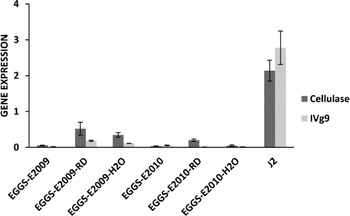
Expression of 2 genes encoding effectors (IVg9 and cellulase) (Jones et al. Reference Jones, Kumar, Pylypenko, Thirugnanasambandam, Castelli, Chapman, Cock, Grenier, Lilley, Phillips and Blok2009) was highly activated in hatched juveniles (Fig. 2). These genes were slightly up-regulated in eggs soaked in water or PRD in quiescent nematodes (E-2009). However, this up-regulation was not observed in nematodes in diapause (E-2010). The activation of gene expression in quiescent eggs was stronger for cellullase than IVg9. This was in contrast to the expression in J2 s, in which induction of IVg9 was slightly higher than that of cellulase.
Plant-parasitic nematode gene expression using second-stage juveniles (J2), dehydrated eggs from population E-2009 (eggs-E2009), dehydrated eggs from population E-2010 (eggs-E2010), eggs soaked in water for 5 days from population E-2009 (eggs-E2009-H2O), eggs soaked in water for 5 days from population E-2010 (eggs-E2010-H2O), eggs soaked in water for 5 days and transferred to potato root diffusate (PRD) for 24 h from population E-2009 (eggs-E2009-PRD), eggs soaked in water for 5 days and transferred to potato root diffusate (PRD) for 24 h from population E-2010 (eggs-E2010-PRD). All levels of expression are the mean of 3 biological replicates and in the format: mean ± S.D. All genes are normalized using eifA4.

Observation of quiescent and diapaused J2 s in response to water and PRD
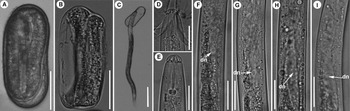
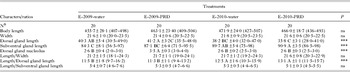
The dorsal and subventral pharyngeal gland cells responded to PRD treatment more strongly in quiescent as compared to diapaused nematodes. Differences in dorsal and subventral pharyngeal glands, the diameter of the dorsal gland cell nucleolus and the relationship between length of the body and the dorsal pharyngeal gland were statistically significant between the different treatments studied (Table 3, Fig. 3). All other measurements (body length L, width, L/width and L/subventral pharyngeal gland length) did not show any differences between the treatments (P ⩾ 0·05).
Light micrographs of eggs and dorsal gland second-stage juvenile nucleolus of Globodera pallida under different treatments. (A) Eggs hydrated after 5 days. (B) Egg dehydrated. C) Second-stage juvenile hatching from the egg. (D and E) Second-stage juvenile anterior region. (F and G) Dorsal gland nucleolus of second-stage juvenile from E-2009 hydrated after 5 day in water. (H and I) Dorsal gland nucleolus of second-stage juvenile from E-2009 hydrated after 5 days in water and soaked in root potato root diffusate for 4 days. Abbreviation: dn, dorsal gland nucleolus. Scale bars: A, B = 50 microns; C = 100 microns; D-I = 20 microns.

Morphometrics of Globodera pallida juveniles soaked in water for 5 days (-water) and soaked in water for 5 days and additionally 24 h in potato root diffusate (-PRD) from quiescent nematodes (E-2009) and diapaused nematodes (E-2010)A

A Measurements are in μm and in the form: mean ± standard deviation (range).
ns, not significant P < 0·01 (***).
B N, number of nematodes measured.
The dorsal pharyngeal gland cell was longer in quiescent nematodes compared to those in diapause. This result was correlated with a lower ratio length/dorsal pharyngeal gland length in quiescent than diapaused nematodes. The subventral pharyngeal gland was longer in diapaused nematodes soaked in PRD compared to quiescent nematodes soaked in water. Dorsal gland nucleolus diameter was clearly increased (P ⩽ 0·05) by the application of PRD in quiescent nematodes (E-2009) and this treatment was significantly different from the rest of the treatments (Table 3, Fig. 3).
DISCUSSION
Many studies have demonstrated the essential role of host plant diffusates in hatching of potato cyst nematodes, with a 5-min exposure to PRD being sufficient to initiate the hatching process of G. rostochiensis (Perry and Beane, Reference Perry and Beane1982). PRD alters the permeability of the lipoprotein membranes of the eggshell (Perry et al. Reference Perry and Beane1982) allowing leakage of solutes, principally trehalose (Clarke et al. Reference Clarke, Perry and Hennessy1978). This reduces the osmotic pressure allowing an increase in water content and metabolic activity (Ellenby and Perry, Reference Ellenby and Perry1976). Not all eggs in a population hatch and the majority of diapaused nematodes are insensitive to root diffusate. An excellent review of factors affecting the hatching process was provided by Perry (Reference Perry, Marks and Brodie1998). However, the neurosecretory and genetic control of diapause and quiescence has not been investigated further in cyst nematodes. Genetic, neurosecretory and hormonal involvement in development arrest in C. elegans dauer larvae is well studied (Fielenbach and Antebi, Reference Fielenbach and Antebi2008). In addition to environmental cues (food and temperature), a dauer pheromone is secreted at high nematode densities and this hormone promotes the formation of the dauer larvae.
Low levels of cGMP actively trigger the formation of dauer larvae, and reproductive growth when they are high, with signalling mediated through the amphidial sensory cilia (Fielenbach and Antebi, Reference Fielenbach and Antebi2008). Other nematodes such as A. caninum and A. ceylanicum are recovered from developmental arrest by this compound (Brand and Hawdon, Reference Brand and Hawdon2004). In our case, hatching of juveniles was not activated in quiescent nematodes and in the presence of PRD, and some inhibitory effect on hatching at high concentration (1 mM) was demonstrated in the diapaused nematodes (E-2010). It is possible that the reduction of osmotic pressure produced by the presence of PRD could allow a better penetration of the compound into the amphid. However, this compound activates hatching in quiescent nematodes when the compound was diluted in water. Our results partially agree with those obtained by Atkinson et al. (Reference Atkinson, Taylor and Fowler1987) in which concentrations of 5 mM of cAMP or 0·025, 0·05 and 2·5 mM of cGMP reduced significantly hatching of G. rostochiensis in a 1/10 dilution of PRD. However, differences in inhibitory effects have been found between cAMP and cGMP after the removal of the chemical and the addition of PRD (Atkinson et al. Reference Atkinson, Taylor and Fowler1987). One possible explanation for these differences is the different populations used, age and different species (G. pallida vs G. rostochiensis). Oxotremorine, a synthetic muscarinic agonist did not induce any effect on the hatching of G. pallida which differs from results obtained in other nematodes (Tissenbaum et al. Reference Tissembaum, Hawdon, Perregaux, Hotez, Guarente and Ruvkun2000). Muscarinic agonists promote insulin release both in vivo and in vitro in mammals (Miller, Reference Miller1981; Hawdon and Schad, Reference Hawdon and Schad1993). Insulin seems not to play a role in hatching of either diapaused or quiescent G. pallida, suggesting limited effects of this drug in the release of insulin-like factors from secretory cells. However, atropine partially inhibited hatching at high concentrations (5 mM) in the quiescent population (E-2009) and completely inhibited hatching in the diapaused population (E-2010). Atropine inhibits all subtypes of the muscarinic acetylcholine receptor and not nicotinic receptors in mammals, and the dauer recovery is almost completely inhibited in other nematodes at lower (1 mM) or higher levels of the drug (5 mM) (Tissenbaum et al. Reference Tissembaum, Hawdon, Perregaux, Hotez, Guarente and Ruvkun2000). In our case, hatching inhibition may also be linked to a high rate of mortality at the levels studied, especially at 2·5 and 5 mM as determined by hatching observations following the removal of the drugs and soaking the cysts in PRD (data not shown). It is possible that in G. pallida this phenomenon has a different neuronal pathway to the TGF-β signalling pathway, which in C. elegans dauer recovery acts convergently with the insulin-like (or muscarinic) pathway or a different atropine-resistant pathway could explain the partial but not complete inhibition of hatching.
Sequence comparisons of diapause-related genes in G. pallida with those from C. elegans revealed few genes that were strong candidates for orthologues of diapause-related genes from C. elegans. Surprisingly, few orthologues were found in the other plant-parasitic nematodes previously studied, even in B. xylophilus, which is more closely related to C. elegans (Holterman et al. Reference Holterman, van der Wurff, van den Elsen, van Megen, Bongers, Holovachov, Bakker and Helder2006) and which has a dauer stage in its life cycle. No clear pathways or gene patterns seem conserved in the plant-parasitic nematodes studied. This result is shown by the absence of genes for orthologues/homologues for the signalling insulin, TGF-β and steroid hormone pathways. It seems that these pathways are partially represented, because the major signals are not present in the nematodes studied (daf-7 and daf-28) and the respective receptors are only present in some species, including daf-1(B. xylophilus), daf-4 (G. pallida, B. xylophilus, M. incognita and M. hapla), daf-2 (M. incognita) and daf-12 (B. xylophilus). However, the guanylyl cyclase pathway is mainly conserved (with the exception of M. hapla), possibly because of its important role in detection of environmental cues. The use of other molecules or genes and the phylogenetic separation of these species from C. elegans could also make amino-acid sequence comparison difficult. However, some genes may have been missed during genome assembly or annotation. Kinases potentially related to the insulin pathway seem mainly conserved. PDK-1 is much conserved within the nematodes studied and acts downstream of AGE-1/PI3 K and upstream of the AKT-1 and AKT-2 kinases (www.wormbase.org, 2012). While SGK-1 forms a complex with the AKT kinases and phosphorylates DAF-16 (www.wormbase.org, 2012). The surprising lack of good gene candidates similar to DAF-16 (with the exception of M. incognita) suggests that these genes could have other functions in nematode development. The insulin/IGF pathway in the plant-parasitic nematodes is not the same as that described for C. elegans and it is corroborated in the lack of hatching in the oxotremorine eggs exposed to PRD. Daf-6 is required for the normal function of the non-neuronal amphidial sheath cells of the amphid and the outer labial sensilla (www.wormbase.org, 2012). Daf-6 mutants show a disruption in the joining of the amphid sheath and socket cells to form the receptor channel, displaying defects in several distinct functions including formation of dauer larvae, chemotaxis, osmotic avoidance, male mating, negative regulation of lifespan, negative regulation of ASJ's axonal growth late in development and dye uptake by amphids and phasmids (www.wormbase.org, 2012). Daf-21 activity is required for larval development, negative regulation of dauer larva formation, and a number of specific chemosensory behaviours (www.wormbase.org, 2012). Daf-21 sensory defects can be rescued by a cyclic GMP analogue, suggesting regulation in chemosensory behaviours (www.wormbase.org, 2012). Our results disagree with the results published by Opperman et al. (Reference Opperman, Bird, Williamson, Rokhsar, Burke, Cohn, Cromer, Diener, Gajan, Graham, Houfek, Liu, Mitros, Schaff, Schaffer, Scholl, Sosinski, Thomas and Windham2008) and Kikuchi et al. (Reference Kikuchi, Cotton, Dalzell, Hasegawa, Kanzaki, McVeigh, Takanashi, Tsai, Assefa, Cock, Dan Otto, Hunt, Reid, Sanchez-Flores, Tsuchihara, Yokoi, Larsson, Miwa, Maule, Sahashi, Jones and Berriman2011), in which the majority of the diapause genes studied were strongly supported as orthologues. However, we used a more stringent filtering method than those used in the previous studies. Differences in these parameters could affect the results obtained in the comparisons between nematode genes. These results suggest that different or modified pathways may be used by plant nematodes to control this physiological event.
In our RT-PCR experiments, unhatched J2 s did not show a clear activation of parasitism gene expression in the presence of PRD, with only a slight increase in expression observed in quiescent nematodes exposed to PRD. However, the preparation for parasitism gene expression is indicated by changes in the diameter of the nucleolus in quiescent nematodes exposed to PRD. No expression of parasitism genes was detected in nematodes in diapause and the gland cells of these nematodes did not respond morphologically to PRD. Similar results were obtained by measurement of the nucleolus diameter from the dorsal gland cell and by acridine orange staining using quiescent populations of G. rostochiensis soaked in root diffusate (Atkinson et al. Reference Atkinson, Taylor and Fowler1987; Blair et al. Reference Blair, Perry, Oparka and Jones1999). Additionally, some authors have proposed that the real analogue of the dauer stage in cyst nematodes could be the J2, but gene expression studies using microarrays did not support this (Elling et al. Reference Elling, Mitreva, Recknor, Gai, Martin, Maier, McDermott, Hewezi, McK Bird, Davis, Hussey, Nettleton, McCarter and Baum2007).
It has been suggested that diapause in G. rostochiensis is initiated by signals from the plant during the growing season (Hominick et al. Reference Hominick, Forrest and Evans1985). Nematodes develop inside the female and are arrested at J2, after moulting from J1. This development has been observed in eggs outside the female and the arrest point remains in the J2 (Langeslag et al. Reference Langeslag, Mugniery and Fayet1982; Palomares-Rius et al., unpublished results). Preliminary results in our group have shown that this arrest in the J2 stage is not broken by PRD. However, a second generation in the field and in controlled conditions has been detected in G. pallida if the host potato plant is healthy and in warmer temperatures (Jiménez-Pérez et al. Reference Jiménez-Pérez, Crozzoli and Greco2009). The low number of G. pallida orthologues of C. elegans genes related to dauer formation suggests that these genes are not involved in the inhibition of hatching of diapaused eggs. The position of individual cysts in the root system may influence the syncytium establishment and access to an adequate food source, as well as egg production (possible egg condition in relation to non-diapaused, diapaused or quiescence in individual cysts within a population) and the host physiological condition (active growth vs senescence) are the main focus for future research to clarify conditions which affect this complicated biological survival strategy in an important crop pest.
ACKNOWLEDGEMENTS
The authors thank the Spanish Ministry of Education for funding to the first author under the ‘Ayudas para la movilidad postdoctoral en centros extranjeros’ scheme. The James Hutton Institute receives funding from the Scottish Government. Statistical advice from Jim McNicol is gratefully acknowledged (BIOSS, UK).