

Archaeologists tend to neglect the difference between form and content when it comes to social interpretations of material culture patterns. All too often, artefacts and practices from different areas that are classified as being similar or connected in terms of formal stylistic characteristics are uncritically interpreted as the signs of a corresponding social phenomenon (such as group identity, ethnicity, etc) that is likewise shared between these areas. Thus our archaeological units of classification are, far too easily, turned into single social entities that match the spatial and temporal extent of the archaeological unit.
Although archaeological ‘cultures’ or groups are outcomes of an heuristic archaeological classification that may be useful for sorting and dating, the units created are mistaken as representations of one social totality, be it a specific social group, a factor, or a process. Favoured candidates are ethnic units, migrations (or demic diffusion), the emergence of new, large-scale economic strategies (e.g. pastoralism), responses to climate changes, and the emergence of new kinds of marriage networks or elite networks.
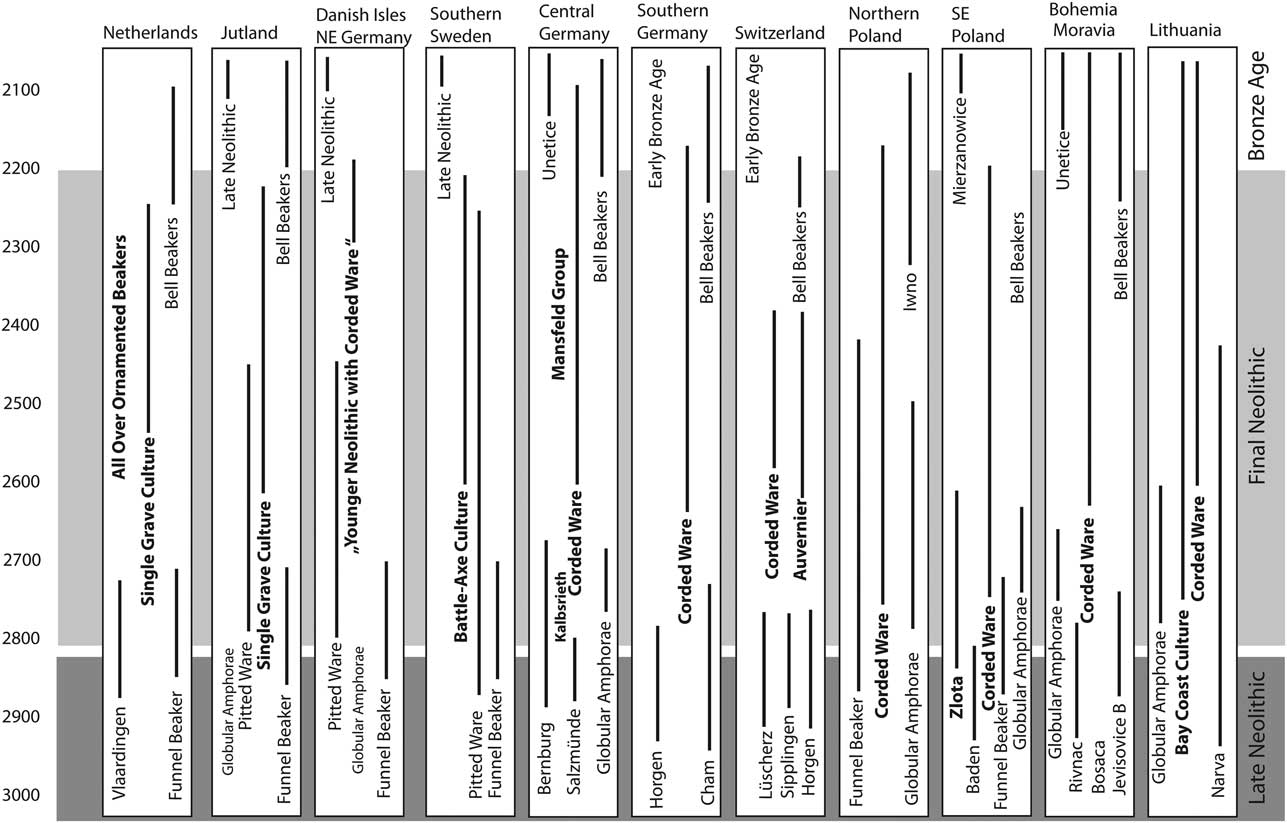
The ‘Corded Ware’ phenomenon or ‘Corded Ware Culture’ of central and eastern Europe (Fig. 1) is an excellent example of how archaeologists have mistaken the presence of similar material culture traits as a sign of a similar, or at least connected, social equivalent. All the debates on how to interpret ‘the Corded Ware phenomenon’ in social terms have suffered from the same crucial error, namely the presumption that there would be one social group, one process, or one trigger responsible for the formation of that archaeological unit.
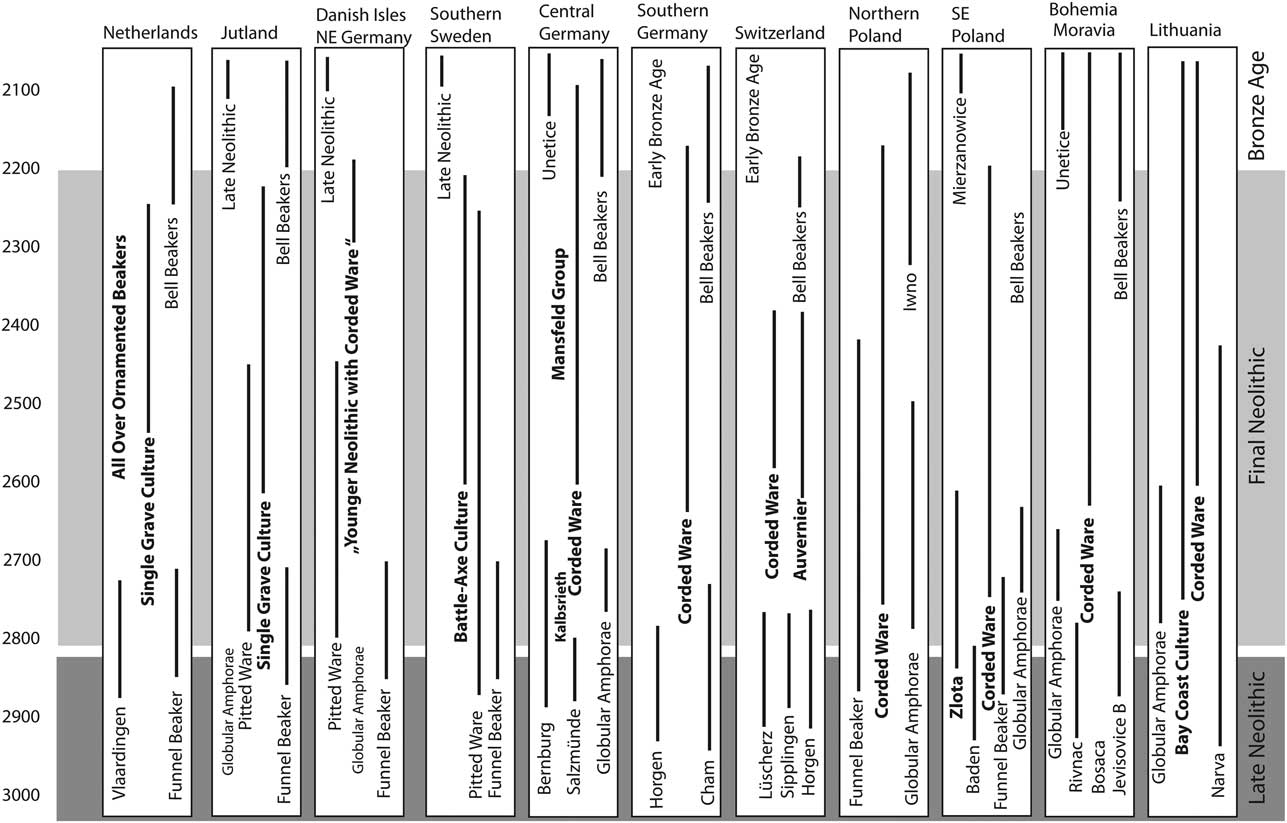
Summary table for the chronological positions (extent of name plus vertical lines) of the most important traditional archaeological ‘cultures’, ‘Groups’ or pottery styles discussed in this paper. Note that the definitions of those units are far from consistent or comparable, because they derive from different national and regional research traditions. Bold letters indicate a unit connected to the Corded Ware phenonomenon
This false presumption is connected to, or rather the cause of, the methodological weakness in the definition of the archaeological unit of ‘Corded Ware Culture’. As with all archaeological cultures, single artefacts are taken as ‘type fossils’ for a specific unit (archaeological culture or ‘culture group’) which, in the course of a monothetic classification, are presumed to be uniform and clearly bounded in space and time. However, such uniformity is hardly ever questioned. It is mostly presumed, because the idea of a social equivalent, a corresponding social group, has already imposed itself on the classification process.
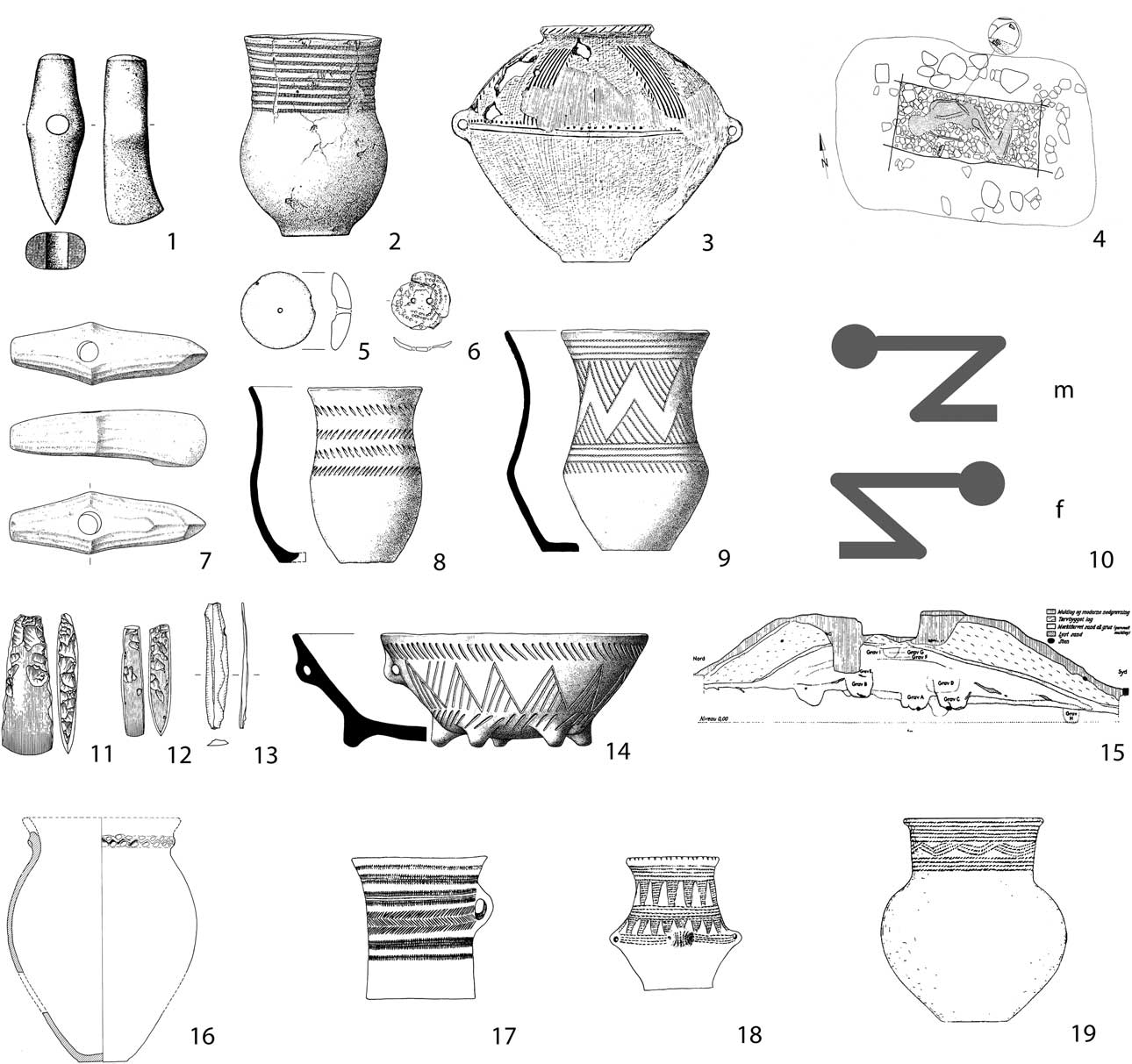
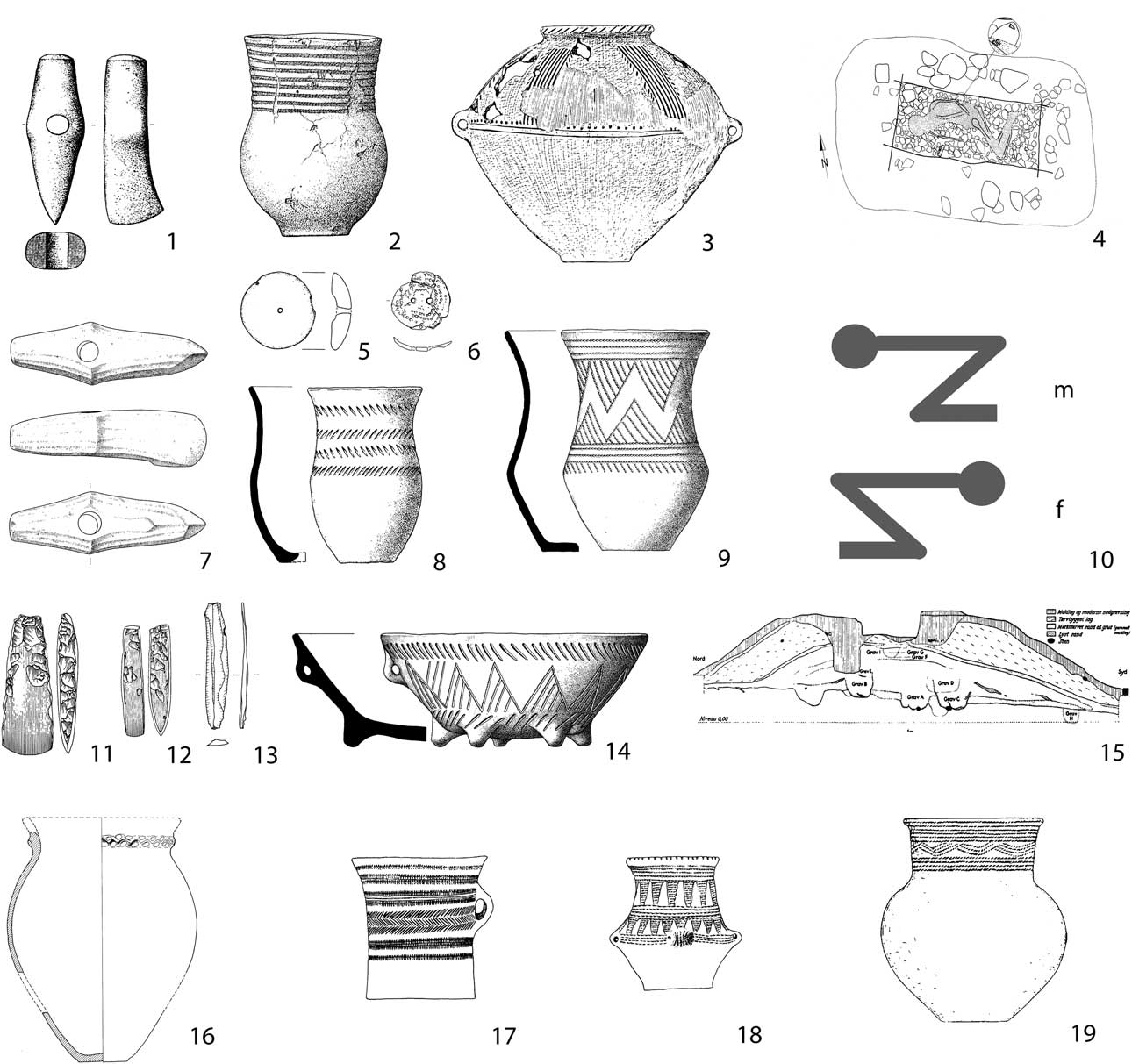
Archaeologically, the Corded Ware phenomenon is defined as encompassing a set of material culture traits, most prominently ceramic beakers and amphorae decorated with cord-impressions (Fig. 2: 2–3, 8–9, 17–19), pots with short-wave moulding (Fig. 2: 16), shaft-hole axeheads (Fig. 2: 1), and burial practices such as single interment under barrows, oriented west–east, and gender-differentiated (Fig. 2: 4, 10, 15). These date from 2900 cal bc to 2000 cal bc and are identified over a wide swathe of Europe, from Central Scandinavia to the Alps, and from the Dutch coast to the Russian forest Steppe. This enormous spatial distribution has been used to link the ‘Corded Ware Culture’ to (among others) a migrating people identified as the speakers of the Indo-European language (eg, Gimbutas Reference Gimbutas1994; see Whittle Reference Whittle1996; Prescott Reference Prescott2013 for discussion). There is no evidence for such a claim, but this is only the most prominent of a number of over-simplifications, where ‘Corded Ware Culture’ is treated as a unified sign system representing some kind of unified social phenomenon, be it ‘a people’ (or, indeed, ‘a group of people’), ‘a new economic strategy’, ‘an ideology’, ‘a network’, and the like. These over-simplifications include Furholt (Reference Furholt2003).
Corded Ware elements with a supra-regional distribution: 1. Battle-axe (Type A); 2. Corded beaker (type A); 3. ‘Strichbündelamphora’; 4. Single burials below barrows (15), Gender-specific deposition rules (10); 5. Amber ornament disc (all Hübner Reference Hübner2005); 6. Bone ornament disk; 7. Facetted battle-axe; 8. Herringbone-ornamented beaker; 9. Triangle-ornamented beaker (all Dresely Reference Dresely2004); 11. (flint) axe; 12. (flint) chisel; 13. flint blade (all Hübner Reference Hübner2005); 14. Bowl (Dresely Reference Dresely2004); 16. Short-wave-moulded ‘Wellenleisten-’ storage vessel (Strahm Reference Strahm1971); 17. Straight-walled vessel; 18. Amphora (both Matthias Reference Matthias1968); 19. Short-necked beaker (Włodarczak Reference Włodarczak2006)
Such interpretations seem to forget that the ‘Corded Ware Culture’ is simply a summary term that refers to certain ceramic vessel types distinguished by their decoration technique and weapons that are often, but not always, connected to a particular set of funerary practices.
In this paper the archaeological evidence that defines the ‘Corded Ware’ phenomenon is revisited and the variability in material culture characteristics that has been glossed over by previous research explored. Based on these re-evaluations, it is argued that the components of the ‘Corded Ware’ phenomenon, especially those connected to the supposedly early uniform ‘A-Horizon’, originated and emerged independently in different parts of Europe, and that those components – the A-Beaker (Fig. 2: 2), the A-Amphora (Fig. 2: 3), and the A-Axe (Fig. 2: 1) are spread unevenly throughout the Corded Ware regional groups and are embedded in regionally diverse cultural backgrounds. This re-evaluation reveals that there is a much greater formal variability than had previously been commonly stated, both in artefact style and in burial rites, and it reduces the supposed uniformity of Corded Ware to a set of overall principles.
Finally, where social interpretations are concerned, it will be argued that there is no need for, and no reason to infer, the presence of one single social totality, group, process, or cause underlying the formation of the archaeological unit known as ‘Corded Ware’ phenomenon.
The Traditional Definition of ‘The Corded Ware’ Phenomenon
Although Corded Ware has been given different names in different regions (Fig. 1) – namely ‘Single Grave Culture’ in Denmark and northern Germany, ‘Protruding Foot Beaker Culture’ in the Netherlands, ‘Battle Axe Culture’ in Sweden and Finland, ‘Bay Coast Culture’ in the Baltic Countries, ‘Fatjanovo Culture’ in Russia, and ‘Corded Ware Culture’ in central and southern Germany, Switzerland, the Czech Republic, Austria, Poland, and Ukraine – and despite the variability in approaches and explanations, few have doubted the unity of these ‘Corded Ware groups’, or ‘Cultures with Corded Ware’ (Buchvaldek Reference Buchvaldek1986; Buchvaldek & Strahm Reference Buchvaldek and Strahm1992; Siemen Reference Siemen1997; Ebbesen Reference Ebbesen2006; Strahm Reference Strahm2010).
Traditionally, Corded Ware represents an archaeological ‘culture’, commonly dated from roughly 2800 bc to 2200 bc, which is known almost exclusively from grave finds (eg, Buchvaldek Reference Buchvaldek1986). Settlements are still clearly under-represented in the records (Dörfler & Müller Reference Dörfler and Müller2008). The majority of Corded Ware graves contain individual interments, often beneath small burial mounds, following a set of rules of deposition. In addition to the dominance of a west–east orientation, gender roles are especially marked through a dichotomy of practice, with males being buried on their right side, with the head to the west, and females being buried on their left side, with the head towards the east. Typical elements of Corded Ware grave furniture are beakers and amphorae (often decorated by cord impressions), battle axes, flint tools, and jewellery of bone, tooth, amber, and copper (Fig. 2).
The debate surrounding the interpretation of Corded Ware as a large-scale phenomenon has clearly been dominated by the southern Scandinavian evidence, especially since 1945, when P. V. Glob published his thesis about the Single Grave Culture of the Jutland Peninsula (Glob, Reference Glob1944). The chronological order of battle-axe types and associated pottery created by Glob formed the basis for the later definition of the ‘A-Horizon’, or ‘Einheitshorizont’ of the early Corded Ware (Struve Reference Struve1955; Buchvaldek Reference Buchvaldek1967; Strahm Reference Strahm1971 and others). Glob observed that those types of grave goods that were identified as early period in Jutland had a supra-regional distribution and appeared in northern and central Germany, Poland, eastern Prussia, Sweden, and Finland, even in Russia (Glob Reference Glob1944, 217ff.).
Glob's chronology was based on a limited number of stratigraphic observations from the grave barrows and find associations, and in particular on the depth of depositions in the single grave barrows. He assumed that graves below the (prehistoric) land surface were the oldest, whereas those deposited on the surface or even above it, within the body of the barrow, were younger.
However, the definition of an early A-Horizon all over central and eastern Europe was essentially a circular one, claiming that all these types – the A-Battle Axe, the Corded Beaker and the A-Amphora – comparable to the early specimens from Jutland – must be equally early in the other regions, and then, having ‘identified’ such a uniform early horizon in different regions, it was cited as an example of extraordinarily homogeneous material culture. It is crucial to point out that none of the local chronologies of Corded Ware groups outside Jutland that were established in the decades following Glob's work was properly based on stratigraphy or scientific dating methods. Struve (Reference Struve1955) explicitly followed Glob's system, while Kilian (Reference Kilian1955) based his considerations on a discussion on supra-regional typology and ideas about chronology. Buchvaldek (Reference Buchvaldek1967) defined three typological groups and singled out the ‘A-horizon’ to be the earliest one – without any arguments apart from typology and comparison to other regions. The same can be said of Machnik's (1966) and Strahm's (1971) contributions, which defined the chronologies of southern Poland and Switzerland. Jacob's (1991) chronological model for north-eastern Germany is again solely based on the chronological interpretation of typological observations in other regions. Only the Dutch evidence was tested by obtaining radiocarbon dates (Lanting et al. Reference Lanting, Mook and Waals1973). Another exception is central Germany, where Ulrich Fischer (Reference Fischer1958) published a chronology based on a few stratigraphic observations and on a discussion mainly of central German material. However, over the following decades, different and opposing chronological models were proposed based on the same material. These based the definition of chronological phasings primarily on typological arguments (Hein Reference Hein1987; Stock Reference Stock1998).
The model of an early A-Horizon and a successive regionalisation is connected to a simple uni-causal concept of culture change through large-scale migration. Despite a fundamental critique of the role of migration in cultural change since the late 1960s (Clarke Reference Clarke1968; Shennan Reference Shennan1976; Reference Shennan1989; Damm Reference Damm1991) and, more recently, more sophisticated discussions where migration is conceptualised as different forms of mobility (Kristiansen Reference Kristiansen1989; Burmeister Reference Burmeister2000; Prien Reference Prien2005), the old mass migration concept remained embedded in the majority of models. The perceived importance of migration has, however, been challenged by recent research developments, in particular the use of radiometric dating and dendrochronology as the basis of chronological construction (Winiger Reference Winiger1993; Müller, Reference Müller1999; Dresely & Müller Reference Dresely and Müller2001; Czebreszuk & Szmyt, Reference Czebreszuk and Szmyt2001; Furholt, Reference Furholt2003; Reference Furholt2004; Włodarczak Reference Włodarczak2006; Reference Włodarczak2009), and the re-assessment of the single grave finds from the Jutland Peninsula (Hübner Reference Hübner2005).
These developments have produced new arguments for the understanding of the Corded Ware phenomenon by their focus on the ‘empirical’ basis upon which the old migration-model was founded. The following section will offer a broad summary of the significant results from this research that challenge the old framework with its concentration on overall uniformity, and will propose a new model emphasising the diversity in the records.
Radiocarbon and Dendrochronology Versus Typological Dating
The relative chronology of the Corded Ware regional groups was initially established using seriation, where different variants of cultural material were grouped typologically, assuming that differences in style reflect mainly a temporal drift, continuous and of a more or less uniform continuous speed (cf. Machnik Reference Machnik1966; Strahm Reference Strahm1971). This chronological interpretation of typology was aided by reference to the presumably secure temporal order established by Glob for the Single Graves of the Jutland Peninsula. Inherent in the method is the presumption that different styles were unlikely to be in contemporary use and a rejection of the idea that individual forms could have a long duration (cf. Stöckli Reference Stöckli2009; Włodarczak Reference Włodarczak2009). Although the possibility of Bayesian modelling is, with a few exceptions (Furholt Reference Furholt2003; Müller et al. Reference Müller, Seregély, Becker, Christensen, Fuchs, Kroll, Mischka and Schüssler2009), prevented by the dominance of single burials in the archaeological record, with the application of radiometric dating to Corded Ware sites, it is clear that the duration of the most significant types, such as the Corded Beaker (A-Beaker), the ‘A-Amphora’ (see Fig. 2: 2–3), and others (Dresely & Müller Reference Dresely and Müller2001; Müller Reference Müller1999; Furholt Reference Furholt2003), was much longer than previously thought. Consequently, it appeared that several styles were in contemporary use, and this opened the way to new interpretations regarding the social significance of different co-existing symbols (Müller Reference Müller2001; Furholt Reference Furholt2004). Inevitably, such interpretations have been disputed, as has the reliability of the radiocarbon dates (Włodarczak Reference Włodarczak2006; Reference Włodarczak2009; Stöckli Reference Stöckli2009). However, the present author sees no reason why stylistic variation is more likely to be explained by mere temporal drift than by other reasons, including the active use of material symbols in social discourses, and thus sees no reason to dispute the validity of hundreds of radiocarbon dates, obtained from laboratories all over Europe (Furholt Reference Furholt2003), which clearly contradict the traditional model of continuous and regular change in material culture.
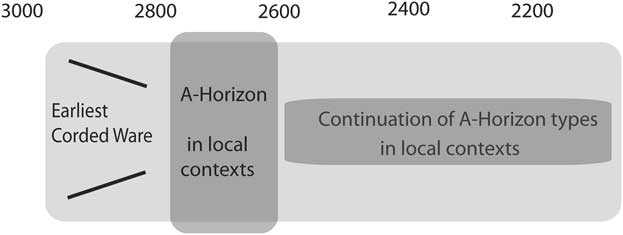
Acceptance of the results of radiometric dating meant that the concept of the so called ‘A-Horizon’ also had to be reformulated. If we are dealing with such a phase at all, it is not a classic typological period that is defined by a uniform material culture inventory, but rather a set of types which show a wide distribution, but which are always integrated into a locally specific and thus regionally variable context. The situation resembles that of the Bell Beakers, where a few supra-regional types are associated with local forms of ‘Begleitkeramik’ (i.e. pottery that accompanies Bell Beakers: Strahm Reference Strahm1995; Besse Reference Besse1996).
The distribution data indicate that this set of forms (namely the A-Beaker, ‘A-Amphora’, and A-Battle Axe, as well as Herringbone-decorated Beakers) was to be found over much of Europe around 2700 bc, and that the currency of these forms was not short: they seem to have been used continuously during the Final Neolithic, perhaps even until 2000 bc (Fig. 3; Furholt Reference Furholt2004). Analysis of the radiometric and dendrochronological determinations also indicates that the A-Horizon is not the earliest Corded Ware phase (Fig. 3). Instead, it appears to follow an apparent earlier phase in Poland during which Corded Ware pottery was in use from as early as 2900 bc (Furholt Reference Furholt2003; Reference Furholt2008a; Włodarczak Reference Włodarczak2006; Ullrich Reference Ullrich2008).
Chronological model following from radiocarbon dating. Mark the contrast to the traditional model of the A-horizon as the earliest phase and a successive increase in regional variability later on

The Re-Assessment of The Single Grave Evidence in The Jutland Peninsula
Hübner's monograph on the Single Grave barrows of Jutland (Hübner Reference Hübner2005) presented for the first time an inventory of the archaeological material that Glob had used for his typo-chronological scheme in 1944. The material is presented as a catalogue and a database, and the stylistic variation in pottery, weapons, tools, and grave structures is described and discussed in detail. Chronological and spatial analyses can now be grounded in reproducible statements about contextual relations and on statistics relating to the frequency of specific artefacts and features. A very useful tool is the correspondence analyses (CA) that Hübner employed to characterise the closed grave inventories of Jutland (Hübner Reference Hübner2005, figs 119–20). Her main aim was to identify the chronological element in the variability of grave goods, to review Glob's chronological model. She undertook two separate and independent analyses for the Danish and the German part of the Jutland Peninsula, both showing a pattern that she interpreted as representating a temporal trajectory for the stylistic development of the grave goods. Such a view is indeed supported by the radiocarbon dates available (Hübner Reference Hübner2005, 660ff). Glob's chronology was confirmed, maintaining the three phases of Untergrabzeit (ie, below ground surface Early Single Graves, phases 1a–c), Bodengrabzeit (graves on the old land surface, Middle Single Graves, phases 2a–b), and Obergrabzeit (above-ground graves, Late Single Graves, phases 3a–c). However, it is in the details that interesting deviations are suggested.
A first, striking result is the general absence of pottery in the early phase in both regions. In the CA of the Danish graves, only a single vessel is placed in the earliest group of graves (Hübner's Phase 1a) and it is not until Phase 1c that vessels become common.
The presence of a single vessel in the seriation matrix is, however not tantamount to the regular appearance of that kind of item; rather, it is likely that this vessel represents an outlier. Looking at Hübner's seriation matrix, it is clear that the practice of depositing pottery as a regular grave good begins during Phase 1b. This is strongly supported by the parallel, and much clearer, situation that emerges from the north German seriation. Here, no vessels are to be found in graves within the earliest phase. Indeed, pottery as a regular grave good does not seem to be established before Phase 1c.
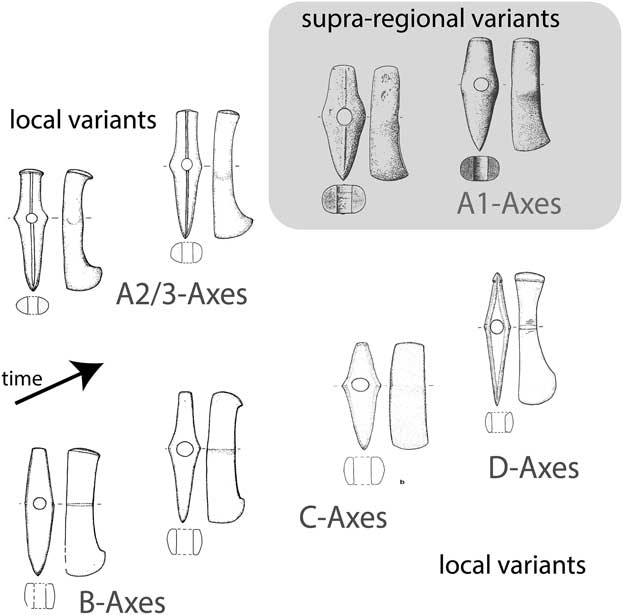
The second useful element in Hübner's analysis is her re-assessment of the battle-axe chronology. On solely typological grounds, Sophus Müller, and also Glob, established the supposedly chronological succession from the rather simple A1 variant to the more elaborate A2 and A3 subtypes. (See Fig. 4; read the A-Axe types from right top to bottom left). Underlying this order was a presupposed logic of development from simple to complex, and the evidence seemed to accord well with the observation of a supra-regional distribution of the simple type A1, which thus could be connected to the (supposedly) early A-Horizon, whereas the more complex A2 and A3 specimens are much more restricted to the Jutland peninsula, and were thus viewed as a secondary regional variant.
Different ways of looking at Danish battle-axe typology. The traditional model assumed a succession from simple A1 forms to more elaborate local A2 and A3 variants, followed by the local types B, C, and D. As a contrast, Hübner′s (2005) analysis suggest that the local forms A2, A3, as well as B2 and B3 are the earliest, whereas the A1 axe, that is part of the pan-European A-horizon, is a secondary development in Denmark, although contemporary to the local B1, C, and D axes

In Hübner's CA, however, the complex types A2 and A3 are present in the earliest phase, together with the also regional battle-axe types B2 and B3, whereas battle-axe type A1 has its floruit during Hübner's phase 1b. (See Fig. 4; read the axe types from bottom left to top right). This is again reproduced in the independent sample of the northern German graves. Thus it seems very likely – following the chronological interpretation of the CA – that the temporal development goes from the regional and elaborate axe types A2 and 3 (as well as B2 and B3) to the simpler and supra-regional variant A1. This type, then, is placed chronologically close to the appearance of the first pottery vessels in the graves. Thus, there is a certain time when the artefact types that define the A-Horizon were being deposited, but this is not during the earliest phase of the Danish or northern German Single Grave period, but a later one, around 2700 bc. And it is definitely no pure A-Horizon in the classical sense, because the types in question are contemporary to a much larger number of regional types, such as battle axe types B, C, and D (Fig. 4).
Consequences for the Concept of an ‘a-Horizon’
This reading of Hübner's analyses of the Jutland data thus supports the model of an A-Horizon as it was inferred from the review of radiocarbon dates available in 2003 (Furholt Reference Furholt2003; 2004; see above). Interestingly, the A-horizon appears to be a secondary development occurring around 2700 cal bc, and was preceded by an early formative phase where some groups started to inter single (mostly male) individuals according to a west–east orientation under small burial mounds – as is typical for the Corded Ware burial practice – but did not yet use Corded Ware pottery. Such practices are seen in central and southern Germany (Fischer Reference Fischer1958; Furholt Reference Furholt2004), Denmark, and perhaps Sweden (Malmer Reference Malmer1962, 176ff.). The evidence relating to this predecessor horizon, pre-dating the A-Horizon, suggests that the elements of this horizon represent a combination of symbol systems deriving from different parts of Europe:
To summarise the Danish/northern German cultural trajectory, at 2900 bc, some time after the decline of megalithic construction activities (Jensen Reference Jensen2001), a new grave form – the single grave associated with a small round barrow – and a new gender-differentiated burial practice emphasising male individuals orientated west–east, was combined with the interment of new, but local battle-axe types (A2 and A3, as well as B2 and B3). This new burial practice is present in several regions of Europe and its adoption thus reflects supra-regional developments, whereas the new battle-axe types are most likely to represent local inventions (Fig. 4). Battle Axes as grave goods have a longer tradition in Denmark, and the A-Axes, in particular show the highest variability and density of finds in this region.
According to Hübner's (2005) chronological model, the elaborate, and clearly local variants of the A-Axe (subtypes A3 and A2) are transformed, over the course of several generations, up to 200 years, into less elaborate specimens, known as subtype A1. This simpler variant of the A-Axe is the one that is so widely distributed and is commonly regarded as a part of the A-Horizon. It thus appears that this particular component of the A-Horizon was developed in Jutland and subsequently became part of the supra-regional A-Horizon. In turn, previously unknown pottery forms, such as the Corded Beaker, began to feature among the grave goods of the single graves in the Jutland Peninsula. From this perspective, the A-Horizon was formed by the combination of different types with different origins. The A-Amphora is also present in Jutland, but is so rare there that its first appearance still cannot be dated properly. It is, however, important to point out that the components of the A-Horizon are integrated into a distinctly local set of grave goods (Fig. 4).
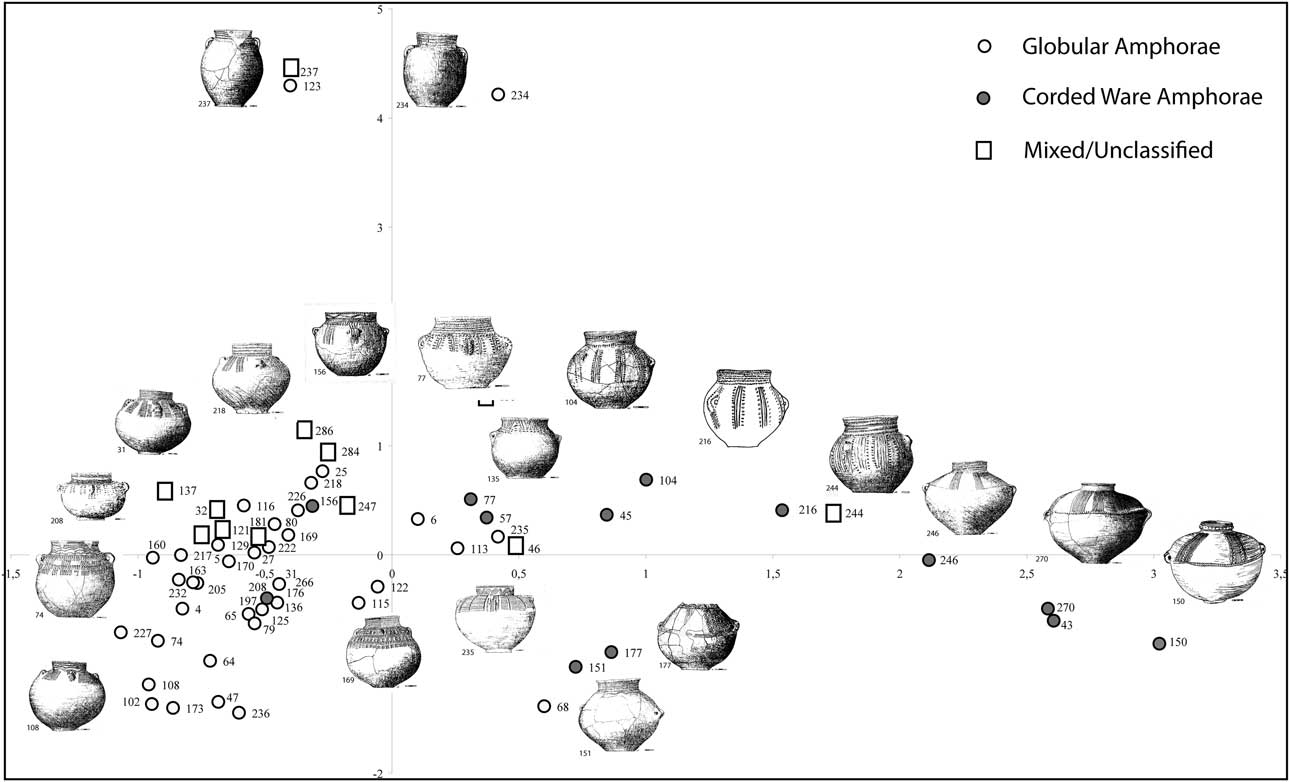
The model presented for Jutland suggests that one component of the A-Horizon – the A-Axe – was invented in that region. Regarding the second component, the A-Amphora, it is highly likely that this type of pottery originated elsewhere. Stylistically, A-Amphorae may be connected closely to Globular Amphorae, especially the eastern variants known from Poland (Beran Reference Beran1997). An illustration showing the closeness of the typological connection between Globular Amphorae and Corded Ware vessels, and revealing how artificial is their separation into two bounded ‘archaeological cultures’, is offered by the Złota-Group in south-eastern Poland (Krzak Reference Krzak1976). This group of graves is often referred to as a hybrid, or a mixed archaeological culture, as it exhibits a combination of pottery forms that are connected to the Funnel Beaker, Baden, Globular Amphorae, and Corded Ware ‘Cultures’. A typological analysis of the pottery types, especially the amphorae from the Złota-Cemeteries, clearly indicates that there is no formal boundary between the different variants of amphora (Furholt Reference Furholt2008a). Correspondence analysis (Fig. 5) showed that there is a continuum of traits and characteristics among the amphorae, even though those located at one end of the continuum would be classified as ‘Globular Amphorae’, while those at the other would be termed ‘Corded Ware’ amphorae. Considering the early absolute dating of the Złota graves to the early part of the ‘Corded Ware Culture’ around 2900–2600 bc, together with the generally close connections between the Globular and Corded Ware pottery types, it seems very likely that at least the Corded Ware Amphorae could be pinned down as a new form that evolved out of Globular Amphorae forms somewhere in Poland.
Correspondence analysis of amphorae from the Złota-graveyards reveals that there is no typological break between Globular Amphorae and Corded Ware Amphorae, including ‘Strichbündelamphorae’ (after Furholt 2008)
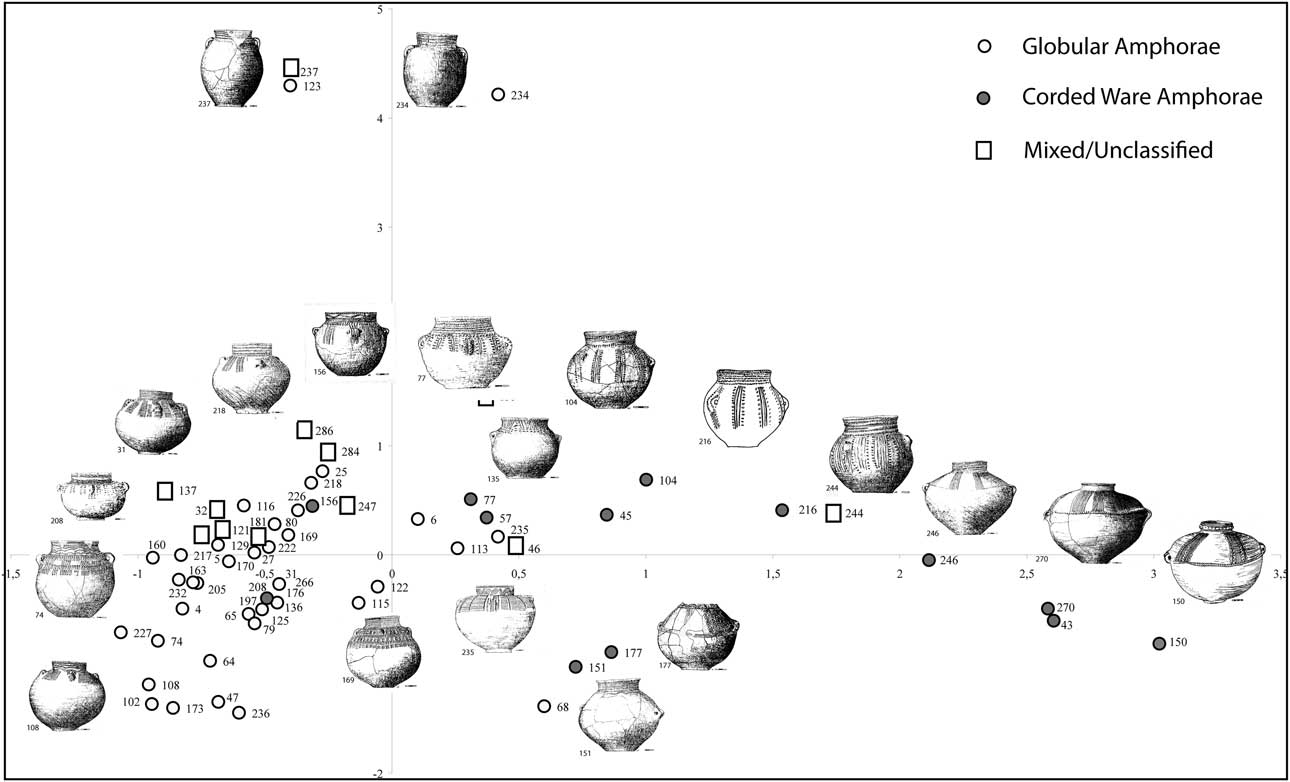
Thus, we have seen that at least two of the three main defining characteristics of the Corded Ware A-Horizon may have originated in different parts of Europe, the type A Battle Axe coming from Jutland, and the ‘A-Amphora’ (which is seldom in Jutland) from east-central Europe. Concerning the third component, the A-Beaker, Markus Ullrich (Reference Ullrich2008) was able to show that two variants of this ceramic type could actually be identified, both constituting an early horizon in the development of Corded Ware. Indeed, there is very marked variability in the shape and decoration of these early beakers, and it is also necessary to include herring-bone decorated beakers within the domain of this supposed A-Horizon. That said, the different variants of the early beakers do share some general features in common, such as the form of their profile (with variation residing in the body section proportions) and the position of the decoration (which covers the upper part, mostly not reaching below the shoulder). It is likely that the A-Beakers represent different local expressions of one basic idea. To judge from these findings, then, there is much value in retaining to the idea of an A-Horizon, but only if the horizon is carefully defined.
This A-Horizon is formed by a set of supra-regional elements embedded within material culture repertoires of local origin. We are not dealing with the dispersal of a ‘package’ of cultural traits that had formed in any one region; rather, elements originating in different regions were exchanged over what can be described as supra-regional networks, and together they formed a supra-regional set of traits.
This process may have taken several generations, in which ideas and norms that were already active at a supra-regional scale – such as rules governing the orientation of graves, the gender-specific positioning of the dead and the form of the funerary monument – were allowed to become ingrained in several local burial practices. At the same time, new pottery forms started to be used in the Late Neolithic settlements (Furholt Reference Furholt2008b).
Thus, the ‘A-Horizon’ is not the sudden beginning of a new era, but rather one point in a socio-ritual development that was initiated by changes in burial practices and a dramatic upturn in supra-regional exchange. At this point, these supra-regional networks had proved to be so effective that a set of symbols had become important in the interaction processes. These symbols were accepted and regularly used in the whole region, albeit at varying levels of intensity.
Uniformity Within ‘The Corded Ware Phenomenon’?
Uniformity, or the lack of it, is the next aspect crucial to the understanding of the Corded Ware phenomenon. One of the defining characteristics of this phenomenon is its supposed uniformity. However, this assumption is contradicted by the available archaeological evidence. As with our A-Horizon, there are elements of burial customs, pottery, and tool types that appear in several regions, but it is striking how those supra-regional elements have systematically been over-emphasised at the cost of regional variation. A rapid review of the material clearly makes this case.
The realm of funerary practices
Corded Ware funerary practices are frequently portrayed as being highly uniform, with the individual dead laid out in a west–east and east–west orientation, with a strict gender differentiation in which male individuals are laid on their right side, with their heads to the west and looking south, and female individuals are laid on their left side, with their heads to the east and also looking south. However, closer examination of the evidence reveals considerable regional variation and deviation from these supposedly strict norms. There are many collective graves in all the Corded Ware regional groups, and there is variability in grave pit form, in cist construction, in orientation and body position, and in the presence or absence of a covering barrow, with barrows being rare in the southern part of the ‘Corded Ware province’ (Buchvaldek Reference Buchvaldek1967) yet common in Denmark, the Netherlands, and northern Germany (Hübner Reference Hübner2005). Examples of this variability include the following:
-
• In southern Sweden the prevailing orientation of graves is north-east–south-west and south–north and, contrary to the supposed rule, male individuals are regularly deposited on their left, and females on their right side (Malmer Reference Malmer1962).
-
• On the Danish Isles and in north-eastern Germany the majority of finds from the Single Grave Period (that is, the regional variant of the Final Neolithic Corded Ware ‘Culture’) derive from megalithic graves. There are only a handful of real single graves from the typical barrows on the Danish Isles (Ebbesen Reference Ebbesen2006; Jacobs Reference Jacobs1991).
-
• In the Krakow area of Lesser Poland and in Moravia, north–south and north-east–south-west orientation prevails (Włodarczak Reference Włodarczak2006; Šebela Reference Šebela1999; Kolář Reference Kolář2011).
-
• In the Lubaczów-group of south-eastern Poland (Machnik Reference Machnik1966), in Kujawia (Czebreszuk Reference Czebreszuk1996) and Hesse, Germany (Wiermann Reference Wiermann2004), neither the dominance of west–east orientation nor a gender differentiation can be proven statistically.
-
• In the area of the Baltic States, the few Corded Ware graves that exist show neither a predominantly west–east orientation, nor gender differentiation (Kilian Reference Kilian1955, 64).
-
• In the southern German Tauber valley, there is no gender differentiation detectable in the orientation: west–east prevails, as do collective burials (Dornheim et al. Reference Dornheim, Lißner, Metzler, Müller, Ortolf, Sprenger, Stadelbacher, Strahm, Wolters and Wiermann2005).
-
• In Switzerland the almost total lack of graves is again to be interpreted as a deviation.
Such variability challenges the idea that strict Corded Ware funerary norms existed. There is overlap between some Corded Ware practices and those seen among the contemporary Yamnaya group (Harrison & Heyd Reference Harrison and Heyd2007), among the partly contemporary Bell Beaker users and among Early Bronze Age groups such as the Ún
 tice, Mierzanowice, and Nitra Groups, and also variability within and between those groups. There is no clear-cut correlation between these archaeological cultures and specific norms in funerary practices, and it seems more useful to speak of a Final Neolithic Burial Complex of practices that extends into the Early Bronze Age.
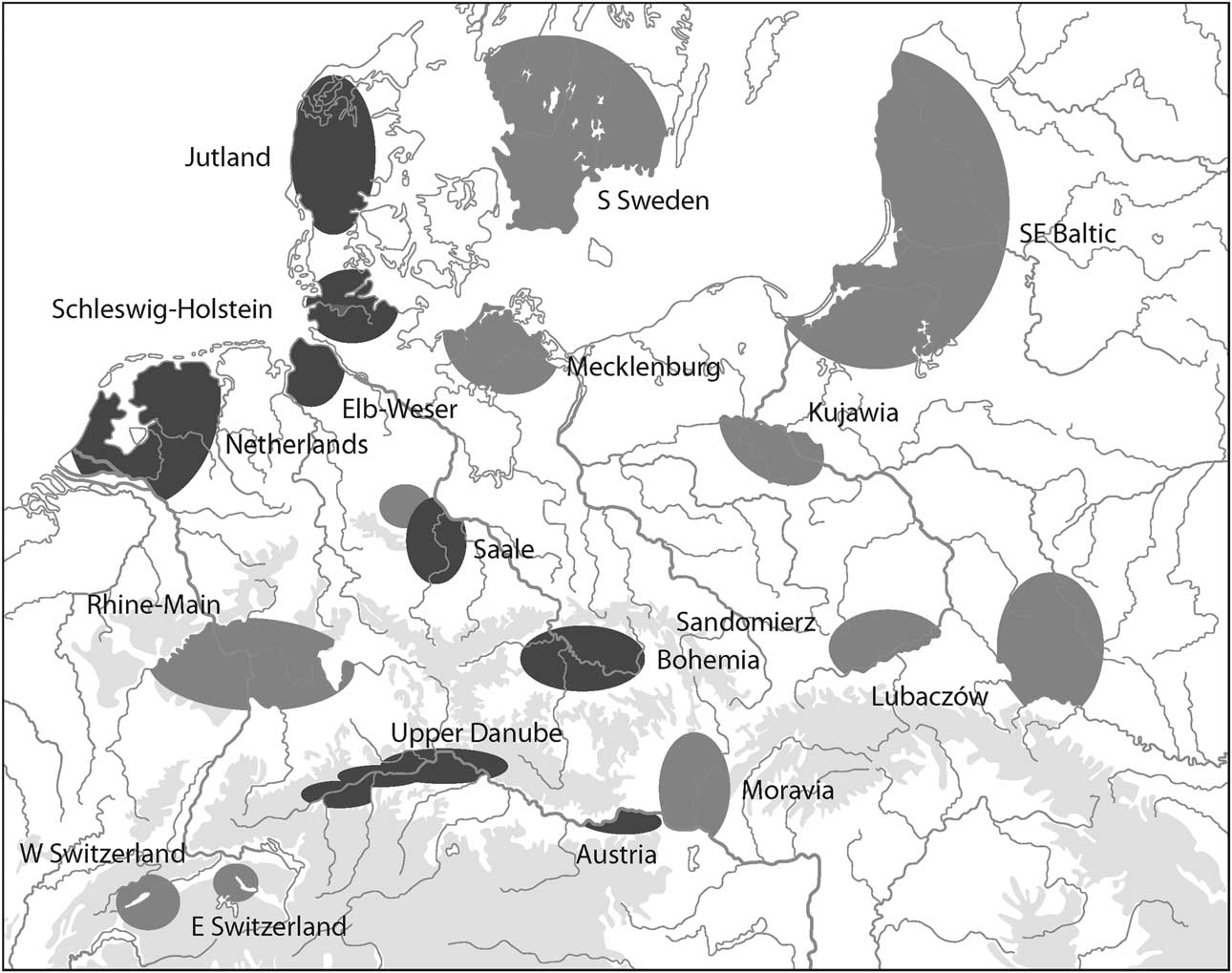
Nevertheless, there are regions where the ‘typical’ Corded Ware burial system was practised (Fig. 6). From a superficial review of the evidence one could argue for a territorial core, consisting of Bohemia, Austria, the Saale Region, the Upper Danube region in southern Germany, north-western Germany, the Netherlands, and Jutland. These areas constitute the western border of the Corded Ware area. Whittle (Reference Whittle1996) has cautiously proposed such a geographical grouping of ‘conventional’ Corded Ware practices.
Map of the Corded Ware regions discussed for central Europe. The dark shading indicates those regions where Corded Ware burial rituals are present regularly

Whittle's caution is justified, however, since such a view is misleading. First of all, it ignores the marked variability within that area, such as that noted above for the Hesse and Tauber valleys, or that of the Mansfeld Group in the Saale region (Dornheim et al. Reference Dornheim, Lißner, Metzler, Müller, Ortolf, Sprenger, Stadelbacher, Strahm, Wolters and Wiermann2005), meaning that there is no real ‘territorial’ core of the Corded Ware burial complex.
Second, in order to highlight homogeneity, the traditional view has artificially isolated these mortuary traditions from an entire spectrum of similar mortuary practices, some contemporary with Corded Ware and some later, associated with the Bell Beaker and Early Bronze Age groups. It seems much more convincing to see Corded Ware mortuary practices as part of a larger continuum that characterises the Final Neolithic Burial Complex, since they all highlight the individual, maintain specific rules of orientation and share features such as the flexed position of the corpse and the deposition of drinking vessels, weapons, and other specific types of object as grave goods (Strahm Reference Strahm2002; Harding Reference Harding2000).
In addition, even if we were to define the western Corded Ware regions, from Bohemia to Jutland, as the core area of Corded Ware burial customs, this grouping would not be matched by any patterning in material culture, as will be shown below.
Material culture
As with funerary practices, the claimed homogeneity of artefact types in Corded Ware burials and settlements does not stand up to close scrutiny. This strongly suggests that the Corded Ware ‘Culture’ is not a uniform cultural phenomenon, but a highly variable one. A considerable degree of regional and chronological variability can be seen not only in relatively rare artefact types, such as those made from copper or amber, but also among more common types that are abundant in Corded Ware settlements and graves, such as axeheads, flint artefacts, and various kinds of pottery (including amphorae, handled cups, straight-walled vessels, and globular vessels). Amber ornaments show a clear concentration in the northern Corded Ware regions (Hübner Reference Hübner2005; Loze Reference Loze2003), while copper plays a similar role in the south (Krause Reference Krause2003). Flint axeheads are only abundant in those regions, concentrating in the north, where they had previously played an important role (Brandt, Reference Brandt1967; Hübner Reference Hübner2005). A distinct pottery type present in several regions is the straight-walled beaker: examples are frequently found in the single graves of the Jutland Peninsula (Hübner Reference Hübner2005) and in Kujawian Corded Ware (Czebreszuk Reference Czebreszuk1996), and less frequently in Corded Ware graves of the Saale region (Fischer Reference Fischer1958) One could also mention globular bowls, distributed mainly in the eastern Baltic (Edgren Reference Edgren1970) and southern Sweden (Malmer Reference Malmer1962). These vessel types do show supra-regional distribution patterns, but they are clearly not coherent with respect to ‘Corded Ware’ or to each other.
The diversity in early A-Beakers has already been pointed out; the distribution of A-Amphorae is similarly far from being even. Miroslav Buchvaldek published a map showing the distribution of all A-Amphorae (Buchvaldek Reference Buchvaldek1986, fig. 1). In contrast to what he wanted to demonstrate, however, the map clearly shows that although A-Amphorae are present over vast areas of Europe, from Latvia to Switzerland and from Lesser Poland to the Netherlands, the frequency at which A-Amphorae are encountered varies greatly between regions. It is only in some areas, most notably Bohemia, central Germany, and Switzerland, that these amphorae are found in great numbers. Instead, in most regions with Corded Ware, A-Amphorae are represented by only a few of vessels, and sometimes just single finds.
There are also marked regional differences in the distribution of battle axes. Facetted types are concentrated in the southern regional groups, while A-Axes are mostly found in the north; there is considerable variability in battle-axe types in Jutland, while ‘Boat-shaped Axes’ occur in north-easterly regions (Zápotocký Reference Zápotocký1992; Ebbesen Reference Ebbesen1997; 2006).
Systematic comparisons
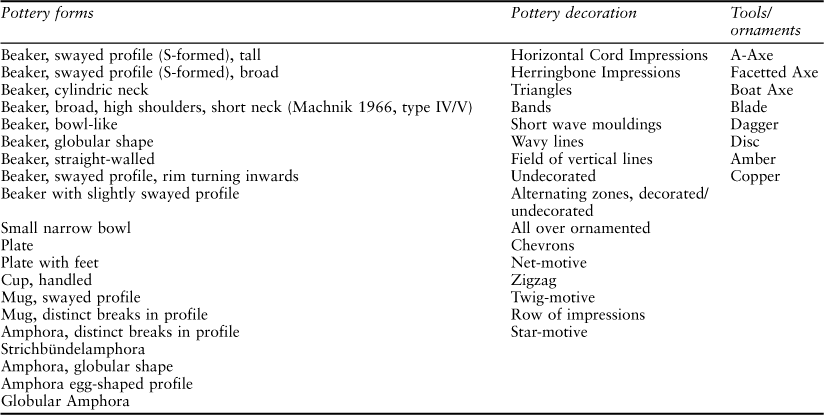
The qualitative observations regarding variability in Corded Ware funerary practices and material culture presented above are further supported by quantitative analysis (Furholt Reference Furholt2011, 256–62). To this end, a list of artefacts and traits was constructed as a base for a statistical approach to similarities in material culture (Table 1). This trait list covers those pottery forms and decorative characteristics that are present in more than one region, along with the commonest tool types, weapons, and ornaments. Thus it accounts for those elements which are commonly used to argue for a uniform Corded Ware ‘culture’. The assumption underlying this traditional characterisation of the ‘Corded Ware Culture’ is that if numerous similar traits and artefacts are found in several or all of the Corded Ware regional groups, then this cannot be explained in any other way than by the sharing of traditions and practices, and more specifically by the sharing of a common ethnic and/or ideological or religious identity (Buchvaldek Reference Buchvaldek1986; Strahm Reference Strahm2002). The problem with this argument is that there has never been a thorough investigation into whether or not the types and traits listed do really display such uniformity. The presence of a single artefact resembling one known from another region might be due to coincidence, or it might reflect a casual or isolated event of exchange. If, however, we want to argue about shared practices or shared traditions that could be interpreted as an indication of the expression of identities, we need to take a quantitative approach. If identities are formed by practice then, from an etic perspective, the quantity and scale of shared practices – for which similarities in material culture production and in their integration into burial rituals are seen as a proxy – is the kind of evidence to look at, not the mere presence or absence of single traits or artefacts.
list of corded ware elements used for a quantifying comparison of similarity and diversity between the corded ware regional groups
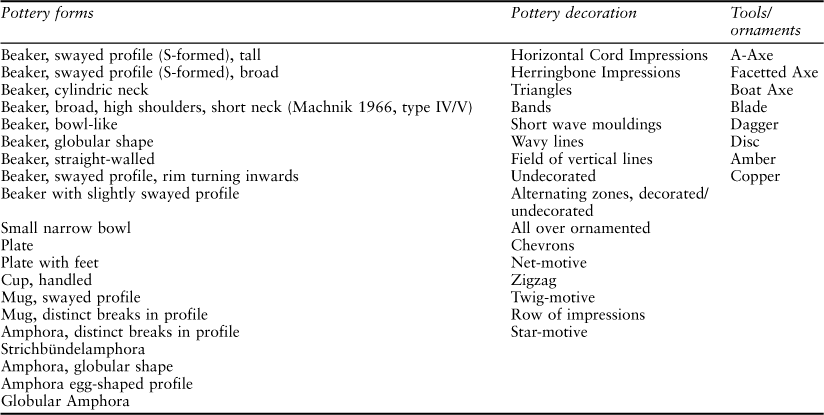
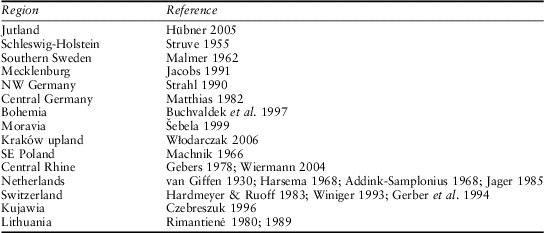
While constructing a list of artefacts and traits is a subjective exercise, it is an unavoidable heuristic operation that makes it possible to interrogate existing ideas about cultural homogeneity (as expressed, for example, by Buchvaldek Reference Buchvaldek1986; Buchvaldek & Strahm Reference Buchvaldek and Strahm1992; Beran Reference Beran1997; Reference Beran2000; Strahm Reference Strahm2002; 2010) in a systematic, quantitative manner. To compile the database, it was necessary to use the existing catalogues relating to the different regional groups (see Table 2). While these catalogues are of course biased selections of finds, they are still currently the best source available for large-scale quantitative investigations, especially since the central European research tradition has been focused on a detailed and representative display of the empirical base.
list of published archaeological catalogues forming the basis for the analysis shown in Figure 7

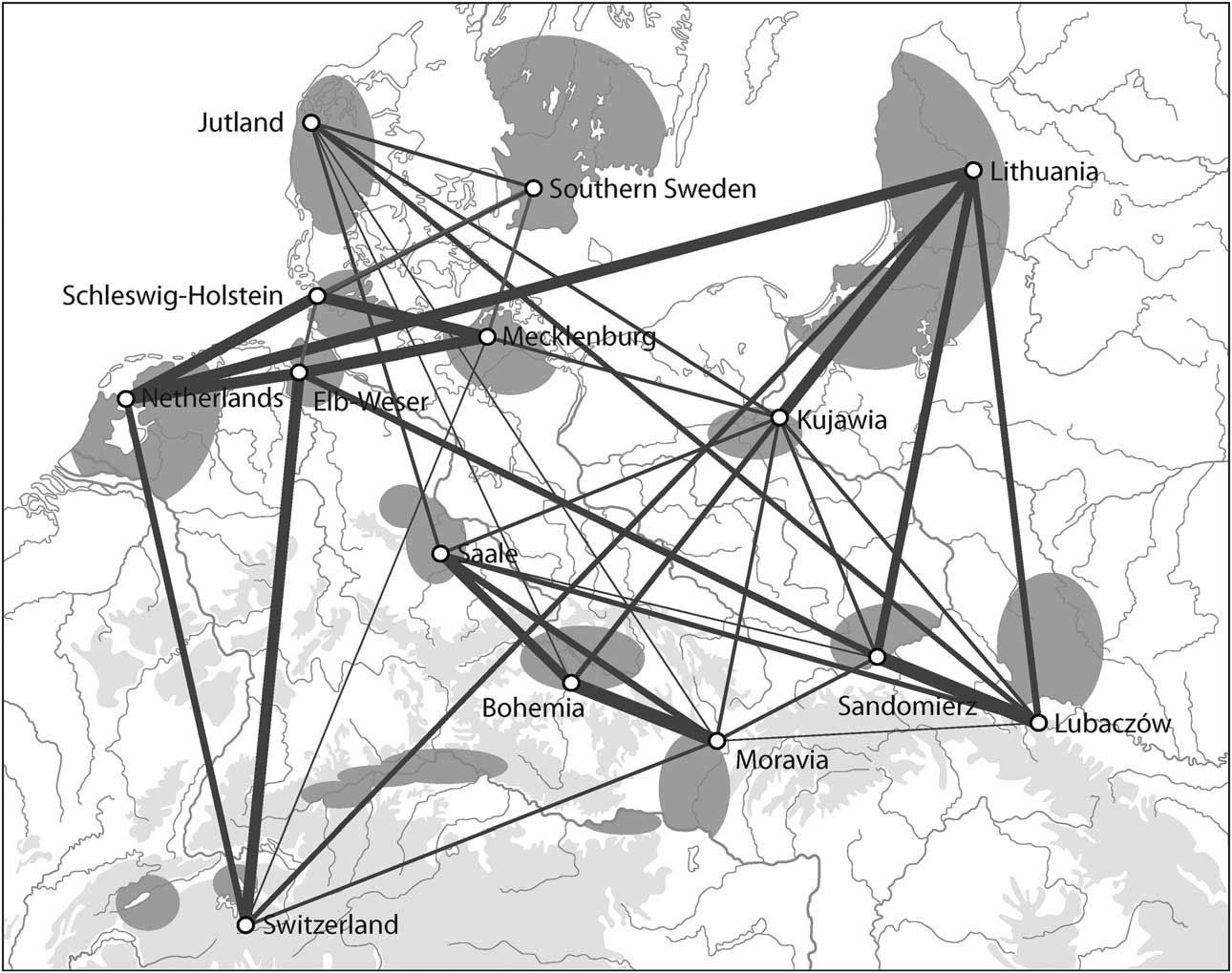
To make a quantitative assessment of the finds and traits, their incidence in each region was counted and the resulting lists normalised. Similarities between the regions were then calculated using correspondence analysis (Furholt Reference Furholt2011, 258f.). These analyses produced measures of similarity that were used for a network analysis. According to a polythetic classification, such values were calculated separately for pottery forms, pottery decoration types, tools, and jewellery (see Table 1), forming separate, independent similarity data sets. The network analysis was applied to all these data sets. As Figure 7 shows, the resulting network model accounts for the supra-regional scope of the ‘Corded Ware phenomenon’, but the differences in line thickness, representing the correlation of similarity values between the regional units, and in the frequency of connections, clearly indicate that there are significant structures on a smaller scale. Within the overall network, there are more intense regional and inter-regional interconnections (or ‘sub-networks’), as in the case of the Saale region, Bohemia and Moravia, or the Netherlands, and northern Germany (Schleswig-Holstein, the Elbe-Weser region, and Mecklenburg). Another example of a regional sub-network would be Kujawia and the Baltic (represented by Lithuania). However, these sub-networks, defined on the basis of similarities in material culture, do not correspond with the patterning seen in funerary practices. As noted above, the latter show a possible ‘core area’ that includes the Netherlands, northern Germany, central and southern Germany, and Bohemia, but clearly excludes other regions such as Moravia. Similarly, in funerary practices the north German Province of Schleswig-Holstein and the Netherlands seem very close to Jutland but, when material culture is considered, Jutland is clearly separated from northern Germany and the Netherlands. It should also be noted that different patterns of regional variability can also be discerned in settlement systems and economy (Dörfler & Müller Reference Dörfler and Müller2008), although space precludes a detailed discussion of this.
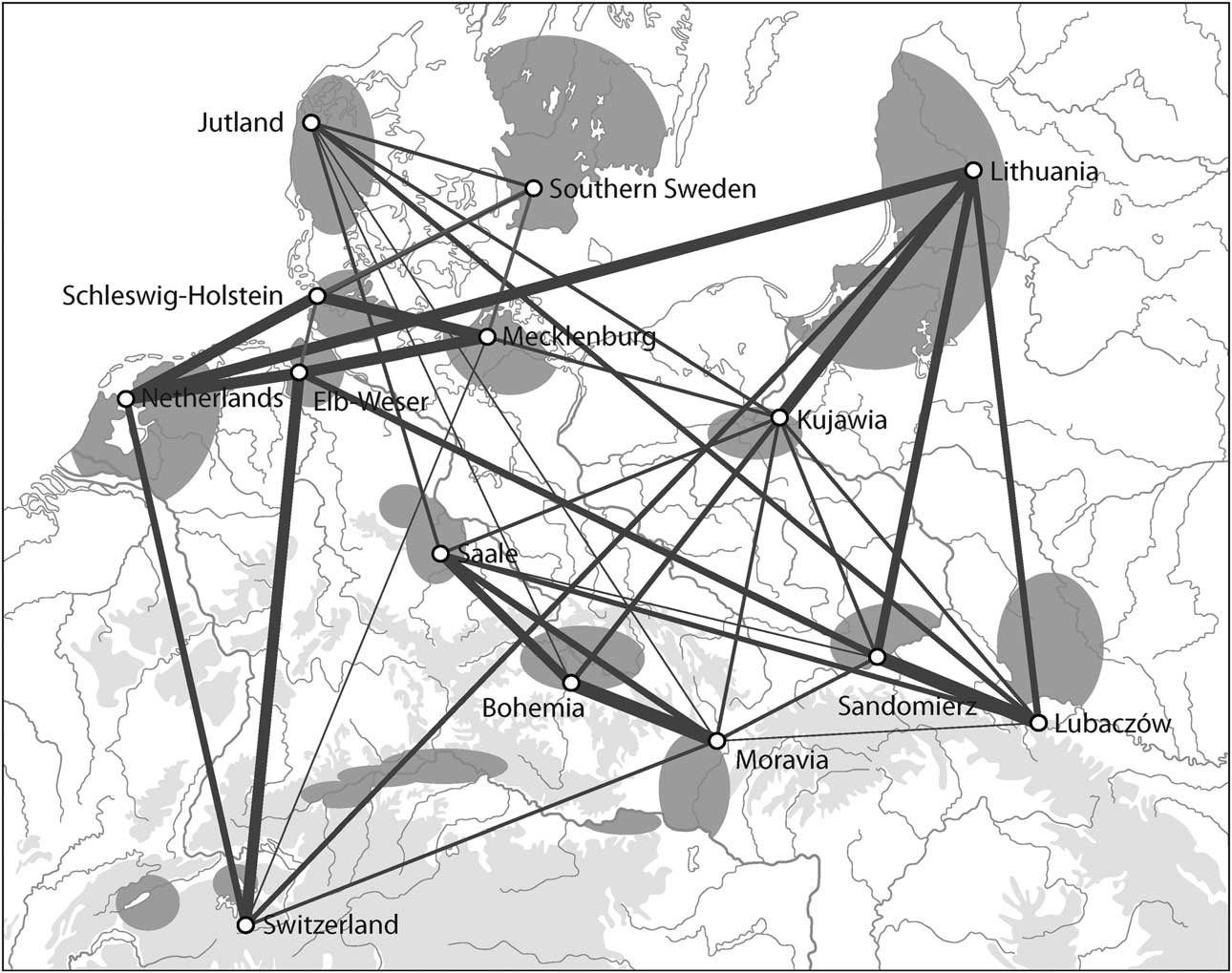
All these observations demonstrate that the dynamics of variability in funerary practice, material culture and other traits across ‘Corded ware regions’ were complex. In addition to the various patterns of regional variability that can be discerned, there was presumably also chronological variability.
Discussion
If we take similarities in burial practices and material culture as indicators of the existence of prehistoric networks, then several such networks can be discerned, relating to different aspects of social practice. These overlap and vary in geographical extent and intensity.
What we call ‘Corded Ware’ may very well reflect an overall set of ideas, but it appears differently in different regions: its defining characteristics are present in varying frequencies, with some being absent from, or rare in, certain regions. So, even if we were to suppose that these different components (ie, the artefact types listed in Table 1, plus the various aspects of the burial rites) reflected clearly defined and unchanging symbols – a rather simplistic thought – then those ideas would be represented in different intensities and would appear in varying contexts. Thus it would be misleading to speak about ‘the Corded Ware phenomenon’ as a totality, when it comes to interpretation. It seems more appropriate to think of the Corded Ware elements as symbols that were exchanged through several supra-regional networks without assuming that they had the same meaning and significance to all people involved. Meanings are constantly recreated in social practice. So when a vessel is transferred from one region to another, such a sign would be adjusted. It would be misunderstood, reinterpreted, and integrated into the local sign system. Thus when comparing Corded Ware traits in different regions, we have to acknowledge that these vessels and weapons as symbols were integrated in clearly diverse ways, and they were altered and transformed within local contexts.
So what the Corded Ware elements meant in one region might have been very different from what they meant in another. Such a view is, in the author's opinion, also much more in line with the archaeological evidence than are those totalitarian explanations referred to earlier, especially as there are contemporary archaeological ‘cultures’ that overlap Corded Ware with regard to many of the elements mentioned, be it the ‘Yamnaya Culture’, the ‘Globular Amphorae Culture’, or the ‘Beaker Cultures’ (Harrison & Heyd Reference Harrison and Heyd2007).
That being said, it is, on the other hand, not unrealistic to acknowledge that after 3000 bc there were certain general developments in the central, eastern and western European societies that furthered the display of some overall ideas, that could be summarised as individuality, marked gender differences, potential to physical violence (weapons), and rituals of bonding involving alcohol consumption (beakers and amphorae, drinking and serving vessels). This is not restricted to Corded Ware graves, but several of the elements can also be identified within other archaeological units at that time (Harrison & Heyd Reference Harrison and Heyd2007). To what degree such ideas really affected those societies adopting some or all elements of the (archaeologically defined) Corded Ware set, is again unclear, and it might be, that the values mentioned were totally transformed, changed, or lost and gave way to a purely habitual use of the vessels, axes, and ornaments, as it might be the case in the Swiss lakeside settlements, that know no Corded Ware burial rituals.
While widening networks and a change in the mechanism of exchange appears to have contributed to the emergence of the Corded Ware archaeological phenomenon, and also the contemporaneous Yamnaya graves (Harrison & Heyd Reference Harrison and Heyd2007) and the following Bell Beaker and Early Bronze Age phenomena, it remains to be seen exactly what factors contributed to the development of these systems. It may be that there were changes in subsistence practices, perhaps involving a rising importance of animal herding that subsequently required higher mobility (for a discussion see Dörfler & Müller Reference Dörfler and Müller2008), but considering the obvious diversity in subsistence patterns present in different Corded Ware groups, such an explanation would seem appropriate for the transformation in some regions, but surely not for the eastern hunter-fisher-gatherer groups of the Baltic (Bläuer & Kantanen Reference Bläuer and Kantanen2013). Also, trade with amber and copper might have played its role, but there are so far no indications for a significant rise in quantity or reach of these two materials in connection with Corded Ware graves or settlements (Furholt Reference Furholt2003, 125–7). The impacts of animal traction and the wagon are also to be taken into account, as they are present since 3400 bc (Mischka Reference Mischka2011) but does at least not play any visible role in Corded Ware burial rituals, very much in contrast to the previous periods (Johannsen & Laursen Reference Johannsen and Laursen2010). There is no evidence for horse riding, but the domesticated horse seems to be present in central Europe since before 3000 bc (Becker Reference Becker1999) and have also been found in Corded Ware settlements (Becker Reference Becker2008), but again the evidence of domesticated horses is much more abundant in the period before 3000 bc.
So, concerning amber and copper exchange, or the impact of the wheel and animal traction, there is the recurrent motive of stronger evidence for the period before 3000 bc than during or in connection to Corded Ware finds after 2700 bc.
But also out of general considerations it makes no sense to try to find a single explanation for the spread of the elements referred to as Corded Ware phenomenon. It has been argued above that they are clearly unevenly spread and show a considerable regional variability, concerning presence or absence of traits, or their quantitative representation. So, while treating the pottery and weapon forms as well as burial ritual characteristics as a totality with respect to classification of the archaeological material may have some heuristic value, pulling this notion of totality onto the level of interpretation is surely misleading. There is no anthropological model that would support such a claim, except crude concepts about ethnicity and mass migration of uniform social units. But even those concepts do not fit with the diversity of the archaeological record, or the evidence of a multidirectional creation of the types of the A-Horizon.
Conclusion
In this article, the main aim was to challenge the picture of a uniform ‘Corded Ware’ and the connected idea of ‘the Corded Ware’ as a social totality. Regarding the archaeological material, I emphasized the internal temporal and spatial variation of the Corded Ware phenomena, material culture, and burial practices. The evidence strongly points towards a long period of coalescence from 3000 to 2700 bc, when several innovations in burial customs, pottery, and tool types sprung forth from different places and subsequently spread via different networks of exchange and interaction. These surely showed a significant rise in scale, reach, and impact on local practices, but the same is true for the contemporary Globular Amphora and Yamnaya ‘Cultures’. This exchange resulted, roughly spoken, in a phenomenon like the A-Horizon. The latter however, bears a misleading name, as it under-values the considerable variation in the distribution of the items subsumed under it. This A-Horizon means that certain items are widely – but unevenly – integrated into local burial customs and produced in settlement contexts, and this author sees no reason to construct any uniform social group responsible for that spread. In the same way, it seems very probable that the objects connected to the Corded Ware A-Horizon function as symbols for certain ideas that gain importance after 3000 bc, but again, it seems unrealistic to postulate the presence of one overall, uniform ideology (cf. Strahm Reference Strahm2010). The set of new ideas breaking through after 3000 bc should be seen as interconnected, but still changing and variable. It seems unrealistic to believe that a group of people at the Lake Constance that start to produce Corded Ware pottery in their settlements, and obviously continue their (archaeologically invisible) burial practices, would identify that symbol with the same ideas as the groups in the Jutland Peninsula who integrate that vessel type into their gender-differentiated single graves. In the contrary, the variation in forms, the differences in the scale of usage of the different types in different regions, and the connection to a considerable variety of burial customs, suggest that the ideologies in which these things and rituals played their part should also be seen as variable and mutable. This non-uniform shape and distribution of practices and symbols is to be understood as a result of historical developments, where multiple agencies are to be seen as simultaneous and interacting with the structural settings that are commonly over-emphasised when talking about ‘the Corded Ware’. It is conceivable that the display of the individual, gender differences, weapons, and drinking vessels is connected to powerful ideological trends, but it seems naïve to think of one explicit ideological block that would be imposed on all social groups in central and eastern Europe in the same way. It seems unrealistic to think that the integration of signs into local contexts would result in the same systems of meaning in Finnish and Baltic forest hunter-gatherer (or maybe early food producing) societies, in Swiss lakeside dwellers or with southern Scandinavian megalith-users.
The most significant novelty in the time after 2900 bc, or the formation of the ‘Corded Ware’ phenomenon, is the fact that the practices and symbols in question are so widely exchanged and integrated into the local habits and discourses, less than it would be their concrete contents – which are, as repeatedly stressed, to be thought of as quite variable. Obviously there is a change in the structure of networks, showing first a significant widening of scales, connecting formerly distant regions, and secondly the widespread willingness to integrate those new practices and symbols. On a scale beyond this supra-regional network there are regional coherences in the way the practices and symbols are concretely performed, and as argued above, these could be interpreted as expressions of identities on a regional level, but these do in their scale and shape not fundamentally differ from the regional settings of the period before 3000 bc.
Thus, it seems reasonable to explain the wide regional reach of those Corded Ware elements as the result of a general increase in mobility and thus an increase in the spatial extension of regional networks, triggered by the long-term effects of technological innovations and connected economic and social transformations in Europe since 3400 bc. It is the increase in mobility and regional networks that is new to the European Neolithic Societies after this time, and it is not only the Corded Ware elements, that are spread through these channels but also Yamnaya, Globular Amphorae, Bell Beaker ‘Cultures’, and copper and bronze artefacts in later periods. Those are archaeological classification units, heuristic tools for the ordering of finds, while brushing over variability and overlapping traits, and so they should not be confused with real social groups.
Acknowledgment
I want to thank Cheryl Makarewicz for her useful comments and English correction. All faults remain my responsibility.