
 α



%20--%3e%3c!DOCTYPE%20svg%20PUBLIC%20'-//W3C//DTD%20SVG%201.0//EN'%20'http://www.w3.org/TR/2001/REC-SVG-20010904/DTD/svg10.dtd'%3e%3csvg%20version='1.0'%20id='Layer_1'%20xmlns='http://www.w3.org/2000/svg'%20xmlns:xlink='http://www.w3.org/1999/xlink'%20x='0px'%20y='0px'%20width='64px'%20height='64px'%20viewBox='5.5%20-3.5%2064%2064'%20enable-background='new%205.5%20-3.5%2064%2064'%20xml:space='preserve'%3e%3cg%3e%3ccircle%20fill='%23FFFFFF'%20fill-opacity='0'%20cx='37.785'%20cy='28.501'%20r='28.836'/%3e%3cpath%20fill='%23595959'%20d='M37.441-3.5c8.951,0,16.572,3.125,22.857,9.372c3.008,3.009,5.295,6.448,6.857,10.314%20c1.561,3.867,2.344,7.971,2.344,12.314c0,4.381-0.773,8.486-2.314,12.313c-1.543,3.828-3.82,7.21-6.828,10.143%20c-3.123,3.085-6.666,5.448-10.629,7.086c-3.961,1.638-8.057,2.457-12.285,2.457s-8.276-0.808-12.143-2.429%20c-3.866-1.618-7.333-3.961-10.4-7.027c-3.067-3.066-5.4-6.524-7-10.372S5.5,32.767,5.5,28.5c0-4.229,0.809-8.295,2.428-12.2%20c1.619-3.905,3.972-7.4,7.057-10.486C21.08-0.394,28.565-3.5,37.441-3.5z%20M37.557,2.272c-7.314,0-13.467,2.553-18.458,7.657%20c-2.515,2.553-4.448,5.419-5.8,8.6c-1.354,3.181-2.029,6.505-2.029,9.972c0,3.429,0.675,6.734,2.029,9.913%20c1.353,3.183,3.285,6.021,5.8,8.516c2.514,2.496,5.351,4.399,8.515,5.715c3.161,1.314,6.476,1.971,9.943,1.971%20c3.428,0,6.75-0.665,9.973-1.999c3.219-1.335,6.121-3.257,8.713-5.771c4.99-4.876,7.484-10.99,7.484-18.344%20c0-3.543-0.648-6.895-1.943-10.057c-1.293-3.162-3.18-5.98-5.654-8.458C50.984,4.844,44.795,2.272,37.557,2.272z%20M37.156,23.187%20l-4.287,2.229c-0.458-0.951-1.019-1.619-1.685-2c-0.667-0.38-1.286-0.571-1.858-0.571c-2.856,0-4.286,1.885-4.286,5.657%20c0,1.714,0.362,3.084,1.085,4.113c0.724,1.029,1.791,1.544,3.201,1.544c1.867,0,3.181-0.915,3.944-2.743l3.942,2%20c-0.838,1.563-2,2.791-3.486,3.686c-1.484,0.896-3.123,1.343-4.914,1.343c-2.857,0-5.163-0.875-6.915-2.629%20c-1.752-1.752-2.628-4.19-2.628-7.313c0-3.048,0.886-5.466,2.657-7.257c1.771-1.79,4.009-2.686,6.715-2.686%20C32.604,18.558,35.441,20.101,37.156,23.187z%20M55.613,23.187l-4.229,2.229c-0.457-0.951-1.02-1.619-1.686-2%20c-0.668-0.38-1.307-0.571-1.914-0.571c-2.857,0-4.287,1.885-4.287,5.657c0,1.714,0.363,3.084,1.086,4.113%20c0.723,1.029,1.789,1.544,3.201,1.544c1.865,0,3.18-0.915,3.941-2.743l4,2c-0.875,1.563-2.057,2.791-3.541,3.686%20c-1.486,0.896-3.105,1.343-4.857,1.343c-2.896,0-5.209-0.875-6.941-2.629c-1.736-1.752-2.602-4.19-2.602-7.313%20c0-3.048,0.885-5.466,2.658-7.257c1.77-1.79,4.008-2.686,6.713-2.686C51.117,18.558,53.938,20.101,55.613,23.187z'/%3e%3c/g%3e%3c/svg%3e)
%20--%3e%3c!DOCTYPE%20svg%20PUBLIC%20'-//W3C//DTD%20SVG%201.0//EN'%20'http://www.w3.org/TR/2001/REC-SVG-20010904/DTD/svg10.dtd'%3e%3csvg%20version='1.0'%20id='Layer_1'%20xmlns='http://www.w3.org/2000/svg'%20xmlns:xlink='http://www.w3.org/1999/xlink'%20x='0px'%20y='0px'%20width='64px'%20height='64px'%20viewBox='5.5%20-3.5%2064%2064'%20enable-background='new%205.5%20-3.5%2064%2064'%20xml:space='preserve'%3e%3cg%3e%3ccircle%20fill='%23FFFFFF'%20fill-opacity='0'%20cx='37.637'%20cy='28.806'%20r='28.276'/%3e%3cg%3e%3cpath%20fill='%23595959'%20d='M37.443-3.5c8.988,0,16.57,3.085,22.742,9.257C66.393,11.967,69.5,19.548,69.5,28.5c0,8.991-3.049,16.476-9.145,22.456%20C53.879,57.319,46.242,60.5,37.443,60.5c-8.649,0-16.153-3.144-22.514-9.43C8.644,44.784,5.5,37.262,5.5,28.5%20c0-8.761,3.144-16.342,9.429-22.742C21.101-0.415,28.604-3.5,37.443-3.5z%20M37.557,2.272c-7.276,0-13.428,2.553-18.457,7.657%20c-5.22,5.334-7.829,11.525-7.829,18.572c0,7.086,2.59,13.22,7.77,18.398c5.181,5.182,11.352,7.771,18.514,7.771%20c7.123,0,13.334-2.607,18.629-7.828c5.029-4.838,7.543-10.952,7.543-18.343c0-7.276-2.553-13.465-7.656-18.571%20C50.967,4.824,44.795,2.272,37.557,2.272z%20M46.129,20.557v13.085h-3.656v15.542h-9.944V33.643h-3.656V20.557%20c0-0.572,0.2-1.057,0.599-1.457c0.401-0.399,0.887-0.6,1.457-0.6h13.144c0.533,0,1.01,0.2,1.428,0.6%20C45.918,19.5,46.129,19.986,46.129,20.557z%20M33.042,12.329c0-3.008,1.485-4.514,4.458-4.514s4.457,1.504,4.457,4.514%20c0,2.971-1.486,4.457-4.457,4.457S33.042,15.3,33.042,12.329z'/%3e%3c/g%3e%3c/g%3e%3c/svg%3e)
1. NGC 346 and metal-poor massive stars
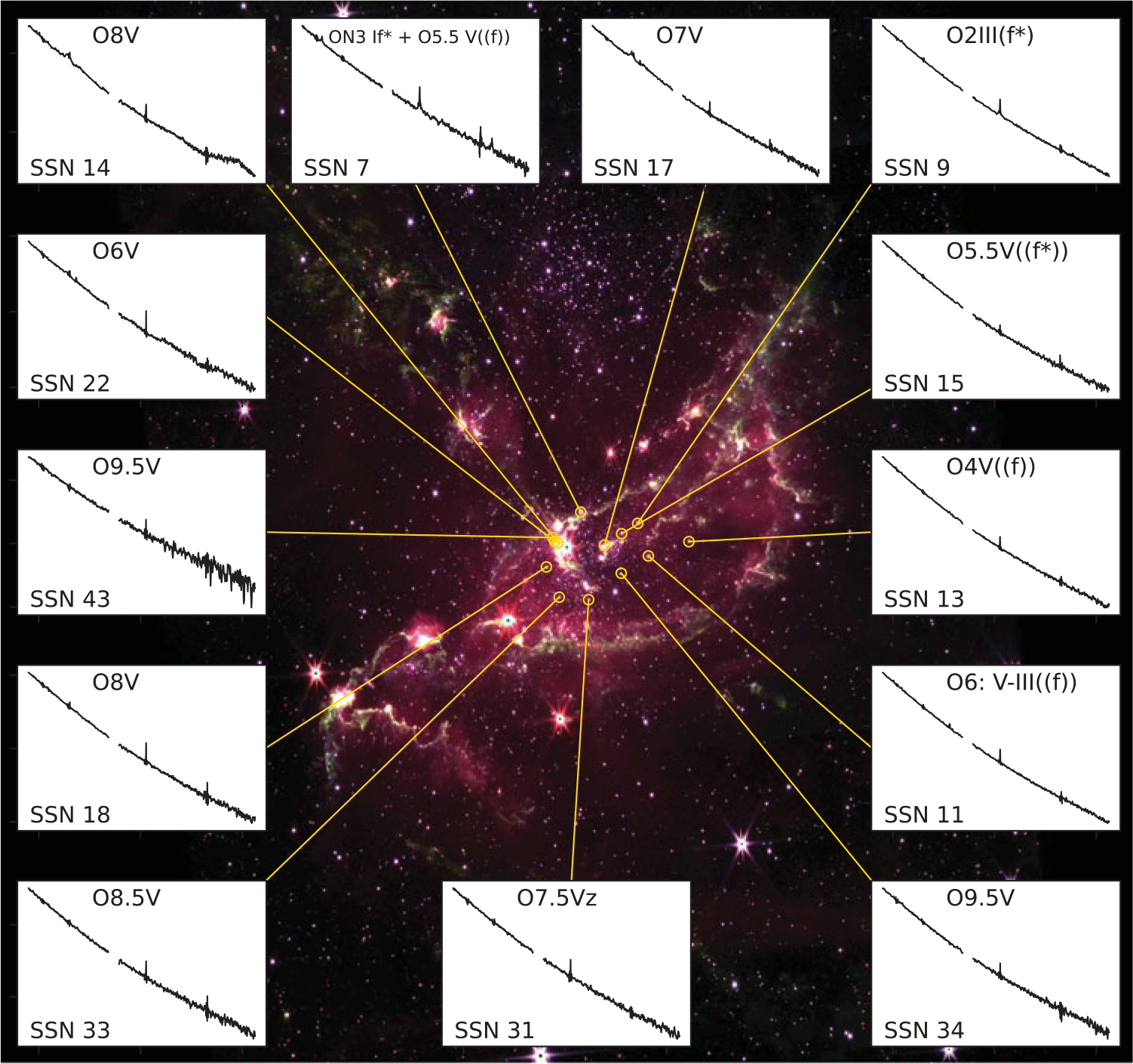
The open cluster NGC 346 (Fig. 1) is the most massive star cluster in the Small Magellanic Cloud (SMC), with a metallicity 5-7 times lower than the Milky Way (Dufour et al. Reference Dufour, Shields and Talbot1982; Larsen et al. Reference Larsen, Clausen and Storm2000; Trundle et al. Reference Trundle, Dufton and Hunter2007). For this reason, it makes a perfect laboratory to study the properties of massive stars at low metallicity. Its O-star population has been previously studied by Rickard et al. (Reference Rickard, Hainich and Hamann2022), but the weakness of the wind diagnostics in the UV and optical resulted in only upper limits for the fainter targets. We aim to complement this study with unprecedented JWST/NIRSpec observations. In this work, we present the first infrared spectroscopic observations of some of its O-stars. We describe the observations and data reduction in Sect. 2, while in Sect. 3 we show the observations of the Br
 $\alpha$
line of our sample and describe its nature as a mass-loss diagnostic. Afterward, we present the results of a first comparison with stellar atmosphere models (Sect. 4). Finally, we discuss what the future looks like regarding massive stars and infrared spectroscopy (Sect. 5).
NIRCam image of NGC 346 with the NIRSpec spectra observed for this work as described in Mang Román et al. (Reference Mang Román, Zeidler and Hamann2025).

2. Observations and data reduction
The data was obtained with the NIRSpec spectrograph (Böker et al. Reference Böker, Beck and Birkmann2023) using the S200A1 slit, the high-resolution grating G395H, and the F290LP filter. This configuration enables a wavelength coverage between 2.8 and 5.1
 $\mu$
m and a resolution of
 $R \sim 2700$
. The data reduction was performed to remove cosmic rays and detector artifacts. However, the critical part for these observations was the background subtraction. As seen in Fig. 1, the targets are embedded in a dense H ii region, resulting in a strong contamination around the lines of interest. As described in Mang Román et al. (Reference Mang Román, Zeidler and Hamann2025), for some of the targets, the background subtraction was performed manually by extracting the nebular signal from the 2D spectrum. The reduced spectra can be seen in Fig. 1.
3. Br
 $\alpha$
: theory and observations

The Br
 $\alpha$
line at 4.05
 $\mu$
m was predicted to be in emission even for hydrostatic atmospheres due to a non-LTE effect (Auer & Mihalas Reference Auer and Mihalas1969). More recently, Najarro et al. (Reference Najarro, Hanson and Puls2011) showed, using the non-LTE stellar atmosphere code CMFGEN (Hillier & Miller Reference Hillier and Miller1998), that the emission core of the line is sensitive to the mass-loss rate,
 $\dot{M}$
. They found that the emission core reacts inversely to the value of
 $\dot{M}$
, making it a very powerful tool to determine weak winds. The authors were able to apply this line to measure
 $\dot{M}$
in a sample of Galactic O-stars. However, until the arrival of JWST, this was impossible for targets in the Magellanic Clouds. The observed Br
 $\alpha$
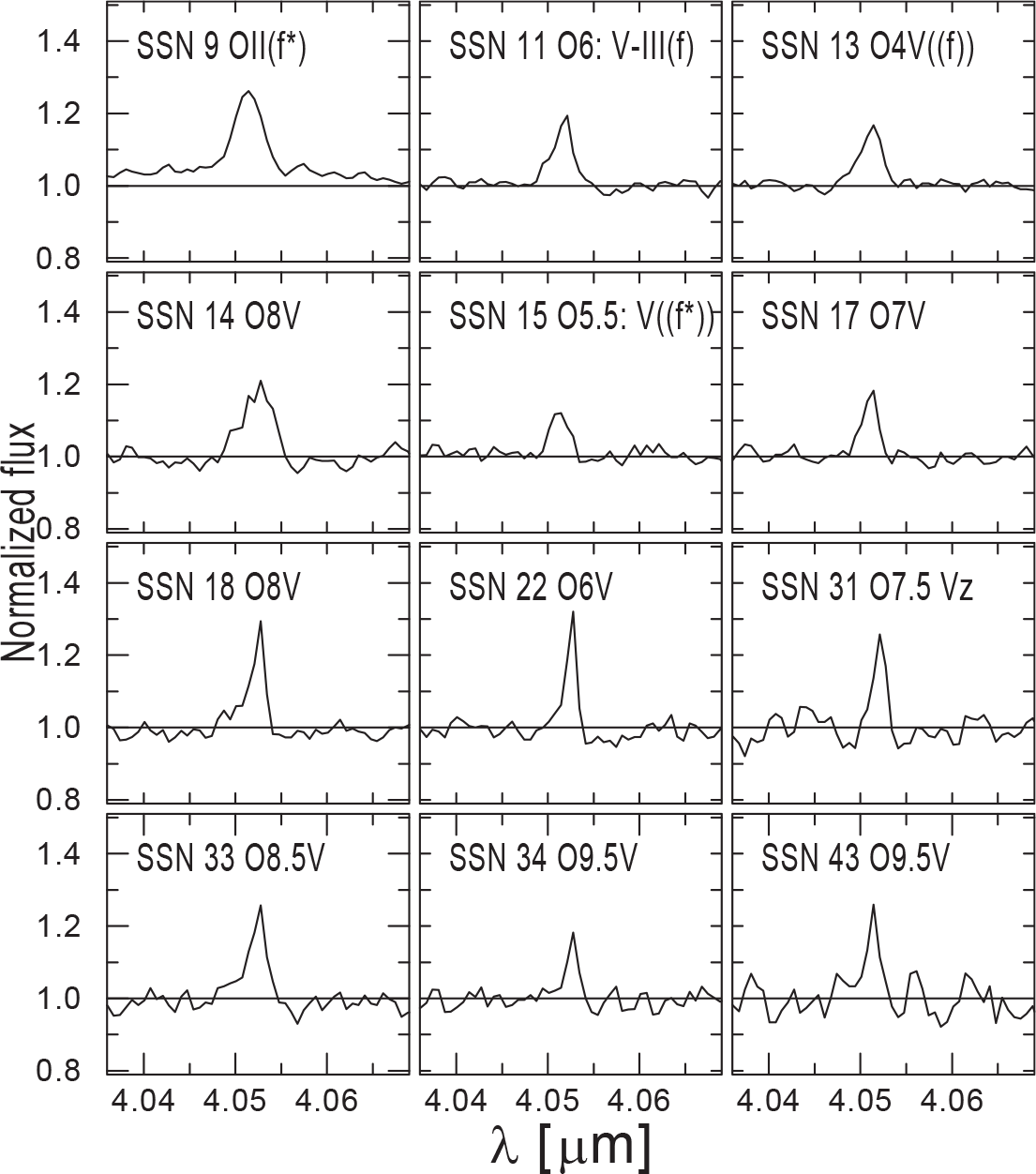
spectra of our targets are shown in Fig. 2. We see that the line is in emission for all of them. For the brightest targets, the profile has a broad component, while only a narrow emission core can be seen for the fainter ones.
Normalized observed Br
 $\alpha$
spectra for 12 of the 13 targets.

4. First comparison with PoWR models
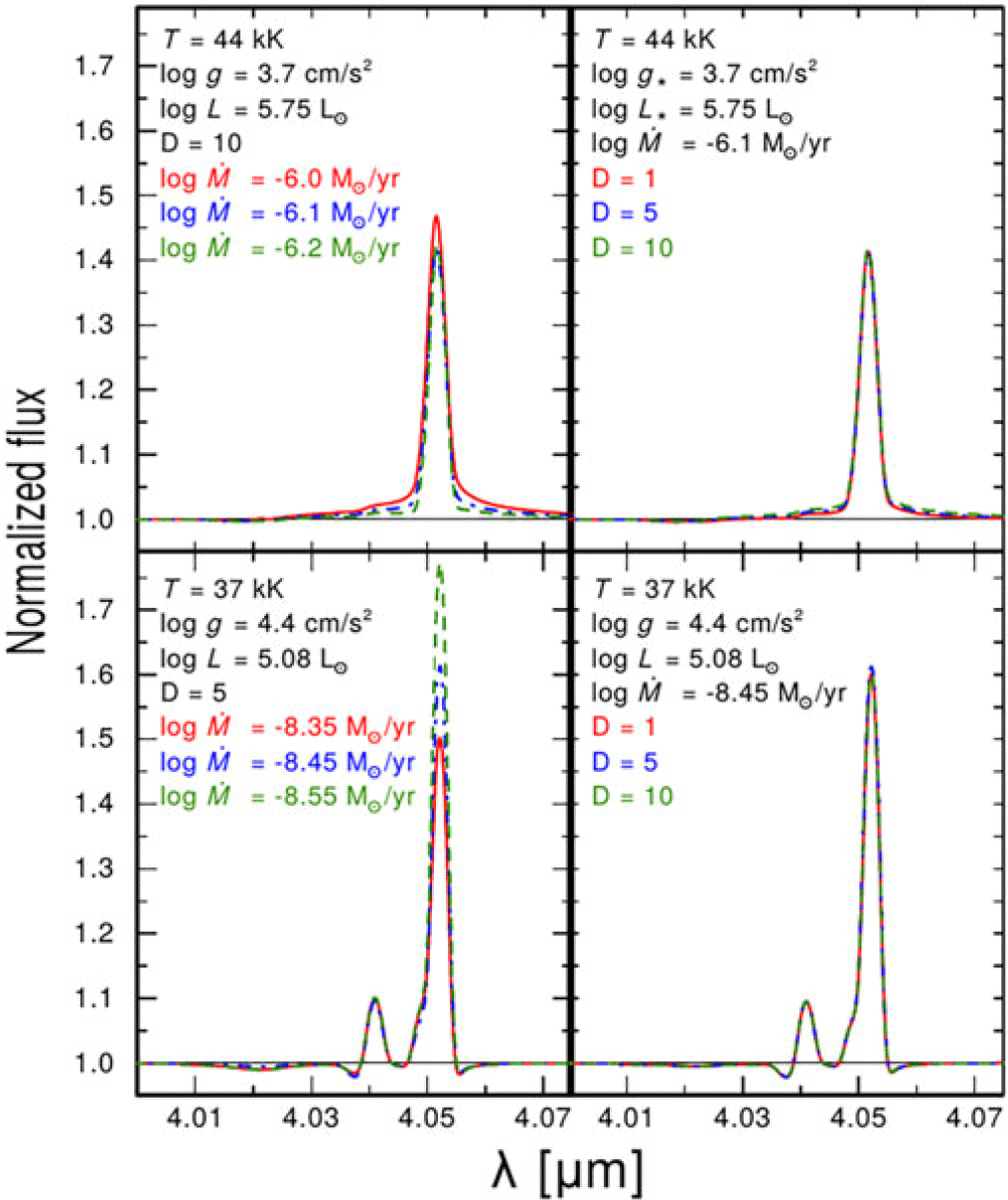
For a preliminary analysis, we compared the observed NIRSpec spectra with models computed with the non-LTE stellar atmosphere code (Gräfener et al. Reference Gräfener, Koesterke and Hamann2002; Hamann & Gräfener Reference Hamann and Gräfener2003; Sander et al. Reference Sander, Shenar and Hainich2015). In Fig. 3, we show the PoWR spectrum of Br
 $\alpha$
for two stars with weak and strong winds. We see that for the luminous star, Br
 $\alpha$
reacts proportionally to
 $\dot{M}$
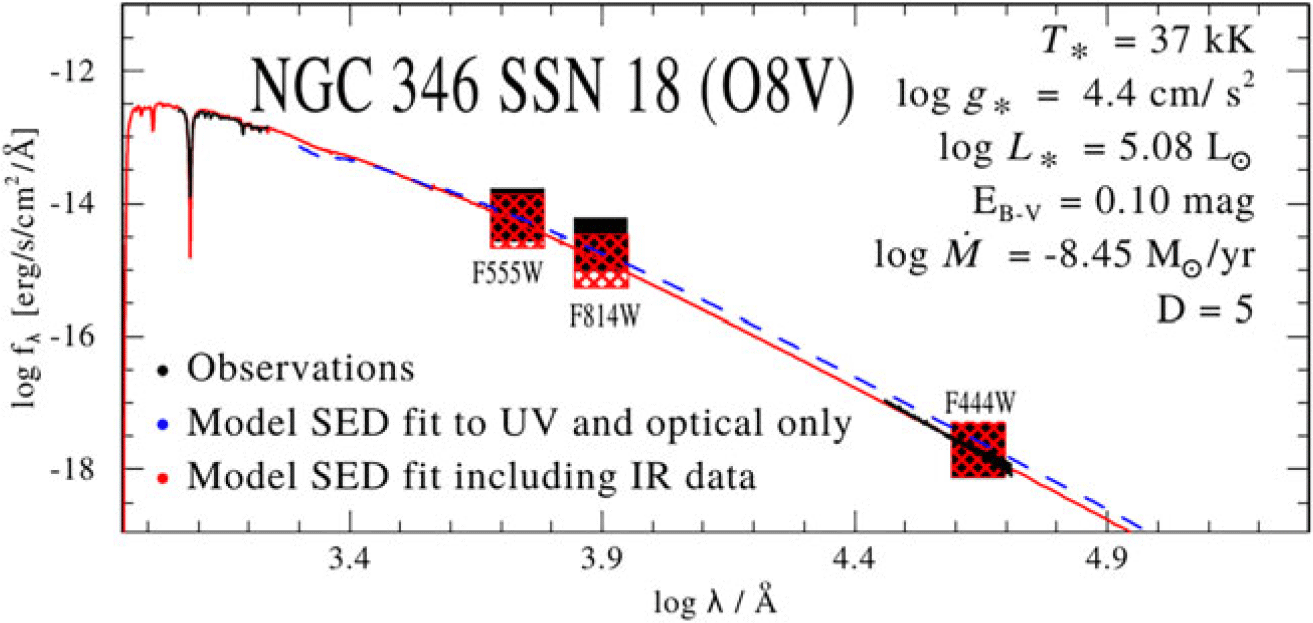
, while the opposite occurs for the fainter one. Additionally, we fitted the model SED to multi-wavelength observations, including UV spectra and optical photometry (Fig. 4). As extinction has a negligible effect on the IR part of the spectrum, the new NIRSpec observations can be used to strongly constrain luminosity. The revised luminosities are systematically lower than when only considering the UV and the optical ranges (Mang Román et al. Reference Mang Román, Zeidler and Hamann2025).
PoWR model Br
 $\alpha$
spectra of two stars with different
 $\dot{M}$
(left panels) and clumping density contrast, D (right panels). Top and bottom panels show, respectively, models for thick (luminous supergiant) and thin (faint dwarf) winds.

Synthetic SED (red solid line) adjusted to UV, optical and IR observations (black lines and boxes). The blue dashed line is the model SED without considering the IR.

5. Future of IR spectroscopy in massive stars
The results presented in this work show that IR spectroscopy can be a powerful tool for massive star astrophysics. However, data reduction reminds extremely critical, especially when observing targets embedded in ionized nebulae. The capabilities of the JWST will allow to create a bridge between stars at different metallicities, and reveal useful spectral signatures in reddened or obscured stars. The presence of Br
 $\alpha$
in low-Z stars opens a new window into the study of stellar winds.
Supplementary material
To view supplementary material for this article, please visit https://doi.org/10.1017/S174392132610595X
 α
 α
 M˙


 Open access

