Introduction
A new mineral species, fluorlamprophyllite, ideally Na3(SrNa)Ti3(Si2O7)2O2F2, has been found in the Poços de Caldas alkaline massif, Morro do Serrote (Serrote Hill), Minas Gerais, Brazil. Alternatively, the idealized chemical formula could be written as (SrNa)[(Na3Ti)F2][Ti2(Si2O7)2O2], setting the large interlayer cations before the cations of the layer (Rastsvetaeva et al., Reference Rastsvetaeva, Chukanov and Aksenov2016). The new mineral and its name have been approved by the Commission on New Minerals, Nomenclature and Classification (CNMNC) of the International Mineralogical Association (IMA2013-102). The holotype and part of the co-type sample have been deposited at the University of Arizona Mineral Museum (catalogue no. 19589) and the RRUFF Project (deposition no. R130421: http://rruff.info/fluorlamprophyllite), respectively.
Fluorlamprophyllite is the F-analogue of lamprophyllite and the fourth reported F-dominant member of the lamprophyllite group, the others being schüllerite (Chukanov et al., Reference Chukanov, Rastsvetaeva, Britvin, Virus, Belakovskiy, Pekov, Aksenov and Ternes2011), lileyite (Chukanov et al., Reference Chukanov, Pekov, Rastsvetaeva, Aksenov, Zadov, Van, Blass, Schüller and Ternes2012) and emmerichite (Aksenov et al., Reference Aksenov, Rastsvetaeva and Chukanov2014). It is also part of the family of heterophyllosilicates (Ferraris and Gula, Reference Ferraris and Gula2005). Also, the term ‘heteropolyhedral (H) sheet’ has been used instead of heterophyllosilicates, which emphasizes the fact that the H sheet consists of different cation polyhedra (Sokolova, Reference Sokolova2006). The general chemical formula can be expressed as [M1M22]A 2[M3L 2](Si2O7)2O2Y 2, where M1 = Na, Mn2+, Mg or Fe2+; M2 = Na or Mn2+, Mg, Fe2+ or Ca; A = Ba, Sr, K, Na, Ca or □; M3 = Ti, Mn2+, Mg, Fe3+ or Fe2+; L = Ti or Fe3+ and Y = OH, O or F, according to the ion occupancies suggested by Chukanov et al. (Reference Chukanov, Pekov, Rastsvetaeva, Aksenov, Zadov, Van, Blass, Schüller and Ternes2012) and Rastsvetaeva et al. (Reference Rastsvetaeva, Chukanov and Aksenov2016). In fluorlamprophyllite, the Y site is dominated by F. There are other eight members of this group, including monoclinic (2M) and orthorhombic (2O) polytypes: lamprophyllite-2M and -2O, Na3(SrNa)Ti3(Si2O7)2O2(OH)2 (Woodrow, Reference Woodrow1964; Saf'yanov et al., Reference Saf'yanov, Vasil'eva, Golovachev, Kuz'min and Belov1983; Krivovichev et al., Reference Krivovichev, Armbruster, Yakovenchuk, Pakhomovsky and Men'shikov2003), ericssonite-2M and -2O, Ba2 ${\rm Mn}_{\rm 4}^{{\rm 2 +}} {\rm Fe}_{\rm 2}^{{\rm 3 +}} $(Si2O7)2O2(OH)2 (Moore, Reference Moore1971; Matsubara, Reference Matsubara1980), nabalamprophyllite-2M and -2O, Na3(BaNa)Ti3(Si2O7)2O2(OH)2 (Chukanov et al., Reference Chukanov, Moiseev, Pekov, Lazebnik, Rastsvetaeva, Zayakina, Ferraris and Ivaldi2004; Sokolova and Hawthorne, Reference Sokolova and Hawthorne2008), barytolamprophyllite-2M, Na3(BaK)Ti3(Si2O7)2O2(OH)2 (Sokolova and Cámara, Reference Sokolova and Cámara2008), ferroericssonite-2M, Ba2
 ${\rm Fe}_{\rm 4}^{{\rm 2 +}} {\rm Fe}_{\rm 2}^{{\rm 3 +}} $(Si2O7)2O2(OH)2 (Kampf et al., Reference Kampf, Roberts, Venance, Dunning and Walstrom2011), schüllerite-1T, Ba2NaMnFe2+Fe3+Ti2(Si2O7)2O2F2 (Rastsvetaeva et al., Reference Rastsvetaeva, Aksenov and Chukanov2011; Chukanov et al., Reference Chukanov, Rastsvetaeva, Britvin, Virus, Belakovskiy, Pekov, Aksenov and Ternes2011; Rastsvetaeva et al., Reference Rastsvetaeva, Chukanov and Aksenov2016), lileyite-2M, Ba2Na(Na,Fe,Ca)2MgTi2(Si2O7)2O2F2 (Chukanov et al., Reference Chukanov, Pekov, Rastsvetaeva, Aksenov, Zadov, Van, Blass, Schüller and Ternes2012) and emmerichite-2M, Ba2Na3Fe3+ Ti2(Si2O7)2O2F2 (Aksenov et al., Reference Aksenov, Rastsvetaeva and Chukanov2014; Chukanov et al., Reference Chukanov, Rastsvetaeva, Aksenov, Blass, Pekov, Belakovskiy, Tschörtner, Schüller and Ternes2014; Rastsvetaeva et al., Reference Rastsvetaeva, Chukanov and Aksenov2016). This paper describes the physical and chemical properties of fluorlamprophyllite and its crystal structure determined from single-crystal X-ray diffraction data.
Sample description and experimental procedure
Occurrence, chemical composition and Raman spectra
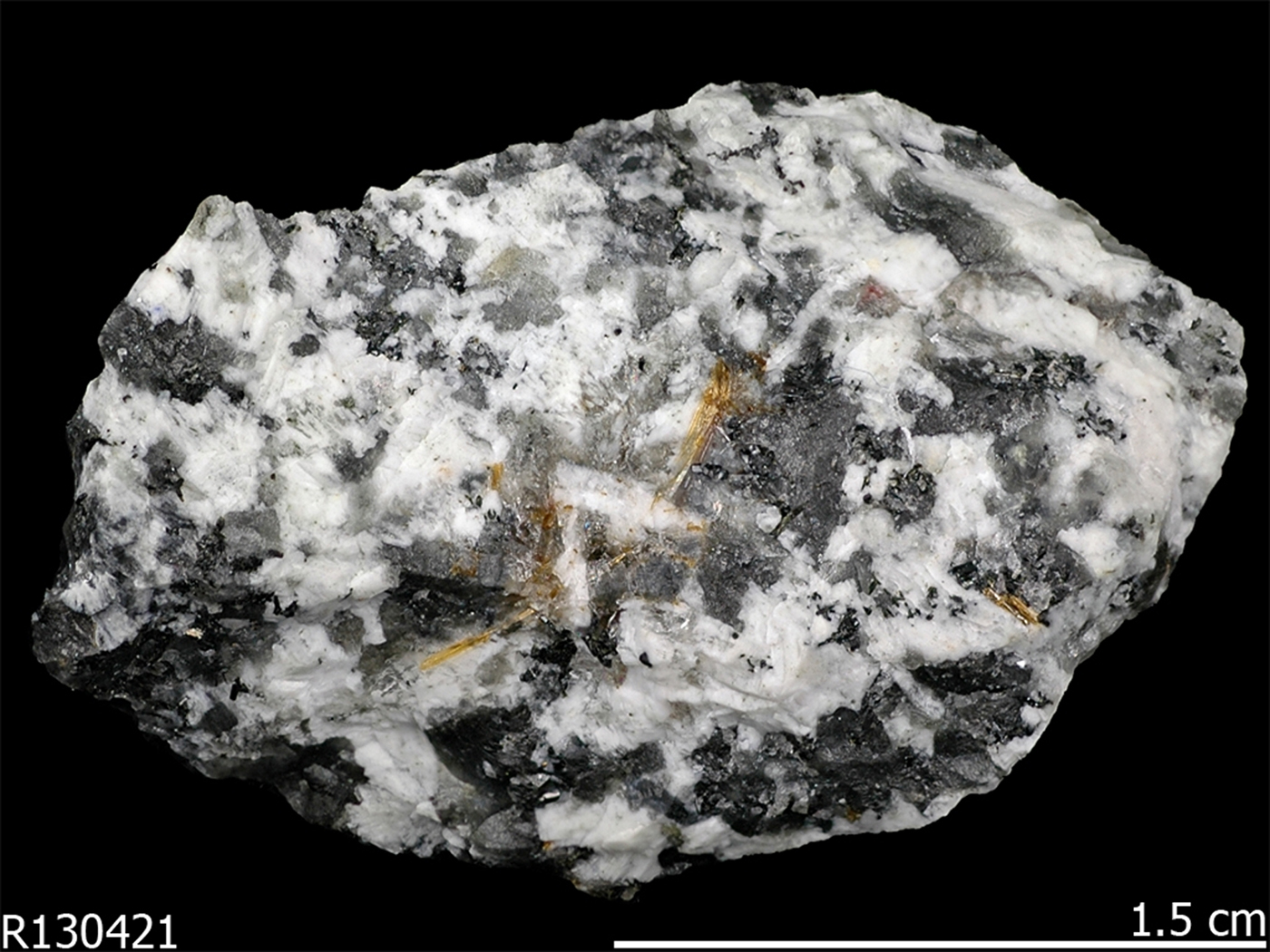
Fluorlamprophyllite was found embedded in the mass of a sample of nepheline syenite (Fig. 1) collected from Morro do Serrote, Minas Gerais (21°53'05”S, 46°38'45”W). Associated minerals include aegirine, analcime, natrolite, nepheline and microcline. The nepheline syenite at Morro do Serrote is an intrusive body (9 km2, 60–65 Ma) in phonolites, located in the central-western portion of the subcircular Mid-Cretaceous Poços de Caldas alkaline massif (800 km2). The massif's geology and petrology have been studied since the 19th century and a systematic study of its structure, mineralogy and petrology has been presented by Ulbrich (Reference Ulbrich1984), including a comprehensive classification of the different nepheline syenite facies from Morro do Serrote. Also, Morro do Serrote is an important bauxite deposit (Leonardi et al., Reference Leonardi, Ladeira and dos Santos2011).
A piece of the specimen in which fluorlamprophyllite was found.

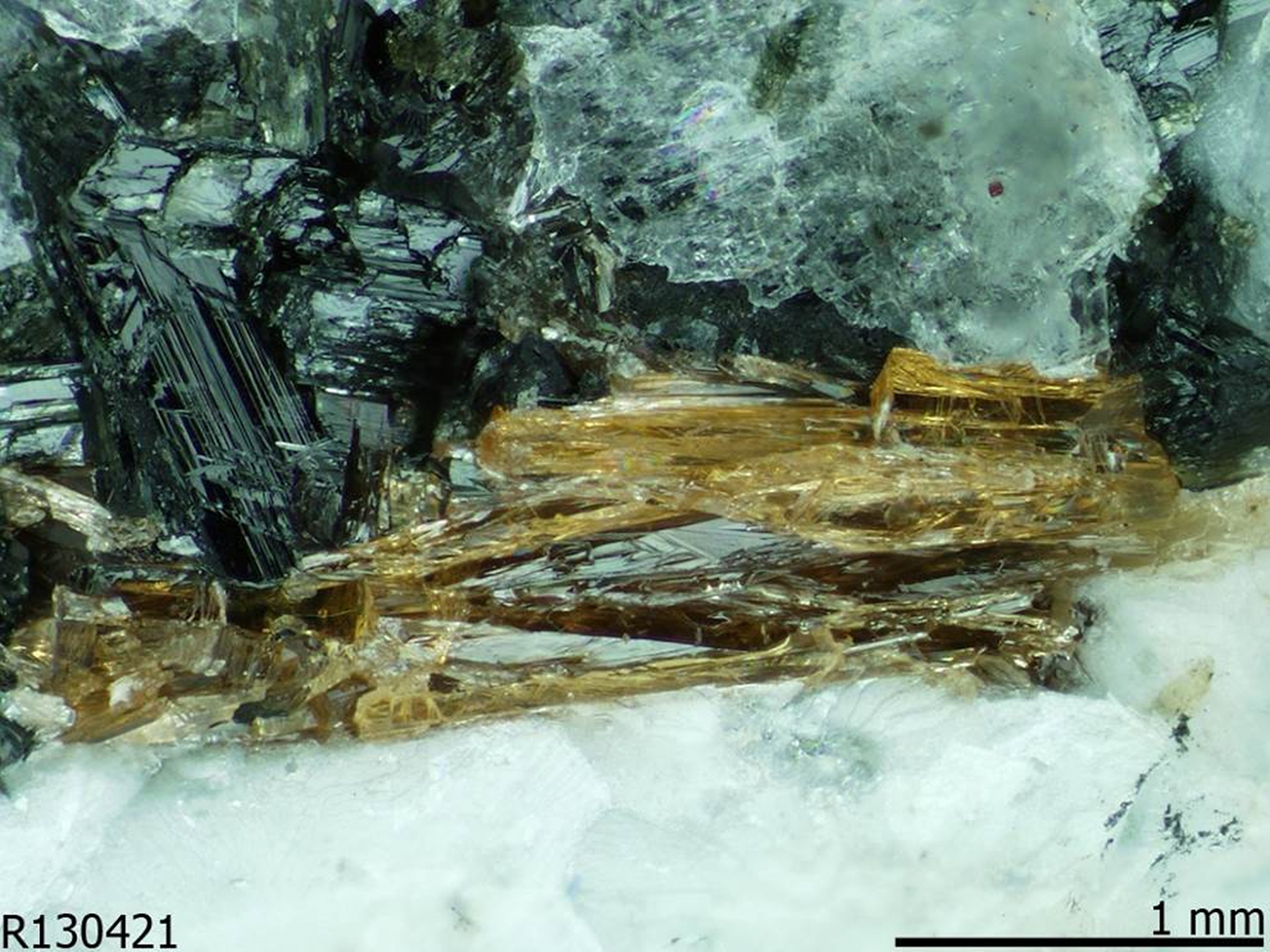
Fluorlamprophyllite crystals are orange and bladed, up to 3 mm long, 0.3 mm wide and 0.2 mm thick (Figs 1 and 2). The mineral is transparent with a pale yellow streak and an adamantine lustre. It is brittle and has a Mohs hardness of ~3; cleavage is perfect on {100} and no parting was observed. The calculated density is 3.484 g/cm3. Optically, fluorlamprophyllite is biaxial (+), with α = 1.735(7), β = 1.749(7) and γ = 1.775(9) (white light), 2Vmeas = 72(3)°, 2Vcalc = 74°, and the orientation X ⊥ b, Z ∧ c ≅ 5°. The pleochroism is X = yellow–green, Y = yellow–brown and Z = brown.
A microscopic view of brownish-orange, bladed fluorlamprophyllite crystals.

The chemical composition of fluorlamprophyllite was determined using a CAMECA SX-100 electron microprobe with an operating current of 15 kV and 10 nA and 10 µm beam diameter. The standards included albite (Na), microcline (K), wollastonite (Si), SrTiO3 (Sr), diopside (Ca and Mg), anorthite (Al), rhodonite (Mn), rutile (Ti), fayalite (Fe) and MgF2 (F), yielding an average composition (wt.%) (9 analytical points) of: Na2O 10.63(30), K2O 0.47(3), SiO2 30.51(13), SrO 18.30(24), MgO 0.81(17), Al2O3 0.23(2), CaO 1.11(7), MnO 5.03(38), TiO2 27.41(87), Fe2O3 2.45(37), F 2.86(23) and O = F –1.20, with the total = 98.61%. The elements Nb and Ba were sought, but contents were below microprobe detection limits. The resultant chemical formula was calculated on the basis of 18 (O + F) atoms per formula unit, yielding (Na2.63Sr1.35Mn0.54Ca0.15Mg0.15K0.08)Σ4.90(Ti2.63 ${\rm Fe}_{{\rm 0}{\rm. 24}}^{{\rm 3 +}} $ Al0.04)Σ2.91Si3.89O16[F1.15(OH)0.85]Σ2.00, which can be simplified to the following ideal formula Na3(SrNa)Ti3(Si2O7)2O2F2. The total is brought close to 100% by adding 1.00 H2O.
The Raman spectra of fluorlamprophyllite were collected from a randomly oriented crystal on a Thermo-Almega microRaman system, using a 532 nm solid-state laser with a thermoelectric cooled CCD detector. The laser was partially polarized with 4 cm–1 resolution and a spot-size of 1 µm.
X-ray crystallography
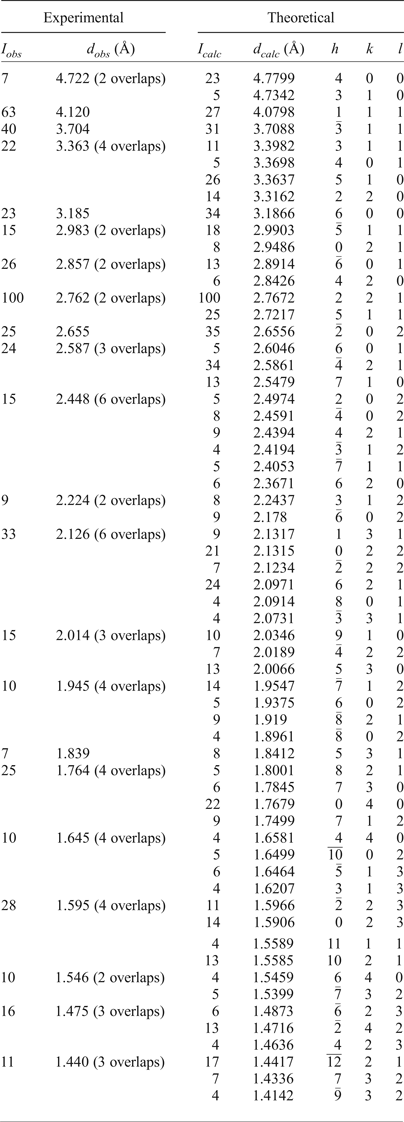
The powder and single-crystal X-ray diffraction data of fluorlamprophyllite were collected on a Bruker APEX2 CCD X-ray diffractometer equipped with graphite-monochromatized MoKα radiation. Listed in Table 1, are the measured powder X-ray diffraction data, along with those calculated from the determined structure using the program XPOW (Downs et al., Reference Downs, Bartelmehs, Gibbs and Boisen1993). It was not possible to determine unambiguously the unit-cell parameters from the powder diffraction data because of severe overlapping of reflections.
Powder X-ray diffraction data for fluorlamprophyllite.*

* Theoretical data were calculated from the determined structure model using the XPOW program (Downs et al., Reference Downs, Bartelmehs, Gibbs and Boisen1993).
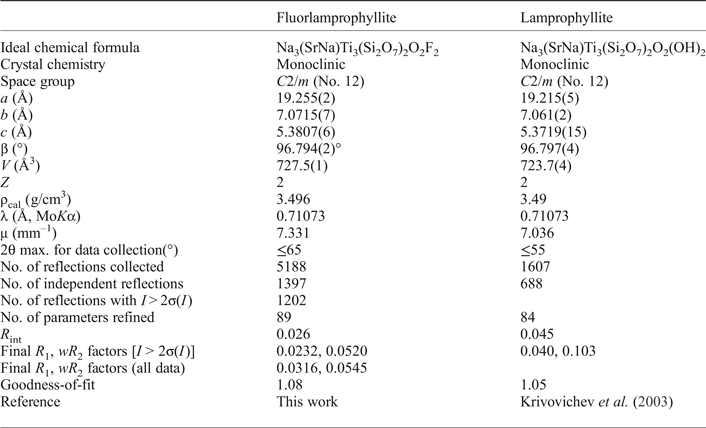
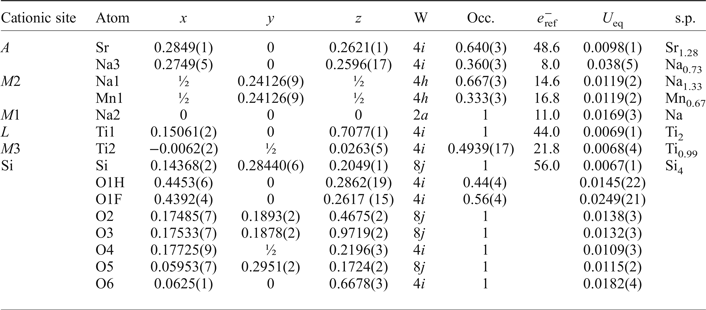
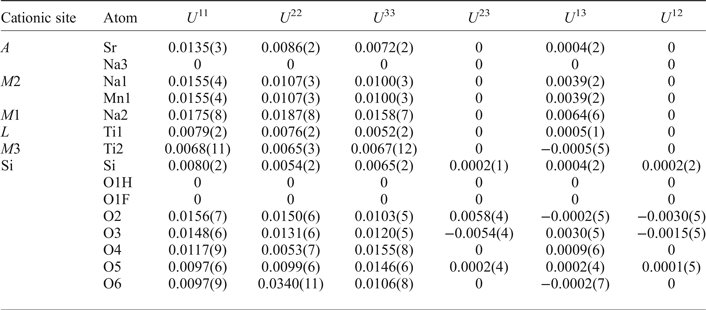
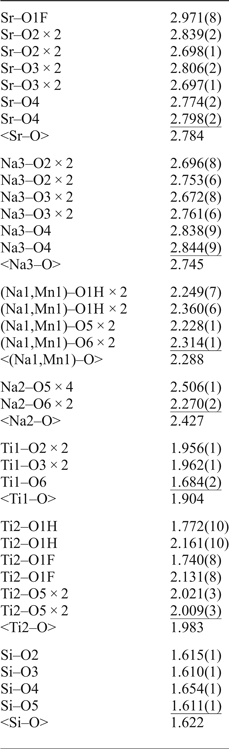
The single-crystal X-ray intensity data were collected from a nearly equi-dimensional crystal (0.06 mm × 0.05 mm × 0.05 mm) with frame widths of 0.5° in ω and 30 s counting time per frame. All reflections were indexed on the basis of a monoclinic unit-cell. The intensity data were corrected for X-ray absorption with the software SADABS (Sheldrick, Reference Sheldrick2007). The summary of crystal data and refinement results for fluorlamprophyllite (this work) and lamprophyllite (Krivovichev et al., Reference Krivovichev, Armbruster, Yakovenchuk, Pakhomovsky and Men'shikov2003) are presented in Table 2. It is the monoclinic 2M polytype, with space group C2/m. The crystal structure was solved and refined using SHELX97 (Sheldrick, Reference Sheldrick2008). A preliminary structure refinement based on the ideal chemical formula of fluorlamprophyllite revealed an unusual size of the displacement ellipsoid of the F/OH site, suggesting positional disorder. It was therefore modelled as two split nonequivalent sites, O1F and O1H, displaced 0.165 Å from each other. Also, we could identify by difference-Fourier maps that Sr was split in two partially occupied nonequivalent sites, identified as Na3 and Sr. Furthermore, the occupancies at the two sites were allowed to vary. In contrast to previous studies (e.g. Krivovichev et al., Reference Krivovichev, Armbruster, Yakovenchuk, Pakhomovsky and Men'shikov2003), Ti2 was displaced from the special position of site symmetry 2/m at (0, ½, 0) and refined assuming a split Ti-site with site symmetry m based on difference-Fourier maps. For simplicity, during the structure refinements, minor Mg was treated as Mn, (Ca + K) as Na, and (Fe + Al) as Ti. During the refinements, the correspondence between the sites indicated in the general formula and the atoms site positions is the following: M1 = Na2; M2 = Na1 + Mn1; A = Sr + Na3; M3 = Ti2; L = Ti1; and Y = F + OH. The divalent cations are ordered in the A site and present in the M2 site. The position of most of the atoms were refined with anisotropic displacement parameters, except for the partially occupied O1F, O1H and Na3 sites, giving rise to the refined structure formula (Na2.33Mn0.67)Σ3.00(Sr1.28Na0.73)Σ=2.01Ti2.99Si4O16[F1.12(OH)0.88]Σ2.00. Final coordinates and displacement parameters of atoms in fluorlamprophyllite are listed in Table 3 and 4 and selected bond distances in Table 5. Additional structural information is provided in the crystallographic information file (available as supplementary material, see below).
Summary of crystal data and refinement results for fluorlamprophyllite and lamprophyllite.

Coordinates, Wyckoff positions (W), refined number of electrons (e −ref), equivalent displacement parameters (U eq, Å2) and site population (s.p.) in fluorlamprophyllite.

Anisotropic displacement parameters of atoms in fluorlamprophyllite (Å2).

Selected bond distances (Å) in fluorlamprophyllite.

Discussion
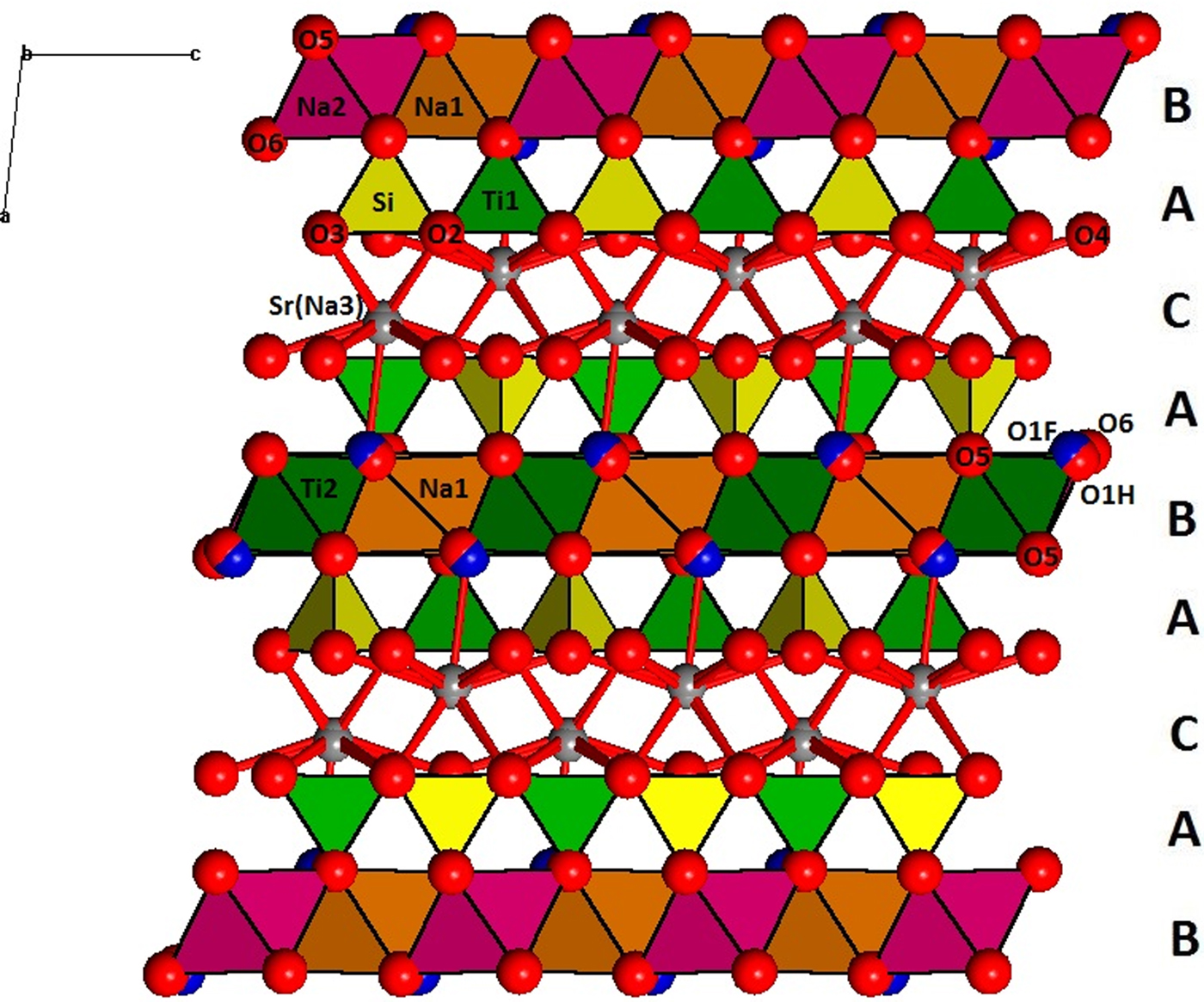
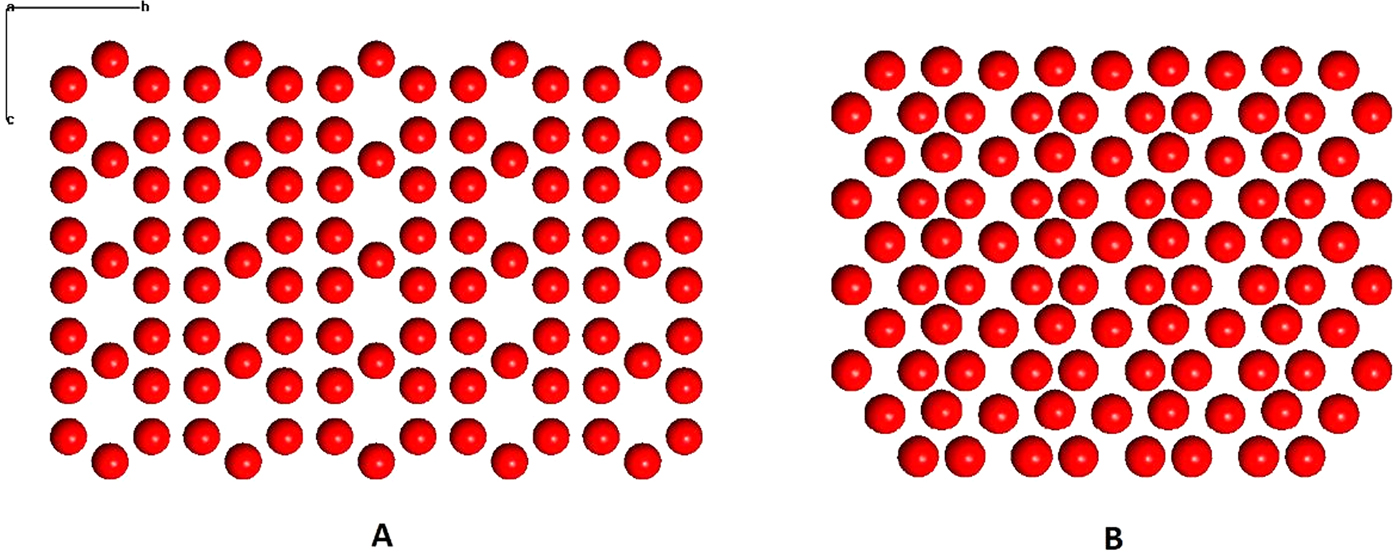
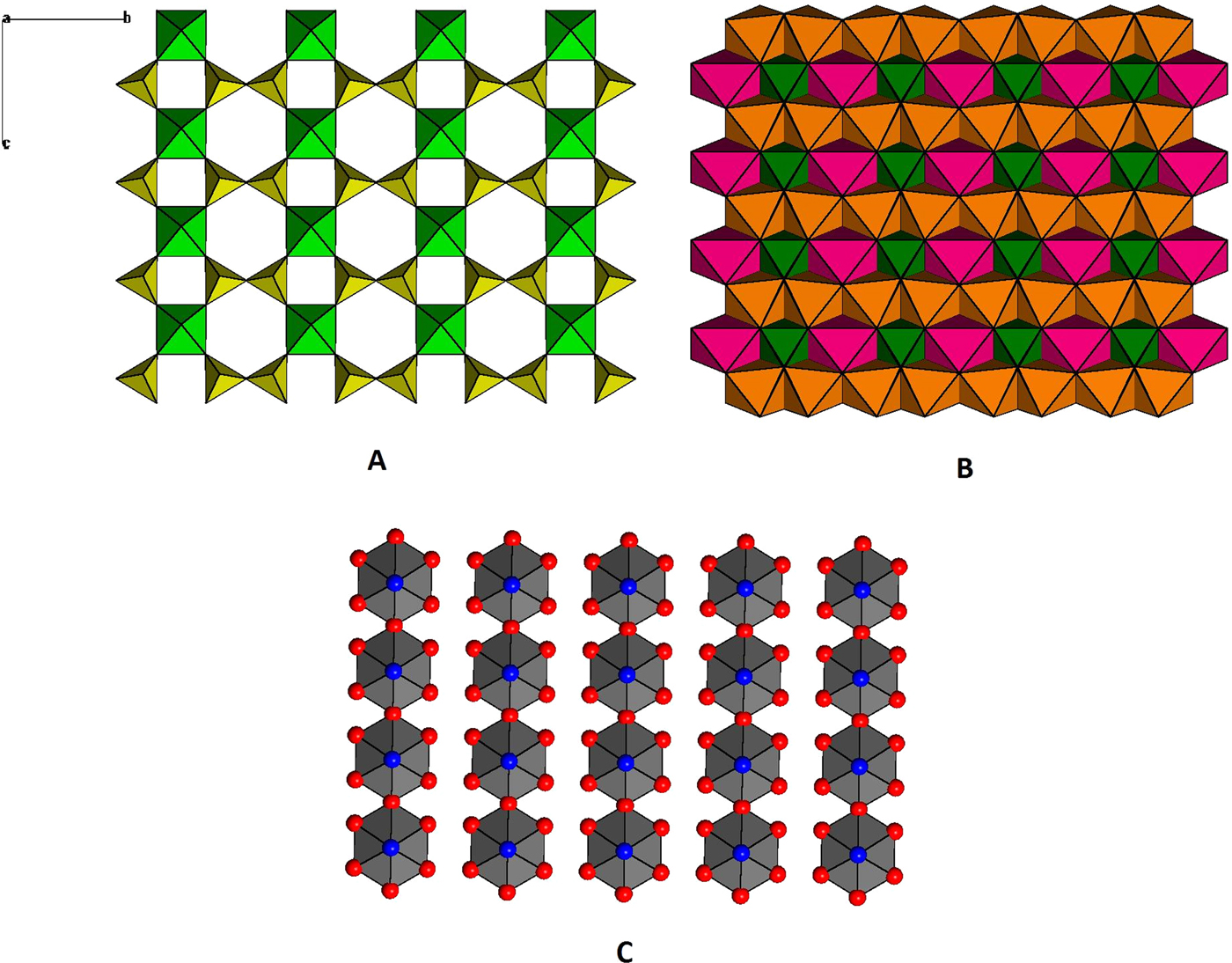
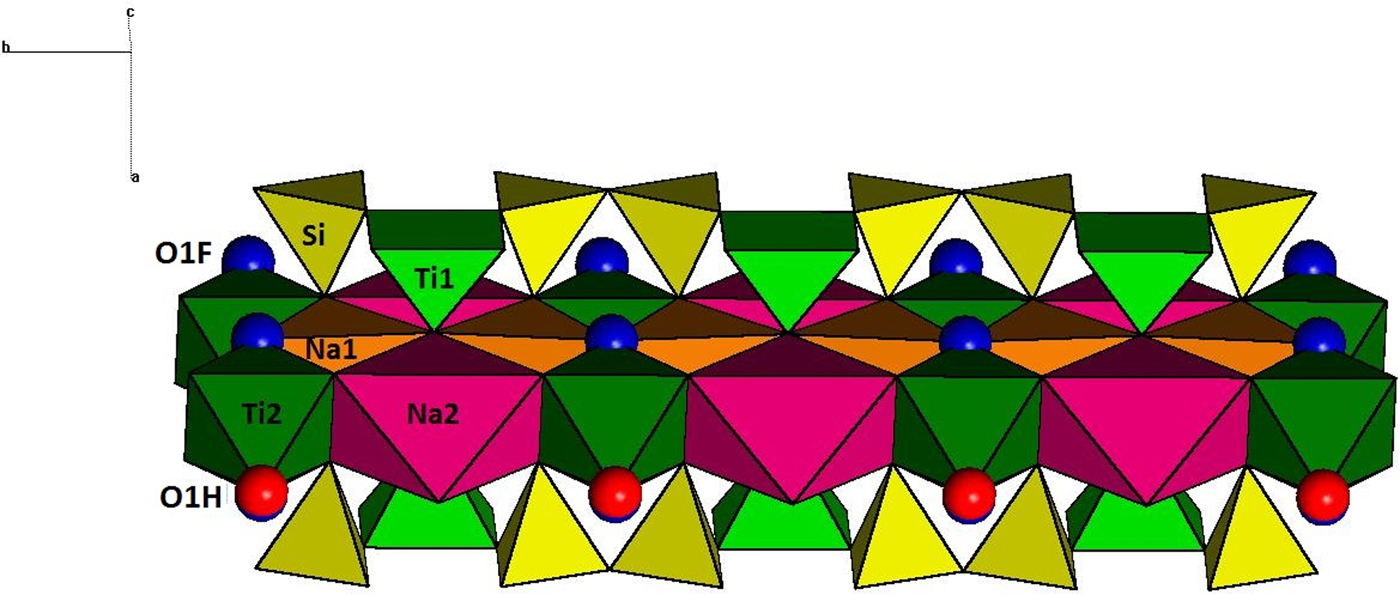
Details of lamprophyllite-type structures, including triclinic, monoclinic and orthorhombic structures have been discussed by Krivovichev et al. (Reference Krivovichev, Armbruster, Yakovenchuk, Pakhomovsky and Men'shikov2003) and Rastsvetaeva et al. (Reference Rastsvetaeva, Aksenov and Chukanov2011). The structure of fluorlamprophyllite is a layered silicate inasmuch as the O atoms are arranged in well-defined, though not necessarily close-packed layers, as shown in Figs 3 and 4. It can be seen that the oxygens are not arranged in hexagonal close-packed layers. The polyhedral units also form three distinct layers parallel to (100), designated as A = (Si2O7) dimers connected by TiO5 polyhedra, B = brucite-type layer of (Na1)O6, (Na2)O6 and (Ti2)O6 edge-sharing octahedra, with (Ti2)O6 alternating in columns with (Na1)O6 and C = (Sr + Na3) (Figs 5 and 6). Sandwiches of strongly bonded ABA layers are separated by the weaker bonded C layers, responsible for the perfect cleavage on {100}. The cations in layer C (Sr + Na) are coordinated to 6 O atoms on one side of the layer and 4 on the other (Fig. 6). The Si–O–Si angle within the Si2O7 dimer in fluorlamprophyllite, 134.33(12)°, is among the smallest of the lamprophyllite group, which exhibit Si–O–Si angles ranging from 134° to 148° for lamprophyllite (Krivovichev et al., Reference Krivovichev, Armbruster, Yakovenchuk, Pakhomovsky and Men'shikov2003) and ericssonite (Matsubara, Reference Matsubara1980), respectively.
The crystal structure of fluorlamprophyllite. Na1 [brown], Na2 [purple], Si [yellow], Ti1 [light green], Sr(Na3) [grey], Ti2 [dark green], O [red], O1H [red] and O1F [blue].

The O layers of the A and B sheets in fluorlamprophyllite showing that the oxygens are not arranged in hexagonal close-packed layers

The layers in fluorlamprophyllite: A = (Si2O7) dimers connected by TiO5 polyhedra; B = brucite-type layer of (Na1)O6, (Na2)O6 and (Ti2)O6 edge-sharing octahedra; and C = Sr(Na3).

The The F/OH atoms, B and A layers in fluorlamprophyllite.

Raman spectra of fluorlamprophyllite are shown in Fig. 7. Tentative assignments of major Raman bands (cm–1) are 3550–3700 O–H stretching, 750–1200 Si–O stretching of SiO4 groups, 690 Si–O–Si bending of Si2O7 groups, 590 Ti–O stretching in TiO5 and TiO6 groups, and < 500 lattice modes. As expected, the Raman spectra of fluorlamprophyllite (R130421) and lamprophyllite (R070200, R070284 and R130240) presented in the project RRUFF (http://rruff.info/) are pretty similar considering the similarities in their structures.
The Raman spectrum of fluorlamprophyllite.

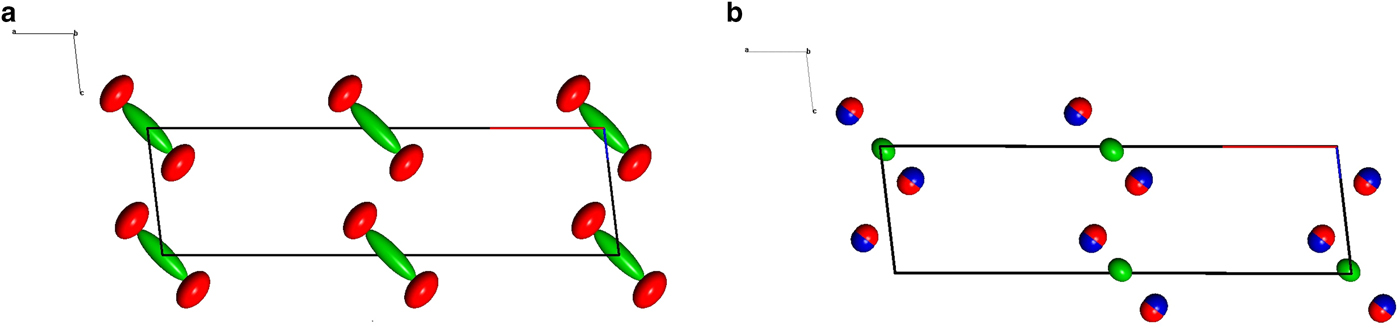
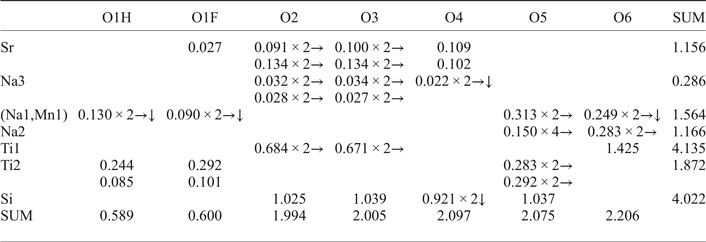
Bond-valence sums (Table 6) for the fluorlamprophyllite structure were calculated using the parameters given by Brese and O'Keeffe (Reference Brese and O'Keeffe1991) and are consistent with structure refinement results. The Sr2+ cation in fluorlamprophyllite is bonded to ten O atoms and weakly to a F atom within 3.0 Å and the bond-valence sum for the site is 1.156 valence units (vu). Initially, Ti2 was located at (0, ½, 0) (Krivovichev et al., Reference Krivovichev, Armbruster, Yakovenchuk, Pakhomovsky and Men'shikov2003). However, we observed a significant increase in the R-factor and abnormal temperature factors for the Ti (Fig. 8). Using the difference-Fourier maps, it was possible to find the new position (–0.0062, 0.0263, 0.494) and consequently the Ti-site splitting. Also, a more systematic and complete discussion on the Ti-site splitting in the lamprophyllite-type minerals is in preparation. The Ti1 and Ti2 positions by Ti are in good agreement with the bond-valence sums of 4.135 and 1.872 vu, respectively. The Ti2 calculation was obtained from anion contributions of O1H and O1F from the split-site Y and from O5. The Na1 position incorporates Na and bivalent cations (Mn2+). The bond-valence sum for Na1 is 1.564 vu. The bond-valence sums for the partially occupied O1F and O1H positions in fluorlamprophyllite are 0.600 and 0.589 vu, respectively, which are in a good agreement with their assignment to fluorine and hydroxyl groups.
Fluorlamprophyllite unit cell: (a) Ti2 at (0, ½, 0) (green) and (O1H,O1F) (red) at (0.44190, 0, 0.2727) atoms; (b) Ti2 at (−0.0062, ½, 0.0263) (green), O1H (red) at (0.4452, 0, 0.2862) and O1F (blue) at (0.4392, 0, 0.2617) atoms. Displacement ellipsoids drawn at the 99.9% probability level.

Calculated bond-valence sums (in valence units) for fluorlamprophyllite.

Crystal structure and physical properties of lamprophyllite-group minerals have been studied and new species characterized in recent years. However, there are no synthetic analogues of lamprophyllite-group minerals, representing a challenge to the development of new compounds based on layered mineral structures.
Acknowledgements
We acknowledge the Science Foundation Arizona, CNPQ and Sao Paulo Research Foundation for financial support (Grant: 2013/03487-8).
Supplementary material
To view supplementary material for this article, please visit https://doi.org/10.1180/minmag.2017.081.027