Implications
Sow reproduction ability is important to economics of pig industry. A shorter gestation length means higher reproduction efficiency. With an increased litter size, good maternal ability is required to sows to improve the survival rate of their offspring. In this study, a whole genome scan was conducted to identify the chromosome regions influencing the sow maternal ability and gestation length. This is an important step to identify causative genes for sow maternal ability and gestation length, and then to genetic improvement of sow reproduction ability.
Introduction
Reproduction traits are the important economic traits for the pig industry. It has profound effects on economical interest of pig production. Besides some well-known reproduction traits, such as litter size and age at puberty, gestation length and maternal ability are also important to sow reproduction. It is important for commercial pig farms to predict the starting time of farrowing. Producers can supervise the farrowing and treat sows at the appropriate time to induce farrowing and give assistance to sows and piglets to reduce piglet mortality during the perinatal periods (Holyoake et al., Reference Holyoake, Dial, Trigg and King1995). The selection for increased litter size brings problems with increasing piglet mortality and decreasing piglet growth (Johnson et al., Reference Johnson, Nielsen and Casey1999). Sows are required for good maternal ability to take care of their litters, because maternal effects are more important than any other single factor in determining early offspring growth and survival (Lee et al., Reference Lee, Majluf and Gordon1991).
Variation among sows in their gestation length and maternal ability is caused by both genetic and environmental effects. Gestation length varies in both purebred sows (Kennedy and Moxley, Reference Kennedy and Moxley1978) and crossbred sows (Sasaki and Koketsu, Reference Sasaki and Koketsu2007). Sasaki and Koketsu (Reference Sasaki and Koketsu2007) showed that shorter gestation length was associated with more piglets born and dead piglets. An increase in gestation length has been related with improved piglet vitality at birth and reduced stillbirths (Knol et al., Reference Knol, Leenhouwers and Van der Lende2002). Variation in maternal ability also exists in different breeds. The Meishan breed shows good maternal abilities with resulting in heavier piglets at weaning than European white sows (Sinclair et al., Reference Sinclair, Edwards, Hoste and McCartney1998). Meishan piglets have 5% advantage in survival rate than large white piglets due to good maternal behavior (van der Steen and de Groot, Reference van der Steen and de Groot1992).
As a complex trait, maternal ability is considered to have a relatively low additive genetic variance and low heritability (Gäde et al., Reference Gäde, Bennewitz, Kirchner, Looft, Knap, Thaller and Kalm2008). The heritability of gestation length in pigs ranges from 0.47 (Leigh, Reference Leigh1981; Hanenberg et al., Reference Hanenberg, Knol and Merks2001) to 0.13 (Casellas et al., Reference Casellas, Varona, Muñoz, Ramírez, Barragán, Tomás, Martínez-Giner, Óvilo, Sánchez, Noguera and Rodríguez2008). The moderate-to-high values of heritability estimated have increased its importance as a potential breeding goal to improve the reproduction efficiency of sow per year (Casellas et al., Reference Casellas, Varona, Muñoz, Ramírez, Barragán, Tomás, Martínez-Giner, Óvilo, Sánchez, Noguera and Rodríguez2008). Until now, no quantitative trait loci (QTL) were reported for maternal ability related traits in pigs. In mice Peripato et al. (Reference Peripato, De Brito, Vaughn, Pletscher, Matioli and Cheverud2002) mapped two QTL for maternal performance for offspring survival on chromosomes 2 and 7. Wilkie et al. (Reference Wilkie, Paszek, Beattie, Alexander, Wheeler and Schook1999) detected three QTL on pig chromosomes (SSC)1, 9 and 15 for gestation length in a three-generation Meishan × Yorkshire resource population. Casellas et al. (Reference Casellas, Varona, Muñoz, Ramírez, Barragán, Tomás, Martínez-Giner, Óvilo, Sánchez, Noguera and Rodríguez2008) identified three QTL for gestation length on SSC6, 8 and 11 in the Iberian × Meishan F2 sows. Moreover, Jiang et al. (Reference Jiang, Robinson, Verrinder Gibbins, Gibson, Archibald and Haley2002) found a QTL for gestation length on SSC8 using a candidate gene approach in a Meishan × large white resource population.
In this study, a whole genome scan was performed to identify QTL for gestation length and maternal ability related traits in a White Duroc × Erhualian intercross resource population.
Material and methods
Animals and phenotype recording
Experimental animals were from a three-generation White Duroc × Erhualian intercross. Erhualian is a Chinese indigenous pig breed well known for its excellent reproductive performance, and Duroc is a popular Western pig breed. Two White Duroc boars and 17 Erhualian sows were crossed as founder animals to produce F1 animals, and 59 F1 sows were randomly mated with 9 F1 boars to produce 1912 F2 individuals in six batches. Two hundred and thirty-seven sows were raised in three pig farms including Shangyou (n = 112), Dongxiang (n = 52) and Nanchang (n = 73). Animal management was described in detailed by Chen et al. (Reference Chen, Gilbert, Yang, Guo, Segonds-Pichon, Ma, Brenig, Sargent, Affara and Huang2008) and Li et al. (Reference Li, Ren, Xing, Zhang, Ma, Guo and Huang2009). In brief, gilts were observed for signs of standing estrus for 30 min twice a day in the interval of 8 to 10 h at the age of 7 to 10 months. All sows were naturally mated to Western purebred boars or F2 boars after 24 h detecting standing estrus, and the second natural service was given in the interval of 12 h (Li et al., Reference Li, Ren, Xing, Zhang, Ma, Guo and Huang2009). From the 1st week after mating to 1 month before the expected farrowing day, two sows were housed in a pen of 2 × 2.5 meters with a concrete floor. After that, each pen accommodated only one sow. The straw was provided when sows were near to giving birth. The room temperatures were uncontrolled with natural lighting. Animals were floor fed three times a day and were offered the formula feed for lactation diet from gestation through lactation. In the last 3 weeks of gestation, the amount of diet was increased in moderation. All sows gave birth naturally.
Gestation length, litter size related traits and maternal ability related traits were measured in 237 F2 gilts. The gestation length was defined as the number of days from the date of second natural service to the date of farrowing completed. Litter size related traits included total number born (TNB), number born alive (NBA), number of stillborn (NSB) piglets, number of mummies and piglet birth weight per litter were recorded as described previously (Li et al., Reference Li, Ren, Xing, Zhang, Ma, Guo and Huang2009). No piglet was cross fostered in all 237 F2 gilts. Piglets were weaned at 45 days after birth. Litter size at weaning and piglet body weight at weaning was also recorded. The survival rate of piglet at weaning was defined as the percentage of the all-living piglets at weaning in total NBA.
Marker genotyping
Genomic DNA was extracted from porcine ear or spleen tissues using a phenol/chloroform extraction method and diluted to a final concentration of 20 ng/μl. A total of 194 informative microsatellite markers covering all 18 porcine autosomes and the X chromosome at approximate intervals of 20 cM were selected according to the USDA-MARC linkage map (Rohrer et al., Reference Rohrer, Alexander, Hu, Smith, Keele and Beattie1996). Primers were labeled with fluorescent dye (HEX, NED or FAM). All founder animals, F1 individuals and 280 F2 sows were genotyped for the 194 markers as described previously in Guo et al. (Reference Guo, Mao, Ren, Yan, Duan, Yang, Ren, Zhang, Yang, Ouyang, Brenig, Haley and Huang2009).
Statistical analysis
The linkage map was constructed with CRIMAP version 2.4 (Green et al., Reference Green, Falls and Crook1990) as described by Guo et al. (Reference Guo, Mao, Ren, Yan, Duan, Yang, Ren, Zhang, Yang, Ouyang, Brenig, Haley and Huang2009). The PROC GLM procedure of SAS version 9.0 (SAS Institute Inc., Cary, NC, USA) was used to determine factors affecting the gestation length and maternal ability related traits. Factors above 5% significance level were included as fixed effects or covariates in the subsequent QTL mapping model. Correlation coefficients (r) between gestation length and traits related to litter size were analyzed by PROC CORR procedure of SAS version 9.0.
The presence of potential QTL and their relative positions were determined by a composite interval mapping based on the least-squares regression analysis (Haley et al., Reference Haley, Knott and Elsen1994). All analyses were carried out with QTL express (Seaton et al., Reference Seaton, Haley, Knott, Kearsey and Visscher2002). Family and farm was included as fix effects for both gestation length and maternal ability related traits. TNB was kept as a covariate in the QTL model for gestation length. For maternal ability related traits, average body weight of piglet at birth was included as a covariate. Litter size showed no significant effect on survival rate of piglets at weaning, so it was not included into the QTL model. The phenotypic data were regressed onto the additive and dominance effects of putative QTL. The QTL analysis was carried out at 1 cM intervals along each chromosome and the F-value for the QTL effect was calculated at each point. The detected QTL was fixed as the genetic background for next round QTL identification. Empirical threshold values for QTL mapping were determined by using the genome-wide permutation test with 1000 random data shuffles as described by Churchill and Doerge (Reference Churchill and Doerge1994). The suggestive, 5% and 1% genome-wide threshold values were used. The 5% chromosome-wide threshold obtained following de Koning et al. (Reference de Koning, Harlizius, Rattink, Groenen, Brascamp and van Arendonk2001) was considered as the suggestive significance level. The empirical 95% CIs were estimated by the bootstrapping approach with 2000 iterations (Visscher et al., Reference Visscher, Thompson and Haley1996).
Results
Phenotypic data and correlation of gestation length with litter size related traits
The valid data number of gestation length, survival rate of piglet at weaning and average body weight of piglet at weaning in the current population was 237, 212 and 216, respectively (Table 1). The phenotypic mean, standard error, standard deviation and range of gestation length, and maternal ability related traits are listed in Table 1. The F2 gilts from the White Duroc × Erhualian resource population showed considerably large variation and segregation in all traits measured. The correlation coefficients (r) between gestation length and litter size related traits are shown in Table 2. Gestation length was significantly correlated with TNB (r = −0.13; P < 0.05). Sows with more total number of born piglets had shorter gestation length. There was no correlation of gestation length with NBA, NSB, mummies and the means of piglet birth weight per litter (P > 0.05).
Phenotypic data of gestation length and maternal ability related traits at the first parity in the White Duroc × Erhualian resource population

STD = standard deviation.
Correlation coefficients (r) between gestation length and litter size related traits in the F2 sows

r = correlation coefficients; P = P value; TNB = total number born; NBA = number born alive; NSB = number stillborn; NM = number of mummies; PBW = piglet birth weight.
*P < 0.05 significant level.
QTL mapping of gestation length and sow maternal ability related traits
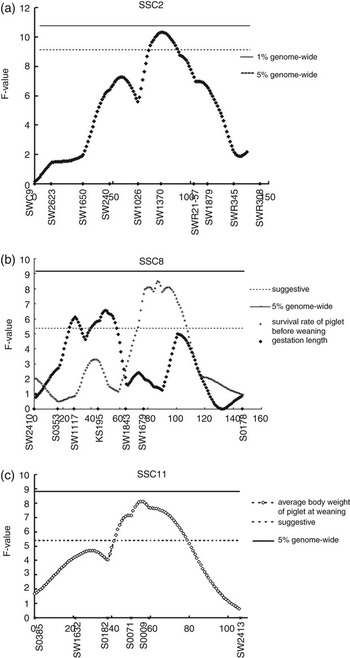
Separate significance thresholds were determined for each trait via experiment-wide permutations. The average of the suggestive, 5% and 1% genome-wide threshold values and their s.d. were 5.39 (0.021), 8.70 (0.262) and 11.08 (0.535), respectively. Three QTL were detected on SSC2, 8 and 12 for gestation length. The QTL at 82 cM on SSC2 achieved 5% genome-wide significance level. It accounted for 5.4% of phenotypic variance and had a 95% CI of 41.0 to 120.0 cM (Figure 1a). The additive effect of −0.72 ± 0.16 for this QTL indicated that sows receiving both alleles from their Meishan granddames had a gestation length of 1.44 days less than sows that inherited both copies from the White Duroc grandsires. A suggestive QTL was identified on SSC8, showing two F-value peaks at 28 cM and 49 cM of this chromosome, respectively (Figure 1b). This QTL also showed significant additive effect. Another suggestive QTL was detected at 86 cM on SSC12, explaining 3.16% of phenotypic variance (Table 3). The dominance effect of this QTL was 0.96 days, indicating that heterozygous sows are expected to have a gestation length of 0.96 longer than the average of the homozygote for the White Duroc allele.
The statistic F-curves showing quantitative trait loci (QTL) for gestation length, survival rate of piglets at weaning and average body weight of piglets at weaning. Markers and distance in cM are given on the x-axis; F-values are shown on the y-axis. (a) 5% genome-wide significant QTL for gestation length on SSC2; (b) suggestive QTL for gestation length and survival rate of piglets at weaning on SSC8; and (c) suggestive QTL for average body weight of piglets at weaning on SSC11.

Details of quantitative trait loci for gestation length and sow maternal ability related traits in the White Duroc × Erhualian F2 resource population

Chr = chromosome; LRT = likelihood ratio test; LOD = log odds score.
*5% genome-wide significant level.
A total of four suggestive QTL were identified for maternal ability related traits. The QTL for survival rate of piglet at weaning was mapped at 86 cM on SSC8, which explains 6.42% of phenotypic variance. The additive effect of 0.05 ± 0.01 for this QTL showed that sows inheriting two alleles from Erhualian granddames had 10% advantage in their offspring survival than sows receiving both alleles from White Duroc grandsires. Three suggestive QTL for average body weight of piglet at weaning were found at 87 cM on SSC3, 55 cM on SSC11 and 32 cM on SSC13, explaining 3.96%, 5.86% and 4.72% of the phenotypic variance, respectively. The alleles from the Erhualian breed at the two loci on SSC11 and SSC13 were associated with increased average body weight of piglet at weaning, but the QTL on SSC3 acted in the opposite directions with the favorable allele derived from the White Duroc breed.
Discussion
In this study, the mean of gestation length in the White Duroc × Erhualian F2 sows was 113.84 days at their first farrowings. The value was comparable with the mean gestation length in a naturally mated West-type population (113.5 to 114.5 days) (Leenhouwers et al., Reference Leenhouwers, Van der Lende and Knol1999; Cassady et al., Reference Cassady, Young and Leymaster2002), but longer than in Iberian × Meishan F2 sows (112.16 days), which were mated with artificial insemination (Casellas et al., Reference Casellas, Varona, Muñoz, Ramírez, Barragán, Tomás, Martínez-Giner, Óvilo, Sánchez, Noguera and Rodríguez2008). Just as the results reported by Sasaki and Koketsu (Reference Sasaki and Koketsu2007), gestation length had a negative correlation with total number of born piglets. The possible explanation for this observation is that large litter size may have a larger placental unit, which release more oxytocin and prostaglandin (Dziuk, Reference Dziuk1991).
The moderate-to-high heritability estimates for gestation length (Hanenberg et al., Reference Hanenberg, Knol and Merks2001; Nguyen et al., Reference Nguyen, McPhee and Wade2006) have increased the potential of this trait as a breeding goal to improve the sow reproduction efficiency. Three QTL were detected for gestation length in this study and the QTL on SSC2 and SSC12 were detected for the first time. Several peaks of F-value curve were shown on SSC8, suggesting that there might be more than one QTL for gestation length on this chromosome (Figure 1b). The peak at 49 cM was consistent with the previous QTL found in a Meishan × large white population (Jiang et al., Reference Jiang, Robinson, Verrinder Gibbins, Gibson, Archibald and Haley2002). In this region Jiang et al. (Reference Jiang, Robinson, Verrinder Gibbins, Gibson, Archibald and Haley2002) found that estrogen sulfotransferase gene showed overdominance effects on gestation length. The peak near the 110 cM was overlapped with QTL region for gestation length reported by Casellas et al. (Reference Casellas, Varona, Muñoz, Ramírez, Barragán, Tomás, Martínez-Giner, Óvilo, Sánchez, Noguera and Rodríguez2008) in the Iberian × Meishan F2 sows, although it did not achieve chromosome significance level. According to the human-pig comparative maps, except the Booroola fecundity gene (BMPR1B) which was related with gilt prolificacy at first parturition (Tomas et al., Reference Tomas, Frigo, Casellas, Ramírez, Ovilo, Noguera and Sánchez2006), there are no other genes associated with animal reproduction near the QTL region. The QTL for gestation length on SSC1, 6, 9, 11 and 15 (Wilkie et al., Reference Wilkie, Paszek, Beattie, Alexander, Wheeler and Schook1999; Casellas et al., Reference Casellas, Varona, Muñoz, Ramírez, Barragán, Tomás, Martínez-Giner, Óvilo, Sánchez, Noguera and Rodríguez2008) were not observed in this study. This could be explained by different breeds or genetic background of founder animals in tested F2 resource populations.
To our knowledge, this is the first report about QTL mapping for maternal ability related traits including survival rate of piglets at weaning and average body weight of piglet at weaning. But no genome-wide significant QTL were detected for these traits in this study. This could be due to the relatively low heritability for these traits (Gäde et al., Reference Gäde, Bennewitz, Kirchner, Looft, Knap, Thaller and Kalm2008) and small size of the F2 population. Another factor is the complex genetic architecture for maternal ability related traits and environmental factors. Moreover, interaction between QTL, for example epistasis, may contribute to complex traits. In mice, two QTL affecting maternal performance for offspring survival were mapped at D2Mit17 + 6 cM and D7Mit21 + 2 cM on chromosomes 2 and 7 (Peripato et al., Reference Peripato, De Brito, Vaughn, Pletscher, Matioli and Cheverud2002), but the two chromosome regions are not homolog to the porcine QTL region detected in this study. The beneficial allele at the QTL on SSC8 for survival rate of piglet at weaning was observed in the Erhualian breed. This result is consistent with the observation that Meishan piglets have 5% advantage in survival rate than large white piglets due to good maternal behavior (van der Steen and de Groot, Reference van der Steen and de Groot1992). We mapped seven QTL for maternal infanticide on SSC2, 6, 14, 15 and X chromosomes in the current population (Chen et al., Reference Chen, Guo, Yang, Yang, Zhang, Yang, Yan, Perez-Enciso, Ma, Duan, Brenig and Huang2009). In comparison, there are no overlapped region among QTL for maternal infanticide and maternal ability related traits. One possible reason for it could be that maternal infanticide is an extreme and failed maternal behavior and belongs to puerperal disease. It cannot be responsible for the ability of sow maternal care.
Many QTL influencing sow reproductive traits were identified on SSC8 in the White Duroc × Erhualian resource population, such as at 80 cM for teat number (Ding et al., Reference Ding, Guo, Knorr, Ma, Mao, Lan, Xiao, Ai, Haley, Brenig and Huang2009), at 77 cM for age at puberty (Yang et al., Reference Yang, Ren, Li, Mao, Guo, Zou, Ren, Ma and Huang2008), at 84 cM for NSB (Li et al., Reference Li, Ren, Xing, Zhang, Ma, Guo and Huang2009), at 86 cM for survival rate of piglets at weaning and at 49 cM for gestation length detected in this study. According to the porcine QTL database (Hu et al., Reference Hu, Dracheva, Jang, Maglott, Bastiaansen, Rothschild and Reecy2005), QTL influencing ovulation rate (Rathje et al., Reference Rathje, Rohrer and Johnson1997), TNB and NBA (King et al., Reference King, Jiang, Gibson, Haley and Archibald2003) have also been mapped to this chromosome. This further confirms that the pig chromosome 8 plays very important roles to porcine female reproduction.
In summary, a whole genome scan was conducted to detect the QTL for gestation length and maternal ability related traits in the White Duroc × Erhualian resource population. Three QTL for gestation length were detected on SSC2, 8 and 12, and the QTL on SSC2 achieved 5% genome-wide significance level. A suggestive QTL was identified on SSC8 for survival rate of piglets at weaning, and three suggestive QTL for average body weight of piglets at weaning were found on SSC3, 11 and 13.
Acknowledgement
This project was supported by National Basic Research Program of China (973 Program, 2006CB102103) and National Natural Science Foundation of China (30760164).