




No CrossRef data available.
Outcome expectations and self-regulation in cancer patients: Reliability, initial factor structure, and relationships with benefit finding
Published online by Cambridge University Press: 03 March 2006
Abstract
Objective: The purpose of this research was to investigate outcome expectation and self-regulation measures within a sample of cancer patients and to explore relationships of these variables with benefit finding. The outcome expectation and self-regulation measures were evaluated for reliability and initial factor structure.
Method: A convenience sample of 141 cancer patients completed study measures while waiting for appointments at a cancer center.
Results: The measures demonstrated good reliability (alphas = .88 and .92, for outcome expectation and self-regulation respectively). Initial factor structure suggested six outcome expectation factors (managing symptoms, expressing emotions, talking about cancer, learning about cancer, managing self-image, and managing needs) and one self-regulation factor. Gender and treatment status were related to outcome expectations but not self-regulation. Outcome expectations and self-regulation were significant predictors of benefit-finding, F(8, 80) = 3.1, p = .005.
Significance of the research: Measures of outcome expectations and self-regulation are reliable, are related to gender and clinical variables, and may be useful as predictors of cancer patients' ability to find benefits in their cancer experience.
Information
- Type
- Research Article
- Information
- Copyright
- © 2005 Cambridge University Press
INTRODUCTION
Social Cognitive Theory (SCT) has been used to predict health behaviors and psychological outcomes for a variety of medically ill populations, including people with arthritis, chronic pain, organ transplants, and cancer (O'Leary et al., 1988; Holman & Lorig, 1992; Buckelew et al., 1994; DeGeest et al., 1995; Lev, 1997; Lev & Owen, 2000). The founder of SCT, Albert Bandura, describes three constructs related to the theory: self-efficacy, outcome expectations, and self-regulation. Self-efficacy, or one's belief in his or her ability to engage in a certain behavior, has been thoroughly researched as both a predictor of behavior and a mechanism of change. For example, self-efficacy has been found to predict healthy eating, regular exercise, cessation of smoking, and adaptation to cancer (cf. Telch & Telch, 1986; Shadel & Mermelstein, 1993; Anderson et al., 2000). In contrast, less systematic research has been conducted with outcome expectations and self-regulation as described by SCT (see Lent et al., 1993; Anderson et al., 2000, for exceptions). Outcome expectations refer to an individual's expectancy regarding the outcome of a behavior, whereas self-regulation is the process by which an individual learns from his or her environment and applies that knowledge to promote adaptive responses in the future. Although expectations and self-regulation have been investigated for decades (e.g., self-regulation model, Carver & Scheier, 1981, 1998; Common Sense Model of Illness, Leventhal et al., 1998, 2003), predictors of these concepts have not been elucidated, measured as consistent with SCT, or assessed within a cancer patient population. Thus, the purpose of the present research was to evaluate the initial psychometric properties of outcome expectation and self-regulation measures designed for a cancer patient population and to evaluate predictors and correlates of these concepts.
Application of Social Cognitive Theory to Oncology
SCT has been used to understand and promote health behaviors and adjustment for individuals with chronic illness (see Holman & Lorig, 1992; Bandura, 1997, ch. 7). Lev (1997) reviewed the application of self-efficacy to oncology and reported that enhancing self-efficacy has led to better adjustment in cancer patients. In addition to self-efficacy, outcome expectations and self-regulation may impact cancer patients' overall quality of life and adjustment to their illness. As evaluated both theoretically and clinically, these components contribute to the interaction between the person and his or her environment (Bandura, 1997; Anderson et al., 2000).
SCT provides a framework that incorporates the individual's interaction with and view of the environment and self. To understand human behavior, it is necessary to have “an integrated causal perspective in which social influences operate through self-processes that produce action” (Bandura, 1997, p. 6). SCT assumes that individuals are able to symbolize their abilities, thus providing a cognitive experience of potential outcomes. Purposive behavior is the result of this cognitive experience. For cancer patients and survivors, purposive behavior can be represented by active coping through information gathering about their diagnosis and treatment, challenging negative expectations, communicating clearly, regulating emotions, and engaging in positive self-care behaviors (Lev, 1997; Graves et al., 2003).
Self-efficacy, outcome expectations, and self-regulation have been defined in detail elsewhere (Bandura, 1997; Graves et al., 2003). In brief, self-efficacy is the “belief in one's capabilities to organize and execute the course of action required to produce given attainments” (Bandura, 1997, p. 3). A psychometrically sound measure of self-efficacy for coping with cancer, the Cancer Behavior Inventory, was developed by Merluzzi et al. (Merluzzi & Martinez Sanchez, 1997; Merluzzi et al., 2001). Self-efficacy significantly predicted survival for cancer patients after controlling for stage of disease (Merluzzi & Nairn, 1999), and level of emotional self-efficacy was related to lower distress in breast cancer survivors (Giese-Davis et al., 1999). Moreover, breast cancer patients' confidence in their ability to care for themselves was related to adjustment (Lev et al., 2001).
In addition to self-efficacy, a part of this mutable process of adaptation to illness is one's expectations about behaviors related to coping and the consequences of those behaviors. Expectancies about the outcome of one's behavior directly influences that behavior, such that when an individual expects a negative outcome from a behavior, he or she is less likely to engage in that behavior, regardless of belief in ability to perform it. For example, a person who is healthy enough to walk for exercise every day may have the utmost confidence that she could walk when it was raining, but because of expectations about becoming damp and cold, may not engage in walking on a rainy day. Outcome expectations are categorized as the “physical, social, and self-evaluative expectations one holds for the outcome of one's behaviors” (Graves et al., 2003, p. 123). For example, physical outcome expectations are thoughts related to how one expects to feel after a certain behavior, such as expecting to experience nausea after chemotherapy.
Outcome expectations are shaped though a self-regulatory process. Self-regulation “refers to the process of planning, monitoring, and changing one's behaviors and cognitions to correspond with abilities, the environment, and desired outcomes” (Graves, 2003, p. 123). Self-regulation occurs as a person interacts with his or her environment, selecting or altering behavior or the environment in a manner that maximizes adaptation. Personal standards are adopted in which people place value on certain behavioral outcomes; appraisal of whether behavior is consistent with these standards leads to the creation of strategies that motivate and guide the behavior (Maddux, 1995).
For individuals with cancer, self-regulation helps create attainable and incrementally more challenging goals to improve overall functioning. The practice and feedback aspects of SCT help an individual learn to use self-regulation to attain goals. Self-regulation is an integration of self-efficacy and outcome expectations, with each component reciprocally influencing the other. Being able to appropriately self-regulate when faced with a serious illness is important for adjustment and quality of life of cancer patients (Scheier & Carver, 2003).
Outcome Expectations, Self-Regulation, and Benefit Finding
Positive or negative outcome expectations, as well as a person's ability to appropriately self-regulate, may influence a person's overall assessment of his or her cancer experience. Adapted from literatures related to finding meaning out of trauma or tragedy, the concept of benefit finding has also been evaluated in individuals with cancer. Benefit finding refers to patients' perceived benefits arising from their cancer experience (Antoni et al., 2001). As benefit finding necessitates reframing cognitions and engaging in reappraisal of a challenging situation, it is likely related to outcome expectations and self-regulation.
To identify benefits from a traumatic experience such as cancer, one has to engage in cognitive appraisal of the experience. A cancer patient must first recognize the areas in which the illness and/or treatment is challenging before being able to label and act on opportunities for growth. Evidence from previous research suggests that the ability to find benefit from breast cancer is related to better adjustment (Carver et al., 1993; Stanton & Snider, 1993). In other literatures, finding benefit in a traumatic event represents more than the absence of distress and is not systematically related to the amount of time passed since the event (Burt & Katz, 1987; Fromm et al., 1996).
As suggested by Scheier and Carver (2003), illness characteristics may influence expectancies and self-regulation strategies and thus provide information for how to tailor interventions. To date, no research has evaluated whether demographic (age, gender, race) or clinical (stage of disease, type of cancer, or treatment status) variables relate to cancer patients' outcome expectations and self-regulation. Further, no research has been conducted to evaluate the relationship between outcome expectations, self-regulation, and benefit finding. Thus the purposes of this article were threefold: (1) to evaluate internal consistency reliabilities and initial factor structure of outcome expectation and self-regulation measures designed for a cancer patient population, (2) to investigate the influence of demographic and clinical variables on cancer patients' outcome expectations and self-regulation, and (3) to examine whether outcome expectations and self-regulation predict benefit finding. For this third objective, we hypothesized positive relationships between the SCT variables and benefit finding.
METHOD
Participants
Participants (N = 141) were recruited from a regional cancer center in the southern United States. Eligibility criteria were a diagnosis, regardless of stage of disease, of any type of cancer and ability to read and write in English. Participants ranged in age from 21 to 83 years, with a mean of 56.1 years of age (SD = 12.6). The convenience sample was predominately female (78%), and, of the subsample (n = 45) for which race was measured, 68.9% reported Caucasian ethnicity, 28.9% African American ethnicity, and 2.2% American Indian ethnicity. Race was measured in a subsample as it was not initially included with the demographic items. The majority of respondents indicated they were currently receiving treatment (69.5%). A variety of cancer types and treatment approaches were reported; demographic data are reported in Table 1.
Demographic characteristics of sample (N = 141)

Measures
Demographic and clinical information was obtained with a paper and pencil instrument. Patients reported age, sex, treatment status, type of treatment, and type and stage of cancer. A subset of the participants were asked to report race (n = 45).
Benefit finding was measured by the instrument created by Antoni et al. (2001). This 17-item measure demonstrates good internal reliability (alpha = 0.95) and sound test–retest reliability (alpha = 0.87). Responses were rated on a 5-point Likert scale from not at all to extremely. Sample items include: “Having had cancer has led me to be more accepting of things,” and “Having had cancer has shown me that all people need to be loved.” As described by Antoni et al. (2001, p. 23), this scale assesses benefit finding across a variety of domains: “acceptance of life's imperfections, becoming more cognizant of the role of other people in one's life, and developing a sense of purpose in life.”
Outcome expectations and self-regulation were assessed by measures developed by the first author using guidelines set by Bandura (1997).1
Copies of the measures can be obtained from Kristi D. Graves.
The 22-item self-regulation measure included items assessing participants' problem solving and planning as related to their cancer treatment and the future. For example, participants were asked about goal setting, self-care activities, and problem solving. The self-regulation scale was also piloted on a sample of 32 women with breast cancer and had an initial coefficient alpha of 0.88 (Graves et al., 2003).
Procedures
Cancer center volunteers approached potential participants regarding their interest in completing some surveys while waiting for their appointment. Interested patients were given a packet of questionnaires containing the study measures and demographic survey. Study measures took approximately 20 min to complete. Participants were instructed by the volunteers to avoid including their name on any of the survey forms. All participants were given a coupon for a free gift from the cancer center gift store (value of $5.00).
Analyses
To examine the psychometric properties of the outcome expectation and self-regulation measures, reliability analyses for internal consistency were conducted for the entire set of items for each measure and for subscale items of the outcome expectation measure. Items for the outcome expectation and self-regulation measures were factor analyzed separately through exploratory factor analysis (EFA) with the principal axis factor extraction method. Guidelines set forth by Fabrigar et al. (1999) suggest that EFA is appropriate when the goal is to identify latent constructs, when the total number of measured variables (in this case, items) is at “least three to five times the number of expected factors” (p. 273), and when the measures to be evaluated are reliable. Further, Fabrigar et al. indicate that in most situations, use of samples of convenience is acceptable for EFA.
Scree plots and parallel analysis were used to determine the appropriate number of factors to extract. Parallel analysis compares the eigenvalues of the reduced correlation matrix from observed data with the eigenvalues of the reduced correlation matrix from random data (Montanelli & Humphreys, 1976). Parallel analysis is useful in that it elucidates whether a factor accounts for more variance than one would expect to occur by chance. Following the extraction of factors, oblique rotation (promax) was used as the factors were hypothesized to be correlated.
Depending on the characteristics of the variables, Pearson, biserial, or point-biserial correlations were calculated to examine relationships among demographic variables, outcome expectations, self-regulation, and benefit finding. Regression analyses were conducted to explore whether demographic and clinical variables predicted outcome expectations and self-regulation. Further, outcome expectations and self-regulation were evaluated as predictors of benefit finding through a regression analysis.
RESULTS
Of 200 packets distributed by volunteers to patients in the waiting room, 141 (70.5%) were returned with the demographic survey and with over 75% complete data for the entire survey packet. The primary reasons for declining participation were not having enough time or not being interested in completing surveys. Individuals with less than 75% complete data differed from participants with complete data on stage of disease and type of cancer. Noncompleters were less likely to report their stage of disease than completers, t(61) = −2.4, p < 0.05, and were more likely to be diagnosed with gynecologic or lung cancer than completers. Of the 141 returned surveys, missing data constituted less than 4% of the data and were replaced with the series mean.
Internal Consistency Reliability
Analyses were conducted to evaluate the internal consistency reliability of the outcome expectation, self-regulation, and benefit-finding measures. In addition to the complete measure, reliability for the initial five subscales was also evaluated: learning about cancer and its treatment, having a positive attitude, talking about cancer, engaging in relaxation, and setting goals. For the subscale of learning about cancer, one item had low item-scale correlation and was thus deleted (“If I learned about my cancer and its treatment, I would worry that I could not meet the needs of my family”). Similarly, one item was deleted from two of the four other subscales to enhance reliability: maintaining a positive attitude (“If I looked at the positive side of having cancer, I would not be facing reality”), and setting goals (“If I set goals related to my illness, I would be pretending to control things I can't control”). Thus, the final measure consisted of 57 items with a coefficient alpha of 0.88. Coefficient alphas for the subscales of the outcome expectation measure were: learning about cancer (r = 0.74), having a positive attitude (r = 0.76), talking about cancer (r = 0.82), engaging in relaxation (r = 0.86), and setting goals (r = 0.62).
Reliability analyses for the self-regulation measure evidenced a strong alpha coefficient, r = 0.92. The benefit-finding scale demonstrated sound reliability (r = 0.93), similar to alpha coefficients reported for this scale in previous research (Antoni et al., 2001; Stanton et al., 2002).
Factor Analysis
The items of the outcome expectation and self-regulation scales were used to construct and factor analyze correlation matrices. For the outcome expectation measure, the parallel analyses suggested six to eight factors be extracted. Evaluation of the Scree plot suggested six factors, and the six-factor solution demonstrated a root mean square off-diagonal residual of 0.05. Eigenvalues ranged from 1.8 to 10.0. The following six factors were identified for the outcome expectation measure (see the appendix for items within each factor): managing emotional and physical symptoms, expressing emotions and maintaining a positive attitude, talking about cancer with one's partner and family, learning about cancer and its treatment, managing negative outcomes related to self-image, and managing illness and treatment needs. The final scale consisted of 51 items; six items were dropped because they loaded at less than 0.40. Internal-consistency reliability for the six outcome expectation factors and the 51-item scale were good: 0.89 for managing emotional and physical symptoms, 0.84 for expressing emotions and maintaining a positive attitude, 0.86 for talking about cancer with one's family, 0.82 for learning about cancer and its treatment, 0.82 for managing negative outcomes related to self-image, 0.79 for managing illness and treatment needs, and 0.90 for all 51 items together.
Parallel analyses with the self-regulation measure suggested one factor was appropriate. Further, evaluation of the Scree plot also suggested one factor. The one factor solution had root mean square off-diagonal residuals of 0.08. The eigenvalue for the one factor solution was 8.05.
Correlational Relationships among Study Variables
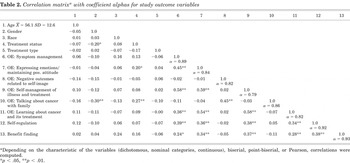
As shown in Table 2 several statistically significant correlations emerged between benefit finding, self-regulation, and factors of the outcome expectation measure. On average, cancer patients in this sample reported finding benefit in their experience with the illness, as the mean response was 4.07 on the 5-point Likert scale.
Correlation matrixa with coefficient alphas for study outcome variables

Several statistically significant relationships emerged among demographic characteristics and subscales on the outcome expectation measure. Specifically, gender (rpb = −0.30, p < 0.01) and treatment status (rb = 0.27, p < 0.01) were related to expectations for talking about cancer with one's partner and family. Men had lower expectations than women regarding outcomes associated with talking about their illness, and participants who were receiving treatment had higher expectations related to talking about cancer than participants off treatment. Treatment status was also related to expectations for expressing emotions and maintaining a positive attitude (rb = 0.20, p < 0.05), such that individuals on-treatment scored higher than individuals off-treatment. SCT variables were related to benefit finding: outcome expectations for managing emotional and physical symptoms (r = 0.24), expressing emotions and maintaining a positive attitude (r = 0.34), managing illness and treatment needs (r = 0.37), learning about cancer (r = 0.36), and self-regulation (r = 0.39), all p values < 0.05.
Regression Analyses
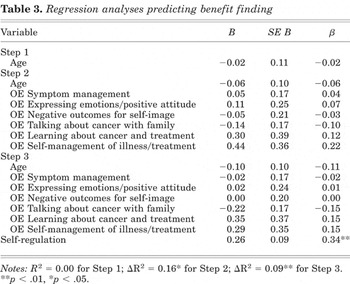
Regression analyses were used to further evaluate relationships among demographic, clinical, SCT variables, and benefit finding. Treatment status and gender were entered simultaneously into the regression model and predicted outcome expectations for talking about cancer with one's family, F(2,117) = 8.6, p < 0.01. Specifically, gender (beta = −0.24, p < 0.01) and treatment status (beta = 0.22, p < 0.05) were significant predictors of expectations for talking about cancer. For expectations related to expressing emotions and maintaining a positive attitude, currently receiving treatment was a significant predictor, F(1,125) = 5.0, p < 0.05. To evaluate the impact of outcome expectations and self-regulation on benefit finding, age was entered first into the equation, as it has been found to be related to benefit finding (Lechner et al., 2003). The six outcome expectation factors were entered next, followed by self-regulation. Age was not a significant predictor, whereas outcome expectation factors and self-regulation were significant predictors of benefit finding, F(8,80) = 3.1, p < 0.01. Results are presented in Table 3.
Regression analyses predicting benefit finding

DISCUSSION
The purpose of this study was to evaluate outcome expectation, self-regulation, and benefit-finding measures in a sample of cancer patients with mixed diagnoses. The moderate to strong reliability coefficients indicate the potential utility of including measures of outcome expectation and self-regulation in studies with cancer patients. Specifically, the outcome expectation measure provides a way to assess patients' expectations about engaging in certain coping behaviors: managing emotional and physical symptoms, expressing emotions and maintaining a positive attitude, talking about cancer with one's family, learning about cancer and its treatment, managing negative outcomes related to self-image, and managing one's illness and treatment needs. Use of the outcome expectation measure could identify individuals with negative expectations that may limit the likelihood of using effective coping strategies, thereby influencing their ability to adapt to illness in a psychologically healthy manner. For example, individuals who endorsed low expectations for outcomes associated with talking about their diagnosis with their physician could be instructed in how to communicate assertively without perceiving themselves as difficult patients. Further, patients who expect negative outcomes for communicating with their partners and/or families may inhibit their concerns and emotions. Such inhibition may lead to strained relationships or increased anxiety for the patient and family members.
Likewise, sound reliability coefficients indicate that the self-regulation measure may have utility in identifying those patients with skill deficits related to goal setting, communicating, planning, and engaging in self-care activities. The initial factor analyses suggested that this scale represents one construct. The statistically significant positive correlations between self-regulation and benefit finding indicate that individuals who report more self-regulative skills such as goal setting, taking time for themselves, providing rewards for meeting goals, and planning are also more likely to report personal growth through their experience of cancer.
Benefit finding was also positively related to outcome expectations for learning about cancer and treatment, managing emotional and physical symptoms, expressing emotions and maintaining a positive attitude, and managing illness and treatment needs. Having higher expectations for outcomes related to learning about cancer and its treatment may be related to higher levels of benefit finding because individuals who want to learn more about their illness are more likely to be cognitively engaged in searching for positive meaning or evaluating changes they have experienced as a result of cancer or its treatment. Managing symptoms, expressing emotions and maintaining a positive attitude, and managing one's needs as a patient (e.g., activity level, fatigue) may be related to benefit finding, as they represent active coping strategies. Learning how to manage stress and anxiety was the focus of the intervention by Antoni et al. (2001) that resulted in higher levels of benefit finding. Similar to the relationship between emotional expression and adjustment (Lepore, 2001), emotional expression and benefit finding may be related to one's cognitive processing of thoughts and concerns, particularly when occurring within a supportive environment.
The lack of statistically significant relationships among demographic variables and benefit finding indicates that the ability to experience growth from a cancer diagnosis is not dependent on disease stage, gender, race, or age. The finding that age and disease severity were not related to growth differs from results of a study by Lechner et al. (2003). These researchers found that younger age was associated with higher benefit-finding scores, whereas individuals with Stage II disease found more benefit than those with Stage I or Stage IV cancer diagnoses. In the present study, younger age was associated with having positive expectations for talking about cancer. Talking about and expressing emotions related to cancer within a supportive environment is related to better adjustment (Lepore, 2001). As many of the participants in the present study either did not know or were unsure of their cancer staging, low power may have contributed to our inability to detect statistically significant relationships between stage of disease and benefit finding (Lipsey, 1990).
The experience of growth during or after a life-threatening diagnosis is likely related to holding positive outcome expectations for behaviors related to coping with the diagnosis. Likewise, finding benefit and/or meaning in cancer may be related to a person's ability to self-regulate or learn from a situation and apply new knowledge to future challenges. Prior research has identified that a substantial number of cancer patients indicate growth, including a renewed sense of purpose, a shift in life priorities, greater spirituality, and improved relationships (Dow et al., 1996; Fromm et al., 1996; Snodgrass, 1998). Postcancer growth is supported by the results of this study, as the average level of benefit reported was 4 on a 5-point scale, indicating respondents perceived quite a bit of benefit from having had cancer.
Relationships emerged among treatment status and outcome expectations related to emotional expression/maintaining a positive attitude and talking about cancer. These results are to be expected, as individuals currently undergoing treatment are often hopeful that their treatments are working to prevent further spread of the disease or remove it completely. In addition, these patients are more likely to have positive outcome expectations related to talking about their disease, as they are in circumstances that promote discussion of their illness during physician visits and treatment sessions.
Men had less positive outcome expectations related to talking about their cancer; this finding supports the idea that men may disclose less information than women because they do not expect positive consequences for disclosure. Further exploration of the reason behind these expectations, other than the “traditional” male role, would be interesting. Perhaps men would benefit from an intervention in which they are encouraged to disclose their thoughts and feelings in a completely anonymous manner. Expressive writing could serve as such an intervention; this technique has recently been applied to the psychooncology setting (Stanton et al., 2002) and requires further investigation in terms of the types of populations that may benefit the most (i.e., men or individuals with low social support).
The results of this study highlight the utility of outcome expectation and self-regulation measures and demonstrate how these constructs are related to benefit finding in a sample of cancer patients. Despite these contributions, several limitations should be noted. A convenience sample of patients in a cancer center waiting room was used; thus the generalizability of the findings is limited. For this study, the research question involved testing theoretical constructs and thus using a heterogeneous convenience sample is less of a concern than it would be if the research question involved evaluation of the prevalence of a specific phenomenon that may interact with study variables of interest. Heterogeneity of disease type is useful for evaluating the SCT measures in a diverse sample; however, patients within specific diagnostic categories may respond differently than participants in this study. For example, patients with rectal cancer may report more negative outcome expectations for talking about illness and treatment side effects than patients with melanoma. Future studies could investigate the utility of the outcome expectation and self-regulation measures within specific populations. In addition to the heterogeneity of disease sites, the majority of the participants were female (77.3%). Women may have been more likely to complete the surveys because the incentive for survey completion consisted of a gift certificate to a boutique. The sample bias is somewhat reflected in the findings that men hold more negative outcome expectations related to talking about their disease; thus men may be less inclined to complete surveys about their attitudes regarding cancer when approached in the waiting room.
The results from the EFA should be interpreted with caution. Factor analysis necessitates a large number of people for measures with many items. In addition, true comparison of the outcome expectation and self-regulation measure will need to be made with other psychometrically sound scales. For example, the cancer patients' scores on the SCT measures in this study can be compared with validated quality of life measures as well as measures of depression, anxiety, and coping style. Although a measure of self-efficacy was included in the pilot evaluation of the outcome expectation and self-regulation scales (Graves et al., 2003), inclusion of self-efficacy in a study with a larger sample size would be helpful.
Exciting possibilities exist for future research involving outcome expectations, self-regulation, and benefit finding in cancer patient populations. First, these measures can be used to examine models of positive outcomes for cancer patients. Specifically, a study including a diverse sample of cancer patients can investigate what SCT factors contribute to overall quality of life and/or coping style. Thorough evaluation of the psychological characteristics that contribute to beneficial coping strategies as well as quality of life would be helpful in identifying areas for psychological intervention. Moreover, results from the current study suggest the need to evaluate gender differences in expression related to illness. Which type of interventions might most benefit men who report negative outcome expectations associated with talking about cancer? Is expression actually related to improvements in quality of life? Initial evidence in this area suggests that individuals who are able to express their deepest thoughts and feelings related to their illness have better physical functioning (Smyth et al., 1999; Stanton et al., 2002). These findings can be explored within a cancer patient population so that tailored and effective services can be provided for patients in need of additional psychological and social support.
ACKNOWLEDGMENTS
Support for this research was provided by the Charleston Consortium Psychology Internship Program at the Medical University of South Carolina and by a National Research Service Award from the National Cancer Institute (F32CA97760).
APPENDIX: SAMPLE ITEMS FOR OUTCOME EXPECTATION FACTORS AND SELF-REGULATION SCALE
Factor 1: Managing Emotional and Physical Symptoms
If I relaxed, I would feel more in control of my emotions.
If I relaxed, I would be less afraid of having a recurrence.
If I relaxed, I would be better able to handle any nausea I experience.
Factor 2: Expressing Emotions and Maintaining a Positive Attitude
If I looked at the positive side of having cancer, I would be able to take advantage of each day.
If I looked at the positive side of having cancer, I would not worry about the future as much.
If I looked at the positive side of having cancer, I would feel closer to my family and friends.
Factor 3: Talking about Cancer with One's Partner and Family
If I talked with my partner about my cancer, it would put extra stress on our relationship.
If I talked with my partner about changes in my body due to treatment, I would be embarrassed.
If I talked with my partner about costs of treatment, I would feel like a burden.
Factor 4: Learning about Cancer and Its Treatment
If I learned about cancer and its treatment I would be able to communicate with others about my illness.
If I learned about cancer and its treatment I would feel better about my relationship with my doctor.
If I learned about cancer and its treatment I would be more able to accept changes in my body from treatment (hair loss, fatigue, etc.)
Factor 5: Managing Negative Outcomes Related to Self-Image
If I looked at the positive side of having cancer, I would feel foolish.
If I talked with my doctor about my illness, I would feel too pushy.
If I talked with my doctor about my illness, I would feel disrespectful.
Factor 6: Managing One's Illness and Treatment Needs
If I learned about cancer and its treatment I would be able to set proper limits for myself.
If I talked with my doctor about my illness, I would be able to get the information I need.
If I relaxed, I would not be as nervous when I talk to my doctor.
Self-Regulation Sample Items
I plan ways to make my treatment sessions more bearable.
If I have negative emotions about something, I try to make them more positive.
I write down questions I have about my illness or treatment so I can ask the doctor or nurse.
I know how to recognize when I have a negative thought about something.
I look for information I need to make decisions about my cancer treatment.
I try to realize when I need to take a break and rest.
References
REFERENCES
Anderson, E.S.,
Winett, R.A., &
Wojcik, J.R.
(2000).
Social cognitive determinants of nutrition behavior among
supermarket food shoppers: A structural equation analysis.
Health Psychology,
19,
479–486.Google Scholar
Antoni, M.H.,
Lehman, L.M.,
Kilbourn, K.M.,
et al.
(2001).
Cognitive-behavioral stress management intervention decreases the
prevalence of depression and enhances benefit finding among women under
treatment for early-stage breast cancer.
Health Psychology,
20,
20–32.Google Scholar
Bandura, A.
(1997)
Self-efficacy: The Exercise of Control.
New York:
W.H. Freeman.
Buckelew, S.P.,
Parker, J.C.,
Keefe, F.J.,
et al.
(1994).
Self-efficacy and pain behavior among subjects with
fibromyalgia.
Pain,
59,
377–384.Google Scholar
Burt, M.R. &
Katz, B.L.
(1987).
Dimensions of recovery from rape: Focus on growth outcomes.
Journal of Interpersonal Violence,
2,
57–81.Google Scholar
Carver, C.S.,
Pozo, C.,
Harris, S.D.,
et al.
(1993).
How coping mediates the effect of optimism on distress: A study of
women with early stage breast cancer.
Journal of Personality and Social Psychology,
65,
375–390.Google Scholar
Carver, C.S. &
Scheier, M.F.
(1981).
Attention and Self-Regulation: A Control-Theory Approach to Human
Behavior.
New York:
Springer Verlag.
Carver, C.S. &
Scheier, M.F.
(1998).
On the Self-Regulation of Behavior.
New York:
Cambridge University Press.
DeGeest, S.,
Borgermans, L.,
Gemoets, H.,
et al.
(1995).
Incidence, determinants, and consequences of subclinical
noncomliance with immunosuppressive therapy in renal transplant
recipients.
Transplantation,
59,
340–346.Google Scholar
Dow, K.H.,
Ferrell, B.R.,
Leigh, S.,
et al.
(1996).
An evaluation of the quality of life among long-term survivors of
breast cancer.
Breast Cancer Research and Treatment,
39,
261–273.Google Scholar
Fabrigar, L.R.,
Wegener, D.T.,
MacCallum, R.C.,
et al.
(1999).
Evaluating the use of exploratory factor analysis in psychological
research.
Psychological Methods,
4,
272–299.Google Scholar
Fromm, K.,
Andrykowski, M.A., &
Hunt, J.
(1996).
Positive and negative psychosocial sequelae of bone marrow
transplantation: Implications for quality of life assessment.
Journal of Behavioral Medicine,
19,
221–240.Google Scholar
Giese-Davis, J.,
Koopman, C.,
Butler, L.D.,
et al.
(1999).
Self-efficacy with emotions predicts higher quality of life in
primary breast cancer patients. Annals of Behavioral
Medicine,
21,
S199.Google Scholar
Graves, K.D.
(2003).
Social cognitive theory and cancer patients' quality of life:
Meta-analysis of psychosocial intervention components.
Health Psychology,
22,
210–219.Google Scholar
Graves, K.D.,
Carter, C.L.,
Anderson, E.S.,
et al.
(2003).
Quality of life pilot intervention for breast cancer patients: Use
of social cognitive theory.
Palliative and Supportive Care,
1,
121–134.Google Scholar
Holman, H. &
Lorig, K.
(1992).
Perceived self-efficacy in self-management of chronic
disease. In
Self-Efficacy: Thought Control of Action,
Schwarzer, R. (ed.), pp.
305–323.
Washington, DC:
Hemisphere.
Lechner, S.C.,
Zakowski, S.G.,
Antoni, M.H.,
et al.
(2003).
Do sociodemographic and disease-related variables influence
benefit-finding in cancer patients?
Psycho-Oncology,
12,
491–499.Google Scholar
Lent, R.W.,
Lopez, F.G., &
Bieschke, K.J.
(1993).
Predicting mathematics-related choice and success behaviors: Test of
an expanded social cognitive model.
Journal of Vocational Behavior,
42,
223–236.Google Scholar
Lepore, S.J.
(2001).
A social cognitive processing model of emotional adjustment to
cancer. In
Psychosocial Interventions for Cancer,
Baum, A. &
Anderson, B.L. (eds.), pp.
99–116.
Washington, DC:
American Psychological Association.
Lev, E.L.
(1997).
Bandura's theory of self-efficacy: Applications to
oncology.
Scholarly Inquiry for Nursing Practice: An International
Journal,
11,
21–37.Google Scholar
Lev, E.L.,
Daley, K.M.,
Conner, N.E.,
et al.
(2001).
An intervention to increase quality of life and self-care
self-efficacy and decrease symptoms in breast cancer patients.
Scholarly Inquiry for Nursing Practice,
15,
277–294.Google Scholar
Lev, E.L. &
Owen, S.V.
(2000).
Counseling women with breast cancer using principles developed by
Albert Bandura.
Perspectives in Psychiatric Care,
36,
131–138.Google Scholar
Leventhal, H.,
Brissett, I., &
Leventhal, E.
(2003).
The common-sense model of self-regulation of health and
illness. In
The Self-Regulation of Health and Illness Behavior,
Cameron, L.D. &
Leventhal, H. (eds.), pp.
42–65.
London:
Routledge.
Leventhal, H.,
Leventhal, E.A., &
Contrada, R.J.
(1998).
Self-regulation, health and behavior: A perceptual-cognitive
approach.
Psychology and Health,
13,
717–733.Google Scholar
Lipsey, M.W.
(1990).
Design Sensitivity: Statistical Power for Experimental
Research.
Newbury Park, CA:
Sage.
Maddux, J.E.
(1995).
Self-efficacy theory: An introduction. In
Self-Efficacy, Adaptation, and Adjustment: Theory, Research and
Application,
Maddux, J.E. (ed.), pp.
3–36.
New York:
Plenum.
Merluzzi, T.V. &
Martinez Sanchez, M.A.
(1997).
Assessment of self-efficacy and coping with cancer: Development and
validation of the Cancer Behavior Inventory.
Health Psychology,
16,
163–170.Google Scholar
Merluzzi, T.V. &
Nairn, R.C.
(1999).
An exploration of self-efficacy and longevity in persons with
cancer.
Annals of Behavioral Medicine,
21,
S200.Google Scholar
Merluzzi, T.V.,
Nairn, R.C.,
Hedge, K.,
et al.
(2001).
Self-efficacy for coping with cancer: Revision of the Cancer
Behavior Inventory (version 2.0).
Psycho-Oncology,
10,
206–217.Google Scholar
Montanelli, R.G. &
Humphreys, L.
(1976).
Latent roots of random data correlation matrices with squared
multiple correlations on the diagonal: A Monte Carlo study.
Psychometrika,
41,
341–348.Google Scholar
O'Leary, A.,
Shoor, S.,
Lorig, K.,
et al.
(1988).
A cognitive-behavioral treatment for rheumatoid arthritis.
Health Psychology,
7,
527–544.Google Scholar
Shadel, W.G. &
Mermelstein, R.J.
(1993).
Cigarette smoking under stress: The role of coping expectancies
among smokers in a clinic-based smoking cessation program.
Health Psychology,
12,
443–450.Google Scholar
Scheier, M.F. &
Carver, C.S.
(2003).
Goals and confidence as self-regulatory elements underlying health
and illness behavior. In
The Self-Regulation of Health and Illness Behavior,
Cameron, L.D. &
Leventhal, H. (eds.), pp.
17–41.
London:
Routledge.
Smyth, J.M.,
Stone, A.A.,
Hurewitz, A.,
et al.
(1999).
Effects of writing about stressful experiences on symptom reduction
in patients with asthma or rheumatoid arthritis.
Journal of the American Medical Association,
281,
1304–1309.Google Scholar
Stanton, A.L.,
Danoff-Burg, S.,
Sworowski, L.A.,
et al.
(2002).
Randomized, controlled trial of written emotional expression and
benefit finding in breast cancer patients.
Journal of Clinical Oncology,
20,
4160–4168.Google Scholar
Stanton, A.L. &
Snider, P.R.
(1993).
Coping with a breast cancer diagnosis: A prospective study.
Health Psychology,
12,
16–23.Google Scholar
Telch, C.F. &
Telch, M.J.
(1986).
Group coping skills instruction and supportive group therapy for
cancer patients: A comparison of strategies.
Journal of Consulting and Clinical Psychology,
54,
802–808.Google Scholar

Demographic characteristics of sample (N = 141)
Correlation matrixa with coefficient alphas for study outcome variables
Regression analyses predicting benefit finding
 You have
Access
- 10
- Cited by