Weed resistance is a serious global concern, causing extensive crop damage and economic loss. Resistant weeds are difficult to control with conventional herbicides. Two types of mechanisms confer resistance to the acetyl-coA carboxylase (ACCase)-inhibiting herbicides: target-site resistance (TSR) and non–target-site resistance, with the former being more common (Délye Reference Délye2005; Powles and Yu Reference Powles and Yu2010). Substitution of amino acids in the carboxyl transferase (CT) domain of ACCase usually results in TSR. Thus far, 14 amino acid substitutions have been identified at seven sites in the ACCase CT domain: Ile1781 to Val, Leu, Thr, or Gla; Trp1999 to Cys, Leu, or Ser; Trp2027 to Cys; Ile2041 to Asn or Val; Asn2078 to Gly; Cys2088 to Arg; and Gly2096 to Ala or Ser (Délye et al. Reference Délye, Zhang, Michel, Matéjicek and Powles2005; Jang et al. Reference Jang, Marjanovic and Gornicki2013; Kaundun et al. Reference Kaundun, Bailly, Dale, Hutchings and McIndoe2013; Liu et al. Reference Liu, Harrison, Chalupska, Gornicki, O’Donnell, Adkins, Haselkorn and Williams2007; Pan et al. Reference Pan, Li, Zhang, Zhang and Dong2015b, Reference Pan, Li, Zhang and Dong2015c; Scarabel et al. Reference Scarabel, Panozzo, Varotto and Sattin2011; Xu et al. Reference Xu, Zhu, Wang, Li and Dong2013, Reference Xu, Li, Zhang, Cheng, Jiang and Dong2014a; Yu et al. Reference Yu, Collavo, Zheng, Owen, Sattin and Powles2007b). These mutations can confer different patterns of resistance to the ACCase-inhibiting herbicides.
ACCase (EC.6.4.1.2), a biotin-dependent enzyme, catalyzes the first key step of fatty-acid biosynthesis in plants (Zhang et al. Reference Zhang, Yang, Shen and Tong2003). Three chemically distinct classes of the ACCase-inhibiting herbicides include aryloxyphenoxypropionates (APP), cyclohexanediones (CHD), and phenylpyrazolines (DEN). Since the late 1970s, the ACCase-inhibiting herbicides have been used globally to control grass weeds. The world’s first case of an ACCase-inhibiting herbicide-resistant weed, rigid ryegrass (Lolium rigidum Gaudin), was reported in Australia in 1986 (Heap and Knight Reference Heap and Knight1986). To date, the resistance to ACCase-inhibiting herbicides has been reported in approximately 47 grass weed species worldwide (Heap Reference Heap2016). Previous reports have shown that the amino acid substitutions Ile1781 to Val or Leu or Thr, Asn2078 to Gly, and Cys2088 to Arg confer resistance to all APP, CHD, and DEN herbicides. The amino acid substitutions Trp2027 to Cys, Ile2041 to Asn or Val, and Gly2096 to Ala or Ser confer resistance to APP and DEN herbicides. Only Trp1999 to Cys or Leu or Ser substitution confers resistance to fenoxaprop-P-ethyl (Délye et al. Reference Délye, Calmès and Matéjicek2002a, Reference Délye, Matéjicek and Gasquez2002b, Reference Délye, Zhang, Chalopin, Michel and Powles2003; Kaundun Reference Kaundun2010; Petit et al. Reference Petit, Bay, Pernin and Delye2010).
Keng stiffgrass is a serious farmland grass weed distributed in winter wheat fields and rice–wheat rotation-cropping systems. It has become a troublesome and predominant weed in eastern China. In recent decades, Keng stiffgrass has been successfully controlled by POST application of ACCase-inhibiting herbicides in China (Zhang Reference Zhang2003). However, the excessive and persistent use of ACCase-inhibiting herbicides has led to the emergence of serious resistance in this species. Recently, Yuan et al. (Reference Yuan, Liu, Bi, Du, Guo and Wang2015) have reported that Keng stiffgrass has evolved resistance to several APP herbicides. They found two resistant Keng stiffgrass populations from Shandong Province, 12-SD-12 and 12-SD-13, which harbored TSR mutations and confirmed slight resistance to fenoxaprop-P-ethyl and pinoxaden. However, their study reported only the molecular mechanism and cross-resistance in Keng stiffgrass; the biochemical mechanism and multiresistant cases remain unknown.
Therefore, the main objectives of this study were (1) to screen the susceptibility of a Keng stiffgrass population originating from Jiangdu, JYJD-2, to fenoxaprop-P-ethyl; (2) to investigate the cross- and multiple resistance of the resistant population JYJD-2 to various herbicides; (3) to elucidate the molecular and biochemical mechanisms underlying fenoxaprop-P-ethyl resistance in Keng stiffgrass; and (4) to develop derived cleaved amplified polymorphic sequence (dCAPS) markers to identify the target-site mutation, W1999C, associated with herbicide resistance in Keng stiffgrass.
Materials and Methods
Plant Materials
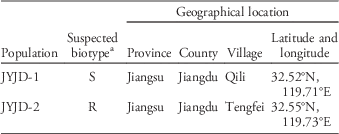
Seeds of the suspected resistant Keng stiffgrass population (JYJD-2) were collected from a wheat field in Jiangdu, Jiangsu province, in 2015; this field had been treated with fenoxaprop-P-ethyl for more than 5 yr, and the JYJD-2 population was hardly controlled by fenoxaprop-P-ethyl. Seeds from a susceptible population (JYJD-1) were collected from the roadside several kilometers away from the wheat field where JYJD-2 was collected (Table 1). To break dormancy, the collected seeds were buried in soil for 30 d under natural conditions and subsequently stored in paper bags at 4 C until further use (Rao et al. Reference Rao, Dong, Li and Zhang2008).
Location of collection sites for Keng stiffgrass populations used in this study.

a Abbreviations: S, susceptible; R, resistant.
Herbicides and Chemicals
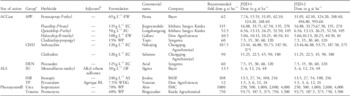
The herbicides listed in Table 2 were used for the whole-plant pot bioassay experiments.
Herbicide treatments applied for dose–response tests.

a Abbreviations: APP, aryloxyphenoxypropionates; CHD, cyclohexanediones; DEN, phenylpyrazolines (DEN); SU, sulfonylurea; IMI, imidazolinone; TP, triazolopyrimidine; EW, emulsion in water; EC, emulsifiable concentrate; WP, wettable powder; OF, oil-miscible flowable; AS, aqueous solution; WDG, water-dispersible granules.
b Dash (—) indicates no adjuvants are added.
The standard-grade fenoxaprop (free acid) used for the ACCase assay was supplied by Dr. Ehrenstorfer (Augsburg, Germany), and NaH[14C]O3 was from PerkinElmer (Waltham, MA). All other chemicals were purchased from Solarbio Science & Technology (Beijing, China).
Sensitivity to Fenoxaprop-P-ethyl
Twenty-five seeds of Keng stiffgrass were sown in plastic boxes (8-cm height by 7-cm length by 7-cm width) filled with a 2:1 (w/w) mixture of sand and soil and grown at 20/15 C day/night temperatures. After emergence, seedlings were thinned to 18 per box. Seedlings at the 3- to 4-leaf stage were sprayed with fenoxaprop-P-ethyl using a laboratory sprayer equipped with a flat-fan nozzle delivering 280 L ha−1 at 230 kPa. Fenoxaprop-P-ethyl at 0, 7.76 (1/8X), 15.53 (1/4X), 31.05 (1/2X), 62.10 (1X), 124.20 (2X), and 248.40 (4X) g ai ha−1 and at 0, 31.05 (1/2X), 62.10 (1X), 124.20 (2X), 248.40 (4X), 496.80 (8X), and 993.60 (16X) g ai ha−1 was applied to the JYJD-1 and JYJD-2 populations, respectively. These doses were based on preliminary experimental results (unpublished data). The experiment was conducted twice in a completely randomized design with four replications. Twenty-one days after treatment, plants from each pot were cut at the soil surface, and their fresh weight was recorded.
DNA Extraction and Plastidic ACCase CT Domain Amplification and Cloning
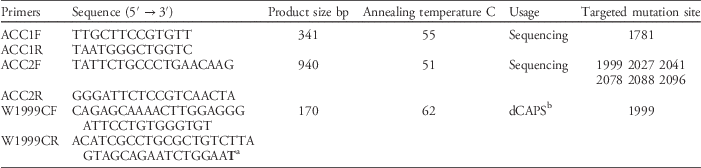
Twenty individual samples from each JYJD-1 and JYJD-2 population were analyzed. Approximately 100 mg of young shoot tissue was obtained at the 4- to 5-leaf stage from each plant, and DNA was extracted using the Plant Genomic DNA Kit (Tiangen Biotech, Beijing, China) according to the manufacturer’s instructions. Based on the known sequence of the ACCase gene of blackgrass (Alopecurus myosuroides Huds.) available in the NCBI GenBank (accession number AM408429), two pairs of primers were designed using Primer Premier 5.0 (Premier Canada) software to amplify the ACCase gene fragments from Keng stiffgrass (Table 3). These primer sequences spanned all seven known mutation sites contributing to the ACCase-inhibiting herbicide resistance. PCR was performed in a final volume of 50 μl containing 2.5 ng of DNA, 2 μl of each primer (10 μM), 25 μl of 2X PCR Taq Mix (Dongsheng Biotech, Guangzhou, China), and ddH2O to a final volume of 50 μl. The cycling program consisted of an initial denaturation step at 94 C for 4 min, followed by 30 cycles of 94 C for 30 s, X C for 30 s, and 72 C for 30 to 120 s, followed by a final extension step at 72 C for 10 min, where X is the annealing temperature for each primer pair used.
Primers used in this study.

a Nucleotide in bold is a mismatched nucleotide base in the primer.
b Abbreviation: dCAPS, derived cleaved amplified polymorphic sequence.
The PCR products were visualized via gel electrophoresis using ethidium bromide–stained 1% agarose gel in 1X Tris-acetate EDTA (TAE) buffer. The PCR products produced from the resistant and the sensitive populations were cloned into a pMD19-T vector (TaKaRa Biotechnology, Shiga, Japan).The positive clones were commercially sequenced (3730XL DNA Analyzer, Applied Biosystems, Carlsbad, CA) in the forward and reverse directions to minimize the sequencing errors (Invitrogen Biotechnology, Shanghai, China). The sequencing data were analyzed using the BioEdit Sequence Alignment Editor Software (Ibis Biosciences, Carlsbad, CA).
ACCase Extraction and Assay
Leaves of the JYJD-1 and JYJD-2 samples were separated from individual plants before being treated with fenoxaprop at the 3- to 4-leaf stage. ACCase was extracted from these leaves using the slightly modified protocol of Shukla et al. (Reference Shukla, Leach and Devine1997). Briefly, frozen shoot tissue (3.5 g) was homogenized with a mortar and pestle in 10 ml extraction buffer containing 100 mM Tris (pH 8.0), 1 mM EDTA, 10% (v/v) glycerol, 2 mM isoascorbic acid, 1 mM phenylmethylsulfonyl fluoride, 0.5% PVP-40, 0.5% insoluble PVP, and 20 mM dithiothreitol (DTT). The homogenate was centrifuged at 27,000 g for 15 min. The supernatant was brought to 40% (NH4)2SO4 saturation by dropwise addition of saturated (NH4)2SO4 and stirred for 30 min. The solution was centrifuged at 27,000 g for 30 min. The pellet was resuspended in 2.5 ml elution buffer (50 mM tricine, pH 8.0, 2.5 mM MgCl2, 50 mM KCl, and 1 mM DTT) and desalted on a Sephadex G-25 column pre-equilibrated with elution buffer. The eluate was stored at −20 C until use. Enzyme sensitivity assays were performed using the standard-grade fenoxaprop (free acid) at six concentrations (0.01, 0.1, 1, 10, 100, and 1,000 μM) (Xu et al. Reference Xu, Zhu, Wang, Li and Dong2013). An untreated (no-herbicide) control was included for comparison.
The determination of the ACCase enzyme activity was based on the rate of incorporation of 14C from NaH[14C]O3 into an acid- and heat-stable product (Stoltenberg and Gengenbach Reference Stoltenberg and Gengenbach1989; Xu et al. Reference Xu, Zhu, Wang, Li and Dong2013). The enzyme activity was expressed as the percentage of the untreated control. The fenoxaprop (free acid) concentrations causing 50% inhibition of enzyme activity (IC50) were also calculated from a linear regression analysis (Yang et al. Reference Yang, Dong, Li and Moss2007; Yu et al. Reference Yu, Cairns and Powles2007a). The enzyme activity was assayed twice with four replications per herbicide concentration.
dCAPS Markers for Genotype
To detect the W1999C mutation accurately, a dCAPS method was developed based on the ACCase CT domain sequence data. The primers and their restriction enzymes were designed using dCAPS Finder software (Neff et al. Reference Neff, Turk and Kalishman2002). The forward and reverse primers were designed to detect the point mutation TGG-to-TGC, resulting in the W1999C mutation. This pair of primers (Table 3) introduced a mismatch to create the restriction sites for Mva1269I (Thermo Fisher Scientific, Waltham, MA) at both the ends of a 170-bp-long fragment to be amplified in the ACCase gene. In particular, the primers were designed so that only the mutant amplicons were digested with Mva1269I, but not the wild-type ones.
PCR was performed as described earlier. Briefly, 5 μl of each PCR product was mixed with 1 μl of excess enzyme Mva1269I and 2 μl of 10X FastDigest Green Buffer, and ddH2O was added to obtain a final volume of 15 μl. The reaction mixture was incubated at 37 C for 30 min. The products were analyzed on a 3% agarose gel stained with ethidium bromide.
Sensitivity to Other Herbicides
The resistance patterns to other herbicides were also determined. The whole-plant pot bioassays were conducted to determine the sensitivity as described earlier, using herbicides with different mechanisms of action and doses (Table 2).
Statistical Analysis
All dose-response data from two experiments were analyzed by ANOVA (SPSS 21, IBM, Armonk, NY). There was no significant (P>0.05) trial by treatment interaction for any experiment, and data were therefore pooled and fitted to a four-parameter nonlinear logistic-regression model (Equation 1) using SigmaPlot 10.0 (Systat Software, San Jose, CA) statistical software. The effective dose of herbicide causing 50% inhibition in fresh weight (ED50) was computed using Equation 1:
 $${{Y\,{\equals}\,c{\plus}\left( {d{\minus}c} \right)} \mathord{\left/ {\vphantom {{Y{\equals}c{\plus}\left( {d{\minus}c} \right)} {\left[ {1{\plus}\left( {{x \mathord{\left/ {\vphantom {x g}} \right. \kern-\nulldelimiterspace} g}} \right)b} \right]}}} \right. \kern-\nulldelimiterspace} {\left[ {1{\plus}\left( {{x \mathord{\left/ {\vphantom {x g}} \right. \kern-\nulldelimiterspace} g}} \right)b} \right]}}$$
where Y is the aboveground fresh weight expressed as a percentage of the nontreated control, x is the herbicide rate, b is the slope of the curve, c is the lower limit, d is the upper limit, and g is the herbicide rate at the point of inflection halfway between the upper and lower limit. The same regression analyses were also used for the enzymatic experiment to calculate the 50% inhibition of ACCase activity (IC50) value. Resistance indices (RI) were calculated by dividing the ED50 of the resistant population by the ED50 of the sensitive population.
Results and Discussion
Sensitivity to Fenoxaprop-P-ethyl
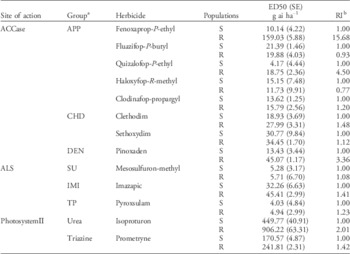
The ED50 value for the presumptive resistant population JYJD-2 (159.03 g ai ha−1) was significantly higher than the recommended dose (62 g ha−1), while the perceived susceptible population JYJD-1 showed a relatively lower ED50 value (10.14 g ha−1). The whole-plant pot bioassay experiments showed that the JYJD-2 population was highly resistant to fenoxaprop-P-ethyl. Based on the RI values, the JYJD-2 population was confirmed to be 15.68-fold more resistant than the JYJD-1 population.
Since the production of fenoxaprop-P-ethyl in 1998, it has been widely used to control grass weeds in the wheat fields of China. Previous studies have shown that the resistance to ACCase-inhibiting herbicides could develop even after an herbicide selection period of as short as 3 yr (Hochberg et al. Reference Hochberg, Sibony and Rubin2009; Tardif and Powles Reference Tardif and Powles1994). In China, the farmers would increase the dosage and duration of a herbicide treatment to enhance its weed control effect, rather than applying other expensive herbicides with different modes of action. Therefore, the development of herbicide resistance is a serious problem in China (Cui et al. Reference Cui, Li, Wang, Wang, Wei and Cao2012; Zhang Reference Zhang2003).
Several other noxious weeds in wheat fields, such as Japanese foxtail (Alopecurus japonicus Steud.) (Bi et al. Reference Bi, Liu, Guo, Li, Yuan, Du and Wang2016; Xu et al. Reference Xu, Li, Zhang, Cheng, Jiang and Dong2014a), American sloughgrass [Beckmannia syzigachne (Steud.) Fernald] (Li et al. Reference Li, Du, Liu, Yuan and Wang2014; Pan et al. Reference Pan, Li, Xia, Zhang and Dong2015a), Asia Minor bluegrass (Polypogon fugax Nees ex Steud.) (Tang et al. Reference Tang, Zhou, Chen and Zhou2014), and sterile oat (Avena sterilis L.) (Liu et al. Reference Liu, Harrison, Chalupska, Gornicki, O’Donnell, Adkins, Haselkorn and Williams2007), have also been reported to have evolved resistance to fenoxaprop-P-ethyl after its extensive application for several years. In the present study, the W1999C mutation was detected only in the JYJD-2 population. Therefore, it was important to understand the herbicide application history of this population. We collected Keng stiffgrass seeds from a rice–wheat double-cropping area in central Jiangsu province, where farmers had been using fenoxaprop-P-ethyl to control grass weeds for the last 5 yr. In this area, farmers prefer to use the recommended field dose or a higher dosage when applying herbicides. In the area from which the JYJD-2 population was collected, fenoxaprop was applied year after year until the JYJD-2 population became resistant.
ACCase CT Domain Amplification and Cloning
To analyze the ACCase amino acid sequence, we amplified two different ACCase fragments from both the susceptible and resistant populations. The length of the amplified fragments was 1,281 bp. The deduced amino acid sequences of both populations showed approximately 91% similarity with the published plastidic ACCase sequence of blackgrass (AJ310767), but only 75% similarity with the cytosolic ACCase sequence of blackgrass (AJ632096). The sequences Acc1;1-1, Acc1;2-1 and Acc1;1-2, Acc1;2-2 were obtained from susceptible and resistant populations, respectively. By comparing the sequences of the JYJD-1 and JYJD-2 populations, we obtained 21 single-nucleotide polymorphisms. We detected 15 synonymous and 6 nonsynonymous nucleotide mutations (at codon positions 5235, 5326, 5544, 5618, 6153, and 6358), resulting in the amino acid substitutions Glu-1745-Asp, Thr-1776-Ser, Glu-1849-Val, Arg-1873-Gln, Trp-1999-Cys, and Ile-2129-Val.
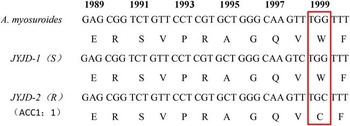
Among these mutations, the W1999C substitution (Figure 1), caused by the TGG to TGC point mutation, was reported to confer resistance to fenoxaprop-P-ethyl (Jang et al. Reference Jang, Marjanovic and Gornicki2013; Kaundun et al. Reference Kaundun, Bailly, Dale, Hutchings and McIndoe2013; Liu et al. Reference Liu, Harrison, Chalupska, Gornicki, O’Donnell, Adkins, Haselkorn and Williams2007; Scarabel et al. Reference Scarabel, Panozzo, Varotto and Sattin2011; Xu et al. Reference Xu, Li, Zhang, Cheng, Jiang and Dong2014a; Yuan et al. Reference Yuan, Liu, Bi, Du, Guo and Wang2015). Three mutations at codon position 1999 have been identified to confer resistance to ACCase-inhibiting herbicides: W1999C in sterile oat and wild oat (Avena fatua L.) (Beckie et al. Reference Beckie, Warwick and Sauder2011; Liu et al. Reference Liu, Harrison, Chalupska, Gornicki, O’Donnell, Adkins, Haselkorn and Williams2007); W1999L in perennial ryegrass (Lolium perenne L.) and blackgrass (Délye et al. Reference Délye, Pernin and Michel2011; Tardif and Powles Reference Tardif and Powles1994); and W1999S in perennial ryegrass (Liu et al. Reference Liu, Harrison, Chalupska, Gornicki, O’Donnell, Adkins, Haselkorn and Williams2007). Previously, the mutation W1999S has also been reported in Keng stiffgrass by Yuan et al. (Reference Yuan, Liu, Bi, Du, Guo and Wang2015). To the best of our knowledge, this study is the first report of the occurrence of W1999C mutation in the ACCase gene of Keng stiffgrass. In this study, we found that there were two copies of the gene encoding plastidic ACCase in Keng stiffgrass. In grass weed species, multiple copies of the genes encoding plastidic ACCase have been reported in tetraploid Japanese foxtail and in hexaploid sterile oat and wild oat (Beckie et al. Reference Beckie, Warwick and Sauder2011; Xu et al. Reference Xu, Zhang, Zhang, Li, Wu and Dong2014b; Yu et al. Reference Yu, Ahmad-Hamdani, Han, Christoffers and Powles2013). It is worth noting that any of the three Acc1 homologues (Acc1;1, Acc1;2, and Acc1;3) in wild oat can host ACCase resistance mutations (Liu et al. Reference Liu, Harrison, Chalupska, Gornicki, O’Donnell, Adkins, Haselkorn and Williams2007; Yu et al. Reference Yu, Ahmad-Hamdani, Han, Christoffers and Powles2013). In our study, the W1999C mutation was found only at the Acc1;1 locus. The other five mutations in the resistant population JYJD-2 (Glu-1745-Asp, Thr-1776-Ser, Glu-1849-Val, Arg-1873-Gln, and Ile-2129-Val), but not Glu-1849-Val, were also found at the Acc1;1 locus. Further research is needed to confirm whether these mutations conferred resistance to fenoxaprop-P-ethyl.
Partial amino acid sequences of acetyl-CoA carboxylase (ACCase) from Japanese foxtail (A. myosuroides) and the susceptible (JYJD-1) and resistant populations (JYJD-2). The box indicates a nonsynonymous nucleotide mutation from tryptophan to cytosine in Acc1;1.

ACCase Activity
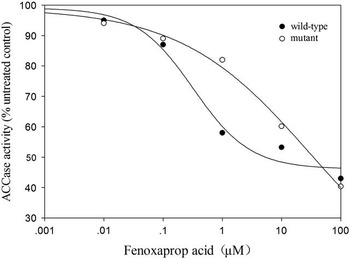
Individual plants of each population were assayed for ACCase activity. The average relative ACCase activity for each population was expressed as a percentage of the control assay, as shown in Figure 2. The IC50 value of the wild-type population JYJD-1 was 4.81 μM. However, the IC50 value of the mutant JYJD-2 population (31.16 μM) was considerably higher than that of the wild-type population. The RI of the resistant population was 6.48-fold higher than that of the susceptible population (Table 4).
In vitro inhibition of ACCase activity by fenoxaprop acid for the resistant (JYJD-2) and sensitive populations (JYJD-1).

The IC50 (herbicide concentration causing 50% inhibition of enzyme activity) values for fenoxaprop acid using ACCase isolated from resistant and sensitive populations.

a Abbreviations: S, susceptible; R, resistant.
b RI, resistance index: the ratio between the IC50 values of the resistant and sensitive populations.
ACCase of the resistant JYJD-2 population was significantly less sensitive to fenoxaprop-P-ethyl than that of the susceptible JYJD-1 population. This might be attributed to the TSR mechanism in the resistant population. Délye et al. (Reference Délye, Zhang, Michel, Matéjicek and Powles2005) and Yu et al. (Reference Yu, Collavo, Zheng, Owen, Sattin and Powles2007b) reported that mutant plastidic ACCases with a Trp-2027-Cys or an Asp-2078-Gly or a Cys-2088-Arg substitution displayed a strongly reduced ACCase-specific activity, indicating that these residues were located in the CT active-site cavity and were important for CT catalytic activity. Therefore, we propose that the change in ACCase activity toward fenoxaprop-P-ethyl caused by a W1999C mutation in the plastidic ACCase of Keng stiffgrass is one of the important mechanisms underlying herbicide resistance.
Sensitivity to Other Herbicides
JYJD-1 was found to be sensitive to all herbicides (Table 5). However, JYJD-2 showed moderate resistance to quizalofop-P-ethyl and pinoxaden, with RI values of 4.50 and 3.36, respectively (Table 5). However, it appeared sensitive to fluazifop-P-butyl, haloxyfop-R-methyl, clodinafop-propargyl, clethodim, and sethoxydim, with RI values of 0.93, 0.77, 1.30, 1.20, and 1.12, respectively (Table 5). There was no resistance observed to the acetolactate synthase (ALS)-inhibiting herbicides mesosulfuron-methyl, imazapic, and pyroxsulam. For isoproturon and prometryne, JYJD-1 and JYJD-2 showed different sensitivities, with RI values of 2.01 and 1.42, respectively (Table 5).
Sensitivity of populations resistant and sensitive to herbicides.

a Abbreviations: APP, aryloxyphenoxypropionates; CHD, cyclohexanediones; DEN, phenylpyrazolines (DEN); SU, sulfonylurea; IMI, imidazolinone; TP, triazolopyrimidine; S, susceptible; R, resistant.
b RI, resistance index: the ratio between the ED50 values of the resistant and sensitive populations.
Jang et al. (Reference Jang, Marjanovic and Gornicki2013) reported that the W1999C mutation could confer resistance not only to fenoxaprop-P-ethyl but also to a moderate extent to quizalofop-P-ethyl and pinoxaden. Using yeast gene replacement assays, Liu et al. (Reference Liu, Harrison, Chalupska, Gornicki, O’Donnell, Adkins, Haselkorn and Williams2007) found the W1999C mutation in wild oat renders the yeast gene replacement strain resistant to only fenoxaprop-P-ethyl but has no effect on its sensitivity to haloxyfop-R-methyl, sethoxydim, and clodinafop. Similarly, in the present study, we found that the W1999C mutation in JYJD-2 could confer strong resistance to fenoxaprop-P-ethyl and moderate resistance to quizalofop-P-ethyl and pinoxaden, but not to other herbicides (Table 4). Compared with the occurrence of mutations at other codon positions, the infrequent occurrence of mutations at codon position 1999 was considered to be of special significance for herbicide resistance (Beckie and Tardif Reference Beckie and Tardif2012; Kaundun et al. Reference Kaundun, Bailly, Dale, Hutchings and McIndoe2013; Powles and Yu Reference Powles and Yu2010). Previous studies have shown that the mutations W1999C, W1999S, and W1999L confer resistance to only fenoxaprop-P-ethyl, quizalofop-P-ethyl, and pinoxaden, but are still sensitive to other ACCase-inhibiting herbicides (Délye et al. Reference Délye, Pernin and Michel2011; Jang et al. Reference Jang, Marjanovic and Gornicki2013; Scarabel et al. Reference Scarabel, Panozzo, Varotto and Sattin2011). For the resistant population JYJD-2, only the mutations at codon position 1999 were detected; therefore, the herbicide application history of this population was meaningful. The area from where JYJD-2 was collected is a part of the rice–wheat double-cropping region of China. Only fenoxaprop-P-ethyl was used to control the grass weed species in the wheat fields of this area. This might explain the occurrence of the mutations at codon position 1999 in this population.
dCAPS Method for the W1999C Mutation in Keng Stiffgrass
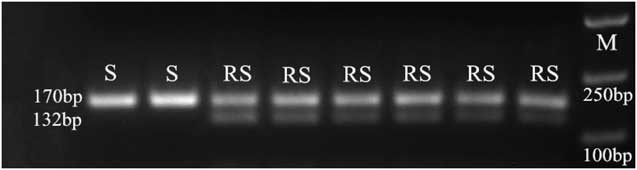
The forward primer (W1999CF) and the reverse primer (W1999CR) were used to amplify a 170-bp DNA fragment of the ACCase gene. After restriction digestion with Mva1269I, the mutant alleles were cut into two fragments of 132 bp and 38 bp, whereas the wild-type alleles were not cut. In general, the mutant alleles are classified as homozygous and heterozygous alleles. However, in the JYJD-2 population, no homozygous alleles were detected (Figure 3). Of the 100 JYJD-2 plants tested for the presence of W1999C mutation, 47 were heterozygous resistant (RS) and 53 were homozygous sensitive (SS).
The derived cleaved polymorphic amplified sequence technique (dCAPS) method developed for detecting W1999C mutations. Heterozygous resistant (RS) and homozygous sensitive (SS) genotypes are shown.

To ensure the accuracy of the dCAPS method, we randomly selected 10 samples from the tested plants and analyzed their DNA sequences. The results were consistent with the results of dCAPS method, confirming that the dCAPS method was very effective and accurate in detecting the W1999C mutation in Keng stiffgrass.
We established a dCAPS method for rapid detection of the W1999C mutation in Keng stiffgrass for the first time. This method is useful for detecting sequence polymorphisms. However, the results of dCAPS suggested that no homozygous ACCase loci were present, and the frequency of the W1999C mutation was not significantly high in the genome of fenoxaprop-P-ethyl–resistant population of Keng stiffgrass. We speculate that this might be because of the emergence of the resistant weeds in only the last few years. However, the individual resistant plants did not dominate the population, indicating that the resistant populations included many plants that did not carry the W1999C mutation. In tetraploid Keng stiffgrass (Yuan et al. Reference Yuan, Liu, Bi, Du, Guo and Wang2015), two copies of the plastidic ACCase gene were identified. The heterozygotes detected were probably the homologous heterozygotes and not the “true” allelic heterozygotes (Warwick et al. Reference Warwick, Sauder and Beckie2010; Xu et al. Reference Xu, Zhang, Zhang, Li, Wu and Dong2014b; Yu et al. Reference Yu, Ahmad-Hamdani, Han, Christoffers and Powles2013). Therefore, we reported heterozygosity at the whole-genome level.
In conclusion, we report the occurrence of W1999C mutation in the ACCase gene of Keng stiffgrass for the first time and thereby elucidate the molecular mechanism underlying fenoxaprop-P-ethyl resistance in Keng stiffgrass. We believed that Keng stiffgrass evolved resistance to fenoxaprop-P-ethyl via TSR caused by a W1999C mutation and developed a dCAPS method for detecting the W1999C mutation and the frequency of its occurrence in the ACCase gene of Keng stiffgrass rapidly and accurately. We also investigated the cross- and multiresistance of the fenoxaprop-P-ethyl–resistant Keng stiffgrass carrying a W1999C mutation. This study confirmed that it is not appropriate to use fenoxaprop-P-ethyl, quizalofop-P-ethyl, and pinoxaden to control Keng stiffgrass with the W1999C mutation. However, farmers can still use ALS-inhibiting herbicides such as mesosulfuron-methyl and pyroxsulam and photosystem II–inhibiting herbicides such as isoproturon and prometryne to control Keng stiffgrass in wheat fields. At the same time, we suggest that appropriate rotation of herbicides with different modes of action should be used to control farmland grass weeds in order to delay the occurrence of herbicide resistance.
Acknowledgments
This research was funded by the Special Fund for Agro-scientific Research in the Public Interest (201303031). The authors would like to thank Hongle Xu, Yuhua Zhang (Nanjing Agricultural University, College of Plant Protection, Nanjing, China), and Xudong Zhu (Nanjing Agricultural University, College of Sciences, Nanjing, China) for technical assistance. The first two authors contributed equally to this work.