Introduction
The hemipteran infraorders Cicadomorpha and Fulgoromorpha (Auchenorrhyncha) are sap-sucking insects, injuring plants either directly through feeding and oviposition (Nault and Ammar, Reference Nault and Ammar1989; Backus et al., Reference Backus, Serrano and Ranger2005; Perez Grosso et al., Reference Perez Grosso, Mercado, Ponessa, Conci and Virla2016) or indirectly through transmission of plant pathogens (Maramorosch and Harris, Reference Maramorosch and Harris1979; Nault, Reference Nault1997; Weintraub and Beanland, Reference Weintraub and Beanland2006). In several species, these characteristics are aggravated by a high reproductive potential, short life cycle, great adaptability and high rates of dispersion.
Most of the studies on the characterization of direct damage by Auchenorrhyncha have been performed on species involved in the induction of hopperburn symptoms, and have dealt with feeding, quantification of probing behavior using the direct current electrical penetration graph (DC-EPG) system, cellular alterations in the feeding site, and occlusion phenomena (i.e. Ogunlana and Pedigo, Reference Ogunlana and Pedigo1974; Backus et al., Reference Backus, Serrano and Ranger2005; Carpane et al., Reference Carpane, Wayadande, Backus, Dolezal and Fletcher2011; Saeed et al., Reference Saeed, Razaq, Rehman, Waheed and Farooq2018).
Hopperburn is induced by several hopper species (mostly Typhlocybinae in the Cicadellidae) by a dynamic interaction between insect feeding stimuli and complex plant responses; it causes millions of dollars' worth of yield loss and control costs (Backus et al., Reference Backus, Serrano and Ranger2005). On the other hand, few studies have quantified direct damages, such as the reduction of biomass, yield, or hydric stress, and most of them were focused on Delphacidae (Noda, Reference Noda1986; Wilson and Claridge, Reference Wilson and Claridge1991; Sarao and Bentur, Reference Sarao and Bentur2018; Goode et al., Reference Goode, Minteer, Foley, Tipping, Valmonte, Knowles and Gettys2019), and a few devoted to Cicadellidae (Cuperus et al., Reference Cuperus, Radcliffe, Barnes and Marten1983; Jones et al., Reference Jones, Anderson-Wong, Follett, Yang, Westcot, Hu and Ullman2000; Atakan, Reference Atakan2009; Ersin et al., Reference Ersin, Yilmaz, Kaya, Ilker and Turanli2017).
In tropical and subtropical America, the corn leafhopper Dalbulus maidis (DeLong) (Hemiptera: Cicadellidae) causes enormous damage to maize (Zea mays L.) because it efficiently transmits three important plant pathogens: corn stunt spiroplasma (CSS), maize bushy stunt phytoplasma (MBSP) and maize rayado fino virus (MRFV) (Oliveira et al., Reference Oliveira, Waquil, Fernandes, Paiva, Resende and Kitajima1998; Virla et al., Reference Virla, Casuso and Frias2010). In these regions, CSS is one of the most dominant pathogens affecting maize. The highest infection rates have been found in Central America, Peru, Brazil and Argentina, with 100% of the crop plants affected in many maize fields (Virla et al., Reference Virla, Díaz, Carpane, Laguna, Ramallo, Gómez and Giménez Pecci2004). The importance of CSS and MBSP alternate depending on the cultivated germplasms of maize and/or climatic factors (Oliveira et al., Reference Oliveira, Carvalho, Duarte, Andrade, Resende, Oliveira and Recco2002). Sabato et al. (Reference Sabato, Landau, Barros and Oliveira2020) demonstrated that in Brazil, MBSP is more tolerant than CSS at lower temperatures and is able to express symptoms in a larger number of plants than CSS under these conditions.
Few studies have been conducted on the direct damage caused by D. maidis to maize plants. As with other cicadellids, D. maidis cause direct damage by feeding and oviposition. As they feed, they insert stylets into the plant, lacerating the mesophyll and parenchyma cells. They are active phloem feeders preferring small and intermediate vascular bundles rather than central veins, but sometimes they probe xylem and parenchymatic tissues (Alivizatos, Reference Alivizatos1982). D. maidis secretes large volumes of honeydew that accumulates and supports the growth of sooty mold fungi (Bushing and Burton, Reference Bushing and Burton1974). Females oviposit endophytically inside the plant tissues (Heady and Nault, Reference Heady and Nault1984), cutting the leaf cuticle with the ovipositor valvulae, which contains numerous teeth. The eggs are deposited individually in the central midrib or leaf blades, and a conspicuous opening is left where the ovipositor was inserted (Heady and Nault, Reference Heady and Nault1984; Luft Albarracin et al., Reference Luft Albarracin, Virla and Ordano2021).
In USA (California), Bushing and Burton (Reference Bushing and Burton1974) reported that D. maidis causes more damage on late-planted silage maize by extensive feeding on the foliage rather than by transmitting CSS. Waquil (Reference Waquil1997) reported that 10-day-old maize plants exposed to a density of 10 adults/plant reduced their canopy by 40% and their root system dry weight by 62%. However, he made no mention of the watering regime used in the assays, nor discriminated between the damage caused by females or males. Drought stress is one of the most adverse factors of plant growth and productivity (Anjum et al., Reference Anjum, Xie, Wang, Saleem, Man and Lei2011). Due to the importance of this leafhopper in America and considering the very scarce information on the direct damages that it causes to maize crops, we postulate the following hypotheses: (1) herbivory damage would cause drought stress, and the effects would be more notorious on a watering restricted regime, (2) a density of 10 insects per seedling would cause biomass loss, even in an ad libitum watering regime, and (3) Due to their ovipositing habits, females would be more injurious than males. Therefore, the aims of our study are to evaluate the effects of D. maidis on maize seedlings' biomass under different watering regimens and to determine differences in the levels of damage caused by females and males.
Materials and methods
Insect rearing
Dalbulus maidis colony used in this study was established from individuals collected at Los Nogales, Tucumán, Argentina (S 26°42′, W65°13′, 588 m a.s.l.). The leafhoppers were fed using potted maize plants (landrace sweet white maize ‘maizón’) within cages built with PVC pipes (50 × 50 × 50 cm) and protected with voile fabric to facilitate catch, prevent escape and avoid accidental parasitism (Coll Araoz et al., Reference Coll Araoz, Jacobi, Fernandez, Luft Albarracin, Virla, Hill and Catalan2019). The colony has been maintained in the Biological Control Division (PROIMI-CONICET) laboratory, located in San Miguel de Tucumán, Tucumán, Argentina (S26°48′36″, W65°14′27″, 465 m a.s.l) for several years and new individuals are collected from the field twice a year, during summer, to avoid inbreeding. Only pathogen-free colonies were used in the experiments. Individuals used in all experiments were obtained from established colonies, belonging to the third generation in laboratory rearing, with no symptoms of corn stunt disease in the plants used for rearing; moreover, random PCR analysis for the detection of S. kunkelii presence in the leafhoppers were carried out twice a year.
Soil and maize seedlings
The maize plants (landrace sweet white maize) were kept in expanded polystyrene pots, of 250 cm3 capacity filled with 95 g of dry soil, and were grown from seeds that weighed 0.5 g. The used soil was a typical fine Argiudoll (Pereyra and Fernández, Reference Pereyra, Fernández, Rubio, Lavado and Pereyra2018) taken from a surface layer (0–20 cm) of an agricultural land. The initial test of the soil properties indicated: organic matter (2.71%), pH (5.93), total nitrogen (0.160%), nitrates NO3 (32.3 kgN ha−1), phosphorous (7.7 ppm) and potassium (1.17 me 100 g−1).
Plants were irrigated with 5 ml of water on the day of planting and with the same volume every two days until the beginning of the assays. All trials were carried out using maize seedlings whose first leaf had the same length as the second leaf in development (from 8 to 9 cm in height, and 10–12 days after emergence). Two experiments were carried out, the first one to verify the effect of insect density on the biomass of maize seedlings, and the second one to assess the levels of damage caused by females and males. Both were done under two different levels of watering: (a) ad libitum watering, where the plants were supplied with 5 ml of water daily, and (b) with restricted watering, where the plants received 5 ml of water only on days 0, 5, and 10 after the leafhoppers were introduced. In both levels of watering, the initial soil moisture was ~33%, which was the field capacity of the soil. In the assay with daily watering, soil moisture was maintained between 32 and 33% along the duration of the experiment. In the assay with watering every five days, soil moisture decreased between 17.5 and 18.5% before watering on the fifth day, when a 21–23% humidity was restored after the addition of 5 ml of water. The amount of water provided to the plants was calculated on the basis that the monthly average rainfall does not exceed 100 mm at the time of sowing in the northern subtropical plains of Argentina. Trials were conducted during the summer of 2019.
Influence of insect density
Tests were carried out by exposing four maize seedlings to different vector densities. The tests were performed in glass cages, 20 × 20 × 35 cm, with two lateral windows covered by voile fabric (Fig. 1S). There were four treatments: control (without leafhoppers), low density (10 leafhoppers/plant), medium density (30 leafhoppers/plant) and high density (50 leafhoppers/plant). Five replicates were done for the ad libitum watering regimen and four replicates for the restricted watering regimen. Only adults were used, in a proportion of 1:3 males:females. All plants were exposed to leafhoppers for 7 days, after which the leafhoppers were removed. Plants were left isolated for a week after the removal of the leafhoppers. Afterwards, they were carefully removed from the soil under water flow to avoid loss of root material. The aerial parts were separated from the roots with a razor blade and the fresh weights (FW) of the aerial parts were recorded. Then, the aerial parts and roots from each plant were labeled, bagged in paper and dehydrated in an oven at 45°C during 7 days until constant weight. Dry weight (DW) was then recorded.
Influence of leafhopper gender
Individual plants were covered by a plastic cylindrical cage (6.5 cm diam × 26 cm height) with a piece of voile fabric on the top (Fig. 2S) and then exposed to the different treatments. There were six treatments; (1) control: with restricted watering and without leafhoppers (N = 30); (2) with restricted watering and 10 females/plant (N = 37); (3) with restricted watering and 10 males/plant (N = 33); (4) with ad libitum watering but without leafhoppers (N = 65); (5) with ad libitum watering and 10 females/plant (N = 72); and (6) with ad libitum watering and 10 males/plant (N = 68).
The leafhoppers used for both experiments were randomly captured from breeding colonies. After release into the cages, insects were counted daily and dead individuals were replaced immediately by specimens of the same sex. Trials were performed in climate-controlled chambers (25 ± 2°C, 75 ± 10% RH, and 14L:10D light). All plants were exposed to leafhoppers for 7 days, after which insects were removed. Plants were left isolated for a week after the removal of the leafhoppers and afterward, they were removed from the soil as described above. The FW of the root and the aerial parts (hereafter canopy) of each plant was immediately recorded, and plants were then dehydrated as described above and the DW was recorded. The water content in each plant was calculated from the difference between the FW and DW.
Experimental design and statistical analysis
For the ‘Influence of insect density’ assay, we designed an experiment with two factors: the first factor, ‘insect density’, had four levels (0, 10, 30, and 50 leafhoppers/plant) while the second factor, ‘watering amount’, had two levels (ad libitum watering and restricted watering). Due to the restrictions in the aleatorization procedure, a mixed model was used for DW data analysis: aleatory effects were used for the factor ‘replicate/cage’ and fixed effects for the density of insects in each cage and the watering regimen. We fitted a quadratic model to our data and calculated the determination coefficient (R 2) between the vector density and DW of the canopy or root as previously described by Waquil (Reference Waquil1997).
In the ‘Influence of vector gender’ assay, raw data means were compared with one-way ANOVA (P < 0.05). The means of canopy FW of plants under the restricted watering regimen were compared with ANOVA after normalization to log-normal distributions. Homogeneity of variance and normality were checked using Bartlett's and Shapiro−Wilk tests, respectively. If ANOVA assumptions were not met, the Kruskal−Wallis test was performed using XLSTAT® 19.6.
Voucher specimens of D. maidis were deposited in the Instituto de Entomología, Fundación Miguel Lillo (San Miguel de Tucumán, Tucumán, Argentina) (IMLA).
Results
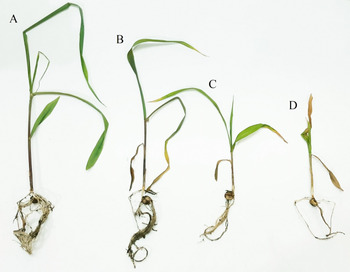
During the experiments, we never observed hopperburn symptoms in plants exposed to the corn leafhopper. The symptoms observed in the most affected plants corresponded to those typical described for significant water stress (fig. 1).
General appearance of the corn plants exposed for 7 days at different densities of Dalbulus maidis and under a regime of watering restriction, one week after taking out the vectors. (a) control, (b) 10 adults/plant, (c) 30 adults/plant, and (d) 50 adults/plant. The assays were carried out in the laboratory, under controlled conditions (25 ± 2°C, 75 ± 10% RH, and 14L:10D light) during the summer of 2019.

Influence of insect density
No mortality occurred in the plants that received ad libitum watering and had 0 or 10 leafhoppers/plant, but plant mortality was observed in the rest of the treatments. At the highest leafhopper density (50 individuals/plant), a high mortality of plants was observed after 7 days of exposure to the leafhoppers: 40% and 56.2% for those watered ad libitum and with restricted watering, respectively (Table 1).
Effect of different density of Dalbulus maidis on maize biomass under different watering regimens: percentage of seedlings mortality and percentage of biomass loss of the exposed plants relative to the control plants.

FW, fresh weight; DW, dry weight.
The assays were carried out in the laboratory, under controlled conditions (25 ± 2°C, 75 ± 10% RH, and 14L:10D light) during the summer of 2019.
Biomass loss was less severe in an ad libitum watering regime and this was corroborated for every leafhopper density analyzed. In both watering regimes, there was a corresponding reduction in FW and DW of the canopy and DW of the roots (Table 1).
Both the watering regimen and the insect density influenced the DW of maize plants (fixed effects: F = 8.155, df 133, P = 0.007, F = 30.679, df 133, P < 0.0001, respectively). With a density of 10 insects, there was a greater effect of leafhopper density on DW (F = 20.309, df 115, P = 0.0004) than the watering regimen (F = 3.186, df 115, P = 0.094).
When adjusting the data to a quadratic relationship between the vector density and the canopy DW and roots DW, we only found a relatively acceptable relationship for the canopy DW of the treatment with restricted watering (R 2: 0.46) (fig. 2). In the remaining treatments, the adjustments were poor, with determination coefficients below 0.40.
Relationship between the dry weight (DW) of maize seedlings (canopy and roots) exposed to different densities of Dalbulus maidis. Adjustments curves of the quadratic relation and the corresponding coefficient of determination (R 2) are given. (a) ad libitum watering regime, (b) restricted watering regime. The assays were carried out under controlled laboratory conditions (25 ± 2°C, 75 ± 10% RH, and 14L:10D light) in the summer of 2019.

Influence of vector gender
Under the ad libitum watering regimen, plants exposed to 10 leafhoppers of different gender did not show noticeable differences in their canopy FW (F = 2.29, df = 2102, P = 0.097), although the plants exposed to females were lighter (fig. 3a). In contrast, under the restrictive watering regime, the canopy FW of plants exposed to vector females was significantly lighter than that of the control plants (F = 3.21, df = 297, P = 0.045) (fig. 3b).
Biomass of control maize plants (without insects) and plants exposed to either 10 females or 10 males Dalbulus maidis, under two watering regimens. (A) water ad libitum fresh weight of aerial parts. (b) water restriction fresh weight of aerial parts. (c) water ad libitum dry weight of aerial parts. (d) water-restriction dry weight of aerial parts. (e) water ad libitum dry weight of roots. (f) water restriction dry weight of roots. Different letters indicate significant differences (P < 0.05) among gender. The assays were carried out under controlled laboratory conditions (25 ± 2°C, 75 ± 10% RH, and 14L:10D light) in the summer of 2019.

When the DW was considered, there was a significant reduction in the canopy DW of the exposed plants independent of leafhopper gender with a density of 10 females or males in both watering regimes, ad libitum (K = 22.99, P < 0.001) and restricted (K = 18.22, P < 0.001) (fig. 3c, d). Females had a greater effect on canopy DW, particularly in a water-restricted regime; relative to control plants, those exposed to females had a 53.84% (±SE, 4.43) reduction in canopy DW compared to a 33.59% (±5.92) reduction caused by males. This effect was also noticeable in ad libitum watering conditions: a 46.63% (±3.65) reduction in canopy DW in plants exposed to females vs a 28.97% (±8.64) in plants exposed to males. However, although noticeable and biologically relevant, using a significance level of P < 0.05 there were no statistical differences between the canopy reduction in plants exposed to females and males.
The effect of biomass loss was less evident in the roots. There was a significant root biomass loss in plants exposed to the females in the ad libitum watering regimen (F = 10.96, df = 2102, P < 0.001) (fig. 3e). Interestingly, there was not a significant reduction in root biomass in watering restricted plants, independently of the vector gender (F = 0.36, df = 297, P = 0.697) (fig. 3f). No plant mortality was recorded during the course of this experiment.
There were no significant differences in the water content of the plants (FW-DW) under the ad libitum watering regimen (K = 3.24, P = 0.198) (2.52 g ± 0.15 for the control plants, 2.10 ± 0.17 for those with females, 2.14 ± 0.17 for those with males). However, under a restricted watering regimen, plants subjected to females had significantly less water content (0.80 g ± 0.10) than the control plants (1.17 ± 0.15) and those exposed to the males (1.13 ± 0.12) (K = 7.43, P = 0.024).
Discussion
The results of our study showed that, in the early stages of plant development, a density of 10 adult leafhoppers per plant can significantly damage the crop, even when water is freely available. If small plants are subjected to water stress, then attack by D. maidis can also lead to significant plant mortality, reducing crop stand. Direct damages are not only associated with the extraction of sap, but also with water loss in the tissues due to the injuries caused by females during oviposition. Our results showed that good water availability allowed the plants to better withstand the attack of the leafhopper.
Bushing and Burton (Reference Bushing and Burton1974) and Waquil (Reference Waquil1997) are the only two previous works that refer to the direct damage caused to maize by D. maidis. They stated that the corn leafhopper is capable of causing serious yield losses. But they made no mention that feeding by this leafhopper did not produce hopperburn, and that plants may die from their attack. Bushing and Burton (Reference Bushing and Burton1974) affirmed that feeding damage was more important than damage by transmitted diseases, and that the quality of silage maize was affected by sooty mold resulting from the large volumes of honeydew secreted by the leafhopper. Waquil (Reference Waquil1997), working with maize seedlings, showed that one-, five-, and 10 adults/plant confined on 15-day-old plants for one week caused little feeding damage; however, significant damage was seen on 10-day-old plants. Neither study indicated that plant mortality occurred, nor did they examine the relationship between leafhopper damage and the level of irrigation. We showed that seedlings grown under a restricted watering regimen, which emulated the field conditions in the north of Argentina, and exposed to 10–50 leafhoppers, exhibited mortality rates ranging from 12 to 56%. On the other hand, plants irrigated daily showed mortality only when they were exposed to very high leafhopper densities (30 and 50 adults/plant), with a range of 10–40%, respectively. The highest densities used in the assays (30 and 50 individuals/plant) are unlikely to occur in the field 10–15 days after the emergence of the plant; but in late plantings it is possible to observe up to 10 adults/plant in that phenological stage (Waquil, Reference Waquil1997; Virla & Luft Albarracin, personal observation).
Good water availability allowed maize plants to better withstand leafhopper attack. In our trials, we observed that plants exposed to the leafhoppers and subjected to restricted watering showed evident symptoms of drought stress. Drought stress in maize plants affects several morphological and physiological characteristics, including senescence, reduction of foliar area, chlorophyll content, root elongation, stomatal closure, membrane integrity, osmotic adjustment of water relations, and photosynthetic activity (Moussa and Abdel-Aziz, Reference Moussa and Abdel-Aziz2008; Anjum et al., Reference Anjum, Xie, Wang, Saleem, Man and Lei2011; Curá et al., Reference Curá, Franz, Filosofía, Balestrasse and Burgueño2017). In nature, drought stress impacts the growth and yield of corn crops; the severity of the symptoms depends on different factors such as genotype, developmental stage, and duration of the stress (Anjum et al., Reference Anjum, Xie, Wang, Saleem, Man and Lei2011). We observed that, depending on the situation, not all of the plants subjected to leafhopper attack could overcome the stresses due to drought and water deficiencies.
When we compared the effect of the watering regime with the effect of herbivory, analyzing only the data of the control plants and those exposed to 10 insects per plant, herbivory affected DW more than water restriction. Insect density had a very marked effect on the percentage of biomass loss, both of the canopy and the roots. At the lowest vector density (10 adults/plant), the DW loss of the seedlings' canopy reached 25% under an ad libitum watering regimen and 56% under a restricted watering regimen. Waquil (Reference Waquil1997) found that 10 leafhoppers/plant reduced 40% of the canopy DW and 62% of the root DW but did not indicate the level of irrigation provided. Notably, our findings differ in the measured root DW because we observed a much lower biomass loss than that found by Waquil (Reference Waquil1997); in an ad libitum watering regime roots dry weight was reduced by only 26% (36.2% lower than that reported by Waquil) and, surprisingly, only 18% in the watering restricted regimen (43.6% less than reported by Waquil). In addition, Waquil (Reference Waquil1997) found a quadratic relationship between corn leafhopper infestation density with canopy and root DW of 10-day-old plants (R 2: 0.44 for canopy DW, and R 2: 0.55 for root DW). We only found a relatively acceptable quadratic relationship between insect density and the canopy DW weight when seedlings were maintained under a restricted watering regime (R 2: 0.46).
In general, the water stress of the plants was much more evident when they were exposed to females. The water content of the canopy in plants exposed to leafhoppers was less than control plants, and this difference was substantially greater in the treatment with restricted water supply. The canopy FW and DW, and root DW of attacked plants were generally lower in those exposed to females compared to those exposed to males. But the greatest differences were observed when the plants were poorly watered. The main reason for this is because plants exposed to males suffered damage only due to feeding (punctures plus sap extraction) while plants exposed to females, were damaged not only by feeding, but also by the oviposition, as they lay eggs endophytically. The plants thus showed abundant open wounds that allowed a constant and uncontrollable loss of water from its tissues. Our findings contrast with the observations made by Alyokhin et al. (Reference Alyokhin, Yang and Messing2001) and Avanesyan et al. (Reference Avanesyan, Snook, Follett and Lamp2019), who studied the damage to different plants caused by Sophonia orientalis (Matsumura), the two-spotted leafhopper. They stated that oviposition damage in leaf mid-veins resulted in the death of distal tissue, but it is unlikely that oviposition alone can cause significant damage to affected plants and the major problem was caused by feeding.
In our study, there was no significant reduction in the root biomass (as DW) of plants exposed to leafhoppers under a restricted watering regimen, regardless of the leafhopper gender. As was mentioned, the effect of the attack of D. maidis was barely noticed in roots dry weight in water-restricted plants in both experiments. This fact could be explained by the mode of action of the phytohormone abscisic acid (ABA). As a physiological response to water deficit, plants close their stomata, a process that is regulated by ABA, which is synthesized mainly in the leaves (Mittelheuser and Van Steveninck, Reference Mittelheuser and Van Steveninck1969; Geiger et al., Reference Geiger, Maierhofer, Al-Rasheid, Scherzer, Mumm, Liese, Ache, Wellmann, Grill, Romeis and Hedrich2011). One of the most noticeable effects of ABA is the inhibition of growth in most plant tissues, but in contrast to the inhibitory effect on shoot growth, increased levels of ABA in plants experiencing stressful conditions promote root growth (McAdam et al., Reference McAdam, Brodribb and Ross2016). These differential changes in growth by ABA are thought to be an adaptive response to water stress, increasing the allocation of biomass to roots and thereby the effectiveness of root water uptake (Creelman et al., Reference Creelman, Mason, Bensen, Boyer and Mullet1990).
In summary, our results indicate that D. maidis causes substantial biomass loss in maize seedlings, even in the absence of disease. The levels of damage are significantly influenced by the amount of water available for the plant, and in drought conditions damage can be significantly greater, causing plant mortality. Also, due to oviposition activities, females are more injurious than males and can cause more damage.
Supplementary material
The supplementary material for this article can be found at https://doi.org/10.1017/S0007485321000079.
Acknowledgements
The authors wish to thank those colleagues who indirectly encouraged them to make this contribution and Dr Joseph Patt who made valuable contributions to the first draft. This research was supported by ANPCyT (PICT 2015-1147 and partially by PIP CONICET no. 0222).