Between 10 and 40 percent of the population suffer from dyspeptic symptoms (12), and dyspeptic patients account for 2–5 percent of all consultations in general practice (18). Society, therefore, carries a considerable economic burden from sick leaves, consultations, use of health care (30), high and escalating expenses for endoscopy (33;34;40;42), and antisecretory medicine (1;2;29;41).
The choice of initial management strategy contributes markedly to differences in societal costs. Management strategies for dyspepsia include empirical antisecretory therapy, endoscopy-guided therapy (EGT), and testing for Helicobacter Pylori (H. pylori) followed by eradication therapy for the H. pylori–positive cases (“test and eradicate”) (8).
A Cochrane review (8) concluded that EGT was associated with a 5 percent absolute risk reduction (ARR) in the proportion of symptomatic patients after 1 year compared with empirical antisecretory therapy, but recommended tighter definitions of dyspepsia based on predominant symptoms (e.g., reflux). Three of the randomized controlled trials (RCTs) included an economic evaluation (8). Bytzer et al. (6) found the EGT strategy to be the more cost-effective, whereas Delaney et al. (10) and Laheij et al. (24) found the empirical antisecretory therapy to be the more cost-effective strategy.
Decision analyses applying theoretical modeling of cost-effectiveness (CE) concluded that empirical antisecretory therapy was the more cost-effective (9;11;13;23;27;37). Spiegel et al. (38) found that strategies combining empirical proton pump inhibition (PPI) therapy and “test and eradicate” were more cost-effective than empirical PPI therapy or “test and eradicate” alone. Together with Ofman and Rabeneck (31), he recommended the conduction of prospective RCTs comparing combined PPI/H. pylori–based management strategies with an EGT strategy.
This RCT is designed to compare the CE of two strategies for management of dyspepsia in primary care: (i) EGT and (ii) empirical PPI therapy, which in the absence of symptom improvement or recurrence is followed by endoscopy or therapy individualized according to age, H. pylori status, or reflux.
METHODS AND DATA
The RCT was designed to include prospective economic resource data. Patients were included from June 2000 to August 2002, in Aarhus County, Denmark, and a 1-year follow-up was made. A total of 368 consecutive dyspeptic patients ≥18 years of age from thirty-two general practices consulting their GP were eligible, and dyspeptic patients were only included upon indication for antisecretory therapy and/or diagnostic testing for H. pylori. Exclusion criteria were immediate referral to upper endoscopy according to the GPs, pregnancy, or prior surgery of the upper gastrointestinal tract. We defined dyspepsia as “persistent or recurrent pain or discomfort centered in the upper abdomen with or without nausea, vomiting, acid regurgitation, heartburn, early satiety, or abdominal bloating” (39).
Study Design
The patients were randomly assigned to EGT (EGT group) or empirical PPI therapy (PPI group).
Procedures for the PPI Group
The patients received omeprazol 40 mg for 2 weeks, with a clinical follow-up by the GP. No improvement in dyspeptic symptoms resulted in referral to endoscopy. In case of recurrence of dyspeptic symptoms, patients ≥45 years of age were referred to endoscopy. H. pylori–positive patients <45 years of age received eradication therapy. Patients <45 years of age testing H. pylori–negative with symptoms of reflux had another 2 weeks of PPI therapy, whereas H. pylori–negative patients <45 years of age without reflux were referred to endoscopy.
Procedures for the EGT Group
The endoscopies were performed within 2 weeks, and the patients were treated according to the endoscopic findings (ulcus duodeni/H. pylori–positive ulcus ventriculi, eradication therapy; H. pylori–negative ulcus ventriculi/esophagitis, 4 weeks of omeprazol 40 mg). Clinical follow-up by the GPs was performed 2 weeks after the endoscopy. If no organic disease was discovered at endoscopy, but symptoms of reflux persisted, the patients received omeprazol 40 mg for 2 weeks.
Outcome Measure
The GP assessed the patient's predominant dyspeptic symptoms upon inclusion. After 1 year, they assessed people free from their predominant dyspeptic symptoms, and the patients themselves assessed whether they were free of dyspeptic symptoms in general. Using questionnaires, patients assessed the number of days with dyspepsia within the past 3 months (days with dyspepsia from inclusion to 3 months) and after 1 year (days with dyspepsia from 9 months to 1 year). Dyspeptic episodes were measured on a 4-graded scale (1, 2–3, 4–5, >5). We made the following assumptions: 2–3 = 2.5 episodes, 4–5 = 4.5 episodes, and >5 = 7 episodes. The duration of the episodes was measured on a 4-graded scale (≤1 day, 1–7 days, and ≥7 days, “various”). We made the following assumptions: ≤1 = 1 day, 1–7 = 4 days, ≥7 = 7 days, and “various” = 4 days. Days with dyspepsia were measured by multiplying dyspeptic episodes by the duration of episodes. Alternative transformations from scales into absolute numbers were tested in the sensitivity analysis. No attempt was made to assess patients' assessment of intangible factors like reassurance, adverse effects of medical therapy, pain/discomfort related to dyspepsia, and anxiety due to endoscopy.
Costs
Applying a societal perspective, costs were calculated by quantifying the resources used and assigning a specific unit cost to these resources. Endoscopies were captured from medical records mailed from the hospitals to the project secretary. The number of H. pylori tests used by the GPs was obtained from the GPs' questionnaires after 1 year. Both GPs and patients assessed the consumption of medicine. In the GP questionnaire, the duration of medical therapy was stated on a 4-graded scale (<1 month = 14 days, 1–3 months = 60 days, 3–6 months = 135 days, >6 months = 270 days). The patients assessed their actual consumption of medicine 1 year after inclusion. The primary data source concerning medicine was the GPs. The patients' answers were used to support the GPs' answers, and to obtain information on the use of nonprescription drugs. Visits to general practice due to dyspeptic symptoms were stated in the patients' questionnaires at 3 (from 0 to 3 months) and 12 months (from 3 to 12 months) using a 4-graded scale (0, 1, 2, ≥3). If the patients responded ≥3 visits, we chose 4 visits for analysis. Sick leave days were stated as absolute numbers in the patients' questionnaires at 3 (from 0–3 months) and 12 months (from 3 to 12 months). The indirect patient costs of dyspepsia comprised the value of patient time lost from work due to illness and for visits to GPs and for endoscopies.
Unit Cost
Unit costs in 2006 prices are reported in Table 1. The costs of endoscopies were based on diagnosis-related group charges (National Board of Health in Denmark) and included all hospital expenses except research, education, and depreciation costs of equipment. The last item was calculated from information about investment costs and durability of equipment (equal to €73/endoscopy). Positive and negative H. pylori tests had different cost profiles (Health Insurance, Aarhus County, Denmark), because additional tests were performed in case of a positive H. pylori test. All consumed medicine, except the initial project medicine (omeprazol 40 mg), was converted into defined daily doses (DDD). We used the DDD from The WHO Collaborating Centre for Drug Statistics Methodology (www.whocc.no). The drugs were ordered according to their Anatomical Therapeutic Chemical (ATC) classification (A02BC, A02BA, A02A, A02EA01). The most consumed drug within each ATC class decided the unit cost.

The value of a patient's time was estimated as the cost of foregone activities (32). Time costs for patients presently employed were equivalent to the value of foregone production approximated by an hourly gross mean wage (adjusted by occupation and gender). Involuntarily nonworking and retired patients' time also has a value that should not be ignored. Although the Washington Panel (17) proposed guidelines for this group, the literature on economic evaluation provides no clear guidance on this issue (35), hence, the value of their time was excluded from the analysis. Transport costs were calculated assuming that the return distances were 6 km (GP) and 20 km (endoscopies) multiplied by 0.11 €/km (Danish Ministry of Transport www.trm.dk).
Cost-effectiveness Analysis
The incremental CE ratio was calculated as the difference in mean cost (ΔC) divided by difference in effect (ΔE). Effect was measured as the number of days free of dyspeptic symptoms and the proportion of patients with symptoms of dyspepsia after 1 year.
By using the nonparametric bootstrap method (4), we present the uncertainty of the estimates of the incremental CE ratio as CE acceptability curves (14) and 95 percent confidence intervals (CIs). From 10,000 random draws from the original sample, the standard deviation is derived and used for 95 percent CIs. The CE acceptability curves represent the probability that the intervention is cost-effective with society's increasing willingness to pay (WTP) for additional treatment success. Student's t-test was used to compare groups where appropriate. We used the statistical package SPSS 10.0.
Ethics
The protocol was approved by the Aarhus County Research Ethics Committee and the Danish Data Protection Agency in accordance with the principles of the Declaration of Helsinki.
RESULTS
Clinical Results
A total of 184 patients (39 percent males; mean age, 48 years; 95 percent CI, 46–50) were assigned to the PPI group and 184 (51 percent males; mean age, 48 years; 95 percent CI, 46–51) to the EGT group. Ten persons in the former and eight in the latter were lost to follow-up due to migration, cancer, or death, leaving 174 (PPI group) and 176 (EGT group) for intention-to-treat analysis after 1 year. The response rates after 1 year were 90 percent for GPs and 86 percent for patients.
Costs
In the EGT group, eight patients withdrew from endoscopy, and four patients had two endoscopies performed (control of gastric ulcer). Sixty-nine endoscopies were performed in the PPI group due to lack of improvement, recurrence of dyspeptic symptoms or gastric ulcer. In 15 (PPI group) and 12 cases (EGT group), the GPs used the test for H. pylori upon recurrence of symptoms. Patient time costs were only calculated for people employed during the whole year (101 PPI group, and 102 EGT group).
The cost of endoscopy in the PPI group was less than half the cost in the EGT group (Table 1). The costs of sick leave days were highest in the EGT group. Overall, the average cost per patient was €399 higher in the EGT group than in the PPI group (€24 without patients' indirect costs).
Outcomes
The number of days without dyspepsia from 0–3 months was 75.7 (PPI group) and 76.7 (EGT group) and from 9–12 months 76.8 (PPI group) and 77.1 (EGT group). Within the 6-month period, this translated into 1.3 fewer days with dyspepsia in the EGT group (95 percent CI, 7.3–9.9 days) and 2.6 fewer days with dyspepsia in the EGT group within the 12-month period (95 percent CI, 14.6–18.8 days) given that the difference was the same from 3–9 months as in the calculated 6-month period. After 1 year, the GPs assessed that 55 percent (86/157; PPI group) and 61 percent (94/153; EGT group) were free of their predominant dyspeptic symptoms. According to the patients' own assessments, 21 percent (32/154; PPI group) and 24 percent (35/148; EGT group) were in general free of dyspeptic symptoms after 1 year.
Incremental CE Ratio
The EGT strategy was marginally more effective than the PPI strategy, but more expensive (Table 2). The incremental CE ratio for 1 day free of dyspeptic symptoms using the EGT strategy compared with the PPI strategy was €/day 154 (€/day 95 without patients' indirect costs). After 1 year, it was €13,905 (€10,510 without patients' indirect costs) calculated on the basis of the patients' evaluation, and the incremental CE ratio for one person free of predominant symptoms after 1 year was €5,990 (€3,734 without patients' indirect costs) according to the GPs' evaluation (Table 2).

The 10,000 incremental CE ratios generated from bootstrapping are all in quadrants I and II in the CE plane. For 1 day free of dyspepsia, the incremental CE ratio will with 95 percent confidence interval fall within the €−951 to €1,071 range.
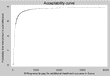
The CE acceptability curve is a plot of the probability that the incremental step going from the cheapest to the more expensive strategy is cost-effective as a function of increasing WTP. The probability that, for example, the incremental step from EGT strategy to PPI strategy is cost-effective at WTP is equal to €100 is 47.3 percent (Figure 1). If society's WTP for an additional treatment success increases to €300, the CE probability increases to 70.3 percent. The acceptability curve will asymptotically approach 80 percent.

The CE acceptability curve is a plot of the probability that the incremental step going from the cheapest to the more expensive strategyis cost-effective as a function of increasing WTP. The probability that, for example, the incremental step from EGT strategy to PPI strategy is cost-effective at WTP is equal to €100 is 47.3 percent. If society's WTP for an additional treatment success increases to €300, the CE probability increases to 70.3 percent. The acceptability curve will asymptotically approach 80 percent. CE, cost-effectiveness; WTP, willingness to pay; EGT, endoscopy-guided therapy; PPI, proton pump inhibition.
Sensitivity Analysis
Endoscopies, PPI consumption, and sick leave days were the most costly items and all carried the highest cost per patient in the EGT group (Table 1). Change of cost for endoscopies or PPI did not alter the direction of the incremental CE ratio (Table 3). If productivity costs were reduced to 25 percent (36), the incremental CE ratio for EGT would be €111 per day free of symptoms (Table 3). Patients in the EGT group had more days free of dyspeptic symptoms than patients in the PPI group, regardless of the transformations of scales; however, the incremental CE ratio varied from €75 to 499, depending on the transformation (Table 3).

Reflux was stated by the GPs as the predominant symptom upon inclusion in 28 percent of the patients. When reflux was not the predominant symptom, the incremental CE ratio for endoscopies decreased to €72. When reflux was the predominant symptom, the PPI strategy was more effective than the EGT strategy. Hence, the PPI strategy was the more cost-effective (Table 3). The incremental CE ratio for the EGT strategy compared with the PPI strategy was higher among patients below 45 years than for patients 45 years of age and older (Table 3).
DISCUSSION
Compared with the PPI group, EGT patients on average had 2.6 more days without dyspeptic symptoms, the average cost per patient was €399 higher and the incremental CE ratio was €154 per symptom-free day. When the predominant symptom upon inclusion was reflux, the PPI strategy was both less expensive and more effective than the EGT strategy.
Strengths and Weaknesses of the Study
We obtained information about medicine consumption from both the GPs who prescribed the drugs and from the patients who consumed the drugs, which strengthens our conclusions about total consumption compared with studies relying on prescription databases. Assessments based on scales instead of absolute numbers could potentially bias the results. The scale transformations were appropriate as alternative transformations did not change the conclusions. A societal perspective was adopted for cost analysis, as recommended when explicit cost calculation methods are used, and for collection of cost information (15). The relevance of using indirect cost lies in the loss of productivity associated with gastrointestinal disease. Whether the indirect cost method applied here compensates for such absenteeism can be discussed (3;36), and a reduction of the indirect cost to 25 percent diminished the incremental CE ratio, but did not change its direction. The higher indirect cost in the EGT group cannot solely be explained by the time of the endoscopy procedure, which usually does not result in sick leave days. Effectiveness measures from this study after 2 weeks and 3 months (21) indicate that the PPI strategy in the short-term is more effective, hence leading to fewer sick leave days.
The absence of any significant difference in effectiveness between the strategies observed in this and other RCT studies of dyspepsia (8) could be explained by the high proportion of patients with functional dyspepsia, which is the most difficult diagnosis to treat (21). We choose a CE analysis instead of a cost-minimization analysis because the later analysis tends to overemphasize type I error at the expense of type II error, and absence of evidence is not evidence of absence (16). The CE acceptability curves illustrate the uncertainty in CE analyses. Although the amount society is willing to pay is unknown, the EGT strategy seems not to be cost-effective at a realistic level of WTP.
Days with symptoms are usually preferred as an effectiveness measure in economic evaluations, but most RCTs of dyspepsia use ARR (8). To make the analyses most comparable, we decided to include both longitudinal and vertical effectiveness measures.
Economic evaluation based on ARR/number needed to treat, was questioned by Kristiansen and Gyrd-Hansen (22), especially where a delay is measured rather than avoidance of an event. The ARR may also underestimate treatment effect in patients with an incomplete, yet beneficial response (7). Assuming that people without dyspepsia after 1 year had had their problem solved rather than delayed, we found the use of ARR to be an appropriate effectiveness measure.
We calculated days without dyspepsia from 0 to 3 months and from 9 to 12 months. The immediate effect of the strategies and the need for further investigation and treatment were measured within the first 3 months. The long-term effect was measured during the last 3-month period. Three-month periods reduced recall bias compared with longer periods. The differences between the two strategies were almost exactly the same in the first and the second period. We are confident that no important additional information would have been obtained if the patient's recall period had been longer, and that the doubling of the 6-month estimate produced a valid estimate for the entire study period.
Strengths and Weaknesses in Relation to Other Studies
This study differs from other RCT studies in design. Delaney et al. (10) only investigated patients older than 50 years, Bytzer et al. (6) used an outpatient setting, but neither of these studies consistently used PPI as their first choice of antisecretory therapy. Laheij et al. (24) only included patients already referred to endoscopy. Bytzer et al. (6) found no difference in symptoms, but higher costs in the antisecretory therapy group, due to a high level of medicine consumption and a high degree of secondary referral to endoscopies (10;24–26). Like the present study, Delaney et al. (10) and Laheij et al. (24) found that the EGT strategy carried higher costs and a marginally better clinical effectiveness than the antisecretory strategy. Decision analytic models have indicated that empirical therapy combined with H. Pylori testing is most cost-effective (38). We used a strategy where H. Pylori testing was on demand and only recommended in case of recurrence of symptoms in patients <45 years of age in the PPI group. This approach resulted in low utilization of H. Pylori test and, therefore, contributed to the low cost profile for the PPI strategy. Due to high medicine cost in the antisecretory group, Delaney et al. (10) concluded that the EGT strategy would be the more cost-effective of the two if the cost of endoscopies dropped below a certain level. Our results did not support this conclusion, because the incremental CE ratio favored antisecretory therapy regardless of reductions in costs for the resource items. The high medicine expenses in the EGT group may be rooted in the PPI treatment of endoscopy-negative reflux disease. Laheij et al. (24) found no significant difference in the costs of medication between the strategies, which supports our conclusion. Delaney et al. (10) used primary care case records to calculate medicine consumption, whereas Bytzer et al. (6) and Laheij et al. (24) relied on the patients' own reporting. We combined GP records and patients' own reporting of medicine consumption, which may explain the different conclusions on medicine consumption. Predominant symptoms upon inclusion and patient age have an impact on effectiveness and, to a lesser degree, on costs. We found it interesting that the EGT strategy was both less effective and carried higher costs when reflux was the predominant symptom. The incremental CE ratio for people randomly assigned to EGT was much higher among younger than among older patients, as also found by Laheij et al. (24).
External Validity
The present design integrates CE measurement and effectiveness estimation with prospective collection of all healthcare utilization data and does not, as do many other studies, rely on external data sources and expert opinion. This design extends both the internal (28) and the external validity of the results. Despite recommendations about early referral to endoscopy (6), GPs choose antisecretory therapy four times as often as endoscopy for managing dyspepsia (20). We included patients if the GP would otherwise have prescribed antisecretory therapy or performed an H. Pylori test. The GPs often combine antisecretory therapy and H. Pylori testing. Our strategy of using PPI followed by a H. Pylori test, therefore, reflects current management strategies for dyspepsia in general practice. Bytzer (5) found that, within the same country, cost estimates published in the same year differed by up to 400 percent. To enhance the external validity, we tested alternative costs for endoscopies and transformations of the scales. This did not change our conclusion. The value for the patient of an endoscopic diagnosis was estimated by Hirth et al. (19). They found a very low WTP for diagnostic certainty for both ulcer and esophagitis, which, therefore, did not alter our conclusion.
CONCLUSION
There was a small, nonsignificant improvement in patients' symptoms using the endoscopy strategy compared with the PPI therapy. However, it was more costly. A strategy using empirical antisecretory PPI therapy should be recommended if the alternative is an endoscopy strategy for managing dyspeptic patients in general practice, especially if reflux was the predominant symptom.
POLICY IMPLICATIONS
This study demonstrates a common problem regarding management strategies for health problems. One strategy is both more costly and more effective. Possible early detection of serious gastrointestinal disease, and other intangible reasons are valid reasons for referral to endoscopy (19). We are confident that the GPs had these considerations in mind when they decided to treat the patients in general practice and, hence, found them eligible for the study. Even then the EGT strategy was marginally better, the cost was much higher; hence, referral to EGT of patients the GPs would otherwise have treated in general practice should not be recommend, especially if reflux was the predominant symptom.
CONTACT INFORMATION
Hans C. Kjeldsen, MD, PhD, (hck@alm.au.dk), Assistent Professor, Department and Research Unit of General Practice, University of Aarhus, Denmark; Chief of Pregraduate Education, Department and Research Unit of General Practice, Institute of Public Health, Vennelyst Boulevard 6, 8000 Aarhus C, Denmark
Mickael Bech, PhD (mbe@sam.sdu.dk), Associate Professor, Institute of Public Health, University of Southern Denmark, Denmark, J.B.Winsløwsvej 9, 1, 5000 Odense C, Denmark
Bo Christensen, MD, PhD (bc@alm.au.dk), Professor, Department of General Practice, University of Aarhus, Denmark; Chaiman, Department of General Practice, Institute of Public Health, Vennelyst Boulevard 6, 8000 Aarhus C, Denmark
We thank the general practitioners and all patients who participated in the study. B.C. and H.C.K. have received lecturing fees from AstraZeneca. This study was funded jointly by the County of Aarhus, Denmark; The Danish Research Foundation for General Practice; and AstraZeneca. None of the fund providers had any role in data interpretation or in the production of this manuscript.