“If you see any honey,” wrote Charlotte Brontë to Ellen Nussey in 1846, “gather it. . . . I don't, after all, suppose we ought to despise everything we see in the world merely because it is not what we are accustomed to.”Footnote 1 Honeybees, as agents of feminine industry, foresight, and creative adaptability, were most certainly creatures Brontë admired and sought to emulate in her professional and private life.Footnote 2 The “honey-seeking” bee features as a symbol of survival in one of Brontë's earliest published poems (“Winter Stores” [1846]), and her sister Anne employs a similar image of the bee in Agnes Grey (1847) when she creates a character (much like Charlotte) intent on gathering “the honey” for “ourselves.”Footnote 3 In Brontë's novels, this small but important theme of honey gathering can be said to reside at an interstice between representations of sexual desire, creative expressions of self-affirmation, and eudemonistic assertions of the value to be derived from possessing an autonomous labor identity. Nearly all of Brontë's novels celebrate the professional identity of their Victorian heroines but problematize its existence by situating the heroines within economic and romantic environments wherein masculinity, the problems it produces, along with the erotic desires it elicits, present the central impediment to that identity's maintenance and survival.
In these environments, masculinity, and particularly aristocratic masculinity, is frequently represented by Brontë as an attractive yet selfish nectar-bearing flower, or nectarium, possessed of an erotic power that threatens to collapse the boundaries between sexual and professional identity. In Jane Eyre (1847), the aroma of Edward Rochester's cigar smoke comingles with the “honey-dew” and “sweet-briar” of his garden to attract the night-roving moth Jane Eyre.Footnote 4 Early in The Professor (1857), William Crimsworth compares himself unfavorably to “a plant growing out of the slimy walls of a well,” and he later sells his romance with Frances Henri to the reader as “honey fresh from flowers.”Footnote 5 In Villette (1853), Dr. John Bretton resembles a tall bearded iris. Lucy Snowe spies Bretton sunbathing and becomes “riveted” by the “overmastering strength and power of attraction.” But such nectar, Lucy later realizes, “belonged in no shape to me: it was part of himself: it was the honey of his temper; it was the balm of his mellow mood; he imparted it, as the ripe fruit rewards the riffling bee; he diffused it about him, as sweet plants shed their perfume,” but does “the nectarine love either the bird or the bee it feeds? Is the sweet-briar enamoured of the air?”Footnote 6
The affinity established between Brontë's protagonists and riffling insects inverts the traditional understanding of the Victorian use of botany to represent sexuality in the novel by endowing the feminine protagonist with an ulterior form of entomological agency. For Amy King, whose classic study Bloom (2003) delineates a narrative intersection between botanical taxonomy and the novel, the popularization of Carl Linnaeus's sexual system of plant classification established a vernacular code conducive to the representation of feminine sexuality and the erotics of courtship in the English romance novel.Footnote 7 When placed in the context of insect-flower relationships, nascent theories about pollination, and debates concerning the existence and intention of the nectarium, I suggest that the bloom narrative can be expanded to explore a much broader network of ecological relationships. In her novels, Brontë deploys an entomological imaginary to dispute the conservative schema of the botanical romance, but only to arrive at the social problem of the masculine nectarium. The nectarium's self-absorbed nature attracts insects only to repel them as interlopers, pests, or what Patricia Yaeger once described as honey robbers.Footnote 8 In Jane Eyre, Rochester boasts that he can get “sweet fresh pleasure” whenever he likes.Footnote 9 Wealth and privilege position him at the center of a pleasure economy adapted to attract a variety of entomological visitants, while in Villette Dr. John's possession of a stimulating medical career engrosses him to the extent that he appears ignorant of the psychological effect that his “honey-dew” letters have on Lucy Snow, who is forced to sneak them up to Madame Beck's garret to devour in a state of “strange, sweet insanity.”Footnote 10 It is in Brontë's industrial romance Shirley (1849), however, that the social problem of the masculine nectarium finds sustained representation in Robert Moore's effusion of an economically poisonous species of romantic sweetness.
This essay presents a close reading of the ecological relationship between insects, flowers, and nectar in Shirley. The first half of it is devoted to the location of the nectarium in botanical culture from the 1760s to the 1840s. The topic to be explored here involves not the process of pollination but a misunderstanding regarding the nectarium's role in incentivizing that process. The nectarium was initially viewed by Linnaean and Romantic botanists through the paradigm of bodily autonomy, and its lack of structural consistency and ubiquitous positioning on the flower later came to frustrate the structural determinism and functionalist logic that underpinned much early Victorian thinking about sexual morphology.Footnote 11 Focusing specifically on the nectarium's location in Romantic and early Victorian plant biology is important to our understanding of early Victorian ecology and pest discourse because not only does the nectarium help spotlight the epistemological taboos that had to be overcome as nineteenth-century science moved from organicism to open ecology, it further draws attention to the environmental consequences derived from the denial of certain forms of pleasure.Footnote 12 If, as King so eloquently illustrates, the morphology of the bloom “socialised the sexual content of the flower into an acceptable taxonomy of marriage,” thus rendering visible the illicit contours of an alien body, the nectarium worked to mask and express an erotic pleasure, namely the orgasm, which was itself subject to attempts at erasure in contemporary Victorian gynecology.Footnote 13 Thinking about the nectarium in this way complements Theresa Kelly's suggestion that the cryptogamia also defied the “Linnaean regime” through their “resilient hiddenness.”Footnote 14 Mosses are, of course, exceedingly erotic organisms. Though they may be said to lack the dulcet pungence and scopophilic pigmentation of angiosperms, they possess the maturity and somatic verisimilitude we find regularly expressed by Brontë in her love of “strange mosses.”Footnote 15 But as an economic mediator in interspecies relationships, the nectarium complicates the harmonious dénouement of the romance novel by forcing readers to confront sexual desire's emergence from within unequal power relationships.Footnote 16 Shirley, I suggest in the second half of this essay, exemplifies this asymmetricity, as it is a social-problem novel that openly eschews the “equal—as we are!” commensalism of Jane Eyre by erecting a romance in which class and gender relationships are resolved in a manner that is far from harmonious.Footnote 17 Rather than ameliorate in the conventional fashion assigned by scholars to the study of natural history in Victorian culture, the figurative languages of botany and entomology operate in Shirley to poison and castrate. In Shirley, the feminist theme of honey gathering turns to honey poisoning to narrate a crisis in the plotting of Victorian femininity. Caroline Helstone's desire for more, a more that doubles as a demand for greater economic and romantic autonomy, is complicated by her nocturnal lust for Robert Moore and the poisonous honeysuckles that adorn his counting house windows. The transformation of the Luddite weaver William Farren into Caroline's subservient ground bee, I further suggest, works to naturalize Brontë's High Tory fantasy of a feminine monarchy in which working-class radicals must either undergo political castration or find themselves branded as pests and transported to botany bay.
1. The Linnaean Nectarium
Brontë's question in Villette about natural intent in insect-flower relationships speaks to an early Victorian ambiguity about the place of the nectarium in flower morphology. In the eighteenth century, Linnaeus had done much to introduce the term nectarium into botanical nomenclature in his Nectaria Florum (1762). He used the term nectarium to designate an often amorphous gland evident in flowers, which was neither calyx, petal, stamen, nor pistil, but could be identified by its secretion of a honied sweetness, or “dulcissimi mellei.”Footnote 18 Despite having taken the name nectarium from a passage in book 4 of Virgil's Georgics (“nectare cellas”), having also noted the preponderance of insects to be found in and around nectariums, and having further become famous for making sex central to how plants were to be categorized, Linnaeus did not perceive a connection between insects, nectariums, and plant fertilization.Footnote 19 Rather, Linnaeus conceived of the nectarium as functioning to aid in the process of fructification and, as Jacob Lorch and Stefan Vogel have each shown respectively, most eighteenth- and early nineteenth-century botanists followed him in conceiving of the nectarium as either a type of yolk to support a flower's ovaries, excreta, or toxins comparable to urine, yet more commonly as food for the flower itself to eat.Footnote 20
Erasmus Darwin, in both The Botanic Garden (1789) and Zoonomia (1794), promoted the idea of thinking of nectar as a type of blood-juice used by the plant to feed its developing sexual organs. These organs were like polyps or coral insects in being fixed to the parent-tree and in need of food.Footnote 21 Maria Jacson, in her highly popular Botanical Dialogues (1797), followed Darwin by suggesting that the nectarium's sticky exterior and secluded position within flowers indicated it was “formed for the purpose of preserving from insects the precious store contained within.”Footnote 22 The perfoliate honeysuckle (Lornicera caprifolium), to use one example, was distinctly shaped to prevent insects’ access. “Nature,” writes Darwin, “has in many flowers used a wonderful apparatus to guard the nectary or honey gland from insects. In the honey-suckle the petal terminates in a long tube like a cornucopia, or horn of plenty, and the honey is produced at the bottom of it.”Footnote 23 In the bee orchids (Ophrys), which do not possess nectaries proper but have exchanged them for chemical scent glands adapted to invite pseudocopulation, the flower's similarity to bees and other insects worked to convey the message to approaching insects that its nectarium was already being robbed of nectar. “The nectary and petals resemble in form and color, the insects which plunder them, and thus,” surmised Darwin, “it may be supposed they escape these hourly robbers, by having the appearance of being preoccupied.”Footnote 24 While contemporary natural theologians dealt with the similarity between Ophrys and insects by appealing to the law of analogy, which held structural imbrications in form and color between disparate phyla to be “iconisms,” the accidental yet exuberant sign of God's universality, Darwin's logical inference regarding Ophrys was founded on the belief that the nectarium required protection.Footnote 25 Even when working to mimic insects, the nectarium was seen as producing nectar to serve the plant's own needs, its tender seed buds, ovaries, stamens, and pistils.
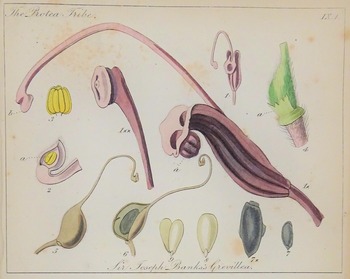
Early Victorian botanists upheld this view of bodily autonomy while also advocating for the redaction of the term nectarium from botanical nomenclature all together. This is particularly evident in the botany of John Lindley, a utilitarian orchidologist recognized by Victorian scholars as a pivotal figure in the professionalization and masculinization of botany.Footnote 26 Lindley, as Ann Shteir has shown, embarked on a campaign throughout the 1830s and 1840s to defeminize botany and transform it into a more manly or “serious utilitarian science.”Footnote 27 In his books, Lindley explicitly aspired to render the nectarium obsolete owing to what he saw as its ephemerality.Footnote 28 In the glossary to his Elements of Botany (1841) the terms nectarium, nectarostigma, and nectarotheca are labeled “obsolete” and “objectionable” for such terms have been “extended to mere discolorations.”Footnote 29 Structural configurations or excrescences in flowers supportive of sweet juices are handled in a similar fashion. Describing the morphology of the spider flower (Grevillea banksii) in his Ladies’ Botany (1834–37), Lindley remarks that the “jagged scale”, or crenulated honey-cup (fig. 1 [4.a]), located at the base of the pistil, “used to be called the nectary, under the idea that it was formed for the purpose of secreting honey or nectar, but that term is now abandoned.”Footnote 30 Flower “terminology,” argued Lindley in his Introduction to Botany (1832), requires that “every term should have a distinct, positive meaning, which cannot be misunderstood,” and the nectarium failed to meet this standard.Footnote 31 It constituted a structural superfluity requiring redaction from the textbooks “on account of the vagueness of its application.”Footnote 32
Sarah Drake, “Plate IX.1,” in Ladies’ Botany, detail, 10cm x 7cm, color engraving, 1848. Melbourne University, Special Collections.

An inevitable consequence of viewing the nectarium as an autonomous structure or superfluity was that entomological visitants to flowers came to be viewed as criminals, sexual deviants, and pests. The sphinx moth's proboscis is described by Darwin in his Botanic Garden as an excellent “contrivance for robbing flowers of their honey,” which keeps “this beautiful insect fat and bulky.”Footnote 33 The moth's nocturnal behavior, flying “only in the evening” when flowers like honeysuckles have apparently closed, “and are thence more difficult to access,” furthered the imagery of moth-burglary.Footnote 34 In Robert Thornton's The Temple of Flora (1807), the complex organization of exotic passionflowers spoke to the romantic imaginary of a gothic dungeon. The nectariums of Passiflora alata and quadrangularis were “first defended with small teeth placed in several rows,” writes Thornton, “and as if that was not a sufficient guard, nature has also formed a complete barrier by a thick membranous expansion closely locking up the reservoir of nectar.”Footnote 35 Romantic poems like Charlotte Smith's “Flora” (1807) and Percy Bysshe Shelley's “The Sensitive Plant” (1820) illustrate a similar divorce between insects and flowers. In Smith's “Flora,” the flower's thorns, spikes, and spadices defend the “honeyed nectaries” of the flower from dragonflies, the “winged Ant,” and “the headlong beetle in flight.”Footnote 36 In Shelley's “The Sensitive Plant,” an aesthetic distinction separates those “killing insects” or “things obscene and unlovely in form,” which are to be gently removed from the garden, and beetles, bees, and the “soft moths that kiss the lips of the flowers,” which are permitted to remain in the garden because they “harm not.”Footnote 37
Romantic botanists and poets may have played upon the nectarium's location at an intersection between the erotic and the economic, but as their thinking came to be supplanted by Lindley's utilitarianism, some naturalists began to advocate that bees deemed injurious to plants be exterminated. In the first year of publication of The Gardeners’ Chronicle (1841), a periodical edited by Lindley and dedicated to the liberalization of horticultural knowledge, the pioneering economic entomologist John Curtis penned an anonymous article (“Humble-Bees” [1841]) contending that bees belonging to the Bombus genus were destroying broad bean and horse bean crops.Footnote 38 Curtis had witnessed humble bees nibbling holes into the plant's blossom and stealing nectar, which, according to Curtis, led to a significant decrease in bean yields. Ornamental garden flowers, such as azaleas and honeysuckles, were violated in a similar fashion, and Curtis suggested that the nests of these creatures should be uprooted, destroyed, and children “employed to catch and kill females in the bean fields as soon as the first blossoms have expanded.”Footnote 39 In “Humble-Bees,” Curtis presents his entomological subjects as pests, creatures that build crude habitations “amongst loose rubbish” and engage in bouts of drunken licentiousness. These “jovial bees are often seen reeling about as if intoxicated, throwing their legs in a very grotesque manner, and eventually nestling in the soft flowers, fall asleep at the close of night.”Footnote 40 By the time of his Farm Insects (1860), Curtis had compiled a litany of humble bee offenses, which he placed alongside a catalog of bee predators and bee parasites that farmers could utilize in their struggle against the mischievous humble bee.Footnote 41
This is not to say that humble bees were without their defenders. Otto Plath was perhaps the first bumblebee specialist to point out that not long after Curtis's “Humble-Bees” appeared in The Gardeners’ Chronicle, the naturalist Charles Darwin sent in a detailed rebuttal.Footnote 42 In Darwin's “Humble Bees” (1841), Curtis's observations are questioned, challenged, and recontextualized. “Your correspondent says that the honeysuckle is sometimes bored,” quips Darwin, but “I have never happened to notice this.”Footnote 43 What Darwin had observed were humble bees gathering pollen from honeysuckles, a behavior ignored by Curtis, and he further doubted Curtis's attribution of bean crop failure to humble bees owing to the farmer's own ability to drastically change the phenotype of bean-flowers through crossbreeding and hybridization without apparently hindering fructification. In other words, the amount of damage attributed to the small perforations made by bees seemed disproportional. In “Humble Bees,” Darwin turns Curtis's discourse of extermination on its head by pointing out the Dickensian intelligence these urbane “pick-pockets” display in manipulating flowers with their smooth tongues. Such behavior, particularly when observed in bees working on the alien plants at Kew Gardens, furnished the naturalist with an “instructive case of acquired knowledge” in animals generally considered instinctual in psychology.Footnote 44 “One would lament,” cautioned Darwin with much creaturely sensibility, “to see these industrious, happy-looking creatures punished with the severity proposed by your correspondent.”Footnote 45
Embedded in Darwin's response to Curtis's “Humble Bees,” we also find the desire to draw attention to the nectarium's role in the process of pollination studied in detail by the Prussian naturalist Christian Konrad Sprengel. After the seventeenth-century rediscovery, or recontextualization, of pollen's importance to plant sexuality, a number of English, French, and German botanists began to connect insects to the cross-fertilization of plants. Yet it was in Sprengel's The Secret of Nature in the Form and Fertilization of Flowers Discovered (1793) that the nectarium took on a central importance in insect-flower relationships. In The Secret of Nature, Sprengel introduced a new lexicon to describe the contrasting colors, shapes, lines, and spots on petals that, as William Kirby and William Spence explained to readers in the first volume of An Introduction to Entomology (1815), appeared to be placed on flowers “expressly to guide insects into their nectaries.”Footnote 46 Whereas botanists like Robert Thornton clearly used exotic flowers to celebrate the opulence of Britain's colonial possessions, Sprengel's focus on the inner world of flowers can be related to the interiorization of the early German mind, an idea evinced most famously by the Romantic poet Novalis's creation of a blue flower only encounterable in one's dreams, but also in the homely sensibility, or Gemütlichkeit, Sprengel identified in insect-flower relations. Sprengel suggested that the raised ovary towers in passion flowers functioned to dapple an insect's abdomen with pollen as she romped around its colorful corona drinking nectar. Rather than gothic teeth, the “three shades of color” (blue, white, and purple) that adorn the corona filaments of Passiflora caerulea “point the insect to the center of the flower where the juice is.”Footnote 47 These nectaries, or “juice tubs,” are positioned in a ring of openings, so that “if the insect wants to enjoy the whole juice supply” it must move around the nectary.Footnote 48 But a “large insect can make it round the juice tub very comfortably,” as “it runs on the corona as on the spokes of a wheel” and licks up the juice as it goes. Sprengel's descriptions of flower-insect relations ooze with a eudemonistic glee that Charles Darwin clearly found stimulating. As Jonathan Smith has shown, Darwin began devoting his summers in the 1840s to investigating insects visiting flowers, later recruiting his children to observe bees visiting wild orchids and, as Devin Griffiths further notes, the scribblings that adorn Darwin's copy of Sprengel's Secret of Nature constitute some of the most copious to be found in his library. Many of these doodles consist of nothing more than multiple exclamation marks expressive of excitement at the novelty and naïveté of Sprengel's ideas.Footnote 49 “The construction of this flower,” declares Sprengel with respect to Passiflora, “is most beautiful and admirable,” and “I was so happy to see how the flower was fertilized,” exclaims Sprengel when it came to bee orchids.Footnote 50 Despite the insect being tricked into an unusual position, that is, the position expedient to the flower, the insect nevertheless seemed to take pleasure in the deceit.Footnote 51
Although Sprengel's ideas found favor amongst some botanists, entomologists, and beekeepers, the significance of his descriptions of insect-flower relationships appear to have been ignored and rejected by the majority of the botanical establishment in the early nineteenth century. “Who will seriously believe,” wrote the botanist Benjamin Smith Barton, “that Nature has exerted so much care and skill in the construction of the beautiful petals of the flowers, merely to form a palace for insects.”Footnote 52 The idea that a flower existed to serve an insect's aesthetic sentiments ran contrary to the anthropocentric reasoning of many natural theologians who held God to have created flowers to be perfect in themselves.Footnote 53 Sprengel's thinking blurred the disciplinary boundaries between entomology and botany during a period when ecology did not yet exist at an institutional level, and it further violated the epistemological assumption that sexuality could not function at the interspecies level. Whereas the anthropomorphic eroticism of Erasmus Darwin's Linnaean poetry titillated because it undermined the centrality of monogamy in British society, Sprengel removed humans from the figurative equation, and in doing so he was unknowingly gesturing at a relationship comparable to bestiality. Sprengel was thus mocked by many of his contemporaries as a writer of “fairy tales” and criticized by others (most notably by Johann Wolfgang von Goethe) for departing from the “true path” of plant physiology.Footnote 54
2. The Masculine Nectarium in Shirley
The purpose of the discussion up to this point has been to describe how the nectarium came to constitute a site of much ambiguity, contestation, and erotic creativity in Romantic and early Victorian natural history. That this contestation reflected the reproduction of certain cultural norms in botany was evident, for instance, in the criminalization of insects and the denial of certain forms of pleasure. Given the Victorian propensity to conflate sexuality with botany while simultaneously naturalizing feminine passivity, it is perhaps not very surprising that the nectarium underwent silencing. Lindley denied the existence of the nectarium in the same way that contemporary opponents of autoeroticism in women advocated for clitoridectomies. As Emma Rees has pointed out, Victorian gynecologists like Baker Brown promoted the excision of the clitoris with scissors as expedient to women's health as pleasure was not seen as “an essential part of the generative system.”Footnote 55 Phobias about masturbation and masculinity also developed into life-threatening pathologies diagnosed by physicians whose surgical procedures now read like the ravings of madmen.Footnote 56 Claude François Lallemand dealt with spermatorrhea in males by burning the prostatic section of the urethra with silver nitrate and promoting the systematic introduction of preventative circumcisions for children.Footnote 57 Thinking about the nectarium as an analogue for the Victorian orgasm is disturbingly helpful because it indicates that sexual typologies deemed deviant challenge modes of functionalist logic and structural determinism in ways that foreground the ethical, environmental, and epistemological consequences of scientific patriarchy.Footnote 58 Lindley was like Lallemand and Brown in wanting to remove the nectarium from flower morphology on account of a perceived superfluity, and Curtis followed suit when he suggested farmers employ children to kill bees to increase bean yields.
In Shirley, the nectarium is not introduced as an object of scientific investigation and regulation but as a site of romantic and economic visualization. We first see nectar as a figurative resource Robert Moore has monopolized by way of his dual roles as industrial capitalist and romantic gardener. Moore is perhaps unique to industrial literature in marrying his interest in horticulture, and particularly floriculture, to the management of his factory. He has surrounded his textile mill (Hollow's mill) in Briarfield with garden beds full of nectar-bearing snowdrops, crocuses, primroses, moss-roses, lilies, holly-oaks, privet, and laurel (71, 373, 386). Honeysuckle creepers overhang the windows of Moore's counting house. This is a structure from which Moore emerges in the morning armed not with a cudgel used to instill industrial discipline but with a garden “spade” to dig new flower beds (61). The reader is shown the “budless” stalks of plants and the trains of lattice Moore has laid in “prediction” of a coming inflorescence (60). We learn that Moore plans to cultivate “the starving and the unemployed” on the “Rushedge” and “Bilberry moss” that margin his factory grounds (606). The “poor man's heart” needs to be nourished on special “dews” if it is to “evolve foliage—perhaps blossom” (69).
Beneath the utility of this horticultural discourse Moore is further represented by Brontë as a species of romantic plant, “à fleur de tête” whose “hybrid nature” renders him an agent of suspicion and seduction in Napoleonic Yorkshire (57). Moore oozes with a desirable “sweetness” (15, 181, 290, 506, 559). He wants to “attract, to dazzle” (238), and though his “manhood has been drenched and blighted by the pitiless storm” of life (28), he possesses special “roots” that allow him to grasp a “sapling” from the main plant of himself and regenerate elsewhere (560). For the indigenous inhabitants of Yorkshire's West Riding, and especially the Luddites, Moore is viewed as “foreign gall” and as an “alien” they would like to see transported to “botany bay” (37, 43, 49, 308). For Caroline Helstone, in contrast, Moore was “something agreeable to sit near, to hover around and look at” (172). His appearance is often preceded by flowers and their sweet perfumes. The “pure incense exhaling from tree or plant” and “the long sprays of hawthorn, shooting out” are smelled and seen before Moore is detected moving between them (295). Caroline looks into Moore's “hedge of privet and laurel,” but “her eyes longed to see something more, a certain human figure” (386). At times this interplay between botany and desire works to mask explicit bodily explorations of erotic pleasure. As Caroline's “sweet secret” (290), she and Moore had often gone to the Hollow to “scent the freshness of the earth, where a growth of fragrant herbage carpeted a certain narrow terrace, edging a deep ravine, from whose rifted gloom was heard a sound like the spirit of the lonely watercourse, moaning amongst its wet stones, and between its weedy banks, and under its dark bower of alders” (221). In another sweet passage, Moore hides himself beneath the “tall erection” of a tombstone after having embraced his “sweetheart” (242). Crouching “with one knee in the turf,” with “his hat off, his curls bare to the dew, his dark eyes shining, and his lips parted” (243), Moore mimics a gothic creeper to avoid paternal detection.
Moore's heterodox nature excites Caroline's pleasure sensorium while disrupting the traditional conflation of botany with feminine sexuality. Part of Brontë's intention here, I suggest, concerns drawing attention to the social problem of masculine self-absorption. Though desirable and sweet, Moore is inherently selfish. “It is my fancy,” he asserts early in the novel, “to have every convenience within myself” (25). Moore is repeatedly shown to display little to no care for those sucked into his world beyond the pleasure and instrumental value they can bring him. He views his employees as “savages” and treats the Luddites who have rebelled against his authority as “vermin” (57, 42, 486). His unwillingness to acknowledge his responsibility in their economic displacement is connected to the emergence of a nocturnal “fighting animal” that he views as a pest requiring extermination (326). Likewise, Moore's ability to attract Caroline coincides with his inability to consider the idea that she may possess professional aspirations beyond the domestic pleasures he views her as capable of providing him. Caroline's repeated expressions of a desire to work, to find an “occupation” and to “make money,” are reciprocated with floral emblems: a bouquet of flowers and a kiss on the forehead (69–82). Moore proves incapable of empathizing with Caroline's economic marginalization, and he is later found espousing the paternalistic view that women were to have their knowledge carefully “measured out” for them by a man's “hand” and administered via his “lips” (506). Mature and apparently ugly women like Miss Mann are compared to “briars and thorns” (172), and, much like Hiram Yorke, who enjoys ogling Caroline in church because her soft body reminds him of his dead love Mary Cave, Moore views Caroline as an escape from the quotidian vulgarity of commerce. Marriage to her would alleviate “the sordid, cankering calculations of your trade,” and replace them with “pure affection,” “love of home,” and a refreshing desire for “sweet discourse” (506).
Moore's androcentric constructions of feminine utility form the anthers of Brontë's sustained problematization of masculine self-absorption. Indeed, the very atmosphere of the West Riding is permeated by a toxic dew exuded by the novel's male characters. The three curates of Shirley are introduced as “blossoming” weeds or “rods of Aaron” in “the bloom of youth” (6). They ignore the sick of their community in favor of bickering amongst themselves. Caroline's uncle, the Reverend Mathewson Helstone, has girdled his own loins with his own peculiar type of biblical “honey” (410). Helstone views women as cognitive imbeciles and pleasure dolls. “At heart he could not abide sense in women: he liked to see them as silly, as light-headed, as vain, as open to ridicule as possible” (112). We are led to believe Helstone killed his first wife (Mary Cave) through romantic neglect, and that the generational dimorphism evident in his contemplation of marriage to the teenage Hannah Yorke would invert “the natural order of insect existence” by transforming the “admired butterfly” into a “crawling worm” (113). Caroline's ignorance regarding her own genesis, along with her inability to find meaningful employment as a governess, stems from the privileging of his desires. Helstone will “not have it said that” his “niece is a governess” (184) because her entry into the labor market would imply maleficence and a loss of communal standing on his part. Joe Scott's comical warning that the “dews at this hour is unwholesome for females” prefaces the idiocy of his patriarchal rant and signposts the masculine origins of Yorkshire's toxic atmosphere (311).
It is into this toxic ecology that Brontë introduces the theme of honey gathering. On one level of representation, namely that of the novel's romance, with its erotic undercurrents, the aerial mobility of the insect gifts Brontë with a means of challenging the stasis of the bloom. We catch glimpses of Caroline gliding, fluttering, and flying into Moore's garden “to scent the fragrance of hedge-flowers sweeter than the perfume of moss-rose or lily” while a “soft agitation of wings caressed her cheek” (373). These liminal acts occur at a nocturnal intersection between sex and sedition and are framed as transgressive in nature. Moore, who has adopted the insomniac's habit of guarding his private property from the prowling Luddites, suspects Caroline's nocturnal presence in “the white sprays of hawthorn,” “the flutter of every bird over its nest,” and “the rustle of every leaf” (241). His attempts to reveal Caroline's presence prove futile, however, owing to her aerial nature. Rather, what remains exposed is the spectacle of Moore's own eruptive botany, or a “balsam plant in a flower-pot, covered in the flush of bloom” (241).
When it comes to Shirley’s handling of the woman question, the subversion latent in an erotized mode of honey seeking ossifies to form a much more negative network of apicultural representations. Excluded from meaningful employment and reduced to a literary diet of “faded flowers” from which she had long “extracted the honey” (366), Caroline's mind is described as a failed beehive. “Thousands of busy” and “brilliant thoughts” create “cells in her brain” (99), but they gradually starve themselves to death, because there is no “pleasant food” (331), “no manna of hope, no hived honey” (331). The psychological image of a famished working bee recalls Brontë's early use of the bee to embody the Romantic ideal of stoic fortitude in isolation. In her poem “Winter Stores” (1846), the “honey seeking” bee's ability to work memory into honey, or a “lasting good,” ensures survival from “Winter's future sorrow.”Footnote 59 The key difference between this poem and Shirley concerns lack of winter food. Brontë's industrial romance is dominated by the dual themes of romantic and economic hunger.Footnote 60 Unlike the embodied swarms that Heather Johnson and Leila Brosnan have identified in the modernist writings of Virginia Woolf and Sylvia Plath, or the enduring bees Jane Wright has located in Elizabeth Barrett Browning's poetry, Brontë zones in on a nectarial dearth.Footnote 61 A modernist escape into an emergentist conception of selfhood, or the conception of selfhood created by a language of bees, is visualized but pathologized in Shirley.
Here, romance and economics converge to narrate a crisis in the plotting of Caroline's identity. Moore's control of the “cordial of heart's-ease,” a substance capable of lifting Caroline on the “wing of hope” (562), proves to be toxic because it coincides with masculine self-absorption and romantic inconstancy. Moore flirts with Caroline in private, but he tends to ignore her existence in public, and he then goes on to propose marriage to Shirley Keeldar for purely economic reasons. Caroline is fated to “weep gall” (220). She becomes obsessed with the nocturnal sight of Moore's lamp glowing beneath the “honeysuckle” creepers that overhang his counting-house (180–81). “How she caught the fever,” writes Brontë with much self-reflexive irony, “she could not tell, probably in her late walk home, some sweet poisoned breeze, redolent of honey-dew and miasma had passed into her lungs and veins, and finding there already a fever of mental excitement, and a languor of long conflict and habitual sadness, had fanned the spark to flame, and left a well-lit fire behind it” (393). The conflation between nectar, romance, and poisoning is reemphasized by Brontë during Caroline's fever. “I smelt the honeysuckles in the glen this summer morning,” she whispers while contemplating death, “as I stood at the counting house window” (399). Caroline's relationship with Moore is pathologized in terms that approach the classical, Sapphic representation of the bee as Eros, the bringer of honey but also poison.Footnote 62 Romance is described as “the sweetest and yet the bitterest thing we know” (358). It is a pernicious γλυκύπικρον that leaves its victims to “crawl” away “galled, crushed, paralyzed, dying” (408).Footnote 63
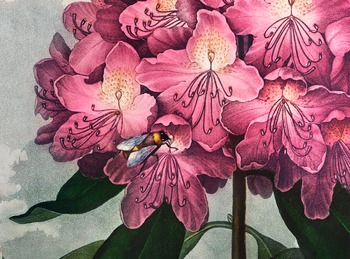
This phenomenon of honey and nectar poisoning was well known in the nineteenth century.Footnote 64 The aforementioned botanist Benjamin Smith Barton gave a detailed account of poisoning by plants like wild honeysuckle in his essay “Some Account of the Poisonous and Injurious Honey of North America” (1802).Footnote 65 Sections of Barton's essay were reproduced in an article on “Animal Poisons” in Chambers Journal in 1844, a source alluded to by Brontë in Shirley for its natural history value, and the year of Shirley’s publication coincided with the appearance of Joseph Hooker's The Rhododendrons of Sikkim-Himalaya (1849). Hooker's book came with popular accounts of the poisonous nectaries of Rhododendron ponticum and, as Jim Endersby notes, “created a sensation and helped start a widespread fashion for growing rhododendrons in British gardens.”Footnote 66 In Robert Thornton's earlier Temple of Flora (1807), plate XXV (fig. 2) depicts the English “humble bee” feeding on one of ponticum’s glowing nectaries.Footnote 67 The plant's somber alpine habitat rendered it a conducive symbol for forlorn states of melancholic femininity, while its engorged nectaries focused the gaze on an exotic sweetness.Footnote 68 So fertile “for the formation of honey” are these nectaries, remarked Thornton, “that you may observe a sweet globule in every expanded flower.”Footnote 69
Peter Henderson (painter) and James Caldwell (engraver), “The Pontic Rhododendron,” from The Temple of Flora, detail, 20cm x 15cm, 1807, hand-colored and color-printed in aquatint, stipple, and line engraving. From the Biodiversity Heritage Library, www.biodiversitylibrary.org/item/32#page/287/mode/1up.

In the Romantic poetry created concurrent to the spread of alien plants like ponticum across the British Isles, the theme of poisoning by honey was regularly used to explore erotic, oracular, and paradoxical etiologies and sensations. Poetry, science, and honey shared a liquidity during this period owing to what Amanda Jo Goldstein describes as the recurrent appeal to the “honeyed cup” of Lucretian materialism, and they were only much later separated by the “generic alignments normalized over the nineteenth century.”Footnote 70 What links yet separates Brontë from her Romantic predecessors concerns her use of honeyed poisoning to draw attention to the importance of professional identity in Shirley. Brontë's “Men of England!” address (369–71), which precedes Caroline's sickness, explicitly links feminine pathology to lack of meaningful employment.Footnote 71 This is not to say that sexual desire is ever stigmatized in Shirley. A central question raised by Brontë is also whether or not “labour alone can make a human being happy?” (216). To this question she responds in the negative via her portrait of Miss Ainsley's “bed as narrow as a coffin” (369). Ainsley's negation of an erotic identity is framed as a violation of “nature” (369). Romantic desire is positioned at the center of Shirley. Like honey, love is “the essence of life: a taste of existence, with the spirit preserved in it, and not evaporated” (552). But Caroline's midnovel poisoning seems indicative of the contrary point that love is not enough.
One way Brontë appears to stress the importance of labor is in the economic and political marginalization that Caroline shares with the redundant hand-loom weaver William Farren. Unlike Moore, who is shown to avoid Caroline while sick, Farren arrives to care for Caroline's small collection of plants and aid in her convalescence. Their relationship comes to center symbolically on natural history and the study of a species of “ground-bees” (415). William and Caroline “had a dozen topics in common—interesting to them, unimportant to the rest of the world. They took a similar interest in animals, birds, insects, and plants; they held similar doctrines about humanity to the lower creation, and had a similar turn for minute observation on points of natural history. The nest and proceedings of some ground-bees, which had burrowed in the turf under an old cherry-tree, was one subject of interest” (415). The harmonious industry of bees, particularly as figured by Saint-Pierre, whose Studies in Nature (1784) Brontë received as a gift from Constantin Heger in 1843, serves as a model for social order opposed to Briarfield's mechanized economy.Footnote 72 For Danielle Coriale, Farren's and Caroline's shared study of natural history posits “an alternative social network organized around natural history's universal appeal,” which was believed to “cut across class and gender” and thereby “unify the disparate people who pursued it.”Footnote 73
Given the internal dynamics of social insects like ground bees (their division of labor), it might be worthwhile questioning, as Sally Shuttleworth does in her close reading of Shirley: what exactly is implied by Farren and Caroline's relationship?Footnote 74 Ostensibly, Farren never appears to be positioned on an equal footing with Caroline. He was “there to wheel her round the walks, to show her what he had done amongst her plants,” and “to take her directions for further work” (415). Agnes Pryor, Shirley Keeldar's governess and Caroline's estranged mother, expresses horror at the proximity between her daughter and “that rough-handed, rough-headed, fustian-clad clown” (416). Pryor invokes the notion of “caste” to describe the distance that should exist between members of the gentry and their ground bees. She “wondered how her daughter could be at ease with a ‘man of the people.’” She “found it impossible to speak to him otherwise than stiffly,” as though “a great gulf lay between her caste and his, and that to cross it, or meet him half-way would be to degrade herself” (415). Amongst Tories “high and low,” Pryor was “queen” (190), holding aristocratic superiority to be “indispensable to the well-being of every community” (357). Farren's presence in her daughter's garden resonates with phallic anxiety, an oral sclerosis, which Pryor resolves by erecting the curious image of a degraded chasm.
Her ideology of High Toryism is not dismissed by Brontë but refined via Caroline's own queenly ability to better manage or temper Farren and his rustic masculinity. Farren naturally views Caroline as his superior, his queen bee. “Unconsciously,” she was “his ideal of a lady. Her gentle mien, step, gesture, her grace of person and attire, moved some artist-fibres in his peasant heart” (306). Positioned outside Caroline's house, Farren works, digs, weeds, and serves his queen in natural obedience. The idea that Farren might possess romantic feelings for Caroline will never be considered by critics because Brontë brackets it out as an absurdity. Farren is neutered, first introduced to the reader in a servile posture and later encountered by Shirley and Caroline behaving in a distinctly feminine light. We see him seated with a baby on his knee and nursing it as “tenderly as any woman” (305). To be sure, the projection of maternal attributes onto Farren gestures toward an incredibly admirable representation of working-class masculinity, yet it seems incidental to Brontë's broader interest in naturalizing a High Tory feminine monarchy in which women like Shirley would appear to govern through charming smiles and “homely harshness.”
The apparent equality to be found in the shared study of ground bees gives way, I would suggest, to the caste dynamics of social hierarchy in nature, as the emancipatory potential of honey gathering is occluded by the emergence of a queenly discourse. As “the queen” of Moore's heart, it is “natural” that Caroline should side with Moore rather than the Luddites during their nocturnal beast-battle over Hollow's mill (323). Shirley Keeldar is framed as a “queen” (471), an “amazon” (470), a “monarch” (427), and a “sovereign” (585). Endowed with Lilliputian “wings and a crown” (505), “if once the poor gather and rise in the form of the mob” against her, Shirley “shall turn against them as an aristocrat” (253). “Sympathy,” notes Shuttleworth, “is extended to the workers only for as long as they refrain from expressing their grievances.”Footnote 75 Workers who transgress traditional class boundaries by claiming to possess agency and intellect are excoriated by Brontë as invasive pests, “men always in debt and often in drink, men who had nothing to lose, and much, in the way of character, cash, and cleanliness, to gain” (362). Moses Barraclough, the disabled Luddite spokesman, is discredited to the extent that, as Terry Eagleton points out, even his disability is “denied authenticity.”Footnote 76 His comrade Michael Hartley is depicted as either drunk or insane, but typically as both. A critical frustration related to Shirley involves the establishment of a sustained parallel between class and gender oppression that is not consolidated into the emancipatory polemic implied by Brontë's Romantic sensibility but bifurcated to form an aporia endemic to middle-class feminism. Brontë's choice to animalize and masculinize the Luddite body, which ignores the fact that many Luddites were in historical reality women and children, reads like a strategic ploy designed to exploit contemporary egalitarian sensibilities while simultaneously legitimizing the violence enacted on the proletarian body. In terms of plotting, the theme of honey gathering dissipates in synchronicity with the emergence of a High Tory discourse of queenliness, Caroline's marriage to Moore, and the transportation of the Luddites to botany bay.
3. Conclusion
To end this reading of Shirley by suggesting that Brontë was actively compliant in the propagation of industrial patriarchy would be to ignore the pragmatics of survival latent in her idea of honey gathering. As Lucasta Miller argues, it is understandable but anachronistic to want Brontë's feminism to speak to some greater utopian belief in social equality, yet it is equally a mistake not to recognize that her assertion of “women's erotic nature” constituted an extremely radical act in itself and was “greeted as disturbing by puritanical feminists and social conservatives” alike.Footnote 77 Perhaps it was Brontë's emphasis on the erotic that led her friend, the feminist Mary Taylor, to accuse her of being “a coward and a traitor” on account of the supplementary role that professional identity seems to take on in Shirley. Footnote 78 For Taylor, whose colonial adventures call to mind the feminist honey hunter envisioned by Harriet Martineau in the first story of her Illustrations of Political Economy (1832–34), “a woman who works is by that alone better than one who does not.”Footnote 79 What is easy to forget about Shirley concerns the novel's own existence as an exemplum of labor value, of honey gathering, of trying to survive through creative labor. The fact is that Brontë was paid a smooth £500.00 by Smith, Elder & Co. for the copyright to Shirley, and a sense of honeyed cheekiness pervades her novel.Footnote 80 Shirley is introduced as a type of foodstuff and closes with a demand for payment, a settling of “accounts” (594). The creative labor of writing constituted the only stable medium through which Brontë could achieve imaginative control over the economic and erotic conflicts she was forced to navigate in her life.
The purpose of this essay has been to delineate an epistemological link between the nectarium, masculinity, and the orgasm in early Victorian culture, and in doing so explore the figurative implications of King's theory of the bloom in the same way that recent scholars have sought to ecologize Gillian Beer's idea of open fields. Ecology, a term now so routinely co-opted by the humanities, has always relied upon the work of specialists to support the broader environmental consciousness it generates, and there is hope the discipline of science and literature will continue to encourage and support the work of specialists whose research helps focalize what would otherwise be a blurred pattern, an entangled bank of common nouns, generic categories, and metaphysical abstractions. To those specialists, I can do no better than end this paper by echoing Brontë's advice to her friend Ellen Nussey: “if you see any honey, gather it. . . . I don't, after all, suppose we ought to despise everything we see in the world merely because it is not what we are accustomed to.”