Introduction
There is increasing recognition in the social science literature that infertility is a devastating problem for women, particularly in the high-fertility context of sub-Saharan Africa (e.g. Feldman-Savelsberg, Reference Feldman-Salvesberg1999; Boerma & Mgalla, Reference Boerma and Mgalla2001; Inhorn & van Balen, Reference Inhorn and van Balen2002; Hollos & Larsen, Reference Hollos and Larsen2008). Regardless of the medical causes of infertility, women in most African societies suffer grief, social stigma, ostracism and often serious economic deprivation. A previous article (Hollos et al., Reference Hollos, Larsen, Obono and Whitehouse2009) demonstrated that these hardships vary across different cultural contexts, given that institutional settings influence the meanings and consequences of the condition. In that paper the focus was on these settings in two southern Nigerian communities and a number of particularly salient differences between the two communities in their impact on community responses to infertile women were documented. The communities are Amakiri (pseudonym), an Ijo community in Delta State, and Lopon (pseudonym), a Yakurr community in Cross River State. The major difference between these localities is that descent in Amakiri is patrilineal, traced through the father's side, whereas in Lopon it is double unilineal, traced through both parents' sides. In addition, high levels of infertility are historically documented in Lopon (Forde, Reference Forde1964; Obono, Reference Obono2001), whereas infertility levels in Amakiri are relatively low (Hollos & Larsen, Reference Hollos and Larsen1992). The findings indicated that based on these differences, responses to infertility were considerably more negative in Amakiri than in Lopon.
In the current paper, the focus is first on the experiences of individual women with infertility, derived from in-depth life history interviews in each community, and second, using survey data, these life experiences are compared with those of their fertile counterparts. Specifically, how the differences in the lineage structure in the two communities impact on the childless and subfertile women's experiences in their marital and interpersonal relations and socioeconomic activities are documented. In this way, the study distinguishes between women who are childless and those with subfertility and compares them with high-fertility women. It is hypothesized that the experiences of women who are childless or have subfertility in Lopon will be less negative than of those in Amakiri, given the differences in the institutional settings and the historically evolved symbolic meaning of the infertile condition.
Background
Research on infertility in sub-Saharan Africa
This research builds on the work of demographers and anthropologists who have shown how social and economic contexts influence local meanings of fertility and infertility. Much of this literature is situated in the broader anthropological discourse on reproduction (e.g. Ginsburg & Rapp, Reference Ginsburg and Rapp1995). There is ample documentation that the social consequences of infertility are borne primarily by women, especially in sub-Saharan Africa. As Inhorn (Reference Inhorn1994, Reference Inhorn1996) has shown for Egypt, in most of these cultures women receive the major blame for reproductive mishaps. For example, Feldman-Savelsberg (Reference Feldman-Salvesberg1999) reports that in Cameroon infertility is grounds for divorce among the Bangangte, causing a woman to lose her access to her husband's land. Infertile women are treated as outcasts and their bodies are buried on the outskirts of the town among the Ekiti Yoruba of Nigeria (Ademola, Reference Ademola1982) and among the Aowin of Ghana (Ebin, Reference Ebin and MacCormack1982). Johnson-Hanks (Reference Johnson-Hanks2006, p. 81) has shown that even among highly educated Beti women in the Cameroon, ‘Being respected is associated with achievement, particularly monetary, marital and reproductive achievement,’ and honour and respectability are so conflated with fertility that women who have not borne a child by age 20 are routinely brought to ritual specialists for infertility treatments, regardless of whether they have been intentionally managing their fertility to avoid pregnancy (Johnson-Hanks, Reference Johnson-Hanks2006, p. 249). Similarly, fertility has been shown to be important in the progression of women through life stages and thus in shaping their identities as mature persons. A childless woman among the Tswana in Botswana (Suggs, Reference Suggs, Suggs and Miracle1993), for example, cannot attain full adult womanhood. Previous findings (Hollos et al., Reference Hollos, Larsen, Obono and Whitehouse2009; Hollos & Whitehouse, Reference Hollos and Whitehouse2009) similarly indicate that Ijo women who have not given birth cannot achieve the mature life stage of erera, nor can they participate in women's associations or family meetings and are more likely than their fertile counterparts to migrate out of the community.
Social mechanisms can alleviate some of these problems and help women deal with infertility. These include voluntary associations and cults that support women with infertility problems. An example of this is the Kanyaleng kafo in Gambia, an association and a set of rituals specifically formed for this purpose (Skramstad Reference Skramstad1997). A similar mechanism is participation in a spirit possession cult in Kigoma, Tanzania, which brings together urban women of different origins in their search for fertility (McCurdy, Reference McCurdy2000). Research among the Yakurr has shown that the kekonakona society, whose explicit mission is to help members conceive through supernatural means, also acts as a support group for infertile women and provides an avenue for participation in community life. Members have benefited from a highly visible presence at town events, including the annual first fruits festival during which members receive a blessing from the town's paramount chief (Hollos et al., Reference Hollos, Larsen, Obono and Whitehouse2009, p. 5).
Across the continent of Africa, individual infertile women also respond to their conditions through a number of strategies, both in ‘traditional’ and biomedical arenas, and through their kinship networks (Green, Reference Green1994; Gerrits, Reference Gerrits1997; Kielman, Reference Kielman, Lock and Kaufert1998; Sundby & Jacobus, Reference Sundby, Jacobus, Boerma and Mgalla2001; Hollos, Reference Hollos2003). While women suffer the greatest consequences of infertility, they are far from passive victims of ‘ascribed gender and reproductive regimes and institutionalized reproductive policies’ (Kielman, Reference Kielman, Lock and Kaufert1998, p. 129). Recent scholarship recognizes that women actively use resources at their disposal and devise strategies not only to challenge but also to alter oppressive systems (Greenhalgh, Reference Greenhalgh1995, p. 31). Much current work in anthropological demography analyses women's everyday discourses and practices as bargaining and strategizing tactics (Bledsoe, Reference Bledsoe and Handwerker1990; Bledsoe et al., Reference Bledsoe, Hill, D'Allesandro and Langerock1994; Kielman, Reference Kielman, Lock and Kaufert1998; Upton, Reference Upton1999), directed both at bodily practices and outcomes and at the redefinition of the social situation in which they find themselves. Women's agency is also apparent in their quest for solutions to infertility, and is particularly important in contexts where there are no institutional supports available and where the community definition of infertility is highly negative.
Defining infertility
In Western biomedicine the clinical definition of infertility is the absence of conception after twelve months of regular unprotected intercourse (Collins et al., Reference Collins, Wrixon, James and Wilson1983). The World Health Organization recommends 24 months of unprotected intercourse as the preferred definition of the condition (Rowe et al., Reference Rowe, Comhaire, Hargreave and Mellows1993). There is usually a distinction made between ‘primary’ and ‘secondary’ infertility. The former denotes the infertility of women who have never conceived and the latter that of infertile women who have conceived at least once.
The authors' work in Nigeria began with the medical definition of infertility and with an assumption of a major difference between ‘primary’ and ‘secondary’ infertility, presuming that the latter would present much less of a problem for women in both communities. It was soon found that these definitions were not completely applicable and it was consequently decided to follow more locally appropriate conceptualizations of childlessness and subfertility. By these conceptualizations, ‘childless women’ are those who have never borne a child and subfertile women are those who are seen to have borne too few children. As the experiences of the subjects show, while a childless woman is more disadvantaged than a subfertile woman in many contexts, these distinctions are not absolute and a woman with ‘not enough children’ can also face serious social and economic problems both in her younger and in her older years.
Research settings
The research was conducted in two communities in southern Nigeria: in Amakiri, an Ijo community, and in Lopon, a Yakurr community.
Amakiri is located on the western bank of the Forcados branch of the Niger River. Its population (based on a 2005 household survey) is approximately 7000; its seven quarters are patrilineal descent groups comprising segments of the clan to which all Amakiri Ijo, as well as Ijo from surrounding villages, belong.
Amakiri residents live patrilocally, i.e. with the husband's male relatives. Inheritance is patrilineal for all immovable property, including building plots within the quarters, rights to farmland and fishing sites. Other rights inherited patrilineally include membership in the family council, the right to serve the paternal ancestors and the responsibility to marry widows.
Amakiri's economic base is horticulture, with a number of secondary occupations. The two primary economic activities, farming and fishing, are done almost exclusively by women. Most are also involved in marketing and trading. The few women not engaged in primary occupations work as seamstresses, shopkeepers or schoolteachers. Men hold most secondary and tertiary occupations. Because of relatively low cash intakes by males for daily needs, the household is largely dependent on women's activities. The labour contribution of children of all ages is considerable.
Lopon is a local government headquarters with a population of about 120,000. The town is composed of five semi-autonomous divisions, which are the residential territories of patrilineal groups. Political organization within these areas follows patrilineal principles but, within the town as a whole, political authority resides with priests of fertility spirits representing 23 independent matrilineal clans. At the head of this theocratic council is a paramount chief with jurisdiction over the entire town.
Like other Yakurr, residents of Lopon are a double unilineal people: they reckon descent through the matrilineal line for some purposes (e.g. ritual observance, marriage payments and the inheritance of transferable wealth) and patrilineally for others (e.g. the use of land and houses and the provision of cooperative labour). Full siblings normally belong to the same patrilineage and matrilineage, while fathers belong to the same patrilineage but different matrilineage as their children, and mothers belong to the same matrilineage but different patrilineage as their children.
While agriculture remains the main economic activity of its inhabitants and access to land is still determined by rules of kinship, Lopon has emerged as an important site in north–south distribution networks for perishable cash crops. Women perform most agricultural tasks as well as much of the town's trading.
Methods
This paper is based on extensive ethnographic and demographic research in both communities by the authors (Hollos & Leis, Reference Hollos and Leis1983; Obono, Reference Obono2001, Reference Obono2004). In addition, between 2005 and 2007, a combination of qualitative and quantitative methods were applied, focusing specifically on the issue of infertility. All households in Amakiri's seven quarters and one of Lopon's five divisions were enumerated during the summers of 2005 and 2006, respectively. Seven of this division's fourteen adjacent residential clusters were selected for enumeration. Enumeration in both communities entailed listing all households and their adult members, including the household head, his co-resident brother(s), if any, and their current wives as well as the wives' fertility histories, in order to identify infertile women. A household was considered to consist of those individuals who regularly sleep in the same compound structure. A total of 966 households were registered in Amakiri, and 812 in Lopon. This enumeration was intended to serve as a sampling frame for the surveys, having identified the infertile women. When the surveys were conducted in 2007, however, it was found that a large number of fertile women registered as infertile, apparently believing infertile status would result in financial advantage from the survey. Consequently, the final sample for the surveys was selected by snowball sampling.
All the women studied were over age 30 years at survey date to assure that they had been in a steady sexual relationship for an extended period. In these communities, all women engage in sexual relationships, sexual debut is typically in the teenage years and many women are in multiple unions (either simultaneously or sequentially) throughout their adult lives. It is difficult to measure sexual exposure, e.g. dates of entry into and exit out of a union are not known or not reported. A woman who had never had a child was defined as childless, a woman who had had one or two children as subfertile and a woman who had had five or more children as fertile. The survey interviews were conducted by local teachers and elders, all of whom were known and respected in the communities and knew the respondents and their life circumstances.
In-depth interviews with a sub-sample of approximately 25 childless and subfertile and 25 fertile women were conducted in each community in the summers of 2005 and 2006.
The survey instrument, administered in 2007, was constructed using information gained through in-depth life history interviews. In the surveys women were asked about their age, parity and how long they had been trying to have a child. Information was also collected about marital history, contraceptive use, socioeconomic characteristics, circumcision and participation in initiation. Women were asked about the disadvantages of infertility in the community, including inability to participate in certain activities, as well as possible alternative activities, including caring for non-biological children.
In Amakiri, the aim was to interview all childless and subfertile women, and similar numbers were chosen in Lopon. The samples of childless and subfertile women were matched with samples of fertile women by ward of residence and by age (within a two-year age range). It should be noted that all the childless and subfertile women reported at survey date that they would like to have more children, suggesting that infertility is a concern. The ages must be considered approximate, however, given that chronological age is often not known in these communities. The comparisons between childless, subfertile and fertile women were done using a nested case-control design to reduce the required survey sample sizes. In general, one case (childless or subfertile) was matched to one or two controls (fertile). Marital, interpersonal and socio-economic characteristics were determined for childless and fertile women, as well as for subfertile and fertile women, and significant differences between the two groups were determined using a χ 2 test. Subsequently, univariate and multivariate conditional logistic regressions were used to estimate odds ratios (OR) and 95% confidence intervals (CI) of childlessness versus fertility by background characteristics. Similar analyses were done for subfertile compared with fertile women. In Amakiri and in Lopon three multivariate models were calculated for childlessness and for subfertility, including marriage, interpersonal and socioeconomic variables, respectively. Variables that were significant at the 0.20 level or higher in the univariate models were included in the multivariate analysis.
This study was approved by the Brown University Institutional Review Board and by the Ethics Committee of the University of Ibadan, Nigeria.
Results
Life history interviews
This section presents findings derived from the life history interviews with childless and subfertile women, first in Amakiri and then in Lopon. The narrative form of life histories provided a framework that made it possible for women to discuss intimate problems and enabled information they possessed, but may not have been able to articulate explicitly, to be retrieved. This approach is considered to be particularly appropriate for understanding infertility's impact on individuals and their attempts to cope with the situation since it allows individuals to give their own analytic accounts of their experiences.
For the analysis, the interview texts have been thematically coded following a bottom-up approach (Strauss & Corbin, Reference Strauss and Corbin1990). During this phase of the analysis, respondents' answers were re-grouped across individuals in categories, reflecting issues related to infertility. Following this approach, a number of particularly salient areas emerged in the lives of these women, including marriage, divorce, attainment of womanhood, employment and migration, help with work, fostering and old age support. These areas, with the exception of old age support, were subsequently statistically analysed in the survey data. Old age support was excluded since the number of childless older women was too small.
Amakiri women's experiences
Marital relations and divorce. The vast majority of the interview subjects were married according to Ijo custom: a long, elaborate process consisting of a number of small cash payments and libations by the groom's family to the bride's. As time passed and no pregnancy followed, relations with the husband and his relatives became strained. This is true particularly for mothers-in-law whose eager expectation for children soon turned to scorn and ostracism. Husbands' attitudes also changed over time and many of them became abusive or barely tolerant of the childless wife. The consequence of difficult marital relations, with very few exceptions, was divorce or permanent separation. The relationship histories of childless and subfertile women alike consist of frequent separations and remarriages. These occur either because the woman facing the husband's mistreatment, the family' ostracism and the co-wives' taunts finds her situation unbearable and leaves, or because the husband sends her away as ‘useless’. This pattern seems to be equally true for both childless and subfertile women, since women who produced only one or two children were soon exposed to similar ostracism.
As an example, Yard (age 70), a childless woman, was never legally married but lived with several men from age 15. When it became clear that she could not get pregnant, these men started mistreating her, beating her and calling her names. They also refused to pay the bridewealth, which would finalize the marriage until she ‘proved’ herself. She said that in each of these cases she would have stayed but a peaceful life ‘was not possible without a child’.
Of the subfertile women, Court (age 80) was married to her husband for several years without having a child. The husband eventually brought in other wives, none of whom became pregnant either. When he died, Court was inherited by his younger brother. When she didn't get pregnant by this husband either, the family started ostracizing her, even though none of the other wives had children by him. She finally resorted to having sex with a third brother of her late husband and delivered a daughter. This made life somewhat more bearable for a while, but when no second child (or son) followed, the ostracism resumed and she returned to her parents' home, leaving her daughter behind. After this, ‘Nobody came for me, they knew about my condition.’
Attaining womanhood. The Ijo recognize a number of named life stages in the life cycle. Individuals advance from one stage to another according to a combination of physiological and mental development and certain additional criteria, depending on the particular stage. Young women enter the stage of ereso around the age of 13, usually marked by the onset of their menses. Their progression to the next stage of erera is dependent on a number of criteria, including being married and having given birth to a child. Before this first child is born, until recently a clitoridectomy was performed, usually in the seventh month of pregnancy. Women circumcised each year also used to perform a special dance, known as the seigbein, during the town's annual spring festival marking their entry into the erera stage. Circumcision was considered so important in this process that a number of women had the procedure performed early, either anticipating eventual pregnancies or pretending to be pregnant. Several childless women claimed that their ‘belly went up’ and so they rushed to be circumcised, only to discover subsequently that it was a false pregnancy.
Today, many women no longer participate in the dance, which is only performed occasionally, and young women often do not practise circumcision. While the connection between circumcision and childbearing is thus severed, childbearing is still important in attaining full womanhood. Childless women cannot attend women's association meetings, reserved for erera. This severely disadvantages childless women who thus remain in limbo between the two stages. They are eventually too old to be ereso but cannot be considered erera, given that they did not fulfil the major criterion of mature womanhood, i.e. giving birth to a child.
In the accounts of older childless women, concern over their circumcision still figures prominently. Ibadan (age 85) for example was first married at 15. After three years without becoming pregnant, she decided to undergo circumcision, thinking that ‘this would help me get a child’. She even did her seigbein but, ‘It did not help. I never became pregnant and so I was still not able to join the erera in their meetings.’
While circumcision and the seigbein were not of major concern for younger women, inability to progress in the life stages without having given birth, and particularly to participate in the women's association meetings, was a great concern. For example, Elizabeth (age 41), a primary school teacher, is considered to be a woman of some accomplishment. Nevertheless, she feels that she has no place in the town since without a child she cannot join the other women in their associations. This is one of the main reasons for her hoping to be transferred to a different teaching post where nobody knows her.
This is an area where women with one or two children do have advantages over childless women. Even one child gives them entry into the erera stage. Similarly, childless women who gave birth at least once have the same advantage, as demonstrated by the example of Edith (age 75) who gave birth to twins, both of whom died soon after birth. Since then she has been suffering as a childless woman in most respects (no help around the house, old age deprivation) but her entry into the erera stage was assured.
Migration. Since childless women are in limbo in Ijo society – they cannot join age-appropriate women's associations and their marriages often end in divorce – they inevitably leave the community, most frequently to become petty traders in large urban centres. Trading is done primarily to accumulate funds to finance often costly infertility treatments. Migrating out is practised to a lesser extent by subfertile women.
Agnes was a petty trader most of her life, living with her husband in various towns. After her marriage failed due to her inability to have children, she tried living in Amakiri for a while but as a childless woman she found the situation unbearable. So she returned to the north of Nigeria to trade independently and try various treatments. After a couple of years saving money, she opened a small restaurant in Abuja. She was doing well for a while but as she got older, she found the hours difficult and returned to Amakiri.
Another reason for leaving the community is for further education. This, it was found, was one of the major reasons for subfertile women to migrate. Several of the younger childless, as well as the subfertile women, attended teachers' college in nearby Bomadi after they were married, given that with only one or two children to look after, they had time to attend to other activities, such as furthering their education.
Given that it is impossible to determine the identity and the number of individuals absent, the estimate of the prevalence of outmigration by childless women is based on two factors: the absence of younger childless women from the community and the life histories of older childless women who have returned. Because of the tendency for the childless women to migrate, most younger childless women were absent from Amakiri and without exception the older childless women all recounted a life history that revealed a continuous story of migration from one location to another, finally returning to Amakiri in their old age. It is more than likely that many others in this category have remained in other locations, not wanting to face a difficult and lonely old age in the home community.
Economic activities. Most women in Amakiri are traders and farmers and have only a few years of primary school education. However, some have gone as far as secondary school or teacher's training and a few even have university degrees. It was found that childless and subfertile women are more likely to be in this group, although many no longer reside in the community.
Josephine (age 48) is one of those who stayed in Amakiri, mostly because she has been able to get a job there. She was married to her husband, a teacher, for several years before conceiving her first child. In the meanwhile, she attended secondary school. She eventually gave birth to two daughters but had difficulty conceiving more children. Because she felt that this enabled her to continue her education, she registered at the Bomadi teacher's college, about an hour's distance from Amakiri. She left the children with her husband who cared for them with the help of a house-girl. ‘This would not have been possible if I had more children,’ she said. After receiving her degree, she was hired by the local elementary school and returned to Amakiri.
Farming is done on land owned by the patrilineages, which cannot be privately owned. However, as daughters of these lineages women can acquire private houses and movable property through their own economic activities. Most women aspire to this and try to accumulate wealth to pass on to their own children in a polygynous situation or to have security in old age. Very few succeed, however. Those who do are more likely to be either childless or subfertile and the property they accumulate is the result of trading activities.
A prime example of this is Apalaere (age 60) who after her marriage failed moved to Lagos and started out as a petty trader, selling provisions, toilet paper, kerosene and soft drinks, all in order to be able to afford infertility treatments. After a few years and not succeeding in getting pregnant, she switched to selling cloth, which eventually took her to long-distance trading, travelling as far as to London, Liverpool and Germany. Finally, she ended up buying used cars in Germany and importing them to Lagos. Thus she became a wealthy trader, buying several buildings and constructing a new two-story one in Amakiri.
One activity related to economic well-being is attendance at family meetings. These are held for all extended family members with a depth of several generations, whether they live in Amakiri or elsewhere. Issues addressed include land disputes with neighbours, allocation of common family land, and the burial of kin. While infertile women are eligible to attend, those without children rarely do so and claim they are not regarded as equal members. This disadvantages them vis-à-vis other family members regarding the division of common resources, such as building plots and agricultural land. Subfertile women, however, are more likely to attend.
Workload and foster children. Nigerian households require many hands to function. Water must be fetched from a well, firewood for cooking must be collected in the forest, foodstuff harvested and carried home, then processed and cooked on a wood fire, washing done on the riverbank and compounds cleaned. It is virtually impossible for one person to accomplish all this alone, thus children are usually recruited for all menial tasks. Childless women, even if they live in a polygynous compound or in their father's home, have a serious disadvantage in performing these daily tasks. The recourse is to foster in relatives' children, whom they agree to raise and school in return for help with daily chores. This would appear to be an advantageous arrangement for all parties concerned: the childless woman receives not only help but the love and loyalty of a younger person and the children the care and attention of a devoted adult. In the long run, however, the relationship rarely turns out to be what the women have hoped for and it certainly does not alleviate the yearning for a child.
Apalaere first took two of the children of one of her brothers to raise and then two from her father's brother. They all stayed with her in Lagos while she was trading. ‘This was however not like having children of my own,’ she said. Even though she carried them on her back and schooled them, they have all abandoned her now that they are grown.
Old age. Unless they have managed to accumulate property through their trading activities, the major concern of childless women is where to live and how to survive in their old age. As most of these women are divorced, they have no rights to live in their husbands' homes. They do have residence rights in their fathers' compounds as daughters of the family and this is where they usually end up. By the time they return to Amakiri, however, their fathers are frequently deceased and the women are at the mercy of their brothers and their wives. Very often they live in marginal conditions, in back rooms, uncared for and even maltreated. Their foster children usually abandon them and many are dependent on the goodwill of strangers for food and sustenance. Subfertile women do not fare much better unless they have a son. Even so, given the patrilocal residence pattern, it is difficult for the sons to accommodate their divorced mothers. It is even more difficult for the daughters who are married patrilocally elsewhere and have no rights to bring their mothers to live with them.
A prime example of old-age misery is Ibadan, who lives in one room of a large compound inherited and owned by her nephew Newman. Until Newman retired from the military, Ibadan collected the rent from a number of other tenants in the building and ran a small trading stand in front of it. Once Newman returned, he claimed the rent money and took Ibadan's stand as his own, saying that by right it belonged to the owner of the compound. This left Ibadan destitute and dependent on food handouts for survival.
Court, a subfertile woman with an only daughter, lives in one of the poorest houses in the community. It is an old mud brick house with a thatched roof that has not been repaired since her father died decades ago. She said that she can no longer sleep in the house during the rainy season since the roof leaks profusely. At such periods, she sleeps on her neighbour's porch. She, however, would not leave the house, as it is hers and gives her independence.
Lopon women's experiences
Marital relations and divorce. Marriage is also a lengthy, elaborate process for most of the interview subjects in Lopon. Once it was discovered that the wife is unable to bear a child, the relationship often became strained. Most of these marital relations, however, were not as fraught as in Amakiri. Many women reported that their husbands loved them in spite of their infertility and even married them despite knowing of their fertility problems. For example, Veronic (age 49) reported that her husband ‘… married me, even when my inability to conceive had at that point become common knowledge in Lopon society.’ Similarly, the husbands' mothers continued to treat the childless or subfertile wives with more consideration than in Amakiri.
Polygamy is the most frequent result of the wife's inability to have (enough) children, but also seems to be far more frequent in the general population in Lopon than in Amakiri. In most cases, the wives get along with each other and help raise each other's children. The childless women are allowed (and asked) to participate fully in this. Joyce (age 45) and Veronica (age 49), for example, were co-wives for several years and according to Joyce, ‘Our relationship had been so warm and trusting that Veronica had been the one who brought me from my home to join our husband during the marriage ceremonies and helped the husband with the money for the bridewealth.’ Women claimed that because the husbands of childless women tend toward polygyny, the women had to be nice to any additional wives and take the children of these women as their own. Of course, not all co-wife relationships are harmonious. Susan (age 39) and her current co-wife Felicia (age 42) are not happy together since Felicia accused Susan of causing the death of her first child. Their husband, Payo, however, took Susan's side since ‘… he knows that I am not the kind of person who would cause harm to Felicia.’
Many of the marriages of barren or subfertile women do end in divorce. The divorce can be initiated by either the wife or the husband but rarely appears to be acrimonious. With very few exceptions, these women remarry and try to make a success of their new marriages. Women who do not remarry or who are between marriages in this community have a choice of residence. They can return to their father's compounds or move in with their mothers or other matrilineal relatives. Ada (age 48), who was married three times but had no child and finally gave up on men, stays with her mother who lives in her late father's younger brother's house. Grace (age 53), a subfertile woman, moved in with her only child (a daughter) after divorcing her second husband. This daughter is married with three children, and Grace is happy and busy in helping care for her grandchildren.
Attaining womanhood. One of the reasons for childless Lopon women's greater capacity to lead satisfactory lives is their ability to progress to womanhood, or the life stage of sanen, in spite of their barrenness. This stage is normally achieved through a combination of marriage and childbearing. By custom, after marriage, the bride relocated to the groom's household only upon becoming pregnant and the marriage ceremony was performed during pregnancy. Circumcision (kukpol) followed pregnancy, and after it was completed the woman's transition from childhood to adulthood was celebrated. The community reserved particular rituals to help infertile women conceive and thus achieve full adult status. Instead of the kukpol, a special form of circumcision known as kekpolpam was performed for women who did not become pregnant, and included additional prayers and sacrifices offered to chase away their infecundity. Today circumcision is only rarely performed, but this custom suggests a more supportive social environment for infertile women in Lopon than in Amakiri. An unmarried woman today can become sanen if she is considered old enough, and none of the childless interview subjects complained about inability to partake in adult women's activities.
What does cause discomfort and pain for these women, especially the childless, is the annual celebration of the town's first fruit or harvest festival, the leboku, in August. The festival basically demonstrates the town's fundamental fertility ethos, which presents a difficult experience for infertile women. However, a community mechanism that helps alleviate some of this pain is the kekonakona society, which serves as a support group for barren women and permits these women's participation in community life. Members of this group dance at the leboku and are blessed by the town's paramount chief. While membership in the society is reserved for descendants of particular matrilineal groups and the society today has all but died out, its existence symbolizes the fact that infertility is publicly acknowledged as a condition requiring support.
Migration. As a consequence of the relatively lower stigma and of a wider array of possible living arrangements, including remarriage and staying with either patrilineal or matrilineal relatives, infertile women in Lopon tend not to leave the community with the same frequency as their counterparts in Amakiri. Whereas the life histories of the childless Amakiri women are often histories of their moving from one place to another, from smaller towns to increasingly larger ones, Lopon women are less likely to leave their home town in the event of childlessness and divorce. Women do go elsewhere for schooling or to accompany their husbands, but none of the women interviewed described having left Lopon on their own, whether for trade, medical treatment or any other reason. Consequently, the 30- to 50-year-old childless or subfertile women who are largely absent in Amakiri are present in Lopon where they manage to lead satisfactory, if not happy, lives. Interviews with older women revealed no migration history due to their childlessness or subfertility.
Economic activities. Since they tend not to emigrate, childless or subfertile Lopon women generally perform the same types of work as their fertile peers. Many are farmers, teachers, seamstresses, hairdressers or petty traders. They use their earnings from these jobs primarily for everyday expenses and have little savings. Perhaps owing to the lack of emigration (leaving home to trade being Nigerian women's main strategy for wealth accumulation), none of the childless or subfertile women interviewed in Lopon owned her own house or other buildings.
Like their Amakiri counterparts Lopon women with few or no children also appear especially likely to further their educations. The histories of two subfertile women exemplify this pattern. Grace (age 53) had one daughter and then a series of miscarriages. She received training in hairdressing and now runs a successful hair salon in Lopon. ‘If I had more children I could never have had the time to do this,’ she said, ‘and who knows where I would be now.’ Mary (50), who was unable to conceive again after giving birth to a son, subsequently paid for her own studies, earned a university degree and teaching certificate, and eventually became a primary school headmistress. ‘If I had more children I would not have been able to go to school this long,’ she stated.
Foster children and adoption. With the exception of two interview subjects who fostered their (ex-) husbands' children, all childless Lopon women fostered their sisters' children. Adai (age 60) raised three of her sister's children. ‘I was responsible for their upbringing and their school fees. They came to live with me so that they can help, fetch water, for example.’ Mary (age 50), who had a son but no daughter, said that, ‘Sisters will give you a child to help you. Now I have my junior sister's daughter stay with me.’ Obandi (age 36), a childless woman, took in two children from her junior sister after her divorce. She is now breast-feeding the youngest of these who was left as a baby. ‘I will not tell her that I did not give birth to her,’ she said.
While fostering is a common practice, as in Amakiri it also has its downside. As Ada (age 48) said, ‘At my stage it is difficult to live alone. Someone must help with the dishes and run errands for me. But just when you are getting used to the child, the parent comes along and says they want their child back, and that is how life has been treating me.’ The solution that Lopon women found to this problem is adoption. While none of the interviewed Amakiri women even entertained the idea of adoption, probably because of the difficulty of bringing a strange child into the patrilineage, this alternative seems to be accepted by the double unilineal Yakurr. Veronica (49), for example, adopted a daughter from a neighbouring village. ‘At different times, two men paid bridewealth for her and this way I was able to have grandchildren.’ For others, the orphanage at Calabar 100 km away is the source for adoptable children. Ada (age 48) was saving to adopt a child from one of these orphanages. She said: ‘That is what I hear people are doing … my thinking is that I should adopt a child.’ Similarly, Margaret (age 55) said that ‘… my husband went to Calabar to adopt a child for me. He was eight months old. Now he is 12 years old. This was like having my own child. I was breast-feeding him. He carries the name of my husband.’
Old age. Where to live in their old age is also a concern for Lopon women. Without a child to house and care for them, these women feel vulnerable since their husbands could ask them to leave at any time, and they have no right to remain in their husbands' compounds once the husbands die. They do have the right to move to their father's home and a majority of them do so. The major difference between Lopon and Amakiri, however, is that in Lopon childless women can also join their mother's compound and receive help from maternal relatives. A number of informants expressed a preference for doing so, even while living in their paternal compounds, saying that they were closer to the mother's side. Another difference between Lopon and Amakiri is that due to the matrilineal connection, subfertile women with daughters can move in with maternal kin to be cared for in their old age.
Mama Obongha at 80 years of age lives in her paternal compound and the people who live there are her father's extended relations. She said that, ‘The people here are kind to me. I am here because all my mothers are dead.’ After her divorce Odiah (age 40) also moved to her father's house ‘… because on my mother's side my mother was an only child and so I have no maternal relatives. My mother and her mother are also dead. Otherwise I would have gone there by now.’
Others who are being taken good care of in the father's compound say that their maternal family visits them and helps them and the younger childless women also help their mothers. Mary (age 50), who lives in her own house, said that before her mother died she took care of her and that she was ‘… much closer to my mother's family then to my father's.’ Similarly, Sarah (age 40) claimed that she visits her mother every day. ‘I help her financially. My brother does not live in Lopon and so it's harder. My mother lives in my father's compound but I still need to look after her.’
Others live with their daughters and mothers. Grace (age 53) said that, ‘My family now is my mother and my daughter. My other sisters are in Abuja and Calabar and so I am the closest to my mother of all people. I am the one who looks after her.’ Similarly, Obiah (age 45) who lives in her father's compound said that she assumes that when she is old it is her sisters' children who will look after her.
The result of these alternative avenues for care and support in old age is that none of the interview subjects in Lopon expressed the same desperation and fear of old age as did the Amakiri subjects. Yet subfertile women did enjoy advantages over childless women in this respect. Even a woman with only one child typically expressed complete confidence in her future ability to depend on that child for support in old age. This was a type of security that childless women, even those who fostered in many children, could not articulate.
Survey analysis
The analysis of childlessness included 124 pairs (childless versus fertile) in Amakiri and 142 pairs in Lopon, while the analysis of subfertility included 122 pairs and 138 pairs, respectively. In Amakiri, the childless women were aged 30–90 and the subfertile women were aged 31–84, while in Lopon the two respective groups' members were aged 30–77.
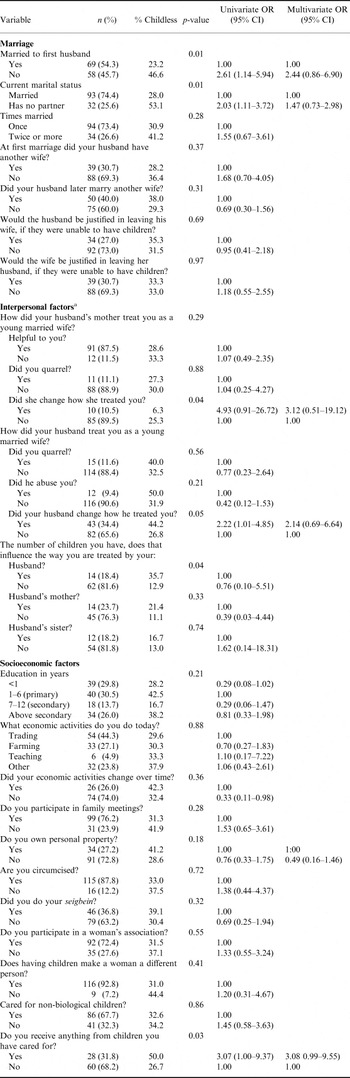
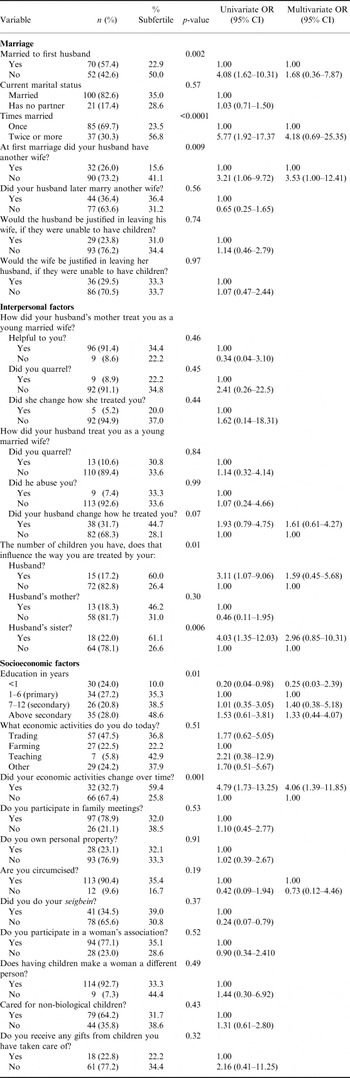
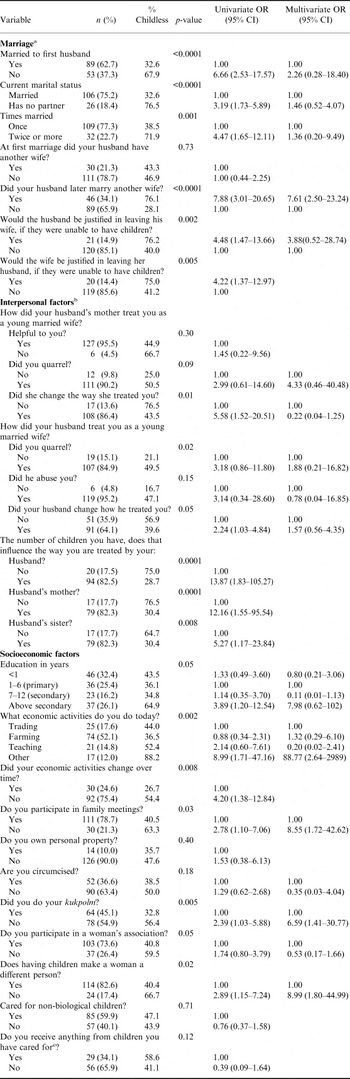
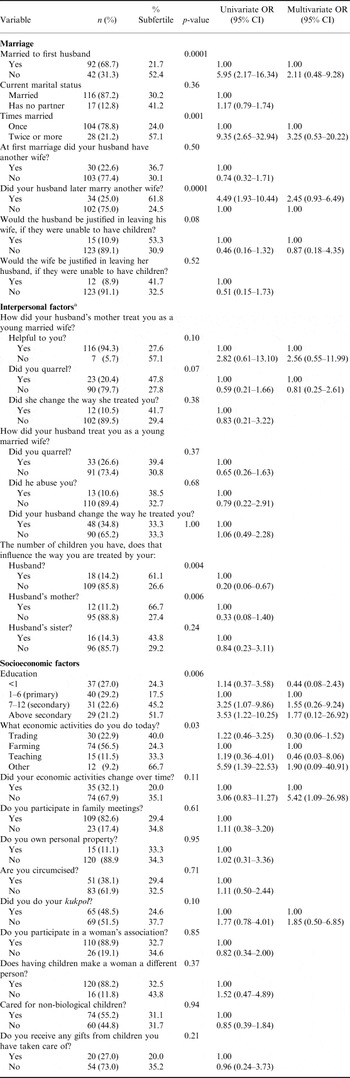
Marital factors. In both Amakiri and Lopon, childless women were significantly more likely than fertile women to be no longer married to their first husband and not to have a partner at survey date; these differentials were particularly pronounced in Lopon (Tables 1 and 3). In contrast, childless and fertile women were not different in terms of having married a man who had other wives. Further, the remaining marriage variables were significant only in Lopon. For example, childless women were more likely to have been married twice or more, to have a husband who later married another wife and to report that both the husband and the wife would be justified in leaving a childless marriage. The discussed differentials in marital status were similar between subfertile and fertile women, although subfertile women were more likely to be in a higher-order marriage in both Amakiri and in Lopon (Tables 2 and 4). In the multivariate analysis of marriage, no variable was significant in the model of childless women in Amakiri, while in Lopon the husband of a childless woman was more likely to marry another wife (OR=7.61; CI, 2.50–23.24). No variable was significant in the multivariate models of subfertility in Amakiri and in Lopon.
The associations between marriage, interpersonal and socioeconomic factors and childlessness versus having five or more children in Amakiri, 2007

a Did not include any of the variables within the group of variables ‘The number of children you have, does that influence the way you are treated by your…’ in the multivariate model. Model did not converge when these variables were included.
The associations between marital, interpersonal and socioeconomic factors and women with one or two children versus women with five or more children in Amakiri, 2007

The associations between marital, interpersonal and socioeconomic factors and childlessness versus having five or more children in Lopon, 2007

a The multivariate model for marriage did not converge when it simultaneously included the two variables ‘Would the husband be justified in leaving his wife, if they were unable to have children?’ and ‘Would the wife be justified in leaving her husband, if they were unable to have children?’ The multivariate models were almost identical whether they included one or the other variable.
b Did not include any of the variables within the group of variables ‘The number of children you have, does that influence the way you are treated by your…’ in the multivariate model. Model did not converge when these variables were included.
c The multivariate model for socioeconomic factors did not converge when this variable was included.
The associations between marital, interpersonal and socioeconomic factors and women with one or two children versus women with five or more children in Lopon, 2007

a Did not include any of the variables within the group of variables ‘The number of children you have, does that influence the way you are treated by your…’ in the multivariate model. Model did not converge when these variables were included.
Interpersonal factors. In both Amakiri and Lopon, there was no difference between childless and fertile women with respect to the ways the husband's mother treated them as a young married wife. However, in both communities childless women reported that the behaviour of their mothers-in-law toward them changed once their infertility became apparent (OR=5.58; CI, 1.52–20.51) in Lopon, and the husbands' behaviour toward them also changed. Further, women in Lopon reported that the number of children one has influenced how one was treated by the husband, his mother and his sister. Treatment by co-wives or neighbours was not affected by the number of children a woman had in either community (results not shown). Finally, in both communities subfertile women reported that the ways they were treated by the husband were influenced by the number of children they had. None of the variables in the interpersonal multivariate models was significant.
Social and economic factors. The level of education and other socioeconomic variables were generally not different between childless and fertile women in Amakiri. In Lopon, childless women were significantly more likely to have above-secondary education (OR=3.89; CI, 1.20–12.54). Childless women were also less likely to participate in family meetings or to have undergone kukpol and were more likely to say that having children makes a woman a different person (OR=2.89; CI, 1.15–7.24). Women were significantly more likely to report having received material support from their foster children in Amakiri (OR=3.07; CI, 1.00–9.37) but not in Lopon. With respect to subfertility, in Amakiri subfertile women were significantly more likely to have completed primary education than to have less than one year of schooling, and were more likely to have changed economic activities over time. In Lopon, subfertile women were more likely to report that they had more than primary education and they had ‘other’ occupation than farming. Other variables in the socioeconomic model were not significant. Finally, no variable was significant in the socioeconomic multivariate model of childlessness in Amakiri, while in Lopon the socioeconomic variables that were significant in the univariate analysis were generally also significant in the multivariate model. In the multivariate models of subfertility only one variable was significant: in Amakiri subfertile women reported that economic activities had changed (OR=4.06; CI, 1.39–11.85), while in Lopon subfertile women reported that economic activities had not changed (OR=5.42; CI, 1.09–26.98). The difference between the two communities in this respect shows that, given their difficult situation, Amakiri subfertile women are more agentive in searching for other opportunities, either through schooling or through repeated in- and out- migration from the home community.
Discussion
This paper had two aims: one, to compare the consequences of childlessness and subfertility on the lives of women in two communities with different institutional settings and perceptions of these conditions; and two, to examine the lives of childless and subfertile women within each community and compare them with the lives of fertile women.
Concerning the first issue, it was hypothesized that childlessness and subfertility would have more serious consequences for women in Amakiri than in Lopon. This was confirmed by qualitative interviews in which it was found that Amakiri women without (enough) children have difficult marital relations, are ostracized by their husbands, mothers-in-law and co-wives and inevitably get divorced. Further, childless women cannot attain the status of mature women or join associations, and consequently the bulk of them migrate out of the community. Some manage to accumulate wealth or attain a higher level of education but most fear a lonely and marginalized old age.
In Lopon, women with fertility problems have similar issues, yet the impact is mitigated by the double unilineal descent system, which allows women to affiliate themselves with their matrilineal kin, and by the existence of associations and other institutions that openly support childless women.
Some of these findings are confirmed by the surveys. For example, it was found that Amakiri women are less likely to be married than Lopon women to their first husbands. It was difficult, however, to distinguish significant differences between the lives of childless/subfertile and fertile women in Amakiri based on survey data, probably since most women in the former category between the ages of 30 and 50 were absent from the community, having migrated out to escape their marginalized situation. It is argued that this indirectly confirms the study's hypothesis, although it makes the comparison difficult. It is also difficult to estimate how many women have left and of these, how many returned, or to evaluate the outcomes of these women's migrations, given that there were no data on the migrants who did not return. The amount of outmigration, however, suggests that it is more painful to be childless in Amakiri than in Lopon, where outmigration of childless and subfertile women is minimal.
The large-scale outmigration from Amakiri also demonstrates these women's agency. Although in Lopon childless or subfertile women may attain higher education, their economic activities have changed little over their lifetimes. Amakiri women with fertility problems, on the other hand, not only attain higher education and accumulate wealth, but they also seem to constantly move and shift occupations.
Concerning the second issue, the comparison of the lives of the three categories of women (childless, subfertile and fertile), it is easier to make in Lopon, given that so many of the Amakiri childless and subfertile women between the ages of 30 and 50 are absent. Qualitative findings, however, confirm that in Amakiri the lives of childless women are extremely difficult. Subfertile women are in a somewhat better situation, given that they are able to attain womanhood, but they are still likely to be divorced and, unless they have sons, to be facing a lonely and marginalized old age. In Lopon, both qualitative and quantitative findings show that childless women are more likely than fertile women to have husbands who marry other wives, to be treated differently by their husbands and mothers-in-law and to forego kukpol (initiation into womanhood). While their lives are less difficult than those of their Amakiri counterparts, the consequences of low fertility and especially childlessness, remain severe in this community as well.
In closing, despite community differences between the meanings and consequences of childlessness, as evidenced by this body of research and reaffirmed by these findings, childbearing and the achievement of motherhood represents a milestone for women in sub-Saharan Africa which confers on them an adult identity and represents the normative fulfillment of what is considered female destiny. While subfertility may also present serious problems and result in divorce, ostracism, abandonment and often a lonely old age, the fact of having borne at least one child entitles the woman to join the ranks of mature women and participate in community life.
Acknowledgment
This work was funded by the National Science Foundation. A previous version of this paper was presented at Medical Anthropology at the Intersections: Celebrating 50 Years of Interdisciplinarity at Yale University, September 2009, and at the Annual Meeting of the Population Association of America, Dallas, April 2010.