I. Introduction
The sanctity of private property has long been considered fundamental to liberal society. The power of government to take private property for its own use, or to give to some other entity to use, has been a frequent source of political disquiet precisely because of the tension it creates with notions of individual rights ingrained in the liberal conscience. The political backlash caused by the Supreme Court’s decision in Susette Kelo, et al. v. City of New London Connecticut, et al., 545 U.S. 469 (2005), demonstrates the point. Since the Kelo decision came down, the use and abuse of eminent domain by governmental actors has become an important component of political discourse in the United States. Public backlash against the Court’s decision in Kelo is unprecedented in modern times: polls consistently found that three-quarters or more of citizens opposed the substance of the Court’s holding, and 45 states have passed statutes or constitutional amendments protecting their citizens from takings such as those in Kelo (Nadler, Diamond, and Patton Reference Nadler, Seidman Diamond, Patton, Persily, Citrin and Egan2008; Somin Reference Somin2009, Reference Somin2015; Zilis Reference Zilis2015). The one-sided nature of public opinion on this issue attracted scholars’ attention as it seemed to present a somewhat unique case in a largely polarized political atmosphere.
Public policy regarding takings has remained an important and contentious subject in the decade since Kelo: 45 states have reformed their laws to restrict the use of eminent domain, including 10 that have gone as far as amending their constitutions.Footnote 1 The importance of takings in national politics is unlikely to abate in the near future, as the current debates over the wisdom and prudence of the Keystone XL pipeline project directly implicate takings, to take but one prominent example. Potential environmental impacts, energy independence, and job creation are the most frequent frames of the debate over the pipeline project, but for many local residents along the pipeline’s proposed route, the possibility of having their property taken by the government is central.
This raises important questions: What accounts for the significant public reaction against Kelo? More broadly, what factors influence attitudes toward takings in general? As noted above, these questions have important implications for contemporary policies and politics, and getting the answers to these questions right is a necessary first step in addressing these pressing policy issues. For example, if the core reason for the broad opprobrium toward Kelo is that a person’s home was being taken, as many have argued, then the appropriate remedy may be to ban or severely curtail the taking of homes or to offer individuals payment substantially above the fair-market value of the home. Alternatively, if the backlash was caused by the nature of the taking—that is, by the fact that the properties were taken to transfer to a private developer in order to enhance their economic value—then the appropriate policy remedy is rather different. In this scenario, the appropriate policy remedy may be to ban or severely curtail takings for the purpose of economic development or to offer individuals payment substantially above the market value for their property when taken for such purposes. Additionally, this study can contribute to existing theoretical debates in the study of public opinion, in that uncovering the sources of public opinion about takings has implications for how we view the public—do people have principled opinions or not?—which in turn has important implications for democratic theory.
As of yet, however, we do not know what caused the massive public reaction to Kelo or what factors shape attitudes toward eminent domain more broadly. I seek to answer these questions by conducting two observational studies and one experimental study designed to isolate factors theorized to influence attitudes toward takings. In doing so, I argue that public attitudes toward takings are shaped primarily by the purpose for which property is being taken and that the type of property being taken does not much affect attitudes. The article proceeds in four parts. First, I review the Court’s decision in Kelo and the relevant literature on public opinion on that decision and on attitudes toward takings more broadly. I then propose a theory of attitudes toward eminent domain that builds on Richard Epstein’s (Reference Epstein1985) normative theory of takings. Second, I outline the research design and describe the data obtained. Third, I analyze the data to test the hypothesis and describe the relevance of this project to prior work. I conclude with a discussion of the findings and their implications and avenues for future research.
II. Literature Review and Theory
A. Kelo v. New London
The city of New London, Connecticut, condemned homes and other buildings in a working-class neighborhood so that the land on which they sat could be cleared and redeveloped. The area targeted for redevelopment was needed (from the city’s perspective) because New London was attempting to attract the multinational pharmaceutical manufacturer Pfizer to build a new research facility there as part of a larger effort to boost the local economy. Owners of some of the threatened properties sued, arguing that economic development was not a valid purpose for which governments could take property. In a 5–4 decision, the Supreme Court upheld the condemnations on the grounds that redevelopment constituted a “public use” within the meaning of the Fifth Amendment’s Taking Clause, despite the fact that the land would not be used by, or even open to, the public. In brief, the Court held that the Fifth Amendment does not require actual public use, but only that the land taken would be used for a “public purpose” such as raising revenue. Further, the Court held that the nature of the use was determined by an elected legislature (i.e., the New London City Council) and that this is all the “process that is due.” That is, the Court held that the local government’s decision to take individuals’ homes for the purpose of giving them to another private actor to redevelop the land was admissible under the Fifth Amendment because the decision was made through a democratic process, the council members being duly elected.
This decision was not well received, to put it mildly. The public backlash to Kelo is unprecedented in modern times (Nadler et al. Reference Nadler, Seidman Diamond, Patton, Persily, Citrin and Egan2008; Somin Reference Somin2009). Unfortunately, there were almost no public opinion polls on eminent domain prior to Kelo, so very little is known about public attitudes toward takings prior to that controversial decision. Indeed, the huge and largely unexpected public backlash to the Kelo decision spawned virtually all of the extant empirical literature on eminent domain; therefore, most of what we know about popular attitudes on eminent domain is a direct result of the broad opprobrium that decision evinced. The backlash was genuinely surprising to most scholars, many of whom view the Court’s decision as a reaffirmation, or at most a modest extension, of Berman et al., Executors, v. Parker et al., 348 U.S. 26 (1954), and Hawaii Housing Authority et al. v. Midkiff et al., 467 U.S. 229 (1984) (Barros Reference Barros and Malloy2008; Nadler and Diamond Reference Nadler and Seidman Diamond2008; Wilkerson Reference Wilkerson, McIntosh and Hatcher2010; Baum Reference Baum2013; cf. Justice O’Connor, dissenting, in Kelo v. New London).
Following the Court’s announcement of its decision in Kelo, numerous surveys asked respondents what they thought of the decision and quickly confirmed that Americans were deeply opposed to the Court’s chosen policy. A November 2005 Zogby poll, for example, reported that 95% of Americans disagreed with the decision.Footnote 2 Similarly, 81% of respondents to a 2005 Saint Index survey stated that they disagreed with the Court.Footnote 3 State-level surveys generally comport with the national averages (Nadler et al. Reference Nadler, Seidman Diamond, Patton, Persily, Citrin and Egan2008; Somin Reference Somin2009; Mihaly and Smith Reference Mihaly and Smith2011).
Both the Zogby and Saint Index polls focused not on eminent domain per se but on the more particular circumstances of Kelo. Subsequent polling moved away from the Kelo decision itself, but still tended to focus on takings intended for economic development. In this vein, the nationwide 2010 Constitutional Attitudes survey found that 81.3% of Americans opposed the use of eminent domain for “commercial projects that could benefit the local economy.” A 2008 poll conducted by the National Constitution Center found that 87% of Americans thought that governments should not have the power “to take people’s private property in the interest of redeveloping an area.” Numerous state-level surveys yielded similar results. Ninety-one percent of respondents to a 2006 Minnesota survey said that they did not support the exercise of eminent domain for development. A 2007 poll found that 82% of Ohioans are opposed to economic development takings. Polls in New Jersey, California, and Illinois have yielded similar results. A 2012 survey of Illinoisans found that fully 94% opposed takings for economic development.Footnote 4
Importantly, the reaction to Kelo was not confined to negative opinions documented by polls. The backlash resulted in a significant amount of legislation at the state and national levels. Within a year of the decision, 29 states had acted on Justice Stevens’s invitation to enact limitations on eminent domain more stringent than the one adopted by the Court (Ross and Tolan Reference Tolan2006; see also Stern Reference Stern2013). Today that number has risen to 45, including 10 that have amended their constitutions to prevent taken property from being transferred to most private actors (Beienburg Reference Beienburg2014).
B. Explaining the Backlash to Kelo
The unprecedented backlash to the Kelo decision generated substantial scholarly interest into what motivated the reaction, yet its source remains unclear. Previous studies have typically argued that the cause of the outrage over Kelo was either the nature of the property taken in that case (Susette Kelo’s home and the homes of some of her neighbors), notions of “ownership” and the psychic harms caused by being stripped of one’s own home, or both.
Schultz (Reference Schultz, McIntosh and Hatcher2010), for example, notes that some salient takings cases, such as Poletown Neighborhood Council v. City of Detroit, 304 N.W.2d 455 [410 Mich 616] (1981), have angered liberals and conservatives alike. Thus, he tosses out the partisan-ideological explanation for those attitudes but does not advance any argument as to what does account for this relatively unified opinion. Becher (Reference Becher, McIntosh and Hatcher2010) uses ethnographic methods to conduct an in-depth case study of attitudes toward takings in a community in Philadelphia. She argues from this case study that for most Americans, the meaning of property invoked by takings like those in Kelo is “ownership”—including the hard work and emotional investment made in one’s property. Becher suggests that the mobilization of resistance to eminent domain centers on the type of property taken, namely, homes.
Looking at opinion on Kelo specifically, Nadler et al. (Reference Nadler, Seidman Diamond, Patton, Persily, Citrin and Egan2008) find that public disapproval was between 80% and 90% and was uniform across partisan affiliation, income levels, level of education, race, gender, and age (see also Somin Reference Somin2015, 137–41). In light of this consistency, Nadler et al. conclude that the sources of the backlash lay in feelings about the “sacredness of the home” and a subverted expectation that the “Supreme Court will protect ordinary citizens from overreaching governmental power,” though they do not empirically test either claim (304). Similarly, Wilkerson (Reference Wilkerson, McIntosh and Hatcher2010, 74) argues that in the response to Kelo, “the well intended actions of government officials to improve the economic prospects of a depressed city were overwhelmed by the powerful attachments that Americans have to the idea of home.”
Utilizing a pair of experiments, Nadler and Diamond (Reference Nadler and Seidman Diamond2008) argue that many individuals place extremely high subjective values on their homes. That is, they attach value to the property in light of improvements they have made to the property, the labor they have invested, as well as memories that are inexorably tied to the property. Importantly, Nadler and Diamond argue that individuals are only “moderately sensitive to the purpose” of proposed takings, leading them to conclude that the reaction against Kelo, as well as the broader move against eminent domain, stems from public empathy toward homeowners being forced to part with property that was likely attached with far more subjective value than market value. Put differently, it is the idea that one can be forced from one’s home that the public generally opposes. Metcalf (Reference Metcalf2014) replicated Nadler and Diamond’s study on a sample of Canadian students and also concluded that attitudes on takings are driven by attachment to property and that the use to which a taken property will be put does not significantly affect attitudes.Footnote 5
Zilis (Reference Zilis2015) argues that Kelo’s institutional context happened to make it a prime candidate for creating backlash. That is, Kelo was an unusually newsworthy decision because of the sympathetic plaintiffs and the strident disagreements over the decision between the justices in the majority and the dissenters (see also Wolf Reference Wolf and Paul Malloy2008; Bryan and Ringsmuth Reference Bryan and Ringsmuth2016). Under Zilis’s model, the presence of dissents to any given decision sends a signal to reporters that the decision is controversial, which tends to lead to less favorable media coverage. Further, he notes that the state and federal responses to the decision kept the issue of takings salient for some months and thus further fueled public opposition. In short, whatever the causes of micro-level disapproval, the media environment likely fueled the observed backlash.
In summary, these studies generally suggest that it is the sort of property being taken (homes), and how psychologically invested the owners are in their property, that drives public micro-level opposition to eminent domain. Macro-level opposition, by extension, is driven by public empathy for people whose homes are threatened, as people can easily imagine what their feelings might be if their own home were ever threatened. This empathy was, in this case, likely fueled by extensive media coverage. This research, however, has a narrow evidence base in two respects: it focuses largely on a single legal case (Kelo or fictitious cases that generally conform to its contours), and it typically examines only a single kind of property being taken (homes) rather than the whole range of properties that might be subject to takings.
By moving away from the narrow confines of the facts of the Kelo case and looking instead at attitudes toward eminent domain more generally, however, a few observational studies have found that the purpose for which property is being taken meaningfully influences public opinion. Polls of residents in New Jersey, Illinois, Ohio, and California have found that respondents are more likely to oppose takings for economic development than for more traditional public purposes such as building roads or schools (Hatcher, Strother, and Burnside Reference Hatcher, Strother and Burnside2013). Similarly, using vote data from 14 state-level eminent domain reform measures, Hoehn and Adanu (Reference Hoehn and Adanu2014) argue that property ownership, economic vulnerability, and political ideology all independently influence attitudes toward takings. In a study of actual uses of eminent domain by county administrators, Hoyman and McCall (Reference Hoyman and McCall2010) found that only about 7% of takings in their sample were intended to be used for economic development. In surveying these county officials, they found that officials reported a “propensity toward a narrow interpretation of a legitimate government purpose for eminent domain” (889). To the extent that county administrators are like the broader body of citizens they serve, this finding suggests that purpose for which property is to be taken is an important factor in forming judgments about takings. In sum, a few recent studies have found important differences in levels of support for takings for different purposes. Taken together, these studies suggest that many factors influence attitudes toward eminent domain, yet the sum of the findings is clearly inconsistent. As a result, the existing literature leaves us unable to pin down the fundamental causes of opposition to eminent domain and thus offers little guidance for contemporary political debates over takings.
This discrepancy in the literature is likely attributable to inadequate attention paid to the possibility that individuals are sensitive to the purpose for which property is to be taken. This lack of attention led to research designs that cannot fully account for that potential causal factor. Put differently, it is likely the case that findings of Nadler and Diamond (Reference Nadler and Seidman Diamond2008) and Metcalf (Reference Metcalf2014) that individuals are “only moderately sensitive to the purpose of [a] taking” (Nadler and Diamond Reference Nadler and Seidman Diamond2008, 742) but that an “owner’s relationship to the property exerted strong and consistent effects” (743) on attitudes toward takings is an artifact of their experimental design. The studies conducted by Hoehn and Adanu (Reference Hoehn and Adanu2014) and Hatcher et al. (Reference Hatcher, Strother and Burnside2013) ask about individuals’ attitudes toward takings in general, while Nadler and Diamond’s (Reference Nadler and Seidman Diamond2008) experimental design has all respondents imagine that the property being taken is their own home.Footnote 6 Thus it is possible that the observational finding of differences across purposes is simply wiped out when one is asked about having one’s own home taken. Because it is very unlikely that any given individual will ever face a taking of his own home, however, it is unlikely that attitudes toward having one’s own home taken generalize to attitudes about takings in general.
Further, most prior studies have looked only at one type of taking—usually economic takings like the one at issue in Kelo (cf. Hatcher et al. Reference Hatcher, Strother and Burnside2013). In an effort to carefully analyze the possibility that the purpose of a taking is an important consideration in individual-level evaluations of proposed uses of eminent domain, I incorporate all of these dimensions (type of property, purpose of taking, imagined ownership of property) into my experimental design, which is discussed at length below. It is my goal in doing so to move beyond a narrow focus on the backlash to Kelo by testing a general theory of attitudes toward takings.
In this paper I advance a theory of public attitudes toward takings that builds on Epstein’s (Reference Epstein1985) normative theory of eminent domain. Epstein distinguishes between narrow and broad constructions of the “public use” requirement of the Fifth Amendment as interpreted and applied by the Supreme Court. Narrow constructions are those that restrict constitutionally valid takings to actual public uses. Put differently, narrow-use takings are those for projects whose final product will be used by or open to the public at large. Narrow uses include takings to build roads, bridges, and other types of infrastructure, water and sewage systems, and other types of utilities, schools, prisons, hospitals, and the like. These are “traditional” uses of the eminent domain power (Epstein Reference Epstein1985). These uses are commonly viewed as provisions of “collective goods” or remedies for “collective bads” (Hoyman and McCall Reference Hoyman and McCall2010).
Broad constructions, on the other hand, are those that require for their justification appeals to indirect benefits to the public generated by the use in question. That is, these broad uses are couched in terms of generating benefits to the community, though the public may not directly “use” the end product in the same way it might use a road. Thus rather than facilitating the provision of public goods or ameliorating some public problem, broad-use takings are aimed at some other goal. Economic development takings are the quintessential “broad” use. Takings for economic development are generally justified as serving a public purpose because they are intended to either create jobs or increase tax revenues. These uses are justified under the Court’s holdings in Berman v. Parker, Hawaii v. Midkiff, and Kelo that valid takings require only a “public purpose” as opposed to a bona fide public use.
It is my argument that individuals will intuitively distinguish between genuine “public use” takings (i.e., “narrow” constructions) and those that are not, even if the latter are described in terms of “public benefit” or “public purpose” (i.e., “broad” constructions).Footnote 7 In other words, I argue that citizens will recognize whether a proposed taking directly aims to benefit the public at large and will be more likely to support those that do than those that do not. Further, because narrow uses are by definition aimed at public goods (or bads) and intended for public use, the necessity of the project is typically considered implied (Bird and Oswald Reference Bird and Oswald2009).Footnote 8 The necessity of broad-use takings is much less clear: even if one can make a case that more jobs or a larger tax base is in some sense needed, it is rather difficult to attach that need to a particular piece of property. Thus I argue that there are two related reasons that individuals will naturally tend to view these types of takings as different: they will recognize whether public or parochial interests are served by the proposed project, and they will have an intuitive sense of whether the project—and thus the taking—is at least arguably needful.
For these reasons I expect that individuals will be sensitive to the purpose for which property is being taken when forming their evaluations of an exercise of the eminent domain power. To be clear, I do not propose that individuals will support narrow uses in absolute terms, only that the levels of support for narrow uses will be significantly higher than for broad uses. Nor do I contend that American citizens have internalized Epstein’s normative theory of takings per se. Rather I argue that the narrow/broad distinction drawn out here maps on to the intuition of citizens. Thus, I propose the following hypothesis: Individuals will be more opposed to proposed “broad uses” than “narrow uses” of eminent domain, regardless of attachment to home or the type of property being taken.
III. Method and Data
I adopt a multimethod approach to empirically scrutinize the theory presented above. I begin by briefly analyzing observational data drawn from representative surveys of adults in New Jersey, Illinois, and Ohio. These surveys suit the purpose at hand because they are among the very few that ask respondents about their attitudes toward at least one type of narrow-use taking and at least one broad-use taking and thus allow for assessment of differences in attitudes across these two broad types. Details on question wording for all three surveys are presented in full in appendix D.
I build on these observational analyses with an original experiment that serves as the empirical centerpiece of the article. The experimental design isolates the hypothesized key cause of public opposition to eminent domain while controlling for other potential causal factors. That is, subjects were randomly assigned into one of eight treatment groups (a 2 × 2 × 2 factorial design) and assigned to read a vignette depicting a fictitious taking in which the type of property being taken, the purpose for which it was being taken, and imagined ownership of the property were manipulated. Responses were then analyzed to assess the effects of the three experimental treatments. Regression analyses were utilized to examine potential moderating effects and to improve the precision of the estimated effects of the treatments.
Finally, in order to validate the inferences from the observational and experimental analyses, I fielded a short, open-ended survey on a convenience sample of undergraduate students enrolled in political science courses. These students were asked an open-ended question about what differentiates legitimate takings from illegitimate ones. Their responses were then coded for analysis and tallied for presentation. Each portion of the study is described in detail in the following section.
IV. Analysis and Findings
A. Observational Study
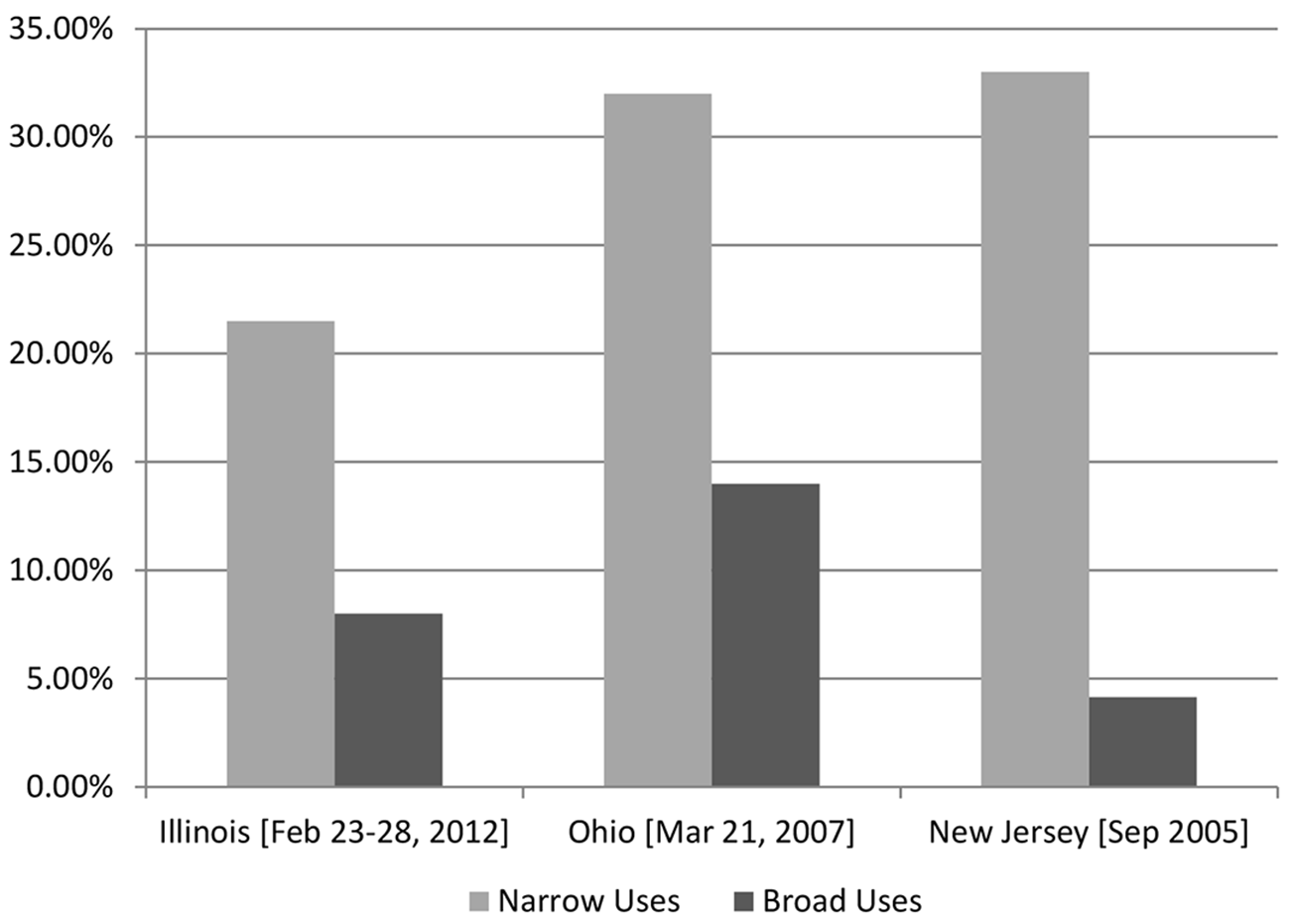
To begin to assess the theory presented here I analyze representative surveys of adults in New Jersey, Ohio, and Illinois. The surveys are of high quality, conforming to widely accepted standards in both sampling and instrument construction. The New Jersey survey polled 800 randomly selected residents 18 years of age or older; it was conducted via telephone by the Monmouth University Polling Institute between September 21 and 26, 2005. The Ohio poll was conducted by Quinnipiac University in March 2007; it utilized random digit dialing (RDD) to sample likely voters living in Ohio. The Illinois survey was conducted by the Paul Simon Public Policy Institute at Southern Illinois University. It utilized RDD to randomly sample registered voters in the 18 southernmost counties of Illinois between February 23 and 28, 2012. Figure 1 presents graphically the aggregate differences in attitudes toward narrow (traditional) uses of eminent domain, such as for building roads, schools, and utilities on the one hand and support for the quintessential broad use, economic development, on the other. This first cut seems to very clearly indicate that broad uses are far less popular than narrow uses among voting-age citizens. It is important to point out, however, that the public in all three states sampled is broadly opposed to takings of all kinds: even support for narrow-use takings does not exceed one-third of respondents.
Public support for narrow versus broad constructions of eminent domain. Data sources: Illinois: Paul Simon Public Policy Institute Poll, 2012 Illinois Statewide Counties Poll Telephone Survey (February 2012); Ohio: Quinnipiac University Poll, Report (March 21, 2007); New Jersey: Monmouth University/Gannett NJ Poll (September 2005). Data are on file with the author.
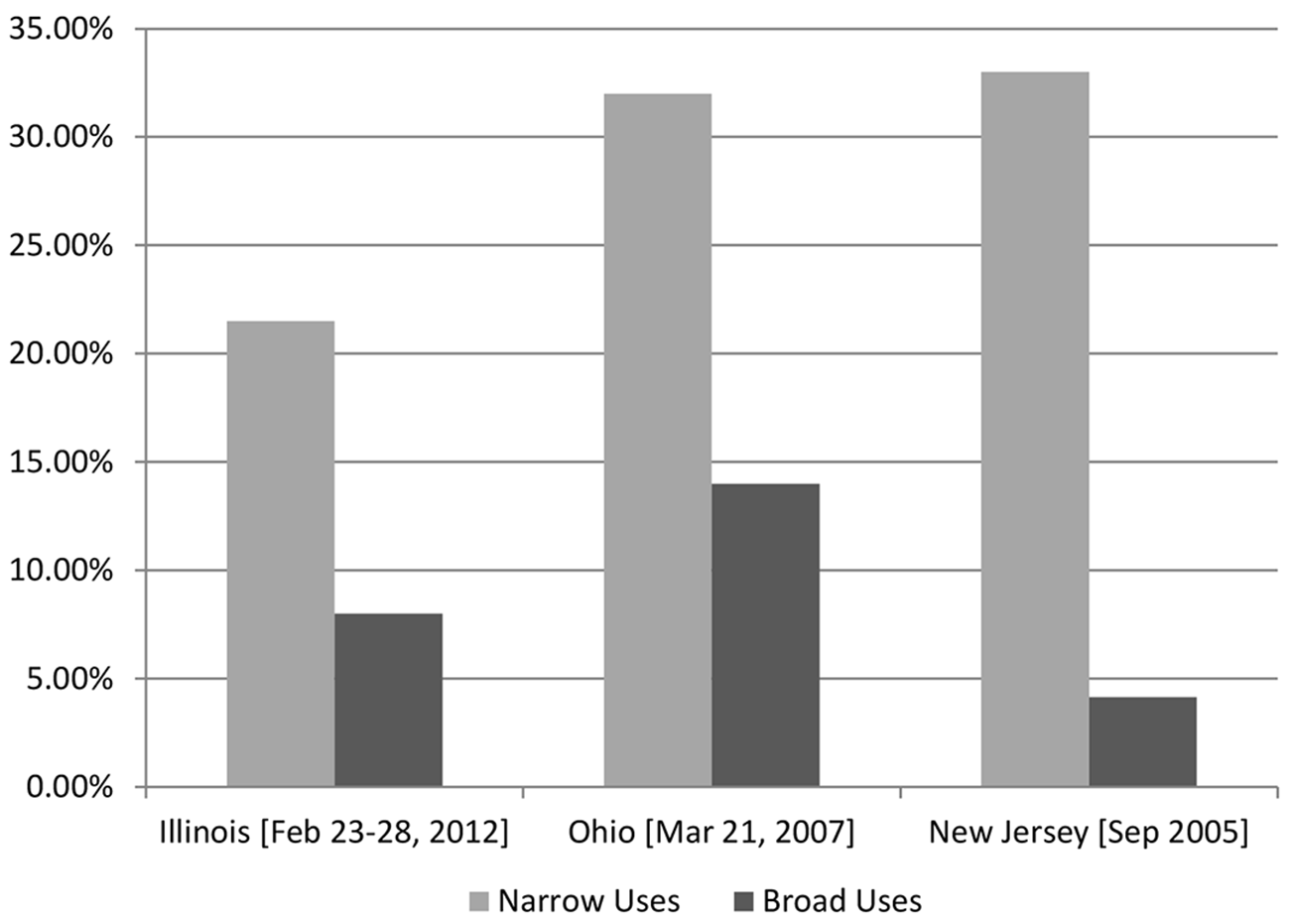
There are some important differences in these data that are worth noting. In the Illinois survey, respondents were asked general questions about their attitudes toward takings for different purposes (e.g., “Do you think people should be forced to sell their property so that the government can build infrastructure for utilities?”). In the New Jersey poll, on the other hand, respondents were asked rather more specific questions, for example, “Is it O.K. or not O.K. to use eminent domain to take low value homes from people in order to build a school?” Full question wordings from all three state polls can be found in appendix D. Crucially, though, in all three states, support for narrow takings was substantially higher than support for broad takings.
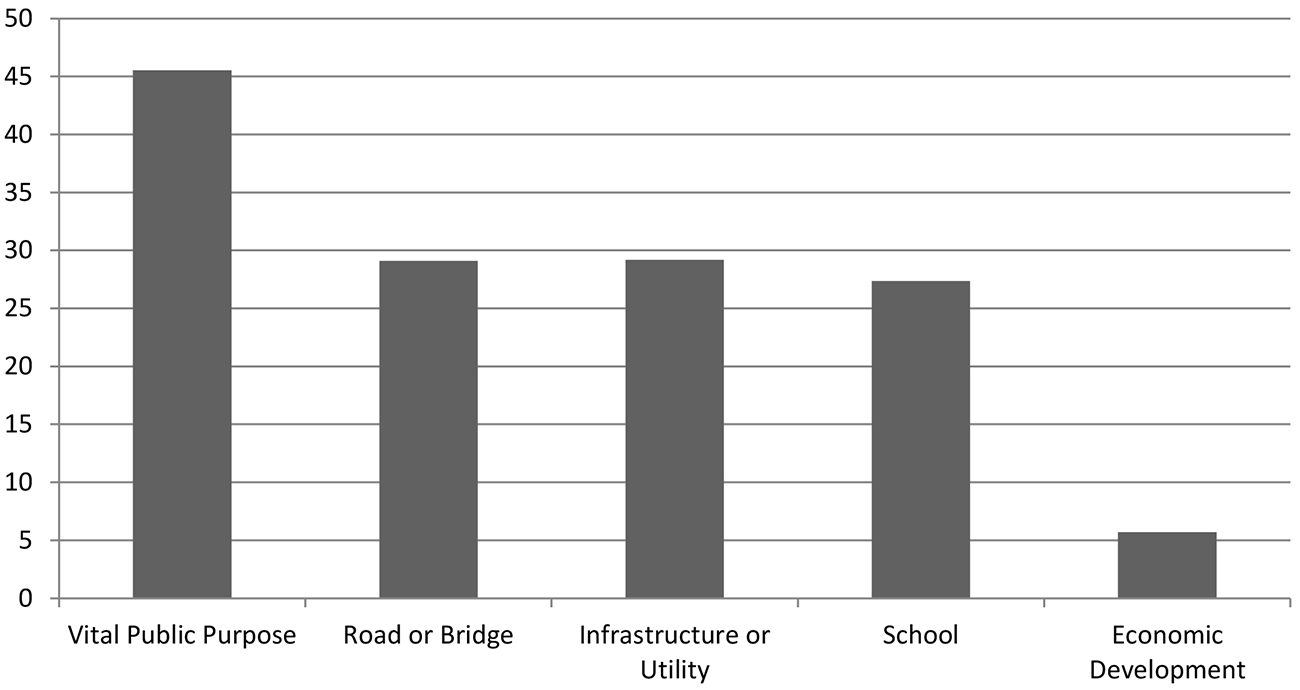
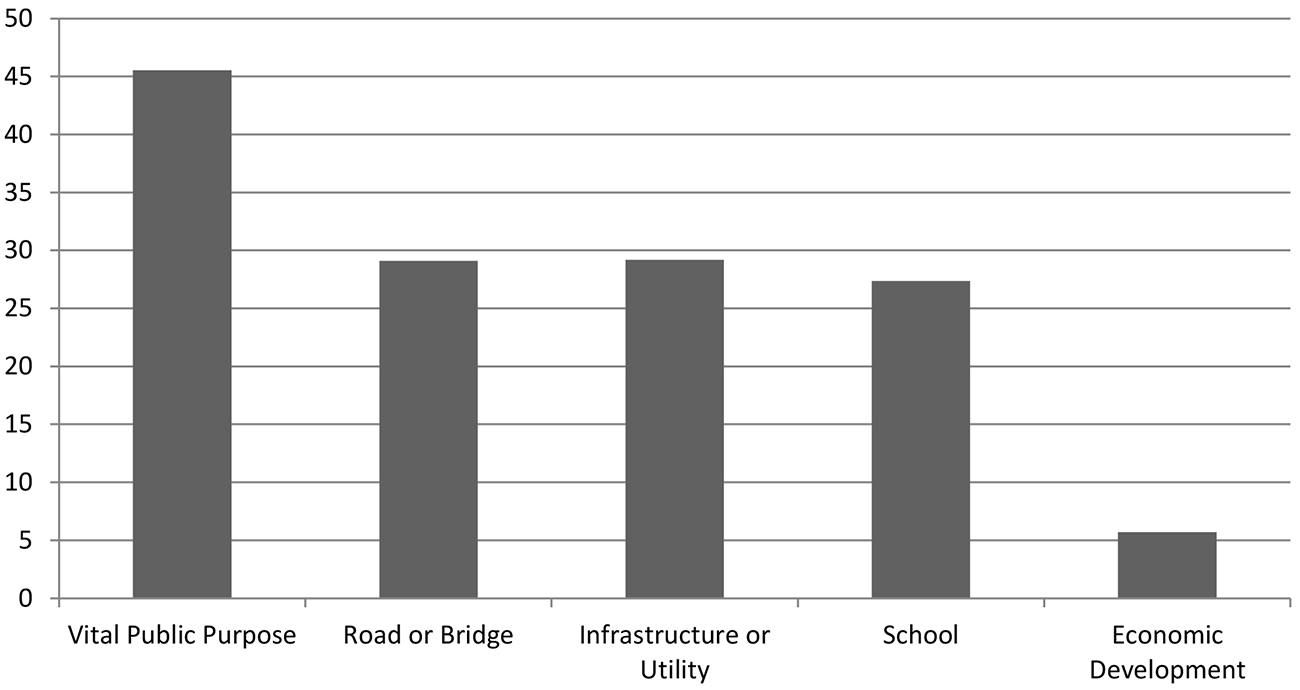
Next, I present observational data from my original survey on the overall levels of support and opposition to takings for a range of purposes. Figure 2 presents the findings graphically. Though not derived from a representative sample, the congruence with the state samples is notable. Overall, it is quite clear that individuals are strongly opposed to takings—and especially opposed to takings for economic development. Support for takings for a “vital public purpose” clearly deviates from the overall pattern of support and opposition (it is the only category to eclipse 40% support), but it is unclear what might constitute a “vital purpose” given that roads, infrastructure, and utilities seem not to constitute vital purposes, in that support for those categories is much lower than the abstract “vital” category. It is likely that respondents here are implicitly recognizing that many purposes might be vital in certain contexts but that no type of taking is vital per se. A glance at the distributions presented below indicates basic support for the key hypothesis: individuals are opposed to takings across the board but are much more opposed to takings for economic development (the quintessential broad use) than to takings for more traditional purposes, such as roads and schools. The margins reported in figure 2 also increase our confidence in the convenience sample because of the congruence with the representative state samples.
Percentage of respondents expressing support for takings (MTurk). This figure presents the percentage of respondents in the MTurk sample who support takings for each of the above purposes.
B. Experimental Study
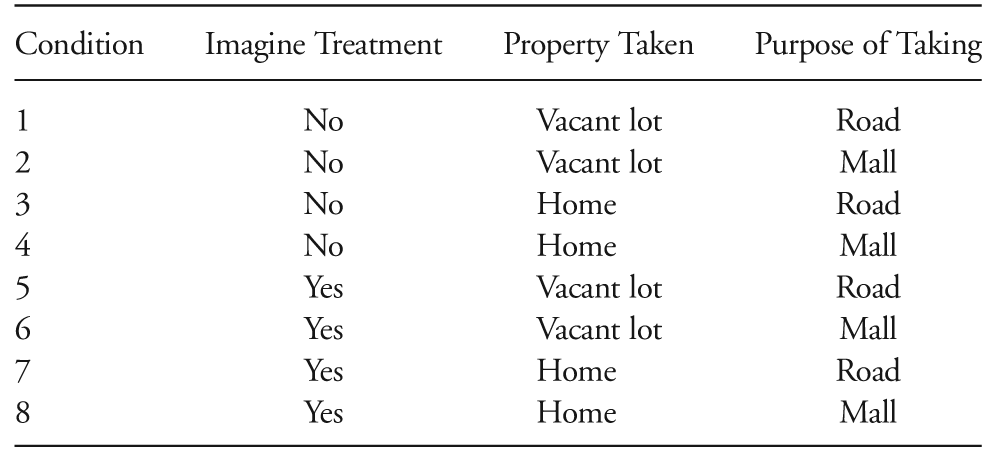
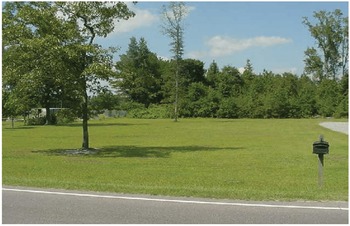
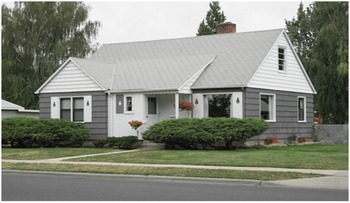
To more rigorously assess the theory presented here I fielded an original survey experiment that is designed to provide leverage on the question of causation in the relationships of interest. I employ a 2 × 2 × 2 factorial design (imagined ownership vs. control; home vs. vacant lot; mall vs. road) in which imagined ownership of a piece of property was manipulated before respondents were randomly assigned into one of four treatment conditions. Respondents were first shown a picture of a piece of property (either a house or a vacant lot) and asked to “imagine” that the property was either “someone’s” or “yours.” The survey was designed such that respondents in the “home” treatment group would see a picture of a house, and respondents in the “vacant lot” treatment group would see a picture of a vacant lot. Respondents in the “imagined-ownership” treatment group were asked to imagine that they owned the parcel in question (e.g., “To begin, imagine that this is your house”). Respondents were asked to “imagine” that the property was either “someone’s” or “yours” before assignment into the main treatments in order to create some level of psychological attachment to the property in question (i.e., to induce an endowment effect; see, e.g., Kahneman, Knetsch, and Thaler Reference Kahneman, Knetsch and Thaler1991; McDermott Reference McDermott2004; Soroka Reference Soroka2014). Each respondent was then presented with a vignette describing a taking, but the stories varied on two dimensions: the vignette depicted (1) a vacant lot being taken in order to build a road (the theoretical baseline condition), (2) a vacant lot being taken in order to build a shopping mall, (3) a home being taken in order to build a road, or (4) a home being taken to build a shopping mall (the vignettes can be found in app. A).
This design allows for direct testing of the theory presented here by embedding broad and narrow uses of eminent domain within the experimental treatments. Narrow constructions are operationalized in the “road” treatment condition (i.e., those who read about a taking for the purpose of building a road) and broad constructions in the “mall” condition. Thus the theory can be directly tested by comparing support for the taking read about across these treatments. Further, the design allows for the direct testing of two frequently cited competing hypotheses: that it is the concept of ownership or the nature of the property taken (namely, homes) that drives opposition to takings. Importantly, by using news stories about a prospective taking and by omitting any discussion of the Supreme Court, I mitigate against the possibility of bias from elite cues or framing effects (Zilis Reference Zilis2015). Table 1 summarizes the experimental design.
Summary of Experimental Design
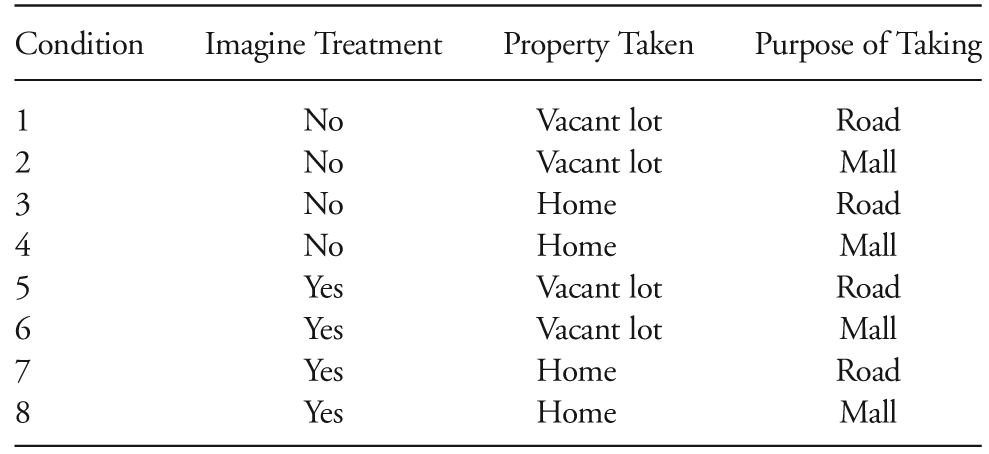
After being assigned into a treatment condition and reading the vignette, respondents were asked a series of questions about their attitudes toward the proposed taking (see app. A). First, they were asked whether they support or oppose the taking they had just read about in the vignette (measured dichotomously). Second, they were asked about the intensity of that attitude: those who responded that they support [oppose] the taking they read about were then asked whether they “strongly support [oppose] it, somewhat support [oppose] it, or only slightly support [oppose] it.” Respondents were then asked, “If the city does in fact use eminent domain as described in the article, how angry would you be?” and presented with a 10-point sliding scale, ranging from “not angry at all” to “very angry.” Respondents were also asked whether they support a bill before Congress that would “make it very difficult for governments to take peoples’ property for economic redevelopment and similar purposes,” with the likelihood that they would support it being measured on a five-point ordinal scale.
Next, respondents were asked a number of questions concerning their attitudes toward takings in general. The questions took the following form: “Generally speaking, do you support or oppose the government having the power to force people to sell their property in order to build a road or bridge?” Respondents were asked this question with respect to building a new school, infrastructure, or utilities; for a private business to develop it; and for a vital public purpose.Footnote 9 These questions present additional operationalizations of the key concepts. Takings for roads, infrastructure, schools, and vital public purposes constitute narrow constructions of eminent domain, while takings for economic development constitute a broad construction. Finally, respondents answered a range of questions about their backgrounds, political attitudes, and various demographics.
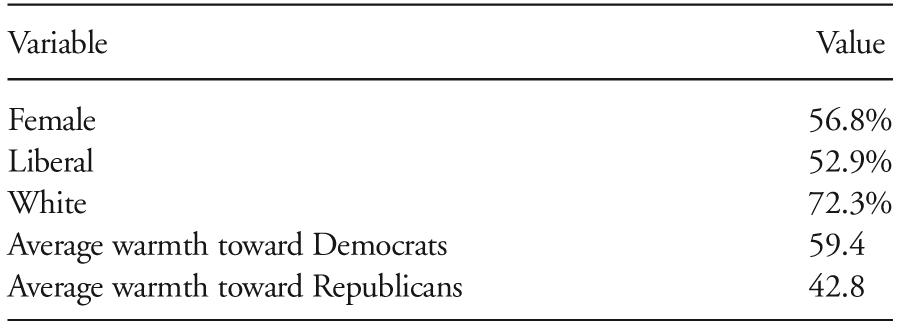
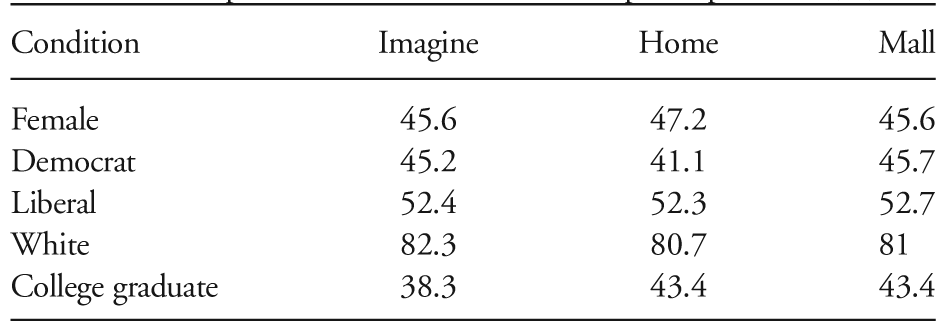
Data for this part of the study were collected during the summer of 2015; 722 subjects participated in a study on public opinion on eminent domain. Subjects were recruited from the Amazon.com Mechanical Turk (MTurk) workplace. The entire study took respondents a little more than 10 minutes to complete, and subjects were compensated $0.50 for their participation. Mechanical Turk has been demonstrated to be more representative of the US population than in-person convenience samples and can be used to successfully replicate canonical published experimental work (Berinsky, Huber, and Lenz Reference Berinsky, Huber and Lenz2012; Weinberg, Freese, and McElhattan Reference Weinberg, Freese and McElhattan2014). Further, MTurk is increasingly being used by political scientists and psychologists because of the high quality of the panel and its relatively low cost per respondent (e.g., Buhrmester, Kwang, and Gosling Reference Buhrmester, Kwang and Gosling2011; Arceneaux Reference Arceneaux2012; Albertson and Gadarian Reference Albertson and Kushner Gadarian2015; Krupnikov, Piston, and Bauer Reference Krupnikov, Piston and Bauer2016).Footnote 10 Further, conducting a survey-based experiment on MTurk mitigates some concerns about a nonrepresentative sample: if, for example, one thinks that MTurkers might be more sophisticated than the average American or more liberal (etc.), random assignment into treatment conditions means that all of the groups of respondents should be equally oversophisticated, overliberal (overfemale, overeducated, etc.). Thus any differences in attitudes across treatment conditions can be attributed to the treatment, and not to any demographic features, even if the sample differs from the general population. As Druckman and Kam put it, “when the true data-generating process produces a single treatment effect, estimates from any sample will produce an unbiased estimate of the true underlying treatment effect” (Reference Druckman, Kam and Druckman2011, 46). The only remaining concern, then, must hinge on the possibility that the sample group differs in theoretically relevant ways from the larger population (Krupnikov and Levine Reference Krupnikov and Seth Levine2014). To mitigate against this concern, I include measures of a wide range of theoretically relevant moderators beyond standard political and demographic controls, including attitudes toward libertarians and corporations and views on the relative importance of property rights. Put differently, for my purposes, broad, national demographic representativeness is less important than the experimental manipulations; after controlling for alternative explanations, there is no reason to expect that MTurkers should be either more or less influenced by the treatments than other Americans (e.g., Nicholson and Hansford Reference Nicholson and Howard2003). Descriptive statistics of the sample and a randomization check are presented in appendix B.
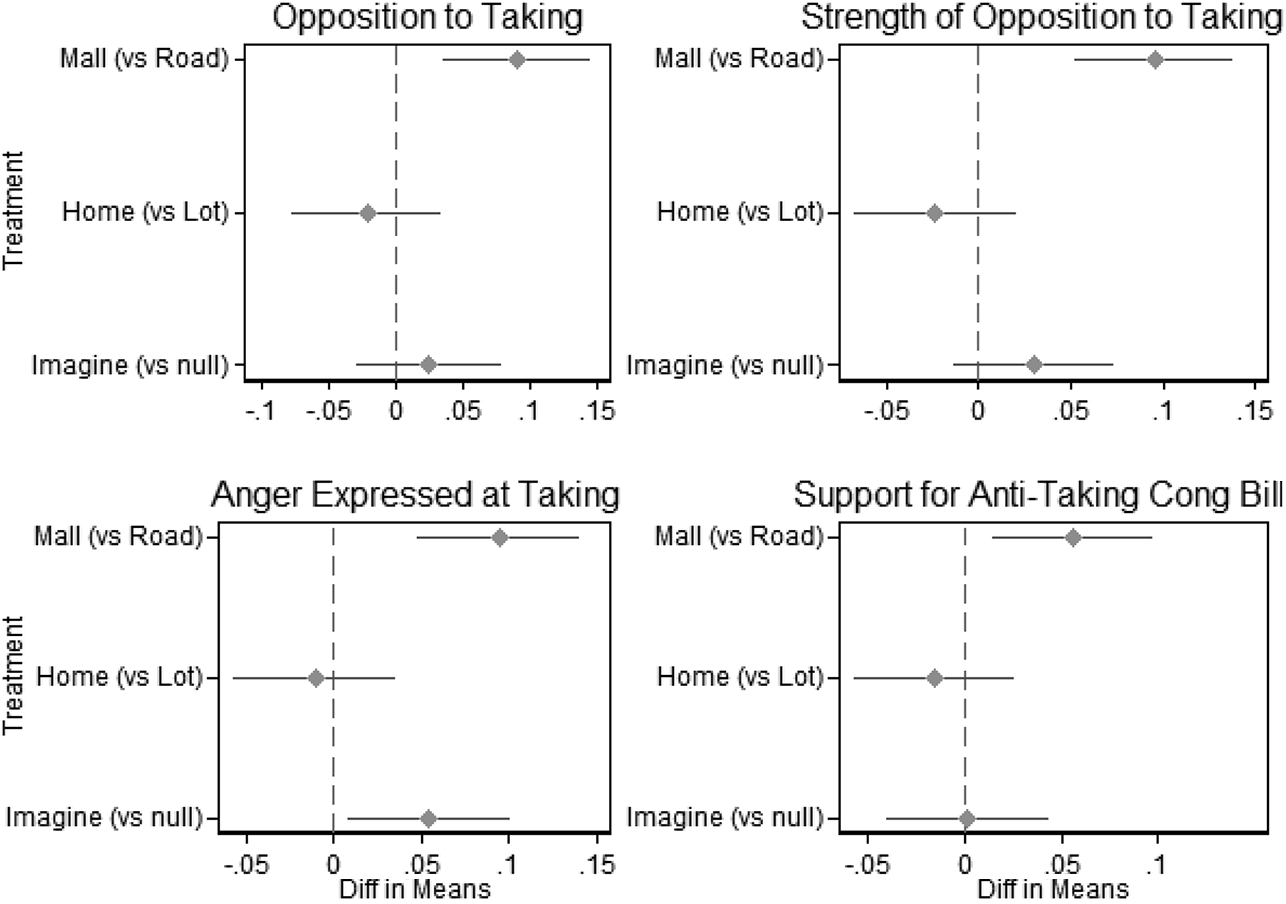
The experimental design allows me to rigorously test the theory presented here, that the purpose for which property is being taken is crucial in determining individuals’ attitudes toward that taking. I first conduct simple cross-tabulations of support for the taking that the respondent read about in the news story against each experimental treatment, using Pearson’s χ2 to test significance. These tests reveal that support for the taking did not vary across those in the imagined ownership treatment compared to those not in it (p = .359) nor across those who read about a home being taken and those who read about a vacant lot being taken (p = .455). Those who read about a property being taken for the purpose of building a strip mall (a broad use) were significantly more opposed to the taking than those who read about property taken to build a road (a narrow use; p = .001). Figure 3 presents these differences graphically.
Difference in means between treatment conditions. Dependent variables in all specifications are scaled to vary between zero and one. The figures above demonstrate that the purpose of taking (mall compared to road) exerts a substantively large effect on attitudes, robust to four separate measurements of those attitudes (opposition, strength of opposition, anger, and support for a congressional bill banning takings such as the one in the news story). Respondents were no more opposed to takings of homes (home) than they were of vacant lots. The findings with respect to imagined ownership (imagine) are mixed: ownership appears to intensify opposition but not to create opposition.
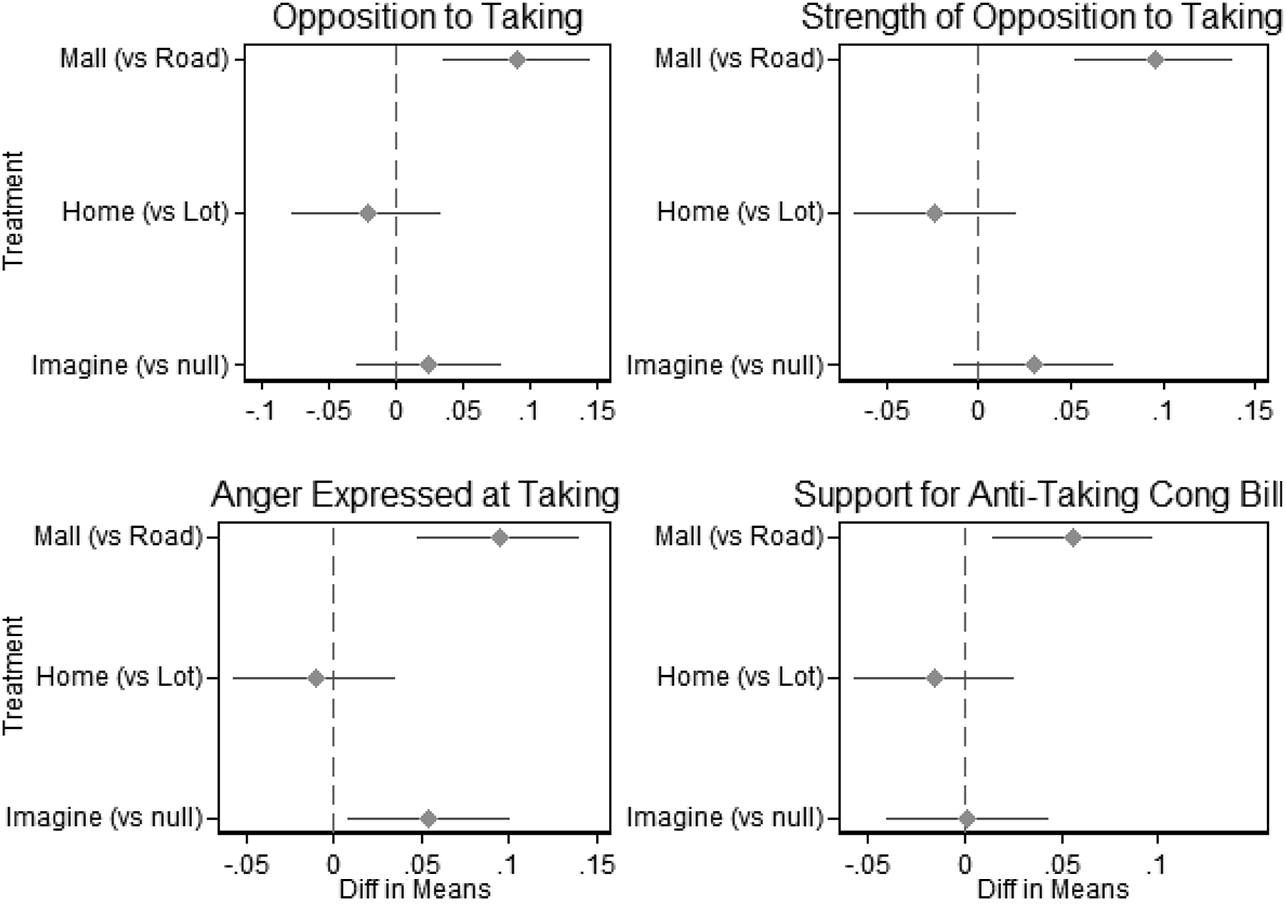
The two-way graphs in figure 3 display the results for all respondents. It uses dots to indicate point estimates and lines to illustrate the 95% confidence intervals for the effect of each treatment condition (mall vs. road; home vs. vacant lot; imagined ownership vs. null) for all four specifications of the dependent variable. For example, the graph at the top left, “opposition to taking,” compares mean opposition to takings (measured dichotomously) across each of the three treatment conditions. There we see that respondents in the mall treatment were, on average, about 9.5 percentage points more likely to be opposed to the taking they read about than those in the road treatment. Further, we see that neither the home nor imagined ownership treatment exerted a statistically significant effect under this specification of the dependent variable, as zero falls within the confidence intervals for each. The graphs indicate that the type of property being taken (a home vs. a vacant lot) does not influence support for the taking in the news story, anger toward that taking, or support for a congressional bill banning that sort of taking. In short, the type of property being taken does not affect public attitudes toward the taking in question.
Further, the graphs show that imagined ownership of the property being taken in the news story does not affect absolute support for the taking or support for a congressional bill banning that type of taking; but imagined ownership does increase the level of anger expressed by the respondent. This finding arguably squares with Nadler and Diamond’s findings (given that all of their subjects were induced to imagine that they owned the property in question) in that the observed higher levels of anger and stronger opposition can be attributed to attachment to the property induced by the imagined ownership treatment.Footnote 11 Finally, figure 3 demonstrates that the purpose for which property is being taken exhibits a substantively large and highly significant effect on respondents’ attitudes, robust to four specifications of the dependent variable. People who read about a property being taken to build a mall were much more opposed to the taking, more strongly opposed to the taking, more angry about the taking, and more likely to support a bill before Congress that would ban that type of taking than were respondents who read about property taken in order to build a road.
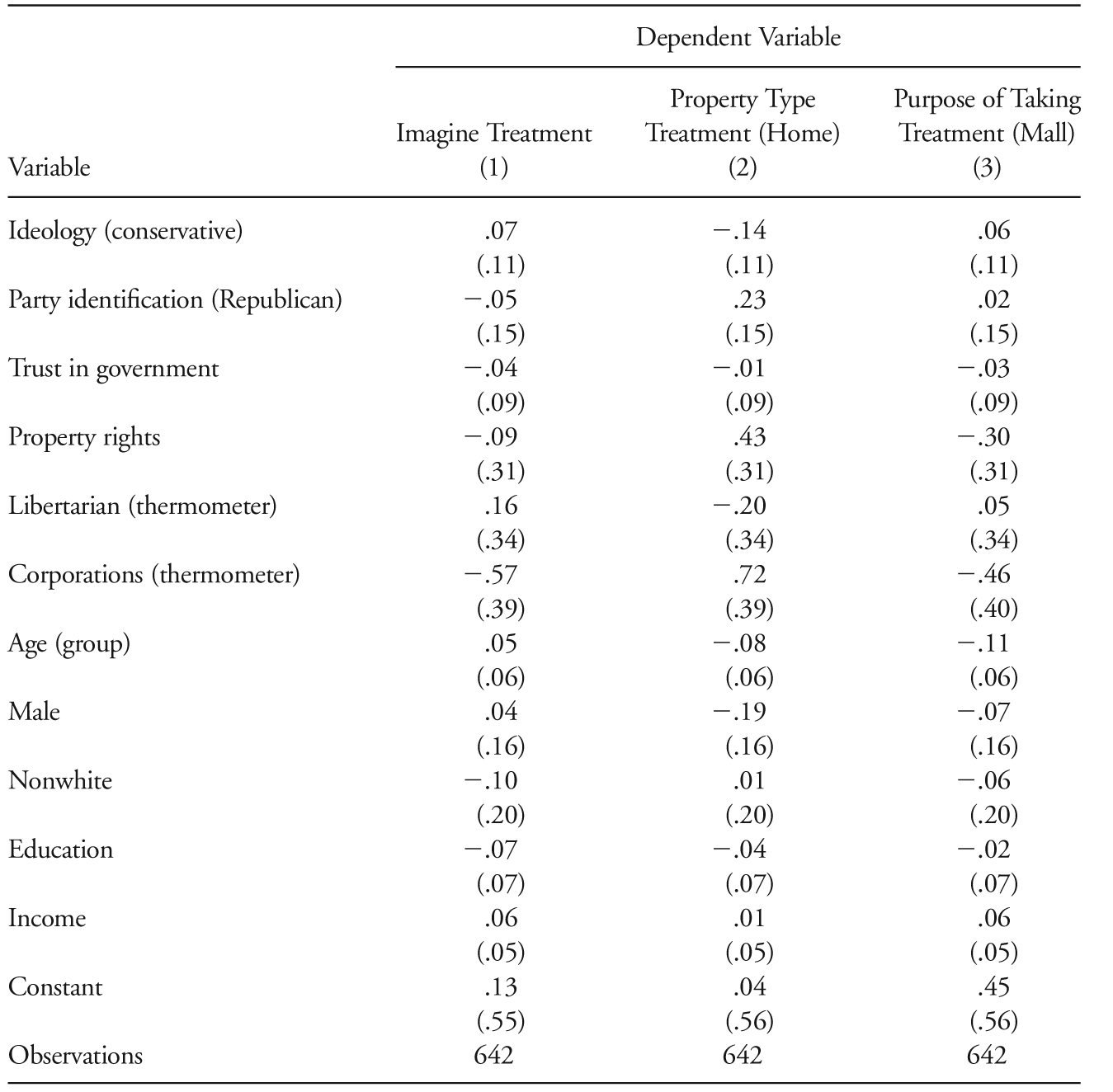
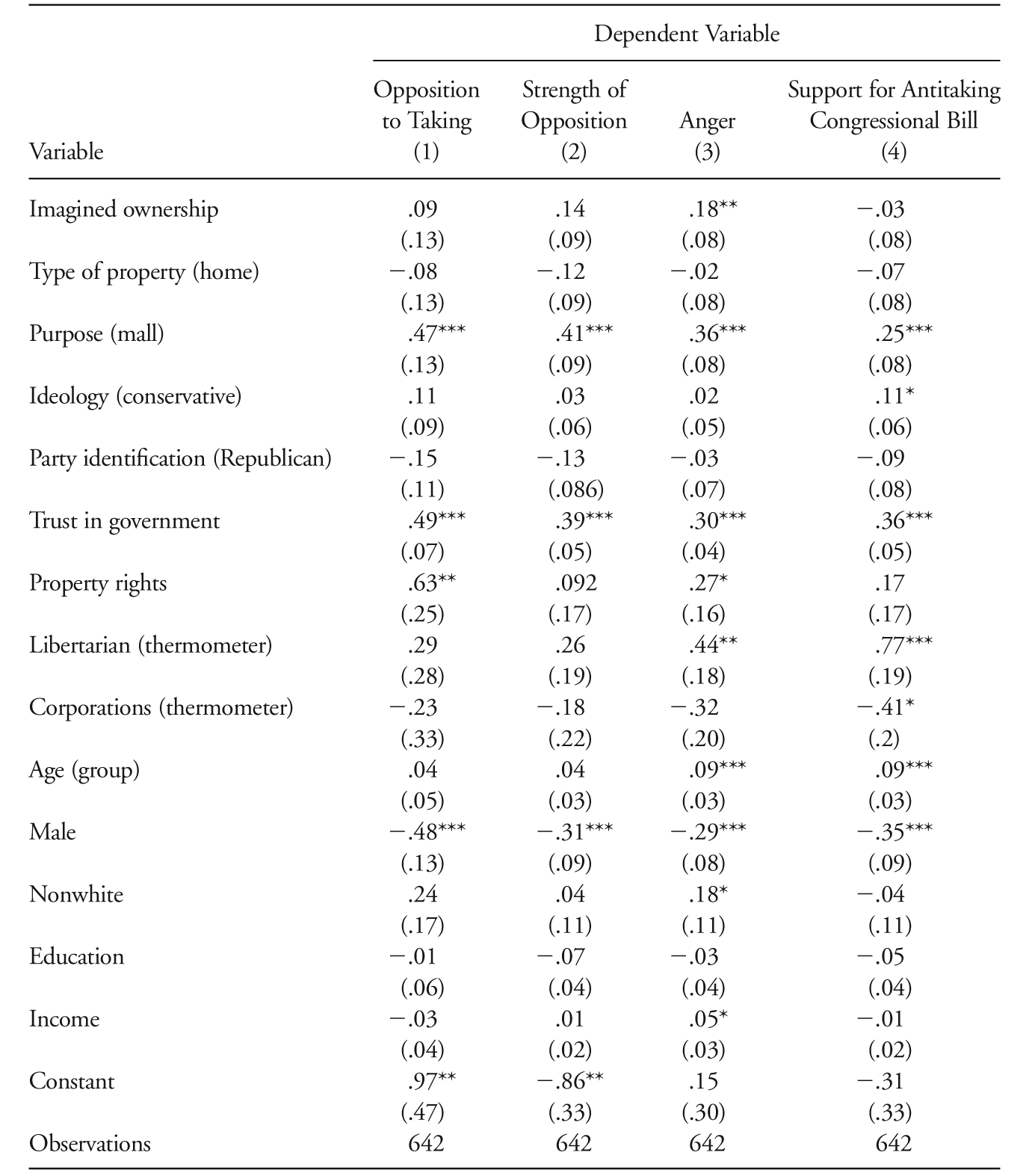
To further interrogate the relationships between attitudes toward takings, the type of property being taken, and the purpose for which the property is being taken, I conducted a series of multivariate probit and ordered-probit regression analyses. Probit was utilized because in all specifications of the dependent variable, the dependent variable either is dichotomous or takes discrete, ordered values. It is important to note here that in all specifications, a higher value on the dependent variable indicates greater opposition to the taking; thus positive coefficients indicate an increase in opposition, and negative coefficients indicate increasing support (i.e., decreasing opposition). Given the experimental design employed, we should expect the estimates from the multivariate model to look very similar to those depicted in figure 3. Including covariates in the models improves the precision of the estimates and corrects for any imbalances across the treatment groups.
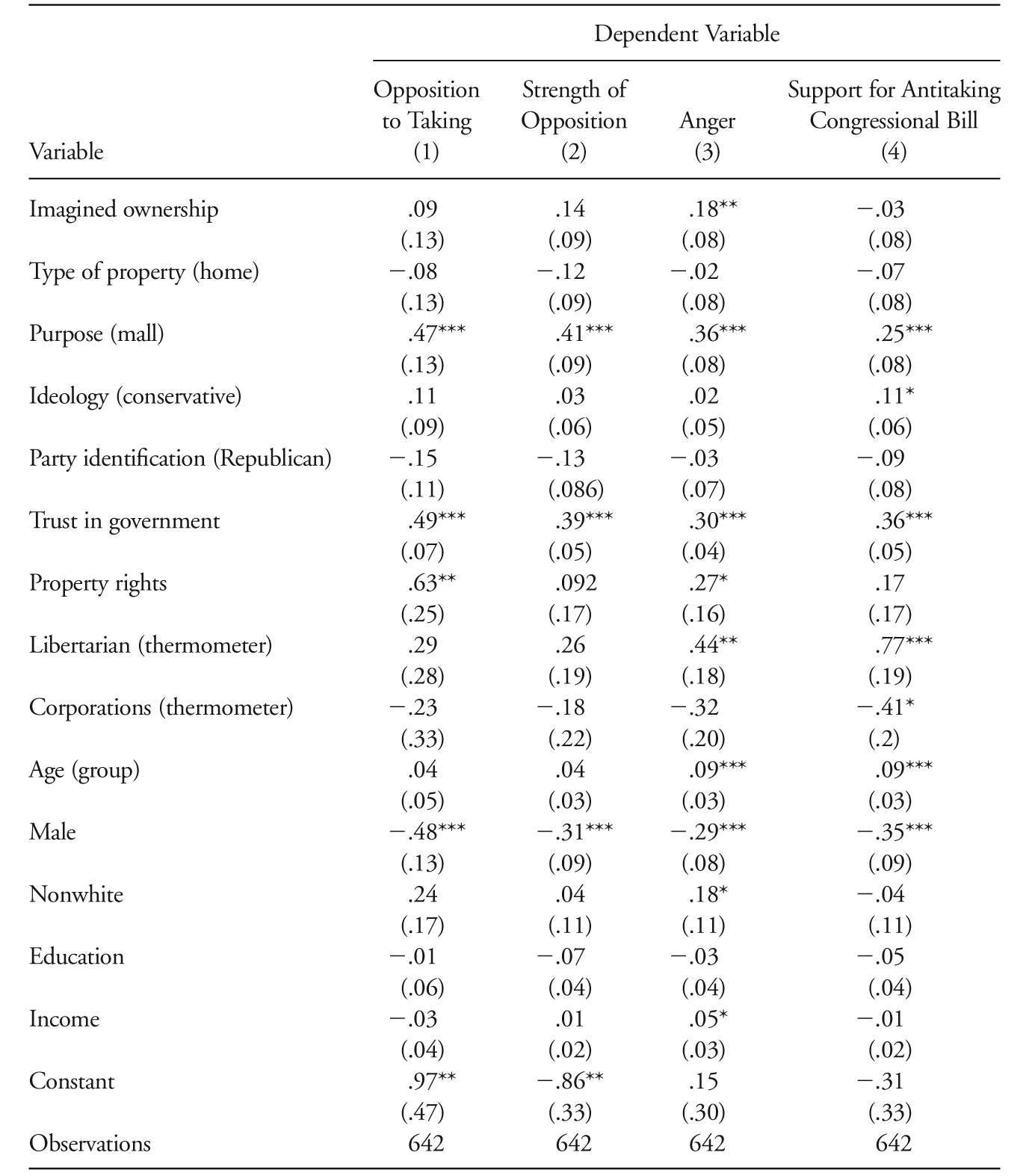
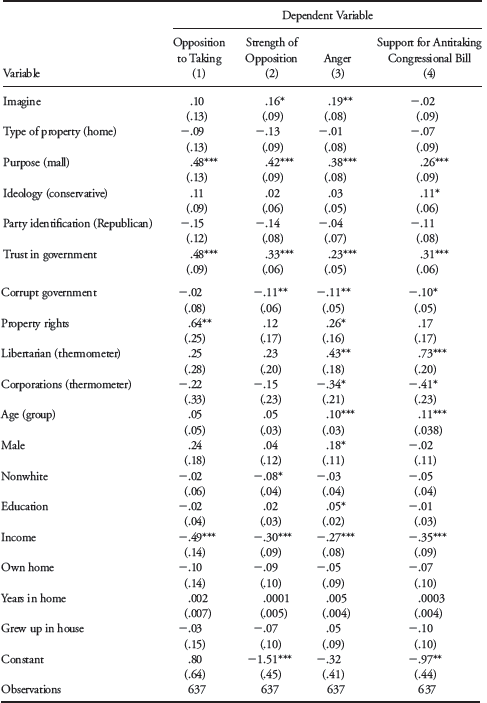
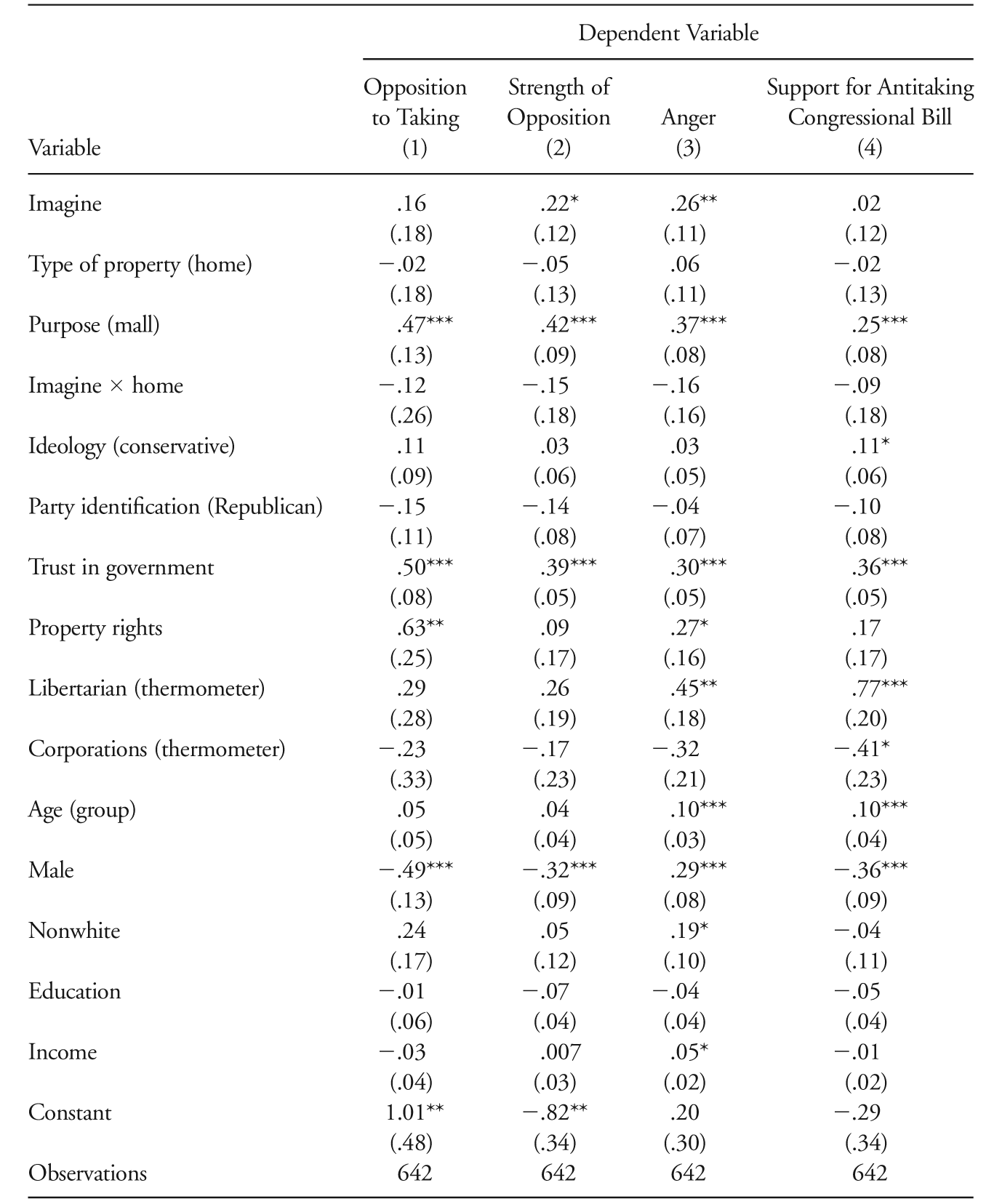
The estimates reported in table 2 demonstrate that even when controlling for a number of potentially relevant variables, the purpose for which property is to be taken exerts a substantively large and highly significant effect on respondents’ attitudes toward the taking: people are significantly more opposed to takings for a mall than takings for a road. The predicted probability (from model 1) that an individual supports the taking he read about differed significantly depending on whether the property was to be taken for a road or a strip mall (holding all other variables at their means): 18.1% of those in the road condition express support for the taking, while only 8.2% of those in the mall condition did.
Estimates of Determinants of Opposition to Takings: Probit Coefficients
Note.—Standard errors are in parentheses.
*. p < .1.
**. p < .05.
***. p < .01.
Model 2 estimates the strength of opposition to the taking read about, measured using a six-point ordered scale, ranging from strong support (1) to strong opposition (6). This model further demonstrates that the purpose for which property is to be taken exerts a substantively large and highly significant effect on respondents’ attitudes toward the taking and again shows no effects for either the type of property taken or the imagined-ownership treatment. As above, predicted probabilities can facilitate interpretation of the model estimates. The predicted probability that respondents in the road condition strongly support the taking is 2.8% compared to 1.01% for respondents in the mall condition. The effect is even starker at the other end of the spectrum: the predicted probability that a respondent in the road condition strongly opposes the taking is 40.3%, while the predicted probability that a respondent in the mall condition strongly opposes the taking is 56.9%.
Model 3 utilizes a third specification of the dependent variable: expressed anger toward the taking described in the news story measured using a 10-point sliding scale, which ranges from “not angry at all” (1) to “very angry” (10). Here again we see that the purpose for which property is being taken exhibits a large, highly significant effect on the level of anger expressed by respondents. Again I calculate predicted probabilities that respondents report anger in order to facilitate interpretation of the reported estimates. Respondents in the mall treatment condition are more than 9 percentage points more likely to report being very angry about the taking they read about (22.2%) than are respondents in the road condition (12.9%).
Finally, model 4 utilizes a fourth specification of the dependent variable: expressed support for a bill before Congress that would “make it very difficult for governments to take people’s property for economic redevelopment and similar purposes.” Individuals in the mall treatment condition were much more likely to express support for this bill than were those in the road condition. The predicted probability that respondents in the mall condition said they would be very likely to support the takings-curbing bill is 51.1%, compared to 41.1% for respondents in the road condition. Taken together, these findings suggest that the influence of the purpose of the taking exhibits a substantively large and statistically significant effect on attitudes toward the taking, even when controlling for a number of potentially relevant variables. The robustness of this finding is demonstrated by the consistency of the effects across multiple specifications of the dependent variable. Including additional or alternative measures of control variables and interactions of the treatments does not materially affect this central finding (see app. C).
Further, the models demonstrate that the type of property being taken was immaterial to respondents’ attitudes toward the taking they read about. Imagined ownership of the property in question was also largely irrelevant, though it did increase respondents’ expressed anger toward the taking (model 3). Thus the data clearly do not support the claim that it is the taking of homes that motivates massive public opposition to takings. Further, imagined ownership (empathy from subjective attachment to property) is clearly not the primary—or even a large—factor in informing individuals’ attitudes.Footnote 12 The data demonstrate that imagined ownership can intensify opposition to takings but is not sufficient to affect overall levels of support.
A few final points warrant comment. First, the analyses above indicate, unsurprisingly, that individuals who are less trusting of the government are considerably more opposed to takings. The data do present one surprise, however: men are consistently and significantly more supportive of takings than are women. Third, ideology is a marginally significant factor in model 1 and is fairly significant, although substantively small, in model 4. The coefficient indicates that conservatives are somewhat more supportive of the proposed bill banning economic takings than are liberals. One possible explanation for this is that the sitting Congress (at the time the experiment was in the field) was strongly Republican; thus perhaps conservative respondents reasoned that a bill before Congress would likely reflect their ideological predispositions. Education attains marginal significance in models 2 and 4, though again the effects are relatively small. The coefficient on education indicates that more highly educated respondents were slightly less opposed to takings than were their less educated counterparts. The marginal significance in these models, combined with the absence of significance in the other two, suggests the fragility of that relationship. Finally, and crucially, the observed effects are not driven by libertarian tendencies (measured as expressed “warmth” toward libertarians), antibusiness attitudes (measured as “warmth” toward corporations), or disproportionately pro–property rights attitudes, though each of these does somewhat influence attitudes in some specifications of the models (see table 2).
To summarize, the theory presented here, as operationalized in the hypothesis proposed above, is strongly and robustly supported: individuals are more opposed to broad-use takings than narrow-use takings regardless of the type of property being taken. Neither the type of property being taken nor imagined ownership of the property being taken (the operationalization of empathy toward homeowners) consistently influences attitudes toward takings, though imagined ownership does appear to significantly intensify anger about takings. A few other factors were found to influence attitudes toward takings. Respondents who reported low levels of trust in government, unsurprisingly, were more opposed to takings than those who reported higher levels of trust. Gender exerts a consistent and significant influence on attitudes toward takings, though it is unclear why. Ideology displays some relatively weak effects: it does not much inform overall support, or strength of support, for takings but does significantly influence one’s willingness to support antitaking legislation, with conservatives being more supportive than liberals.
C. Open-Ended Survey
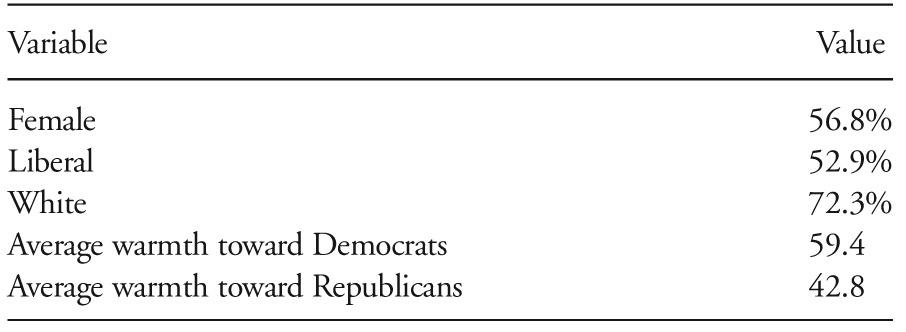
In order to validate the inferences from the experimental and observational studies described above, I surveyed a convenience sample of 272 undergraduate students taking courses in political science at Syracuse University. The use of undergraduates for the study is justified: student samples are not perfect, but they have been demonstrated to be remarkably like the general population on most variables relevant to political inquiry, substantially reducing the risk of bias (Kam Reference Kam2005; Druckman and Kam Reference Druckman, Kam and Druckman2011). Further, student samples are routinely used in political science and psychology (Sears Reference Sears1986; Kam, Wilking, and Zechmeister Reference Kam, Wilking and Zechmeister2007; Druckman and Kam Reference Druckman, Kam and Druckman2011; Krupnikov and Levine Reference Krupnikov and Seth Levine2014). Descriptive statistics of the sample can be found in appendix B.
Surveys typically prescribe a limited range of options to respondents while the open-ended format allows respondents to take the questions on their own terms; thus I asked respondents a simple open-ended question: after having eminent domain defined for them, each respondent was asked, “In general, what do you think the main difference is between a legitimate use of eminent domain, and an illegitimate use?” This format allows respondents to offer any ideas they have on the topic, unrestrained by the researcher’s priors. As such, this approach offers a potent test of my hypothesis.
Respondents were informed that “eminent domain is the power a government has to force an individual to sell her property. The Constitution’s Fifth Amendment requires that when using eminent domain, the government must still provide ‘just compensation’ for the property being taken.” After having eminent domain defined for them, each respondent was asked, “In general, what do you think the main difference is between a legitimate use of eminent domain, and an illegitimate use?” This approach is especially warranted given the narrow existing evidence base of previous works in that it casts an exceptionally wide net.
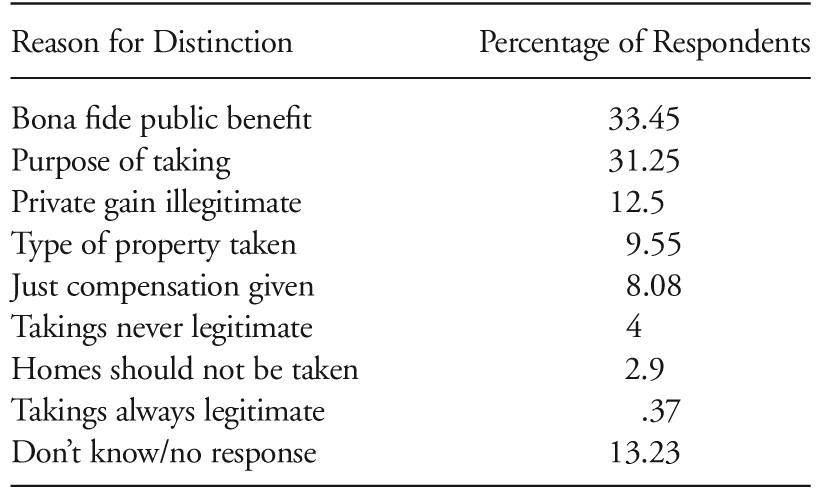
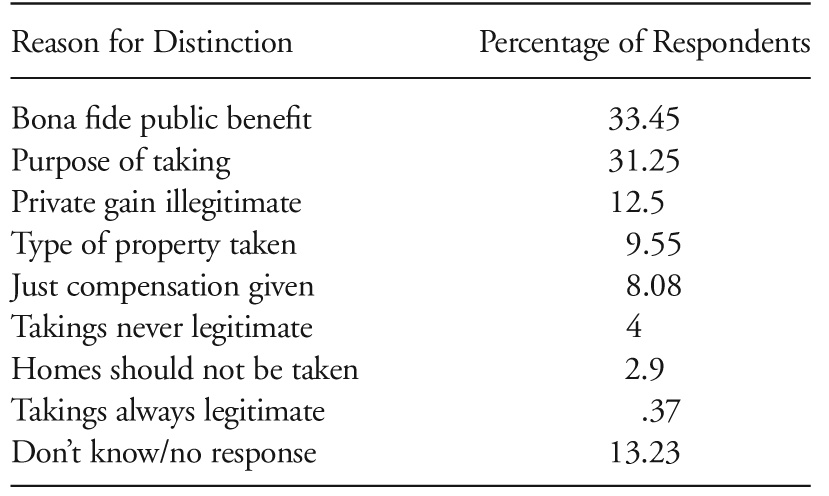
Typical responses include “if what is being built will benefit everyone in the surrounding area in some way then the use of eminent domain is legitimate” and “legitimate if it is going to be used for something that is important and could make peoples lives safer. illegitimate if it’s use does not make the area safe, like if its just going to be used for profit” [sic]. Another respondent opined that “legitimate use would be for public need while illegitimate would be for private needs.” Table 3 summarizes the responses to this question from the entire sample.
Summary of Open-Ended Responses
Note.—Column adds to over 100% because some responses fit into more than one category.
Several themes emerged in the open-ended responses. For each theme, a response category was created (essentially, a dummy variable). All responses were read closely and then coded as 1 if something the respondent wrote fit into that category and 0 otherwise, such that any given respondent may have had her response coded as 1 in any number of categories.Footnote 13 All open-ended responses were coded for mentions of the type of property being taken (any mention of property type relating to the legitimacy of the taking was coded as 1), the word “home” (any mention = 1), the purpose of the taking, the importance of a “true” public benefit, the relevance of private gain, and the importance of just compensation. Categories were also created for responses stating that takings are always legitimate and that takings are never legitimate and for “don’t know”/“unsure” responses.
As table 3 indicates, respondents were more than three times more likely to identify the purpose of a taking as determinative of its legitimacy than the type of property being taken. Further, less than 3% of respondents volunteered that the taking of homes was a per se indicator that a taking was illegitimate. This finding is particularly damaging to the prevalent view in the literature. A plurality of respondents indicated that the key distinction between legitimate and illegitimate uses was that the taking be for a bona fide public good; that is, the taking had to benefit the majority and not just some connected private interest. This plurality view is clearly distinct from the broad/narrow distinction emphasized here, but it is consonant with the general argument offered that it is the purpose for which property is being taken that individuals home in on when judging a taking. This is true also of the third-most-frequent response, that takings for private gain are per se illegitimate. These open-ended responses strongly validate the inferences drawn from the experimental and observational studies above and support the theory offered here.
V. Discussion and Conclusion
Because of their salience in contemporary politics and the important policy questions they raise, scholars are increasingly interrogating public attitudes toward takings. The present study moves beyond prior works in that it carefully examines a theorized cause of public opposition to takings that has previously received little scholarly attention. The experimental design used here also allows for the testing of multiple competing hypotheses and provides clear comparisons across these different treatments. Moreover, the multimethod design significantly increases confidence in the findings: the broad agreement among the experimental sample group, the three representative state-level observational studies, and the open-ended study of college students strongly suggests that the findings are not an artifact of research design or sampling.
The data indicate two things clearly: Americans are broadly opposed to eminent domain across the board, and they are sensitive to the purpose for which property will be taken. This basic finding is robust across different types of samples, across several specifications of the dependent variable, including intensity of opposition, expressed anger about taking, and support for a bill in Congress that would outlaw economic development takings, and multiple specifications of the statistical models. The findings presented here provide robust support for my key hypothesis: individuals are sensitive to the purpose for which property is taken and are relatively more supportive of narrow-use takings than they are of broad-use takings. With that said, the distinction drawn here between “narrow” and “broad” uses is admittedly imprecise; it is possible that numerous specific purposes could be broad or narrow depending on context. Even so, the findings presented here clearly indicate that the purpose of a taking is the key factor in explaining public attitudes. Future research should seek to unpack what exactly it is about the purpose that really matters to individuals and thus what drives the observed effect. Another important takeaway from this study is that while Americans are strongly opposed to takings, there is substantial variation in the levels of opposition with respect to the purpose of the taking. Support was relatively high (44.6%) for takings for a “vital public purpose,” although what constitutes such a purpose is unclear.
These findings have important empirical, theoretical, and practical implications. I have empirically demonstrated that the purpose for which property is to be taken is highly influential on public attitudes toward uses of eminent domain. Specifically, individuals exhibit significantly higher levels of opposition to broad-use takings than they do to narrow-use takings. Though many people oppose eminent domain almost categorically (at least for those purposes broached in the above studies), among those who are willing to tolerate it in some cases, support or opposition is powerfully influenced by the purpose for which property is being taken. Further, it is important to note that both prospective takings in the experimental study were described in neutral (as opposed to sympathetic or antagonistic) terms. It is possible that if the takings are presented in a more positive light—for example, if the putative benefits of the proposed projects were laid out in some detail—individuals might be more supportive.
A clear empirical implication of this finding is that the backlash to Kelo is likely attributable in important part to the purpose for which those properties were being taken (economic development). Although the sympathetic plaintiffs, the nature of the property being taken (the “little pink house”), and dissensus among the justices surely did increase the salience of the decision (Zilis Reference Zilis2015), those factors do not appear to be the primary drivers of attitudes toward eminent domain generally. And indeed, the findings here indicate that imagined ownership did significantly intensify anger toward takings; so to the extent that the news coverage of Kelo induced empathy, the concept of ownership may explain some part of the resulting backlash. Theoretically, the findings here suggest that the long-standing claim that individuals’ political attitudes are unprincipled, and based almost entirely on group affect, may be overbroad. Future work should seek to unpack this possibility by further homing in on why individuals are more opposed to broad-use takings. Further, I found that men appear to be more supportive of eminent domain than women; future studies should seek to find out why. Indeed, uncovering the root of the gender difference may shed some light on the more general sources of individuals’ opposition to takings, especially broad-use takings.
The findings presented here also have important practical implications. In discussing the implications of their study, Nadler and Diamond argue that one key takeaway is that governments not only should consider the market value of a property when determining “just compensation” for its owners but also should consider remunerating people for subjective attachment when the property being taken is a home. The practical implications of my findings suggest a rather different remedy: governments should not exercise eminent domain for broad uses—especially economic development.Footnote 14 Though narrow takings are not themselves popular, curtailing broad-use takings would likely at least reduce political backlash to takings. Indeed, American political practice has moved generally in that direction since Kelo was decided, though economic takings are still possible in most states (Somin Reference Somin2015). In short, one appropriate remedy suggested by the analyses here would be to revive the genuine “public use” requirement and discard the current “public purpose” regime as it exists under the rules announced in the Court’s decisions in Berman, Midkiff, and Kelo.Footnote 15
This article presents a systematic examination of public attitudes toward takings and is among the first to do so using experimental methods. Still, its limitations must be acknowledged. It experimentally compares only two types of property taken and two purposes for takings. Future studies could broaden the variety of purposes for takings (other types of narrow and broad uses) and the types of property being taken (farmland, business locations, derelict buildings, etc.) in order both to further test the theory offered here and to provide nuance. Further, while the sample used in the experimental study is of high quality, it is not nationally representative. This potential shortcoming is mitigated by the fact that analyses of three separate representative state-level samples support the inferences drawn from the experimental data. These inferences are further validated by the open-ended responses of another separate convenience sample. Taken together, the broad agreement among five separate samples is highly suggestive of the reliability of the findings. To the extent that my findings generalize to the American population, they raise serious questions about the validity—in terms of popular sovereignty and democratic legitimacy—of a wide range of uses of eminent domain, especially as that power pertains to economic development.
Appendix A
Experimental Treatments, Vignettes, and Survey Instrument
Imagine (Ownership/Empathy) Treatment vs. Null
Condition 1 [Baseline]
To begin, imagine that this is someone’s vacant lot:
Picture 1.
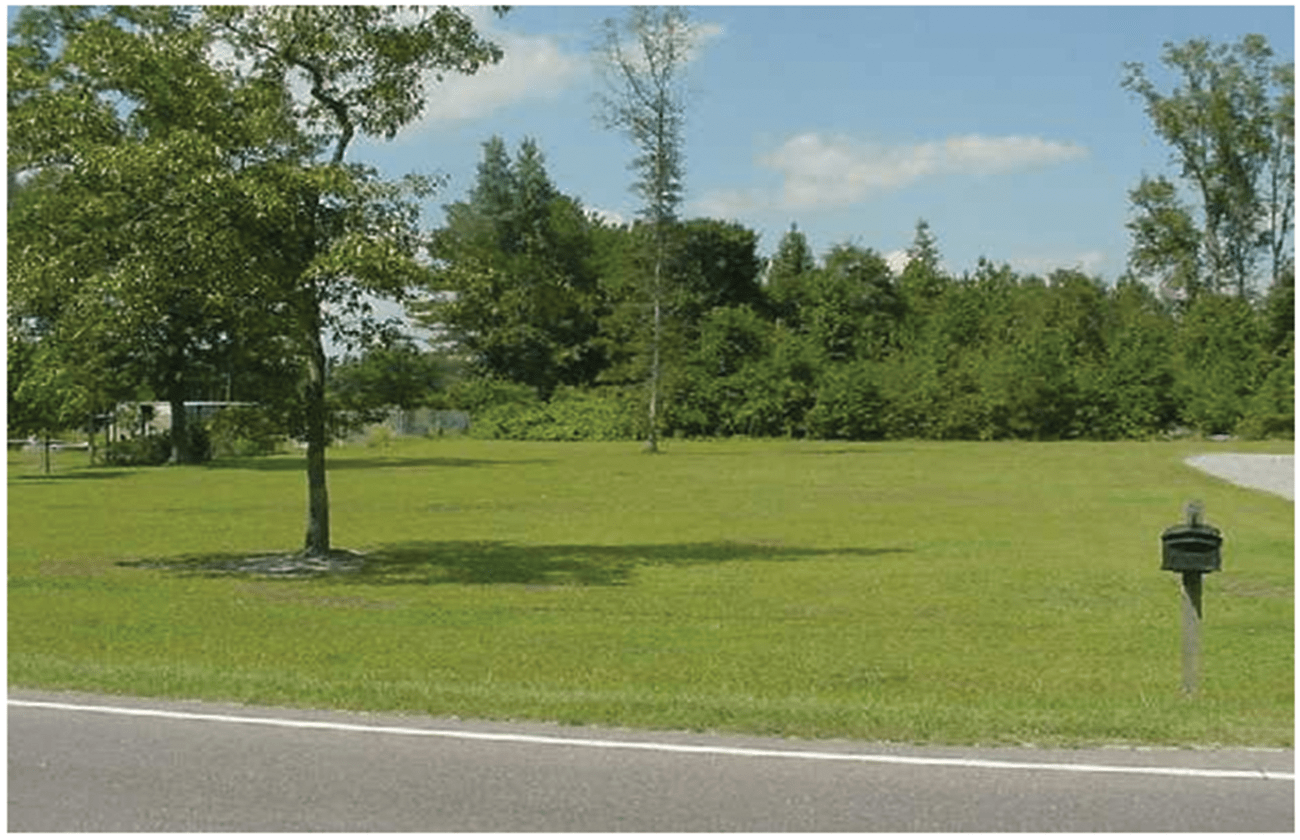
Condition 2 [Lot/Imagine]
To begin, imagine that you own this vacant lot: [picture 1]
Condition 3 [Home]
To begin, imagine that this is someone’s house:
Picture 2.
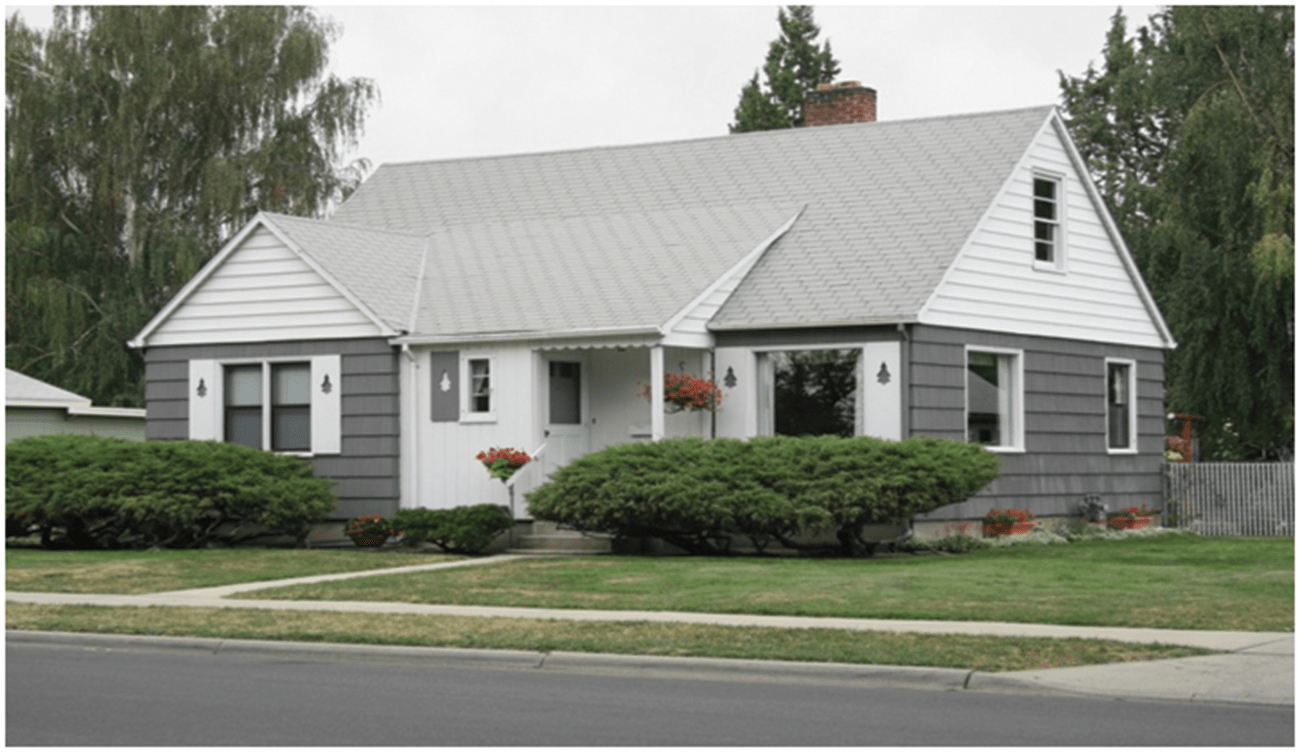
Condition 4 [Home/Imagine]
To begin, imagine that this is your house: [picture 2]
Baseline [Text]
City OKs using eminent domain for street-widening
June 9, 2014
By JEFF COVERLEY/THE ORANGE COUNTY REGISTER
This piece of land separating Jamboree Road and a shopping center parking lot is being targeted with eminent domain.
NEWPORT BEACH—Elected officials Tuesday night approved using eminent domain to gain ownership of a parcel of land needed to clear the way for a street-widening project. Eminent domain is the power a government has to force an individual to sell her property. The Constitution’s Fifth Amendment requires that when using eminent domain, the government must still provide “just compensation” for the property being taken.
Newport Beach has offered $20,000 for the property along Jamboree Road at the 73 freeway. In an interview, an attorney for the property owner said a fair price hasn’t yet been established but that the city’s offer is insufficient.
The property is about one acre and consists of an unused but well-maintained lot. While officials began eminent domain proceedings Tuesday, they promised to continue negotiating.
The city wants to widen Jamboree Road in order to improve traffic flow in several busy downtown areas, including around the new Back Bay Court shopping center.
Mayor Keith Curry said the measure is justified in this case, describing it as a needed tool for dealing with a property owner who “can hold up the government and taxpayers for more money than the parcel’s worth.”
When asked to comment, the property owner said “This is my land and I don’t want it to be taken just so people can get to work two minutes faster.”
Treatment 1 [Text]
City OKs using eminent domain for shopping center
June 9, 2014
By JEFF COVERLEY /THE ORANGE COUNTY REGISTER
This piece of land separating Jamboree Road and the proposed Back Bay Court shopping center is being targeted with eminent domain.
NEWPORT BEACH—Elected officials Tuesday night approved using eminent domain to gain ownership of a parcel of land needed to clear the way for a new shopping center. Eminent domain is the power a government has to force an individual to sell her property. The Constitution’s Fifth Amendment requires that when using eminent domain, the government must still provide “just compensation” for the property being taken.
Newport Beach has offered $20,000 for the property along Jamboree Road at the 73 freeway. In an interview, an attorney for the property owner said a fair price hasn’t yet been established but that the city’s offer is insufficient.
The property is about one acre and consists of an unused but well-maintained lot. While officials began eminent domain proceedings Tuesday, they promised to continue negotiating.
The city wants to acquire the property in order to develop it, along with several adjacent properties, into the newly proposed Back Bay Court shopping center.
Mayor Keith Curry said the measure is justified in this case, describing it as a needed tool for dealing with a property owner who “can hold up the government and taxpayers for more money than the parcel’s worth.”
When asked to comment, the homeowner said “This is my house and I don’t want it to be taken just so people can have another place to buy shoes and handbags.”
Treatment 2 [Text]
City OKs using eminent domain for street-widening
June 9, 2014
By JEFF COVERLEY/THE ORANGE COUNTY REGISTER
This home separating Jamboree Road and a shopping center parking lot is being targeted with eminent domain.
NEWPORT BEACH—Elected officials Tuesday night approved using eminent domain to gain ownership of a parcel of land needed to clear the way for a street-widening project. Eminent domain is the power a government has to force an individual to sell her property. The Constitution’s Fifth Amendment requires that when using eminent domain, the government must still provide “just compensation” for the property being taken.
Newport Beach has offered the family $452,000 for their home along Jamboree Road at the 73 freeway. In an interview, an attorney for the property owner said a fair price hasn’t yet been established but that the city’s offer is insufficient.
The property is about one acre and consists of a small family home and residential yard. While officials began eminent domain proceedings Tuesday, they promised to continue negotiating.
The city wants to widen Jamboree Road in order to improve traffic flow in several busy downtown areas, including around the new Back Bay Court shopping center.
Mayor Keith Curry said the measure is justified in this case, describing it as a needed tool for dealing with a property owner who “can hold up the government and taxpayers for more money than the parcel’s worth.”
When asked to comment, the homeowner said “This is my house and I don’t want it to be taken just so people can get to work two minutes faster.”
Treatment 3 [Text]
City OKs using eminent domain for shopping center
June 9, 2014
By JEFF COVERLEY/THE ORANGE COUNTY REGISTER
This home separating Jamboree Road and the proposed Back Bay Court shopping center is being targeted with eminent domain.
NEWPORT BEACH—Elected officials Tuesday night approved using eminent domain to gain ownership of a parcel of land needed to clear the way for a new shopping center. Eminent domain is the power a government has to force an individual to sell her property. The Constitution’s Fifth Amendment requires that when using eminent domain, the government must still provide “just compensation” for the property being taken.
Newport Beach has offered the family $452,000 for their home along Jamboree Road at the 73 freeway. In an interview, an attorney for the property owner said a fair price hasn’t yet been established but that the city’s offer is insufficient.
The property is about one acre and consists of a small family home and residential yard. While officials began eminent domain proceedings Tuesday, they promised to continue negotiating.
The city wants to acquire the property in order to develop it, along with several adjacent properties, into the newly proposed Back Bay Court shopping center.
Mayor Keith Curry said the measure is justified in this case, describing it as a needed tool for dealing with a property owner who “can hold up the government and taxpayers for more money than the parcel’s worth.”
When asked to comment, the property owner said “This is my land and I don’t want it to be taken just so people can have another place to buy shoes and handbags.”
Question Wording for MTurk Survey Experiment
Key Dependent Variable Measures:
Q1. Do you support or oppose the use of eminent domain described in the news article you just read?
-
- Support
-
- Oppose
Q1a. [if “Support” on Q1]: Do you strongly support it, somewhat support it, or only slightly support it?
-
- Strongly support
-
- Somewhat support
-
- Slightly support
Q1b. [if “Oppose” on Q1]: Do you strongly oppose it, somewhat oppose it, or only slightly oppose it?
-
- Strongly oppose
-
- Somewhat oppose
-
- Slightly oppose
Q2. Why do you feel that way?
-
- [Text box]
Q3. If the city does in fact use eminent domain as described in the article, how angry would you be?
-
- [Slider] Not angry at all ←→ very angry
Q4. Why do you feel that way?
-
- [Text box]
Q5. If people in the community organized to protest against the use of eminent domain described in the article, how likely would you be to participate?
-
- Very likely
-
- Likely
-
- Undecided
-
- Unlikely
-
- Very unlikely
Q6. How likely would you be to donate to a legal fund to help people fight takings like those described in the article you read?
-
- [Categories same as Q5]
Q7. There is currently a bill before Congress that, if passed, would make it very difficult for governments to take peoples’ property for economic redevelopment and similar purposes. How likely would you be to support this bill?
-
- [Categories same as Q5]
General Attitudes toward Eminent Domain
Q8. Generally speaking, do you support or oppose the government having the power to force people to sell their property in order to build a road or bridge?
-
- Strongly support
-
- Support
-
- Somewhat support
-
- Neither support nor oppose
-
- Somewhat oppose
-
- Oppose
-
- Strongly oppose
Q9. Generally speaking, do you support or oppose the government having the power to force people to sell their property in order to build a new school??
-
- [Categories same as Q8]
Q10. Generally speaking, do you support or oppose the government having the power to force people to sell their property in order to build infrastructure or utilities?
-
- [Categories same as Q8]
Q11. Generally speaking, do you support or oppose the government having the power to force people to sell their property in order for a private business to develop it?
-
- [Categories same as Q8]
Q12. Generally speaking, do you support or oppose the government having the power to force people to sell their property in order to use it for environmental purposes, such as wetland development?
-
- [Categories same as Q8]
Q13. Generally speaking, do you support or oppose the government having the power to force people to sell their property if the property is needed for a vital public purpose?
-
- [Categories same as Q8]
Q14. In general, what do you think the main difference is between a legitimate use of eminent domain, and an illegitimate use?
[text box]
Appendix B
Sample Demographics and Randomization Check
Descriptive Statistics of MTurk Sample Population (%)
Descriptive Statistics of Syracuse Undergraduate Sample Population
Randomization Check for MTurk Experiment: Logit Coefficients
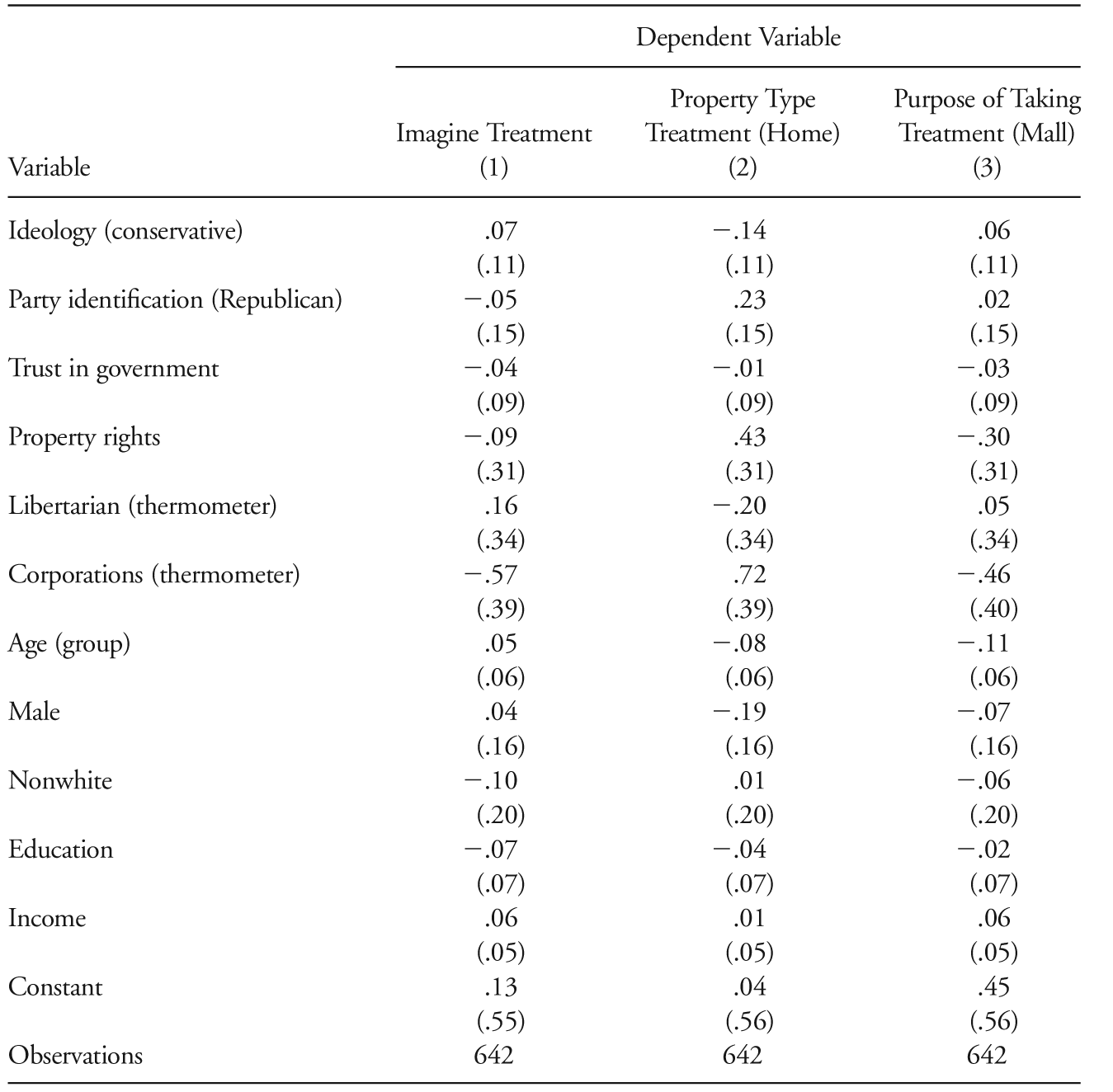
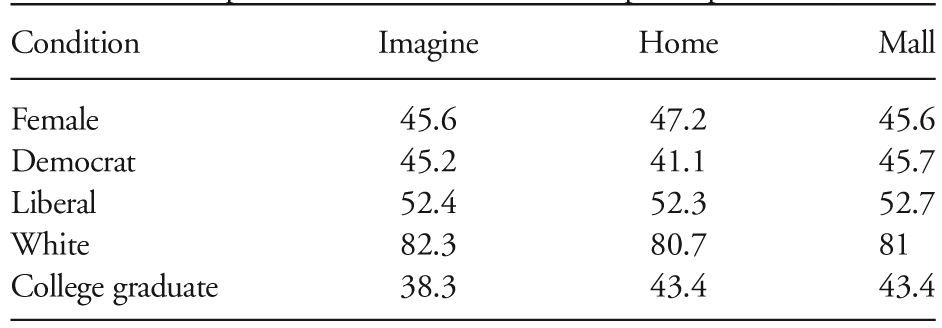
Note.—Standard errors are in parentheses. This table presents models in which I operationalize inclusion in a treatment group as the dependent variable and regress demographic and attitudinal covariates on treatment. The models indicate that randomization was successful.
Appendix C
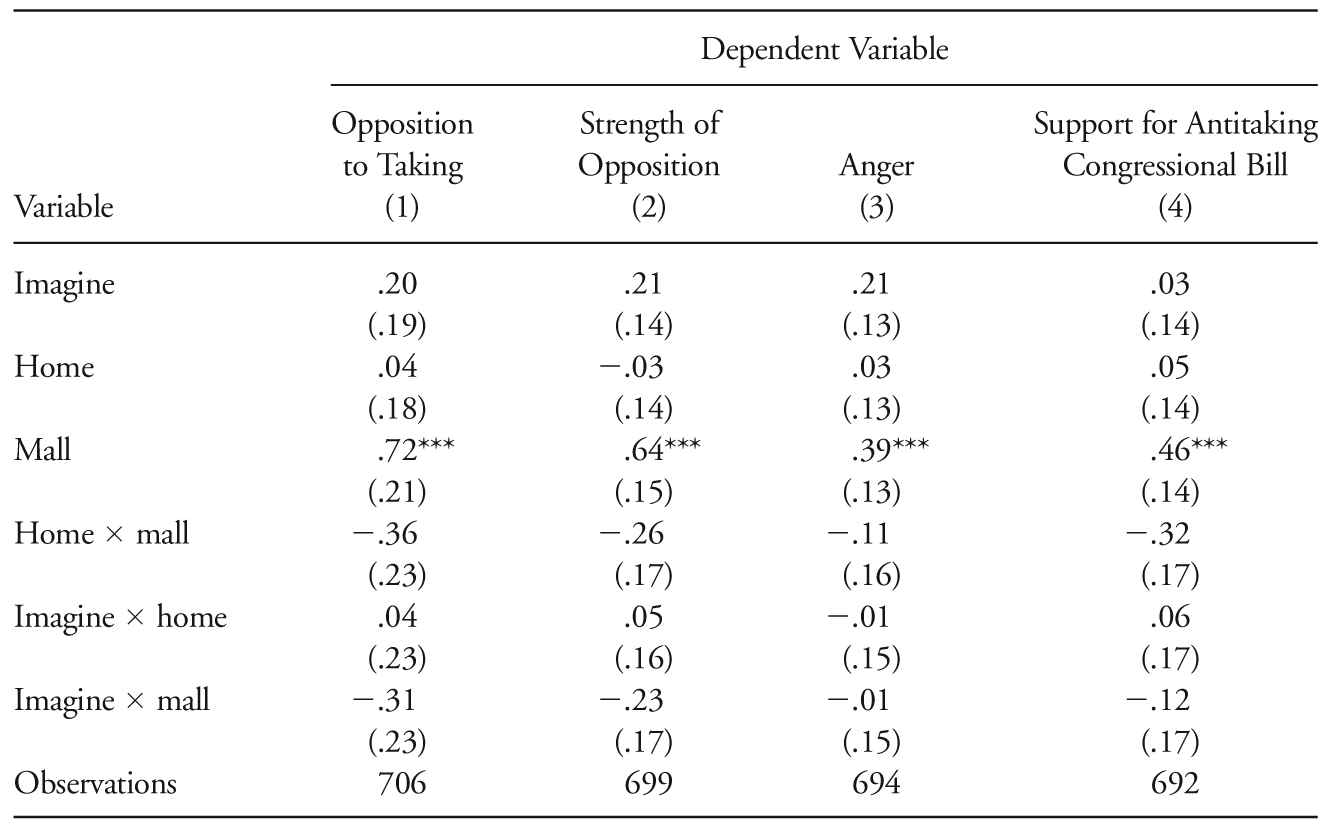
Additional Model Specifications
Interactions of Treatment Conditions: Probit Coefficients
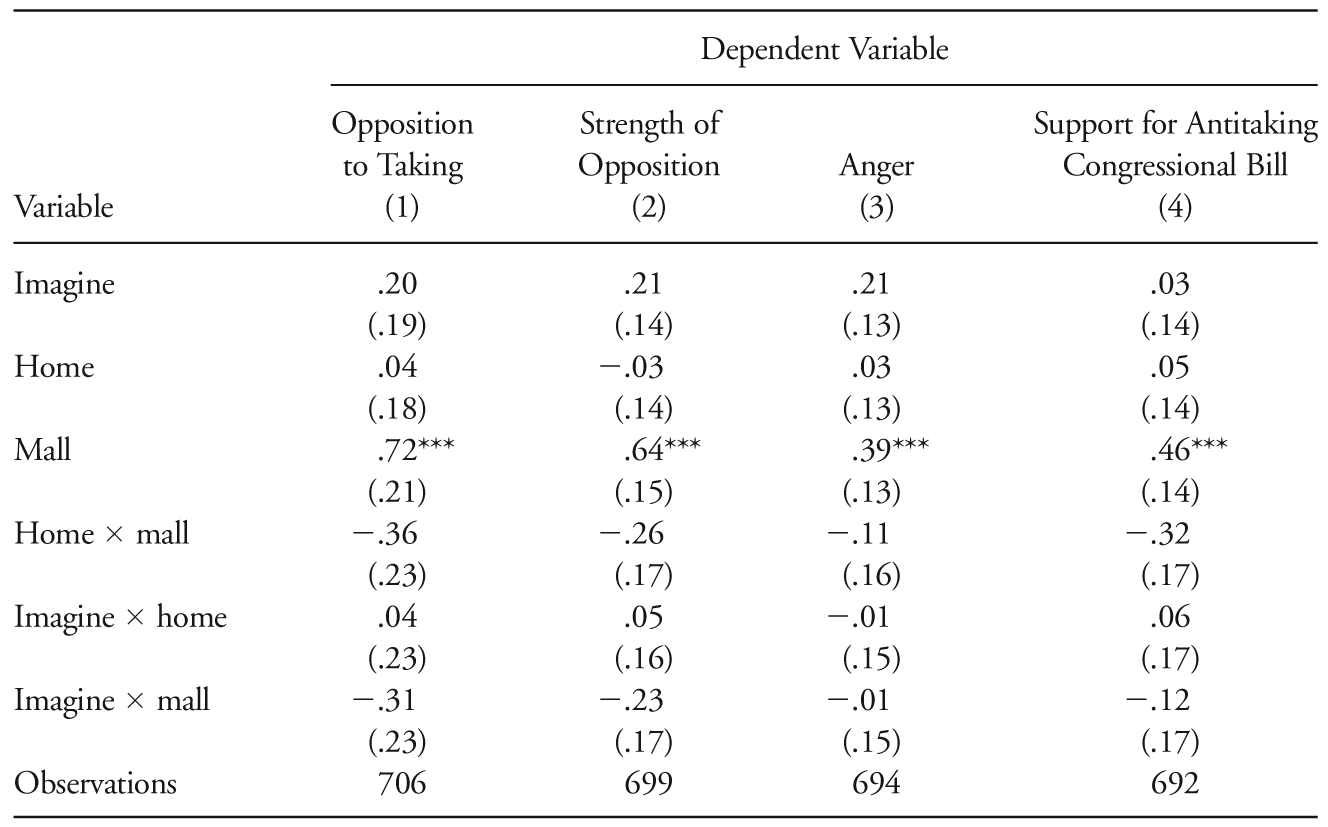
Note.—Standard errors are in parentheses.
*. p < .1.
**. p < .05.
***. p < .01.
Expanded Models: Probit Coefficients
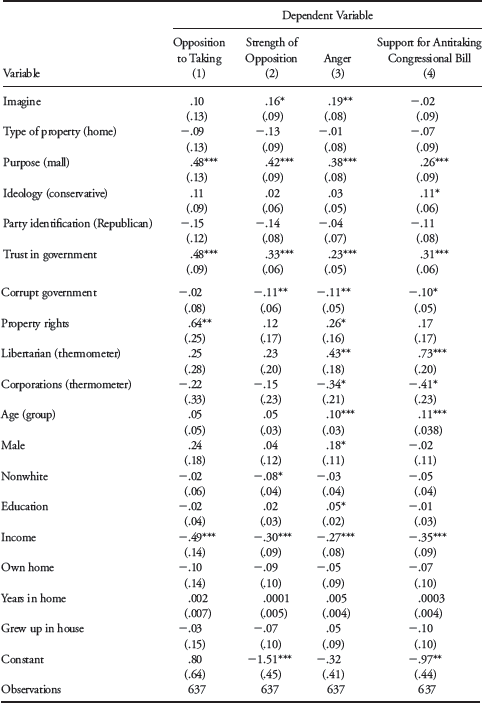
Note.—Standard errors are in parentheses.
*. p < .1.
**. p < .05.
***. p < .01.
Main Models Plus Interaction Term to Directly Test Nadler and Diamond (2008): Probit Coefficients
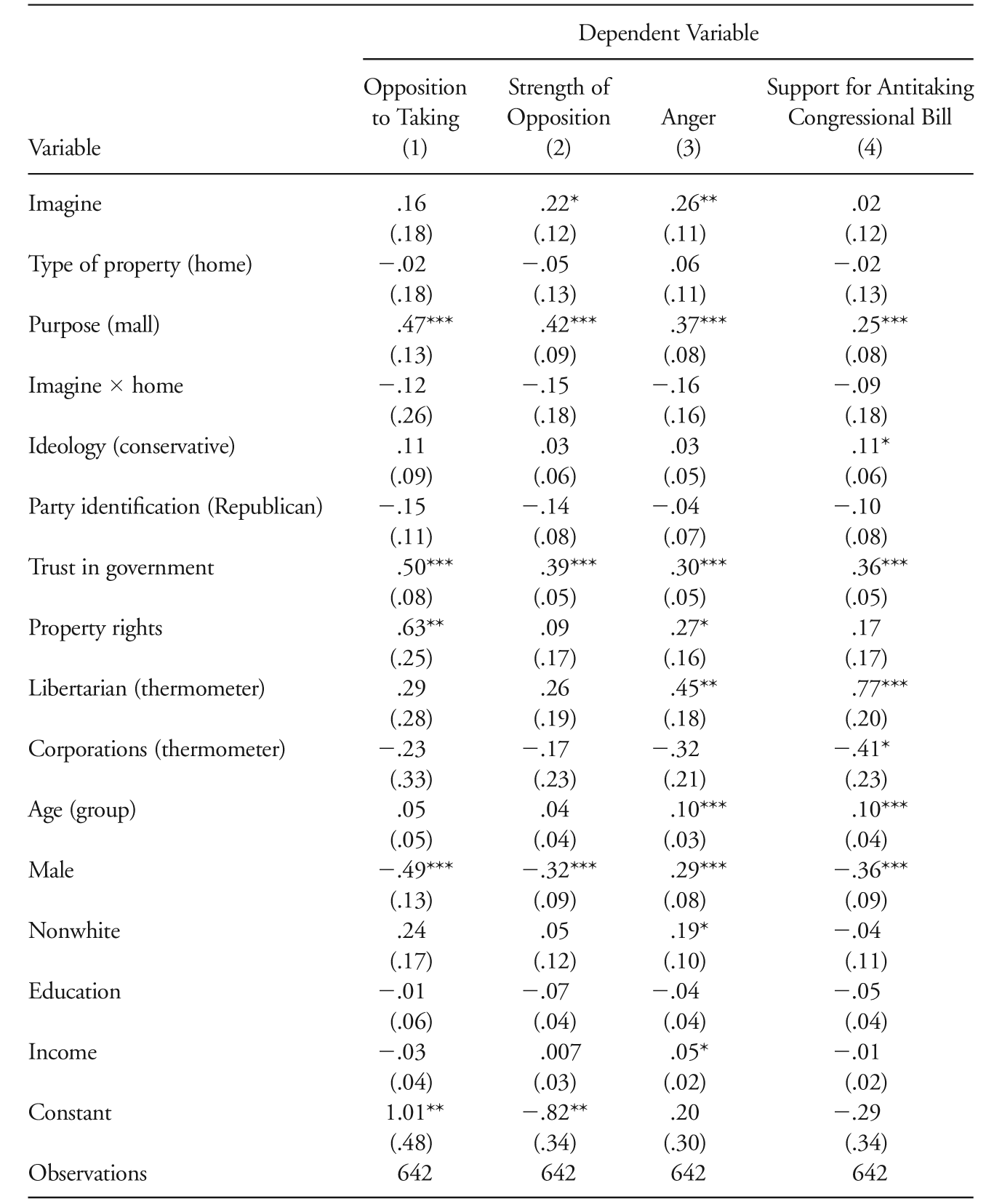
Note.—Standard errors are in parentheses. Note that the interaction term (those whose own home is being taken) does not approach statistical significance when controlling for relevant factors. Nor does it attain significance in the basic models presented in this appendix.
*. p < .1.
**. p < .05.
***. p < .01.
Appendix D
Question Wording for State Polls
New Jersey (2005 Monmouth Poll)
I’m going to read you some situations where eminent domain might be used. Please tell me whether you think using eminent domain is O.K. in each case.
Is it O.K. or not O.K. to use eminent domain to:
Take low value homes from people in order to build a school?
Take low value homes from people in order to build a shopping center?
Ohio (2007 Quinnipiac Poll)
As you may know, the government has the power of eminent domain. Under eminent domain, if the government needs a person’s property for what it considers important public projects, it pays what’s determined to be fair market value and the person must sell.
Do you support or oppose the state using eminent domain to take private property for public use projects like roads?
Do you support or oppose the state using eminent domain to take private property for economic development projects like new businesses?
Illinois (2012 Simon Poll)
Do you think people should be forced to sell their property if the property is needed for a vital public purpose?
Do you think people should be forced to sell their property so that a school district can build a new school?
Do you think people should be forced to sell their property so that the state can build a road or bridge?
Do you think people should be forced to sell their property so that the government can build infrastructure for utilities?
Sometimes governments buy property and give it to a business for economic development. Do you think people should be forced to sell their property so a private business can develop it?