

1. Introduction
With the global trend of population aging, the rapid expansion of the elderly population not only increases the demand for long-term care services but also presents challenges to traditional retirement security systems. In the field of retirement financial product design, tontines emerge as a compelling mechanism that combines longevity risk sharing with a wealth basis, directly dependent on the survival situation of participating members. Tontine schemes further enhance this concept by dynamically allocate life expectancy benefits contingent on cohort mortality experience, thereby inherently pooling longevity risks among participants.
In light of the benefit from longevity and mortality risk pooling, tontines have evolved significantly and is often proposed as an alternative to more traditional annuities due to its ability to effectively manage concentrated risks in the elderly population. Distinct from annuities, tontines do not require a security surcharge because the benefits are not guaranteed, relying instead on the survival of participants (Piggott et al., Reference Piggott, Valdez and Detzel2005; Stamos, Reference Stamos2008; Hanewald et al., Reference Hanewald, Piggott and Sherris2013). The foundational work of Milevsky and Salisbury (Reference Milevsky and Salisbury2015) proposes the structure of retirement tontine and derive closed-form payout function that optimizes individuals’ lifetime utility under a homogeneous cohort by Euler–Lagrange theorem (Gelfand and Fomin, Reference Gelfand, Fomin and Richard1963). As a continuation of their work, Milevsky and Salisbury (Reference Milevsky and Salisbury2016) revisit their model under mixed-cohort assumption. Instead of solving optimal payouts, they describe the notion of equitable “share price” in a tontine scheme and propose ways to design an equitable tontine scheme since uniform fairness (among cohorts) is hard to achieve in theory. Chen et al. (Reference Chen, Hieber and Klein2019) later revise this original tontine structure and include a random mortality shock factor, which is applied uniformly across ages to the mortality rate for the pool of retirees. In subsequent research (Chen et al., Reference Chen, Hieber and Rach2021), fairness among mixed cohorts and the impact of subjective mortality beliefs on the attractiveness of optimal tontines are also investigated. Then Chen et al. (Reference Chen, Nguyen and Sehner2022) are among the first to propose a unit-linked tontine product closely linked to the performance of underlying financial market, with its utility-based design. In the broader framework of actuarial fairness, Chen and Rach (Reference Chen and Rach2023) introduce a collective fairness definition that distinguishes itself from earlier individual fairness approaches by optimizing weighted group utilities.
Among these earlier works, a majority of mortality modeling frameworks tend to adopt deterministic mortality laws when tracking cohort-specific dynamics, primarily due to the analytical complexity introduced by group-linked payment structures. A critical gap in traditional mortality modeling lies in its inability to capture long-range dependence (LRD). Traditional models, whether discrete-time frameworks like the Lee–Carter model or continuous-time approaches such as affine jump diffusions, struggle to reconcile two empirically observed phenomena: persistent long-memory deviations and modeling the volatility of mortality rates. Biffis (Reference Biffis2005) demonstrated the analytical tractability of affine processes through a two-factor square-root diffusion framework, where stochastic drifts and mean-reversion parameters explicitly model persistent deviations such as longevity risk. Blackburn and Sherris (Reference Blackburn and Sherris2013) have assessed the consistency of a multifactor dynamic affine mortality models in longevity risks applications and are able to produce closed-form survival curves. However, empirical studies reveal that mortality fluctuations exhibit volatility exceeding Brownian motion assumptions. For instance, Delgado-Vences and Ornelas (Reference Delgado-Vences and Ornelas2019) validated LRD using a fractional Ornstein–Uhlenbeck process with Italian mortality data. Similarity, Yan et al. (Reference Yan, Peters and Chan2021) identified persistent long-memory patterns across age groups, gender, and countries by using the dataset of 16 countries, revealing that traditional mortality models underestimate life expectancy when ignoring LRD. These findings clearly demonstrate the necessity of incorporating LRD into mortality modeling frameworks to enhance the accuracy of actuarial predictions.
Beyond the limitations of traditional models, researchers have recognized that classical affine processes, despite their popularity in finance and dynamic mortality modeling, fail to adequately capture the volatility observed in mortality fluctuations. Empirical evidence suggests that these fluctuations exhibit greater volatility than can be explained by standard Brownian motion models. These recent applications are built upon a solid foundation from earlier works on stochastic equations and dynamic systems (Duffie et al., Reference Duffie, Pan and Singleton2000, 2003) for instance). Consequently, a growing body of research (Zhang, Reference Zhang2010; Abi Jaber et al., Reference Abi Jaber, Larsson and Pulido2019b; Wang et al., Reference Wang, Chiu and Wong2021) has shifted focus toward stochastic Volterra equations or convolution-type stochastic equations. Abi Jaber et al. (Reference Abi Jaber, Larsson and Pulido2019b) generalized the framework for rough volatility models and affine Volterra processes. Their work established the existence of unique solutions to various Volterra models, which subsequently inspired Wang et al. (Reference Wang, Chiu and Wong2021) to develop the innovative Volterra mortality model. Specifically, the Volterra framework specifies mortality dynamics as,
 $\mu_x(t) = m_x(t) + \eta \int_0^t K(t-s) Y_x(s)\,ds, $
where the kernel
 $K(\cdot) $
explicitly weighs past mortality shocks
 $Y_x(s) $
. When the kernel simplifies to
 $K \equiv 1$
, this framework reduces to a short-memory Ornstein–Uhlenbeck process, clearly distinguishing long-memory effects as a key theoretical innovation. Recent advancements extend this framework to incorporate cointegration between national and insurer-specific mortality rates (Chiu et al., Reference Chiu, Wang and Wong2025). These theoretical advances complement computational tools like the Affine Mortality R package (Ungolo et al., Reference Ungolo, Garces, Sherris and Zhou2023), which enhances estimation and prediction capabilities for such models. Further extensions include multi-factor age-cohort affine frameworks (Ungolo et al., Reference Ungolo, Garces, Sherris and Zhou2024), which utilize continuous-time structures to derive closed-form survival curves while preserving the flexibility to model cohort-specific LRD patterns.
In this study, we enhance the classical Gompertz mortality by embedding a stochastic Volterra process, thereby addressing its limitation in capturing LRD. While the Gompertz model effectively describes age-dependent exponential mortality growth, our Volterra-Gompertz framework explicitly incorporates path-dependent volatility, enabling a more realistic representation of mortality trends observed in aging populations. Building on the collective fairness definition of Chen and Rach (Reference Chen and Rach2023), we derive closed-form solutions for optimal tontine benefit structures under a homogeneous cohort assumption. By solving the associated Euler-Lagrange equations within the Volterra mortality framework, we demonstrate how LRD features fundamentally reshape payout trajectories and survival probabilities. Our results generalize prior studies (Milevsky and Salisbury, Reference Milevsky and Salisbury2015; Chen et al., Reference Chen, Hieber and Klein2019) by reconciling actuarial fairness with Volterra mortality, while remaining reducible to classical mortality models as special cases. Moreover, we extend beyond homogeneous pools to develop a mixed-cohort tontine scheme that accommodates heterogeneous participant cohorts. For scenarios lacking closed-form solutions, we implement the proposed model using discrete-time simulation schemes as suggested by Richard et al. (Reference Richard, Tan and Yang2021). By specifying a fractional convolution kernel K in a Volterra-Vasicek mortality model, we numerically analyze how cohort-specific mortality shocks spread through tontine payouts.
Furthermore, we introduce a new perspective on fairness in tontines by integrating the long-memory effects of mortality into the fairness assessment. We employ the f-value, a fairness measure proposed by Chen et al. (Reference Chen, Feng, Wei and Zhao2024) to quantify actuarial fairness in mutual aid (MA), is adapted here to evaluate tontine fairness by redefining its structural analogy. For tontines, we redefine the triggering “event” as survival (contrary to mutual aid models where claims are tied to adverse events), with death acting as the non-event state. A higher f-value indicates that a cohort receives disproportionately larger benefits relative to their mortality risk, implying cross-subsidization from other groups. This provides a novel tool for assessing actuarial fairness among different age groups within the tontine structure. Our results reveal that, although the model ensures actuarial fairness at the group level, relative payments are lower for older age groups, indicating room for improvement in achieving fairness across all age groups. Specifically, under the Gompertz model, initial f-values exhibit a declining trend across age groups, reflecting moderate disparities. In contrast, the Volterra mortality model amplifies inter-group gaps due to its cumulative memory of past survival advantages. This finding validates the practical effectiveness of the f -value fairness measure. By applying this metric, they can identify fairness issues among different risk groups, ensuring the actuarial fairness of insurance products.
The structure of the remainder of this paper is as follows: Section 2 constructs a theoretical framework and conducts an analysis of fairness, introducing the concepts of individual and collective fairness based on the Volterra mortality model. Section 3 studies how to implement these fairness standards within a tontine comprising distinct groups and proposes a numerical representation for the optimal tontine payout (OTP). Section 4 presents a numerical analysis to illustrate the practical implications of our enhanced tontine model, utilizing the Volterra Vasicek (VV) mortality model to simulate mortality trajectories and assess actuarial fairness across different age groups. Section 5 concludes the paper.
2. Model development
This section establishes the foundational framework for our tontine model, particularly focusing on mortality modeling, tontine payout structures, and fairness criteria across multiple cohorts with heterogeneous initial wealth and entry ages. In Subsection 2.1, we introduce the stochastic mortality model driven by a Volterra process, clearly defining the probability space and filtration structures that support the mortality intensity dynamics. Subsequently, Subsection 2.2 explicitly formulates the tontine payout mechanism within this Volterra mortality framework, beginning with a homogeneous cohort and extending to multiple cohorts. Finally, Subsection 2.3 details the critical concepts of individual and collective actuarial fairness. And fairness measures f-value from Feng et al. (Reference Feng, Liu and Zhang2024) are introduced to ensure robust and equitable tontine designs across two age-heterogeneous cohorts.
2.1. Stochastic mortality modeling with Volterra model
In this subsection, we introduce basic definitions and concepts of stochastic mortality and the Volterra model. First, we consider a probability space
 $(\Omega, \mathcal{F}, \mathbb{F}, \mathbb{P})$
, where the filtration
 $\mathbb{F} = (\mathcal{F}_t)_{t \geq 0}$
satisfies the usual conditions and represents the information flow related to the mortality process. And
 $\mathbb{P}$
is the usual physical probability measure under which the mortality model is defined. Let N(s) denote an
 $\mathbb{F}$
-adapted counting process with associated stopping time
 $\tau_x$
, representing the future lifetime of a policyholder age x at time
 $s=0$
(with t denote the time of entrance). The mortality intensity process
 $\mu_x(s)$
, governing the counting process evolution, resides in a sub-filtration
 $\mathbb{G} \subseteq \mathbb{F}$
that excludes individual death time information.
 $\mathbb{G}$
may be interpreted as representing the evolution of mortality intensity
 $\mu$
, but not the actual mortality experience of an individual. Given a realization of state
 $\omega \in \Omega$
and historical path for intensity up to time t. For a homogeneous cohort of age x, the conditional survival probability satisfies:
 \[P(N(s+\Delta s)-N(s)\gt 0|\mathcal{F}_s) \approx \mu_x(s)\Delta s \quad \text{for} \quad \tau_x \gt s. \]
This stochastic formulation fundamentally differs from deterministic models through its explicit incorporation of intensity path dependence. Conditional on trajectory realization over [s, T], the counting process follows an heterogeneous Poisson law:
 \[P(N(T)-N(s)=k|\mathcal{F}_s \vee \mathcal{G}_T) = \frac{\left(\int_s^T \mu_x(r) dr\right)^k \exp\left\{-\int_s^T \mu_x(r) dr\right\}}{k!}, \]
and setting
 $k=0$
gives the usual deterministic survival function.
Then we refine the baseline Gompertz mortality model by incorporating LRD to better reflect real-life mortality patterns. Recognizing that an individual’s mortality rate is influenced not only by current factors but also by historical experiences and environmental influences, we propose a dynamic approach to model mortality rates. The Volterra mortality model is first introduced and extensively studied in Wang et al. (Reference Wang, Chiu and Wong2021), based on key results and theorems from Biffis (Reference Biffis2005) and Abi Jaber et al. (Reference Abi Jaber, Larsson and Pulido2019b). Following this framework, we express the mortality rate as
 \begin{equation} \mu_x(s) = M_x(s, Y_s) = m_x(s) + \eta Y_{x}(s), \end{equation}
where
 $m_x(s)$
represents the baseline mortality rate, which increases over time and with the age of the individual. The baseline mortality rate is modeled using the Gompertz function as follows:
 \begin{equation} m_{x}(s) = \frac{1}{b} e^{\frac{x+s-m}{b}}, \end{equation}
where b is the scaling factor for the Gompertz function, determining the rate at which mortality increases,
 $m\gt 0$
denotes the modal age at death. The process
 $\{Y_x(s)\}_{s \geq 0}$
follows a stochastic Volterra integral equation:
 \begin{equation} Y_x(s) = Y_x(0) + \int_0^s K(s-r)b(Y_x(r)) \, dr + \int_0^s K(s-r)\sigma(Y_x(r)) \, dW(r), \end{equation}
where
 $Y_x(0) $
is the initial value of the process,
 $ K(s - r) $
is a kernel function that determines the weight of past events at time r on the current time s. This kernel introduces memory effects, enabling the model to capture LRD by weighting historical influences on the current state. And W(s) is a one-dimensional standard Brownian motion, which introduces stochasticity into the process. Here, b(y) and
 $ \sigma(y) $
are defined as follows:
 \[ b(y) = b_0 + b_1 y, \quad \sigma(y) = \sigma_0 + \sigma_1 y, \]
where
 $ b_0 $
,
 $ b_1 $
,
 $ \sigma_0 $
, and
 $ \sigma_1 \in \mathbb{R} $
are constants. These equations define a dynamic mortality model that incorporates LRD, marking an extension to the traditional tontine model.
The kernel function
 $K(s-r)$
encodes historical memory. It satisfies:
 \[ K \in L^2_{\text{loc}}(\mathbb{R}_+,\mathbb{R}), \quad \int_0^h K(t)^2\,dt = O(h^\gamma), \quad \int_0^T (K(t+h)-K(t))^2 \,dt = O(h^\gamma), \]
for some
 $\gamma \in (0,2]$
and any
 $T\lt \infty$
. This ensures well-posedness of the Volterra process. If K is constant,
 $(Y_s)_{s\ge0}$
reduces to a standard affine SDE. By contrast, a non-constant kernel enables LRD. A key example is the fractional kernel:
 \[ K(t) = \frac{c\,t^{\alpha-1}}{\Gamma(\alpha)}, \]
where
 $c\gt 0$
and
 $\Gamma(\cdot)$
is the Gamma function, and where
 $\alpha = H + 1/2$
and
 $H \in [0.5,1]$
is the Hurst parameter H. This kernel assigns decaying weights to past mortality shocks via a power-law structure, aligning with empirical observations of persistent memory in mortality data.
Chen et al. (Reference Chen, Hieber and Klein2019) instead introduce a shock variable
 $\varepsilon$
for systematic risks, uniformly shifting mortality rates across all ages. While effective for simplicity, this approach neglects age-specific deviations and path-dependent memory. However in our case, since deviations from the baseline mortality function (or superimposed random noise) are modeled directly through a Volterra process underlying our model and LRD is implied when a general kernel (non-constant) K is adopted, we do not consider any forms of shocks separately. Once K is non-constant, LRD arises naturally. In this way, the model extends classical tontine or affine mortality frameworks. The choice of modeling the deviations in mortality rates using the stochastic Volterra process
 $Y_x(s)$
is motivated by the need to capture both the stochastic fluctuations and the LRD in mortality dynamics. The kernel function
 $K(s-r)$
allows the process to incorporate historical dependencies, meaning that the evolution of
 $Y_x(s)$
depends on its entire past trajectory. This is essential for accurately modeling mortality rates, as past mortality experiences and environmental factors can have a persistent impact on future mortality.
2.2. Tontine structure under Volterra mortality
In this subsection, we formalizes the retirement income tontine structure under the Volterra mortality model introduced in Subsection 2.1. We first define the tontine payout mechanism for a homogeneous cohort of policyholders, where mortality dynamics are governed by the stochastic intensity
 $\mu_x(s)$
in (2.1) and its Volterra-driven deviation process
 $Y_x(s)$
in (2.3). The framework is then extended to multiple cohorts, each with independent mortality trajectories. All formulations are conditioned on the filtered probability space
 $(\Omega, \mathcal{F}, \mathbb{F}, \mathbb{P})$
, where
 $\mathbb{F}$
captures mortality experience and financial market information.
For a homogeneous cohort of n policyholders, let t denote the time of entrance and aged x at entry, the mortality intensity process follows the Volterra model as defined in formula (2.1). Consider the indicator random variable
 $\mathbb{I}_{\{\tau_{x} \gt s\}}$
, the force of mortality of each member is
 $\mu_{x}(s)$
in this cohort. Furthermore, we introduce the notation:
 \[ S_x(s) = \mathbb{E}\left[ \mathbb{I}_{\{\tau_x \gt s\}} \big| \mathcal{G}_{t+s} \right] = \exp\left( -\int_0^{s} \mu_x(r)dr \right), \]
where
 $ \mathcal{G}_{t+s} $
is the sigma-algebra generated by
 $ \{ \mu_{x}(r) \mid r \leq s \} $
, which contains all the information regarding the systematic mortality risk up to time s starting from age x. And the number of surviving participants N(s) follows a doubly stochastic binomial distribution:
 \[ N(s) \big| \mathcal{G}_{t+s} \sim \text{Binomial}\left( n, \ S_x(s) \right).\]
Following the tontine structure and optimal payout problems that was initially proposed in Milevsky and Salisbury (Reference Milevsky and Salisbury2015), we adopt the similar retirement income scheme. The continuous benefit stream for the j-th surviving policyholder in the homogeneous cohort is:
 \begin{equation} b_j(s) = \frac{n w_j d(s)}{N(s)} \mathbb{I}_{\{\tau_x \gt s\}}, \end{equation}
where
 $j = 1, 2, \ldots, n$
and
 $w_j$
denotes initial contribution and d(s) is the payout rate per unit wealth which is uniform among all policyholders over the homogeneous cohort.
Next we extend the framework to L heterogeneous cohorts with distinct initial wealth levels and entry ages, where
 $n_i$
denotes the number of participants in cohort
 $i \in {1,\ldots,L}$
, yielding total initial pool size
 $n = \sum_{i=1}^L n_i$
. Members within each cohort are homogeneous in age and wealth, characterized by entry age
 $x_i$
(with t denote the time of entrance) and initial wealth
 $w_i$
per member in cohort i. Each cohort’s mortality intensity
 $\mu_{x_i}(s)$
follows:
 \begin{equation} \mu_{x_i}(s) = m_{x_i}(s) + \eta Y_{x_i}(s), \end{equation}
where
 $m_{x_i}(s)$
represents the Gompertz mortality and
 $Y_{x_i}(t)$
solves the independent Volterra equation:
 \begin{equation} Y_{x_i}(s) = Y_{x_i}(0) + \int_0^s K(s-r) b(Y_{x_i}(r)) dr + \int_0^s K(s-r) \sigma(Y_{x_i}(r)) dW_i(r), \end{equation}
where we further assume that
 $(W_1(t), W_2(t),\ldots,W_L(t))^{T}$
defines n-independent Brownian motions over the complete probability space.
Then the total survivors are
 $N(s) = \sum_{i=1}^L N_i(s)$
, where
 $N_i(s)$
counts survivors in cohort i. From the perspective of any surviving policyholder in the ith cohort, since
 $\mathbb{I} _{\{\tau_{x_i}\gt s\}}$
, the number of pool members
 $N_i(s)$
is at least 1, and the number of survivors N(s) conditional on the joint filtration
 $\mathcal{G}_{t+s}^{(1)} \vee \cdots \vee \mathcal{G}_{t+s}^{(L)}$
follows a Poisson-binomial distribution with probability vector
 \[ \underbrace{S_{x_1}(s),\ldots,S_{x_1}(s)}_{n_1}, \ldots, \underbrace{S_{x_i}(s),\ldots,S_{x_i}(t)}_{n_i-1}, \ldots, \underbrace{S_{x_L}(s),\ldots,S_{x_L}(s)}_{n_L } , \]
of length
 $\sum_{i=1}^{L} n_i-1$
. Here,
 $S_{x_i}(s)$
is the conditional survival probability for cohort i:
 \[ S_{x_i}(s) = \mathbb{E}\left[ \mathbb{I}_{\{\tau_{x_i} \gt s\}} \big| \mathcal{G}_{t+s}^{(i)} \right]=\exp\left( -\int_0^s \mu_{x_i}(r)\,dr \right), \]
where
 $\mathcal{G}_{t+s}^{(i)}$
is the sigma-algebra generated by
 $\{\mu_{x_i}(r)| r \leq s\}$
. Assuming independence between cohort-specific filtrations, N(s) reduces to the sum of L independent binomial random variables.
Following Milevsky and Salisbury (Reference Milevsky and Salisbury2016), let
 $d_i(s)$
denote the withdrawal rate for cohort i, reflecting the unique financial strategies or risk profiles adopted by each cohort, where
 $i=1,2,\ldots,L$
. The benefit adjusts for heterogeneity through tuning parameters
 $\pi_i$
:
 \begin{equation} b_{x_i}(s) \,:\!=\, \frac{\pi_i w d_i(s) }{N(s)} \mathbb{I}_{\{\tau_{x_i} \gt s\}},\end{equation}
where
 $w=\sum_{i=1}^{L}n_i w_i=\sum_{j=1}^{n} w_j$
represents the total initial wealth pooled from all participants, forming the basis of the collective fund. This variable can flexibly manage the allocation of funds to accommodate the specific needs and preferences of different groups. In addition,
 $\pi_i$
signifies the participation rate of individual in cohort i, which determines the individual’s proportional share within the total pooled wealth. Together, these parts form the basis for a comprehensive and equitable risk-sharing arrangement.
2.3. Actuarial fairness and f-value
In risk-sharing mechanisms, fairness is important for ensuring that all participants can benefit reasonably. Here, we formalize the concepts of individual actuarial fairness and collective actuarial fairness within the tontine model. First, we draw on the research of Milevsky and Salisbury (Reference Milevsky and Salisbury2015) and Chen et al. (Reference Chen, Hieber and Rach2021) regarding the individual fairness of all participants within a tontine and mutual aid domains. Subsequently, we investigate collective fairness, building on the work of Chen and Rach (Reference Chen and Rach2023) regarding collective fairness issues.
In an idealized model of expected actuarial equilibrium, the premiums paid by each member should adequately cover the expected amounts payable to other members upon their death. We fix a probability space
 $ (\Omega, \mathcal{F}, \mathbb{F}, \mathbb{P}) $
, where the filtration
 $\mathbb{F} = (\mathcal{F}_t)_{t \geq 0}$
satisfies all the usual conditions and consists of flow of information that includes the mortality experience. Let r be the risk free rate. Based on formula (2.7), for each policyholder in L distinct groups,
 $i = 1, 2,\ldots,L$
, we calculate the expected present value (EPV) of their periodic payments as follows:
 \begin{align}P_0^i &= \int_0^\infty e^{-rs}\mathbb{E} \left[ \frac{\pi_i w d_i(s)}{N(s)} \mathbb{I}_{\{\tau_{x_i} \gt s\}} \middle | \mathcal{F}_t\right] ds \notag \\[6pt] &= \int_0^\infty e^{-rs} \mathbb{E} \left[ \frac{\left( \sum_{l=1}^L n_l w_l \right) \pi_i d_i(s)}{\sum_{l=1}^L N_l(s)} \mathbb{I}_{\{\tau_{x_i} \gt s\}} \middle | \mathcal{F}_t \right] ds \notag \\[6pt] &= \int_0^\infty e^{-rs} \mathbb{E} \left[ S_{x_i}(s) \mathbb{E} \left[ \frac{\left( \sum_{l=1}^L n_l w_l \right) \pi_i d_i(s)}{\sum_{l=1}^L N_l(s) } \middle | \tau_{x_i}\gt s\right] \middle | \mathcal{F}_{t} \right] ds \notag \\[6pt] &= \int_0^\infty e^{-rs} \mathbb{E} \left[ S_{x_i}(s) \mathbb{E} \left[ \frac{\left( \sum_{l=1}^L n_l w_l \right) \pi_i d_i(s)}{\sum_{l=1}^L N_l(s) } \middle | \mathcal{G}_{t+s}\right] \middle | \mathcal{F}_{t} \right] ds.\end{align}
Definition 2.1. A tontine with homogeneous members is deemed fair if each member’s initial wealth
 $w_j$
can be expressed as
 \[ w_j = P_0^{j} \quad \text{for } j=1,2,\ldots,n. \]
Individual fairness concentrates on balancing the benefits and contributions of each participant, ensuring each member’s contributions align with their received earnings. In contrast, collective fairness expands this notion to include the whole group, emphasizing equitable treatment across all subgroups. It attempts to guarantee that no subgroup suffers disproportionate disadvantages or loss of benefits due to the systemic configuration of the scheme.
Definition 2.2. Collective fairness is realized when the sum of the expected present values (EPV) of all participants’ future benefits is equal to the sum of their initial wealth. Mathematically, this can be represented as
 \[ \sum_{i=1}^{L} n_i w_i = \sum_{i=1}^{L}n_iP_0^{i} . \]
Following the methodologies outlined in Chen et al. (Reference Chen, Feng, Wei and Zhao2024), to explicitly quantify actuarial fairness, we introduce the fairness measure
 $f_{x_i}(s)$
, adapting the concept originally formulated within mutual aid (MA) frameworks into the tontine setting. In the MA context, the fairness measure
 $f_k$
is defined as the ratio of expected loss to the probability of avoiding that loss event. Analogously, for the tontine framework,
 $f_{x_i}(s)$
represents the ratio of expected survival benefits to the probability of non-survival. Specifically, we define:
 \begin{equation} f_{x_i}(s) = \frac{s_{x_i}(s)b_{x_i}(s)}{1 - s_{x_i}(s)}, \end{equation}
where the deterministic survival probability
 $s_{x_i}(s)$
for cohort
 $x_i$
at time s is defined by
 \[ s_{x_i}(s) = \mathbb{E}[S_{x_i}(s) \mid \mathcal{F}_{t}]= \mathbb{E}\left[\mathbb{E}\left[ \mathbb{I}_{\{\tau_{x_i} \gt s\}} \big| \mathcal{G}_{t+s}^{(i)} \right] \middle| \mathcal{F}_{t}\right]=\mathbb{E}\left[\exp\left\{-\int_0^s \mu_{x_i}(r) dr\right\}\middle| \mathcal{F}_{t}\right]. \]
Here,
 $i=1,2,\ldots,L$
and
 $s_{x_i}(s)$
differs from the previously introduced survival probability
 $S_{x_i}(s)$
through explicit conditioning on the filtration
 $\mathcal{G}_{t+s}^{(i)}$
, incorporating all historical mortality information except individual-specific death events. The f-value thus indicates the actuarial benefit magnitude for a given cohort i, offering views into the fairness of the benefit distribution.
3. Optimal tontine under Volterra mortality
In this section, we get an optimal tontine by enhancing mortality modeling through the integration of Volterra processes. In Subsection 3.1, we initially get an optimal tontine
 $d^{*}(s)$
for a homogeneous cohort to maximize the expected utility of cohort participants while maintaining individual actuarial fairness. Based on the findings of Chen and Rach (Reference Chen and Rach2023), Subsection 3.2 extends to heterogeneous groups using a weighted utility optimization approach. Furthermore, we apply the fairness measure known as the f-value in formula (2.9) to quantify actuarial fairness within these heterogeneous groups, ensuring that the optimized tontine payouts are equitable across all participants regardless of their demographic differences.
3.1. Optimal tontine analysis under a homogeneous cohort
In this subsection, we analyze the optimal tontine structure within the context of a homogeneous cohort and Volterra mortality. Considering a homogeneous group composed of n economically similar individuals, each possessing a utility function U, we set the entry age into the tontine as x (with t denote the time of entrance). Operating within the framework of a Volterra mortality model, we employ the individual actuarial fairness principle formalized in Definition 2.1. This principle is combined with the rational behavior of group members aimed at maximizing their expected utility. Guided by this methodology, we derive the OTP structure
 $ d^*(s) $
for this homogeneous group. Let
 $\rho$
be the subjective discount factor, r represents the risk free rate, and
 $w_j$
represents the initial wealth of each individual in the homogeneous cohort and participation rate
 $\pi_j=1$
. Then our optimization problem is designed as follows:
 \begin{align} \max_{d(s)} \int_0^\infty e^{-\rho s} \mathbb{E} \left[ U \left( \frac{n w_j d(s)}{N(s)} \right) \mathbb{I}_{\{\tau_{x}\gt s\}} \middle| \mathcal{F}_t \right] ds\notag \\[6pt] \text{subject to} \quad P_0^{j} = \int_0^\infty e^{-r s} \mathbb{E}\left[\frac{n w_j d(s)}{N(s)} \mathbb{I}_{\{\tau_{x}\gt s\}} \middle| \mathcal{F}_t \right]ds = w_j.\end{align}
To formulate and solve the constrained optimization problem, we introduce the Lagrangian, which combines the objective function and the constraints into a single function that can be optimized. The Lagrangian
 $ \mathcal{L} $
for our problem is defined as
 \begin{align} \mathcal{L}(d(s), \lambda) = \int_0^\infty e^{-\rho s} \mathbb{E} \left[ S_x(s) \mathbb{E} \left[ U \left( \frac{n w_j d(s)}{N(s)} \right) \middle| \mathcal{G}_{t+s}\right] \middle|\mathcal{F}_{t} \right] \, ds + \notag \\[6pt] \lambda \left( w_j-\int_0^\infty e^{-r s} \mathbb{E} \left[ S_x(s)\mathbb{E} \left[ \frac{n w_j d(s) }{N(s)} \middle| \mathcal{G}_{t+s}\right]\middle|\mathcal{F}_{t}\right] ds \right), \end{align}
where
 $ \lambda $
is the Lagrange multiplier associated with the wealth constraint.
Next, we need to derive first-order conditions (FOCs):
 \begin{align}&\mathbb{E} \left[ e^{-\rho s} S_x(s) \mathbb{E} \left[ U' \left( \frac{n w_j d(s)}{N(s)} \right) \frac{n w_j}{N(s)} \middle| \mathcal{G}_{t+s}\right]\middle|\mathcal{F}_{t}\right] \notag \\[6pt] &= \lambda e^{-r s} \mathbb{E} \left[ S_x(s)\mathbb{E} \left[ \frac{n w_j }{N(s)} \middle| \mathcal{G}_{t+s}\right]\middle|\mathcal{F}_{t}\right]. \end{align}
We investigate power and log utility functions within a tontine structure, modeling mortality rates using Volterra processes. Below we provide some simplified representations of the above optimization problem.
Theorem 3.1. Assume a homogeneous group of individuals, each with a power utility function
 $ U(c) = \frac{c^{1-\gamma}}{1-\gamma} $
, where c denotes consumption and
 $ \gamma $
is the coefficient of relative risk aversion
 $(\gamma \neq 1)$
. Given that the mortality rates are influenced by random shocks and modeled by Volterra processes, the OTP structure
 $ d^*(s) $
for an initial age x and wealth contribution
 $ w_j $
of each individual is given by
 \begin{equation} d^*(s) = \frac{1}{w_j } \left( \frac{1}{\lambda}\frac{e^{-(\rho-r)s}\sum_{k=1}^n \binom{n}{k}(\frac{k}{n})^{\gamma}G_{n,k}(s) }{H_{n,x}(s)} \right)^{\frac{1}{\gamma}}, \end{equation}
where
 $\lambda$
is chosen such that the constraint in (3.1) holds:
 \[ \lambda^{\frac{1}{\gamma}} \,:\!=\, \frac{1}{w_j} \int_0^{x^*-x} e^{-(r+\frac{\rho-r}{\gamma})s} H_{n,x}(s)^{-\frac{1}{\gamma}} \left( \sum_{k=1}^n \binom{n}{k} \left(\frac{k}{n}\right)^{\gamma} G_{n,k}(s) \right) ^{\frac{1}{\gamma}} \, ds. \]
 \[ H_{n,x}(s) \,:\!=\, \sum_{\ell=1}^n \binom{n}{\ell} ({-}1)^{\ell+1} \exp\left\{-\ell\left(\int_{t}^{t+s} m_x(r)dr-\int_{0}^{t}\eta Y_x(r) dr\right)\right\}\exp\{Z_{x,t}^{(\ell)}(s)\}, \]
 \begin{align*} G_{n,k}(s) \,:\!=\, &\sum_{\ell=1}^{n-k} \binom{n-k}{\ell} ({-}1)^\ell\\ & \times \exp\left\{-(\ell+k) \left(\int_{t}^{t+s} m_x(r) \, dr - \int_{0}^{t} \eta Y_x(r) \, dr \right) \right\} \exp\{Z_{x,t}^{(\ell+k)}(s)\}. \end{align*}
For each
 $ \ell $
in the set
 $\{1, 2, \ldots, n\}$
, the process
 $ \{Z_{x,t}^{(\ell)}(s), t \geq 0\} $
is defined with a fixed
 $ T = x + s $
and assuming
 $\varphi_\ell (r) \in L^2([0,T])$
, where s ranges from 0 to
 $ x^* - x $
and
 $ x^* $
denotes the given terminal age. The process
 $ Z_{x,t}^{(\ell)}$
are specified by the following stochastic Volterra integral equation:
 \begin{equation} \left\{\begin{array}{l}\displaystyle Z_{x,t}^{(\ell)} = Z_{x,0}^{(\ell)} + \int_0^{t} \varphi_\ell(T - r) \sigma(Y_{x}^{(\ell)}(r)) \, dW_r - \frac{1}{2} \int_0^t \varphi_\ell(T - r)^2 a(Y^{(\ell)}(r)) \, dr, \\[15pt]\displaystyle Z_{x,0}^{(\ell)} = \int_0^T \left( -\ell \eta + \varphi_\ell(r) b(Y_{x}^{(\ell)}(0)) + \frac{1}{2} \varphi_\ell^2(r) a(Y_{x}^{(\ell)}(0)) \right) dr, \end{array}\right.\end{equation}
where
 $\varphi_\ell (r)$
solves the Riccati–Volterra equation (RVE)
 \[\varphi_\ell (r)= \left( -\ell \eta + b_1 \varphi_\ell(r) + \frac{1}{2} a_1 \varphi_\ell^2(r) \right) K(r), \]
where
 $\eta$
,
 $a_1$
,
 $b_1 \in \mathbb{R}$
are constants and K is a kernel function.
Proof. See Appendix A.1.
Theorem 3.2. Assume a homogeneous cohort, each with a logarithmic utility function
 $ U(c) = \ln(c) $
. Considering that mortality rates are subject to random shocks modeled by Volterra processes, the OTP structure
 $ d^*(s) $
for an initial age x and wealth contribution
 $ w_j $
of each individual can be calculated as follows:
 \begin{equation} d^*(s) = \frac{1}{w_j\lambda}\frac{e^{-(\rho-r)s}\mathbb{E}[S_x(s) \mid\mathcal{F}_t]}{H_{n,x}(s)}, \end{equation}
where the Lagrangian multiplier is given by
 \[ \lambda = \frac{1}{w_j} \int_0^{x^*-x} e^{-(\rho + r)s/2} \, H_{n,x}(s)^{-1} \, \mathbb{E}[S_x(s) \mid \mathcal{F}_t] \, ds. \]
where
 $H_{n,x}(s)$
is defined in Theorem 3.1 and
 \[ \mathbb{E}[S_x(s) \mid \mathcal{F}_t] = \mathbb{E}[e^{-\int_{t}^{t+s}\mu_x(r) dr}]=\exp\left\{-\left(\int_{t}^{t+s} m_x(r)dr-\int_{0}^{t}\eta Y_x(r) dr\right)\right\}\exp\{Z_{x,t}^{(\ell)}(s)\}, \]
where
 $\exp\{Z_{x,t}^{(\ell)}(s)\}$
is defined in equation (3.5).
Proof. See Appendix A.2.
The above theorems provide outcomes for OTPs within a homogeneous cohort. However, in real-world applications, participants often differ in age and wealth, which introduces additional layers of complexity regarding fairness. Next, construct a tontine model that fulfills collective fairness among participants in age-heterogeneous cohorts, addressing the social planner’s problem.
3.2. Multi-cohort tontine design with Volterra mortality
In this subsection, we analyze the optimal design of multi-cohort retirement tontines under the Volterra mortality model, explicitly incorporating the LRD effect of historical mortality deviations. We first establish a general multi-cohort optimization model for heterogeneous groups with different and initial wealth and subsequently study the double-cohort case, where we consider collective fairness introduced in Chen and Rach (Reference Chen and Rach2023).
Consider a tontine pool consisting of L heterogeneous cohorts. Each cohort i (with entry time is t) comprises
 $n_i$
members who join at age
 $x_i$
, each contributing an initial wealth
 $w_i$
. We model the remaining lifetimes of members within each cohort, evaluating their survival probabilities both before and after time s. Our objective is to design a withdrawal rate structure d(s) that not only maximizes the expected utility for each group member but also ensures a fair distribution of wealth between cohorts. We construct the following optimization problem:
 \begin{align} \max_{d(s)} \int_0^\infty \mathbb{E} \left[\sum_{i=1}^L n_i \beta_i e^{-\rho_i s} U_i \left( \frac{w \pi_i d(s)}{\sum_{l=1}^L N_l(s)} \right) \mathbb{I}_{\{T_{x_i}\gt s\}}\middle| \mathcal{F}_t \right]ds \notag \\[6pt] \text{subject to} \quad \sum_{i=1}^L n_i P_0^i = w = \sum_{i=1}^{L} n_i w_i, \end{align}
where
 $ U_i $
is the utility functions for all individuals and
 $\rho_i$
be the subjective discount factor of individual in groups i, assuming homogeneity within each cohort. Furthermore,
 $\beta_1,\ldots,\beta_L$
be nonnegative numbers adding up to 1 and
 $ \beta_i = \frac{\bar{w}^{\gamma_{i}}}{\sum_{j=1}^L \bar{w}^{\gamma_{j}}}, \quad \bar{w} = \frac{1}{n} \sum_{i=1}^n w_i. $
To formulate and solve the constrained optimization problem, the Lagrangian
 $ \mathcal{L} $
for our problem is defined as
 \begin{align}\mathcal{L}(d(s), \lambda) &= \int_{0}^{\infty} \sum_{i=1}^{L} n_i \beta_i e^{-\rho_i s} \mathbb{E} \left[ S_{x_i}(s) \mathbb{E} \left[ U_i \left( \frac{w \pi_i d(s)}{N(s)} \right) \middle| \mathcal{G}_{t+s}\right]\middle|\mathcal{F}_{t}\right] \, ds \notag \\[6pt]&\quad + \lambda \left( w - \int_{0}^{\infty} \sum_{i=1}^{L} n_i e^{-rs} \mathbb{E} \left[ S_{x_i}(s) \mathbb{E} \left[ \frac{w \pi_i d(s)}{N(s)} \middle| \mathcal{G}_{t+s}\right]\middle|\mathcal{F}_{t}\right] ds\right), \end{align}
where
 $ \lambda $
is the Lagrange multiplier associated with the wealth constraint.
Next, we need to derive FOCs:
 \begin{align} &\sum_{i=1}^{L} n_i \beta_i e^{-\rho_i s} \mathbb{E} \left[ S_{x_i}(s) \mathbb{E} \left[ U_i' \left( \frac{w \pi_i d(s)}{\sum_{l=1}^L N_l(s)} \right) \frac{w \pi_i}{\sum_{l=1}^L N_l(s)} \middle| \mathcal{G}_{t+s}\right]\middle|\mathcal{F}_{t}\right] & \notag \\[6pt] &= \lambda e^{-r s} \sum_{i=1}^{L} \left( n_i \pi_i \mathbb{E} \left[S_{x_i}(s) \mathbb{E}\left[\frac{w}{\sum_{l=1}^L N_l(t)} \middle| \mathcal{G}_{t+s}\right]\middle|\mathcal{F}_{t}\right] \right) & \notag \\[6pt] &= \lambda e^{-r s} \sum_{i=1}^{L} \left( n_i \pi_i \mathbb{E} \left[S_{x_i}(s) \sum_{k=0}^{n-1}\frac{w}{k+1} f_{n-1}(k;\, S_{x_1}(s), \ldots, S_{x_L}(s))\middle| \mathcal{F}_{t}\right] \right), \end{align}
where
 $f_{n-1}(k;\, S_{x_1}(s), \ldots, S_{x_L}(s))$
denotes the PMF of a Poisson binomial distribution for
 $n-1$
trials with individual survival probabilities
 $(S_{x_1}(s), \ldots, S_{x_L}(s))$
. This formulation is consistent with the framework established by Fernandez and Williams (2010), which provides a detailed derivation of the distribution.
Formally, consider L heterogeneous cohorts where each cohort i contains
 $n_i$
initial members with age-specific survival probability
 $S_{x_i}(s)$
. From the perspective of a specific policyholder in cohort i, the number of surviving members N(s) excluding oneself follows a Poisson binomial distribution with PMF:
 \[ f_{n-1}(k;\, S_{x_1}(s), \ldots, S_{x_L}(s))=\Pr\{N(s) = k\} = \sum_{A \in \mathcal{F}_k} \left( \prod_{i \in A} S_{x_i}(s) \right) \left( \prod_{i \notin A} \left(1 - S_{x_i}(s)\right) \right), \]
where
 $\mathcal{F}_k$
is the collection of all k-element subsets from the
 $n-1$
members (total pool size
 $n = \sum_{i=1}^L n_i - 1$
). Each product term
 $\prod_{i \in A} S_{x_i}(s)$
quantifies the joint survival probability of exactly k members, while
 $\prod_{i \notin A} (1 - S_{x_i}(s))$
captures the joint mortality probability of the remaining
 $n - k - 1$
members.
In the case of power utility,
 $u(c) = \frac{c^{1-\gamma_i}}{1-\gamma_i},\quad \gamma_i \neq 1$
, one may solve the OTPs of the following form:
 \[d^{*}(s)=\left(\frac{\sum_{i=1}^{L}n_i \beta_i e^{-\rho_i s} \mathbb{E}\left[S_{x_i}(s)\sum_{k=0}^{n-1}\left(\frac{w\pi_i}{k+1}\right)^{1-\gamma_i}f_{n-1}(k;\, S_{x_1}(s), \ldots, S_{x_L}(s)) \middle| \mathcal{F}_t\right]}{\lambda e^{-r s} \sum_{i=1}^{L}n_i \pi_i \mathbb{E}\left[S_{x_i}(s)\sum_{k=0}^{n-1}\frac{w}{k+1}f_{n-1}(k;\, S_{x_1}(s), \ldots, S_{x_L}(s)) \middle| \mathcal{F}_t\right]}\right)^{\frac{1}{\gamma_i}}\]
which can be explicitly solved via similar techniques outlined in Theorem 3.1, following from the direct application of results in Abi Jaber et al. (Reference Abi Jaber, Larsson and Pulido2019b).
Although the above formulation provides a theoretical solution for optimal retirement tontines with multiple heterogeneous cohorts under power utility, implementing such a multi-cohort framework in practice poses significant analytical and computational challenges. Specifically, the complexity arises from evaluating high-dimensional conditional expectations involving Poisson binomial distribution
 $ f_{n-1}(k;\, S_{x_1}(s), \ldots, S_{x_L}(s)) $
. This PMF explicitly depends on each cohort’s survival probabilities, which themselves are random variables due to the historical path-dependent nature of the Volterra mortality model. Consequently, closed-form analytical solutions for optimal payout functions become intractable in most cases, this can be handled in specific forms, via appropriate numerical techniques by considering specific forms of the Volterra mortality model.
Moreover, this model set-up also implicitly allows for different historical mortality experiences of the respective cohorts in the tontine pool. This capability enabled by the Volterra mortality framework distinguishes itself through two mechanisms. First, a deterministic benchmark mortality law establishes baseline survival probabilities that differentiate by age. Second, cohort-specific Volterra processes capture historical deviations from this baseline, thereby reflecting the asymmetrical influences of mortality evolution on optimal payouts. This can be further illustrated from the results under a double-cohort example based on our previous formulation.
Consider again objective and constraint in (3.7) while allowing for tuning parameters
 $\pi_1,\pi_2$
which differentiates the payouts of two different homogeneous cohorts in a tontine pool, we introduce the Volterral mortality structure as follows. We assume two-dimensional independent Brownian motions
 ${(W_1(s), W_2(s) : 0 \leq s \leq x^*)}$
driving the deviation of mortality rates from the same benchmark law for the two cohorts. Adopting similar notations as before, from the perspective of any surviving policyholder from cohort 1 at time t after entry:
 \begin{align} N_1(s) - 1 \mid \mathcal{G}_{t+s} &\sim \text{Bin}(n_1-1, S_{x_1}(s)), \notag \\[5pt] N_2(s) \mid \mathcal{G}_{t+s} &\sim \text{Bin}(n_2, S_{x_2}(s)).\notag \end{align}
where
 $N_1(s),N_2(s)$
denote the alive pool members in the cohorts based on Volterra mortality with
 $n_1, n_2$
being the initial cohort sizes and
 \begin{align}S_{x_1}(s) &\,:\!=\, \exp\left\{-\int_{0}^{s} \mu_{x_1} (r) \, dr\right\}, \notag \\[5pt] S_{x_2}(s) &\,:\!=\, \exp\left\{-\int_{0}^{s} \mu_{x_2} (r) \, dr\right\},\notag \end{align}
where the mortality intensities
 $\{\mu_{x_i}(s) : 0 \leq s \leq x^* - x_i\}$
follow an affine Volterra model (
 $i=1,2$
). Cohorts enter the tontine pool at initial ages
 $x_1, x_2$
with common terminal age
 $x^*$
. Similar to the one in the homogeneous cohort case, both of the notional“survival probabilites”above are random variables themselves without conditioning on realized trajectories of the mortality rates up to time
 $t+s$
. Now it becomes clear that
 $N(s) \mid \{\mathcal{G}_{t+s}^{(1)} \vee \mathcal{G}_{t+s}^{(2)}\}$
a special case of a general Poisson binomial random variable from the convolution of two distinct binomial distributions with different survival rates. The PM again adopts some general form
 $ f_{n-1}(k;\, S_{x_1}(s), S_{x_2}(s)) $
outlined in Fernandez and Williams (2010).
In this case of two distinct cohorts, we rewrite the optimization problem in (3.7) as
 \begin{align} \max_{d(s)} \int_0^\infty \mathbb{E}\left[\left( n_1 e^{-\rho_1 s} \beta_1 U_1 \left(\frac{(n_1 w_1 + n_2 w_2) \pi_1 d(s)}{N_1(s)+N_2(s)}\right) \mathbb{I}_{\{\tau_{x_1} \gt s\}} \right. \right. \nonumber\\[6pt] \left. \left. + n_2 e^{-\rho_2 s} \beta_2 U_2 \left(\frac{(n_1 w_1 + n_2 w_2) \pi_2 d(t)}{N_1(s)+N_2(s)}\right) \mathbb{I}_{\{\tau_{x_2} \gt s\}} \right) \middle| \mathcal{F}_t \right] ds\nonumber\\\text{subject to} \quad \sum_{i=1}^{2} n_i P_0^{i} = w = n_1 w_1 + n_2 w_2, \end{align}
where
 $ U_1 $
and
 $ U_2 $
are the utility functions for individuals in cohorts 1 and 2, respectively, assuming homogeneity within each cohort. The subjective discount rates
 $ \rho_1 $
and
 $ \rho_2 $
are cohort-specific parameters. From the FOCs in (3.10), we need to calculate
 $ f_{n-1}(k;\, S_{x_1}(s), S_{x_2}(s)) $
denotes the PMF of a poisson binomial distribution for
 $ n-1 $
trials with individual survival probabilities
 $ S_{x_1}(s) $
and
 $ S_{x_2}(s) $
. To compute the probability mass function (PMF)
 $f_{n-1}(k;\, S_{x_1}(s),S_{x_2}(s))$
for
 $ k = 0, 1, 2, \ldots, n - 1$
, we use the convolution method. Each participant’s survival can be represented by a Bernoulli random variable. For cohort 1 (age
 $ x_1 $
), the survival probability for each of the
 $ n_1-1 $
participants (excluding the participant under consideration) is
 $ S_{x_1}(s) $
. For cohort 2 (age
 $ x_2 $
), the survival probability for each participant is
 $ S_{x_2}(s) $
.
The distribution of N(s) is derived from the convolution of survival probabilities, with probability generating function (PGF):
 \begin{align} P(z)=(1 - S_{x_1}(s) + zS_{x_1}(s) )^{n_1-1}(1 - S_{x_2}(s) + zS_{x_2}(s) )^{n_2}. \end{align}
This expression represents the probability generating function (PGF) of the Poisson binomial distribution. Expanding P(z) and extracting the coefficients of
 $ z^k $
gives the probabilities
 $ f_{n-1}(k;\, S_{x_1}(s),S_{x_2}(s)) $
. Fernandez and Williams (2010) have outlined the general practice in solving for the probability masses
 $ f_{n-1}(k;\, S_{x_1}(s),S_{x_2}(s)) $
:
 \begin{align} f_{n-1}(k;\, S_{x_1}(s),S_{x_2}(s)) &= \frac{1}{n} \sum_{m=0}^{n-1} \exp\left( -\nu \frac{2\pi}{n} m k \right) \prod_{l=1}^{2} \left[1 - S_{x_l}(t) + S_{x_l}(t) \exp\left( \nu \frac{2\pi}{n} m \right) \right]^{n_l} \nonumber \\[4pt]&= \frac{1}{n} \sum_{m=0}^{n-1} \exp\left( -\nu \frac{2\pi}{n} m k \right) \left[ 1 - S_{x_1}(s) + S_{x_1}(s) \exp\left( \nu \frac{2\pi}{n} m \right) \right]^{n_1} \nonumber \\[4pt]& \times \left[ 1 - S_{x_2}(s) + S_{x_2}(s) \exp\left( \nu \frac{2\pi}{n} m \right) \right]^{n_2}, \end{align}
where
 $ \nu = \sqrt{-1} $
is the imaginary unit and
 $ \frac{2\pi}{n} $
is the angular frequency for discrete Fourier transform (DFT).
 $ n = n_1 + n_2 $
is the total initial cohort size. This formula leverages Fourier analysis to aggregate individual survival probabilities into the collective distribution.
Theorem 3.3. Consider two heterogeneous cohorts indexed by
 $i\in\{1,2\}$
, characterized by distinct ages
 $ x_i $
, subjective discount rates
 $ \rho_i $
, initial wealth allocation parameters
 $ \pi_i $
, and cohort-specific relative risk aversion parameters
 $ \gamma_i \neq 1 $
, sharing a power utility function
 $ u_i(c) = \frac{c^{1-\gamma_i}}{1-\gamma_i} $
. Assume the survival probability of each cohort follows an affine Volterra mortality model defined as
 $ S_{x_i}(s) $
. Under these conditions, the OTP function at time s for the two heterogeneous cohorts is given explicitly by
 \begin{equation} d^*(s) = \left( \frac{1}{\lambda} \frac{\sum_{i=1}^2 \beta_i e^{-(\rho_i - r)s} (\pi_i)^{1-\gamma_i} G_{n_i}(s)}{\sum_{i=1}^2 n_i \pi_i H_{n_i,x_i}(s)} \right)^{\frac{1}{\gamma_i}}. \end{equation}
where
 \begin{align} & G_{n_i}(s) \,:\!=\, \mathbb{E}\left[ S_{x_i}(s) \sum_{k=0}^{n-1} \frac{(w\pi_i)^{1-\gamma_i}}{(k+1)^{1-\gamma_i}} f_{n-1}(k;\, S_{x_1}(s),S_{x_2}(s)) \middle| \mathcal{F}_t \right], \notag\\[5pt] & \quad H_{n_i,x_i}(s) \,:\!=\, \mathbb{E}\left[ S_{x_i}(s) \sum_{k=0}^{n-1} \frac{w}{k+1} f_{n-1}(k;\, S_{x_1}(s),S_{x_2}(s)) \middle| \mathcal{F}_t \right].\notag \end{align}
The PMF
 $f_{n-1}(k;\, S_{x_1}(s),S_{x_2}(s))$
is given as in (3.9), and
 $ G_{n_i}(s)$
and
 $H_{n_i,x_i}(s)$
can be separately evaluated given the expected survival probabilities:
 \begin{align} \mathbb{E}\left[(S_{x_1}(s))^{l} \mid \mathcal{F}_t\right] &= \exp\left\{-l\left(\int_{x_1}^{x_1+s} m_{x_1}(r) \, dr - \int_{0}^{x_1} \eta Y_{x_1}(r) \, dr\right)\right\} \notag\\[5pt]& \times \mathbb{E}\left[\exp\left\{-\ell \int_{0}^{x_1+s} \eta Y_{x_1}(r) \, dr\right\} \, \middle| \, \mathcal{F}_{t}\right], \notag\\[5pt]\mathbb{E}\left[(S_{x_2}(s))^{m} \mid \mathcal{F}_t\right] &= \exp\left\{-m\left(\int_{x_2}^{x_2+s} m_{x_2}(r) \, dr - \int_{0}^{x_2} \eta Y_{x_2}(r) \, dr\right)\right\} \notag\\[5pt]& \times \mathbb{E}\left[\exp\left\{-\ell\int_{0}^{x_2+s} \eta Y_{x_2}(r) \, dr\right\} \, \middle| \, \mathcal{F}_{t}\right].\end{align}
The exponential affine transforms for
 $i=1,2$
, satisfy
 $\mathbb{E}[e^{-\int_{0}^{x_i+s}\ell \eta Y_{x_i}(s)ds}|\mathcal{F}_t]=\exp\{Z_{x_i,t}^{\ell}\}$
under which:
 \begin{equation}\begin{cases} \displaystyle Z_{x_i,t }^{(\ell)} = Z_{x_i, t0}^{(\ell)} + \int_0^{x_i} \varphi_k(T - r) \sigma(Y_{x_i}^{(k)}(r)) \, dW_r - \frac{1}{2} \int_0^t \varphi_\ell(T - r)^2 a(Y_{x_i}(r)) \, dr, \\[2ex] \displaystyle Z_{x_i, 0}^{(\ell)} = \int_0^T \left( -\ell\eta + \varphi_\ell(r) b(Y_{x_i}^{(i)}(0)) + \frac{1}{2} \varphi_\ell^2(r) a(Y_{x_i}^{(i)}(0)) \right) dr, \end{cases} \end{equation}
where
 $\varphi_\ell(r)$
solves the Riccati–Volterra equation:
 \[\varphi_\ell(r) = \left( -\ell\eta + b_1 \varphi_\ell(r) + \frac{1}{2} a_1 \varphi_\ell^2(r) \right) K(r).\]
Proof. The detailed proof is provided in Appendix A.3.
Theorem 3.4. Assume two age-heterogeneous cohorts of individuals, each with a log utility function
 $ U(c) = ln(c) $
. Assume that each cohort’s survival probability follows an affine Volterra mortality model
 $S_{x_i}(t)$
, and that the risk-free rate r is constant. Further assume that the tontine pool is actuarially fair under these mortality and discounting assumptions. Then, the OTP function
 $d^*(t)$
takes the form
 \begin{align} d^*(s) = \frac{1}{\lambda} \left( \frac{\sum_{i=1}^2 n_i \beta_i e^{-(\rho_i - r)s} \mathbb{E}\left[ S_{x_i}(s) \sum_{k=0}^{n-1} f_{n-1}(k;\, S_{x_1}(s),S_{x_2}(s)) \mid \mathcal{F}_t ) \right]}{\sum_{i=1}^2 n_i \pi_i H_{n_i,x_i}(s)} \right). \end{align}
where
 $\lambda$
is the Lagrange multiplier enforcing the actuarial fairness constraint.
Proof. The detailed proof is provided in Appendix A.4.
In Subsection 2.3, we introduced the fairness measure known as the f-value, which works as an indicator of actuarial fairness among different cohorts in a tontine scheme. In Theorems 3.3 and 3.4, we get the expression for the OTP
 $d^*(s)$
, then we substituting the expression for
 $d^*(s)$
into equation (2.9), we get:
 \[f_{x_i}(s)=\frac{\pi_i s_{x_i}(s)I_{\{\tau_{x_i}\gt s\}}\sum_{i=1}^{n_i} w_i d^*(s)}{(1-s_{x_i}(s))(N(s)+1)}.\]
To summarize, this section gives the optimal tontine under both power utility and logarithmic utility functions, incorporating the Volterra mortality hypothesis, for homogeneous and age-heterogeneous tontine, respectively. The next section will present numerical simulations and analyses of these theoretical results, validating the model and examining how various parameters influence the optimal strategy. Moreover, we apply the quantitative f -value measure to assess the relative advantages for different groups within heterogeneous cohorts.
4. Numerical analysis
In this section, we test the numerical implications of the model through several examples. Subsection 4.1 gives the simulation process of the Volterra Vasicek (VV) mortality model using a fractional kernel function K(t). In Subsection 4.2, we compute the OTP under different utility functions and analyze their performance across homogeneous cohort and age-heterogeneous cohorts, and compare our results to Chen and Rach (Reference Chen and Rach2023). Finally, in Subsection 4.3, we apply the fairness measure introduced by Chen et al. (Reference Chen, Feng, Wei and Zhao2024) to assess actuarial fairness across different age groups within a dual-cohort tontine, revealing probable biases in the payment process.
4.1. Volterra Vasicek model and simulation process
In the subsection, we introduce the Volterra-type Vasicek mortality model, based on the Gompertz mortality assumption, with the Y process being defined as an affine process. In our numerical analysis of the OTP, the mortality process
 $ Y_s $
satisfies the following stochastic Volterra integral equation:
 \begin{equation} Y_s = Y_0 + \int_0^s \frac{(s - r)^{\alpha-1}}{\Gamma(\alpha)} \lambda(\theta - Y_r) dr + \int_0^s \frac{(s - r)^{\alpha-1}}{\Gamma(\alpha)} \sigma dW_r, \quad \end{equation}
where K(t) is the kernel function defined as
 \begin{equation} K(t) = \frac{t^{\alpha - 1}}{\Gamma(\alpha)}, \quad \alpha \gt 1, \end{equation}
with
 $\Gamma(\alpha)$
being the Gamma function. This fractional kernel introduces memory effects into the process, allowing for LRD in mortality rates. Research on fractional kernels in rough volatility models has been well documented (Euch and Rosenbaum, 2018; Abi Jaber, et al., Reference Abi Jaber, Bouchard and Illand2019a; Wang et al., Reference Wang, Chiu and Wong2021). This is a fractional VV process with
 $b_0 =\lambda \theta, b_1 = -\lambda, a_0 = \sigma^2$
. This process belongs to the broad class of Volterra OU processes, and thus key results from Abi Jaber et al. (Reference Abi Jaber, Larsson and Pulido2019b) can be applied. In particular, under the VV model, the function
 $ \varphi_\ell(s) $
defined in Theorem 3.1 is given as
 \[ \varphi_\ell (s) = \int_0^s -\eta \ell E_b(r) dr, \]
where
 $ E_b(s) $
is specified through the resolvent
 $ R_b $
of
 $ \lambda K(t) $
:
 \[ E_b(s) = s^{\alpha-1} \sum_{k=0}^{\infty} \frac{({-}\lambda s^{\alpha})^k}{\Gamma(\alpha(k+1))}, \quad R_b(s) = \lambda s^{\alpha-1} \sum_{k=0}^{\infty} \frac{({-}\lambda s^{\alpha})^k}{\Gamma(\alpha(k+1))}. \]
By the conditional expectation of Y, we can explicitly compute
 $ \exp{\{Z^{(\ell)}_{x,t}(s)\}} $
in
 $H_{n,x}(s$
). The specific calculation process is shown in the Appendix A.1. This calculation directly applies the general results from Abi Jaber et al. (Reference Abi Jaber, Larsson and Pulido2019b) and is implemented by recognizing that the resolvent of the fractional kernel K is a Mittag–Leffler function (see Richard et al., Reference Richard, Tan and Yang2021).
For numerical simulations, we discretize the continuous-time stochastic Volterra integral equation using an Euler-type method with fixed step size
 $ \Delta s = 0.05 $
. Specifically, we define discrete time points
 $ s_k = k \Delta s $
, for
 $ k = 0, 1, \ldots, n $
, and approximate the process
 $ Y_s $
by the discrete approximation
 $ Y_{s_k} $
. The Euler discretization scheme is given explicitly as follows:
 \[ Y_{s_{k+1}} = Y_0 + \sum_{i=0}^{k}\frac{(s_{k+1} - s_i)^{\alpha - 1}}{\Gamma(\alpha)}\,\lambda(\theta - Y_{s_i})\,\Delta s + \sum_{i=0}^{k}\frac{(s_{k+1} - s_i)^{\alpha - 1}}{\Gamma(\alpha)}\,\sigma\,\Delta W, \]
where the increments of the Brownian motion
 $\Delta W$
are defined as independent over the same grid.
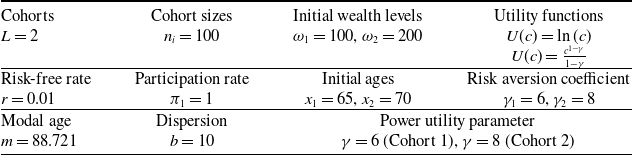
Based on parameters commonly used in the literature, we choose parameters inspired by the work of Wang et al. (Reference Wang, Chiu and Wong2021), and use similar magnitudes. The simulation of the historical trajectory stops at the age of 65 or 70, corresponding to the age when participants enter the tontine scheme.
Simulation parameters.

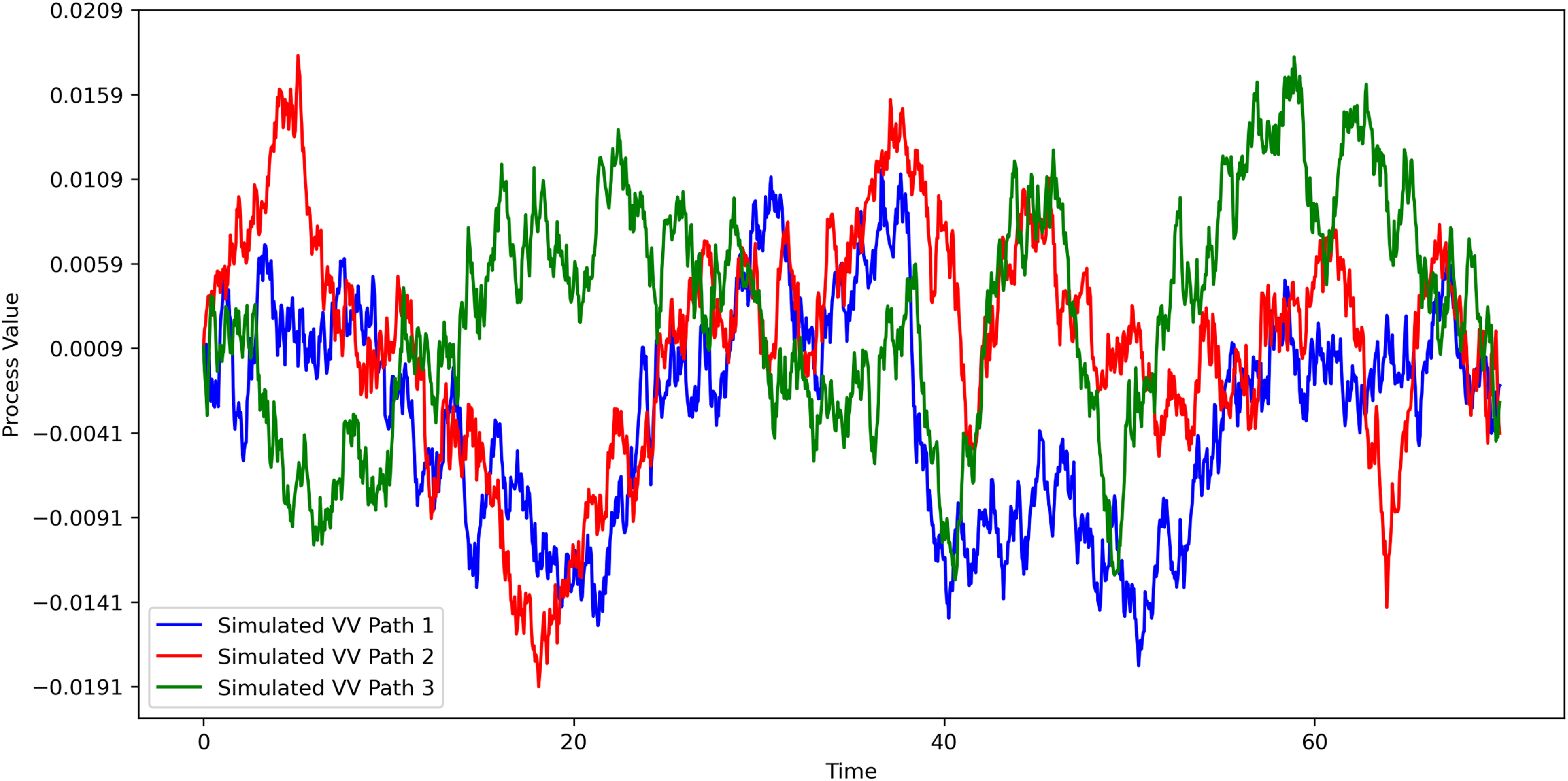
3 sample paths of the specified VV process under 65.

Figure 1 illustrates three sample trajectories generated under the Volterra mortality model to simulate the historical mortality experience of a cohort aged 65. These trajectories play a significant role in calculating the optimal tontine. We emphasize the significant effect of the long-memory properties inherent in affine Volterra processes on the structure of fair tontine payouts and demonstrate that comparing these results with the benchmark Gompertz mortality model allows for a more precise analysis of payment differences across different cohorts. While the existing literature offers a relatively well-recognized framework for tontine fairness, there has yet to be an in-depth exploration of the long range dependence in mortality structures.
This simulation process establishes a foundation for computing the OTPs based on the generated mortality trajectories, which we discuss in the next subsection. In the subsequent analysis, we will select one sample path as the basis for calculating the optimal tontine.
4.2. Optimal tontine payout
In this subsection, we present the numerical results for the optimal tontine payout (OTP) based on the VV mortality model, analyzing its performance across different population groups and utility functions. To compute the OTP, we use the mortality trajectories generated in Subsection 4.1 and numerically solve the continuous-time stochastic differential equation using the discrete-time Euler method. Similar to Chen and Rach (Reference Chen and Rach2023), we apply the Gompertz law for the deterministic counterpart m(s) for the mortality rate
 $\mu$
. This is required as we specify
 $\eta Y$
to be the random deviation from m that fluctuates with time. We have chosen the set of parameters based on the empirical study conducted by Milevsky (Reference Milevsky2020) on calibrating the Gompertz law to different populations.
Base case parameters setup. We assume individuals belong to cohorts
 $i=1,2$
.

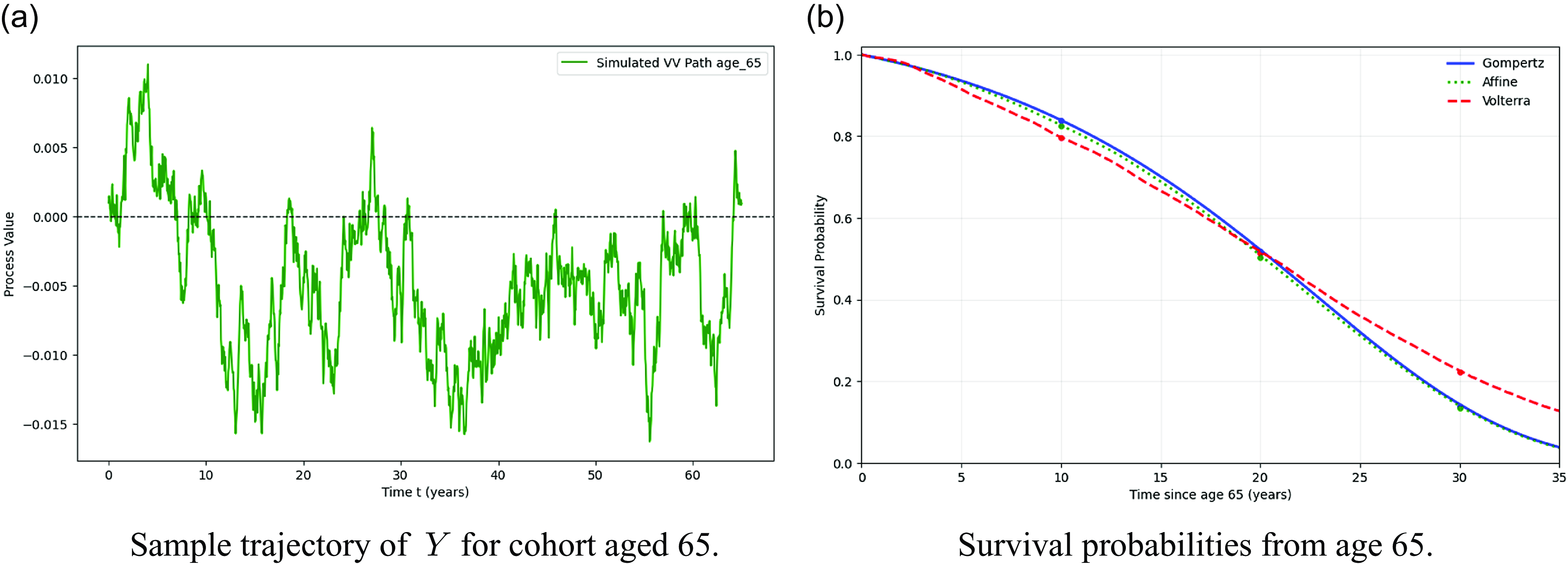
Illustration of the Volterra–Vasicek mortality process and the resulting survival probabilities.

We first select a representative mortality trajectory and calculate the OTP along this path, as shown in Figure 2(a). The results from the conditional expectation of the historical mortality trajectory, demonstrate significant path dependence, reflecting the long-memory property of the VV model. This single-path realization demonstrates significant fluctuations around zero, consistent with the long-memory property intrinsic to the fractional Volterra specification.
However, single-path trajectories alone cannot fully elucidate LRD’s cumulative impact on survival outcomes. To address this, Figure 2(b) presents a comparison of survival probabilities under three distinct mortality assumptions: the traditional Gompertz model, the affine Vasicek model without LRD, and the Volterra–Vasicek model incorporating LRD. While the Gompertz and affine Vasicek curves show close alignment, highlighting their functional similarity in the absence of long-memory effects. The Volterra–Vasicek survival curve initially falls below both the Gompertz and affine curves, reflecting a faster early decline; however, as historical mortality dependence accumulates, it decays more slowly and ultimately produces higher long-term survival probabilities.
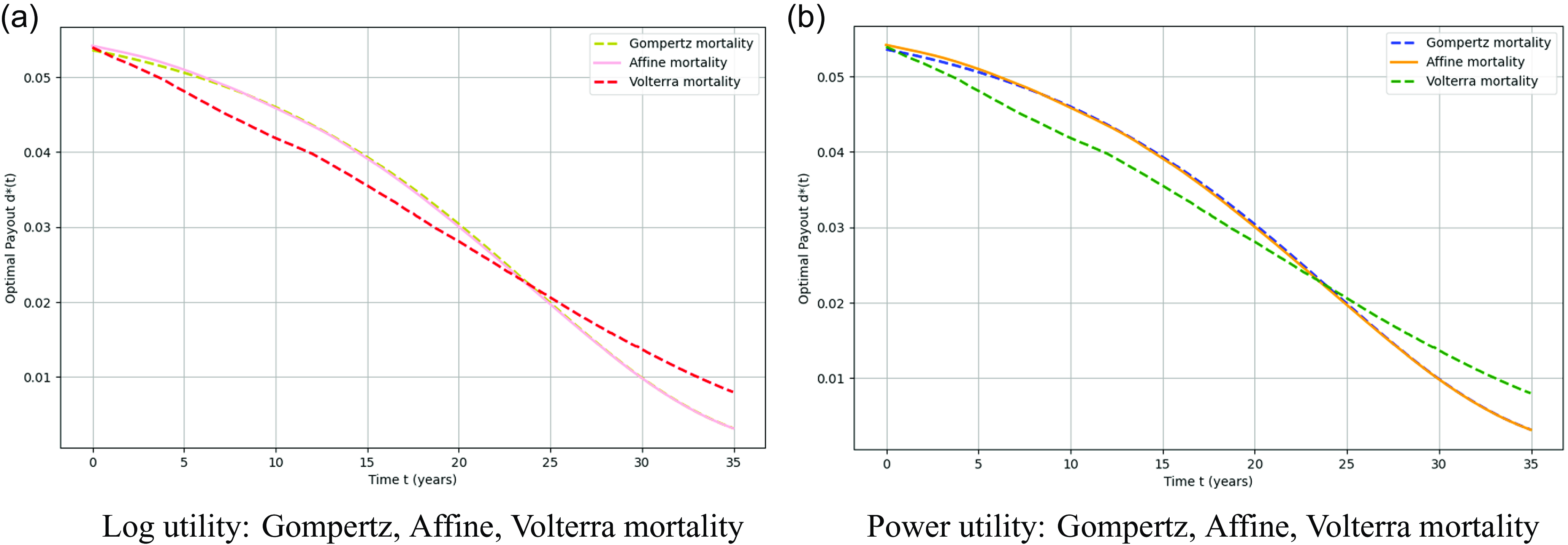
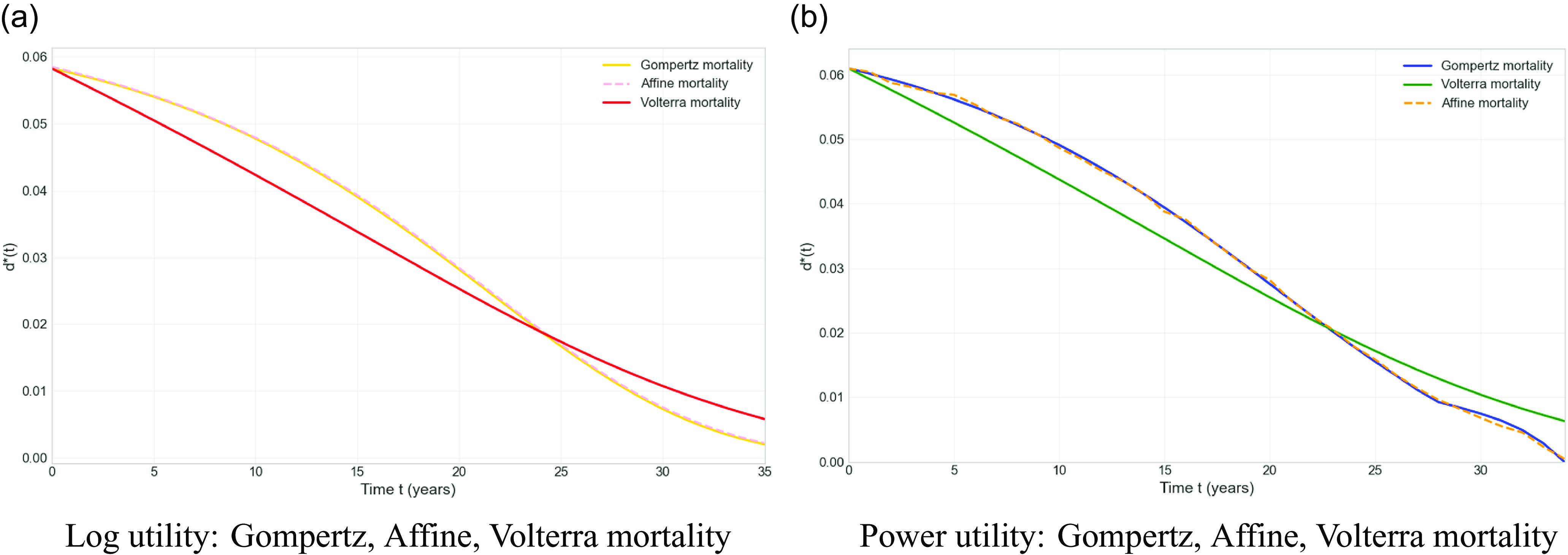
For a homogeneous population, Figure 3 illustrates the comparative dynamics of the OTP over time under three distinct mortality frameworks: the traditional Gompertz model (with random shock
 $\varepsilon$
), the affine mortality model and the Volterra mortality model incorporating long-range dependence (LRD). The left panel corresponds to the logarithmic utility function, while the right panel corresponds to the power utility function. These comparisons offer insights into how different mortality assumptions can significantly affect the optimal payout strategies for cohorts with homogeneous age characteristics, highlighting the role of historical mortality dependence in payout design.
Optimal tontine results under Gompertz, Affine and Volterra mortality models in a homogeneous cohort.

Specially, as shown in Figure 3, the optimal tontine results under Gompertz and affine mortality models in a homogeneous cohort, do not exhibit a significant difference. In contrast, the Volterra-based OTP exhibits a sharper initial decline relative to Gompertz. Arguably this is due to the analytical solution is of a form that is different from the ones presented in Chen et al. (Reference Chen, Hieber and Klein2019, Reference Chen, Hieber and Rach2021) due to the inclusion of Volterra processes. Intuitively, this is also partially explained by the LRD structure. As shown in Figure 2(a), the green solid line representing Y lies below the black dashed zero line up to age 65. Deviations of the Y trajectory from zero, with over 50% of the values being negative, indicate that the cohort’s mortality rate before age 65 is lower on average than the mortality rate projected by the reference mortality law.
Such trajectories imply lower-than-expected mortality experiences on average for the cohort before age 65, consequently translating into higher anticipated longevity risks. Due to the model’s dependency on historical mortality paths, the implied Volterra survival probabilities become higher, reflecting increased longevity uncertainty. As a result, an early-stage payout reduction emerges as a necessary risk compensation mechanism, mitigating potential longevity risk through conservative initial payments.
For mixed-age populations, we analyze two distinct age cohorts of tontine participants with collective fairness. Figure 4 extends this analysis to populations characterized by age heterogeneity, explicitly differentiating two distinct age cohorts. Similar to the homogeneous scenario, the left panel again presents results for the logarithmic utility function, whereas the right panel illustrates those under power utility. Each panel presents three mortality specifications, traditional Gompertz, affine Vasicek, and Volterra–Vasicek. This extension facilitates a direct assessment of mortality model choice under collective fairness, affecting payout outcomes for distinct age cohorts.
Optimal tontine results under Gompertz, Affine and Volterra mortality models in two-age heterogenous cohorts.

From Figure 4, the Gompertz and affine curves almost coincide over the entire horizon. While introducing the Volterra kernel generates a markedly steeper initial decline, followed by a smoother taper, in both utility cases. These curves demonstrate the payment decay over time for each strategy, highlighting variations in time sensitivity and risk preferences. The general trend aligns with findings in the existing literature, such as Chen and Rach (Reference Chen and Rach2023).
When comparing the two utilities, we observe that the introduction of affine mortality results in a significant reduction in the initial optimal tontine, with a notably steeper slope, followed by a gradual and smoother decrease over time. This suggests that the incorporation of the Y process, accounting for historical factors such as past mortality levels leads the model to predict greater future longevity risk, prompting a more conservative payout in the early phases. This model structure more accurately reflects the real-life uncertainty surrounding longevity risk. It is evident that models incorporating the Volterra process exhibit a faster initial decline in pension payments, likely due to their reliance on historical data, which makes the model’s estimates of longevity risk more conservative. This early decline serves as an insurance against uncertain risks associated with future life extension.
4.3. Fairness analysis
In this subsection, we examine the fairness across different age groups within the tontine structure, using the fairness measure f-value proposed by Feng et al. (Reference Feng, Liu and Zhang2024). The f-value quantifies the actual payments received by each group, accounting for differences in survival probability and mortality rates, thereby revealing fairness tendencies in the payment process. We analyzed tontine participants from younger and older groups, calculating the f-value for each group. The results indicate that younger participants typically receive higher relative gains, reflecting a certain fairness bias. This is mainly due to the higher survival probabilities in the younger group, which allow them to claim a larger share of the tontine pool. Consequently, older participants may face a relative disadvantage under the same payment structure, displaying a degree of unfairness.
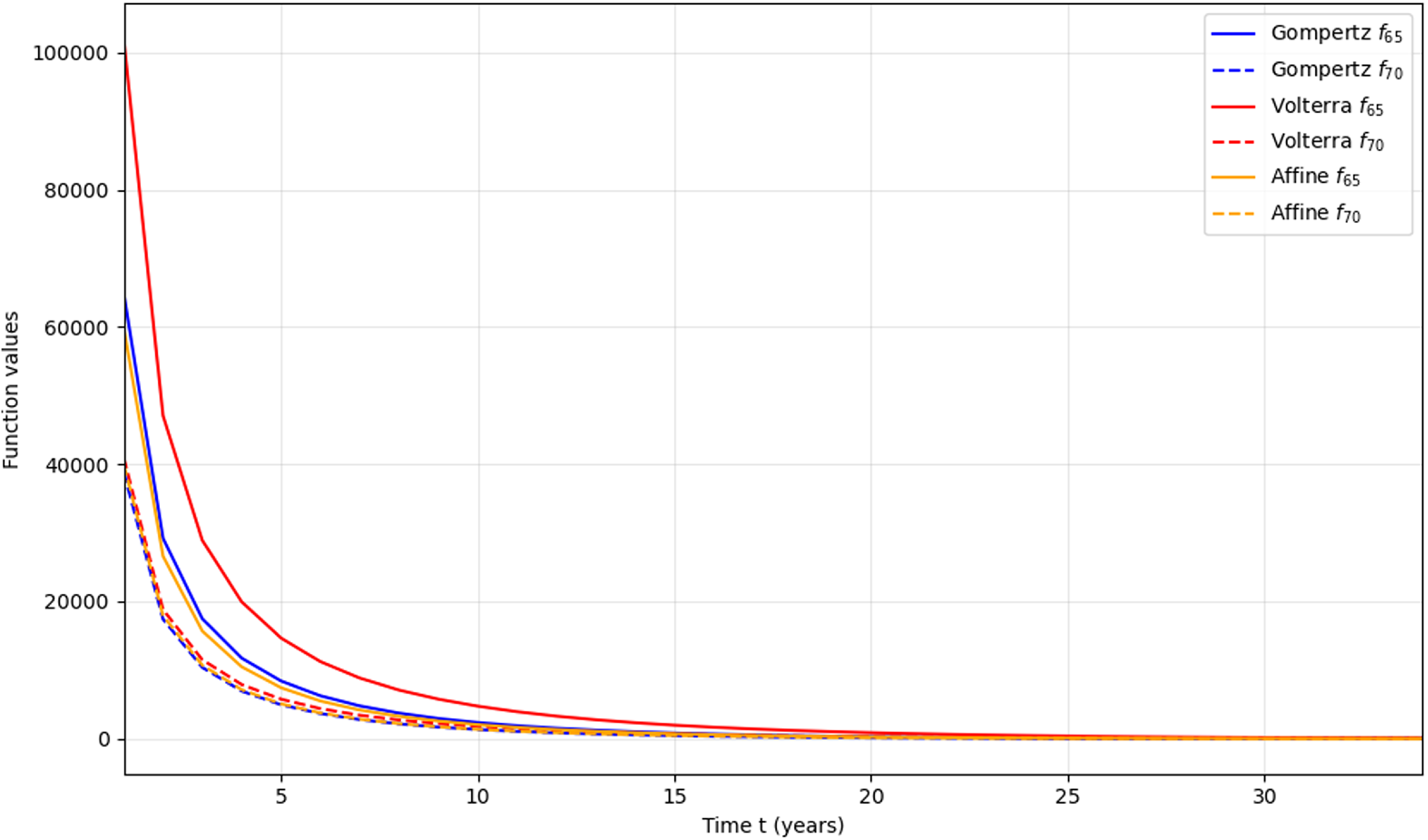
Figure 5 plots the actuarial fairness measure (f-value) dynamics for two entry ages, 65 and 70, under three mortality specifications – Gompertz, affine Vasicek (no LRD), and Volterra–Vasicek (LRD). For both age settings (65 and 70), the Gompertz and affine curves are virtually indistinguishable, whereas the Volterra curve departs markedly owing to the presence of long-range dependence. Although actuarial fairness is comprehensively maintained across groups, there remains an inherent fairness issue disproportionately affecting older participants. Both age cohorts exhibit significant initial declines in their respective f -values, but notably, the group entering at age 70 consistently demonstrates lower f -values over most of the evaluation period. This observation indicates that older participants face greater actuarial disadvantages compared to their younger counterparts, highlighting an age-based inequity within the tontine arrangement. This finding aligns with Chen and Rach (Reference Chen and Rach2023), which shows that actuarial fairness optimized for a common cohort payout
 $ d^*(s) $
may not be optimal for specific subgroups.
Actuarial fairness measures for two heterogeneous age cohorts under distinct mortality models.

The incorporation of the Volterra mortality model, which introduces LRD into mortality rates, influences the f-values by affecting the differences between age groups and intensifies these disparities. The long-memory effects captured by the Volterra process mean that historical mortality experiences have a more pronounced influence on current survival probabilities. In the early to mid term, Volterra–Vasicek yields slightly more conservative survival estimates for older cohorts, but as time advances its decay rate slows and its survival probabilities eventually exceed those of both Gompertz and affine Vasicek models. This behavior produces notably higher initial f-values and a wider inter-cohort spread, while all models converge toward zero over the horizon. Under the Gompertz model initial f-values fall within a moderate range. And the affine Vasicek extension closely mirrors this profile, differing only by small cohort-specific shifts. By contrast, the Volterra–Vasicek curve displays a considerably broader dispersion of initial f-values, extending to values roughly an order of magnitude higher. The application of the f-value fairness measure, adapted from Chen et al. (Reference Chen, Feng, Wei and Zhao2024) for tontines by redefining survival as the triggering event, effectively captures these nuances. Our findings confirm the practical effectiveness of this fairness metric, underscoring the necessity of explicitly considering age heterogeneity and historical mortality dependence in ensuring equitable actuarial outcomes across diverse age cohorts.
5. Conclusion
This study enhances the theoretical study of mortality modeling and introduces new perspectives and methodologies for future research. We examine optimal risk-hedging strategies influenced by LRD, providing financial institutions and individual investors with effective instruments for managing longevity risks. The concept of individual fairness ensures that each participant’s contribution is proportionate to their received benefits, establishing a clear linkage between each person’s actual longevity and their input into the risk pool. On a broader scale, group fairness ensures that risks and rewards are collectively shared among all participants, promoting a balanced distribution of resources across the group.
Specifically, we construct a mortality model that improves the traditional Gompertz mortality rate by incorporating a Volterra-type component. This integration more accurately reflects changes in population and mortality, providing a more realistic approach to modeling longevity risk. The aim of this methodology is to improve the risk-sharing capabilities of the tontine scheme while ensuring fairness is maintained among all participants. By deducing optimal tontine results for different utility functions and calculating the optimal tontine under the requirement of collective fairness, we contribute valuable views into the design of fair and efficient tontine schemes.
In mixed tontine structures with multiple age groups, ensuring equity between groups is a key challenge. We build upon the group equity model introduced by Chen and Rach (Reference Chen and Rach2023), which emphasizes the well-being of society as a whole. By applying weighted utility functions, we ensure that the payments received by each age group align with their probability of survival and life expectancy, thereby promoting social equity within the tontine structure. This design seeks to improve social welfare and prevent undue bias toward any specific age group in the payment distribution, resulting in a more balanced allocation of benefits. In addition, we use the f-value, a fairness measure proposed by Feng et al. (Reference Feng, Liu and Zhang2024), to evaluate actuarial fairness among different age groups in the tontine structure. The result indicates that, although the model ensures fairness at the group level, the relatively lower payments to older age groups suggest room for improvement in achieving fairness across all age groups. The application of the f-value provides important points for refining fairness within the temporal structure of the tontine scheme.
In the future, we might study alternative convolution kernels in the Volterra mortality model to capture different types of long-memory behaviors observed in real-world mortality data. Another area worth investigating is the development of enhanced fairness measures that can more effectively address the differences observed among different age groups in tontine schemes with long-memory mortality models. This could involve refining the f-value measure or proposing new measures that account for the complexities introduced by long-range dependence.
Acknowledgments
The authors are grateful for the support from several funding agencies. This work is supported by the National Natural Science Foundation of China (Grant Nos. 12171158, 12071147, and 12471452), the State Key Program of National Natural Science Foundation of China (Grant No. 71931004), and Fundamental Research Funds for the Central Universities (Grant Nos. 2022QKT001, 2024QKT008).
Competing interests
The author(s) declare none.
Appendix A. Proof of theorems
A.1. Proof of Theorem 3.1
For the jth policyholder at age x in the homogeneous cohort tontine, we can rewrite the expected discounted lifetime utility at the subjective discount rate
 $\rho$
as
 \[\begin{aligned}U(b_{j}(s)) &= \int_{0}^{\infty}e^{-\rho s}\mathbb{E}\left[ U \left(\frac{n w_j d(s)}{N(s)}\right)\mathbb{I} _{\{\tau_{x}\gt s\}} \middle | \mathcal{F}_t \right]ds \notag \\[5pt] &=\int_{0}^{\infty}\mathbb{E}\left[S_x(s)\mathbb{E}\left[e^{-\rho s}U \left(\frac{n w_j d(s)}{N(s)}\right)\middle | \mathcal{G}_{t+s},\mathcal{F}_{t}\right]\right]ds \notag \\[5pt]&= \int_{0}^{x^*-x} e^{-\rho s} U(w_j d(s))\notag \\[5pt]& \times \mathbb{E} \left[ S_x(s) \sum_{k=0}^{n-1} \binom{n-1}{k} \left( \frac{n}{k+1} \right)^{1-\gamma} (S_x(s))^k (1-S_x(s))^{n-1-k} \middle| \mathcal{F}_{t} \right] ds\notag \\[5pt]&= \int_{0}^{x^*-x}e^{-\rho s} U(w_j d(s)) \sum_{k=1}^{n} \binom{n}{k} \left(\frac{k}{n}\right)^{\gamma} \mathbb{E}\left[(S_x(s))^{k} (1-(S_x(s)))^{n-k} \middle | \mathcal{F}_{t}\right]ds.\\ \end{aligned}\]
Under the Volterra mortality model, the expectation terms decompose as
 \[\begin{aligned}G_{n,k}(s) &= \mathbb{E}\left[ (S_x(s))^{k} (1-S_x(s))^{n-k} \,\middle|\, \mathcal{F}_{t}\right] \notag \\[5pt]&=\mathbb{E}\left[\sum_{\ell=0}^{n-k} \binom{n-k}{\ell} ({-}1)^{\ell} (S_x(s))^{\ell+k} \middle | \mathcal{F}_{t}\right]\notag \\[5pt]&= \sum_{\ell=1}^{n-k} \binom{n-k}{\ell} ({-}1)^\ell \exp\left\{-(k+\ell)\left(\int_{t}^{t+s} m_x(r)\,dr - \int_{0}^{t} \eta Y_x(r) \,dr\right)\right\} \notag \\[5pt]& \times \mathbb{E}\left[\exp\left\{-\int_{0}^{T} (\ell+k)\eta Y_x(r) \,dr\right\} \middle| \mathcal{F}_{t}\right]. \end{aligned}\]
The actuarial present value
 $ P_0^j $
is
 \[\begin{aligned} P_0^j &= \int_0^\infty e^{-rs} \mathbb{E}\left[ \frac{n w_j d(s)}{N(s)} \mathbb{I}_{\{\tau_x \gt s\}} \middle| \mathcal{F}_t \right]ds \notag \\[5pt]&= \int_0^{x^*-x} e^{-rs} w_j d(s) \sum_{\ell=1}^n \binom{n}{\ell} ({-}1)^{\ell+1} \mathbb{E}\left[ (S_x(s))^\ell \right] ds. \end{aligned}\]
Then according to the assumptions of mortality, we can get
 \[\begin{aligned} H_{n,x}(s)&=\sum_{\ell=1}^n \binom{n}{\ell} ({-}1)^{\ell+1} \mathbb{E}\left[ (S_x(s))^{\ell} \middle | \mathcal{F}_{t}\right]\notag \\[5pt] &=\sum_{\ell=1}^n \binom{n}{\ell} ({-}1)^{\ell+1} \exp\left\{-\ell \left(\int_{t}^{t+s} m_x(r)\,dr - \int_{0}^{t} \eta Y_x(r) \,dr\right)\right\} \notag \\[5pt] & \times \mathbb{E}\left[\exp\left\{-\int_{0}^{T} \ell \eta Y_x(r) \,dr\right\} \middle| \mathcal{F}_{t}\right]\notag \\[5pt] &=\sum_{\ell=1}^n \binom{n}{\ell} ({-}1)^{\ell+1} \exp\left\{-\ell\left(\int_{t}^{t+s} m_x(r)dr-\int_{0}^{t}\eta Y_x(r) dr\right)\right\}\exp\{Z_{x,t}^{(\ell)}\}. \end{aligned}\]
In particular,
 $ Z^{(\ell)}_{x,t}(s) $
becomes an affine function of the trajectory of the Volterra mortality rate process. The general result was shown in Abi Jaber et al. (Reference Abi Jaber, Larsson and Pulido2019b) given that the kernel function K in (3.5) satisfies mild additional conditions. Now it follows from Theorem 4.3 in Abi Jaber et al. (Reference Abi Jaber, Larsson and Pulido2019b) on the exponential-affine transformation formula of the general form
 $ \mathbb{E}\left[uY_T + (f * Y)_T \mid \mathcal{F}_t\right]. $
With
 $ u = 0 $
, f being reduced to
 $ \ell \eta $
, and given
 $ Z^{(\ell)}_{x,t} $
defined in Theorem 3.1, we have
 \[ \mathbb{E}\left[e^{-\int_0^T \ell \eta Y_x(r) \, dr} \mid \mathcal{F}_t\right] = \exp\left\{Z^{(\ell)}_{x,t}(r)\right\}. \]
Thus, from problem (3.1) and the FOC in Equation (3.3), we calculate the optimal payout
 $ d^*(s) $
 \[ d^*(s) = \frac{1}{w_j } \left( \frac{1}{\lambda}\frac{e^{-(\rho-r)s}\sum_{k=1}^n \binom{n}{k}(\frac{k}{n})^{\gamma}G_{n,k}(s) }{H_{n,x}(s)} \right)^{\frac{1}{\gamma}}, \]
where
 $\lambda$
is chosen such that the constraint in 3.1 holds:
 \[\lambda^{\frac{1}{\gamma}} \,:\!=\, \frac{1}{w_j} \int_0^{x^*-x} e^{-(r+\frac{\rho-r}{\gamma})s} H_{n,x}(s)^{-\frac{1}{\gamma}} \left( \sum_{k=1}^n \binom{n}{k} \left(\frac{k}{n}\right)^{\gamma} G_{n,k}(s) \right) ^{\frac{1}{\gamma}} \, ds. \]
A.2. Proof of Theorem 3.2
We use a logarithmic utility function to rewrite the expected lifetime utility of the tontine as:
 \[\begin{aligned} U(b_{j}(s)) &= \int_{0}^{\infty}e^{-\rho s} \mathbb{E}\left[ \ln\left(\frac{n w_j d(s)}{N(s)}\right) \mathbb{I}_{\{\tau_{x}\gt s\}} \middle| \mathcal{F}_t \right]ds \notag \\[5pt] &= \int_{0}^{\infty}\mathbb{E}\left[S_x(s)\mathbb{E}\left[e^{-\rho s} \ln\left(\frac{n w_j d(s)}{N(s)}\right) \middle| \mathcal{G}_{t+s}\right]\middle|\mathcal{F}_{t}\right]ds. \\ \end{aligned} \]
 \begin{align} \mathbb{E} \left[ e^{-\rho s} S_x(s) \mathbb{E} \left[ \frac{1}{\frac{n w_j d(s)}{N(s)}} \frac{n w_j}{N(s)} \middle| \mathcal{G}_{t+s}\right]\middle|\mathcal{F}_{t}\right] =\lambda e^{-r s} \mathbb{E} \left[ S_x(s)\mathbb{E} \left[ \frac{n w_j }{N(s)} \middle| \mathcal{G}_{t+s}\right]\middle|\mathcal{F}_{t}\right] \notag \end{align}
And
 $H_{n,x}(s)$
uses the same simplified representation as that described in Theorem 3.1,
 \begin{align} \mathbb{E} \left[e^{-\rho s}\frac{S_x(s)}{d(s)} \middle| \mathcal{F}_t\right] &=\lambda e^{-r s} \mathbb{E} \left[ S_x(s)\mathbb{E} \left[ \frac{n w_j }{N(s)} \middle| \mathcal{G}_{t+s}\right]\middle|\mathcal{F}_{t}\right]=w_j\lambda e^{-r s} H_{n,x}(s). \notag \end{align}
where
 \[ \mathbb{E}[S_x(s) \mid \mathcal{F}_t] = \mathbb{E}[e^{-\int_{t}^{t+s}\mu_x(r) dr}]=\exp\left\{-\left(\int_{t}^{t+s} m_x(r)dr-\int_{0}^{t}\eta Y_x(r) dr\right)\right\}\exp\{Z_{x,t}^{(\ell)}\}, \]
and
 $\exp\{Z_{x,t}^{(\ell)}\}$
is defined in Equation (3.5).
So,
 \[ d^*(s) = \frac{1}{w_j\lambda}\frac{e^{-(\rho-r)s}\mathbb{E}[S_x(s) \mid\mathcal{F}_t]}{H_{n,x}(s)}. \]
A.3. Proof of Theorem 3.3
We first rewrite FOCs in (3.9) considering
 $L=2$
, we get
 \begin{align} &\sum_{i=1}^{2} n_i \beta_i e^{-\rho_i s} \mathbb{E} \left[ S_{x_i}(s) \mathbb{E} \left[ U_i^{'}\left(\frac{(n_1 w_1+n_2 w_2)\pi_i d(s)}{N_1(s)+N_2(s)}\right)\frac{(n_1 w_1+n_2 w_2)\pi_i}{N_1(s)+N_2(s)} \middle| \mathcal{G}_{t+s}\right]\middle|\mathcal{F}_{t}\right] & \nonumber \\ &= \lambda e^{-r s} \sum_{i=1}^{2} \left( n_i \pi_i \mathbb{E} \left[S_{x_i}(s) \sum_{k=0}^{n-1}\frac{w}{k+1} f_{n-1}(k;\, S_{x_1}(s), S_{x_2}(s))\middle| \mathcal{F}_{t}\right] \right),& \notag \end{align}
Then in the case of power utility, we get that
 \begin{align} &\sum_{i=1}^{2} n_i \beta_i e^{-\rho_i s} \mathbb{E} \left[ S_{x_i}(s) \sum_{k=0}^{n-1} (d(s))^{\gamma_{i}}\left(\frac{w\pi_i}{k+1}\right)^{1-\gamma_{i}}f_{n-1}(k;\, S_{x_1}(s), S_{x_2}(s))\middle| \mathcal{F}_{t}\right]& \nonumber \\ &= \lambda e^{-r s} \sum_{i=1}^{2} \left( n_i \pi_i \mathbb{E} \left[S_{x_i}(s) \sum_{k=0}^{n-1}\frac{w}{k+1} f_{n-1}(k;\, S_{x_1}(s), S_{x_2}(s))\middle| \mathcal{F}_{t}\right] \right),& \notag \end{align}
The optimal tontine payment can be solved explicitly and follows the following structure:
 \begin{align}& d^*(s) = \left( \frac{\sum_{i=1}^2 n_i \beta_i e^{-(\rho_i - r)s} \mathbb{E}\left[ S_{x_i}(s) \sum_{k=0}^{n-1} \frac{(w\pi_i)^{1-\gamma_i}}{(k+1)^{1-\gamma_i}} f_{n-1}(k;\, S_{x_1}(s),S_{x_2}(s)) \middle| \mathcal{F}_t \right]}{\lambda \sum_{i=1}^2 n_i \pi_i \mathbb{E}\left[ S_{x_i}(s) \sum_{k=0}^{n-1} \frac{w}{k+1} f_{n-1}(k;\, S_{x_1}(s),S_{x_2}(s)) \middle| \mathcal{F}_t \right]} \right)^{\frac{1}{\gamma_i}}.\notag \end{align}
Simplify via
 $ G_{n_i}(s) $
,
 $ H_{n_i,x_i}(s) $
and PMF
 $f_{n-1}(k;\, S_{x_1}(s),S_{x_2}(s))$
. Define the cohort-specific adjustment terms:
 \begin{align} & G_{n_i}(s) \,:\!=\, \mathbb{E}\left[ S_{x_i}(s) \sum_{k=0}^{n-1} \frac{(w\pi_i)^{1-\gamma_i}}{(k+1)^{1-\gamma_i}} f_{n-1}(k;\, S_{x_1}(s),S_{x_2}(s)) \middle| \mathcal{F}_t \right], \notag \\[5pt] & H_{n_i,x_i}(s) \,:\!=\, \mathbb{E}\left[ S_{x_i}(s) \sum_{k=0}^{n-1} \frac{w}{k+1} f_{n-1}(k;\, S_{x_1}(s),S_{x_2}(s)) \middle| \mathcal{F}_t \right].\notag \end{align}
Substitute these into the expression for
 $ d^*(s) $
:
 \begin{align} d^*(s) = \left( \frac{1}{\lambda} \frac{\sum_{i=1}^2 n_i\beta_i e^{-(\rho_i - r)s} (\pi_i)^{1-\gamma_i} G_{n_i}(s)}{\sum_{i=1}^2 n_i \pi_i H_{n_i,x_i}(s)} \right)^{\frac{1}{\gamma_i}}.\notag \end{align}
A.4. Proof of Theorem 3.4
We first rewrite FOCs in (3.9) considering
 $L=2$
and log utility function, we get that:
 \begin{align}&\sum_{i=1}^{2} n_i \beta_i e^{-\rho_i s} \mathbb{E} \left[ S_{x_i}(s) \sum_{k=0}^{n-1} (d(s))^{-1}f_{n-1}(k;\, S_{x_1}(s), S_{x_2}(s))\middle| \mathcal{F}_{t}\right]& \nonumber \\[5pt]&= \lambda e^{-r s} \sum_{i=1}^{2} \left(n_i \pi_i \mathbb{E} \left[S_{x_i}(s) \sum_{k=0}^{n-1}\frac{w}{k+1} f_{n-1}(k;\, S_{x_1}(s), S_{x_2}(s))\middle| \mathcal{F}_{t}\right] \right),& \notag \end{align}
The optimal tontine payment can be solved explicitly and follows the following structure:
 \begin{align} & d^*(s) = \left( \frac{\sum_{i=1}^2 n_i \beta_i e^{-(\rho_i - r)s} \mathbb{E}\left[ S_{x_i}(s) \sum_{k=0}^{n-1} f_{n-1}(k;\, S_{x_1}(s),S_{x_2}(s)) \middle| \mathcal{F}_t \right]}{\lambda \sum_{i=1}^2 n_i \pi_i \mathbb{E}\left[ S_{x_i}(s) \sum_{k=0}^{n-1} \frac{w}{k+1} f_{n-1}(k;\, S_{x_1}(s),S_{x_2}(s)) \middle| \mathcal{F}_t \right]} \right)^{\frac{1}{\gamma_i}}.\notag \end{align}
Simplify via
 $ H_{n_i,x_i}(s) $
and PMF
 $f_{n-1}(k;\, S_{x_1}(s),S_{x_2}(s))$
. Define the cohort-specific adjustment terms:
 \[H_{n_i,x_i}(s) \,:\!=\, \mathbb{E}\left[ S_{x_i}(s) \sum_{k=0}^{n-1} \frac{w}{k+1} f_{n-1}(k;\, S_{x_1}(s),S_{x_2}(s)) \middle| \mathcal{F}_t \right].\]
Substitute these into the expression for
 $ d^*(s) $
:
 \begin{align} d^*(s) = \frac{1}{\lambda} \left( \frac{\sum_{i=1}^2 n_i \beta_i e^{-(\rho_i - r)s} \mathbb{E}\left[ S_{x_i}(s) \sum_{k=0}^{n-1} f_{n-1}(k;\, S_{x_1}(s),S_{x_2}(s)) \mid \mathcal{F}_t ) \right]}{\sum_{i=1}^2 n_i \pi_i H_{n_i,x_i}(s)} \right).\notag \end{align}