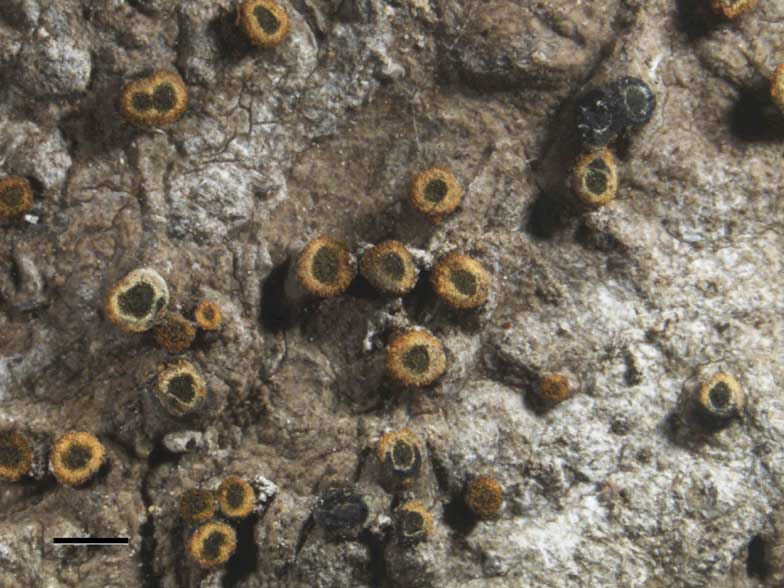
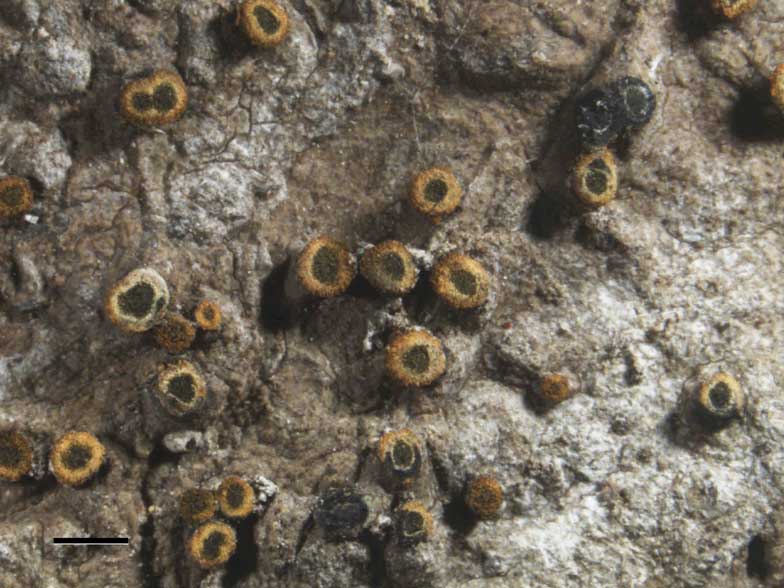
Pyrgillus tibellii Kr. P. Singh & Pushpi Singh was described from Arunachal Pradesh in the Eastern Himalaya, India (Singh & Singh Reference Singh and Singh2012 a). In the same year Kashiwadani et al. (Reference Kashiwadani, Aptroot, Futagami and Moon2012) described P. cambodiensis Kashiw. et al. from Cambodia (Fig. 1). Recently, Shi et al. (Reference Shi, Qian, Harada, Aptroot and Wang2015) reported P. cambodiensis and P. javanicus (Mont. & Bosch) Nyl. as new to China from southern Yunnan and considered P. tibellii (Fig. 2) as conspecific with Pyrgillus cambodiensis following the rule of priority (Art. 11.4; McNeill et al. Reference McNeill, Barrie, Buck, Demoulin, Greuter, Hawksworth, Herendeen, Knapp, Marhold and Prado2012). Shi et al. (Reference Shi, Qian, Harada, Aptroot and Wang2015), however, ignored the chemistry of P. tibellii.
Pyrgillus cambodiensis, habitus (holotype). Scale=1 mm. In colour online.
We have examined the holotype of P. cambodiensis (Cambodia: Siem Reap Province, Western Prasat Top, Angkor Wats complex, Siem Reap, 13°26'N, 103°51'E, alt. c. 30 m, on bark of Dipterocarpus elatus, 24 November 2010, H. Kashiwadani 50508) borrowed from TNS Japan and found it clearly distinct from the type of P. tibellii (India: Arunachal Pradesh, Papumpare district, Sankei view, on bark, alt. c. 340 m, 12 January 1997, K. P. Singh 9616) housed at ASSAM in India. Pyrgillus tibellii, although similar to P. cambodiensis in morphology and anatomy (they both have 3-septate ascospores), is easily distinguished from the latter by its larger ascospores and the presence of lichexanthone (UV+ yellow) in the thallus. In lichen taxonomy, secondary metabolites play a significant role in delimiting species (Hawksworth Reference Hawksworth1976; Lumbsch 1998 Reference Lumbscha , Reference Lumbschb ; Luangsuphabool et al. Reference Luangsuphabool, Piapukiew, Parnmen, Nelsen, Lumbsch and Sangvichien2016). Reaction to ultraviolet (UV) has been considered an important and necessary criterion for the identification of several lichen species (Aptroot Reference Aptroot2012). It is therefore concluded that P. tibellii and P. cambodiensis are two distinct taxa and not conspecific as treated by Shi et al. (Reference Shi, Qian, Harada, Aptroot and Wang2015). Pyrgillus tibellii is endemic to India, so far confined to Arunachal Pradesh in Eastern Himalaya and Kerala in Western Ghats, and grows on trees in tropical forests at lower elevations. It might possibly also occur in China.
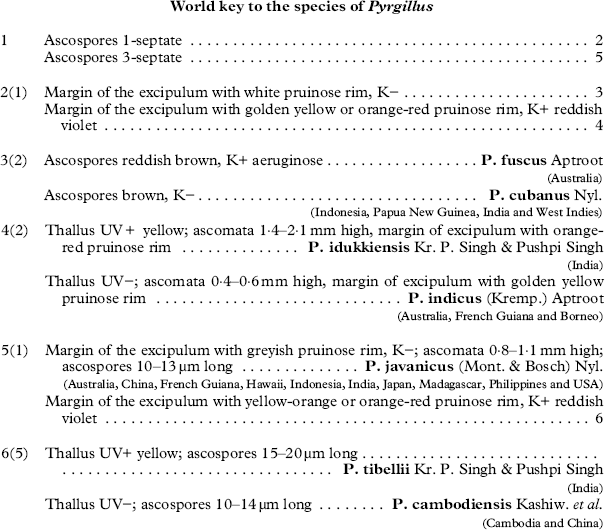
The genus Pyrgillus Nyl. belongs to the family Pyrenulaceae and is so far represented by seven species (Aptroot Reference Aptroot1991; Kashiwadani et al. Reference Kashiwadani, Aptroot, Futagami and Moon2012; Singh & Singh Reference Singh and Singh2012 b), four of which occur in India (Singh & Singh Reference Singh and Singh2012 b). We present a key to these species.
The authors thank the Director of the Botanical Survey of India, Kolkata for encouragement and G. P. Sinha, Head of Office at the Central Regional Centre, Botanical Survey of India, Allahabad for the use of facilities. A. Aptroot, ABL Herbarium, The Netherlands, D. K. Singh, Lucknow and two anonymous reviewers are thanked for their valuable comments on the manuscript. Y. Ohmura, Curator of herbarium at TNS, Japan is thanked for the loan of a type specimen. One of the authors (PS) is grateful to the Botanical Survey of India for financial assistance under the ‘Flora of India Project’.