Introduction
Wisdom is a favoured milestone in human development and has been discussed in all cultures (Assmann Reference Assmann, Featherman, Lerner and Perlmutter1994; Baltes and Staudinger Reference Baltes and Staudinger2000; Clayton and Birren Reference Clayton, Birren, Baltes and Brim1980; Kramer Reference Kramer2000) and in many philosophical and religious traditions, both oral and written, since at least 2500 BC (Clayton and Birren Reference Clayton, Birren, Baltes and Brim1980; Curnow Reference Curnow1999). By contrast, empirical studies of wisdom are rather recent: most have been by human developmental psychologists and have concentrated on the characteristics or features of a ‘wise’ person (Holliday and Chandler Reference Holliday and Chandler1986; Sternberg Reference Sternberg and Sternberg1990a), while a handful have highlighted the facilitating factors such as leadership profession (Baltes and Staudinger Reference Baltes and Staudinger2000), inter-personal conflict as with divorce (Helson and Shrivastava Reference Helson and Srivastava2002), and social crises such as living through the Great Depression (Ardelt Reference Ardelt1998). Although of great interest in the past, religiousness and spirituality as a context for the development of wisdom has received less attention by researchers. Indeed, a review of philosophical and contemplative traditions suggested that religious or spiritual cultivation is a facilitating factor of the higher stages of human development, including wisdom (Alexander et al. Reference Alexander, Davies, Dixon, Dillbeck, Druker, Oetzel, Alexander and Langer1990). This study attempts to assess empirically the role of religion or spirituality in wisdom, and examines how religious/spiritual practice and experiences, as well as mystical experiences, relate to practical and transcendent wisdom. Consistent with Birren and Svensson's (Reference Birren, Svensson, Sternberg and Jordan2005) Birren and Svensson's (Reference Birren, Svensson, Sternberg and Jordan2005)suggestion that wisdom research needs to study people of diverse cultures, this study examines the relation between religion or spirituality and wisdom in two ethnic groups (European-Americans and Vietnamese-Americans) and of different ages (young and old adults).
This paper first discusses different conceptualisations of wisdom and the ways in which wisdom has been measured, giving particular attention to ‘practical’ and ‘transcendent’ wisdom. The theoretical arguments and empirical evidence that suggest a link between spirituality or mysticism and transcendent wisdom are then considered. Values, specifically self-enhancement values, are next discussed as a potential moderator of the link between spirituality/mysticism and transcendent wisdom. Finally, the two studies are presented, of respectively older and young adults, along with the specific hypotheses that were tested.
Wisdom
Wisdom is a complex and multifaceted concept that until only recently has eluded operational definitions and measurement. Indeed, the 13 chapters of Sternberg's Handbook on Wisdom (Reference Sternberg1990b) give 13 different definitions of wisdom. Birren and Fisher's (Reference Birren, Fisher and Sternberg1990) definition considered wisdom as the integration of affective, conative and cognitive aspects of human abilities, and a balance between opposing forces (e.g. action versus inaction).Footnote 1 Similarly, Kramer (Reference Kramer and Sternberg1990) considered wisdom as the integration of cognition and affect. Arlin (Reference Arlin and Sternberg1990) emphasised the cognitive process of reflection and judgement, while Sternberg (Reference Sternberg and Sternberg1990a) regarded wisdom as a meta-cognitive style plus sagacity. Although most researchers have conceptualised wisdom as being person-centred, and drawn on the concept to describe individuals with exemplary psychological characteristics and traits, whether cognitive/mental, affective or behavioural, others have considered wisdom as inherently non-existent without social interactions or discourse or, in other words, as something that cannot be ascribed as intrinsic to a person but rather a product of social and cultural interactions (Edmondson Reference Edmonson2005; Staudinger Reference Staudinger, Baltes and Staudinger1996).
Research designs and ways to measure wisdom have also been diverse. Explicit theories of wisdom, such as the ‘Berlin Wisdom Model’ (Baltes and Staudinger Reference Baltes and Staudinger2000), use explicit, expert-defined theories, whereas implicit theories of wisdom ask lay people what they believe defines wisdom and wise individuals. Bluck and Gluck (Reference Bluck, Gluck, Sternberg and Jordan2005), for instance, studied people's implicit theories of wisdom by asking participants to write about their own personal experiences that reflect wise behaviour in terms of their own definitions of wisdom. Qualitative, ethnographic studies reflect the investigators' implicit theories of wisdom (e.g. Ahmadi Reference Ahmadi1998; Edmondson Reference Edmonson2005). The first edition of the handbook Wisdom: Its Nature, Genesis and Development was published in 1990, but 15 years later no consensus has been reached about its definition or measurement (Sternberg and Jordan Reference Sternberg and Jordan2005). In this paper, I assess the relationships between spirituality or mysticism and two theoretically distinct conceptualisations of wisdom, ‘practical’ and ‘transcendent’ wisdom. The study adopted the methodological framework and self-report measures of the Berlin Wisdom Model. The methodology inclines to logical positivism, with its inherent benefits and limitations.
Practical wisdom emphasises cognition and the pragmatics of daily living, advice and action. Research at the Max Planck Institute of Human Development in Berlin has exemplified practical wisdom. The Berlin Wisdom Model considers wisdom as an ‘expert knowledge system’, or more precisely as ‘expertise in the fundamental pragmatics of life’ (Baltes and Staudinger Reference Baltes and Staudinger2000: 124). According to this conceptualisation, wisdom resides in the ability of individuals, when resolving difficult life dilemmas, to consider factual knowledge, procedural knowledge, lifespan contextualism and relativistic thinking, and to tolerate uncertainty. These are the five criteria by which individual's responses to hypothetical dilemmas are rated.
In contrast, transcendent wisdom reflects a type of wisdom that is about transforming consciousness, or shifting a perspective (Tiberius Reference Tiberius2005). Whereas practical wisdom entails accretion and the acquisition of knowledge and experiences that enable one to live a good life, adherents of transcendent wisdom see such accumulation of experience and knowledge as potentially a hindrance to insight and understanding. Transcendent wisdom is more about shedding beliefs, attachments and other psychological encumbrances that can impede one's vision of reality, not about acquiring cognitive complexity and experiences. Transcendent wisdom does not necessarily emphasise the importance of cognition and action, as with practical wisdom, but instead centres on quieting of the mind so as to gain direct intuitive insight. Others have also considered transcendent wisdom as a developmental process involving self-knowledge, detachment, integration and ultimately self-transcendence (Curnow Reference Curnow1999; Le Reference Le2004; Levenson et al. Reference Levenson, Jennings, Aldwin and Shiraishi2005).
The relation between spirituality/mysticism and wisdom, particularly transcendent wisdom, has been alluded to in philosophical discussions (Osbeck and Robinson Reference Osbeck, Robinson, Sternberg and Jordan2005). Philosophical and contemplative discourse has suggested that religiousness, spirituality and mystical experiences may be central to the development of wisdom by encouraging values and ideals that facilitate ethical and noble human understanding and conduct, and by reminding a person of one's significance or insignificance in the cosmos. It may also be that certain spiritual/mystical experiences lead to a radically changed perspective or consciousness. With respect to transcendent wisdom, it is widely agreed that to be wise, one must have a broader view of life that transcends narrow self-interests. Spiritual engagement or experiences may be a vehicle for adopting a larger perspective and for subsuming the interests of one's immediate life and concerns.
Religiousness, spirituality and mystical experiences
According to Hill et al. (Reference Hills, Pargament, Hood, McCullough, Swyers, Larson and Sinnbaver2000), religiousness and spirituality are related but independent constructs. Whereas religiousness often refers to adherence to an institutional or formal doctrine, spirituality refers to search for the sacred (God, the divine or transcendence) in extraordinary objects or experiences. Historically, religion and religious traditions have played an important function in societies by providing meanings, by prescribing and proscribing values (e.g. empathy, compassion), by setting ideals that facilitate harmonious personal and interpersonal interactions (e.g. hope and ethical conduct), and by facilitating social support. Yet, it must also be noted that a religion of belief differs from a religion of practice; one may profess to uphold and endorse an ideal (e.g. love thy neighbour) but not necessarily practise it in everyday life. In any case, studies have shown that religiousness or spirituality confer physical, psychological and emotional benefits (Miller and Thoresen Reference Miller and Thoresen2003; Powell, Shahabi and Thoresen Reference Powell, Shahabi and Thoresen2003; Smith, McCullough and Poll Reference Smith, McCullough and Poll2003), even including improved survival (McCullough et al. Reference McCullough, Hoyt, Larson, Koenig and Thoresen2000).
According to Wink and Dillon (Reference Wink and Dillon2002), religiousness is related to well-being through positive connections with others and involvement in social and community events. Spirituality, on the other hand, seems to confer wellbeing from personal growth, creativity and knowledge. Whereas religiousness and spirituality have been linked to physical health and wellbeing (Hill and Pargament Reference Hills and Pargament2003), religiousness in young adulthood and spirituality in older adulthood have been associated with wisdom (Wink and Dillon Reference Wink and Dillon2003). Individuals who were religious as young adults also tend to become more spiritual in old age (Wink and Dillon Reference Wink and Dillon2003). Spirituality is associated with wisdom in part because ‘the essence of spirituality seems to consist in an effort to free consciousness from the thrall of genetic instructions’ (Csiksentmihayli 1993: 241). As Levenson and Crumpler (Reference Levenson, Jennings, Aldwin and Shiraishi1996) have suggested, the development of wisdom, or at least transcendent wisdom, requires a certain level of liberation from the strictures of biological, social and cultural programming and conditioning.
Along similar lines, Csiksentmihalyi (Reference Csiksentmihalyi1993) also suggested that spirituality and spiritual qualities are held in very high esteem in civilised cultures because they reduce personal and social entropy (viz. disorder or chaos). Spirituality may increase harmony among individuals' thoughts, emotions and wills, provide coherence and meaning in life, reduce conflicting desires, and provide goals that are consistent with change and transformation. By instilling harmony and reducing entropy, individuals enhance their potential for wisdom. Thus, spirituality may facilitate the development of transcendent wisdom by reducing entropy in consciousness.
Whereas religiousness and spirituality are contextualised and interpreted in a particular belief system or tradition (e.g. Christianity, Buddhism, Islam) (cf. Katz Reference Katz1978), mysticism and mystical experiences are not necessarily culture-bound (Forman Reference Forman1990). Mystical experiences refer to experiences in which one feels a sense of unity or connection with everyone, of ‘nothingness’, or an awareness of a holy or sacred other beyond nature (Spilka et al. Reference Spilka, Hood, Hunsberger and Gorsuch2003). Newberg, D'Aquili, and Rause (Reference Newberg, D'Aquili and Rause2001) suggested that mystical experiences exist in all cultures and can be experienced by everyone, in part because they have neurological substrates and correlates, and are natural and beneficial. Moreover, they often feel real or ‘more real’ than any other experiences. On the other hand, Katz (Reference Katz1978) and others have argued that mystical experiences are very variable, and are interpreted through the lens of each mystic's particular culture and personality. Yet, regardless of whether mystical experiences are culture-bound or universal, they seem to affect individuals in personal ways. Whether they actually influence the development of wisdom remains empirically unexplored.
There are two potential mechanisms by which mystical experiences may facilitate the development of wisdom, at least transcendent wisdom. First, mystical experiences may disrupt routine ways of perceiving and interacting with the world. Leary (Reference Leary2004) discussed how the self can hinder growth and transformation because it constantly engages in an internal dialogue that dims direct awareness and the ability to see events as they are. The self is a filter through which all sensory information and experiences pass; it comments and colours everything. Because of this self-centred inner dialogue, it is virtually impossible to see the world impartially. One logical solution is to inhibit this self-centred dialogue, but this is not easy. Self also hinders growth because of its tendency toward conservatism, to resist any changes to self-images, roles and identities, as well as the tendency to be distracted by egoistic concerns of preservation and instrumentality (viz. what serves me best). Spiritual engagement and mystical experiences may disrupt these processes and tendencies by loosening the self's grip on consciousness, by emptying or quieting the mind, and by stopping the mental chatter (Leary Reference Leary2004). To the extent that spiritual disciplines or mystical experiences arrest the self-centred dialogue, allowing one to perceive the world with fewer intrusive self-thoughts, then perhaps a clearer view of reality can be ascertained. Notably, the ability to see reality ‘as it is’ is a priori a crucial component of wisdom (McKee and Barber Reference McKee and Barber1999). Deikman (Reference Deikman1966) suggested that mystical experiences induce de-automisation by disrupting the routine ways of perceiving and interacting with the world; mindfulness rather than mindlessness may be promoted (Langer Reference Langer1989).
Secondly, mystical experiences may be related to wisdom by essentially disrupting, if not eliminating, the fundamental ground of being, the provisional self. According to Buddhism and the concept of anatta [no self], if one eliminates all passing thoughts, perceptions, memories and emotions that constitute the mind and hence the self, then one realises that the ontology of the self is not that of a discrete, independent entity, but it is provisional. This view also echoes the suggestion of some cognitive scientists that there is no unified self at the core of each individual; the self is just a by-product of the interactions of a host of cognitive functions, of causes and conditions. Mystical experiences may facilitate this process of deconstructing the self. At the neuro-physiological level, certain meditative or mystical experiences are accompanied by less activation in the left posterior superior parietal lobe, which eliminates the self-other dichotomy (Newberg and D'Aquili Reference Newberg, D'Aquili, Andresen and Forman2000).
It should be noted that the spiritual and mystical experiences that have been referred to are not those that necessarily come from hallucinatory drugs, but may occur spontaneously or as a result of disciplined practices (e.g. prayer and meditation). Having such experiences alone is probably insufficient for wisdom. Embracing the right virtues and values, as well as knowledge of how to integrate the experiences, are also probably key conditions. This is where contemplative and spiritual traditions may offer some direction.
The self-enhancement values
Given the importance of goals and values in influencing overall personal development, values should moderate the association between religiousness, spirituality, mystical experiences and wisdom. One well-known conceptualisation of values is that they are cognitive representations of ‘desirable, abstract trans-situational goals’, which provide an orientation in individuals' lives (Schwartz Reference Schwartz1994). Values direct an individual's attention, goals and resources. Many have admonished that the path toward ‘enlightenment’ is riddled with traps and pitfalls, mainly from an inflated sense of self, ignorance or illusion. A poorly integrated self, or the endorsement of power and status values (i.e. self-enhancement values), may be associated with spiritual or mystical experiences being used to buttress or aggrandise the self, fostering delusions of grandeur and narcissism rather than wisdom. Instead of connecting with others, an individual may deem him/herself ‘special’ and be alienated from others and from life. Hence, religious/spiritual or mystical experiences do not necessarily lead to psychological maturity or wisdom. The values and goals that individuals endorse may be just as important in developing wisdom as the spiritual or mystical experiences themselves. Most likely it is an interactive and dynamic process, whereby certain experiences lead to changed values or goals, and having certain values or goals facilitates the interpretation and integration of experiences. Kunzmann and Baltes (Reference Kunzmann and Baltes2003) suggested that a wise person is more likely to endorse self-transcending values and to balance self-centred and altruistic goals. A particular interest of this paper is the extent to which holding self-enhancement values moderates the association between spirituality or mysticism and wisdom. The question was tackled through two comparative studies.
Study 1: Wisdom among older adults
Study 1 examined the association between religious/spiritual practice, religious/spiritual and mystical experiences, and practical and transcendent wisdom in a sample of European-American and Vietnamese-American community-dwelling older adults. Drawing from the literature, as discussed, it was hypothesised that religious/spiritual practice, and religious/spiritual and mystical experiences, are positively associated with transcendent wisdom but not with practical wisdom. It was also hypothesised that self-enhancement values moderate this relation, for example that high endorsement of these values reduces the benefits of religious/spiritual practice, and weakens the association between religious/spiritual and mystical experiences and the outcome of transcendent wisdom.
Sample and procedures
The participants were 97 European-American and 102 Vietnamese-American adults with an age range from 35 to 105 years. Twenty-four per cent were aged 55 years or less; as such, the majority comprised older adults. Through flyers and postings, participants were recruited from community-based centres, retirement homes, senior centres and spiritual communities. Interested individuals were contacted and scheduled for a 1½–2 hours interview. Most were conducted in the participant's home, and a few at a community facility (e.g. senior centre). All measures were administered face-to-face. The responses to the questions on wisdom were tape-recorded and transcribed verbatim. For the Vietnamese sample, all measures were translated into Vietnamese and back-translated, with all differences reconciled. Transcriptions of the tape-recorded responses in Vietnamese were also translated into English.
Measures
The socio-demographic measures were age, sex, ethnicity (Vietnamese-American or European-American), and religious affiliation.Footnote 2 Whether the participant was a member of a religious/spiritual community was identified in the recruitment process (‘1’ yes, ‘2’ secular community). About five per cent in each group were recruited from a religious/spiritual community. Engaging in institutional religious or spiritual practice was assessed by asking the participant for the number of hours spent per week in formal religious/spiritual practice (e.g. church, temple or group meditation). Personal religious/spiritual practice was indicated by asking the participant for the number of hours per week spent in personal (alone) religious/spiritual practice (e.g. prayer, contemplation, meditation or reading scriptures).
Religious or spiritual and mystical experiences
The religious/spiritual and mystical experience measure combined the Hills and Argyle (Reference Hills and Argyle1998) scale and the INSPIRIT scale of Kass et al. (Reference Kass, Friedman, Leserman, Zuttermeister and Benson1991). Only the items from INSPIRIT that did not overlap with the Hills and Argyle's scale were used. In sum, 28 types of religious/spiritual experience were itemised to assess the intensity of different types of religious/spiritual experiences, with the scale ranging from ‘0’ for ‘never experienced’ to ‘6’ for ‘experienced daily’. Both the Hills and Argyle and INSPIRIT scales have good reliability and validity. Confirmatory factor analyses have been previously conducted on these two samples, and revealed two highly correlated but distinct factors, religious/spiritual experience and mystical experience; the scale was also shown to have measurement equivalence across the two samples (see Le Reference Le2004). The religious/spiritual experience factor relates to the social and wellbeing elements of religiousness/spirituality, such as ‘taking part in a shared performance’, ‘feeling supported and helped’, and ‘being part of a larger family’, whereas mystical experiences relate to items such as ‘loss of sense of self’, ‘an out-of-body experience’, and ‘feeling of oneness’. The internal reliabilities in both samples were above 0.75.
Cultural values
The Schwartz (Reference Schwartz1994) ‘Value Scale’ has 57 items (e.g. social justice, family safety and curiosity) that the respondent rates on a scale from ‘−1’ (opposed to my values) to ‘7’ (of supreme importance). The relative importance of a particular value-type over another is the unit of interest. For this study, interest focused on the self-enhancement values (power, achievement and status), one of the four dimensions that Schwartz identified among his diverse samples in over 40 countries. The within-group standardisation technique was used to examine issues related to response style. The internal reliability in the European-American sample was 0.57, and in the Vietnamese-American sample 0.74. Again, the self-enhancement scale demonstrated measurement equivalence across the two samples (Le Reference Le2004).
Transcendent wisdom
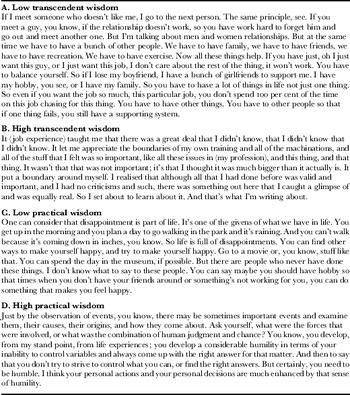
Transcendent wisdom concerns emancipatory and existential types of knowledge and understanding. The participants were asked to think aloud about two personally relevant questions: one asked the participant to identify and describe a difficult or challenging experience in their lives, how they resolved or coped with it, and whether and how they changed or did not change as a result of it (and they could add further reflections). The second question asked the participant to describe a positive, momentous life experience, the circumstance(s) surrounding the experience, and whether it changed their outlook and actions in life in any way. These responses were taped and transcribed. Using a seven-point scale, two independent raters scored each response on the following four criteria: self-knowledge, detachment, integration and self-transcendence. The range of the aggregate score was therefore from 0 to 28. Confirmatory factor analyses provided support for these four manifest variables as indicators of the latent variable transcendent wisdom, with both configural and structural invariance in the two ethnic groups (Le Reference Le2004).Footnote 3 Excerpts of responses that received a low and high transcendent wisdom rating are provided in Table 1.
Statements by example individuals with high and low scores on ‘transcendent wisdom’ and ‘practical wisdom’

Practical wisdom: the Berlin Wisdom protocol
The Berlin Wisdom performance-related measure outlines five criteria for wisdom, conceptualised as fundamental pragmatics (in this study the term ‘practical wisdom’ is used): factual knowledge, procedural knowledge, life span contextualism, relativistic thinking and tolerance/acceptance of uncertainty (see Staudinger, Smith and Baltes (Reference Staudinger, Smith and Baltes1997) for details of the scoring procedure). Each criterion was scored by two independent raters on a seven-point scale (range 0 to 35). Although these criteria have customarily been used for scoring hypothetical vignettes/life dilemmas, they were also used on the responses to the personal questions. The internal reliability was 0.91 for the European-American sample and 0.79 for the Vietnamese-American sample. Examples of responses that received low and high ratings on practical wisdom are also presented in Table 1.
Confirmatory factor analyses provided support for these five manifest variables as indicators of the latent variable practical wisdom, with both configural and structural invariance supported in the two ethnic groups (Le Reference Le2004). The inter-rater reliabilities on these two wisdom scores were around 0.85–0.89 in the European-American sample and 0.70–0.79 in the Vietnamese-American sample. As reported elsewhere, these two wisdom measures were significantly correlated with a lay person's general wisdom impression and interviewer's ratings, providing support for convergent validity (Le Reference Le2004). Although practical wisdom was strongly correlated with transcendent wisdom, the results of the structural equation analysis provided support for keeping the two scales as separate and distinct (Le Reference Le2004). The average word count in the European-American sample (M=1483.7, SD=938.1) was significantly greater than in the Vietnamese-American sample (M=469.0, SD=383.3, F (df 1, 164)=99.82, p<0.05).
Results
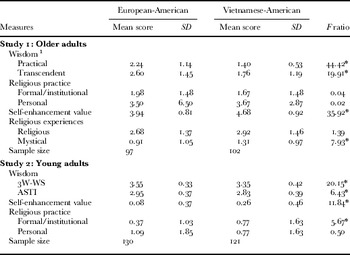
The European-American participants were significantly older (M=73 years, SD=15) than the Vietnamese sample (M=61 years, SD=10), F (df 1, 194)=38.49, p<0.05). There was an equal number of males and females in the Vietnamese sample, but more females (n=63) than males (n=37) in the European-American sample. Vietnamese-Americans in this sample had spent an average of 16 years living in the US. The analysis of variance results showed that European-Americans scored significantly higher on both practical and transcendent wisdom than Vietnamese-Americans (Table 2). On the other hand, the Vietnamese-Americans scored higher on self-enhancement values than the European-Americans. Although not statistically significant, European-Americans reported spending more hours per week than Vietnamese-Americans in institutional/formal religious practice but fewer in personal religious practice. Vietnamese-Americans reported more mystical experiences than European-Americans, but did not differ significantly on religious/spiritual experiences; each group reported an average of three. Among Vietnamese-Americans, 47 per cent self-identified as being affiliated with Christianity, 33 per cent as Buddhist, and 10 per cent as agnostic/atheist, whereas the percentages among European-Americans were 39, four and 21 respectively. Other religious affiliations (e.g. Unitarian) accounted for 26 per cent of the European-America participants.
Profiles of the older adult and younger adult (student) samples: descriptive measures

Note: 1. centred on 0–7 scale. Significance level: * p<0.05.
To examine whether self-enhancement values, religious/spiritual community membership, religious and spiritual practice, and religious and mystical experiences contributed differently to wisdom, controlling for the effects of the socio-demographic variables and covariates, hierarchical multiple regression analyses were conducted to predict practical and transcendent wisdom scores. The variables were entered in blocks to examine the variances contributed by each set. The first step consisted of the socio-demographic measures (age, sex and ethnicity) and the covariates – word count and the other wisdom factor. The second step was to enter the self-enhancement values. Religiousness/spirituality and mysticism variables of religious community, institutional and personal religious/spiritual practice, and religious and mystical experience was entered at the third step, followed at the fourth step by the interaction terms, namely mysticism by self-enhancement, religiousness/spirituality by self-enhancement, and mysticism by self-enhancement by ethnicity, and religiousness/spirituality by self-enhancement by ethnicity. The presented results are from the final model. The ethnicity variable (with European-American as the reference category), sex (male as the reference category) community (secular community as the reference category) were dichotomised, and each of the continuous predictors were centred for the analyses prior to computation of interaction terms as recommended by West, Aiken, and Krull (Reference West, Aiken and Krull1996).
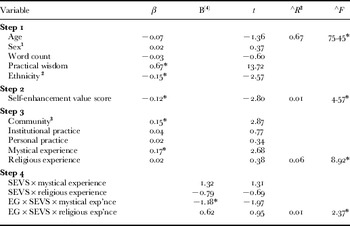
The regression analysis of the transcendent wisdom score showed that at each step, a statistically significant change in R 2 occurred (Table 3). The final set yielded a significant interaction between ethnicity, mystical experiences and self-enhancement value scores, as well as significant first-order effects of spiritual community membership, self-enhancement values, mystical experiences, practical wisdom and ethnicity. The interaction was interpreted by solving the unstandardised regression equations to predict the transcendent wisdom score. The median score was used to divide the sample with low/high self-enhancement values and low/high mystical experiences.
Hierarchical multiple regression analysis of transcendent wisdom, older adults
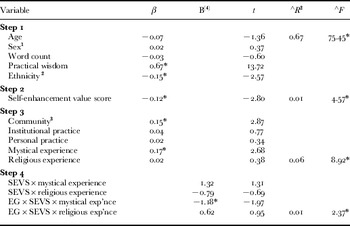
Notes: EG: ethnic group. SEVS: Self-enhancement value score. ∧ Increment or change of. 1. Male is coded as 0. 2. European-American is coded as 0. 3. Religious/spiritual community is coded as 1. 4. Unstandardised regression weights are displayed; standardised weights are deemed inappropriate with interaction terms (see Aiken and West Reference Aiken and West1991: 40–7).
Significance level: * p<0.05.
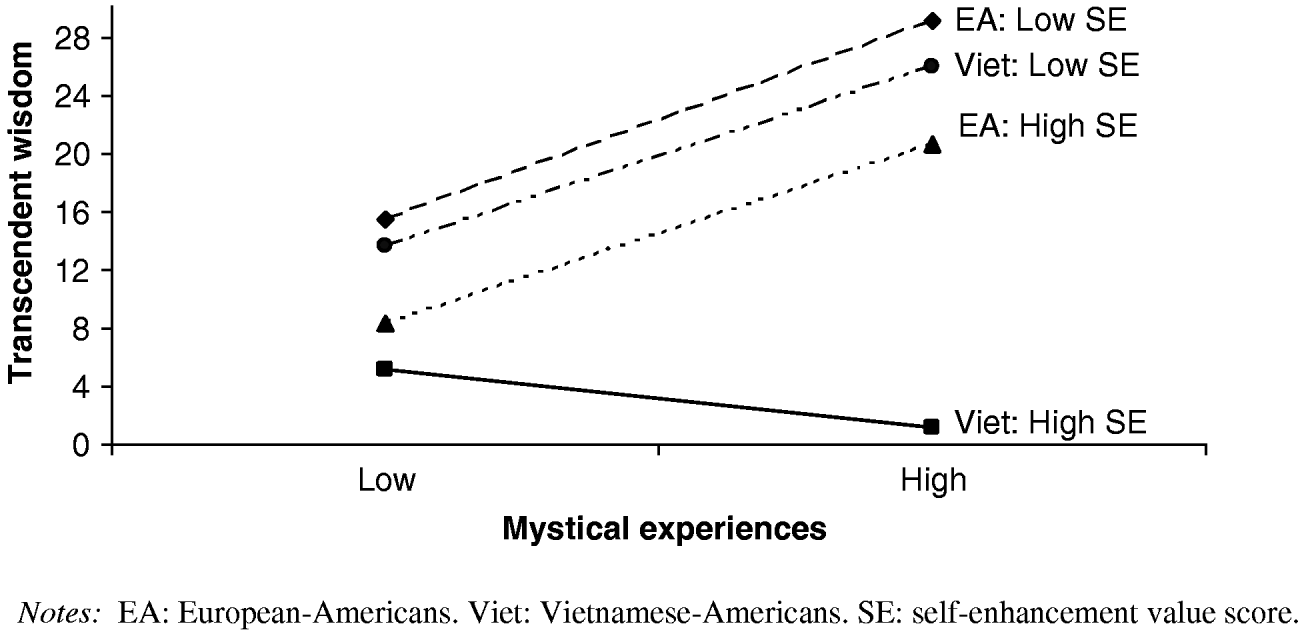
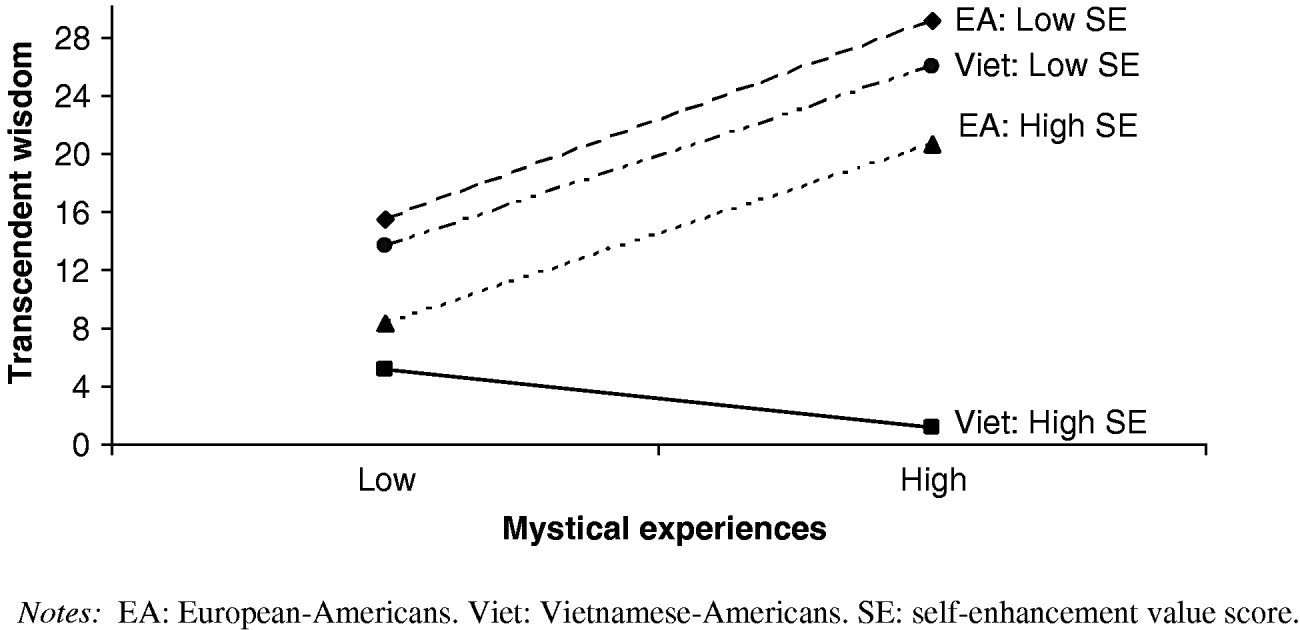
As displayed in Figure 1, European-Americans and Vietnamese-Americans who reported having mystical experiences and endorsed low self-enhancement values scored highest on transcendent wisdom. European-Americans who had mystical experiences but endorsed high self-enhancement values scored about equally on wisdom as their counterparts who did not have mystical experiences, but they reported low self-enhancement values. Among Vietnamese-Americans, individuals who reported having mystical experiences but endorsed high self-enhancement values scored the lowest on transcendent wisdom. In other words, mystical experiences conferred an advantage for transcendent wisdom, but only among those who did not endorse the self-enhancement values (power, achievement and status). The results predicting practical wisdom yielded no significant effects for any of the variables related to religious, spiritual or mystical experiences or for the interaction terms.
Interaction between ethnicity, self-enhancement value, and mystical experience in the prediction of transcendent wisdom.
Discussion
The results of Study 1 revealed that in both ethnic groups, individuals who reported having mystical experiences but did not endorse self-enhancement values scored the highest on transcendent wisdom. For Vietnamese-Americans, in particular, having mystical experiences only conferred an added advantage among those who endorsed low self-enhancement values; in fact, those who reported having mystical experiences but endorsed values related to power, achievement and status scored the lowest on transcendent wisdom. One possible explanation for the strong moderating effect of self-enhancement values in the Vietnamese-American sample may be experiences related to the Vietnam War – they were identified by more than 50 per cent of the participants as being their most stressful life experiences. Many spoke of the trauma of losing their loved ones, their country, their health, their status and sense of livelihood.
From the qualitative interviews, it appeared that in the context of losses and limitations associated with immigration experiences, spiritual and mystical experiences may have served as a valued cultural affirmation position. Having such experiences may be used, especially among those with self-enhancement values, to cope and compensate for many of the losses encountered. Becker (Reference Becker1971) suggested that individuals continually strive to give meanings to their experiences and actions that are consistent with their cultural values. For a culture or subculture that values spiritual/mystical experiences, a person with such experiences may be highly esteemed. Just as with secular experiences, spiritual experiences may be used to attain status and power, or to compensate for what one has lost. Indeed, values interact with experiences in meaning making. With respect to mystical experiences and transcendent wisdom, it seems clear that self-enhancement values moderated this relationship.
That individuals who are members of a religious/spiritual community scored higher on wisdom than those who came from secular communities supports the idea that spiritual communities facilitate the development of wisdom, particularly transcendent wisdom (as Ahmadi (Reference Ahmadi1998), Atchley (Reference Atchley1997) and Thomas (Reference Thomas1991) contended). However, engaging in formal/institutional or personal religious practices (as assessed by simple behavioural measures) did not seem to matter once experiences of mysticism and self-enhancement values were taken into account. More in-depth measures that tap the importance, salience and commitment to personal or religious practice are needed to clarify its role in wisdom.
Study 2: Young adults
I now turn to Study 2 that investigated the relation between institutional and personal religious/spiritual practice and wisdom among Vietnamese-American and European-American young adults. Tornstam (Reference Tornstam1997) coined the term ‘gerotranscendence’ to describe older people who experience a shift in perspective in their relations with time, space, life, death and other people. They express and demonstrate less interest in superficial social engagement, and more in spiritual or existential matters. Whereas Tornstam (Reference Tornstam1997) argued that gerotranscendence is a natural accompaniment of the ageing process that some experience, others have suggested that this shift in perspective, toward self-transcendence and arguably transcendent wisdom, can also occur in young adulthood, or at least commence at that age. Brandtstädter and Rothermund (Reference Brandstädter, Rothermund, Staudinger and Lindenberger2003) suggested that intentional self-development is one avenue toward growth and maturity. Intentional self-development occurs through the selection of certain goals and values. For instance, Bauer and McAdams (Reference Bauer and McAdams2004) noted that exploratory goals related to openness and growth, such as concern for others, meaningful relationships and making a contribution to society, are associated with maturity and high personality development among young adults. Such intrinsic goals lead to the differentiation of new perspectives about self and others that are important for development.
Wink and Dillon (Reference Wink and Dillon2003) observed from a longitudinal study that spirituality in early adulthood predicted wisdom in later adulthood, whereas spirituality in late adulthood was less associated with wisdom in late adulthood. Young adults who endorse spirituality may be orienting their life goals toward others and to causes greater than themselves, which can lead to psychological differentiation and hence growth. Among a sample of university alumni, Kelly, D'Mello and Aldwin (Reference Kelly, D'Mello and Aldwin2004) found that practical wisdom, as measured by the adjective checklist (a well-known and widely used measure of personality), was negatively related to the frequency of attendance at religious services, but positively related to having religious experiences.
In a study of how the internationalisation of certain spiritual beliefs supports the development of wisdom, Ahmadi (Reference Ahmadi1998) interviewed 13 Sufi practitioners, comparing those who became practitioners in young adulthood with those who did so late in life. Based on in-depth, qualitative analyses, Ahmadi concluded that wisdom was a potential consequence of a cultural process. She argued that the internalisation of Sufi ideals (selflessness, transcendence and compassion) altered life paths and lifecourse development, such that those who practised Sufism early in life developed many of the gerotranscendence dimensions noted by Tornstam (Reference Tornstam1997) before reaching old age. As part of the socialisation process, these ideas become integrated in the person, influencing perception and thought processes. On the other hand, she suggested that individuals who were embedded in cultures that did not support spiritual development (e.g. secular and individualistic societies: cf. Lewin Reference Lewin2001) might develop gerotranscendence through the natural ageing process (Tornstam Reference Tornstam1997). In a qualitative study with religious practitioners, Lewin (Reference Lewin2001) found support for the role of religion in both formal or institutional and informal ways of facilitating gerotranscendence.
Design, sample and measures
Study 2 examined in a sample of young adults the association between religious or spiritual practice, both personal and institutional, and two self-reported measures of wisdom, namely self-transcendence and the ‘Three-Dimensional Wisdom Scale’ (3D-WS) (Ardelt Reference Ardelt2003). The hypotheses were that religious/spiritual practice positively associates with both measures of wisdom, and that high scores for self-enhancement values moderate this relation. The study sample was 251 undergraduate students at the University of California, Davis, who completed a survey as a partial fulfilment of an introductory psychology course. Approximately equal numbers were of European-American (51%) and Vietnamese-American (49%) ethnicity. The mean age was 20.2 years (SD=1.8; range 18–28) with no differences between the two groups (t (245)=−0.89, not significant). Females comprised 77 per cent of the sample. There were significant differences in religious affiliation between the ethnic groups, with 50 per cent Christians, 42 per cent agnostic/atheist, and six per cent Jewish in the European-American sample, and 54 per cent Buddhists, 24 per cent Christians, and 20 per cent agnostic/atheist in the Vietnamese-American sample (χ2 (df 2, N=245)=89.6, p<0.05).
The students completed a package of questionnaires at a scheduled appointment and received credit toward an undergraduate psychology course for their participation. The questionnaires took, on average, about 30 minutes to complete. The socio-demographic, institutional or formal religious/spiritual practice, and personal religious/spiritual practice measures were as in Study 1. The ‘Pairwise Comparison of Schwartz Value’ scale (Oishi et al. Reference Oishi, Schimmack, Diener and Suh1998) is a modified version of the ‘Schwartz Value Scale’ (Schwartz Reference Schwartz1994). It has 45 paired-items that participants are requested to compare and rate on a scale from ‘−3’ to ‘+3’.Footnote 4 This version of Schwartz's scale was developed to address the issue of response style, and was demonstrated to converge with both Schwartz's value scale (Reference Schwartz1994) and personal strivings (Emmons Reference Emmons1986). As with Study 1, the main interest was in the self-enhancement value dimension, which had an internal reliability of 0.58 in this sample.
Two self-report measures of wisdom were used in this study. The 3D-WS is a self-report measure of wisdom comprising 39 items, with 14 tapping the cognitive aspects (e.g. ‘there is only one right way to do anything’), 12 the reflective aspects (e.g. ‘things often go wrong for me by no fault of my own’, and 13 the affective dimensions (e.g. ‘I'm easily irritated by people who argue with me’). On some items, participants were asked to indicate the degree to which they agreed or disagreed with the statements, using a five-category scale from ‘1’ for ‘strongly disagree’ to ‘5’ for ‘strongly disagree’, whereas others asked respondents to indicate how true the statement was for themselves, with answers ranging from ‘1’ for ‘definitely true’ to ‘5’ for ‘never true’. Eight items were reverse scored. The scale has been empirically demonstrated to have adequate reliability and validity (Ardelt Reference Ardelt2003). In this student sample, the internal reliability was 0.76. The ‘Adult Self-Transcendence Inventory’ (ASTI) (Levenson et al. Reference Levenson, Jennings, Aldwin and Shiraishi2005) is a 10-item scale that measures the degree of self-transcendence, arguably an important dimension of wisdom. Participants were asked the extent to which they agreed with each item (e.g. ‘my sense of self is less dependent on other people and things’) with reference to the previous five years, using a four-point Likert scale from ‘1’ for ‘disagree strongly’ to ‘4’ for ‘agree strongly’. The internal reliability in these two samples was 0.68.
Results
The results of the multiple analysis of variance showed that the European-American students scored significantly higher than the Vietnamese-American students on both the 3D-WS and ASTI scales (Table 2). On the other hand, the Vietnamese-Americans scored higher on self-enhancement values than European-Americans. Vietnamese-American students also reported spending more time in institutional or formal religious/spiritual practice during a week than European-American students, but not significantly less time in personal religious/spiritual practice than European-American students. As in Study 1, hierarchical multiple regression analyses were conducted to predict the two self-reported wisdom scores on the basis of the socio-demographic characteristics (Step 1), self-enhancement values (Step 2), institutional or formal and personal religious/spiritual practice (Step 3), and the interactions of practice with self-enhancement values (Step 4). The presented results are from the final model. The ethnicity variable (with European-American as the reference category), and gender (male as the reference category) were dichotomised, and each of the continuous predictors were centred for the analyses.
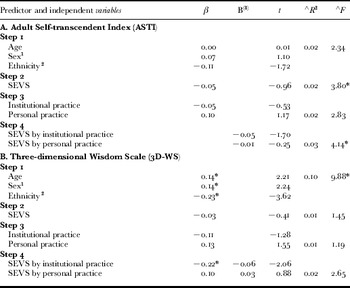
The regression results as illustrated in Table 4 suggest that institutional religious/spiritual practice was significant for 3D-WS, but moderated by self-enhancement values. The final set predicting 3D-WS also yielded a significant first-order effect of ethnicity (European-American), age (older) and gender (female). Religious/spiritual practice was not significant for the ASTI. It was observed that the two self-report wisdom scales were moderately correlated with each other (r=0.48), suggesting convergent validity.
Hierarchical multiple regression analysis predicting self-report measures of wisdom, young adult sample

Notes: SEVS: Self-enhancement value score. ∧ Increment or change of. 1. Male is coded as 0. 2. European American is coded as 0. 3. Unstandardised regression weights are displayed; standardised weights are deemed inappropriate with interaction terms (see Aiken and West Reference Aiken and West1991: 40–7).
Significance level: * p<0.05.
Discussion
The results revealed that, in contrast with previous results (Levenson et al. Reference Levenson, Jennings, Aldwin and Shiraishi2005), neither formal/institutional nor personal religious/spiritual practice was significantly associated with the ASTI among the students, although Levenson et al. (Reference Levenson, Jennings, Aldwin and Shiraishi2005) found a positive association with meditation practice, rather than religious/spiritual practice. With respect to 3D-WS, being older and female seems to confer an advantage for wisdom. There was also a significant interaction between institutional practice and the self-enhancement values score, suggesting that those who engaged in such practices and endorsed low self-enhancement value faired better on wisdom. The notion that self-enhancement values interact with personal religious/spiritual practice was not however supported.
General discussion
William James (Reference James1985, first published 1902) noted in The Varieties of Religious Experiences that religious experiences are as varied as the interpretations that individuals give them. Although studies of religious/spiritual phenomena have recently centred on uncovering the neuro-physiological correlates associated with such experiences (e.g. Lutz et al. Reference Lutz, Greischar, Rawlings, Ricard and Davidson2004; Newberg and D'Aguili Reference Newberg, D'Aquili, Andresen and Forman2000), information is scant about their impact on or consequences for human development. Aside from its association with general wellbeing (Powell, Shahabi and Thoresen Reference Powell, Shahabi and Thoresen2003; Smith, McCullough and Poll Reference Smith, McCullough and Poll2003), little is known about the implications of such experiences with respect to other outcomes such as wisdom or compassion. The presented findings suggest a potential connection between mystical experiences and transcendent wisdom among adults. Most notably, individuals who reported having mystical experiences were more likely to score higher on transcendent wisdom (ratings by objective raters) than those who did not report such experiences. However, self-enhancement value was important in moderating this relationship, especially among Vietnamese-Americans. As mentioned earlier, as a consequence of traumatic losses associated with their immigration experiences, spiritual and mystical experiences may have served a valued cultural function, providing meanings associated with self-worth and self-validation. Contrary to the prevalent view in the United States, which regards mysticism with scepticism and even as pathological, mysticism in Vietnam and for the Vietnamese is perceived more favourably.
The findings also suggest that European-Americans who reported having no mystical experience but endorsed low self-enhancement values scored nearly the same on transcendent wisdom as those who reported having such experiences along with high self-enhancement values. Vietnamese-Americans who had mystical experiences but endorsed self-enhancement values scored the lowest. Values that aggrandise the self to some extent eliminate any benefits associated with transcendent wisdom that mystical experiences confer. Thus, and consistent with William James's proposition, how individuals interpret these experiences matters more. Certainly, values influence how one interprets experiences. These findings also point to the need for more cross-cultural studies to clarify and understand the relationships among spirituality, mysticism, and developmental outcomes such as wisdom.
In addition to the importance of values, belonging to a religious/spiritual community also related to transcendent wisdom. This is in line with other findings, as from Atchley (Reference Atchley1997), Lewin (Reference Lewin2001) and Thomas (Reference Thomas1991), who argued that spiritual culture matters in facilitating the development of wisdom by orientating individual's values or goals toward compassion, ethical behaviour and tolerance, all of which promote growth, change and integration toward harmony and coherence. These values are arguably important for the development of transcendent wisdom. It is important, however, to acknowledge that not all religious/spiritual communities are alike. To the extent that they promote or reinforce values that emphasise the self-other dichotomy, violence or even redemptive violence, rather than unity or compassion, such engagement would be antithetical to wisdom.
Consistent with the quantitative findings noted by Wink and Dillon (Reference Wink and Dillon2003) and the qualitative findings observed by Ahmadi (Reference Ahmadi1998), this study also found that religiousness or spirituality, specifically its institutional practice, was important in young adults with respect to wisdom, at least one conceptualisation of wisdom. As with the older adult sample, self-enhancement value was a significant moderator of this relationship. Consistent with the direction observed in the older adult sample, such values moderated the relation between religious/spiritual practice and wisdom.
For older adults, mystical experiences appear to be more relevant for wisdom, perhaps because the variance in spirituality was less than among young adults. As Wink and Dillon (Reference Wink and Dillon2002) noted, spirituality increases from midlife and beyond, akin to the ageing process associated with gerotranscendence (1997). For young adults, a formal and personal religious/spiritual engagement probably implies an orientation and connection toward the sacred and other people, and the complement, less emphasis on the self, an important attribute in the development of transcendent wisdom. This study did not make the distinction between religiousness and spirituality that some have argued is linked to wisdom (Siksentmihalyi Reference Csiksentmihalyi1993), but did make the distinction between institutional (formal) and personal orientation. Whereas a formal religious/spiritual orientation is more likely to be associated with communality and confers wellbeing, a personal religious/spiritual orientation is more likely to be related to introspection, reflectivity and insight. The findings from both the young and old adult samples support the notion that intentional self-development, as well as supportive cultures conducive to spirituality, are both important and needed for transcendent wisdom (Ahmadi Reference Ahmadi1998; Brandtstädter and Rothermund Reference Brandstädter, Rothermund, Staudinger and Lindenberger2003).
As expected, mysticism was not related to practical wisdom among the older adults. One reason may be related to what Jaynes (Reference Jaynes1976) considered as the bicameral functioning of the brain. Whereas cognitive complexity and relativistic thinking is essentially a left-brain dominant phenomenon, mystical experiences operate through the right brain. Mystical experiences would not necessarily impact cognitive functioning (i.e. making one more cognitively complex), but may reduce the sense of self-centredness and narcissism, or the self-other dichotomy (Newberg and D'Aquili Reference Newberg, D'Aquili, Andresen and Forman2000), thereby facilitating non-dual consciousness (Loy 1999), and thus transcendent wisdom. Recent research by Davidson and his colleagues (Lutz et al. Reference Lutz, Greischar, Rawlings, Ricard and Davidson2004) on neuroplasticity has shown that meditative engagement results in fundamental shifts in brain structure and processes, and potentially consciousness. To the extent that these changes and neuro-theology (Claxton Reference Claxton, Watson, Batchelor and Claxton1999) have implications for wisdom and compassion is an area for future research.
On the other hand, William James cautioned against the notion of reducing spirituality or mystical experiences to physiological functions. What are arguably more relevant are the interpretations one gives to such experiences, which are undoubtedly influenced by values, and how these interpretations influence one's relations to self, others and the world. Cloninger (Reference Cloninger, Staudinger and Lindenberger2003) suggested that what differentiates individuals as pathological, normal or exceptional are not physical characteristics attributed to the brain, but the degree of awareness and coherence of their entire being.
It was interesting that religious or spiritual practice was not significant for self-transcendence (ASTI), as it was for the 3D-WS score among young adults, whereas religiousness or mysticism was relevant for transcendent wisdom but not practical wisdom among the older adults. One likely explanation for these differentials draws from Chinen's (Reference Chinen and Thomas1989) inference that practical wisdom is most likely to precede transcendent wisdom rather than vice versa. From her in-depth studies of respected scientists and philosophers (e.g. Ludwig Wittgenstein and Alfred North Whitehead), she noted how they changed from self-assured logical positivism in their younger years, to pragmatism in middle age, and something like transcendence in old age. Along similar lines, Jung (Reference Jung1933) noted that the early part of life is devoted to learning about society and the world, an external focus which is related to practical wisdom, whereas the later part of life is devoted to cultivating self-knowledge and consciousness, an internal focus related to transcendent wisdom. It is therefore reasonable that the presented analyses find that religiousness or spirituality is more relevant for practical wisdom among young adults, and for transcendent wisdom among older adults. It may also account for the high observed correlation between practical and transcendent wisdom, although they are arguably distinct. Edmonson (Reference Edmonson2005) suggested that there is probably a large degree of overlap between the different types of wisdom.
It was also interesting that Vietnamese-Americans in both samples scored higher on self-enhancement values as compared with European-Americans. This is probably an artefact of the samples. For instance, the European-Americans in the old adult sample were more educated and had fared better economically than the Vietnamese-Americans. In fact, being recent refugees or immigrants and older, many of the Vietnamese-Americans were particularly challenged in terms of earning a living and establishing their livelihood. The trauma and stressors related to the Vietnam War had left an indelible mark, as revealed in many of their accounts. This may partially explain their high mean scores on self-enhancement values. The desire to achieve, succeed and regain one's status is no doubt a motivation among recent refugees and immigrants. Experimental studies have shown that self-enhancement bias is strongest after self-worth has been threatened (Beauregard and Dunning Reference Beauregard and Dunning1998; Dunning Reference Dunning1999). Indeed, war experiences can undermine one's sense of self-worth. This finding, interestingly, was also observed among the student sample. One speculation is that the immigration experience of the parents may promote the transmission of certain values to the younger generation, for example, to achieve and to succeed. Studies of self-enhancement bias and self-enhancement values have generally included East Asian (Japan, China and Korea) rather than southeast Asian and immigrant populations. It is plausible that one may find self-enhancement values to be more strongly endorsed in these latter populations as compared with people from East Asia.
In evaluating the findings, a consideration is the limits of language and how it is used to identify, label and interpret religious, spiritual or mystical experiences. Whether or not an experience is religious depends upon the interpretation of the experience, which is framed by shared meanings and language. These shared meanings occur through participation in cultural groups, be they secular or religious. Claxton (Reference Claxton, Watson, Batchelor and Claxton1999) argued that the intellect and the rational mind have limitations in the process of qualifying and naming experiences. Mystical experiences are intrinsically mysterious, and not completely accessible by the conceptual levels of brain-mind functioning. One way in which mystical experiences operate may be to bypass the standard operation of the self, the system that is involved in adjudicating and prioritising needs and wishes. Consequentially, as William James noted, it is not the nature of the experience that defines it as religious, but its results; and by results he meant the experience of transcending previously experienced limits (Spilka et al. Reference Spilka, Hood, Hunsberger and Gorsuch2003). For the development of transcendent wisdom, spiritual engagement and mystical experiences may facilitate the transcendence of identity, conventionalities and inertia that hinder growth and maturity.
Taking a slightly different tack, Rosch (Reference Rosch2002) contended that cognitive science's current understanding and perception of mind, based on ideas, emotions and actions framed around habits, reflects only one way of knowing, and that this way does not provide accurate insights about who we are, what is real and how to act. There is an alternative way of knowing that is inherently fundamental, original and natural, and not dependent on any particular or special experiences. This way of knowing, or awareness in her term, can be accessed by pacifying the mind to allow simple receptivity and expanding awareness, and by emptying the mind to gain experiences directly. Rosch suggested that awareness, and arguably wisdom, are not necessarily a function of spiritual and mystical experiences, but instead a natural and fundamental state of our being when we are able to reduce the constrictions of our habitual mental state. Echoing the ideas of Clayton (1999), she emphasised that there are two types of automatic behaviour, one stemming from habitual impulses, and the other from a wider field of awareness that becomes accessible once we diminish the self-chatter. It is this later processing that enables wisdom to unfold. Spirituality and mysticism may facilitate this process through prescribing certain practices that quieten or control the mind (e.g. meditation and contemplation).
Limitations of the study
Whatever the interest of the findings, several limitations of the analyses must be acknowledged. First, both studies were cross-sectional, so causality cannot be clearly ascertained. For instance, we do not know whether religiousness/spirituality and mysticism precedes or is a consequence of wisdom, although the paper's argument has been that spirituality and mystical experiences come before. Longitudinal and experimental studies are needed to clarify directionality. Secondly, both studies relied on self-report measures of religious, spiritual and mystical experiences that are constrained by language and interpretations. The extent to which individuals are able to identify, remember and report these potentially emotional experiences may be subject to biases. Moreover, individuals cannot report religious or spiritual experience unless they have access to the training and meaning that enables them to identify and interpret those experiences. In other words, an experienced religious/spiritual practitioner is more likely to identify accurately and recall religious/spiritual experiences (as labelled by researchers) than a novice or non-practitioner. Hill and Pargament (Reference Hills and Pargament2003) also argued that some aspects of religious and spiritual experiences were difficult to capture in self-report measures and were vulnerable to social-desirability bias (Batson, Schoenrade and Ventis Reference Batson, Schoenrade and Ventis1993). Future research using other methods to identify religious/spiritual experiences may usefully corroborate the self-report evidence. Thirdly, the study used convenience samples and its findings cannot be generalised to the wider population. The participants were willing to share their stories and were motivated to participate in the research study. Finally, the measures of religious and spiritual practice had limitations. The study relied on the frequency of institutional and personal practice. Other dimensions of religiousness/spirituality are also needed, such as importance, intensity and saliency. For the student sample, wisdom was accessed using self-report measures; use of objective ratings or other reports would certainly be fruitful.
Conclusions
In addition to providing benefits in terms of social support and emotional and physical health, it has been shown that religious/spiritual practices as well as mystical experiences are related to certain types of wisdom in two American ethnic groups, although in slightly different ways. It has been shown that mystical experiences tend to increase with age, and are likely to be associated with psychological health and wellbeing rather than pathology or social dysfunction (Spilka et al. Reference Spilka, Hood, Hunsberger and Gorsuch2003). Although empirical work on this topic is embryonic, it is hoped that this study will prompt other researchers to examine the consequences of spirituality and mysticism on important human developmental outcomes such as wisdom, compassion and ethical conduct.
Acknowledgements
I am grateful for the comments and edits offered by Rick Levenson and Daria Boeninger on earlier drafts of the paper.