


Berry syndrome is a rare combination of distal aortopulmonary window with aortic origin of the right pulmonary artery, interrupted aortic arch, and an intact ventricular septum. Since first described by Berry et alReference Berry, Bharati and Muster 1 , ~29 cases have been reported in the literature. Among all, one case has been associated with trisomy 13.Reference Sharma, Saleh and Das 2 We report a new case of a neonate confirmed to have Berry syndrome and the same aneuploidy.
Case report
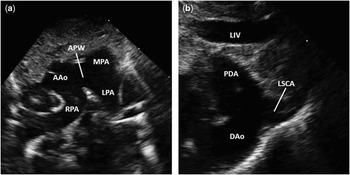
A full-term female infant, weighing 3.34 kg and born vaginally to a healthy 38-year-old mother, presented with respiratory distress and was admitted to the neonatal ICU. Cardiovascular examination revealed normal peripheral pulses and no murmur. Although similar blood pressures were evident in the upper and lower extremities, differential cyanosis was appreciated. Blood gas analysis revealed hypoxaemia with a non-responsive hyperoxia test. Chest X-ray demonstrated gross cardiomegaly. Furthermore, two-dimensional and colour Doppler echocardiographic studies revealed a large distal aortopulmonary window with anomalous origin of the right pulmonary artery from the ascending aorta and an interrupted aortic arch type B (Fig 1). Associated findings included a large patent ductus arteriosus while on prostaglandin therapy, a large atrial septal defect, a small apical muscular ventricular septal defect, and mild prolapse of the mitral valve with normal valve function. The conoventricular septum was intact. Surgical repair of the cardiovascular defects was not performed, because the array comparative genomic hybridisation analysis revealed complete gain of chromosome 13, and the decision for compassionate care was made. The infant expired days later. The parents declined consent to autopsy.
( a ) A high parasternal transverse view shows the AAo and MPA in the cross-section with the APW between them. The RPA relates primarily to the AAo, whereas the LPA arises normally from the MPA. ( b ) A suprasternal long-axis view shows the PDA in continuity with the DAo from which the LSCA originates. AAo= ascending aorta; APW=aortopulmonary window; DAo=descending aorta; LIV=left innominate vein; LPA=left pulmonary artery; LSCA=left subclavian artery; MPA=main pulmonary artery; PDA=patent ductus arteriosus; RPA=right pulmonary artery.

Discussion
Berry syndrome is a rare CHD. Infants usually present with low cardiac output and respiratory distress like other ductal-dependent left-sided obstructive cardiac lesions with excess blood flow to the lungs. Two-dimensional and colour Doppler echocardiographic studies can accurately diagnose all the components of Berry syndrome.Reference Lee 3 , Reference Mendoza, Veda and Nishioka 4 Successful surgical repair of this complex heart malformation has been reported in infants and older children using a staged approach;Reference Tabak, Moskowitz and Wager 5 however, with the improvement in surgical techniques, recent case reports have shown better outcome with one-stage surgical correction.Reference Choi, Kim and Kwak 6 , Reference Park, Joo, Youn, Park and Park 7
Trisomy 13, also called Patau syndrome, is a chromosomal disorder characterised by the presence of numerous malformations. Infants are usually recognised at birth by the presence of a clinical triad of cleft lip and palate, postaxial polydactyly, and microphtalmia. Although mortality is high for newborns with trisomy 13,Reference Rasmussen, Lee-Yang and Quanhe 8 there are reports confirming long-term survival with significant mental retardation and limited quality of life.Reference Redheendran, Neu and Bannerman 9 Deaths are attributed to several factors including the severity of cardiac and cerebral malformations as well as other multiple congenital anomalies.
Our patient, diagnosed to have Berry syndrome by echocardiography, presented with only one sign of the classical clinical triad suggestive of trisomy 13, which was later confirmed by microarray testing. This suggests that the physical examination is not enough to make the diagnosis of Patau syndrome. Even partial common features could indicate a possible trisomy 13.
Although the majority of cases with Berry syndrome reported in the literature were not associated with chromosomal anomalies, very few reports had genetic testing performed.Reference Sharma, Saleh and Das 2 , Reference Jayaram, Knowlton, Shah, Gelatt, Lofland and Raghuveer 10
Our case report should draw attention to the possibility of an association of Berry syndrome with aneuploidy, particularly trisomy 13. Cytogenetic analysis should be performed for all patients with suspected Berry syndrome in order to determine whether there is an underlying genetic condition. Although accurate predictions of life expectancy are difficult to make, patients with trisomy 13 have an extremely poor prognosis, making its diagnosis crucial to provide accurate counselling and optimise management. Non-invasive prenatal testing has recently become clinically available and offers tremendous potential as a screening tool for women at increased risk of foetal aneuploidy.
Acknowledgement
None.
Financial Support
This research received no specific grant from any funding agency, commercial, or not-for-profit sectors.
Conflicts of Interest
None.