This timely volume examines how the concept of underlying representation (UR) or underlying form has been approached in mainstream phonological schools and their offshoots during the past eighty years. The book appears in the new CUP series Key Topics in Phonology, the titles of which are ‘designed to bridge the gap between textbooks and primary literature’ and hence deemed suitable for advanced courses in linguistics and as ‘guides to a particular topic for individual students and researchers’ (ii).
The main contents of the book are organized into nine chapters. Following the prelims, Chapter 1, ‘Getting started’ (1–11), previews the subjects covered in the book, mentions themes not pursued, and furnishes suggestions for how to use the text. Chapter 2, ‘Arbitrariness and opposition’ (12–37), addresses Saussure's langue/parole distinction, the linguistic sign, Trubetzkoy's criteria for phonemic analysis and classification of phonological oppositions as well as Jakobson & Halle's and Chomsky & Halle's distinctive feature theories. Topics of Chapter 3, ‘Derivation and abstractness’ (38–64), are the notion of rule in classical generative phonology, Halle's Russian argument against the taxonomic phoneme, the generative abstractness debate, morpheme-structure and redundancy rules, and the Duplication Problem (i.e., the unwanted outcome that the effects of morpheme-structure rules and phonological rules proper may overlap). Chapter 4, ‘Underspecification returns’ (65–97), scrutinizes the elimination of selected feature values in URs in Radical Underspecification, Contrastive Underspecification, and applications of the Successive Division Algorithm as well as the recourse to idiosyncratic underspecification to handle lexical exceptions. Chapter 5, ‘The devil is in the detail: Usage-based phonology’ (98–127), outlines the basic assumptions of Exemplar Theory, a model presupposing large-scale mental storage of phonetic detail, explicates the role of frequency in shaping URs, pursues the extent to which formal categorical and statistical frameworks are mutually compatible, and critically assesses Exemplar Theory. Chapter 6, ‘Psycho- and neurolinguistic evidence’ (128–148), reports on investigations into the character of URs through psycholinguistic techniques. In particular, it discusses experiments involving non-contrastive features and segments, contrastive features in neutralization environments, and contrastive features in contrast position. Chapter 7, ‘On the form and contents of contrastive features’ (149–175), probes whether underlying features are phonetically grounded entities or content-less labels only; Krämer opts for the latter view. After an approximately three-pages-long introduction to Optimality Theory (OT), Chapter 8, ‘Underlying representations in Optimality Theory’ (176–211), demonstrates that the original OT technique of Lexicon Optimization is insufficient for ascertaining URs, and discusses three possible rescue measures, use of John McCarthy's Comparative Markedness, McCarthy's Free Ride (McCarthy Reference McCarthy2005), and Krämer's own Mirror-Image Lexical Optimization. Finally, Chapter 9, ‘Preliminary results’ (212–221), recapitulates the discussion of UR simplicity or economy, the functions and nature of features, and linguistic mechanisms for inferring URs. Summaries, discussion points, and suggestions for further reading round off most chapters. The core text is in addition supplemented by a list of abbreviations (x), a glossary (222–233), notes (234–240), a bibliography comprising close to 300 titles (241–257), and separate author, language, and subject indices (258–266).
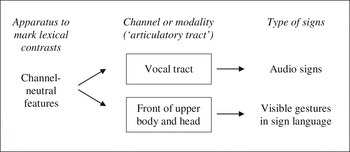
As this synopsis suggests, the book treats a broad spectrum of fundamental issues in phonological theory. Given that it is not possible to touch on even a fraction of these in a brief review, let us single out two major proposals advanced by Krämer himself. The first proposal concerns the feature content, if any, of URs. Basing himself on work by Bruce Morén-Duolljá and accepting the idea, ‘[n]owadays … fully acknowledged’ (168), that not only spoken language but also sign language has ‘phonology’, Krämer submits that the features of URs must be channel-neutral or modality-independent (Section 7.4). These abstract channel-independent features may either be vocalized as in speech or expressed by means of manual and facial gestures as in sign language. The production part of this model may therefore be represented as in Figure 1. Under this conception, phonetic substance becomes linguistically irrelevant to underlying features in a way vaguely reminiscent of tenets in glossematics, where cenemes, i.e., empty or content-less units of the size of traditional phonemes, may be realized by sounds, letters, Braille, or the like. Krämer finds possible support for his view in the origin of language: if ‘sign language is primary and … spoken language evolved from signed language historically …, contrastive features are certainly not defined by their acoustic or audio-articulatory properties’ (152). Moreover, he declares that ‘[i]f semantics, syntax and phonology are separate modules, and their internal organization is not the same, theoretical parsimony suggests that the set of features is shared across modules’ (170). Accordingly, he borrows features from semantics and syntax such as [in] vs. [out] (i.e., inner vs. outer location), [front] vs. [back] (location), [telic] vs. [atelic] (event), [prox] vs. [dist] (proximal vs. distal event), etc. For instance, in a given language the segment /p/, being phonetically labial, is underlyingly [out], while /t/ and /k/, being produced within the mouth, are both [in], but mutually distinguished as [front] vs. [back], respectively. The element /s/, on the other hand, is phonetically continuant and hence underlyingly [atelic] and [prox]. ‘Since this approach “recycles” distinctions from other grammatical domains for phonological [i.e., channel-neutral] contrast there is quite a big reservoir of potential phonological [i.e., channel-neutral] features available’ (165f.). Nevertheless, ‘[s]ince the two modalities [of spoken and signed language] are very different, it cannot be expected that they use exactly the same feature set, but rather that there is a big overlap in the features used’ (169). Finally, due to ‘articulatory [i.e., vocal and gestural] uninterpretability’ (166) many morphological and syntactic features such as gender and case are barred from consideration in the channel-neutral contrastive-feature inventory.
Channel-neutral features in sign production.

This bold proposal, apparently elaborated further in as yet unpublished work (153, 159), raises several questions that are not fully addressed in the book. For example, from the supposition that speech has its ultimate origin in sign language, it does not necessarily follow that sign language determines the organization today and that underlying features are not defined phonetically now. The evolution of human language is an extraordinarily long process. Numerous radical changes may have occurred on the way from a putative original sign-language system to present-day spoken language, and human spoken language could have gradually adjusted itself to its new primary medium. Hence, it is perhaps not so ‘surprising’ (168) that most phonologists still adhere to substance-based features. Similarly, in Krämer's view, ‘cross-modality economy … excludes feature definitions based on acoustic and perceptual properties of segments, since they are irrelevant for the visual channel of signed language’ (217). Yet, while there are certainly commonalities in underlying cognitive machinery, it is not inconceivable that completely different factors govern the formation of URs, factors that are biologically more pressing than cross-modality economy. Also disquieting are the great cross-module (semantic-syntactic vs. ‘phonological’) as well as cross-modality (spoken vs. signed) disparities in feature-inventory size and feature properties. As for feature properties, at one point (168) Krämer ventures a parallel between the fact that American Sign Language marks perfective aspect by terminating a gesture with a hold and the circumstance that Germanic languages often use a coronal stop to signal past tense, although he immediately concedes that the parallel might be merely accidental. Indeed, the analogy may even be factually far-fetched. Furthermore, before elaborating the channel-neutral approach, Krämer actually presents two weighty arguments against completely empty or content-less contrastive features. The theory cannot explain, he says, (i) ‘why we only find certain types of contrasts cross-linguistically’ and (ii) why ‘some segments … are physically possible but never used in language’ (153). Nonetheless, in the course of the chapter he does not revert to the topic in order to counter the objections. Nor does the text broach other possible reasons for phonetic grounding such as the effect of physiologically unavoidable phonetic syllabification on the sequencing of segments in URs, articulatorily constrained consonant combinability in underlying clusters, and the like. An additional inconvenience, not disposed of, is that ‘abstract features … require an elaborate interface component that translates them into motor commands or maps them to specific components of sound and gesture’ (217). Finally, it seems uncertain whether the metaphorical extension of the terms ‘phonology’ (adopted from sign language research; 152) and ‘articulatory tract’ (159) to manual and facial gestures employed in sign language adds to clarity and is helpful, when it comes to comparisons of the two sign systems.Footnote 1
Another major, quite intriguing proposal that Krämer advances in his book is to adjust the original OT technique of Lexicon Optimization (LO) for the purpose of specifying URs. Krämer's ‘mirror-image evaluation’ (alias ‘Mirror-Image LO’, ‘Lexicon Optimization 2.0’, or, for short, ‘LO 2.0’) is a procedure for constructing proper URs starting from particular phonetic forms. The reformulation centers crucially on a redefinition of the classical generative notions of input and output. Because in generative phonology phonological rules may be regarded as formally unidirectional, the input to a phonological rule is usually understood as either a UR or an intermediate representation, while the output is thought to be one step closer to the surface representation (SR) or the SR itself, something which results in derivations of the type ‘UR(I)→SR(O)’ (202; I=input, O=output). This one-way view is also reflected in OT terminological usage, where the ‘output’ of constraint rankings is an SR. However, as Krämer argues with respect to language acquisition, ‘[t]he null hypothesis should be that learners of a language have to acquire only one ranking and that this can be used in either direction’ (239). That is, we should be able to ‘use the computational device [i.e., the OT constraint set] bi-directionally … not only [to] generate the correct output forms, but also a unique underlying representation for every surface form (disregarding the issue of homophony …)’ (219). Consequently, rather than viewing markedness constraints as constraints on surface representations, Mirror-Image LO lets ‘[m]arkedness constraints apply to the candidate output representations of an evaluation, be that UR(I)→SR(O), … SR(I)→UR(O) or any other mapping’ (202; emphasis in the original). The outcome of this move is to enable us to strip URs of (i) redundant features, (ii) certain kinds of non-contrastive segments, and (iii) predictable prosodic structure (209). Remaining kinds of non-contrastive segments are handled by the Free-Ride principle (209). While consistent bidirectionality is ruled out by the existence of neutralizations and neutralizations must seemingly be remedied by general (i.e., not specifically linguistic) cognitive strategies (Eliasson Reference Eliasson and Gvozdanović1997), Krämer's insightful proposal constitutes a substantial and welcome improvement of OT that deserves to be explored further. Numerous noteworthy discussions and suggestions of similar kinds are found throughout the text.
The presentation in the book is largely chronological (11). That is, like Cole & Hualde's (Reference Cole, Hualde, van Oostendorp, Ewen, Hume and Rice2011) handbook article on the same subject, the discussion of crucial aspects of URs is interwoven with an account of the development of the concept, proceeding from earlier to later phonological schools. This has as the obvious advantage that the novice reader will, on the side, obtain useful glimpses of the history of modern phonology. A slight drawback is that the arrangement occasionally forces a single topic to turn up in separate chapters and that the necessary concern with the framework-internal machinery of miscellaneous linguistic schools at times dims the issues, especially perhaps in the long chapter on OT (Chapter 8). A partial aid in coping with terminologically dense portions of the text is given by the accompanying twelve-page Glossary. Approximately two thirds of its 85 main entries have been taken over from Trask (Reference Trask1996), a couple of entries come from the Oxford English Dictionary Online, and the rest (above all on OT, a model that largely postdates Trask's work on his dictionary) stem from Krämer himself.
A few minor points may be touched on in passing. When discussing the linguistic sign, Krämer uses the expression ‘Saussure's cat’ (13, 14) with corresponding illustrations (14), which might lead the reader unfamiliar with Saussure to think that this example is found in the Cours; Saussure (1960: 99) himself, however, uses the Latin item arbor ‘tree’ (1960: 162: French juger ‘judge’ v.). Sometimes tables appear in Krämer's book without explicit mention or special explication in the text. A few OT conventions and practices are not clarified (179), e.g., the use of the exclamation mark (!) and shading in tableaus. The unexplained OT abbreviations W and L, abundantly used in large tableaus on pages 196–198, will constitute a real puzzle to the uninitiated reader (Winner- and Loser-favoring constraint, respectively; see Prince Reference Prince2002: 2, or McCarthy Reference McCarthy2005: 23). Likewise, the constraint Uniformity (195, 196, 197, 198) is left undefined (see McCarthy Reference McCarthy2005: 22). The proof-reading is extremely carefully done, only a couple of the exceedingly rare misprints might cause momentary puzzlement: the slash / (223, lines 27, 28, 33) should be replaced by l, ‘PQ’ in the formal definition of the Elsewhere Condition (225) must read PAQ, and ‘Kisseberth's reduplication problem’ (238) reduces to the customary Duplication Problem. In addition, ‘[p=]’ (230, lines 33, 34, 36) would normally be written [p=] with a superscript equal sign (cf. Pullum & Ladusaw Reference Pullum and Ladusaw1986: 206).
To conclude, with an arrangement of chapters that largely mirrors the historical progression of research, Underlying representations approaches the fundamental concept of UR in phonology mainly from the standpoint of theoretical linguistics but also, to some extent, from a psycholinguistic/cognitive perspective. Given the current state of the art, the time is not yet ripe for formulating a coherent theoretical synthesis of the nature of URs. Nevertheless, this thought-provoking book amasses a vast range of evidence for and against different theories, proposals and hypotheses, and is an excellent guide to previous studies as well as to outstanding research problems. Krämer himself closes his impressive exposition with the modest assessment: ‘Trying to understand something that cannot be directly observed is a challenging task and we haven't succeeded in finding the holy grail of phonology yet. We have merely seen it twinkle in the dark …’ (221).